A DISCOURSE ANALYSIS OF TEACHER-STUDENT INTERACTIONS PATTERN OF THE SECOND GRADE OF SMA KOLESE DE BRITTO YOGYAKARTA 2016/2017
An article
Ricky Julpiusandi Tora Seran 2014083021
ENGLISH EDUCATION DEPARTMENT GRADUATE EDUCATION PROGRAM
UNIVERSITY OF SARJANAWIYATA TAMANSISWA YOGYAKARTA
A DISCOURSE ANALYSIS OF TEACHER-STUDENT INTERACTIONS PATTERN OF THE SECOND GRADE OF SMA KOLESE DE BRITTO YOGYAKARTA 2016/2017
Ricky Julpiusandi Tora Seran [email protected]
Imam Ghozali [email protected]
Graduate School of Education,
Universitas Sarjanawiyata Tamansiswa Yogyakarta, Indonesia
Abstract
“A Discourse Analysis of Teacher-Student Interactions Pattern of the Second Grade at SMA Kolese De Britto Yogyakarta 2016/2017”. This research aimed to Describe the teacher-and students interaction patterns the type of interactional and To reveal the impact of teacher and student interaction.The researcher conducted classroom observation in which two lesson of difference topic were video recorded, transcribe and analyzed using IRF and Self Evaluation of Teacher Talk Grid. The result obtained that classroom. There were found I- R- F , I- I- R- F, I- R- F- R-F and , I- R- R- F, as a interactional pattern performed in classroom interction. There were 14 interactional feature found from the data, they were Scaffolding , Direct Repair, Content Feedback, Extended Wait-time, Referential Question, Display Question, Seeking Clarification, Confirmation Checks, Extended Learner’s Turn, Teacher Echo, Teacher Interruptions, Extended Teacher Turn, Turn Completion, For-Focused Feedback. These factor played a big role of creating a good classroom interaction.
Key words: Classroom interaction, Interactional feature, SETT Framework.
Introduction
Performing good interaction in a classroom is really important so the students
would get the exact function of language. By doing so the students would not get
confused to what is happening in the classroom but get a clear direction of what to do
in the classroom. Performing teaching and creating a good interaction between teacher
such as the ability of the students in communication, especially communication in
English—since it is an English language classroom. If the teacher has already known
his or her class they will get a clear direction what kind of interaction they will use to
conduct the classroom. In example, if a teacher understands that the students are very
active, the teacher may choose a spesific type of interaction to conduct the class.
Classroom interaction then, is necessary and useful as an educational strategy to
enhance learning. The concept of classroom interaction plays a significant role in
the process of second language learning. In fact the considerable interest in the
role of interaction in the context of learning became an important factor for the
researchers of this field, because it creates opportunities for the classroom community
to develop knowledge and skills. Teacher and student interaction that was intended to
be seen in this research are how the teacher and student participate to talk during
teaching and learning process, the teacher and students interaction pattern, corelation
of the amount of teacher and student talk contribute significant result in mastering the
target language by using discourse analysis. The researcher decided to set teacher and
student interaction of English Language Classroom at SMA Kolese De Britto
Yogyakarta, Grade XI- Bahasa Class as a subject of this research. SMA Kolese De
Britto Yogyakarta is one of favorite schools in Yogyakarta and also recommended by
one of English Lecture.
Based on the explanation above, the researcher has problem statement as follows
1. What are the pattern performed by teacher and student at SMA Kolese De Britto?
2. What are the types of interactional features performed by the teacher at SMA
Kolese De Britto Yogyakarta?
3. What is the impact of of teacher and student interaction in teaching and learning
process at SMA Kolese De Britto Yogyakarta
Brown (2001:165) state that in the era of communicative a language teaching,
interaction is the heart of communication. From this concept, it is clearly stated that
interaction is an important thing for language teacher. Since communication is the main
factor in the communicative languge teaching, communication must appear in every
interact with others in language learning context. They will will learn how to
communicate and interact through the interaction itself. Thus, the communication in the
language teaching and learning classroom can be seen from the interaction among the
language classroom participants. According to Walsh, (2011.p.17), one of the most
important features of all classroom discourse is that it follows a fairly typical and
predictable structure, comparising three part : a teacher Initiation, Student Response,
and a teacher feedback. Commonly known as IRF, or IRE ( initiation, Response,
Evaluation). IRF: IRF may have a traditional pattern of discourse, when the teacher asks a question, the student answers and the teacher evaluates. The teacher continues to
ask another question and so the sequence continues. «In this typical three-part structure,
the teacher initiates a question in order to check a student’s knowledge, a student’s responses, and the student’s response is evaluated with feedback from the teacher. The students’ answers are usually brief and students are concerned about giving correct. Then IRE (Initiation, Response, and Evaluation) is preferred by some writer and practitioners to reflect the fact that, most of the time, teacher feedback is an Evaluation
of a student contribution. The teacher is constantly assessing the correctness of an
utterance and giving feedback to learner. The IRF exchange structure has had a huge impact on our understandings of the ways in which teacher and learners communicate. It
also have led to many advances in the field. The IRF interaction pattern it is the
minimum kind of interaction that takes place in the classroom. Most of the time, this
pattern consists of a question initiated by teacher, a responses given by student and
feedback. There are some types of feedback: the first, evaluative feedback (Positive)
(indicate that the learner’s response is acceptable. Evaluates and comment). The second
is Evaluative feedback (negative) immediate oral feedback which at mistake correction,
elicitation, and clue. The third is Repetition feedback, repeating what the student said,
and the last is interactive feedback, a strategy to expand or modify students’ answer.
Method
In this research, the researcher discusses about teacher and students interactional pattern
using discourse analysis. It is taken from grade XI of SMA Kolese De Britto
qualitative is aimed to know the type of teacher talk and students talk in English
language classroom of grade XI SMA De Britto Yogyakarta. The data of this research
are collected by recroding the classroom interaction and observing the natural setting
classroom. The data are then analysed using disourse analysis to know the type of
teacher talk in the classroom. In describing the analysis, the researcher use qualitative
descriptive method. The writer also applied Discourse Analysis (DA) model to do the
research. The discourse analysis was adopted as the methodology to analyze the
collected research data on classroom interaction between teacher and student subjects.
the discourse analysis is applied because the source the data was in form of video
record. It means that the data was spoken classroom discourse. The participant of the
research were the teacher and students of SMA Kolese De Britto who were in
Language Class Grade XI. There were 26 students in the classroom. The research study
was conducted in the second semester of the academic year of 2016/2017.
Result
Some findings are gotten from the observation in the classroom and the transcript of
English class in SMA Kolese De Britto Yogyakarta. here are the findings:
1. The pattern performed by the teacher and the students in SMA Kolese De Britto Yogyakarta.
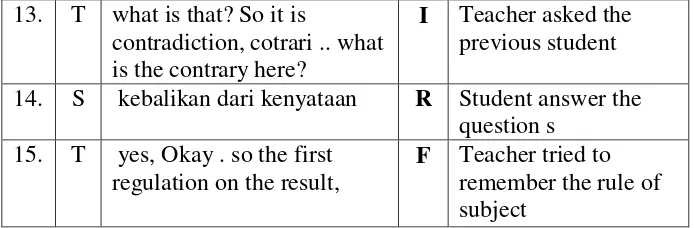
1) Interactional Pattern Teacher and Student by IRF Table 2. the pattern of IRF on Data 1.
the teacher initiate by a question and the student responded with the
answer and feedback came after student response, finishing by the
teacher with compheresion statement. 13. T what is that? So it is
contradiction, cotrari .. what is the contrary here?
I Teacher asked the previous student
14. S kebalikan dari kenyataan R Student answer the question s
15. T yes, Okay . so the first regulation on the result,
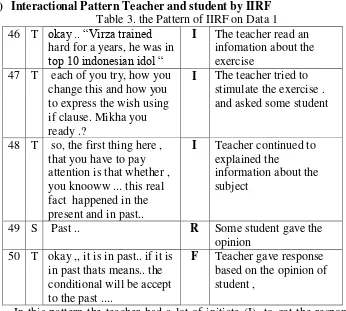
2) Interactional Pattern Teacher and student by IIRF
students , during the teacher explained the researcher had the assumption
that students confused with the explanation. in data 1, before the teacher
offer "Mikha" as a student was ready to do the exercise, the teacher read
exercise , then the teacher tries to remind the students not to forget the
basic of the conditional sentence “in past”, the students respond (R) to
the teacher that the pattern the question of conditional sentence happend in “PAST” conditional. The Feedback (F) by teacher about the answer of the students was "Okay" which is means the correct answer, but the
feedback (F) was emphasizing in appropriate of conditional sentence
3) Interctional Pattern Teacher and Student by IRRF
initiate of teacher then the teacher gave the feedback. This pattern occurs
when the teachers initiate (I) the question to open more interactions
between student-student respond (R). The teacher initiates (I) with the
question of clue so that students who are passive with a conversation can
provide their Response (R) . After hearing all the responses from the
students then the teacher gives Feedback (F) by the student right answer
or respond. The researcher assume that this pattern was a good way.
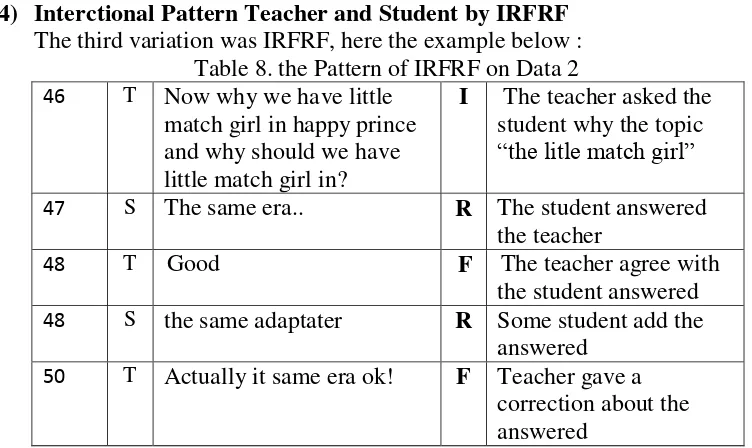
4) Interctional Pattern Teacher and Student by IRFRF The third variation was IRFRF, here the example below :
Table 8. the Pattern of IRFRF on Data 2 46 T Now why we have little
received the response from the teacher. In this variation teacher should
have a good change to follow up the response from student. The
variation was found in all the data. This pattern of teachers initiate
initiation so that students remain consistent with the understanding of the
explanations and materials that have been conveyed, the response of the
students given to the initiation just answering questions then the teacher
tried more deeply with feedback from students' answers by appreciating
the answers and explaining further about answers from students and
teachers still trying to ask questions in the context of feedback from
students' answers by trying students to reinforce student answers whether
they believe in the completeness of combining both teacher responses
and teacher feedback. Once the student is confident and understands the
teacher's answers and explanations, the teacher tries to provide additional
feedback with emphasis on material clarification as the closing of the
conversation patterns between teachers and students.
1. The type of interactional features performed by the teacher at SMA Kolese De Britto Yogyakarta.
The researcher analyzed 2 (two) transcription. The analysis information
about the interaction features which used by the teacher during the lesson.
The writer classified the teacher utterance to find out the classroom
interaction strategy in teaching and learning English. The researcher presents
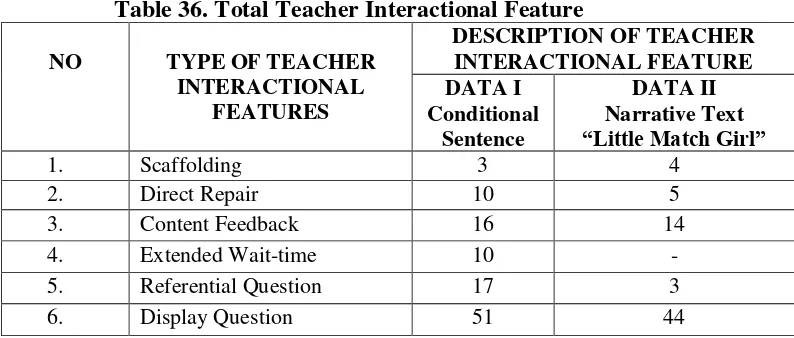
the interaction features in form of tables below:
Table 36. Total Teacher Interactional Feature
7. Seeking Clarification 8 11
8. Confirmation Checks 30 4
9. Extended Learner’s Turn - -
10. Teacher Echo 11 11
11. Teacher Interruptions 2 -
12. Extended Teacher Turn 35 1
13. Turn Completion 27 21
14. For-Focused Feedback 8 6
15. Comment 27 6
16. Informative 15 17
17. Directive 10 2
2. The impact of teacher and student interaction in teaching and learning process at SMA Kolese De Britto Yogyakarta.
Students can understand each explanation by the teacher in because the
teacher becomes the main actor in every interaction The explanation given
by the teacher through the use of fulll english language becomes the trigger
of the students trying to listen to every teacher's utterance. The used of
feedback (F) showed by teacher are mostly Interactive Feedback and Evaluate Feedback. The “interactive feedback” by teacher was a good way to initiate the student response about the instruction or material. The “interactive feedback” was a good way to give the student more space to think what the material will be. Furthermore, the “Evaluation Feedback” was good way to accept and comment what the student said. Unfortunately, her
students were passive in order to response or feedback. the pressure to give
the right answer and the fear of making mistakes and being laughed at by
their peers. The teacher was serious but approachable, strict but caring. We
could see students respected and enjoyed her lessons. In both groups she
started by checking homework and reviewing what had been said on the
previous class, but she used different words to do it. The teacher adapted her
body language, her tone and intonation, the vocabulary, but, still, she kept
the same classroom interaction patterns and managed to have students active
and attentive until the end of the class. Moreover, not only she taught them
teaching could be defined as a matter of adaptation and routine. In other
words, teachers have to adapt their voice, body language, vocabulary,
contents and rhythm to the group class they are working with. But at the same time, students should adapt themselves to each teacher’s standards, rules and methodology.
Conclusion
All the analysis of the study related to the problems that have been discussed in the
previous chapters. This chapter presents conclusion and suggestion of the analysis This
study attempts to examine and analyze the classroom interaction at SMA KOLESE DE
BRITTO Yogyakarta. The teachers question was her strategy to interact with her
students. The teacher used full English language to interact but the student did not find
the difficult to understand the material There were found I- F , I- I- F, I- F-
R-F and , I- R- R- R-F, as a interactional pattern performed in classroom interction. The
highest interactional feature used by teacher were Display question, seeking
clarification, confirmation checks, Extended Teacher Turn and feature as a dominant to
ask and give the student treatment on developing the student knowledge and more
information
References
Brown, G and Yule, G. 1999. Teaching Spoken Language: An Approach based on the
analysis of conversational English, Cambridge: Cambridge university press.
Celce-Murcia, M,.&Olshtain, E. (2000)."Discourse and context in language teaching."
New York: Cambridge University Press.
McCarthy, M. (1992). "Discourse analysis for language teachers."New York: Cambridge
University Press.
Nunan, David. 1993. Introducing Discourse Analysis. UK: England. Penguin Group.
Fairclough, N. (1995). Critical Discourse Analysis. London: Longman.
Riggenbach, H. (1999). "Discourse analysis in the language classroom: Volume 1.
Walsh, Steve. (2011). Exploring Classroom Discourse; Language in Action. New York: