
Computer Engineering
2004
Curriculum Guidelines for Undergraduate
Degree Programs in Computer Engineering
A Report in the Computing Curricula Series
Joint Task Force on Computer Engineering Curricula
IEEE Computer Society
Association for Computing Machinery
2004 December 12
Copyright © 2004 by the IEEE Computer Society
ALL RIGHTS RESERVED
Executive Summary
This report presents curriculum guidelines for undergraduate degree programs in computer
engineering. It draws upon recent efforts in computing curricula developed by the IEEE
Computer Society, the Association for Computing Machinery, and the Association for
Information Systems. These efforts resulted in published curricula recommendations in
computer science [ACM/IEEECS, 2001], information systems [ACM/AIS, 2002], and software
engineering [ACM/IEEECS, 2004]. Recommendations for information technology should
appear in 2006.
Computer engineering as an academic field encompasses the broad areas of computer science
and electrical engineering. Computer engineering is defined in this report as follows.
Computer engineering is a discipline that embodies the science and technology of design, construction,
implementation, and maintenance of software and hardware components of modern computing systems and
computer-controlled equipment. Computer engineering has traditionally been viewed as a combination of
both computer science (CS) and electrical engineering (EE).
Hence, this unique combination prepares students for careers that deal with computer systems
from design through implementation. Computing systems are components of a wide range of
products such as fuel injection systems in vehicles, medical devices such as x-ray machines,
communication devices such as cell phones, and household devices such as alarm systems and
washing machines. Designing computing systems and computing components of products,
developing and testing their prototypes, and implementing them to market are examples of what
computer engineers would do.
This report provides some background on the computer engineering field and explains how
the field evolved. It describes the expectations of graduates of the discipline and shows how
those graduates differ from other computing disciplines. It describes the expected background,
knowledge, and skills employers expect to see from graduates of computer engineering
programs. These include the ability to design computer systems, the realization of the
importance of practicing as professionals, and having the breadth and depth of knowledge
expected of a practicing engineer. It also discusses how programs in computer engineering may
have to stand up to the scrutiny of validation and accreditation by government or private
agencies.
elective. Core units represent the minimal knowledge or depth a program should cover in each
area; however, a curriculum containing only core units would not constitute a complete
curriculum in computer engineering.
A computer engineering program should contain sufficient coursework at the introductory,
intermediate, and advanced levels based on the aforementioned body of knowledge of computer
engineering. Programs should augment this coursework by a judicious selection of elective
courses that build upon that foundation. Breadth and depth in science and mathematics are
important to this discipline. As already mentioned, a design component is essential to the
program, and typically culminates with a capstone or senior project. The curriculum should also
emphasize professional practice, legal and ethical issues, and the social context in which
graduates implement engineering designs. Problem solving and critical thinking skills, oral and
written communication skills, teamwork, and a variety of laboratory experiences are essential to
the study of computer engineering.
CE2004 Task Force Members
David Soldan (Chair)*
James Aylor
Alan Clements
Gerald Engel
Ron Hoelzeman
Esther A. Hughes
Joseph L.A. Hughes*
John Impagliazzo*
Richard C. Jaeger
Robert Klenke
Douglas A. Lyon
Andrew McGettrick*
Victor P. Nelson*
Daniel J. Neebel
Ivor Page
Gregory D. Peterson
N. Ranganathan
Robert Sloan
Pradip K. Srimani*
Mitchell D. Theys*
Wayne Wolf
Murali Varanasi
Kansas State University
University of Virginia
University of Teesside – England
University of Connecticut
University of Pittsburgh
Virginia Commonwealth University
Georgia Institute of Technology
Hofstra University
Auburn University
Virginia Commonwealth University
Fairfield University
University of Strathclyde – Scotland
Auburn University
Loras College
University of Texas – Dallas
University of Tennessee – Knoxville
University of South Florida
University of Illinois – Chicago
Clemson University
University of Illinois – Chicago
Princeton University
University of South Florida
Reviewers
The Computer Engineering Task Force thanks the following individuals
for their comments and suggestions in the development of this report.
NAME
AFFILIATION
Nizar Al-Holou University of Detroit Mercy, United States
Yury A. Bogoyavlenskiy University of Petrozavodsk, Russian Federation
Kevin W. Bowyer University of Notre Dame, United States
Annette Bunker Utah State University, United States
James M. Conrad UNC Charlotte, United States
Susan E. Conry Clarkson University, United States
James A. Davis Iowa State University, United States
R. James Duckworth Worchester Polytechnic Institute, United States
Jose G. Delgado-Frias Washington State University, United States
Lalinda Fernando Rockwell Collins, United States
Edward F. Gehringer North Carolina State University, United States
Ian Greenshields University of Connecticut, United States
David R. Kaeli Northeastern University, United States
Ashfaq A. Khokar University of Delaware, United States
James McDonald Monmouth University, United States
Rafic Makki United Arab Emirates University
Hossein S. Moussavinezhad Western Michigan University, United States
Yale N. Patt University of Texas-Austin, United States
Hardy J. Pottinger University of Missouri-Rolla, United States
S.S.S.P. Rao Indian Institute of Technology, Bombay, India
Albert Reuther MIT Lincoln Laboratory, United States
Fred U. Rosenberger Washington University, United States
Kenneth L. Short SUNY Stony Brook, United States
Adit D. Singh Auburn University, United States
Mani Soma University of Washington, United States
J. Carter M. Tiernan University of Texas at Arlington, United States
Contents
Chapter 1
Introduction
1.1
Overall Structure of the Computing Curricula Project
1.2
Overview of the CE2004 Process
1.3
Structure of the CE2004 Report
Chapter 2
Computer Engineering as a Discipline
2.1
Background
2.2
Evolution of the Field
2.3
Characteristics of Computer Engineering Graduates
2.3.1 Distinctions
2.3.2
Professionalism
2.3.3
Ability to Design
2.3.4
Breadth of Knowledge
2.4
Organizational Considerations
2.5
Preparation for Professional Practice
2.6
Program Evaluation and Accreditation
Chapter 3
Principles
Chapter 4
Overview of the Computer Engineering Body of Knowledge
4.1
The Body of Knowledge
4.2
Structure of the Body of Knowledge
4.3
Learning Outcomes
4.4
Core and Elective Knowledge Units
4.5
Knowledge Units and Time Required for Coverage
4.6
Core Hours and a Complete Program
Chapter 5
Integration of Engineering Practice into the Computer Engineering Curriculum
5.1
The Nature of Computer Engineering
5.2
Design in the Curriculum
5.2.1
Design Throughout the Curriculum
5.2.2
The Culminating Design Experience
5.3
The Laboratory Experience
5.4
The Role of Engineering Tools
5.5
Applications of Computer Engineering Principles
5.6
Complementary Skills
5.7
Communication Skills
5.8
Teamwork Skills
5.9
Student Learning and Assessment
5.10
Lifelong Learning
5.11
The Business Perspective
5.12
The Elements of an Engineering Education
Chapter 6
Professionalism and Computer Engineering
6.2
Decisions in a Societal Context
6.3
Fostering
Professionalism
Chapter 7
Curriculum Implementation Issues
7.1
General Considerations
7.2
Basic Computer Engineering Components
7.2.1
Introductory Courses and the Core
7.2.2
Intermediate Courses
7.2.3
Advanced Courses
7.2.4
Culminating Project
7.2.5
Engineering Professional, Ethical, and Legal Issues
7.2.6
Communication Skills
7.3
Course Material Presented by Other Departments
7.3.1
Mathematical Requirements
7.3.2
Science Requirements
7.3.3
Other Requirements
7.4
Degree Program Implementation: Strategies and Examples
7.4.1
Course Considerations
7.4.2
Elective Courses
7.5
Degree Titles and Organizational Structures
7.6
Sample Curricula
Chapter 8
Institutional Challenges
8.1
The Need for Local Adaptation
8.2
Principles for Curriculum Design
8.3
The Need for Adequate Laboratory Resources
8.4
Attracting and Retaining Faculty
Endnote References to this Report
Bibliography
Appendix A
The Computer Engineering Body of Knowledge
A.1
Introduction
A.2
Structure
of
the
Body
of
Knowledge
A.3
Core
and
Elective
Units
A.4
Time Required to Cover a Knowledge Unit
A.5
Summary of the Computer Engineering Body of Knowledge
A.6
Comments
on
Knowledge
Areas
A.6.1
Comments
on
Algorithms
A.6.2 Comments on Computer Architecture and Organization
A.6.3 Comments on Computer Systems Engineering
A.6.7 Comments on Discrete Structures
A.6.8 Comments on Digital Signal Processing
A.6.9 Comments on Electronics
A.6.10 Comments on Embedded Systems
A.6.11 Comments on Human-Computer Interaction
A.6.12 Comments on Computer Networks
A.6.13 Comments on Operating Systems
A.6.14 Comments on Programming Fundamentals
A.6.15 Comments on Probability and Statistics
A.6.16 Comments on Social and Professional Issues
A.6.17 Comments on Software Engineering
A.6.18 Comments on VLSI Design and Fabrication
A.7
Details of the Body of Knowledge
CE-ALG Algorithms
CE-CAO
Computer Architecture and Organization
CE-CSE
Computer Systems Engineering
CE-CSG
Circuits and Signals
CE-DBS
Database Systems
CE-DIG
Digital Logic
CE-DSC
Discrete Structures
CE-DSP
Digital Signal Processing
CE-ELE
Electronics
CE-ESY
Embedded Systems
CE-HCI
Human-Computer Interaction
CE-NWK
Computer Networks
CE-OPS
Operating Systems
CE-PRF
Programming Fundamentals
CE-PRS
Probability and Statistics
CE-SPR
Social and Professional Issues
CE-SWE
Software Engineering
CE-VLS
VLSI Design and Fabrication
Appendix B
Computer Engineering Sample Curricula
B.1
Format
and
Conventions
B.2
Preparation
to
Enter
the
Profession
B.3
Curricula
Commonalities
B.4
Implementation A – Computer Engineering Program Administered by a Computer Science
Department
B.4.1
Program Goals and Features
B.4.2
Summary of Requirements
B.4.3
Four-Year Curriculum Model for Curriculum A
B.4.4
Mapping of the Computer Engineering BOK to Curriculum A
B.4.5
Curriculum A – Course Summaries
B.5
Implementation B – Computer Engineering Program Administered by an Electrical and Computer
Engineering Department
B.5.1
Program Goals and Features
B.5.2
Summary of Requirements
B.5.4
Mapping of the Computer Engineering BOK to Curriculum B
B.5.5
Curriculum B – Course Summaries
B.6
Implementation C – Computer Engineering Program Administered Jointly by a Computer Science
Department and a Department or College of Engineering
B.6.1
Program Goals and Features
B.6.2
Summary of Requirements
B.6.3
Four-Year Curriculum Model for Curriculum C
B.6.4
Mapping of the Computer Engineering BOK to Curriculum C
B.6.5
Curriculum C – Course Summaries
B.7
Implementation D – Computer Engineering Program Representative of a Program in the United
Kingdom and Other Nations
B.7.1
Program Goals and Features
B.7.2
Summary of Requirements
B.7.3
Three-Year Curriculum Model for Curriculum D
B.7.4
Four-Year Curriculum Model for Curriculum D
Chapter 1
Introduction
I
n the fall of 1998, the Computer Society of the Institute for Electrical and Electronics Engineers (IEEE-CS) and
the Association for Computing Machinery (ACM) established the Joint Task Force on “model Curricula for
Computing” (or CC for short) to undertake a major review of curriculum guidelines for undergraduate programs
in computing. The charter of the task force is as follows:
To review the Joint ACM and IEEE/CS Computing Curricula 1991 and develop a revised and enhanced
version that addresses developments in computing technologies in the past decade and will sustain through
the next decade.
As indicated in the charter, the goal of the CC effort is to revise
Computing Curricula 1991
[ACM/IEEECS,
1991] so that it incorporates the developments of the past decade. Computing has changed dramatically over that
time in ways that have a profound effect on curriculum design and pedagogy. Moreover, the scope of what one calls
computing
has broadened to the point that it is difficult to define it as a single discipline. Previous curricula reports
have attempted to merge such disciplines as computer science, computer engineering, and software engineering into
a single report about computing education. While such an approach may have seemed reasonable in the past, there
is no question that computing in the twenty-first century encompasses many vital disciplines with their own
identities and pedagogical traditions.
Another part of the charter of this group includes supporting the community of professionals responsible for
developing and teaching a range of courses throughout the global community. Providing an international
perspective presents different challenges, but is an important ingredient given the global nature of computing related
developments.
1.1
Overall Structure of the Computing Curricula Project
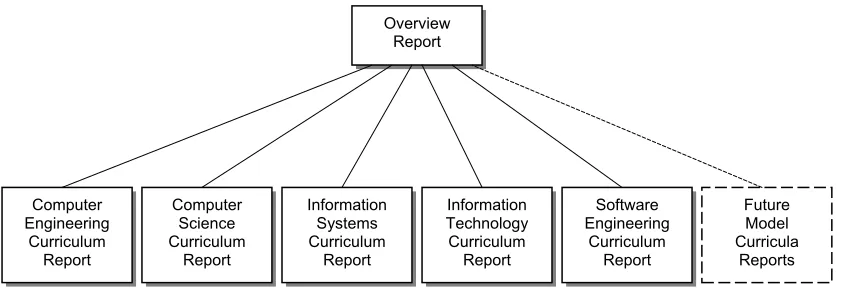
Due to the broadening scope of computing—and the feedback received on the initial draft — the CC initiative
contains several reports. This report focuses specifically on computer engineering, referred to as “Computing
Curricula: Computer Engineering 2004” or simply CE2004. To encompass the different disciplines that are part of
the overall scope of computing, professional organizations have created additional committees to undertake similar
efforts in other areas. These areas include computer science (“Computing Curricula: Computer Science” or the
CCCS report [ACM/IEEECS, 2001] published in December 2001), information systems (“Computing Curricula:
Information Systems” or the IS2002 report [ACM/AIS, 2002] published in 2002), software engineering (“Computing
Curricula: Software Engineering” or the SE2004 report [ACM/IEEECS, 2004] published in 2004), and information
technology (“Computing Curricula: Information Technology” or the CCIT report currently under development).
Overview Report
Computer Engineering
Curriculum Report
Computer Science Curriculum
Report
Information Systems Curriculum
Report
Information Technology Curriculum
Report
Software Engineering
Curriculum Report
Future Model Curricula
[image:12.612.96.520.78.224.2]Reports
Figure 1.1: Computing curricula reports
1.2
Overview of the CE2004 Process
In their charter, the main CC Steering Committee gave individual groups freedom to produce reports that best reflect
the needs and requirements of their particular disciplines. However, the committee did request that groups address a
certain minimal number of matters and, consequently, that they should include certain components in the individual
reports. The minimal set includes:
The body of knowledge (BOK) for the field; that is, the topics the field should cover,
A set of courses that cover the body of knowledge in one or more ways,
The core requirements for the discipline; that is, the requirements that would apply to all undergraduates, and
The characteristics of graduates of degree programs
The Steering Committee viewed the set of requirements as minimal, as one of its goals was to avoid prescription.
The experts must have the freedom to act as they see fit. Yet there must be some commonality across the different
series of reports. The anticipation is that each report will exceed this minimal set in various ways.
In pursuing this charter, it is natural that the Computer Engineering Task Force be cognizant of what the
Computer Science Task Force had already accomplished. The thrust of the Computer Engineering Task Force was
to build on work already completed, wherever possible.
Despite the considerable growth of computer engineering as a discipline, the literature in computer engineering
curricular development is modest. There are a few contributions such as [Bennett, 1986], [EAB, 1986], and
[Langdon, et. al. 1986]. The focus of these was not curricular development, but issues such as resources and design
processes. These issues are still important and appear elsewhere in this document.
To respond to the challenges of their charter, the Computer Engineering Task Force emerged from computer
engineering interests from different countries. In addition, there was some overlap with the original Computer
Science Task Force to ensure continuity. In discharging its duty, the Computer Engineering Task Force felt that it
was vital to involve the wider community; indeed, several consultative activities occurred to confirm the view
expressed in this volume. In addition, the task force used the World Wide Web [Aub] to allow any interested party
the opportunity to provide comment and suggestion. The published report has benefited from this wide and
important involvement
1.3
Structure of the CE2004 Report
This CE2004 report addresses computer engineering programs. The main body of the report consists of eight
chapters. Chapter 2 illustrates how computer engineering evolved as a discipline. It also highlights many of the
characteristics expected of a computer engineering graduate, especially their service to the public, their design
abilities, and their expected breadth of knowledge. It also suggests possible organizational structures, the
responsibility of professional practices, and program assessment. Chapter 3 articulates the principles that have
guided the work of the Computer Engineering Task Force and how these principles relate to
CC2001
. Chapters 4
and 5 present overviews of the computer engineering body of knowledge and curriculum recommendations. They
also articulate learning outcomes, the differences between core and elective knowledge units, the number of core
hours in the program, the importance of design and laboratory experiences, and various skills needed to become an
effective computer engineer. Chapter 6 highlights the importance of professionalism in the practice of computer
engineering. Chapter 7 provides a discussion on the issues affecting the implementation of a computer engineering
curriculum. These include the arrangement of courses within and external to the program and other implementation
considerations. Chapter 8 suggests some challenges that need reviewing when creating or continuing computer
engineering programs. This report provides two sets of references: those made within this report and a full set of
references related to all computing curricula programs.
Chapter 2
Computer Engineering as a Discipline
T
his chapter presents some of the characteristics that distinguish computer engineering from other computing
disciplines. It provides some background of the field and shows how it evolved over time. It also highlights
some of the characteristics expected from its graduates, preparation for entering the curriculum, and student
outcomes and assessment. The chapter also highlights the importance of graduates to have a proper sense of
professionalism to ensure a proper perspective in the practice of computer engineering.
2.1 Background
Computer engineering is defined as the discipline that embodies the science and technology of design, construction,
implementation, and maintenance of software and hardware components of modern computing systems and
computer-controlled equipment. Computer engineering has traditionally been viewed as a combination of both
computer science (CS) and electrical engineering (EE). It has evolved over the past three decades as a separate,
although intimately related, discipline. Computer engineering is solidly grounded in the theories and principles of
computing, mathematics, science, and engineering and it applies these theories and principles to solve technical
problems through the design of computing hardware, software, networks, and processes.
Historically, the field of computer engineering has been widely viewed as “designing computers.” In reality,
the design of computers themselves has been the province of relatively few highly skilled engineers whose goal was
to push forward the limits of computer and microelectronics technology. The successful miniaturization of silicon
devices and their increased reliability as system building blocks has created an environment in which computers
have replaced the more conventional electronic devices. These applications manifest themselves in the proliferation
of mobile telephones, personal digital assistants, location-aware devices, digital cameras, and similar products. It
also reveals itself in the myriad of applications involving embedded systems, namely those computing systems that
appear in applications such as automobiles, large-scale electronic devices, and major appliances.
Increasingly, computer engineers are involved in the design of computer-based systems to address highly
specialized and specific application needs. Computer engineers work in most industries, including the computer,
aerospace, telecommunications, power production, manufacturing, defense, and electronics industries. They design
high-tech devices ranging from tiny microelectronic integrated-circuit chips, to powerful systems that utilize those
chips and efficient telecommunication systems that interconnect those systems. Applications include consumer
electronics (CD and DVD players, televisions, stereos, microwaves, gaming devices) and advanced microprocessors,
peripheral equipment, systems for portable, desktop and client/server computing, and communications devices
(cellular phones, pagers, personal digital assistants). It also includes distributed computing environments (local and
wide area networks, wireless networks, internets, intranets), and embedded computer systems (such as aircraft,
spacecraft, and automobile control systems in which computers are embedded to perform various functions). A
wide array of complex technological systems, such as power generation and distribution systems and modern
processing and manufacturing plants, rely on computer systems developed and designed by computer engineers.
2.2 Evolution of the Field
As noted previously, computer engineering evolved from the disciplines of electrical engineering and computer
science. Initial curricular efforts in computer engineering commonly occurred as a specialization within EE
programs, extending digital logic design to the creation of small-scale digital systems and, eventually, the design of
microprocessors and computer systems.
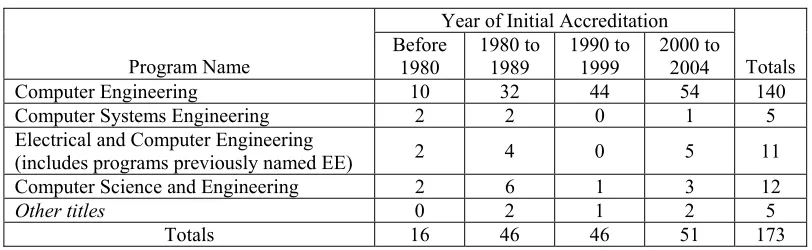
[image:15.612.106.512.261.386.2]In the United States, the first computer engineering program accredited by ABET (formerly the Accreditation
Board for Engineering and Technology) was at Case Western Reserve University in 1971. As of October 2004,
ABET has accredited over 170 computer engineering or similarly named programs. Table 2-1 summarizes the
growth in programs by title and year of initial ABET accreditation (or change of program name). As a point of
comparison, there are approximately 300 accredited electrical engineering programs.
Table 2-1
Summary of ABET-accredited computer engineering programs in the U.S. - as of October 2004
Year of Initial Accreditation
Program Name
Before
1980
1980 to
1989
1990 to
1999
2000 to
2004
Totals
Computer
Engineering
10 32 44 54
140
Computer
Systems
Engineering
2 2 0 1 5
Electrical and Computer Engineering
(includes programs previously named EE)
2 4 0 5
11
Computer Science and Engineering
2
6
1
3
12
Other titles
0 2 1 2 5
Totals
16 46 46 51
173
One would expect that the growth trend in computer engineering will increase as computing and electronic
technologies become more complex. The evolution may take many forms, including (a) an expanded content from
computer science, (b) collaboration with the emerging software engineering discipline on application-focused
projects and embedded systems with a greater emphasis on design and analysis tools to manage complexity, or (c)
re-integration with electrical engineering, as computer-based systems become dominant in areas such as control
systems and telecommunications.
2.3 Characteristics of Computer Engineering Graduates
With the ubiquity of computers and computer-based systems in the world today, computer engineers must be
versatile in the knowledge drawn from standard topics in computer science and electrical engineering as well as the
foundations in mathematics and sciences. Because of the rapid pace of change in the computing field, computer
engineers must be life-long learners to maintain their knowledge and skills within their chosen discipline.
2.3.1
Distinctions
An important distinction should be made between computer engineers, electrical engineers, other computer
professionals, and engineering technologists. While such distinctions are sometimes ambiguous, computer
engineers generally should satisfy the following three characteristics.
2.
Have a breadth of knowledge in mathematics and engineering sciences, associated with the broader scope
of engineering and beyond that narrowly required for the field.
3.
Acquire and maintain a preparation for professional practice in engineering.
Electrical engineering spans a wide range of areas, including bioengineering, power engineering, electronics,
telecommunications and digital systems. Related to the field of computer engineering, electrical engineers concern
themselves primarily with the physical aspects of electronics including circuits, signal analysis, and microelectronic
devices. Computer scientists concern themselves primarily with the theoretical and algorithmic aspects of
computing with a focus on the theoretical underpinnings of computing. Software engineers have a focus on the
principles underlying the development and maintenance of correct (often large-scale) software throughout its
lifecycle. Information systems specialists encompass the acquisition, deployment, and management of information
resources for use in organizational processes. Information technology specialists would focus on meeting the needs
of users within an organizational and societal context through the selection, creation, application, integration, and
administration of computing technologies. Computer engineering technologists support engineers by installing and
operating computer-based products, and maintaining those products.
2.3.2
Professionalism
The public has entrusted in engineers a level of responsibility because the systems they design (whether x-ray
machines, air traffic control systems, or nuclear power plants) affect the public directly and indirectly. Therefore, it
is incumbent upon computer engineers to exercise the utmost conscientiousness in their designs and
implementations of computing systems. As such, graduates should have an understanding of the responsibilities
associated with engineering practice, including the professional, societal, and ethical context in which they do their
work. Such responsibilities often involve complicated trade-offs involving fiscal and social contexts. This social
context encompasses a range of legal and economic issues such as intellectual property rights, security and privacy
issues, liability, technological access, and global implications and uses of technologies.
Professionalism and ethics are critical elements, since the focus of engineering on design and development
makes social context paramount to studies in the field. Computer engineering students must learn to integrate
theory, professional practice, and social constructs in their engineering careers. It is incumbent upon all computer
engineers to uphold the tenets of their profession and to adhere to the codes of professional practice. The public
expects engineers to follow prescribed rules of professional practice and to not engage in activities that would
tarnish their image or that of their practicing colleagues. Because of the importance of this topic, Chapter 6 of this
report is devoted to an expanded discussion on professional practice and responsibilities.
2.3.3
Ability to Design
Engineering draws heavily on the ability to design. The International Technology Education Association (ITEA)
defines engineering design as “The systematic and creative application of scientific and mathematical principles to
practical ends such as the design, manufacture, and operation of efficient and economical structures, machines,
processes, and systems.” [ITEA] Other definitions are possible such as the creative ability required for the
development of better devices, systems, processes, and new products. Many reasons prompt new designs such as
seeking to exploit new developments in related technologies or to develop improvements on existing products (e.g.
making products less expensive, safer, more flexible, or lighter in weight). Identifying deficiencies or weaknesses in
existing products is another motivation for engineering design. Of course, novel ideas are especially important.
Design is fundamental to all engineering. For the computer engineer, design relates to software and hardware
components of modern computing systems and computer-controlled equipment. Computer engineers apply the
theories and principles of science and mathematics to design hardware, software, networks, and processes and to
solve technical problems. Continuing advances in computers and digital systems have created opportunities for
professionals capable of applying these developments to a broad range of applications in engineering.
2.3.4
Breadth of Knowledge
Because of the breadth of the computer-engineering field, curricular content may vary widely among programs, or
even among students in the same program. Computer-related coursework typically comes from computer
organization and architecture, algorithms, programming, databases, networks, software engineering, and
communications. Electrical engineering related coursework typically comes from circuits, digital logic,
microelectronics, signal processing, electromagnetics, and integrated circuit design. Foundational topics typically
include basic sciences, mathematics for both discrete and continuous domains, and applications of probability and
statistics.
At one extreme, a degree program in computer engineering might provide opportunities for its students to study
a wide range of topics spanning the entire field. At another extreme, there may be programs that focus on one
specific aspect of computer engineering and cover it in great depth. The graduates from such programs will
typically tend to seek opportunities in the specialist area they studied, whether it is multimedia systems
development, computer design, network design, safety-critical systems, pervasive computing, or whatever other
specialties emerge and become important. One common measure for differentiating among computer engineering
programs is the relative amount of emphasis placed on topics that are commonly associated with either electrical
engineering or computer science programs.
Despite differences in emphasis and content, there are certain common elements that one should expect of any
computer engineering program. The Body of Knowledge, described in Chapter 4, identifies topical areas that one
may reasonably expect in all programs, as opposed to those that are often included in some programs or those that
one might consider elective or specialized topics. From a higher-level perspective, however, one can reasonably
expect several characteristics of all computer engineering graduates. These include:
System Level Perspective
– Graduates should appreciate the concept of a computer system, the design of the
hardware and software for that system, and the processes involved in constructing or analyzing it. They
should have an understanding of its operation that goes to a greater depth than a mere external appreciation of
what the system does or the way(s) in which one uses it.
Depth and Breadth
– Graduates should have familiarity with topics across the breadth of the discipline, with
advanced knowledge in one or more areas.
Design Experiences
– Graduates should have completed a sequence of design experiences, encompassing
hardware and software elements, building on prior work, and including at least one major project.
Use of Tools
– Graduates should be capable of utilizing a variety of computer-based and laboratory tools for
the analysis and design of computer systems, including both hardware and software elements.
Professional Practice
– Graduates should understand the societal context in which engineering is practiced,
as well as the effects of engineering projects on society.
Communication Skills
– Graduates should be able to communicate their work in appropriate formats (written,
oral, graphical) and to critically evaluate materials presented by others in those formats.
2.4
Organizational Considerations
The administration of computer engineering programs falls within a variety of organizational structures. Currently,
computer engineering programs are rarely organized as separate academic departments. They often appear in
colleges or schools of engineering, either within an electrical engineering department, within a combined
engineering department, or within an electrical and computer engineering department. In such cases, the expectation
is a strong emphasis on circuits and electronic components. Computer engineering programs also appear in areas
such as computer science departments, colleges of arts and sciences, schools or divisions of information technology,
or co-sponsored by multiple entities. In these cases, the programs often relate more to the issues of theory,
abstraction, and organization rather than those of a more applied nature.
2.5
Preparation for Professional Practice
Unlike professions such as law and medicine, engineering generally does not require an advanced degree for
employment in the field. Thus, undergraduate programs in computer engineering must include not only basic
knowledge within the field, but the ability to apply it to the solution of realistic projects. This preparation
encompasses several areas.
Section 2.3.2 defined the professionalism and ethics that are fundamental characteristics of a computer
engineering graduate. Preparation for professional practice requires graduates to have an understanding of their
responsibilities associated with engineering practice, as well as an ability to apply these principles to specific
situations. Professionalism should be a constant theme that pervades the entire curriculum. In particular, the social
context of engineering should be integrated into the teaching of engineering design, including the use of best
practices and trade-offs among technical, fiscal, and social requirements.
In addition to professionalism, appropriate preparation encompasses both technical (design ability, laboratory
experiences, use of engineering tools) and non-technical (teamwork, communication) elements. Chapter 5 of this
report provides a detailed discussion on the integration of these issues into the curriculum.
2.6 Program Evaluation and Accreditation
Processes for program evaluation must accommodate the variations among computer engineering programs. Such
evaluation is critical to ensure that graduates have the proper preparation and that programs are evolving to meet the
emerging requirements of the field. Often, professional societies and governments look toward an external
assessment of programs to ensure that graduates achieve minimally what professional organizations expect of them.
Within the United States, ABET accreditation is widely recognized and accepted. The current engineering
criteria [ABET, 2004] are intended to ensure that all accredited programs satisfy a minimum set of criteria common
to all engineering disciplines and criteria specific to each discipline. A key element of this process is a requirement
that each program engage in an ongoing process of self-assessment and continuous improvement. Programs should
demonstrate that all graduates achieve a set of program outcomes based on the program’s educational objectives.
The ABET criteria are broadly defined. They leave the interpretation of what constitutes the appropriate knowledge
for a given discipline to the professional societies affiliated with that discipline. We anticipate that this report will
provide guidance to accrediting agencies on the appropriate technical content of computer engineering programs.
In the United Kingdom, benchmarking of degrees has developed in recent years as part of governmental quality
assurance efforts. Each institution is required to demonstrate that their degrees meet the requisite benchmark
standards for that discipline. One example of these benchmark standards is [UKQAA, 2000]. This benchmarking
defines both threshold (minimal) and modal (average) expectations with respect to demonstrated student knowledge,
skills, and judgment. The Engineering Council UK has overall responsibility for the accreditation of engineering
degrees within the United Kingdom. Its basic responsibilities include setting standards (of competence and
commitment) for the accreditation of engineering degrees and approving
nominating bodies
that carry out detailed
accreditation on its behalf. In general, the British Computer Society (BCS) carries out accreditation of computing
degree programs and the Institute of Electrical Engineers (IEE) carries out the accreditation of electronic and
electrical engineering degree programs. Degree programs in computer engineering could be accredited by either
society, though perhaps more often by IEE. However, joint accreditation by both societies is common.
In general, institutions tend to use accreditation as a vehicle to provide evidence of quality that they can use in
marketing activities; most institutions offering engineering degrees will have some form of recognition in
accreditation terms. Graduation from an accredited engineering program is typically a prerequisite step towards
professional registration or licensure. Currently, some jobs demand accredited degree status or professional
licensure, although this requirement is not as widespread in computing-related fields as in some other engineering
fields.
Chapter 3
Principles
C
Omputer Engineering is a growing and important area of endeavor. The Computer Engineering Task Force
established a set of principles to guide its work that reflects in part those that appeared in the Computer
Science Report. They appear here with appropriate rewording and modification to reflect better the tenets
expected from a computer engineering program. The presentation here is not in order of priority.
1.
Computer engineering is a broad and developing field.
The original CC Steering Committee had taken the
view that a single report, covering primarily computer science, could not address the full range of issues that
colleges and universities have to consider as they seek to address their computing curricula, and that a different
task force should develop a separate report addressing computer engineering.
2.
Computer engineering is a distinct discipline
with its own body of knowledge, its own ethos, and its own
practices. That discipline embodies the science and the technology of specification, design, construction,
implementation, and maintenance of the hardware and software components of modern computer systems and
computer-controlled equipment.
3.
Computer engineering draws its foundations from a wide variety of other disciplines.
Computer engineering
education is solidly grounded in the theories and principles of computing, mathematics, and engineering, and it
applies these theoretical principles to design hardware, software, networks and computerized equipment and
instruments to solve technical problems in diverse application areas.
4.
The rapid evolution of computer engineering requires an ongoing review of the corresponding curriculum.
Given the pace of change in the discipline, the professional associations in this discipline must establish an
ongoing review process that allows the timely update of the individual components of the curriculum
recommendations.
5.
Development of a computer engineering curriculum must be sensitive to changes in technology, new
developments in pedagogy, and the importance of lifelong learning.
In a field that evolves as rapidly as
computer engineering, educational institutions must adopt explicit strategies for responding to change.
Computer engineering education must seek to prepare students for lifelong learning that will enable them to
move beyond today’s technology to meet the challenges of the future.
6.
The Computer Engineering Task Force should seek to identify the fundamental skills and knowledge that all
computer engineering graduates must possess.
Computer engineering is a broadly based discipline. The final
report must seek to identify the common concepts and skills of the discipline.
7.
The required core of the body of knowledge should be as small as reasonably possible.
The Task Force should
make every effort to keep that core to a minimum to allow flexibility, customization, and choice in other parts
of the curriculum to enable creation of individualized programs.
8.
Computer engineering must include appropriate and necessary design and laboratory experiences.
A computer
engineering program should include “hands-on” experience in designing, building, and testing both hardware
and software systems.
10.
The computer engineering curriculum must include preparation for professional practice as an integral
component.
These practices encompass a wide range of activities including management, ethics and values,
written and oral communication, working as part of a team, and remaining current in a rapidly changing
discipline.
11.
The computer engineering report must include discussions of strategies and tactics for implementation along
with high-level recommendations.
Although it is important for computing curricula to articulate a broad vision
of computing education, the success of any curriculum depends heavily on implementation details. To
accomplish this, the report should provide sample curricula models.
12.
The development of the final report must contain a broad base.
To be successful, the process of creating the
computer engineering recommendations must include participation from many different constituencies
including industry, government, and the full range of higher educational institutions involved in computer
engineering education.
Chapter 4
Overview of the Computer Engineering
Body of Knowledge
D
eveloping any curriculum for undergraduate study in computer engineering should reflect the current needs
of computer engineering students. The curriculum should also reflect current educational practice and
suggest improvements where necessary. The discussion that follows attempts to accomplish this in
preparing a body of knowledge commensurate with producing competent computer engineering graduates.
4.1
The Body of Knowledge
The Computer Engineering Task Force has sought to assemble a modern curriculum by first defining the primary
disciplines that make up the body of knowledge for computer engineering. Some of these discipline areas contain
material that should be part of
all
computer engineering curricula. These are the 18 knowledge areas, including two
covering related mathematics topics, listed in Table 4.1. Other areas contain material that might, or might not, be
part of such curricula, depending on the specific educational objectives of a program. Some of these are listed in
Chapter 7, but are not described in detail in this report.
Table 4.1
CE2004 Discipline Areas Containing Core Material
CE-ALG* Algorithms
CE-CAO
Computer Architecture and Organization
CE-CSE
Computer Systems Engineering
CE-CSG
Circuits and Signals
CE-DBS
Database Systems
CE-DIG
Digital Logic
CE-DSP
Digital Signal Processing
CE-ELE
Electronics
CE-ESY
Embedded Systems
CE-HCI* Human-Computer
Interaction
CE-NWK
Computer Networks
CE-OPS*
Operating Systems
CE-PRF* Programming
Fundamentals
CE-SPR*
Social and Professional Issues
CE-SWE*
Software Engineering
CE-VLS
VLSI Design and Fabrication
---
---
CE-DSC* Discrete
Structures
CE-PRS
Probability and Statistics
* Consult the CC2001 Computer Science report for more detail
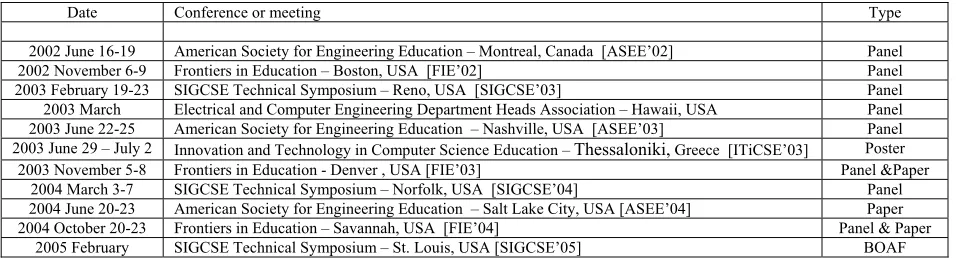
The task force released the resulting document for public review. It solicited reviews at a number of meetings,
conferences, and other sources. The task force held an NSF-sponsored workshop in November 2002 in conjunction
with the Frontiers in Education Conference [FIE’02] in Boston. Reviewers from academia and industry participated
in the workshop and provided comments on the preliminary versions of the body of knowledge. Members from the
task force presented and discussed the body of knowledge at a variety of conferences through panel discussions and
poster sessions. Presentations to date appear in Table 4.2. The entire CE2004 project has been available at [Aub]
since 2002.
Table 4.2
CE2004 Presentations
Date Conference or meeting Type
2002 June 16-19 American Society for Engineering Education – Montreal, Canada [ASEE’02] Panel
2002 November 6-9 Frontiers in Education – Boston, USA [FIE’02] Panel
2003 February 19-23 SIGCSE Technical Symposium – Reno, USA [SIGCSE’03] Panel
2003 March Electrical and Computer Engineering Department Heads Association – Hawaii, USA Panel 2003 June 22-25 American Society for Engineering Education – Nashville, USA [ASEE’03] Panel 2003 June 29 – July 2 Innovation and Technology in Computer Science Education – Thessaloniki, Greece [ITiCSE’03] Poster
2003 November 5-8 Frontiers in Education - Denver , USA [FIE’03] Panel &Paper
2004 March 3-7 SIGCSE Technical Symposium – Norfolk, USA [SIGCSE’04] Panel
2004 June 20-23 American Society for Engineering Education – Salt Lake City, USA [ASEE’04] Paper 2004 October 20-23 Frontiers in Education – Savannah, USA [FIE’04] Panel & Paper
2005 February SIGCSE Technical Symposium – St. Louis, USA [SIGCSE’05] BOAF
4.2
Structure of the Body of Knowledge
The body of knowledge has a hierarchical organization comprising three levels described as follows.
The highest level of the hierarchy is the
knowledge area
, which represents a particular disciplinary sub-field.
A three-letter abbreviated tag identifies each area, such as CE-DIG for “Digital Logic” and CE-CAO for
“Computer Architecture and Organization.”
Each knowledge area is broken down into smaller divisions called
knowledge units
, which represent
individual thematic modules within an area. A numeric suffix added to the area name identifies each
knowledge unit. For example, CE-CAO3 is a knowledge unit on “Memory System Organization and
Architecture” within the CE-CAO knowledge area.
A set of
topics
, which are the lowest level of the hierarchy, further subdivides each knowledge unit. A group
of learning outcomes addresses the related technical skills associated with each knowledge unit. Section 4.3
expands the discussion on learning outcomes. For example, CE-CAO3 contains nine topics, such as “Virtual
Memory Systems”.
To differentiate knowledge areas and knowledge units in computer engineering from those that may have the
same or similar names in the other four curriculum areas associated with this computing curriculum project, the
prefix “CE-” accompanies all knowledge areas and units in computer engineering. Reflecting the examples above,
therefore, tags such as CE-DIG for knowledge areas and CE-CAO3 for knowledge units appear throughout the
report.
4.3
Learning Outcomes
Any specification of a course will include both knowledge and associated learning outcomes. In designing
courses, some designers start with knowledge while others start with the learning outcomes. In reality, a
combination of the two approaches appears most appropriate. In addition, a certain duality exists between the
elements of knowledge and the related learning outcomes or objectives. Different people will place different levels
of emphasis on each. For this document, the view is that they are complementary.
Since learning outcomes imply assessment and since assessment guides learning, teachers should exercise
considerable care in selecting and formulating these. Excessive numbers of very detailed learning outcomes can
lead to bureaucracy and tedium, which is highly undesirable. The existence of these outcomes must not inhibit
course development; it should enhance that activity.
Learning outcomes are part of knowledge units and can be part of
modules
, which constitute the formal units of
assessment. The number of learning outcomes per knowledge unit or module should be a small number—at most
four or five. The learning outcomes for a module will naturally build on the knowledge units and the associated
practical skills. They tend to be of the form:
Demonstrate the acquisition of competence; that is, show the ability to apply knowledge and
practical skills to solve a problem.
Of course, the ways of demonstrating skills can be many and varied; in particular, they can involve a range of
communication and other skills. In this way, imaginative approaches to assessment can lead to the assessment of a
range of skills in a well-conceived assignment.
4.4
Core and Elective Knowledge Units
As computer engineering evolves, the number of topics required in the undergraduate curriculum is growing. Over
the last decade, computer engineering has expanded to such an extent that it is no longer possible to add new topics
without taking others away. One of the goals in proposing curricular recommendations is to keep the required
component of the body of knowledge as small as possible.
To implement this principle, the Computer Engineering Task Force has defined a minimal
core
comprising
those knowledge units for which there is broad consensus that the corresponding material is essential to anyone
obtaining an undergraduate degree in computer engineering. The core is considered essential, independent of the
specific program degree title or organizational structure. Knowledge units presented as part of an undergraduate
program, but which fall outside the core, are
elective
to the curriculum. Based on program goals, an institution may
deem many elective units and areas as essential and require them for its program.
In discussing the recommendations during their development, the Task Force has found that it helps to
emphasize the following important points.
The core is not a complete curriculum.
The intention of the core is minimal and it does
not
constitute a complete undergraduate curriculum. Every
undergraduate program must include additional elective knowledge units from the body of knowledge. This
report does not define what those units should be; that decision is the choice of each institution. A complete
curriculum must also contain supporting areas covered through courses in mathematics, natural sciences,
business, humanities, and/or social sciences. Chapter 7 presents some detail in this area.
Core units are not necessarily limited to a set of introductory courses taken early in the undergraduate
curriculum.
come toward the end of a student's undergraduate program. Similarly, introductory courses may include
elective knowledge units together with the coverage of core material. From a practical point of view, the
designation
core
simply means
required
and says nothing about the level of the course in which it appears.
4.5
Knowledge Units and Time Required for Coverage
To provide readers a sense of the time required to cover a particular unit, this report defines a metric that establishes
a standard of measurement. Choosing such a metric has proven difficult, because no standard measure has global
recognition. For consistency with the computer science report and earlier curriculum reports, the Task Force has
chosen to express time in
hours
, corresponding to the in-class time required to present that material in a traditional
lecture-oriented format. To dispel any potential confusion, however, it is important to underscore the following
observations about the use of lecture hours as a measure.
The Task Force does not seek to endorse the lecture format.
Even though this report refers to a metric with
its roots in a classical lecture-oriented form, the Task Force believes there are other styles - particularly given
recent improvements in educational technology - that can be at least as effective. For some of these styles,
the notion of hours may be difficult to apply. Even so, the time specifications should at least serve as a
comparative measure, in the sense that a five-hour unit will presumably take roughly five times as much time
to cover as a one-hour unit, independent of the teaching style.
The hours specified do not include time spent outside of a class.
The time assigned to a unit does not include
the instructor's preparation time or the time students spend outside of class. As a general guideline, the
amount of out-of-class work for a student is approximately two to three times the in-class time. Thus, a unit
that is listed as requiring three hours will typically entail a total of nine to twelve hours (three in-class hours
and six to nine outside hours) of student effort.
The hours listed for a unit represent a minimum level of coverage.
One should interpret the time
measurements assigned to each knowledge unit as the minimum amount of time necessary to enable a student
to perform the learning outcomes for that unit. It may be appropriate to spend more time on a knowledge unit
than the mandated minimum.
The 420 core hours specified do not include time for laboratories, design, math, science, etc.
These activities
and subjects should be added to the 420 core hours as necessary to provide supporting material and
preparation for engineering practice.
The number of hours shown should be sufficient to ensure familiarity with the topics, but not necessarily to achieve
expertise in that area. The number of core hours was deliberately kept to a minimum to allow programs the
flexibility to emphasize selected areas in accordance with the specific objectives, prerequisite structure, and level of
student preparation in that program. Therefore, the actual time devoted to a particular core topic will vary from
program to program, with some programs spending more than the specified minimum number of hours on selected
core topics, while devoting only the minimum level of coverage to others.
4.6
Core Hours and a Complete Program
The knowledge units designated as core constitute only a fraction (approximately 30%) of the total body of
knowledge. Different computer engineering programs can have different program objectives and as a result, will
have different emphases. The remainder of a specific program at an institution usually will require specific
additional knowledge units that complement the core areas, as well as elective hours chosen by individual students.
Thus, each local program should seek to encompass that portion of the body of knowledge relevant to its program
goals.
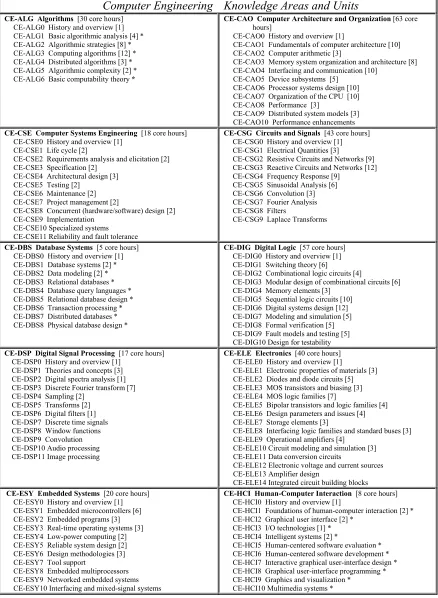
A summary of the body of knowledge—showing the areas, units, which units are core, and the minimum time
required for each—appears in Table 4.3. It consists of 18 knowledge areas; 16 relate directly to computer
Task Force has singled out these two mathematics areas as core because some programs may not consider them
essential to computer engineering, as they would consider calculus. The details of the body of knowledge for
computer engineering appear in Appendix A.
The core hours as specified in Table 4.3 total 420 hours of computer engineering and 66 hours of mathematics.
Recall that an hour refers to a lecture hour and not a credit hour. Assuming a 15-week semester, a typical
three-credit-hour course would have about 42 lecture hours for presentation of material. That is, approximately 14 lecture
hours are equivalent to 1 semester credit hour. The 420 core computer engineering hours are thus roughly
equivalent to ten three-credit-hour courses or 30 semester credit hours. The 30 semester credit hours are
approximately one quarter of the 128 credit hours included in a typical four-year engineering program. The 420
core hours leave ample room for the addition of laboratory courses, a culminating design project, and electives that
allow an institution to customize their program.
In the United States, for example, ABET accreditation criteria currently requires one and one-half years
(approximately 48 semester hours) of engineering topics; it also requires one year (32 semester hours) of
mathematics and basic science. The 48 semester hours are equivalent to 672 contact hours. Therefore, the 420 core
hours listed in Table 4.3 would constitute approximately two-thirds of the required minimum engineering content.
Programs often categorize the discrete structures area and the probability and statistics area as mathematics rather
than engineering or computing areas.
Table 4.3
The Computer Engineering Body of Knowledge
Computer Engineering Knowledge Areas and Units
CE-ALG Algorithms [30 core hours]CE-ALG0 History and overview [1] CE-ALG1 Basic algorithmic analysis [4] * CE-ALG2 Algorithmic strategies [8] * CE-ALG3 Computing algorithms [12] * CE-ALG4 Distributed algorithms [3] * CE-ALG5 Algorithmic complexity [2] * CE-ALG6 Basic computability theory *
CE-CAO Computer Architecture and Organization [63 core hours]
CE-CAO0 History and overview [1]
CE-CAO1 Fundamentals of computer architecture [10] CE-CAO2 Computer arithmetic [3]
CE-CAO3 Memory system organization and architecture [8] CE-CAO4 Interfacing and communication [10]
CE-CAO5 Device subsystems [5] CE-CAO6 Processor systems design [10] CE-CAO7 Organization of the CPU [10] CE-CAO8 Performance [3]
CE-CAO9 Distributed system models [3] CE-CAO10 Performance enhancements
CE-CSE Computer Systems Engineering [18 core hours] CE-CSE0 History and overview [1]
CE-CSE1 Life cycle [2]
CE-CSE2 Requirements analysis and elicitation [2] CE-CSE3 Specification [2]
CE-CSE4 Architectural design [3] CE-CSE5 Testing [2]
CE-CSE6 Maintenance [2] CE-CSE7 Project management [2]
CE-CSE8 Concurrent (hardware/software) design [2] CE-CSE9 Implementation
CE-CSE10 Specialized systems CE-CSE11 Reliability and fault tolerance
CE-CSG Circuits and Signals [43 core hours] CE-CSG0 History and overview [1] CE-CSG1 Electrical Quantities [3]
CE-CSG2 Resistive Circuits and Networks [9] CE-CSG3 Reactive Circuits and Networks [12] CE-CSG4 Frequency Response [9]
CE-CSG5 Sinusoidal Analysis [6] CE-CSG6 Convolution [3] CE-CSG7 Fourier Analysis CE-CSG8 Filters
CE-CSG9 Laplace Transforms
CE-DBS Database Systems [5 core hours] CE-DBS0 History and overview [1] CE-DBS1 Database systems [2] * CE-DBS2 Data modeling [2] * CE-DBS3 Relational databases * CE-DBS4 Database query languages * CE-DBS5 Relational database design * CE-DBS6 Transaction processing * CE-DBS7 Distributed databases * CE-DBS8 Physical database design *
CE-DIG Digital Logic [57 core hours] CE-DIG0 History and overview [1] CE-DIG1 Switching theory [6]
CE-DIG2 Combinational logic circuits [4]
CE-DIG3 Modular design of combinational circuits [6] CE-DIG4 Memory elements [3]
CE-DIG5 Sequential logic circuits [10] CE-DIG6 Digital systems design [12] CE-DIG7 Modeling and simulation [5] CE-DIG8 Formal verification [5] CE-DIG9 Fault models and testing [5] CE-DIG10 Design for testability
CE-DSP Digital Signal Processing [17 core hours] CE-DSP0 History and overview [1]
CE-DSP1 Theories and concepts [3] CE-DSP2 Digital spectra analysis [1] CE-DSP3 Discrete Fourier transform [7] CE-DSP4 Sampling [2]
CE-DSP5 Transforms [2] CE-DSP6 Digital filters [1] CE-DSP7 Discrete time signals CE-DSP8 Window functions CE-DSP9 Convolution CE-DSP10 Audio processing CE-DSP11 Image processing
CE-ELE Electronics [40 core hours] CE-ELE0 History and overview [1]
CE-ELE1 Electronic properties of materials [3] CE-ELE2 Diodes and diode circuits [5] CE-ELE3 MOS transistors and biasing [3] CE-ELE4 MOS logic families [7]
CE-ELE5 Bipolar transistors and logic families [4] CE-ELE6 Design parameters and issues [4] CE-ELE7 Storage elements [3]
CE-ELE8 Interfacing logic families and standard buses [3] CE-ELE9 Operational amplifiers [4]
CE-ELE10 Circuit modeling and simulation [3] CE-ELE11 Data conversion circuits
CE-ELE12 Electronic voltage and current sources CE-ELE13 Amplifier design
CE-ELE14 Integrated circuit building blocks CE-ESY Embedded Systems [20 core hours]
CE-ESY0 History and overview [1] CE-ESY1 Embedded microcontrollers [6] CE-ESY2 Embedded programs [3] CE-ESY3 Real-time operating systems [3] CE-ESY4 Low-power computing [2] CE-ESY5 Reliable system design [2] CE-ESY6 Design methodologies [3] CE-ESY7 Tool support
CE-ESY8 Embedded multiprocessors CE-ESY9 Networked embedded systems CE-ESY10 Interfacing and mixed-signal systems
CE-HCI Human-Computer Interaction [8 core hours] CE-HCI0 History and overview [1]
CE-HCI1 Foundations of human-computer interaction [2] * CE-HCI2 Graphical user interface [2] *
CE-HCI3 I/O technologies [1] * CE-HCI4 Intelligent systems [2] *
CE-HCI5 Human-centered software evaluation * CE-HCI6 Human-centered software development * CE-HCI7 Interactive graphical user-interface design * CE-HCI8 Graphical user-interface programming * CE-HCI9 Graphics and visualization *
CE-NWK Computer Networks [21 core hours] CE-NWK0 History and overview [1]
CE-NWK1 Communications network architecture [3] CE-NWK2 Communications network protocols [4] CE-NWK3 Local and wide area networks [4] CE-NWK4 Client-server computing [3] CE-NWK5 Data security and integrity [4] CE-NWK6 Wireless and mobile computing [2] CE-NWK7 Performance evaluation
CE-NWK8 Data communications CE-NWK9 Network management
CE-NWK10 Compression and decompression
CE-OPS Operating Systems [20 core hours] CE-OPS0 History and overview [1] CE-OPS1 Design principles [5] * CE-OPS2 Concurrency [6] *
CE-OPS3 Scheduling and dispatch [3] * CE-OPS4 Memory management [5] * CE-OPS5 Device management * CE-OPS6 Security and protection * CE-OPS7 File systems *
CE-OPS8 System performance evaluation *
CE-PRF Programming Fundamentals [39 core hours] CE-PRF0 History and overview [1]
CE-PRF1 Programming Paradigms [5] * CE-PRF2 Programming constructs [7] * CE-PRF3 Algorithms and problem-solving [8] * CE-PRF4 Data structures [13] *
CE-PRF5 Recursion [5] *
CE-PRF6 Object-oriented programming *
CE-PRF7 Event-driven and concurrent programming * CE-PRF8 Using APIs *
CE-SPR Social and Professional Issues [16 core hours] CE-SPR0 History and overview [1]
CE-SPR1 Public policy [2] *
CE-SPR2 Methods and tools of analysis [2] * CE-SPR3 Professional and ethical responsibilities [2] * CE-SPR4 Risks and liabilities [2] *
CE-SPR5 Intellectual property [2] * CE-SPR6 Privacy and civil liberties [2] * CE-SPR7 Computer crime [1] *
CE-SPR8 Economic issues in computing [2] * CE-SPR9 Philosophical frameworks * CE-SWE Software Engineering [13 core hours]
CE-SWE0 History and overview [1] CE-SWE1 Software processes [2] *
CE-SWE2 Software requirements and specifications [2] * CE-SWE3 Software design [2] *
CE-SWE4 Software testing and validation [2] * CE-SWE5 Software evolution [2] *
CE-SWE6 Software tools and environments [2] * CE-SWE7 Language translation *
CE-SWE8 Software project management * CE-SWE9 Software fault tolerance *
CE-VLS VLSI Design and Fabrication [10 core hours] CE-VLS0 History and overview [1]
CE-VLS1 Electronic properties of materials [2] CE-VLS2 Function of the basic inverter structure [3] CE-VLS3 Combinational logic structures [1] CE-VLS4 Sequential logic structures [1]
CE-VLS5 Semiconductor memories and array structures [2] CE-VLS6 Chip input/output circuits
CE-VLS7 Processing and layout
CE-VLS8 Circuit characterization and performance CE-VLS9 Alternative circuit structures/low power design CE-VLS10 Semi-custom design technologies
CE-VLS11 ASIC design methodology
Mathematics Knowledge Areas and Units
CE-DSC Discrete Structures [33 core hours]CE-DSC0 History and overview [1] CE-DSC1 Functions, relations, and sets [6] * CE-DSC2 Basic logic [10] *
CE-DSC3 Proof techniques [6] * CE-DSC4 Basics of counting [4] * CE-DSC5 Graphs and trees [4] * CE-DSC6 Recursion [2] *
CE-PRS Probability and Statistics [33 core hours] CE-PRS0 History and overview [1]
CE-PRS1 Discrete probability [6] CE-PRS2 Continuous probability [6] CE-PRS3 Expectation [4] CE-PRS4 Stochastic Processes [6] CE-PRS5 Sampling distributions [4] CE-PRS6 Estimation [4]
CE-PRS7 Hypothesis tests [2] CE-PRS8 Correlation and regression
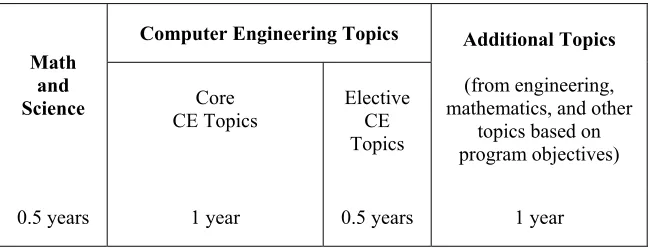
Computer Engineering Topics
Math
and
Science
Core
CE Topics
Elective
CE
Topics
Additional Topics
(from engineering, mathematics,
general studies, and other topics
based on program objectives)
[image:29.612.83.520.93.212.2]1 year
1 year
0.5 years
1.5 years
Figure 4.1. Organization of a four-year computer engineering curriculum.
Computer Engineering Topics
Math
<
![Table 5.1 Learning Stages [Grow 1991]](https://thumb-ap.123doks.com/thumbv2/123dok/1135071.892299/35.612.105.520.197.255/table-learning-stages-grow.webp)

