Full Terms & Conditions of access and use can be found at
http://www.tandfonline.com/action/journalInformation?journalCode=vjeb20
Download by: [Universitas Maritim Raja Ali Haji] Date: 11 January 2016, At: 20:45
Journal of Education for Business
ISSN: 0883-2323 (Print) 1940-3356 (Online) Journal homepage: http://www.tandfonline.com/loi/vjeb20
Online Learning Resources Do Make a Difference:
Mediating Effects of Resource Utilization on
Course Grades
Todd J. Hostager
To cite this article: Todd J. Hostager (2014) Online Learning Resources Do Make a Difference: Mediating Effects of Resource Utilization on Course Grades, Journal of Education for Business, 89:6, 324-332, DOI: 10.1080/08832323.2014.905765
To link to this article: http://dx.doi.org/10.1080/08832323.2014.905765
Published online: 03 Sep 2014.
Submit your article to this journal
Article views: 109
View related articles
Online Learning Resources
Do
Make a Difference:
Mediating Effects of Resource Utilization on Course
Grades
Todd J. Hostager
University of Wisconsin-Eau Claire, Eau Claire, Wisconsin, USA
The author explores the extent to which online learning resources help level the playing field through mediating the effects of grade point average (GPA) and gender in determining course grades. Study findings reveal that a greater use of online resources can fully offset the effects of gender and partially offset the effects of GPA on the grades that students earn in a blended course combining face-to-face and online components. Implications for future research and practice in fully online and blended course contexts are outlined.
Keywords: course grades, gender, online learning, resource utilization
The tenth annual online education survey sponsored by The
Sloan Consortium—Changing Course: Ten Years of
Track-ing Online Education in the United States—documents the continuing growth and adoption of online approaches to learning. Responses obtained from more than 2,800 aca-demic leaders revealed that,
The number of students taking at least one online
course increased by over 570,000 to a new total of 6.7 million.
In the first report of this series in 2003, 57.2 percent of
academic leaders rated the learning outcomes in online education as the same or superior to those in face-to-face. That number is now 77.0 percent.
The proportion of chief academic leaders that say that
online learning is critical to their long-term strategy is now at 69.1 percent.
(Allen & Seaman, 2013, pp. 4–5)
This same pattern of explosive growth in online learning is reverberating through other educational domains, with 30 of the 50 states providing multidistrict fully online schools serving 310,000 students (Watson, Murin, Vashaw, Gemin, & Rapp, 2013). Worldwide expenditures on self-paced eLearning—including online workforce training—grew to
$35.6 billion in 2011 and, with a compound annual growth rate of 7.6%, this figure is projected to reach $51.5 billion by 2016 (Ambient Insight, 2012.)
In addition to making learning resources more accessible to a broader range of students on a global scale, the dream of using online approaches as a great equalizer—helping students from all walks of life to more fully realize their true potential—remains as a vital and vibrant mission among educators. In the words of iNACOL, the Interna-tional Association for K–12 Online Learning:
Why We Do It: To level the playing field for students through the creation of new learning models, and to ensure that students everywhere have access to a world-class edu-cation that prepares them for a lifetime of success, no mat-ter their geographic location or economic situation. (iNACOL, 2013, p. 1)
In this article I examine the extent to which it is true that online learning resources can level the playing field through helping students overcome differences they bring to an introductory accounting course employing a blended approach supported by an integrated online course manage-ment system. I investigate the degree to which student use of online resources—manifest through a range of different online learning behaviors, including logins, accessing online course materials, authoring posts to online discus-sion forums, and taking online self-study quizzes— mediates the effects of grade point average (GPA) and gen-der in determining their course grade. The study makes an
Correspondence should be addressed to Todd J. Hostager, University of Wisconsin-Eau Claire, Department of Management & Marketing, 439 Schneider Hall, 105 Garfield Avenue, Eau Claire, WI 54702–4004, USA. E-mail: [email protected]
ISSN: 0883-2323 print / 1940-3356 online DOI: 10.1080/08832323.2014.905765
important contribution to the field through exploring how a greater utilization of online resources can help students overcome the effects of the achievement histories (GPA) and gender differences they bring to a blended learning environment.
LITERATURE REVIEW
Effects of Gender on the Use of Online Learning Resources
A growing body of research suggests that male students are less inclined than female students to realize the full benefits of educational resources provided through online learning (e.g., Asterhan, Schwartz, & Gil, 2012; Bostock & Lizhi, 2005; Price, 2006; Rovai & Baker, 2005; Young & McSporran, 2001). For example, studies document higher levels of learner–instructor and learner–learner interaction, and greater reported satisfaction with the learning process, among female students in online learning environments (e.g., Price, 2006; Rovai & Baker, 2005; Shea, Frederick-sen, Picket, Pelz, & Swan, 2001; Sullivan, 2001).
Groundbreaking research by Deborah Tannen (1991, 1994) established that women are more likely than men to seek membership in learning communities relying on social interaction and relationship building as key components in a shared learning process. Online learning environments provide students with accessible and user-friendly function-ality promoting collaborative learning in synchronous and asynchronous modes. Thus it is not surprising to find that research spanning more than a decade has documented sig-nificant differences in online learning resource utilization based on gender. Indeed, prior research has shown that while males dominate communication in face-to-face class-rooms, in online formats women are more talkative, collab-orative, and will post more messages than men (Asterhan et al., 2012; Bostock & Lizhi, 2005; Caspi, Chajut, & Sap-orta, 2008; King, 2000; Ory, Bullock, & Burnasks, 1997). This is especially true when an instructor or moderator maintains a “civil environment, free from threats of disrup-tion or harassment” (Herring, 2000, p. 3).
A range of studies have documented higher levels of learner-instructor and learner-learner online interaction— measured in terms of increased frequency and duration of interactions—and greater reported satisfaction with the online learning experience (e.g., Arbaugh, 2000; Price, 2006; Rovai & Baker, 2005; Shea et al., 2001; Sheard, Ced-dia, Hurst, & Tuovinen, 2003; Sullivan, 2001). Work by Young and McSporran (2001) and others revealed that female students access more online learning materials, take more online self-study quizzes, author more online posts, and have higher self-study quiz scores than their male coun-terparts (e.g., Caspi et al., 2008; Gunn, McSporran, Macleod, & French, 2003; Hoskins & van Hoof, 2005;
Lund, Jennings, Volet, Brown, & Pospil, 1997). Accord-ingly, I formulated the following hypotheses:
Hypothesis 1a (H1a):Female students would have a greater number of logins than male students.
H1b: Female students would access a higher number of
online items than male students.
H1c:Female students would author more online posts than
male students.
H1d: Female students would read more online posts than
male students.
H1e: Female students would take more online self-study
quizzes than male students.
H1f: Female students would have a higher average
self-study quiz score than male students.
Effects of GPA on the Use of Online Learning Resources
A wealth of prior research has demonstrated that a higher GPA leads to greater use of online learning resources (e.g., Heffner & Cohen, 2005) and higher course grades (e.g., Bagamery, Lasik, & Nixon, 2005; Bell & Akroyd, 2006; Cater, Michel, & Varela, 2012; Wilson & Allen, 2011; Wojciechowski & Bierlein Palmer, 2005). Thus, I predicted that:
H2a:Higher GPA students would have a greater number of
logins than lower GPA students.
H2b:Higher GPA students would access a higher number
of online items than lower GPA students.
H2c:Higher GPA students would author more online posts
than lower GPA students.
H2d: Higher GPA students would read more online posts
than lower GPA students.
H2e: Higher GPA students would take more online
self-study quizzes than lower GPA students.
H2f: Higher GPA students would have a higher average
self-study quiz score than lower GPA students.
Effects of Online Learning Resource Use on Course Grades
Prior research has established that greater utilization of online resources—as evidenced through more logins, accessing more items online, and increased participation in online discussions via authoring and reading posts—leads to higher course grades (e.g., Bender, 2003; Calafiore & Damianov, 2011; Damianov et al., 2009; Guru-Gharana & Flanagan, 2012; Schrire, 2006; Tseng, Yuan, Chu, & Yuan, 2010; Wu & Hiltz, 2004). Accordingly, I predicted that:
H3a:Students with a greater number of logins would have
higher course grades than students with a lower num-ber of logins.
ONLINE LEARNING RESOURCES 325
H3b: Students accessing a higher number of online items would have higher course grades than students access-ing a lower number of online items.
H3c: Students authoring more online posts would have
higher course grades than students authoring a lower number of online posts.
H3d:Students reading more online posts would have higher
course grades than students reading a lower number of online posts.
H3e:students taking more online self-study quizzes would
have higher course grades than students taking fewer online self-study quizzes.
H3f: Students earning a higher average self-study quiz
score would have higher course grades than students earning a lower average self-study quiz score.
METHOD
Participants and Procedures
Study data were obtained from 158 students (88 men, 70 women) enrolled in five sections of a sophomore-level accounting course offered at a regional Midwestern univer-sity with a total enrollment of 10,000. This class was the second of two semester-long courses in basic accounting principles required of all business majors as part of their core experience. Although the primary learning activities were delivered in the traditional face-to-face mode, online learning materials, assignments, self-study quizzes, and dis-cussion boards were made available through use of the web-based Desire2Learn (D2L) course management system.
D2L is similar in features and functions to Blackboard and other online course management systems, providing an accurate historical record of online learning behaviors dur-ing the semester, includdur-ing records of each student’s number of logins, number of items accessed, number of posts auth-ored, number of posts read, number of self-study quizzes taken, and self-study quiz scores. At the start of the course, the instructor demonstrated the D2L course location and the available online materials, including the discussion site and the self-study quizzes. A PDF handout provided on the course site—Getting Started with D2L—explicitly and sys-tematically walked students through various aspects of D2L (discussions, quizzes) At the start of each new chapter in the course textbook, the instructor reminded students about the availability of course materials on the D2L site. With the sole exception of periodic online class discussions, use of the self-study quizzes and other online course resources was entirely optional. To control for unwanted variance due to differences in instruction and instructors, the same teacher was used across all course sections included in the study, an accepted approach to experimental design, particularly dur-ing an initial study in a formal research stream. Future stud-ies should enhance the generalizability of the present study
through examining the findings within the broader context of data obtained from additional courses and instructors.
Variables and Measures
Gender and GPA were the two independent variables employed in the study. Male students were coded as a 1 and female students were identified as a 2. Student GPAs at the target university were reported as numerical values ranging from 0.00 to 4.00, with values from 3.67 to 4.00 corre-sponding to an A, values from 2.67 to 3.66 correcorre-sponding to a B, values from 1.67 to 2.66 representing a C, values from 0.67 to 1.66 a D, and values from 0.00 to 0.66 translat-ing into an F. To expedite the data analysis, student GPAs
were coded in the following manner: AD4, BD3, CD2,
DD1, FD0. Because course grades were reported using
the same scale, the dependent variable course grade was coded in the same manner.
Because the study was primarily interested in examining the intervening effects of student utilization of online resources on gender and course grades, I consulted Baron and Kenny (1986) for guidance on whether the variables associated with online resource utilization were most prop-erly construed as mediating or moderating variables. According to this article, if the primary focus of the study is on the independent variables, then use of a moderating vari-able approach is warranted. If, however, the primary focus is on the intervening variables, then a mediating approach is best. As such, the study will analyze the following six variables for their mediating relationship between the inde-pendent and deinde-pendent variables:
1. Number of logins(LOGINS), measured simply as the number of times a student had logged into the D2L online course management system during the semester;
2. Number of items accessed (ITEMS), namely the number of different course content items accessed using the D2L online system, during the semester; 3. Number of posts authored (POSTAU) in the D2L
online class discussion area, over the entire semester; 4. Number of posts read (POSTRD) in the D2L online
class discussion area, over the entire semester; 5. Number of self-study quizzes taken (SSQN) in the
D2L online system, during the semester.
6. Average self-study quiz score(SSQA) among all self-study quizzes taken through the D2L online system, during the semester.
Model Construction and Data Analysis
To test for possible mediating effects using the utilization variables listed above, analyses will be conducted in the manner recommended by Baron and Kenny (1986). Specifi-cally, regression equations are run to ascertain whether
three conditions are met: (a) the independent variable affects the mediator, (b) the independent variable affects the dependent variable, and (c) the mediator affects the dependent variable. If these conditions are not met, there can be no mediating effect. If, on the other hand, these con-ditions are met, the dependent variable is regressed on both the independent and mediating variables. If the effect of the independent variable is less in the final regression equation than in the second, a mediating effect exists. Adopting this conservative approach ensures that those mediator variables remaining in the model are indeed significantly related to the independent variables and the dependent variable. Once the final model has been determined, I ran a stepwise, hier-archical regression analysis to test for significant mediating effects of online learning resource utilization variables on the gender and course grade relationship. A second step-wise regression analysis will test for significant mediating effects on the GPA and course grade relationship.
RESULTS
Data Analysis Phase 1: Model Construction
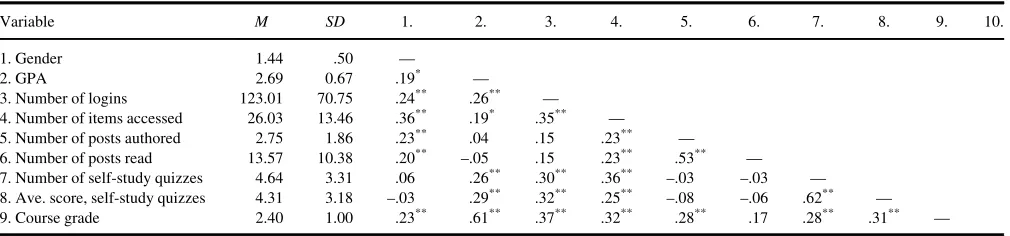
All statistical tests were carried out at the .05 level of sig-nificance using the IBM SPSS Statistics 20 software pack-age. Table 1 provides the descriptive statistics and correlations for the independent, mediating, and dependent variables involved in the study. Gender, the first indepen-dent variable, yielded a mean of 1.44, with 88 men and 70
women (1Dmale, 2Dfemale). As a number of recently
published research articles demonstrates, the reliance on a dataset including an unequal number of male and female participants does not compromise the ability to draw valid results regarding gender differences from the data; relying on an unequal number of male and female study partici-pants is well within the norm for research examining gender differences (e.g., Asterhan et al., 2012; Huh, Jin, Lee, & Yoo, 2010; Liu & Huang, 2008; Wooten & Dillard-Eggers, 2013; Yang, Cho, Mathew, & Worth, 2011.) The second
independent variable, GPA, produced a mean of 2.69 on a scale ranging from 0 to 4.00. Variables 3–8 comprise the six online learning behaviors used to gauge online learning resource utilization. And finally, the sole dependent vari-able in the study—course grade—yielded a mean score of 2.40 on a 0.00–4.00 scale.
Following the procedure outlined in Baron and Kenny (1986), I applied the three-step process to determine which online learning resource utilization variables to retain in the final model for hypothesis testing. Table 2 presents the results of the regressions conducted in accordance with the first step of this approach: regressing the mediators on the independent variables. As this table shows, gender had a significant, positive correlation to four of the six mediator variables, indicating that female students made more logins, accessed more online items, authored more discussion posts, and read more discussion posts than their male coun-terparts. Gender was not significantly related to either of the two self-study quiz mediators, so these two variables will be dropped from the final model testing for the mediat-ing effects of online learnmediat-ing resource utilization on the gender–course grade relationship.
GPA, the second independent variable in the model, had a significant, relationship to four of the six mediators, as well, albeit a different set of four than observed for gender. Similar to gender, GPA was positively related to logins and items accessed, meaning that students with higher GPA’s made more logins and accessed more online items. Con-trary to the findings for gender and conCon-trary to common sense expectations borne from the everyday experiences, was not significantly related to discussion posts authored and read. And unlike gender, GPA was significantly and positively related to both self-study quiz variables, mean-ing that students with higher GPA’s took more online self-study quizzes and had higher average self-self-study quiz scores.
A third regression analysis was conducted using major as a control variable. Since the accounting course was pack-aged and perceived as inside the accounting and the finance
majors, this control variable was coded as follows: 1Dnot
TABLE 1
Descriptive Statistics and Correlations for Study Variables (ND158)
Variable M SD 1. 2. 3. 4. 5. 6. 7. 8. 9. 10.
1. Gender 1.44 .50 —
2. GPA 2.69 0.67 .19* —
3. Number of logins 123.01 70.75 .24** .26** — 4. Number of items accessed 26.03 13.46 .36** .19* .35** —
5. Number of posts authored 2.75 1.86 .23** .04 .15 .23** —
6. Number of posts read 13.57 10.38 .20** –.05 .15 .23** .53** — 7. Number of self-study quizzes 4.64 3.31 .06 .26** .30** .36** –.03 –.03 — 8. Ave. score, self-study quizzes 4.31 3.18 –.03 .29** .32** .25** –.08 –.06 .62** —
9. Course grade 2.40 1.00 .23** .61** .37** .32** .28** .17 .28** .31** —
Note: GPADgrade point average. *p
<.05.**p<.01.
ONLINE LEARNING RESOURCES 327
an accounting or finance major and 2Dan accounting or finance major. Major was only significantly related to two of the six mediator variables and was not included in the final model. One potential source of explanation for the rel-ative lack of effects due to major is that this was only the second accounting course taken by students, taken typically in their sophomore year. A discussion with the Chair of the Accounting and Finance Department at this university con-firmed that many of the students graduating with an accounting or a finance major do not declare that major until later in their academic career, after the second accounting course has been completed.
Moving to the second step in Baron and Kenny’s (1986) approach, I regressed the independent variables on the dependent variable and found both gender and GPA to be significantly and positively related to course grades. These results (as shown in Table 3) allow me to keep both inde-pendent variables in the final model and indicate that female students earned higher course grades and that stu-dents entering the accounting course with higher GPAs also earned higher course grades.
Turning the attention to the third and final step in model construction, I regressed the mediating variables on the dependent variable and found that all six mediators were significantly and positively related to the dependent vari-able, with five of the six mediators significant at the .000
level, as shown in the lower portion of Table 3. In short, it appears that students demonstrating higher levels of online learning resource utilization, on any one (or more) of the six measures, received a higher course grade.
In summary, the model construction phase of data analy-sis revealed that four of the six online learning resource uti-lization mediators had qualified for use with the gender independent variable in the model testing phase: logins, items accessed, posts authored, and posts read. Effects of these mediators on the gender-course grade relationship will be examined using a stepwise, hierarchical regression analysis including gender in the first step, and gender plus logins, items accessed, posts authored, and posts read, in the second step. Evidence for a mediating effect exists when the following four conditions are met: (a) a reduction
in thebfor the independent variable, from step one to step
two; (b) an increase in R2, from step one to step two; (c)
one or more of the mediators are significant at the .05 level in step two; and (d) the model is significant at the .05 level in steps one and two.
The model construction phase also showed four of the six mediators qualifying for use with the GPA independent variable in the model testing phase: logins, items accessed, number of self-study quizzes taken, and average self-study quiz score. The effects of these four mediators on the GPA-course grade relationship will be explored with a stepwise, hierarchical regression analysis involving GPA in the first step, and GPA plus logins, items accessed, number of self-study quizzes taken, and average self-self-study quiz score in the second step. Mediating effects will be examined using the approach identified above.
TABLE 2
Test for Mediation Step 1: Regressing the Mediator Variables on the Independent Variables
Model construction step 1: IV–MV regressions
IV MV b(Standardized) t Sig.
Gender LOGINS .237 3.041 .003** 1DMale; ITEMS .359 4.799 .000***
2DFemale POSTAU .229 2.939 .004**
POSTRD .204 2.609 .010**
SSQN .055 0.688 .492 SSQA –.033 –0.415 .678 GPA LOGINS .258 3.335 .001***
ITEMS .185 2.349 .020* POSTAU .036 0.444 .658 POSTRD –.048 –0.599 .550 SSQN .263 3.410 .001*** SSQA .291 3.798 .000*** MAJOR LOGINS .265 3.438 .001***
(Control var.) ITEMS .122 1.534 .127 1DNot POSTAU .046 0.570 .570
Accounting/finance POSTRD .005 0.069 .945 2DAccounting/finance SSQN .156 1.970 .051
SSQA .217 2.780 .006**
Note: GPADGrade point average; IVDIndependent variable; MVD
Mediator variable; LOGINS: Number of logins; ITEMS: Numbers of items accessed; POSTAU: Number of posts authored; POSTRD: Numer of posts read; SSQN: Number of study quizzes taken; SSQA: Average self-study quiz score.
*p
<.05.**p<.01.***p<.001.
TABLE 3
Test for Mediation Steps 2 and 3: Regressing the Dependent Varia-bles on the Independent VariaVaria-bles, and Regressing the Mediating
Variables on the Dependent Variables
Model construction step 2: IV–DV regressions
IV DV b(Standardized) t Sig.
Gender Grade .232 2.979 .003** GPA Grade .609 9.593 .000***
Model construction step 3: MV–DV regressions
MV DV b t Sig.
LOGINS Grade .368 4.944 .000*** ITEMS Grade .322 4.254 .000*** POSTAU Grade .277 3.605 .000*** POSTRD Grade .174 2.203 .029* SSQN Grade .275 3.579 .000***
SSQA Grade .314 4.135 .000***
Note: DVDDependent variable; IVDIndependent variable; MVD
Mediator variable; LOGINS: Number of logins; ITEMS: Numbers of items accessed; POSTAU: Number of posts authored; POSTRD: Numer of posts read; SSQN: Number of study quizzes taken; SSQA: Average self-study quiz score.
*p
<.05.**p<.01.***p<.001.
Data Analysis Phase 2: Model Testing Using Stepwise, Hierarchical Regression
Table 4 presents the results of the stepwise regression anal-ysis for mediating effects on the gender-course grade rela-tionship. Considering the results of the model construction phase of data analysis, it is not altogether surprising to find that gender is significantly and positively related to course grade in the first step, suggesting that female students earned higher course grades. However, I was intrigued to see that once the mediators were included in the model (in step two), the effect of gender was rendered nonsignificant. This interesting result is contrary to the hypotheses, which were founded on an expectation of finding a partial mediat-ing effect. In other words, I expected the mediators to
sig-nificantly influence the relationship between the
independent and dependent variables, I did not expect the intervening variables to fully mediate this relationship.
As Table 4 illustrates, including the mediators in the
model reduced thebfor gender to the point that it was no
longer significant at the .05 level. At the same time, I
observed an increase in theR2value from step one to step
two, with three of the four mediators significant at the .05 level in step two, and with the model significant at this level in steps one and two. Full mediation effects like this are rel-atively uncommon, and the implications of this finding for future research and for practice are intriguing and will be addressed in the Conclusions and Implications section.
Results of the stepwise, hierarchical regression analysis for mediating effects on the GPA-course grade relationship are provided in Table 5. Again, when I consider the results of the model construction phase, it is not surprising to see that GPA is significantly and positively related to course grade in the first step of the regression analysis. Unlike the step two findings for gender, this table supports the expecta-tion of partial mediaexpecta-tion effects, with (a) a reducexpecta-tion in the
bfor GPA from step one to step two; (b) an increase in the
R2 value from steps one to two; (c) all four mediators
significant at the .05 level in step two; and (d) the model significant at the 0.05 level in both steps of the regression analysis. These results indicate that some, but not all of the significant effects of GPA on course grade were expressed through higher levels of online learning resource utiliza-tion; in particular, I found evidence that students with higher GPAs made more logins, accessed more items online, took more online self-study quizzes, and earned higher average self-study quiz scores, all of this helping them to earn a higher overall course grade. Although GPA by itself still had a significant effect on course grades, the fact that I found significant mediating effects associated with using online learning resources means that there is hope for leveling the playing field by helping students with lower GPAs improve their course grades through encourag-ing them to make more logins, access more online items, and take more online self-study quizzes. Accordingly, the findings yield value for instructors by contributing to their knowledge base regarding the specific avenues through which a student’s prior GPA is expressed (and not expressed) as online learning activity, moving beyond broad impressionistic generalizations arising from the everyday unsystematic observations of differences in the behavior of students with higher and lower GPAs. This knowledge, in turn, will help to design and deliver courses that more effectively encourage students to engage in online learning behaviors leading to higher course grades, regardless of the GPAs they bring to the courses.
CONCLUSIONS AND IMPLICATIONS
The present study makes an important contribution to the growing body of research on the role of gender and GPA in online learning through exploring the effects of online learning resource utilization in mediating a crucial gender– performance relationship: course grades. Most intriguingly, TABLE 4
Results of the Stepwise Regression Analysis for Mediating Effects of Online Learning Resource Utilization on the Gender–Course Grade
Relationship
Results of the Stepwise Regression Analysis for Mediating Effects of Online Learning Resource Utilization on the GPA–Course Grade
Relationship
Note: GPADgrade point average. *p
<.05.**p<.01.***p<.001.
ONLINE LEARNING RESOURCES 329
I found evidence that online behaviors can help to level the playing field through fully mediating the effects of gender and partially-mediating the effects of GPA on course grades. In particular, the study revealed that gender differ-ences were rendered non-significant when the effects of three mediators were taken into consideration: (a) number of logins, (b) number of online items accessed, and (c) number of discussion posts authored.
This result has significant and far-reaching implications for future research and for practice, especially given the growing and increasingly widespread use of online learning approaches noted in the introduction to this article. Although I did not expect to see that online learning behav-iors would fully mediate the gender–course grade relation-ship, the findings are consistent with the wealth of prior research documenting the benefits accruing to female stu-dents from online learning environments due, in no small part, to technological features and functions of these envi-ronments that enable and support a more social, interactive, and collaborative learning paradigm (please see the Hypotheses section, in this regard). I look forward to future studies examining the effects that a broader set of online learning behaviors can have in partially and fully mediating gender–performance relationships, across a range of differ-ent online environmdiffer-ents, from courses delivered differ-entirely online, to blended approaches employing a combination of online and face-to-face learning, administered through and augmented by the use of an online course management system.
From a practical standpoint, the study strongly suggests that efforts to encourage and support the increased use of online learning resources by students will bear significant fruits in the form of improved performance through higher course grades. The data show how greater use of these resources can significantly and positively mediate the effects of both gender and GPA on course grades. These findings lend credence to the view that by studying learning processes and outcomes in a systematic manner, I can iden-tify best practices helping students overcome any disadvan-tages they may bring to the learning environment due to GPA and gender. The good news for educators and students alike is that the study shows how encouraging higher levels of use in the available online learning resources can medi-ate gender–performance and GPA–performance relation-ships. The study provides further added value by showing how different sets of online learning behaviors mediate dif-ferent independent–dependent relationships, setting the stage for future research toward the development of a con-tingency theory approach and the future vision of practical pedagogical approaches that can be tailored to the charac-teristics and desired outcomes associated with particular situations.
However, these important implications for future research and practice highlight several inherent limitations of the study. First and foremost, the findings are limited by
the fact that the study involved a sample drawn from a blended learning environment in which the online compo-nents supplemented and supported a more traditional face-to-face course, with online activity by students largely a voluntary and optional aspect of the class. Although this sample does allow me to examine the effects of unforced online learning behaviors (at self-selected levels) on course grades, it does not allow me to explore the effects of these behaviors when a less intrinsic and more extrinsic motiva-tional approach is employed, (i.e., when the use of online learning resources is a mandated and necessary component of the course). Will I observe the same levels and types of mediating effects when the online learning behaviors occur in a more extrinsic motivational context?
A second limitation of the study derives from the use of undergraduate business students as participants. Drawing samples from other populations of learners—different majors at the undergraduate level, students from other types of secondary and post-secondary schools, and samples from different types of work-related environments—will help future studies explore the generalizability and ecological validity of the findings. A third limitation is the reliance on biological gender as a classification scheme instead of con-structed gender (i.e., a person’s psychological gender) as in the case of a feminine male or a masculine female (e.g., Markman, 2011; McCabe, Ingram, & Dato-on, 2006; Paver & Gammie, 2005). Accordingly, future researchers should employ measures of constructed gender as a potential source of effects on online learning behaviors and on key learning outcomes, including course grades. In addition to constructed gender, I look forward to conducting future studies exploring how learning styles, approaches to study skills, and other characteristics influence online learning behaviors and outcomes (e.g., Adeoye, 2011; Entwistle, McCune, & Tait, 2006; Malcom, 2009).
A third limitation of the research arises from the strength of the experimental design in controlling for unwanted vari-ance due to differences in instructors and courses. While this approach is not uncommon in the initial study of a larger proposed stream of research, one limiting trade-off for eliminating variance due to instructors and course types is a concern for the generalizability of study findings. Accordingly, future researchers should expand the scope of the experimental investigation to include data obtained from additional courses and instructors, thereby enhancing the generalizability of the present results.
In conclusion, the present study adds significant value to the extant literature by demonstrating that higher levels of online resource utilization can partially offset the effects of GPA, and fully offset the effects of gender, on the grade a student receives for a course. These findings send a clear and positive message to educators: encouraging a greater use of online learning resources can help students transcend GPA and gender differences to improve their course grades through implementing more effective learning behaviors.
Future studies will examine these relationships in courses delivered entirely online and in hybrid class situations involving mandatory online learning activities augmenting more traditional face-to-face courses (e.g., Daymont & Blau, 2008; Huh et al., 2010; McCarty, Bennett, & Carter, 2013; Tseng et al., 2010; Wilson & Allen, 2011). Expand-ing the research to additional learnExpand-ing contexts—includExpand-ing samples drawn from secondary schools, graduate schools, technical schools, work-related learning programs, and more—will yield further insights as I continue in the prog-ress toward a contingency theory of best online learning practices.
REFERENCES
Adeoye, B. F. (2011). Culturally different learning styles in online learning environments: A case of Nigerian university students. International Journal of Information and Communication Technology,7(2), 1–12. Allen, I. E., & Seaman, J. (2013).Changing course: Ten years of tracking
online education in the United States. Retrieved from http://www. onlinelearningsurvey.com/reports/changingcourse.pdf
Ambient Insight. (2012).The smart planet: The self-paced eLearning mar-ket is now a global ecosystem across 85 countries. Retrieved from http://www.ambientinsight.com/Reports/eLearning.aspx
Arbaugh, J. B. (2000). An exploratory study of the effects of gender on stu-dent learning and class participation in an internet-based MBA course.
Management Learning,31, 503–519.
Asterhan, C. S. C., Schwartz, B. B., & Gil, J. (2012.) Small-group, computer-mediated argumentation in middle-school classrooms: The effects of gender and different types of online teacher guidance.British Journal of Educational Psychology,82, 375–397.
Bagamery, B. D., Lasik, J. J., & Nixon, R. R. (2005). Determinants of suc-cess in the ETS business major field exam for students in an undergradu-ate multisite regional university business program.Journal of Education for Business,81, 55–63.
Baron, R. M., & Kenny, D. A. (1986). The moderator-mediator variable distinction in social psychological research: Conceptual, strategic, and statistical considerations.Journal of Personality and Social Psychology,
51, 1173–1182.
Bell, P. D., & Akroyd, D. (2006). Can factors related to self-regulated learning predict learning achievement in undergraduate asynchronous web-based courses?International Journal of Instructional Technology and Distance Learning,3(10), 5–16.
Bender, T. (2003).Discussion-based online teaching to enhance student-learning. Sterling, VA: Stylus.
Bostock, S. J., & Lizhi, W. (2005). Gender in student online discussions.
Innovations in Education and Teaching International,42, 73–85. Calafiore, P., & Damianov, D. (2011). The effect of time spent online on
student achievement in online economics and finance courses.The Jour-nal of Economic Education,42, 209–223.
Caspi, A., Chajut, E., & Saporta, K. (2008). Participation in class and online discussions: Gender differences.Computers & Education,50, 718–724.
Cater, J. J., Michel, N., & Varela, O. E. (2012). Challenges of online learn-ing in management education: An empirical study. The Journal of Applied Management and Entrepreneurship,17(4), 76–96.
Damianov, D., Kupczynski, L., Calafiore, P., Damianova, E., Soydemir, G., & Gonzalez, E. (2009). Time spent online and student performance in online business courses: A multinomial logit analysis.Journal of Eco-nomics and Finance Education,8(2), 11–22.
Daymont, T., & Blau, G. (2008). Student performance in online and tradi-tional sections of an undergraduate management course. Journal of Behavioral and Applied Management,9, 275–294.
Entwistle, N., McCune, V., & Tait, H. (2006). Approaches and Study Skills Inventory for Students (ASSIST): Report of the development and use of the inventory. Unpublished report received from N. Entwistle. Gunn, C., McSporran, M., Macleod, H., & French, S. (2003). Dominant or
different? Gender issues in computer supported learning. Journal of Asynchronous Learning Networks,7, 14–30.
Guru-Gharana, K. K., & Flanagan, J. (2012). Econometric study of time use and scores in an online MBA statistics class: A gender analysis.
Journal of Economics and Economic Education Research,13(3), 59–79. Heffner, M., & Cohen, S. H. (2005). Evaluating student use of web-based
course material.Journal of Instructional Psychology,32, 74–81. Herring, S. C. (2000). Gender differences in CMC: Findings and
implica-tions.The CPSR Newsletter,18(1). Retrieved from http://www.cpsr.org/ prevsite/publications/newsletters/issues/2000/Winter2000/herring.html Hoskins, S. L., & van Hoof, J. C. (2005). Motivation and ability: Which
students use online learning and what influence does it have on their achievement?British Journal of Educational Technology,36, 177–192. Huh, S., Jin, J. J., Lee, K. J., & Yoo, S. (2010). Differential effects of
stu-dent characteristics on performance: Online vis-a-vis offline accounting courses.Academy of Educational Leadership Journal,14(4), 81–89. International Association for K–12 Online Learning (iNACOL). (2013).
The International Association for K-12 Online Learning. Retrieved from http://www.inacol.org/
King, L. J. (2000). Gender issues in online communities.The CPSR News-letter,18(1). Retrieved from http://www.cpsr.org/prevsite/publications/ newsletters/issues/2000/Winter2000/king.html
Liu, Z., & Huang, X. (2008). Gender differences in the online reading envi-ronment.Journal of Documentation,64, 616–626.
Lund, C., Jennings, P., Volet, S., Brown, A. & Pospil, R. (1997, December).
Energy studies of the art of going online. Paper presented at the Confer-ence of the Australian Society for Computers in Tertiary Education, Perth, Australia.
Malcom, M. (2009). The relationship between learning styles and success in online learning. Dissertation Abstracts International Section A: Humanities and Social Sciences,70(4-A.)
Markman, E. R. (2011). Gender identity disorder, the gender binary, and transgender oppression: Implications for ethical social work. Smith College Studies in Social Work,81, 314–327.
McCabe, A. C., Ingram, R., & Dato-on, M. C. (2006). The business of ethics and gender.Journal of Business Ethics,64, 101–116.
McCarty, C., Bennett, D., & Carter, S. (2013). Teaching college microeco-nomics: Online vs. traditional classroom instruction.Journal of Instruc-tional Pedagogies,11, 1–13.
Ory, J. C., Bullock, C., & Burnasks, K. (1997). Gender similarity in the use of and attitudes about ALN in a university setting.Journal of Asynchro-nous Learning Networks,1(1), 39–51.
Paver, B., & Gammie, E. (2005). Constructed gender, approach to learning and academic performance. Accounting Education: An International Journal,14, 427–444.
Price, L. (2006). Gender differences and similarities in online courses: Challenging stereotypical views of women. Journal of Computer Assisted Learning,22, 349–359.
Rovai, A. P., & Baker, J. D. (2005). Gender differences in online learning: Sense of community, perceived learning, and interpersonal interactions.
The Quarterly Review of Distance Education,6, 31–44.
Schrire, S. (2006). Knowledge building in asynchronous discussion groups: Going beyond qualitative analysis.Computers & Education,46, 49–70. Shea, P., Fredericksen, E., Pickett, A., Pelz, W., & Swan, K. (2001).
Meas-ures of learning effectiveness in the SUNY learning network. In J. Bourne & J. C. Moore (Eds.),Online education: Vol. 2: Learning effec-tiveness, faculty satisfaction and cost effectiveness(pp. 31–54). Need-ham, MA: Sloan Center for Online Education.
ONLINE LEARNING RESOURCES 331
Sheard, J., Ceddia, J., Hurst, J., & Tuovinen, J. (2003). Inferring student learning behavior from website interactions: A usage analysis. Educa-tion and InformaEduca-tion Technologies,8, 245–266.
Sullivan, P. (2001). Gender differences and the online classroom: Male and female college students evaluate their experiences.Community College Journal of Research and Practice,25, 805–818.
Tannen, D. (1991).You just don’t understand: Women and men in conver-sation. New York, NY: William Morrow.
Tannen, D. (1994).Gender and discourse.New York, NY: Oxford Univer-sity Press.
Tseng, K., Yuan, C., Chu, S., & Yuan, C. (2010). Traditional versus online courses, efforts, and learning performance. The Journal of Human Resource and Adult Learning,6, 115–121.
Watson, J., Murin, A., Vashaw, L., Gemin, B, & Rapp, C. (2013).Keeping pace with K-12 online & blended learning: An annual review of policy and practice. Retrieved from http://kpk12.com/cms/wp-content/ uploads/EEG_KP2013-lr.pdf
Wilson, D., & Allen, D. (2011). Success rates of online versus traditional college students.Research in Higher Education Journal,14, 1–9.
Wojciechowski, A., & Bierlein Palmer, L. (2005). Individual student char-acteristics: Can any be predictors of success in online classes?Online Journal of Distance Learning Administration,8(2), 1–20.
Wooten, T., & Dillard-Eggers, J. (2013). An investigation of online home-work: Required or not required?Contemporary Issues in Education Research,6, 189–197.
Wu, D., & Hiltz, S. R. (2004). Predicting learning from asynchronous online discussions. Journal of Asynchronous Learning, 8, 139–152.
Yang, Y., Cho, Y., Mathew, S., & Worth, S. (2011). College student effort expenditure in online versus face-to-face courses: The role of gender, team learning orientation, and sense of classroom community.Journal of Advanced Academics,22, 619–638.
Young, S., & McSporran, M. (2001). Confident men—Successful women: Gender differences in online learning. In C. Montgomerie & J. Viteli (Eds.),Proceedings of World Conference on Educational Multimedia, Hypermedia and Telecommunications 2001(pp. 2110–2112). Chesa-peake, VA: Association for the Advancement of Computing in Educa-tion. Retrieved from http://www.editlib.org/p/8967/