S
ILVA
F
ENNICA
Monographs 2 · 2001
The Finnish Society of Forest Science
The Finnish Forest Research Institute
Eeva Hellström
Confl ict Cultures –
Qualitative Comparative Analysis
of Environmental Confl icts
ISBN 951-40-1777-3 ISSN 1457-7356
Printed by Tammer-Paino Oy, Tampere, Finland
Hellström, E. 2001. Confl ict cultures – Qualitative Comparative Analysis of environmental confl icts in forestry. Silva Fennica Monographs 2. 109 p.
Owing to the internationalisation of the forestry debate and forest policy, there is growing need to conduct comparative forest policy research at an international scale. This research compares environmental confl icts in forestry in seven cases during 1984–1995. The cases include Finland, France, Minnesota USA, Norway, Pacifi c Northwest USA, Sweden and West Germany. The research is based on the notion that each society has its own ‘cultural’ ways of producing and managing environmental confl icts in forestry, depending on the social, political, economic, and resource characteristics of the society. The purpose of the study is to describe these confl ict cultures, to identify and analyse the societal aspects that impact them, and to discuss the implications of understanding confl icts as cultural phenomena. The research is based on focused interviews of multiple actors related to forest management and protection. For the data analysis, a ‘hermeneutic’ (interpretative and understanding) approach is introduced to Qualitative Comparative Analysis, the use of which has been dominated by causal applications. As a result of the analysis, models of confl ict cultures and confl ict management strategies are constructed. The model of confl ict cultures indicates three basic dimensions of confl ict culture, and defi nes how they are related to each other. These dimensions are mild vs. intense confl icts, separatist vs. co-operative relations between actors and stability vs. change in forest resource policy and use. The model of confl ict management strategies indicates to what extent the different cases place emphasis on interactive vs. institutional confl ict management, and the management of confl icting (sub)cultures within the society vs. the confl ict culture of the society.
Keywords environmental confl ict, forestry, culture, Qualitative Comparative Analysis, QCA method, hermeneutic interpretation, Finland, France, Minnesota, Norway, Pacifi c Northwest USA, Sweden, West Germany
Author´s address Finnish Forest Association, Salomonkatu 17B, FIN-00100 Helsinki, Finland
Fax +358 9 685 08820 E-mail [email protected]
Preface and acknowledgements ... 5
1 Introduction... 7
1.1 Background and motivation ... 7
1.2 Purpose and defi nitions ... 8
1.3 Selection and composition of cases ... 9
1.4 Research strategy and process... 10
1.5 Research on environmental confl icts in forestry ... 11
1.5.1 Scope of studies ... 11
1.5.2 Views on confl icts and confl ict management... 12
1.5.3 Societal aspects of confl ict... 13
2 Theoretical and analytic frames... 15
2.1 Theoretical ideas ... 15
2.2 Analytic frames ... 16
2.2.1 Analytic frame for data collection ... 16
2.2.2 Analytic frame for data analysis ... 18
3 Data and case descriptions... 19
3.1 From evidence to images ... 19
3.1.1 Interviews in the research process ... 19
3.1.2 Forming the images... 20
3.2 Images of the cases ... 21
3.2.1 Finland ... 21
3.2.2 France... 24
3.2.3 Minnesota, USA... 26
3.2.4 Norway... 28
3.2.5 Pacifi c Northwest, USA ... 30
3.2.6 Sweden... 33
3.2.7 West Germany... 35
4 Comparative analysis of the cases... 38
4.1 Qualitative Comparative Analysis (QCA)... 38
4.1.1 Models of application ... 38
4.1.2 Steps of analyses ... 40
4.1.3 Technical choices ... 41
4.2 Empirical typology approach for grouping the cases... 42
4.2.1 Categorisation ... 42
4.2.2 Types of confl ict... 43
4.2.3 Social aspects of the confl icts ... 45
4.2.4 Policy aspects of the confl icts ... 48
4.2.5 Economic aspects of the confl icts ... 50
4.2.6 Resource aspects of the confl icts ... 52
4.2.7 Approaches to confl ict management... 53
4.3 Hermeneutic approach for comparing the cases ... 55
5 Discussion ... 65
5.1 Overview of the study and fi ndings ... 65
5.2 Resulting ideas: understanding confl icts as cultural phenomena... 66
5.2.1 Perceptions of confl ict... 66
5.2.2 The societal aspects of confl ict ... 67
5.2.3 Confl ict management strategies ... 69
5.3 Evaluation of the research... 71
5.3.1 From data to images... 71
5.3.2 Qualitative Comparative Analysis... 73
5.3.3 Results vs. previous research ... 75
5.3.4 Applicability of the results... 78
References ... 80
Appendix 1. List of interviewees ... 85
Appendix 2. List of interview themes... 88
Appendix 3. Categorisation ... 89
Appendix 4. Qualitative Comparative Analysis (QCA)... 97
During the six years of work on this research, I have established a three-fold relationship with environmental confl icts in forestry. First, as a researcher, I have tried to do my best in study-ing the confl icts in a scientifi c manner. As a researcher, I have tried to make my research proc-ess and problems transparent, not hesitating to give interviews and talk about my work from the very beginning. The questions made by journal-ists, for example, have made me consider some aspects that may not have occurred to me other-wise. In addition, I have received valuable feed back from the readers of many of the articles published. Some may argue that openness during the research process could distract my objectiv-ity. On the contrary, I feel that openness during the research process has helped me balance the subjectivity inevitably involved in any qualitative research.
Second, a confl ict researcher who openly dis-cusses her ideas is inevitably an actor in the policy debate. As such, I have learned that any statements made about sensitive issues like con-fl icts may easily create new ones. Although I do not wish to point out any particular confl icts, in some of the worst cases, only describing con-fl ict rhetoric has lead to being accused of taking sides and deliberately presenting information that would only promote the goals of one of the con-fl ict partners. Such events, where the difference between confl ict facts and rhetoric about confl icts tend to get blurred in the minds of the critics, are not only frustrating, but also very tough personal experiences. In these situations, I have found the words of Clifford Geertz (1973) particularly comforting. He regards cultural analysis as a sci-ence whose progress is marked “less by a perfec-tion of consensus than by a refi nement of debate”, and argues “what gets better is the precision with which we vex [agitate] each other”.
After having studied confl icts – and even cre-ated some – I also felt a need to do something about them. An opportunity to make use of my experiences was offered to me through the newly
established Forest Forum for Decision-Makers in Finland, which I have been leading since 1996. This brought about the third dimension that con-fl icts have in my life: concon-fl ict management and prevention. The Forest Forum for Decision-Mak-ers is a discussion forum over forest issues, joining decision-makers throughout the Finnish society. Although I then took over totally other responsibilities than research, I have always received great understanding and support for my work from my new colleagues at the Finnish Forest Association.
This research was conducted in 1994–1999 as a joint effort of the European Forest Institute and the Finnish Forest Research Institute. In addition to funding provided by these two parent institu-tions, I am thankful for the fi nancing from the Ministry of Agriculture and Forestry of Finland and the Maj and Tor Nessling Foundation.
As a researcher at the European Forest Institute, I thank Birger Solberg and Ian Hunter – former directors of the institute – for their encourage-ment to pursue my work on purely scientifi c lines, despite the pressure that occasional criti-cism against some details of my work might have raised. I would also like to thank Leena Roihuvuo, Minna Korhonen and Kirsi Loisa for secretarial help, editorial services and for keeping my accounts straight, and Tim Green for language editing.
During the project I also had the pleasure to work as an associate researcher at the Finnish Forest Research Institute under the instruction of professor Matti Palo by whom this project was initiated, and by director Aarne Reunala who had previously conducted research on the same issue. I would also like to thank Eila Iltanen and Margit Kuronen for accountancy and secre-tarial services. Moreover, the researchers at the Helsinki Research Centre were a constant source for inspiration during 1995–1996 when I had my offi ce there.
grat-itude to Gerard Buttoud, Frank Flasche, Michael Kilgore, Leif Mattsson, George Stankey, and Rolf Zundel for helping me prepare for the material collection in their countries. I have had four vigor-ous research assistants, who have helped me in material collection and in organising it for my further analyses; Haakon Innset, Tiina Rytilä, Elina Vehmasto and Martin Welp.
This research is conducted as a PhD thesis at the Economic Department of the Faculty of Agriculture and Forestry at the University of Helsinki. This thesis belongs to the fi eld of envi-ronmental economics and has been conducted under the supervision of acting professor Markku Turtiainen, and in the very late phases also his successor, professor Markku Ollikainen. In addi-tion to my instructors and supervisors, I thank Pentti Hyttinen, Marjatta Hytönen, Pentti Luoma, Erkki Mäntymaa and Ville Ovaskainen for com-menting upon the manuscript.
An important source of will and energy to com-plete this task has been brought to me by numer-ous colleagues who have regularly inquired about the progress of my work, and also commented upon many of the papers and reports produced during this project. It has made me feel that my work is important, and thus, kept me going.
Kati – my little sister – remember the day I brought up to you the need to understand the QCA method in a hermeneutic perspective? It was much because of your strength in the philo-sophy of social sciences that we were able to succeed with our effort. Heikki – my kid brother – many times you have been my saving angel. Owing to my confi dence in your computer skills, I never recall having ‘wacked out’ even if I thought that I had just lost all data on my project. Anja and Pekka – Mom and Dad – my deepest thanks for your bottomless support and practical help that you have given during the long periods of work. Alec and Roy – my sons – many times I have been astonished by the scope of your understanding when Mom has spent so much of her time with someone else, Mr. ‘Väiski’, as we have called this project together. I know how hard it has been for you to accept Mom’s constant use of our home computer – loaded with interesting games – but now we are both fully at your disposal!
In Helsinki in January 2001,
1.1 Background and Motivation
Forests provide people with a number of physical and mental products and services. Many of them are more inclusive than exclusive of one another, but occasionally they also result in competition between different forms of forest use.
In the 1960s and 1970s, contradictions between wood production and other uses of forests reached such a magnitude that it attracted the interest of the public in many Western countries. The confl icts of this era have been found by Reunala (1986; sum-marised in Reunala and Heikinheimo 1987, and Hellström and Reunala 1995) to originate from simultaneous developments related to economic growth: growing demands for effi cient forest man-agement and wood production, growing standard of living and increased recreational pressure upon forests, and deterioration of the environment and fear for the exhaustion of natural resources.
Today, the environmental discussion about for-estry is conducted in a setting where international questions have supplemented national ones as the issues of confl ict, where the market sphere has challenged the policy sphere as an arena of confl ict, and where new idealists have joined the chorus of old ones as participants of the confl icts. Accordingly, there is continuing need to update and deepen our understanding of the confl icts related to forestry. In particular, increas-ing internationalisation of the forestry dialogue and forest policy bring forth a need to understand forestry confl icts from comparative and cultural perspectives.
Cultural understanding of forestry confl icts in different circumstances is not meant to provide us with the means to control others. Instead, inter-pretations of the actions of others will enable us to place our own society in perspective (Rosenberg 1993, p. 21). Comparing our own confl ict culture with that of others may offer us new insight that helps us understand the social and cultural construction of confl icts, and thus, help develop successful strategies for confl ict managers.
At a practical level, a question that interests policymakers and motivates this research is: What attitude should be taken towards confl icts? For example, there is confusion on what constitutes a confl ict let alone whether confl ict is desirable. Confl icts are usually regarded as negative phenom-ena among the forest sector that has been ‘attacked’. On the other hand, confl icts have been viewed as important ‘tools’ of many environmental NGOs (non-governmental organisations) by ensuring that the voices of various stakeholders are heard, and that new social demands are responded to.
According to Lehtinen (1994, p. 283–284), one of the central challenges of environmental research in the 1990s is the analysis of various actors and mechanisms affecting the structural change of society. Confl ict and confl ict manage-ment are examples of such, and thus of interest to policy analysts. Confl ict management is also a major concern for various actors in the forestry debate, and brings us to the second practical ques-tion motivating this research: Should confl icts be managed, resolved, prevented or even promoted? Views on this question vary largely, if being asked from an environmental activist, a forest owner, a journalist, or a politician. Research can offer important insight on how to address forest resource confl icts. Here, an interesting question is, what type of confl icts and confl ict management best contribute to policy development.
1.2 Purpose and Defi nitions
For understanding the purpose of this study, it is important to make a distinction between two different terms: ‘confl icting (sub)cultures’ and ‘confl ict culture’. Confl icting (sub)cultures relates to situations where the cultural backgrounds of the confl ict partners are different, to the extent of creating a confl ict.
The second term ‘confl ict culture’ relates to the general frame in which a certain society – with its typical social, political, economic and resource aspects – tends to create certain types of confl icts, and respond to them in a certain way. Anderson et al. (1997), for example, argue that natural resource confl icts tend to vary from cul-ture to culcul-ture, as some societies avoid confl icts, while others will resort to physical violence to resolve them.
Whereas most confl ict research aims at describ-ing and analysdescrib-ing confl ictdescrib-ing (sub)cultures within individual locally, temporally or substantially spe-cifi c confl icts, this research focuses on comparing the confl ict cultures of different societies. The difference between this research and the typical type of confl ict research focusing on the group dynamics of one or few individual confl icts is like the difference between a more micro-level eth-nographic study and a more macro-level anthro-pological study of cultural systems (see Geertz 1973, p. 21).
The research is based on the presumption that despite great variation in individual confl icts within any single society, different societies also have their own, cultural ways of ‘producing’ environmental confl icts in forestry, and respond-ing to them, dependrespond-ing upon the social, policy, economic and natural resource characteristic of the societies. The purpose of this research is to investigate confl icts as cultural phenomena by: 1. describing the culture of environmental confl icts
in forestry between 1984–1995 in Finland, France, Norway, Sweden, Minnesota and the Pacifi c Northwest region of USA, and West Germany, (for case selection see Section 1.3, and for case descriptions see Section 3.2),
2. identifying and analysing the major societal aspects that impact the confl ict cultures of these cases (for identifi cation see Section 2.2.2, and for analysis see Sections 4.2 and 4.3), and on this basis,
3. discussing the implications of understanding the origin and management of confl icts as cultural phenomena (see Section 5.2).
In addition to addressing the research problems presented above, an important product of this research is the development of a hermeneutic approach to the method of Qualitative Compara-tive Analysis (hereon, the word ‘hermeneutic’ is understood as interpretative and understanding, in contrast to the traditional causal application by Ragin (1987, 1994a)).
In this study, forestry is understood as human activ-ity aiming at satisfying various needs through the use of forest resources (e.g. timber, non-wood products, biodiversity, stock and fl ows of carbon, landscape, recreation and tourism). Accordingly, forests are not only considered as an economic resource, but also as an environmental, social and cultural resource.
Confl icts within forestry are considered to include struggles related to how the forest resource shall be used (e.g. confl icts concerning forest management and preservation). Confl icts between forestry and the ‘world outside’ are con-sidered to include struggles over land use (e.g. transforming forest into agricultural lands, struction, roads). This research focuses on con-fl icts within forestry, instead of concon-fl icts between forestry and the world around it.
In this research, forestry confl icts are broadly viewed as struggles of varying intensity between interest groups, over values and issues related to forest policy and the use of forest resources. Such a broad defi nition is used because forest policy and the use of forest resources are affected by a wide variety of confl ict types. Answering how different types of confl icts – both mild and intense ones – affect policies and resource uses is one aspect of interest to this study.
1.3 Selection and Composition of Cases
A fundamental component in case study research is defi ning the unit of analysis, that is to say, what the ‘case’ is. In confl ict research, for example, a case could be an individual (confl ict actor), an event (individual confl ict) or an entity (e.g. society), depending on the questions asked (see Yin 1994). In this research, a case represents the ‘confl ict culture’ of a whole society exam-ined, during the whole period of investigation (1984–1995).
In case study research, the cases can be selected so that they are estimated to produce similar outcomes (literal replication), or contradictory outcomes (theoretical replication), but for under-standable reasons (Yin 1994, p. 46; Syrjälä and Numminen 1988, p. 12, 136, 142). The selection of cases in this study was a combination of both aspects.
Focusing the research on countries that share some similarities in resource structure and cul-ture was considered to increase the feasibility of crossing cultural borders. Therefore, the research only focuses on Western societies with substantial forest resources. Moreover, understanding the confl ict history of the societies to be investi-gated is an important basis for understanding the confl icts cultures of the present. Therefore, countries with suffi cient and compatible scientifi c information available on confl icts of the past were preferred. For these reasons, Finland, France, Germany, Norway, Sweden and the USA were chosen as the countries to be investigated. In a desk study (Hellström 1996a), these cases were also found to represent a wide spectrum of differ-ent types of confl ict, thus, opening up interesting possibilities for analysis and interpretation.
Substantial information was already available on the confl icts in these countries prior to 1983 (Reunala 1986; summarised in Reunala and Heikinheimo 1987, and Hellström and Reunala 1995). Therefore, it was considered appropriate for this study to begin with 1984, and to end in 1995 when the data was collected. The year 1984 is superfi cial in the way that it does not mark the beginning or end of any particular period of confl icts. For this reason, when investigating confl icts that were rooted to years prior to 1984, they were also understood from their histori-cal perspective.
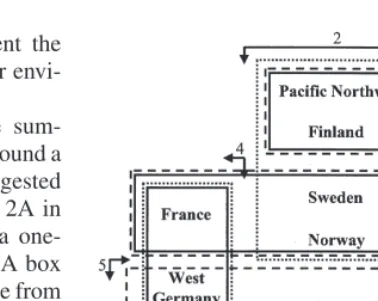
The desk study (Hellström 1996a) helped defi ne the cases in more precision. It suggested that the differences of confl ict cultures within Finland, Sweden and Norway were signifi cantly smaller than the differences of confl ict cultures between these countries. Many of the confl icts within these countries also took place within a national policy setting, and were affected by international market pressure. Accordingly, the cases of Finland, Sweden and Norway were con-sidered to represent the whole societies of these countries.
France is a country with vast regional differ-ences in ecology, geography, and the amount of forest resources. To some extent, this was also refl ected in the variety of confl ict themes that occurred in different regions. Yet, France as a whole was considered to form one case because the confl icts involved many national level organisations and common approaches to confl ict management. Moreover, dividing France into sev-eral smaller cases would not have given credit to diversity itself, which proved to be an important characteristic of the French confl ict culture.
The reunifi cation of the two Germanies took place in the middle of the period investigated. The inclusion of the Eastern states would have produced a diffi cult research situation, where in East Germany, the societal characteristics relevant for this study would have been very different from all the rest of the cases, and where rapid societal transformation would have made the interpreta-tion of confl ict culture diffi cult. Even West Ger-many comprises states with vast differences in relation to resource structure and forest policy. In order to increase compatibility of the German case with the other ones, interviews were con-ducted in two states with substantial forest resources: Baden-Württemberg and Lower-Sax-ony. Because of substantial similarity of the con-fl icts in both states, they were still considered to form one case.
Focusing on Minnesota as a state and not as part of a wider region was preferred, because the most substantial confl icts in Minnesota during the period investigated were related to state-level policy processes. The Pacifi c Northwest region was chosen because the confl icts within this region had been the most substantial ones within the USA during the period investigated. The whole region (comprising parts of Washing-ton, Oregon and Northern California) was treated as one case. This is due to the fact that the resource characteristics related to the confl icts were rather similar throughout the region, and because policies related to these confl icts were more federal than state-specifi c.
It is also essential to recognise what the objects of analysis – the cases as confl ict cultures – are composed of. Cultural analysis is not an experi-mental science in search of law but an interpre-tative one in search of meaning. Writings or discourses about confl icts are often interpreta-tions in second or third order. Thus, they are fi ctions – not in the sense that they are false, but in the sense that they are something ‘made’ or ‘fashioned’ (see Geertz 1973, p. 15).
Being based on interview data, what is called data in this research is nothing more than the researcher’s own construction of other people’s construction of what they and their confl ict partners have said or done in various confl ict situations. As Geertz (1973, p. 16) puts it, such analysis is about “winks upon winks upon winks”. He also argues that there is nothing par-ticularly wrong with this, and that it is inevitable in most cultural research where the line between the mode of representation and substantive con-tent is diffi cult to draw.
1.4 Research Strategy and Process
In relation to the number of cases involved, many political scientists make a distinction between single and multiple case study strategies, and call the latter the ‘comparative case method’. Yin (1994), on the other hand, suggests that single and multiple case studies are basically two variants of one common case study strategy.
Comparative strategy is often interpreted dif-ferently in relation to qualitative and quantitative
methods. Alestalo (1992), for example, considers qualitative case-oriented and quantitative varia-ble-oriented studies as the two basic types of comparative strategies. Furthermore, he suggests that strategies of case-oriented comparisons can be based on searching for differences and simi-larities, universals or variation.
Ragin (1994b) distinguishes ‘comparative research to study diversity’ as the third main research strategy in addition to ‘qualitative meth-ods to study commonalties’ and ‘quantitative research to study covariation’. In conducting the comparisons of this research, focus is placed upon exploring diversity among the cases, rather than on searching for universal truths or similarities and differences. This is also the common strategy of the method of analysis used in this research, Qualitative Comparative Analysis (Ragin 1987, 1994a).
This research is based on Ragin’s (1994b) notion that social research is characterised by a constant interplay between ideas and evidence, as presented in the model of the social research proc-ess (Fig. 1). The strategy used in this research, and also the outline of this report, largely follow the logic of this model. In the following, the process of this research will be briefl y described.
Ideas represent a “reservoir of theoretical ideas” that may be used to interpret the phenomenon to be examined (Ragin 1994b). From the reservoir of ideas, a holistic view on natural resources was selected as the main theoretical foundation for this research. Other important ideas included a constructionist view on culture, and
ing confl ict management from the point of view of confl ict regulation theories (Section 2.1).
Ragin (1994b, p. 60–66) characterises analytic frames as conceptual tools, which “constitute ways of seeing”. They are constructed through interaction of theory and evidence (Fig. 1), and may be revised during the research process. Ragin (1994b) also points out that analytic frames have two components: When concepts are used to clas-sify the phenomena, they frame by case. When concepts are used to characterise the cases, they frame by aspect.
Framing by case is largely about answering what the phenomena investigated is a case of. In this research, the case represents the confl ict culture of the country, state or region investigated, as already identifi ed in Section 1.3.
Framing by aspect is about specifying the key features that differentiate the cases in a broad category (Ragin 1994b, p. 63). In addition to descriptive approaches to confl icts and confl ict management by a variety of confl ict scholars (see Section 1.5), the construction of the analytic frame for this research was particularly infl uenced by a forestry related application of the holistic view of natural resources by Koch and Kennedy (1991) and by basic elements of forestry confl icts and the management of forestry confl icts iden-tifi ed by Walker and Daniels (1997) (Section 2.2.2).
Evidence illustrates the whole range of potential data (e.g. documentation, archives, records, inter-views, observations, physical objects), from which ideas and analytic frames direct the researcher’s attention to specifi c types of evidence (Ragin 1994b). In order to focus the collection of data on the most relevant evidence, a desk study (Hell-ström 1996a) was conducted for guiding mate-rial collection. The data for each of the seven cases consists of about 30 focused interviews of specialists representing interest groups, businesses, administration, researchers and the media (a total of 211 for all the seven cases). (Section 3.1)
Images are the product of an effort to bring coherence to the data by relating it back to the ideas and frames that initially motivated its col-lection (Ragin 1994b). The interview data was organised separately for each country, accord-ing to the structure of the analytic frame and analysed by using hermeneutic text interpretation.
The images that were derived are described in individual country reports on France, Minne-sota USA, Pacifi c Northwest USA, Sweden and West Germany (Hellström and Welp 1996; Hell-ström and Rytilä 1998; HellHell-ström and Vehmasto 2001) and in working documents on Finland and Norway (for summarised case descriptions, see Section 3.2).
Qualitative Comparative Analysis (QCA) (Ragin 1987, 1994a) was chosen as the method of analysis for comparing the cases. However, the fact that the method was traditionally used in causal analysis implied the development of a hermeneutic approach to the method (Rantala and Hellström 2001).
The analysis was constructed in two phases. First, the empirical typology approach to QCA was used to condense the categorised qualitative data and bring coherence to it. In the second phase, the condensed data was analysed by using the new hermeneutic approach to QCA. During the analysis with QCA, analytic frames, as well as the images were considered fl exible. Thus, the idea of retroduction (see Fig. 1) – the combina-tion of induccombina-tion and deduccombina-tion – was central to this phase of analysis (Section 4.1.1).
Although the research process is here described as a step-wise process, in reality, many of the phases overlapped to such a degree that the research process resulted in a constant interplay of ideas and evidence. This dialogue, conducted through systematic methods of analysis, culmi-nated in social representations of environmental confl icts in forestry. The resulting ideas include, for example, the construction of models of con-fl ict cultures and concon-fl ict management strategies (Section 5.2).
1.5 Research on Environmental Confl icts in Forestry
1.5.1 Scope of Studies
In countries where forestry typically receives wide public attention, or where forestry confl icts have been intense, confl icts have interested many authors, journalists and researchers within and outside the forestry profession. In such cases, literature on environmental confl icts in forestry is abundant and the amount of data may even be overwhelming. Especially in the USA, there is a rich tradition of research on environmental confl icts, and aiming at developing confl ict man-agement techniques to concrete, practical confl ict issues. In other countries with mild confl icts and little public attention on forestry, literature on environmental confl icts in forestry may be dif-fi cult to obtain.
Even a quick overview of confl ict literature reveals that most confl ict research has focused on an individual confl ict or confl icts within one country (e.g. Lehtinen 1991; Löf 1993; Vail 1993; Yaffee 1994; see also articles in Solberg and Miina 1997 and Chandrasekharan 1997).
Floyd et al. (1996) have conducted a compari-son of a few individual forest resource confl icts in the USA. Yet, comparative research on confl icts is relatively rare. In comparisons of several coun-tries, the most typical approach seems to involve a comparison of only two countries (e.g. Kajala and Watson 1997; Sidaway 1997). Moreover, com-parative confl ict research is more leaned towards micro-level than macro-level investigation.
Forestry confl icts in several countries have only been presented in a few reports e.g. Banuri and Apffel Marglin 1993a; Lehtinen and Rannikko 1994; Reunala 1986, summarised in Reunala and Heikinheimo 1987, and Hellström and Reunala 1995). The proceedings of an international con-ference on confl ict management and public par-ticipation (Solberg and Miina 1997) also reveal the rarity of international comparative research in this fi eld.
Comparative confl ict research is not usually conducted through the use of a specifi ed com-parative methodology or a common theoretical framework for the cases compared (Hellström 1997a). The existing approach to research on dispute resolution and public participation in for-estry is claimed by Cubbage (1994) to typify the lack of a well-developed tradition of empirical analysis and theory building. Jeffers and Solberg (1997) also acknowledge the need to improve
the theoretical background for confl ict resolution and public participation, and the development of comparative research, which explores the experi-ences from different countries and within differ-ent cultural contexts.
1.5.2 Views on Confl icts and Confl ict Management
In defi ning confl icts, issues are typically attached into the notion of dispute, and values into the notion of confl ict (e.g. Wondolleck 1988, p. 213; Crowfoot and Wondolleck 1990, p. 18; Burgess and Burgess 1994, p. 2). Myllyntaus (1994, p. 12–15) and Heijden et al. (1992, p. 4–6) offer a corresponding view. They state that disputes occur when the attempts to solve them affect the interests of various groups, and that confl icts occur when disputes drift outside settled social mechanisms. A broader review of scholars’ defi ni-tions of confl ict is provided by Walker and Dan-iels (1997, p. 15–16), who provide a list of terms used in defi ning confl icts: struggle, opposition, beliefs, tension, bargaining, dependency, incom-patibility, competition, communication, strategic behaviour, and interaction.
Different types of confl icts are usually classi-fi ed by intensity. Keltner (1990), for example, offers a wide spectrum of levels of intensity of struggles, from mild differences to litigation and physical confrontation. In addition to intensity, environmental confl icts may also vary according to the geographic scale of major actors (Kajala 1994, p. 6; Chandrasekharan 1997, p. 137–138; see also Fig. 6 on p. 42).
anticipation.
The range of techniques commonly used for settling disputes has been portrayed as a con-tinuum extending from informal discussions, through forms of negotiation, arbitration and liti-gation to violent exchanges (Sidaway 1997, p. 290; Keltner 1990). According to Maguire and Boiney (1994, p. 31), confl ict resolution can be enhanced by both qualitative techniques (com-municative tools) for confl ict resolution and by quantitative techniques for decisions under uncer-tainty (e.g. decision analysis).
A division has also been made between obliga-tory and voluntary measures. According to Ellef-son (1992, p. 296–297), the task of confl ict management is in many respects that of the estab-lished institutions of government (the legislatures, courts, and executive agencies), whereas Crow-foot and Wondolleck (1990, p. 19) emphasise more voluntary measures of dispute settlement (voluntary participation, face-to-face interaction, and agreement on the process to be used for settlement).
From an institutional point of view, Bostedt and Mattsson (1996, p. 1–2) have divided confl ict resolution institutions within an existing frame-work of laws and regulations into adversative institutions (usually governmental or judicial) and co-operative institutions (negotiation groups or committees), and in democratic countries into the majority vote within the political law-making process.
Walker and Daniels (1997, p. 22) portray con-fl ict management as a triangle of three inter-related dimensions: substance, procedure and relationship. They argue that any confl ict situa-tion includes all three dimensions, and one can address a confl ict situation initially through any of the three dimensions.
Keltner (1990, p. 319–320) emphasises the need for understanding the nature of the struggles and the conditions under which disagreement escalates to destruction. This allows us to choose a strategy that is most likely to lead to a set-tlement. However, Burgess and Burgess (1994) point out that there are also circumstances where the possibility for environmental mediation is limited (e.g. intractable confl icts, or when a win/ win solution cannot be created). Even then con-fl ict management methods can be used to make
the confrontations more constructive and prevent their further escalation.
1.5.3 Societal Aspects of Confl ict
A wide variety of theoretical approaches have been applied in confl ict research in forestry. From a sociological point of view, the use of forest resources is primarily thought to depend on the values and interests of groups or societies. These interests may be substantive in nature, or they may refer to the process by which settlement is reached, or they may refer to the psychological means of the people in the confl ict (Delli Priscoli 1997, p. 67–68; Walker and Daniels 1997, p. 18, 22).
Confl icts may also be viewed as culture-based, e.g. related to worldviews and identities (Ander-son et al. 1997). They may refl ect fundamental values, and even incompatible views of the rela-tionship between people and the natural envi-ronment (Daniels and Walker 1997, p. 39). For these reasons, confl icts have often been recog-nised to involve strong emotional expressions, misunderstandings and stereotyping having, thus, a psychosocial dimension (Turtiainen 1996, p. 5). Particularly relationship confl icts are supposed to involve strong emotions, misperceptions, poor communication, and negative, repetitive behav-iour (Delli Priscoli 1997, p. 67).
Regarding forestry confl icts, a political scientist may stress the policies and institutions guiding the use of forest resources. Bostedt and Mattsson (1996), for example, have conducted research on institutions for confl ict resolution from the viewpoint of political science and jurisprudence. Also Kajala and Watson (1997) and Cabarle and Lynch (1997) have demonstrated the important impact that national legal systems and the public institutions with jurisdiction over forest resources have on the frequency, intensity and outcome of confl icts.
and Apffel Marglin 1993b; Eckerberg 1990; Stjernqvist 1973) have stressed the importance of knowing how policy formulation and implemen-tation processes operate.
The political context of the dispute has also been discussed in relation to the issue of power, which may affect the willingness of the parties involved to negotiate (Burgess and Burgess 1994, p. 7; Sidaway 1997). In particular, the sources of power in the confl icts have been found to include economic, symbolic, cultural and social resources, and the ability to mobilise the media (Joutsenvirta 1997). In fact, confl ict research often focuses on the mass media, since it pro-vides environmental groups a means of arousing public concern and challenging policy commit-ments (Cotgrove 1982, p. 12).
Economists tend to view the problem of the use of forest resources primarily as a question of the allocation of scarce resources. For example, Rhodes and Wilson (1995, p. 108–110) have constructed an economic model based on confl ict curves within utility space that refl ect Pareto-optimal allocations of land use services. Utility functions have also been used by Pykäläinen et al. (1999) in relation to participatory forest plan-ning.
Confl ict resolution has cost effects, originat-ing from, for example bargainoriginat-ing or court trials. With the use of production possibility functions, Bostedt and Mattsson (1996, p. 1–2, 143) have demonstrated that an institution of confl ict man-agement, which is appropriate from the point of view of political science or jurisprudence, may not necessarily be appropriate from an economic point of view. Furthermore, Gifford and Stone (1975) have found that within a collaborative confl ict resolution process, externalities are inter-nalised within the group so that the socially opti-mal decision and allocation is achieved by merger and the optimisation of a joint utility function.
Confl icts have also been investigated from a
business point of view. Environmental NGOs have increasing power to negatively affect the companies’ images and activities. Owing to con-fl icts, or fear of subsequent poor publicity, green alliances are in some companies seen as feasible, cost-effective long-term strategies (Joutsenvirta 1997).
From a resource aspect, Kajala and Watson (1997, p. 304, 309) have found both physical attributes and use patterns of forests as impact-ing, although not causing confl ict. Based on a comparison of 12 cases, Floyd et al. (1996) have divided forestry confl icts into four types: confl icts over non-renewable (geo-commodity) or renew-able (bio-commodity) resources, and confl icts over amenity use (e.g. outdoor recreation), and amenity preservation (e.g. maintenance of biodi-versity).
2.1 Theoretical Ideas
Litmanen (1996, p. 533–534) suggests that social theories that might be applicable to the study of environmental confl icts include social con-structionist theory (e.g. Hannigan 1995), neo-Weberian theory (e.g. Freudenburg 1993, Perrow 1984), modernisation theories (e.g. Giddens 1990, 1992), systems theory (e.g. Luhmann 1989; Litmanen et al. 1994) and theories of risk society (e.g. Beck 1992; Perrow 1984). According to Turtiainen (1996), environmental confl icts may also be viewed from the point of view of critical planning theory, whereas Maguire and Boiney (1994) have relied on decision-analysis.
From the reservoir of theoretical ideas that may be used to interpret the phenomenon investigated, choices that guide the construction of the analytic frame have to be made (see Fig. 1 on p. 10). This research is mostly based on ideas derived from a holistic view on natural resources, social constsructionist theory and confl ict regulation theory. These theories largely defi ne how forest resources, confl icts and confl ict management are understood in relation to society.
According to the holistic view, natural resources can be viewed not only as attributes of the physi-cal environment, but as attributes of the eco-nomic, political, social and cultural order as well. In fact, there exist congruence between the con-cept of ‘resource system’ and the concon-cept of ‘social system’ (Lively and Preiss 1957, p. 227; Firey 1990, p. 17; Lee et al. 1990a, p. ix, 1990b, p. 10; Hahtola 1990). The defi nitions of what constitutes a resource may also change over time in response to technological advancement and emerging values (Lively and Preiss 1957).
The holistic view on natural resources was independently formulated by Mukerjee (1926) and Vance (1929) in the 1920s (Firey 1990, p. 15–16), and has since been widely applied. The holistic view on natural resources has recently also been adopted by several forest policy ana-lysts (e.g. Koch and Kennedy 1991, p. 332; Glück
1987; Kennedy 1985), only with more precision on the various systems related to the use of forest resources.
The adoption of a holistic view on natural resources implies that problems related to their use cannot in reality be separated into sociologi-cal, politisociologi-cal, economic, or physical ones, but are characterised as complex wholes. Thereby, an analytic frame for investigating confl ict cul-tures should simultaneously view the phenom-enon from multiple aspects. This is the fi rst important foundation of the analytic frames con-structed in the following section (Section 2.2). Because of the multitude of aspects to be inves-tigated in cultural research it can, according to Alasuutari (1995, p. 24), even be said to be cross-disciplinary or even anti-cross-disciplinary.
From a contructionist perspective, social prob-lems are not static or objective conditions, but develop on the basis of collective defi nitions (Hannigan 1995, p. 32). Environmental issues, for example, are not viewed to cause a large social reaction as such, but only when people recognise environmental effects and interpret them as seri-ous problems. Thus, constructionist analysis is concerned with how people assign meaning to their world.
Strict constructionists have been accused by critical realists of denying the existence of serious ‘real-life problems’ (Hannigan 1995, p. 32–34). Indeed, strict constructionism is as problematic for this study as strict functionalism, which, on the contrary, assumes the existence of social problems (e.g. confl icts) as products of only objective con-ditions. Therefore, the line of thought underly-ing this research largely parallels to the view of Rosenberg (1995, p. 101), according to whom, claiming that social institutions are constructed means roughly that they do not exist independent of people’s actions, beliefs and desires.
the fact that confl icts are not only viewed as phenomena constituting of confl ict actors and their actions, but also of images of the confl icts. This setting implies a pluralistic view of social reality: interpretations of objectively perceived situations vary for personal, historical and cultural reasons (Leskinen 1994, p. 17–20; Hahtola 1990, p. 275–276).
The emphasis given to the importance of assigning meanings in cultural studies (e.g. Alasu-utari 1995, p. 24–27) implies that cultural real-ity can be viewed as socially constructed. In a similar way, not only confl icts, but also confl ict cultures can be viewed as socially constructed phenomena.
Refl exive in one sense means that the dis-semination of a social theory can have an impact on its subject (Rosenberg 1995, p. 115–116). For example, research results on confl ict culture may initiate change in such culture. In this sense, even this research can be regarded as refl exive and as part of social discourse (see preface and Sec-tion 5.2.3). Refl exivity has another dimension, too. According to critical theorists, social science is not free from value commitments. Accord-ingly, it is considered to have a moral dimension. Rosenberg (1995, p. 116–118) notes that social science does not always merely describe the way the world is, but provides guidance about the way the world ought to be. In this research, moral commitments are mostly related to the issue of confl ict management, and how it is understood in relation to social development.
According to Leskinen (1994, p. 21–22), social theory offers three main views on confl icts and societal transformation. According to consensus theories, social confl icts are temporary distur-bances, which the society corrects through self-regulating processes. Confl ict theories, on the other hand, consider confl icts as inevitable and as the prime source of mobilisation of social change. Finally, theories of confl ict regulation constitute attempts to produce a synthesis between consen-sus and confl ict theories.
According to Turtiainen (1996, p. 21), any theories on confl ict management are inevitably based on the perspective of regulated confl icts. Indeed, most confl ict management theories are based on the perspective of a potentially positive role of confl icts in social development. For
exam-ple, confl icts are viewed to keep public authori-ties alert, increase awareness of problems, help defi ne issues, promote checks and balances in agency decision-making, motivate and encourage creative solutions to problems, enhance moral and cohesion, stipulate creativity, and ensure that the many interests at stake will be heard (Coser 1956; Wondolleck 1988, p. 2; Tjosvold 1984, p. 122–123). Environmental confl ict can be produc-tive and useful, depending on how it is managed or contained (Tjosvold 1984, p. 121–122). The potentially positive role of confl icts in social development can be realised through multiple processes (Hellström 1996b, 1998b, see also fol-lowing Section).
The approach used in this study resembles confl ict regulation theories. A distinction is made between the existence of confl icts as a general social phenomenon and the occurrence of time, issue or place specifi c individual confl icts. Although some form of confl ict may be viewed as existing inevitably at all times, societal circum-stances and the activities of various actors may have signifi cant impact on confl ict culture (e.g. what type of confl icts emerge, and when, where and how they occur).
2.2 Analytic Frames
2.2.1 Analytic Frame for Data Collection
The conceptual tools used to guide material col-lection and analysis – the analytic frames – are a pragmatic product of interaction of theory and evidence (see Fig. 1 on p. 10). Analytic frames are not indefi nite, but they are revised and refi ned throughout the research process. In the following, the analytic frames for this research are described, as they were understood during data collection (see below) and during analysis of the data (Sec-tion 2.2.2).
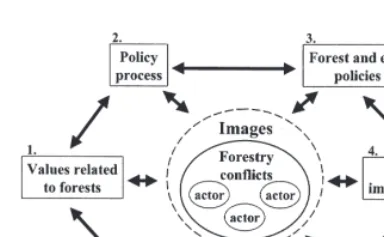
1. Values related to forests. The values of the public have considerable effect on what issues can be raised to the public agenda by the mass media. Such widespread mediation of forestry confl icts as most Western countries have faced during recent years could not have been possible if this agenda setting was not supported by the values of the public. Vice versa, the mediation of forestry confl icts as well as other campaigning of forestry issues affects the values and attitudes of the public by giving impressions of the prevailing value structure of the society. Often, it is this impression of social values rather than the factual social values prevailing in society that is of most importance to political and economic decision-making.
2. Policy formation. The participation of relevant interests in the policy process may be of offi cial or unoffi cial nature. Limited ‘offi cial’ representation of interests may be due to, for example, power structures and traditions in the political culture. However, not all interest groups wish to participate in the ‘offi cial’ policy process, but may even have more infl uence as unoffi cial pressure groups. The publicity of the activities of environmental organi-sations in the media, and their growing support and resource base increase their political power, which again facilitates the integration of their participa-tion into the political culture.
3. Forest and environmental policy. When a particular policy has been proven successful in the prevailing conditions of society, the policy may often become ‘internalised’, so that policy change is actualised only after the symptoms caused by the incompatibility of the policy and
changing circumstances grow intolerable. The policy issues under debate in forestry confl icts are characterised by this incompatibility, and thus, also initiate policy change. In fact, there always exists some delay between societal change and policy change. The emergence of confl icts often shortens this delay.
4. Policy implementation. If there is disagree-ment over policy goals, confl icts may emerge to obstruct the implementation of a disputed policy. Even if there exists agreement between interest groups on policy goals and instruments, the implementation of a policy does not neces-sarily refl ect such underlying goals, owing to, for example, the attitudes of the implementers, technological and economic constraints, or pres-sures from various interest groups opposing the policy. In such cases, environmental organisa-tions may attempt to promote the implementa-tion of the policy by raising public attenimplementa-tion to the issue, and even challenge the implementation of the policy by raising legal suits against the implementers.
5. Markets and economic activity. If the market mechanism functions perfectly, the use of forest resources is a refl ection of the values of the society at large. However, many environmental benefi ts – despite their high social value – are not exchanged in markets. Yet, markets for such ben-efi ts can to some extent be created through policy measures. Confl icts may also arise that impact market structures and processes. For example, non-market values of environmental benefi ts can be attached to the market values of market-able products. The satisfaction of environmental values by the producer increases the market-ability of a product, whereas the dissatisfaction of environmental values by the producer decreases the marketability of the product.
6. Forest resources. The utilisation of forest resources is usually a core issue of environmental confl icts in forestry. Many confl icts are initiated by a disputed forest management action taken in a specifi c locality, and the arising confl icts may have a direct impact on forestry operations in the locality in question. Even in confl icts that are not site-specifi c, the characteristics of the emerging confl icts are signifi cantly affected by the structure and traditions of forest utilisation in the society involved.
The frame illustrated (Fig. 2) was not fi nal nor fi xed but provided ideas that could be used to guide the construction of the interview proto-col (Appendix 2), and to structure the country descriptions (summarised in Section 3.2, for details on some of the cases, see Hellström and Welp 1996; Hellström and Rytilä 1998; Hellström and Vehmasto 2001).
2.2.2 Analytic Frame for Data Analysis
During the comparative analysis, when moving between the data, the categorisations that were constructed from it, and the ideas that resulted form initial rounds of analyses, a need to revise the analytic frame became obvious. For example, the policy sphere of the analytic frame was too dominant in relation to other aspects of the ana-lytic frame. This resulted in a revised anaana-lytic frame for data analysis.
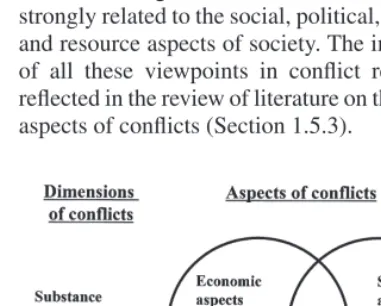
Koch and Kennedy (1991) argue that systems originating and communicating social values related to forests include the social system, the political system, the economic system, and the natural resource system. Confl icts and the man-agement of confl icts can be viewed as forms of communicating social values, and thus, they are strongly related to the social, political, economic and resource aspects of society. The importance of all these viewpoints in confl ict research is refl ected in the review of literature on the societal aspects of confl icts (Section 1.5.3).
The analytic frame is based on descriptive aspects of the confl icts and confl ict manage-ment, and societal aspects of the confl icts. Ideas for the fi rst (descriptive aspects) were largely derived from the literature review (Section 1.5.2), whereas ideas for the latter (societal aspects) were largely derived from Koch and Kennedy (1991), and supplemented with ideas from the literature review (Section 1.5.3).
Accordingly, the aspects of confl icts to be ana-lysed include:
Descriptive aspects: 1. The types of confl ict; and
2. approaches to confl ict management.
Societal aspects:
3. The social aspects of confl icts; 4. the political aspects of confl icts; 5. the economic aspects of confl icts; and
6. the environmental/natural resource aspects of con-fl icts.
Walkers and Daniels (1997, p. 22) portray the origin of confl icts and confl ict management as a triangle of three interrelated dimensions: sub-stance, procedure and relationship. They argue that any confl ict situation includes all three dimensions, and one can address a confl ict situ-ation initially through any of the three dimen-sions. Recognising these three dimensions, each of the six aspects of confl icts listed above are investigated from the point of view of substance, relations and processes, to the extent made pos-sible by the data (Fig. 3).
The analytic frame for data analysis offers a basis for describing and categorising the data (see Sections 3.1.2 and 4.1.2). It cannot offer direct guidance for defi ning any single categories, though. It only points out the potential directions for the researcher, in order to ensure that the categorisation of data takes place within a setting that is relevant for the research problem, and in a broad enough way to cover the scope of interest in this study. Compared with the initial analytic frame (Section 2.2.1), the revised analytic frame brings more structure to fi nal categorisation and analysis, but it does not abandon any of the ele-ments or aspects that are central to the initial analytic frame for data collection.
3.1 From Evidence to Images
3.1.1 Interviews in the Research Process
Focused interviews are used as the primary source of data. They are semi-standardised, and in many respects, they are a combination of structured and open interviews. Focused interviews are based on knowledge that the interviewees have experienced the same kind of phenomenon, and on the fact that the researcher has studied the basic structures and processes of the phenomenon in advance. Subsequently, the researcher has reached some assumptions, based on which she prepares an interview protocol (Hirsijärvi and Hurme 1991).
In focused interviews, predefi ned general themes are operationalised into questions during the interviews both by the interviewer and the interviewee. This allows for the interviewees to react freely to the themes, enabling views that would otherwise be inaccessible to the researcher to be revealed. Like open interviews, focused interviews are sensible to the personal character-istics of the interviewers. Yet, predefi ned themes increase the compatibility of the interviews.
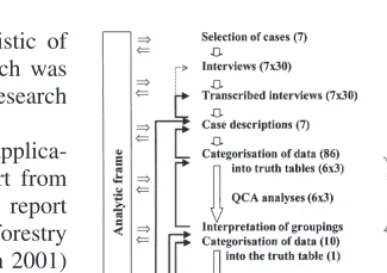
The interview process of this research is pre-sented in Fig. 4. On the basis of a tentative analytic framework (Section 2.1) and a desk
study (Hellström 1996a), assumptions on the major phenomena relevant to the research prob-lem were made. This knowledge was compiled into an interview protocol (Appendix 2). The major themes of the protocol corresponded to the elements of the tentative analytic frame (Fig. 3 on p. 18). For ensuring compatibility between cases, similar interview protocols were used for each case. The diffi culty in formulating the interview protocol was to keep it general enough to fi t the different circumstances of seven cases, but still make it detailed enough to help the interviewer in question formulation.
The interview protocol formed a basis for tion formulation during the interviews. The ques-tions asked included both fact-fi nding and opinion questions. The interviews followed the protocol in relation to the themes to be discussed, but freedom was also given to the interviewer to for-mulate questions in accordance to the relevance of each issue to the specifi c interview situation. It was not expected that all interviewees could be experts in all the listed themes. Neither did all questions have relevance for all interviewees. In a few cases, the interviewees were not even willing to discuss a certain theme. Although, as a whole, the interviews cover the whole range of themes in the interview protocol, they do not include the opinions of all interviewees on all issues or themes. Moreover, the interviewers were given some freedom to follow new clues ‘outside the interview protocol’ that might emerge during the interview.
Lists of interviewees were prepared by local contact persons who had familiarised themselves with the research project. Rather than having a high position in their organisation, the interview-ees were expected to be active and informative in discussions, and have a good overview of the confl ict situation in their country. In most cases, the interviewees were chosen because of their experience from the whole period of investigation. However, within the environmental movement, some young people were also interviewed who
had not been active in the forestry debate during the whole period. Even though most interview-ees represented national level organisations, some representatives of local organisations or special campaign organisations were interviewed if they had particular relevance to confl icts. Although the fi nal composition of interviewees varied slightly according to local circumstances, the main groups of interviewees included:
– research (mainly forest policy researchers); – the media (forestry, environmental);
– environmental movement (local, national and inter-national organisations);
– environmental administration (regional, national); – forestry administration (private and public forests,
regional and national);
– forest owners (national unions and local forms of common ownership);
– forest industry (companies and national federa-tions);
– other relevant interests (recreation, hunting, rein-deer herding, etc.).
The total amount of interviews conducted was 211 (Table 1). Owing to the high amount of inter-views, four different persons conducted them. This was also a necessity because the job required previous knowledge of local circumstances and good language skills.
The role of the interviews in the data collection process was two-fold. They were used as key informants, but they were also asked to point out additional supportive written material on the themes that were discussed. The use of several sources of evidence is also supported by the prin-ciple of triangulation, which is generally recom-mended for case study research. A conclusion is likely to be more convincing and accurate, if it is based on several different sources of information (Yin 1994).
The interview data consists of more than 300 hours of recorded interviews conducted in six different languages. Transcribing this data fi rst carefully – word for word – and then translating it to English – word for word – would have been an enormous task, resources for which were not available. By the time that the tapes were transcribed, the interviewer had already formed a preliminary image and understanding of the data, as an interaction of the data (interviews) and
the analytic frame. During the transcription, this knowledge was used to select the major argu-ments which were only translated into English. Even these summaries of interviews consist of about 700 pages of condensed text.
Thereafter, only the texts transcribed from the interviews through an interpretative process could be relied upon. From these transcripts, the tone of speech was gone and even some of the initial wordings used. It was no longer possible to ask the informants what they meant by saying some-thing. Although, in principle, the researchers could still ask themselves what they had meant by transcribing a statement the way they had (by re-listening to the tapes), it was too laborious to do it very often.
3.1.2 Forming the Images
In Section 1.4, images were defi ned as the prod-uct of an effort to bring coherence to the data by relating it back to the ideas and frames that initially motivated its collection. The following section (Section 3.2) describes the images of environmental confl icts in forestry separately for each case. Below, the process of forming these images from the basis of the transcribed texts is described.
For interpretation, a structural analysis was made by organising and condensing the interview texts according to the structure of the analytic frame. This process was not only inductive (see Fig. 1 on p. 10: from data to images), but also involved of a process of moving from entities to parts, in some occasions, returning even back to
Table 1. Number of interviews conducted.
Case Number of interviews
Finland 35 France 31 Germany 34 Norway 28 Sweden 28 USA
– Washington DC 12
– Minnesota 24
re-listening a few interview tapes. Accordingly, the process of text interpretation was based on the dialectics of explanation and understanding (see Ricoeur 1991 and Rantala 1996).
As a result of the interaction of these proc-esses of understanding (interpreting the texts) and explanation (structural analysis), case descrip-tions were written. In doing this, written mate-rial was used to fi ll in gaps in the interviews like years, fi gures and other facts. To a minor extent, literature was used to support, construct and develop the understanding of the cases. This process resulted in case reports for France, Min-nesota USA, Pacifi c Northwest USA, Sweden and West Germany (Hellström and Welp 1996; Hellström and Rytilä 1998; Hellström and Veh-masto 2001) and corresponding working docu-ments for Finland and Norway.
Two important distinctions have to be made between the descriptions presented in the case reports and the images presented in the following section (Section 3.2).
First, in the case reports, a wide range of origi-nal data (interviews and literature) is presented, whereas the case descriptions presented here are based on interpretation (images) of the data. For example, to say “within the confl ict culture of case A, signifi cant emphasis is placed on sub-stance oriented confl ict management” is not a statement by any of the interviewees or derived from literature, but an interpretation made by the researcher. It may be based, for example, on the fact that several interviewees stressed the importance of informing the general public about ‘forestry facts’, or fi nding proof against the argu-ments of the opponents as a dominant approach to confl ict management, and that this approach was also refl ected in an excessive number of information campaigns or production of informa-tion material.
Secondly, the case reports describe the cases as separate from all the others, whereas the images presented here have been affected by comparison of the cases. For example, the claim “confl ict management in case A is substance oriented to a signifi cant degree” implies an understanding of what is meant by ‘signifi cant’. This, again, implies that the case is viewed in relation to the other cases. The relativity of the categorisations means that the images had to be open to changes
during the comparative analysis.
The images presented in the following section can largely be viewed as descriptions and back-ground information on the fi nal categorisations used in the QCA analysis (see Appendix 3 and tables 1A–1F in Appendix 5) in relation to each case (for the process of constructing the catego-ries, see Section 4.1.2). Because the relevancy of each category to each case varies, only some of the most important categories are referred to in the text presented in the following section.
It should also be noted that the descriptions presented in the following section are an image built upon the rhetoric used by the interviewees, and every detail should not be considered to represent objective ‘facts’ of the confl icts within these cases.
3.2 Images of the Cases
3.2.1 Finland
Forests are the dominating landscape in Finland more than in any other European country, and the amount of forest resources per inhabitant is high (m1) (for description of the category see Appendix 3 and Tables 1A–1F in Appendix 5). Owing to very long traditions of forest use (f1), practically all forests in Finland have been affected by man. Yet, particularly in northeastern and eastern parts of Finland, old-growth forests with high natural values are claimed to remain (m2). Forests in Finland are mainly semi-natural. Reforestation is typically conducted with tree species natural for the site. Owing to the natural conditions of the boreal forest zone, an even-aged management system has been adopted (m5), with regular thinning, and the use of either clear-cuts and planting or natural regeneration.
For the most, these confl icts involved public forests managed by the Forest and Park Service and were, thus, also related to the debate on the role of public forestry (a5). In 1994, private forestry also became strongly involved in the protection debate (d4), beginning from on-site protests that occurred in the forests owned by the Kuusamo Forest Common, a vast forest area owned jointly by a large proportion of the local population. As a whole, the issue of protecting wilderness and old-growth forests grew into a polarised struggle between environmental inter-ests and local communities in northeastern and eastern Finland. Within this struggle, the employ-ment and livelihood aspects of increased forest protection, and its impacts on the livelihood of local communities became a major issue of debate (a3, d3, o4).
As a result of work in the Wilderness Commit-tee and others, the already substantial amount of protected forests (m3) has signifi cantly increased in Finland (n1) through multiple forest protec-tion programmes (g3). However, confl ict over the implementation of the plans for forest protection continued (h5), as insuffi cient resources were available. Accordingly, the main focus on forest protection confl icts has been on increasing the amount of protection areas, not on the manage-ment of old already established protection areas or parks (m4).
A feature very specifi c for Finland in the 1980s was the existence of frequent litigation raised by forest authorities against forest owners, in order to more effectively implement the wood-production oriented private forestry legislation (g1, g4, h5). This litigation was indirectly related to environmental aspects of forestry (b2, e5), but the confl icts gave space for more fl exible later interpretation of the forestry legislation, also regarding environmental consideration in forestry. Although forest protection was the major issue of debate, considerable pressure to develop more environmentally aware forest management prac-tices (g5) also existed.
In particular, forest management issues involved the use of clear-cuts in regeneration. Harvest levels slightly fl uctuated during the period, but the rise of the harvest level was modest compared to, for example the two cases from the USA, and it was not a major issue of debate (n4). The
level of harvest was only discussed in relation to a fear of increased forest protection, not as an issue as such (a2). As practically all forests in Finland are economically accessible for logging, any intensifi cation of confl icts during economic conjunctures was not recognised. Neither did the confl icts seem to be related to the profi tability of forestry (k4) in other respects than the increase of subsidies available for increased environmental consideration.
Environmental confl icts in forestry in Finland mainly involved a debate between environmen-tal and economic interests. The rather limited markets for non-wood products or the relations of forestry with the indigenous population (the Sami), did not raise extensive environmental con-fl ict potential (j5, o2, o3). In Finland, public access and public rights are extensive (o1). It is surprising how little focus was placed upon multiple-use issues, despite the importance of forests as a source of recreation for the Finns (a4, d5). This was also refl ected in the limited involve-ment of other organised interests than forestry or environmental in the confl icts (c5). Subsequently, industrial roundwood has had a dominant role in the forestry confl icts in Finland (j3).