ANALYSIS OF MECHANICAL PROPERTIES OF COMPOSITES FOR
BALISTIC SCREENS AS A FUNCTION OF PROPERTIES OF FIBROUS
MATERIAL
Sylwia Tarkowska1, Marek Snycerski2, Maria Cybulska2 1ITWW MORATEX, Lodz, Poland
2Department of Architecture of Textiles, Faculty of Textile Engineering and Marketing, Technical
University of Lodz, Poland
Abstract
Paper presents analysis of yarns, woven fabrics, prepregs and composites made form aramide fibres. It has been found that initial very high tenacity of aramide yarns significantly decreases on the successive stages of technological processing - during weaving, finishing, coating (prepreg) and pressing
(composite). Properties of anti-ballistic screens have been studied in terms of some parameters of the fibrous material of composite.
Key Words: textiles, mechanical properties, ballistic packets, ballistic screens
1. INTRODUCTION
Aramide yarns, depending on the yarn linear density, are used to produce the woven fabrics designated for, among others, soft packets of bulletproof jackets, or as a fibrous reinforcement for preimpregnates used for fibrous composites (laminates) applied for bulletproof shields or screens for mobile and stable objects. Their usability in this area results from very high strength of aramide fibres, especially their tensile and compression strength effecting from their specific chemical structure.
When designing the packets or composites for stiff anti-ballistic shields, one needs to take into account the changes of mechanical properties of fibrous material on particular stages of the processing, form woven fabric to composite.
Paper presents some basic mechanical properties, as a breaking load and elongation in the weft and warp direction of woven fabrics, prepregs and composites made from or on the basis of aramide fibres. Analysed fabrics were woven from yarns of linear density 93, 110, 330 and 350 tex. The influence of properties of fibrous components on the other mechanical parameters of composites, as energy to break, bending strength and deflection in the weft and warp direction has been also analysed.
2. MATERIAL AND METHODS
Testing material includes 9 soft packets of woven fabric (number of layers of fabric sewed) and 10 stiff composites with fibrous reinforcement () number of layers of aramide based prepreg composed by thermal pressing in high temperature under high pressure).
To prepare the fabric packets and the reinforcement of composites three kinds of woven fabrics have been chosen diversified by thickness, density and crimp of weft and warp. As a matrix the derivative of benzophenol resin and two gum mixtures were used.
Structure of analysed anti-ballistic products is shown in Table 1.
Material number of
layers reinforcement/ matrix Aerial massof reinforcement
(g/m2)
construction
6 Fabric packet TXM-300 40 Aramide 12240 sewing 7 Fabric packet Styl 770S 17 Aramide 7905 sewing 8 Fabric packet Styl 770S 24 Aramide 11160 sewing 9 Fabric packet Styl 770S 40 Aramide 18600 sewing 10 Composite MILAGRO 2001* 25 Aramide/rubber 1 7000 gluing 5x5 layers 11 Composite INDUTEX 2001* 24 Aramide/rubber 2 7344 pressing 12 Composite INDUTEX 2002 24 Aramide/rubber 2 7344 pressing 13 Composite INDUTEX 2003 24 Aramide/rubber 2 7344 pressing 14 Composite INDUTEX 2003 25 Aramide/rubber 2 7650 gluing 5x5 layers 15 Composite INDUTEX 2004 20 Aramide/rubber 2 6120 gluing 5x5 layers 16 Composite INDUTEX2004 25 Aramide/rubber 2 7650 gluing 5x5 layers 17 Composite INDUTEX2004 40 Aramide/rubber 2 12240 gluing 5x5 layers 18 Composite AKZO 2001* 17 Aramide/
benzophenol resin 7950 pressing 19 Composite AKZO 2002 18 Aramide/
benzophenol resin 8370 pressing *)reinforcement of composite MILAGRO 2001 - woven fabric CT 716, composite INDUTEX - woven fabric TXM-300, composite AKZO- woven fabric Styl 770S.
3. RESULTS OF ANALYSIS
Relationship between some properties of fibrous component of the composite and the properties of composite can be easily perceptible. However in some cases it is not that obvious. Increasing number of layers of fibrous reinforcement not always results in proportional increase of its strength and stiffness. On the other hand increasing content of fibrous material always effects in increase of mechanical parameters of the composite.
Tenacity of the packet of woven fabric depends on the fabric aerial mass, which increases with linear density of the yarn used, warp and weft density and crimp.
For each packet the ballistic efficiency has been determined as a boundary velocity of punchthrough V50, defined as a velocity for which the probability of piercing has the same value as a probability of not
piercing, equal to 0,5.
Results of shooting with bullet 9 mm PARA FMJ for analysed packets of woven fabric are shown in Fig.1.
Fig.1. The effect of the aerial mass on the ballistic performance.
When analysing the results presented in Fig.1. one can see that the efficiency of aramide fabric packet is the linear function of it aerial mass.
Fig.2 Number of layer not pierced in the textile packet.
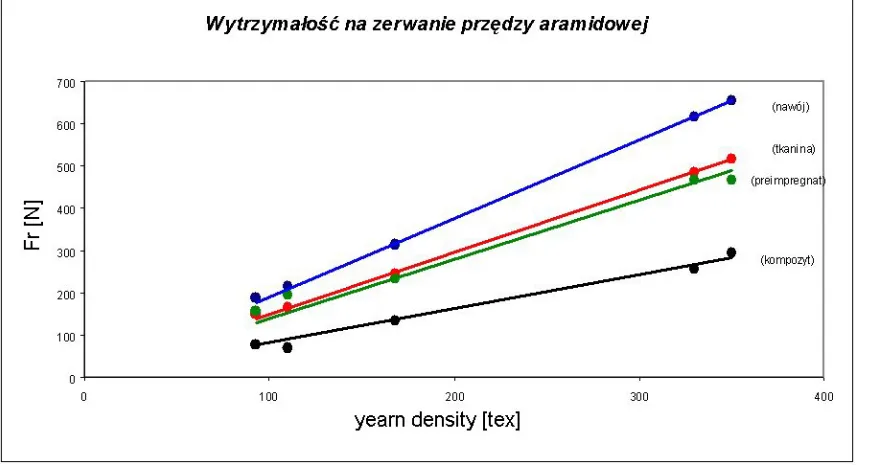
Analysis shows that initial very high tenacity of aramide yarns significantly decreases on the successive stages of the yarn processing - during weaving, finishing, coating (prepreg) and pressing (composite). Fig.3. presents the changes of tenacity of the aramide yarn. Comparison concerns the yarn on the bobbin, in the woven fabric, in prepreg and in the composite.
Fig. 3. The effect of consecutive processing on the strength of aramide composites.
Fig.4. The comparison of the tensile strength of textile packets and aramide composites.
In Fig 4 one can see the change of tenacity of fabric packets and aramide composites. When compare with the composite of the same aerial mass, the tenacity of the fabric packet can be characterised by much higher tensile strength.
Application of aramide yarns in forming anti-ballistic product effects form their high tensile strength. That why some decrease of this parameter results in negative reduction of protective efficiency of the final product. When processing the aramide yarn the attention should be put on minimisation of the loss in yarn tenacity.
In last few years a progress can be noticed in development of antiballistic composites with fibrous reinforcement [3]. Fabric packets are often replaced by composite materials, even if the cost of production of the last ones is much higher.
During pressing under the high pressure further decrease of tenacity of aramide yarn takes place, what should effect in the reduction of composite ballistic efficiency. However, analysis of the results presented in Fig.5. shows opposite effect. One can see that when compare with the fabric packets, most of composites shows much better efficiency determined by boundary punchthrough velocity V50.
On the basis of the results obtained the conclusion can be drawn that the decrease of the yarn tensile strength is compensated by some other factors, what results in higher value of the boundary velocity V50 for composites. When compare to this for fabric packets. Further analysis has shown that
the density and hardness of surface of composite (defined as the load necessary to ram the steel pin of 8 mm diameter into the tested material for 3 mm depth) is much higher for composites than for multilayer packets of aramide fabric. (Fig.6).
Fig. 6. The effect of the composite’s density on its ballistic performance.
Rubber mixture and benzophenol resin significantly increase the stiffness and hardness of the material surface. For this reason in the moment the bullet hits the surface of the material the energy used for bullet deformation also increases significantly. It means that the most of the bullet energy is utilised for its deformation.
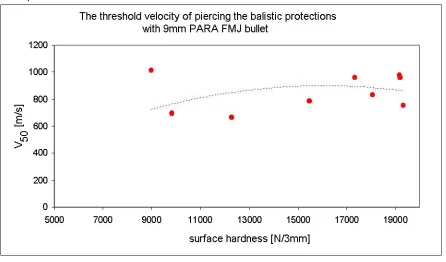
The effect of surface hardness of ballistic screen on maximum punchthrough velocity V50 is
shown in Fig. 7. .
Results obtained can be used when designing the ballistic materials designated personal safeguard (bulletproof jackets, shields and helmets), vehicle and stable objects armour.
Acknowledgement: Research has been subsidised by KBN grant T00C02522 "Designing the structure of fibrous composite materials for ballistic screens".
REFERENCES
1. W. Jabłoński, J. Wnuk „Włókna aramidowe bazą produktów innowacyjnych", Bielsko Biała 2000; 2. J. Szosland „Podstawy budowy i technologii tkanin", WN-T Warszawa, 1972;
3. W. Królikowski "Tworzywa wzmocnione i włókna wzmacniające", Politechnika Szczecińska, 1984.
ADITIONAL DATA ABOUT AUTHORS
1. Sylwia Tarkowska Ph.D., assistant professor, Institute of Technical Textiles MORATEX, Curie-Skłodowskiej 3/5, 90-547 Łódź POLAND, E-mail: [email protected], Phone: +48 42 ; Fax: +4842 . 2. Maria Cybulska Ph.D., assistant professor, Technical University of Lodz, Faculty of Engineering and Marketing of Textiles, Department of Architecture of Textiles, Żeromskiego 116, PL90-543 Łódź POLAND, E-mail: [email protected], Phone: +4842 631-33-37, Fax: +48 42 631-33-43