REGISTER, VOL. 1, N0. 1, 2008
Jl. Tentara Pelajar no. 2 Salatiga, Central Java, Indonesia
Abstract
Caring of students in teaching-learning process should be one of the most important attentions of teachers. They should be the central body by which the measurement of success or failure is underpinned. Teachers will be considered successful when their students get scores above the passing grade. However, they must fail when the students get unsatisfactory achievements. Even though students’ success is the end of the aim of teaching-learning process but their involvement is not taken into account accordingly. To achieve such a goal, their internal potentials should be revitalized. The inner potentials include attitude, motivation, aptitude, and intelligence. The successful study can be achieved when the four internal potential are well managed. For that reason, teachers’ attention should be addressed to intensify the potentials to get the significant yield.
Keywords:Care of, Internal Potentials, Attitude, Motivation, Aptitude,Intelligence
Abstrak
REGISTER, VOL. 1, N0. 1, 2008
58 Kata Kunci: Perhatian, Potensi Internal, Sikap, Motivasi, Bakat,
Kecerdasan
Introduction
Within education world, students are included into raw input. That raw input should be cultivated and nurtured simultaneously to be ripe-input that is outstandingly called out-put. The cultivation of the input is formally conducted in teaching learning processes in classroom, although it may be outside, sometime. The quality of the output is certainly dependent upon the quality of the cultivation. Thus, the raw-input will be best out-put if the students are cultivated well in the processes. Therefore, since students are the raw input, they belong to one of the important determinants to achieve the successful teaching-learning processes.
The existence of students in language classroom is influential. They are determinants that should be taken into account for the better achievement of teaching learning processes programmed. To so doing, they should be involved in a few designs of teaching learning processes in order that the processes can be accomplished effectively. They, for instance, can be involved to communicate the objectives they are going to achieve. Teachers may also invite them to create conducive situation for language learning, to make simple teaching aids, and to improve the quality of teaching. In addition, the teachers may communicate the methods used so they become well prepared since they go out of home teaching.
REGISTER, VOL. 1, N0. 1, 2008
59 become information receiver but the information giver. The cooperation between teachers and students in one hand and among students on the other hand may make the warmer-academic interaction among the determinants in the class. Such a kind of consideration to students creates the humanistic situation in those processes. Thus, students become real living subjects who know something and not merely still objects knowing nothing. This is the fact that they have had invaluable experiences that can be used to intensify the quality of the processes.
REGISTER, VOL. 1, N0. 1, 2008
60 There are several internal potentials coming from students that should be made use. Among the potentials are for instance attitude, motivation, aptitude, and intelligence. The teaching-learning processes, in fact, will be ideal if the students have positive attitude to the subject studied, are well motivated, have positive assumption to their aptitude as well as their intelligence. If the processes are well conducted, this is unimaginable when they will obtain satisfactorily results of a program or study.
Ramelan (1984) says the result of teaching may also be caused by the students because they have strong motivation to learn language. They may also have high IQ and language aptitude. Quoting Lambert’s research results, he affirms that students’ motivation plays the most vital role in the tea ching-learning processes. For that reasons, it is necessary to best regard such previous students’ potentials. They should be aware that they have individual-innate potentials having to be made use. As Ramelan’s and Lambert’s points of view, their potentials must be used to improve the result of their learning qualities. This is teachers’ responsibility to communicate those potentials.
REGISTER, VOL. 1, N0. 1, 2008
61 In the following chapters, the writer is going to discuss such kinds of influential potentials that come from students in a brief.
Discussion
Attitude
Recently I taught English to common-adult students in an Undergraduate Program of Non-English Department in State Institute for Islamic Studies (STAIN) of Salatiga. The students have not studied English since they graduated from Diploma years ago. Even, some of them have not learnt the language for several years. They studied English at the time because they should join the subject. They had no privilege target except achieving the least expectation namely to get the least or the minimal score of passing grade. This was the only expectation they were going to achieve, nothing else. These students should take a seat in my class because the Indonesian curriculum demands them to do. English is one of the compulsory subjects having to be taken in their study at the Department. In other words, they studied English since they were forced to study; unless they had better take the other subject.
REGISTER, VOL. 1, N0. 1, 2008
62 Precisely, my adult students believed that English was very complicated to study. Their negative attitudetowards English did not come into being in a short period. Even this had established from the very beginning when they studied English at the first-secondary school. The impression has accumulated and strongly established within their innermost mind so far. Unfortunately, that negative attitude to it became more and more psychologically powerful when they got terrible experiences when they studied English. Brutal punishments given by teachers when they made mistakes, for instance, were very traumatic. The side effect of the punishments usually made negative mind-set and was not easy to change. Finally, they keep having negative impressions or attitudes in the following English course. This attitude is very hard to change because it has been a conviction they believe a lot.
I did not still stand when I knew that my adult students have had a negative attitude to English. I tried very hard to convince them that English is easy. English is the same as the other languages as Indonesia, Arabic, Russia, and the like. All of them can be studied so can English. You, students, should study English because this is the only international language that is widely used around the world. Two-third of the world population use it as a means of communication in any fields. You should realize that the use of it will be more and more significant when Indonesia has joined the world-free market. However, this is not an easy job to change my students’ belief. It is not an overnight business. Therefore, even though I have tried to change their perception to English, they keep standing still. They keep having negative attitude to the language.
REGISTER, VOL. 1, N0. 1, 2008
63 overcome problems concerning the English study. They were likely sitting at the class, but their thoughts were moving around outside the classroom. Therefore, they did not concentrate to accept the explanations from their lecturer. And the most fatal effect of such a kind of attitudes is their mind-set by which they must pass through though they have no absolute efforts and only get the least passing grade. It seems that there has a certain warranty that they must pass through because their lecturer should do so.
Brown (1980) says that attitudes affect human beings. They develop early in childhood caused by parents’ and peers’ attitudes, contact with people who are ‘’different’’ in any number of ways, and interacting affective factors in the human experience. The attitudes form a part of one’s perception of self, of others, and of the culture in which one is living.
In fact the research of personal attitude to language learning is not something new. Several researchers have conducted researches concerning the attitude. Most of the research results show that positive attitude to language will elicit positive impression to the study of it. Conversely, negative attitude to a certain language will bring about negative transfer to the study of it. Finally, they come into conclusion that personal attitude has significant relation to the successful study of language.
REGISTER, VOL. 1, N0. 1, 2008
64 integrative motivation to learn French. That attitude is a factor of the learner’s attitudes toward his own native culture, his degree of ethnocentrism, and the extent to which he prefers his own language over the one language he is learning as a second language.
Brown (1980) also exemplifies the research result from John Oller and his colleagues. They conducted several large-scale researches of the relationship between attitudes and language success. They looked at the relationship of Chinese, Japanese, and Mexican students’ achievement in English to their attitudes toward self, the native language group, the target language group, their reasons for learning English, and their reasons for traveling to United States. The researchers were able to identify a few meaningful clusters of attitudinal variables that dealt positively with attained proficiency. Each of the three researches yielded slightly differing conclusions, but for the most part, positive attitudes toward self, the native language group, the target language group enhanced proficiency.
Brown (1980) affirms that the second language learner benefits from positive attitudes and negative attitudes may lead to decreased motivation and in all likelihood unsuccessful attainment of proficiency. Yet teacher needs to realize that everyone has both positive and negative attitudes. The negative attitudes can be changed, often by exposure to reality, by encounters with actual persons from other cultures. Negative attitudes usually emerge either from false stereotyping of from undue ethnocentrism. Teachers can assist in dispelling what one often myths about other cultures, and substitute those myths with a realistic understanding of the other culture as one that is different from one’s own, yet to be respected and valued.
REGISTER, VOL. 1, N0. 1, 2008
65 exterminate subject. Studying English is the same as the study of other languages. Without positive attitudes, this is impossible to succeed in the study of the language.
Motivation
Motivation plays an important role in the study of a foreign language. It belongs to one of the factors that not only considers student success in the study but is also considered by his/her success in comprehending the existence of it. Some students are aware it is important and is very crucial to be revitalized. However, they could not manifest the importance of it in their study. It is likely humankind having soul but does not realize that they have the soul. They do not know where they should stand with the motivation. For the reason, even though this is often discussed but the students are still confused to comprehend and utilize that motivation.
Motivation is an innate state of emotion; therefore, everybody has this capacity. Because of this innateness, this is ineffectively managed. As previously explained, sometimes a language learner does not realize that it is a very big impulse being useful to promote his/her zest. He/she studies as if he/she does not have it. This is the time to more understand the reality and the use of the motivation. The writer believes that the awareness of its reality may make studying more effective.
REGISTER, VOL. 1, N0. 1, 2008
66 This is supported by any studies and experiments showing that motivation is a key to learning.
Brown (980) says motivation is an internal drive, impulse, emotion, or desire that moves one to a meticulous action. More exclusively, humankinds commonly posses needs or drives that are more or less innate, however their power is environmentally stipulated. Ausubel cited by Brown (1980) identifies six necessities of humankinds that belong to the divisions of motivations, for instance: the necessity for exploration as investigating the deep structure of words, observing the other side of mountain for looking for the unknown; the necessity for manipulation as using environment to cause change; the necessity for activity as moving and exercising physically or mentally; the necessity for stimulation because humans need to be encouraged by their environment, others, ideas, thoughts, and feelings; the necessity for knowledge as processing and internalizing the result of exploration, manipulation, activity, and stimulation to overcome contradictions, to search the solutions of problems and for self-consistent systems of knowledge; and the necessity for ego enhancement since one needs to be known, accepted, and approved by the other.
Joyce, Bruce Joyce at. Al. (1980) say among the most widely discussed topics in second language learning is the role of motivation in the successful acquisition of the target language.
REGISTER, VOL. 1, N0. 1, 2008
67 them. It is absolutely true that our students may not always realize consciously of what they need and may have only blurred glimmerings what they want. Thus we can help them to explain these two, so that their innate motivation – that energizing force each living entity processes – may bring them ahead to wonderful and satisfying learning under our attention and nurture. He uses the terms ‘nurture’ not direction because what we look for to stimulate is self-directed learning that results from self-realizing motivation.
Actually motivation is not as simple as what people think and feel. This is a very complex state of human mentality. Consequently, we need to understand it mentally rather than physically. Eysenck at.al. cited by Slameto (1987) says that motivation is a process considering activity, intensity, consistency, and the general direction of human behavior. It is a sophisticated concept dealing with the other concepts as aptitude, self-conception, attitude, and the like. Sometimes students look unmotivated in the point of views of teachers but actually, they are well motivated. In one hand the students may well be motivated but there are also many outside efforts, for instance from friends, that trigger them for being unmotivated. Thus, motivation is not simple, but as complicated as the humans themselves are.
Lado (1983) explains human motivation is infinitely more complicated than animal motivation. He exemplifies perhaps, a wealthy person having all his obvious needs completely satisfied may by an act of his will choose to leave of all his comforts and wealth and go to some isolated and primitive community to work for his fellow men under unbelievable hardships. In the process of socializations he may learn a strange language in short term when earlier in school he performed poorly in foreign languages.
REGISTER, VOL. 1, N0. 1, 2008
68 which in turn contributes to the fulfillment of some future spiritual goal, the learners wills to continue the dull practice and wills to learn instead of yielding to the superficially more pleasurable activity of sleeping or watching a movie.
Motivation is an innate energy. It is an abstract state of mental activities. Sometimes this is very difficult to understand though by the owners themselves. It is very important for a foreign language learner, because it may consider the success or the failure of the foreign language learning. Because motivation is sometimes so difficult to understand by the owners, language teachers are responsible to help their students to comprehend its existence in the human selves, thus they may intensify the use of it in their studying.
Aptitude
Everybody has an innate ability to master languages. However, one has different aptitude in the process and the progress of that language mastery. The fact says that everyone speed in catching up language is individually isolated and various. Some pupils master language very fast but others learn language in a normal speed. The other pupils, in fact, learn language very slowly. The latter, accordingly, needs the longer opportunity compared with those having the normal and faster speeds in language learning. Although students study at the same class in a group of learners but they will show different behavior in acquisition of the language.
REGISTER, VOL. 1, N0. 1, 2008
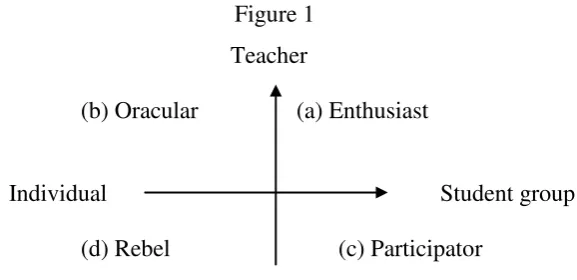
69 norms of behavior in the classroom, every learner remains an individual; no learning group is ever totally homogenous except in cases of shared culture or roughly compatible age ranges. Even within such a group there is likely to be a series of differences among the individual learners. The following is a scheme for studying the behavior of individual learners based on actual observation of classroom interaction rather than psychological theory.
Figure 1 Teacher
(b) Oracular (a) Enthusiast
Individual Student group
(d) Rebel (c) Participator
Student Group
(After McLeish, quoted by Wright, 1988)
Four main types of learner are distinguished in this analysis. Bearing in mind that individual could be placed anywhere on this diagram and thus can differ according to the degree of the tendency towards being of any one type; the types are as follows:
1. The enthusiast – this type tends towards the teacher as a point of reference but at the same time is concerned with the goals of the learning group.
REGISTER, VOL. 1, N0. 1, 2008
70 3. The participator focuses attention both on group goals and on group
solidarity.
4. The rebel leans towards the learning group for his or her point of reference but is mainly concerned with the satisfaction of his own goals.
In the process of language learning, not all pupils realize that they have different aptitude in the learning process. Most of the pupils assume that everybody has equal aptitude in the learning. The assumption becomes more sophisticated when their teachers also have the same assumption to the students’ aptitude. As a result, they will give the same treatment to all students in the class; never mind whether their students are fast or slow learners. Finally, both the students and the teachers agree to vote that ones have excellent aptitude to those who learn very fast and others are stupid or inaptitude to those who are very slow in language learning.
Usually, the terms aptitude and inaptitude elicit significant effects to language learners. Students who feel aptitude will be well motivated to learn. But on the contrary, those who feel inaptitude will be less motivated and even become frustrated to study. They will be reluctant to study hard by reasoning that even though they have tried many they will get the same results. This is since they are inaptitude.
REGISTER, VOL. 1, N0. 1, 2008
71 They never go to library and more like to gossip or just chat with friends, though they have opportunity to do. This is the fact that those who are active in discussion are the fast learners not the slow ones. Then, when they fail in the study they just say that they are inaptitude to study language. The saying can be true because they are impatient to study not because they are inaptitude.
Since aptitude concerns with language learning processes, language teachers need to invite students to make a lot efforts. They should do a lot because the aptitude can be manipulated. Report in researches say that inaptitude students are able to master language well because they have unmatched patient. They always study hard and consult with their teachers when they find difficulties. They absolutely pro-active to confirm to all who are able to solve their problems. Finally, they enjoy their efforts in a fairly short time. And they become skillful in using language as the skills of the fast learners.
To understand whether students have good aptitude or not, teachers may conduct an aptitude test. Aptitude test is administered to measure students’ aptitude for learning. In language study, it can be used to predict what kind of performance expected to be mastered by students. David P. Harris (1969) suggests that at the time of speaking, the examinees may have little or no knowledge of the language to be studied, and the test is employed to assess their potential. Thus it can be administered for those or common people who know nothing. In addition, when they have been joining language classes, it is useful to determine the following level of difficulties, materials, and students’ grades.
REGISTER, VOL. 1, N0. 1, 2008
72 student’s future progress on the basis of linguistic aptitude test. Nevertheless, it immediately became apparent that such tests were inconsistent in a number of ways. They did not appear to assess anything than general intellectual capability even though they apparently looked for linguistic talents. Further, they favored analytic type learners over their more ‘holistic’ counterparts, so that the tests were especially suited for people who have little trouble doing grammar-focused tasks. Those with a more ‘general’ view of things – whose analytical capabilities are not so highly developed, and who receive and use language in a more message-oriented way – appeared to be at a disadvantage. In fact, analytic aptitude is probably not the critical factor in success. Quoting Peter Skehan he says that what distinguishes exceptional students from the rest is that they have unusual memories, particularly for the retention of things that they hear.
Harmer (2001) says that another damning criticism of traditional aptitude tests is that while they may distinguish between the most and the least ‘intelligent’ students they are less effective at distinguishing between the majorities of students who fall between these two extremes. What they do carry out is to influence the way in which both teachers and students behave. It has been suggested that students who score badly on aptitude tests will become de-motivated and that this will then contribute to precisely the failure that the test predicted. In addition, teachers who know that particular students have achieved high scores will be tempted to treat those students differently from students whose score was low. Aptitude tests end up being self-fulfilling prophecies whereas it would be much better for both teacher and students to be optimistic about all of the people in the class.
REGISTER, VOL. 1, N0. 1, 2008
73 to the mastery; whether or not students who get low scores in aptitude test must fail and those who get high score must be successful. There is also assumption that the students getting low scores will be de-motivated in language learning. If so, the solution is how to deconstruct students’ de -motivation to -motivation to improve the students’ aptitude to language learning. Therefore, there must be a clear cut between the aptitude test and students’ aptitude. Aptitude test is not the solution to the betterment of the students’ aptitude to the learning. This is only one of the ways to predict the students’ aptitude in the learning. Therefore, the importance is the management of the aptitude in the classroom learning.
Aptitude is different from intelligence. Lado (1983) states there is a verbal aptitude distinct from general intelligence. Individuals are different in their ability to learn a second language. Some individuals learn more by memorizing related sentences, others by analogy, still others by rules and systems. Individual differences in quantity of learning and quality of achievement are surprisingly enormous. Some individuals, for example, may learn three times as much as some of their classmates in eight weeks of exhaustive study of a second language. In view of these differences, students should not be forced to pursue exactly the same steps in the class or in planned learning.
REGISTER, VOL. 1, N0. 1, 2008
74 Intelligence
The relation between language study and intelligence is similar with that of language, brain, language acquisition, and language development. The relation of them in brain is conceptual but the products of the relation are very concrete. Take for instance; humans are able to produce language utterances after their brain is stimulated by verbal behaviors from outside. Formerly, they only receive the stimuli from others before having abilities to produce the utterances. Then, the recipient tries to retain the stimuli in the deepest brain possessed by all humans that will be recalled sometime when they have been able to produce the language utterances starting from the meaningless to the meaningful ones. Amazingly, at the certain age – approximately six years, the young humans have become matured in the language productions. They are able to use the language by recalling the language stocks in their brain through oral or written symbols. This is absolutely the work of brain sent to the humans’ organs of speech. Thus, before they produce the language symbols, they receive the language stimuli or verbal behaviors. The stimuli are processed in the brain, and by the instruction of it, the organs of speech produce the language symbols. At the course of the time, the process of receiving, processing, producing, and developing of language symbols becomes polarized and complicated. For the reason, there are two working processes done by the brain namely acquisition and production. At the former activity, the brain receives and processes the language stimuli and at the later stage, it produces and develops into the most sophisticated language use.
REGISTER, VOL. 1, N0. 1, 2008
75 Humans will have a great stock of languages when their brains are able to receive the stimuli well. Similarly, the stimuli can be retained longer and stronger when they are able to process those stimuli right. Besides, the language products and the development of them may change significantly when the brains work soundly too. The stage of the processes begins from the simplest through the complicated in accordance with the development of humans’ brain. Humans are only able to receive when the quality and capacity of their brains are still simple. However, they are very skillful to produce unimaginable language utterances when their brain capacity and quality develop.
REGISTER, VOL. 1, N0. 1, 2008
76 Neuro-Linguistic Programming practitioners use different terms concerning the ways in which humans experience the world. They consist of visual, auditory, kinesthetic, olfactory, and gustatory or ‘VACOG’. Revell and Norman quoted by Harmer (2001) say all people have these systems in experiencing the world, even though; they only have one ‘preferred primary system’. When people tend to have more pronounced auditory system, they will be easy to be stimulated by music. Others, who have visual as their primary preferred system, respond most powerfully to images.
Based on the formulation VACOG concept, this is clear that students will respond differently to stimuli and environment. Dede Teeler quoted by Harmer (2001) says that kinesthetic students will behave differently when introduced to the Internet as language learning equipment from the dominant visual learners. The latter will need demonstration of what to be done before they dive into Internet tasks, unlike their kinesthetic friends who just get on and do it. Harmer (2001) says that VACOG also shows some students will get most the things they hear whereas others need to see them. This recommends that purely oral presentations of language will be most appropriate for some individuals in a group. While visual material and written text may be more effective for other students.
REGISTER, VOL. 1, N0. 1, 2008
77 acquiring language than the others. The latter, however, more emphasizes the learning styles characterizing the students. Some of the bodies may be visual learners while others are auditory. This also suggests that teachers should give different treatments and use different teaching apparatuses in the language learning. In conclusion, the same learning task and the same teaching equipment may not be appropriate for all of our students.
Conclusion
At the preceding chapters, the writer has received several students’ internal potentials influential in teaching-learning processes. The potentials determine the success or the failure of study. If the potentials are well organized within the learner-selves, it is unimaginable that the students will get an amazing success. The students’ potentials identified in this paper are not the ends themselves. Academicians may have different corners to view the potentials. In addition, they vary to see them but the insight is useful to extend the paradigm of students’ contribution to successful study. The writer believes that the four components above namely aptitude, motivation, attitude, and intelligence are the major terms used to exploit students’ potentials.
References
Brown, Douglas, H. 1980. Principles of Language Learning and Teaching.New Jersey: Prentice-Hall International. Inc., Englewood Cliffs.
REGISTER, VOL. 1, N0. 1, 2008
78 Harris, David P. 1969. Testing English as a Second Language. McGraw-Hill
Book Company: New York.
Joyce, Bruce and Weil, Marsha. 1980. Models of Teaching.New Jersey: Prentice-Hall International, Inc. Englewood Cliffs.
Lado, Robert.1983. Language Teaching: A Scientific Approach.Bombay-New Delhi: McGraw-Hill Publishing Co. Ltd.
Ramelan, 1984. Introduction to Linguistics for Students of English in Indonesia.Semarang: IKIP Semarang Press.
Rivers, Wilga M. 1983. Communicating Naturally in a Second Language: Theory and Practice in Language Teaching.Cambridge: Cambridge University Press.
Slameto, 1987. Belajar dan Faktor-Faktor yang Mempengaruhinya. Jakarta: Bina Aksara.