THE EFFECTIVENESS OF WORD DETECTIVE STRATEGY ON TEACHING VOCABULARY AT THE SEVENTH GRADE STUDENTS OF
SMPN 1 SAMBIT PONOROGO ACADEMIC YEAR 2017/2018
THESIS
Presented by: NANIK ASTUTI
210914030
ENGLISH EDUCATION DEPARTMENT
FACULTY OF TARBIYAH AND TEACHERS TRAINING THE STATE INSTITUTE OF ISLAMIC STUDIES OF PONOROGO
ABSTRACT
ASTUTI, NANIK. 2018. The Effectiveness of Word Detective Strategy on Teaching Vocabulary at The Seventh Grade Students of SMPN 1 SambitPonorogo Academic Year 2017/2018. Thesis, English Education Department, Tarbiyah Faculty, State Institute for Islamic Studies Ponorogo. Advisor Dr.HarjaliM.Pd.
Key Words: Word Detective Strategy, Vocabulary Mastery
Vocabulary is a group of words of a language that conveys meaning when the language is used. Vocabulary is important for students, it is more important than grammar for communicative purpose. Word Detective Strategy is one of the interesting strategies. It is a strategy in teaching vocabulary that makes the students become a detective to look for the meaning of the word by using context clues and word part clues.
The purpose of this research was to examine whether there was a significant difference between the students’ vocabulary mastery who were taught by Word Detective Strategy and those who were not taught by Word Detective Strategy at SMPN 1 SambitPonorogo in academic year 2017/2018.
This research applied quantitative approach and used the quasi-experimental design. It assigned two classes which are taught two different techniques. The experimental class was taught by Word Detective Strategy and control class was taught by lecturing technique. The population was the seventh grade students of SMPN 1 SambitPonorogo which consist of 86 students. The sample is 58students (29 students of experimental class and also 29 students of control class). The sampling technique was use cluster random sampling.The procedure of data collection were test and documentation. It was analyzed and processed by using statistic data calculation of T-test formula by using SPSS16.00.
The result showed that the experimental class has higher mean score in the post-test than control class. The mean score of post-test in the experimental class was 68.44, while the control class was 57.41. Besides, the result of T-test calculation showed that the value of ttestis higher than the value of ttable. The value of ttestwas 4.304 while the value of ttablewith db = 56 was 2.01. Based on those result, it can be concluded that Ha is accepted and Ho is rejected.
CHAPTER I
INTRODUCTION
In this chapter the researcher describes the background of the study, limitation of the problems, statement of the problems, objective of the study, significance of the study and organization of the thesis.
A. Background of the Study
Language skills are often categorized as receptive or productive skills. Listening and reading are regarded as receptive skills because focus in on receiving information from an outside source.1 The relationship between vocabulary knowledge and reading comprehension is consistently strong and has been recognized as a contributing factor for academic success.2
Vocabulary can be defined as ―words we must know to communicate effectively;
words in speaking (expressive vocabulary) and words in listening (receptive vocabulary)‖.Diamond and Gutlohn, in www.readingrockets.org/ article state that
vocabulary is the knowledge of words and words meanings. From the definitions above, it can be concluded that vocabulary is the total number of words that are needed to communicate ideas and express the speakers’ meaning. That is the reason
why it is important to learn vocabulary.
1
David Nunan, Practical English Language Teaching (Mcgraw-Hill/ contemporary, 2003), 24.
2
Some experts divide vocabulary into two types: active and passive vocabulary. Harmer distinguishes between these two types of vocabulary. The first type of vocabulary refers to the one that the students have been taught and that they are expected to be able to use. Meanwhile, the second one refers to the words which the students will recognize when they meet them, but which they will probably not be able to pronounce. Haycraft, quoted by Hatch and Brown, indicate two kinds of vocabulary, namely receptive vocabulary and productive vocabulary.
Receptive vocabulary is words that learners recognize and understand when they are used in context, but which they cannot produce. It is vocabulary that learners recognize when they see or meet in reading text but do not use it in speaking and writing.Productive vocabulary is the words that the learners understand and can pronounce correctly and use constructively in speaking and writing. It involves what is needed for receptive vocabulary plus the ability to speak or write at the appropriate time. Therefore, productive vocabulary can be addressed as an active process, because the learners can produce the words to express their thoughts to others.3
According to Richards and Renandya, vocabulary is a core component of language proficiency and provides much of the basis for how learners speak, listen, read and write. The other definition of vocabulary states from Hatch and Brown, they say that vocabulary refers to a list or set of words for a particular language that individual speakers of language might use.
3
MofarehAlqahtani, “The Importance of Vocabulary in Language Learning and How to be
Vocabulary acquisition happens in one the way mentioned. There are incidental and direct. Incidental is deliberate or undeliberate acquisition of vocabulary while doing independent listening or reading activities. Direct is through direct conscious study.
Incidental vocabulary acquisition is a typical way of vocabulary acquisition, especially for proficient readers. Incidental vocabulary learning refers to the process of learning without specific focus of attention. It’s the way through which learners
focus on understanding the meaning of a text or listening to contexts, instead of intentional learning. Students who possess reading skills who read different texts may find out that their vocabulary has improved without direct study. According to Richards’ study, students can learn vocabulary through reading which supports the
fact that pleasure reading in a foreign language is an incidental vocabulary acquisition.4
Vocabulary, broadly defined, is knowledge about words and word meanings. However, this definition is inadequate, as it sweeps over some important distinctions. First of all, words come in both oral and written forms, and the words typically used in speech are less precise and of a more limited variety than the words used in print.5
Given the findings of our research and similar research by others, we have prepared this chapter in order to present strategies that middle-grade teachers (Grades 4-8) might use to instruct students to use word-part and context clues to expand their
4
Hong and Richards (Cited in AzadehRezaei*, Neo Mai, Ahmad Pesaranghader). 5
Hayes, D. P., and M. G. Ahrens, Vocabulary Simplification for Children: A Special Case of
reading vocabularies. We begin with a brief review of research on vocabulary instruction, with emphasis on teaching word-part and context clues as means to promote word knowledge. Next, we describe the interventions we implemented and provide sample lessons for teaching word-part and context clues in language arts and content area classes. We conclude by acknowledging limits to and extensions of the instructional recommendations we offer.6
Based on the observation conducted at SMPN 1 SambitPonorogo, researcherlooked some students in the reading class are passive.When the researcher had the students read and understand the content of a text, most of them said that the text was difficult to be comprehend since there were many unknown words found in the passage. They could not understand the new words appearing in sentences or passage. They did not try to think of how to understand the meanings of the words and started to make noises by asking one another. They even did not want to answer questions related to the passage. Whenever the students were asked to understand the unknown words found in sentences or text, they always looked up the words in their dictionaries, got help from friends, and or asked teachers.
Through direct observation done by the researcher, it was found out that most of teachers there taught language components, especially vocabulary, using improper methods or techniques of teaching vocabulary. They just frequently follow up the instruction in the students sheets, such as; giving the students explanations about the
6
components they taught, then giving them some examples, after that, asking them to do the tasks in the worksheets. For example; some English teachers tended to apply translation method during the learning process. They asked the students to translate the reading passage from English into Indonesian. And then the teachers discussed the results of the students’ translation with the whole class. These activities made the
students feel bored and less challenged in learning English. Consequently, their vocabulary mastery was low. Such situation often made the students feel bored so that they were not interested in learning English. English teacher said that many students had not mastered vocabulary well especially in reading.7
There are many ways to learn vocabulary. Some of them is starting from: learning from the roots of the words, prefixes and suffixes, and dictionary.8
Word Detective strategy (word part clues and context clues) guides students through a series of steps to help uncover the meaning of a word and its word parts.9 This strategy (word detective) contains context clues and word part clues. The advantage of word part knowledge is that it may help learners check whether an unknown word has been successfully guessed from context. In other words, integration of information from context and word parts may make guessing more successful and contribute to effective vocabulary learning.10
7
Observation and Interview on 16th November 2017. 8
Jonathan sarwono and YudhyPurwanto, English for Academic Purposes Reading Writing and Vocabulary, C. V ANDI OFFSET: Yogyakarta, (2013), 192.
9
Hanson, S. and Padua, J. F. M. Teaching Vocabulary Explicitly, Hawai: Pacific Resources for Education and Learning, (2011), 24.
10
According to Sasao, integration information from context and word parts may make guessing more successful and contribute to effective vocabulary. This strategy will make the students not only understand the meaning but also understand the class of each word. It will make the students know the use of the word in a sentence. It will be very helpful for the students because they will more understand the meaning and also the word class at the same time. Finally, knowledge of word parts and guessing from the context may be the most useful strategy for learners because this strategy may be used in any situation for any words.
This research tried to use Word Detective Strategy in the vocabulary achievement. According to Denton et al, recent research on teaching word learning to middle school students suggests that combining word part clue and context clue (word detective strategies) is a powerful way to increase your students’ ability to
discover word meaning independently.11
Based on the description of the background above, the researcher is interested in conducting the research under the title ―The Effectiveness of Word Detective Strategy on Teaching Vocabulary at The Seventh Grade Students of SMPN 1
SambitPonorogo Academic Year 2017/2018”. The researcher want to analyze
whether teaching vocabulary by using word detective strategy is more effective to teaching student’s vocabulary mastery.
11
B. Limitation of the Problem
Based on the background above, the research is limited on the differences of student vocabulary achievement before and after taught by using word detective strategy in teaching vocabulary at seventh grade students of SMPN 1 Sambit academic 2017/2018.
C. Statement of the Problem
Is there any significant difference on students’ vocabulary achievement who are taught by using word detective strategy and who those are not at seventh grade students of SMPN 1 Sambit?
D. Objective of the Study
To find out thedifference of students’ vocabulary achievement who are taught using word detective strategy and who those are not at seventh grade students of SMPN 1 Sambit.
E. Significance of the Study
This result of observation is expected giving advantage, both theoretically and practically:
1. Theoretical significance of the research
2. Practically significance of the research a. For the teacher
This research can be used as a means to know the effect of using word detective strategy in teaching vocabulary and learning process. Teachers will be more aware of students’ vocabulary. Besides that, teacher will be
easy to motivate students understanding the meaning of the word. b. For the students
This research will facilitate students for a better knowledge about vocabulary. Through text and sentence, the students will learn to understand the meaning of the word by using word detective.
c. For the readers
For the readers, the researcher hopes that the result of this study can be useful as a reference for a further research concerning with English vocabulary.
F. Organizations of the Thesis
Chapter I tell about general description and take a role as basic of mindset of
the thesis. The first chapter consists of background of the study, limitation of the study, statement of the problems, objective of the study, significant of the study and organization of the thesis.
Chapter II consists of review of related literature. On this chapter II tell about
previous studies, theoretical background, theoretical framework and hypothesis.
Chapter III is research methodology. The research methodology consists of
research design, population and sample, instrument of data collection, technique of data collection and technique of data analysis.
Chapter IV research result. It contains of research location, data description,
hypothesis and discussion.
CHAPTER II
REVIEW OF RELATED LITERATURE A. Previous Studies
In this research, the reseacher use previous study of research finding. This research was presented by Laura Ferguson by the title ―The Effects of Explicit
Teaching of Morphemic Analysis on Vocabulary Learning and Comprehension
and its Transfer Effects to Novel Words”.
This study investigated the effects of explicit teaching of morphemic analysis on vocabulary learning and comprehension and its transfer effects to novel words with sixth grade students. Because research research states that vocabulary and the ability to decode unfamiliar words is vital for comprehension, an increase in vocabulary learning and comprehension was predicted. A sixth grade reading class with low reading assessment result was specifically taught twelve affixes and roots chosen from a bank of morphemes tested in classroom theme and state reading assessments. The 18 students received pre and post assessment on comprehension and vocabulary with an additional post assessment on transfer effects. Result showed significally higher post-assesment scores, but no visible improvement on student transfer to novel words.
The second is that was written by Dillan Kibar Dzikrika. He conducted a research on ―The Effectivness of Morphological Analysis Technique in Teaching
Vocabulary (Quasy-experimental Study at the Eighth Grade Students of SMPN 13
The objective of this study was to find the empirical evidence of the effectiveness of using morphological analysis technique in teaching vocabulary at the eighth grade students of SMPN 13 kota Tangerang Selatan. The method used was a quasy-experimental study. For sampling technique, the writer used purposive sampling. The samples of this research were 39 students of class 8.8 as the experimental class and 37 students of class 8.7 as the controlled class. Before giving treatment, the writer gave pre-test. Then, the writer taught 20 prefixes and 20 suffixes with high frequency of occurence in the experimental class. After four metings, the writer gave the post-test to both classes. In addition, to attain the validity and reliability of the instrument, the writer used ANATES. Further, the calculation of this research was conducted through SPSS 22.
The result showed that sig. 2 tailed (p) was 0.011 while alpha (α) was 0.05. in
other words, p < a. It meant that there was significant differences between both classes mean post-test score. The test of hypothesis showed that count value was greater than table with degree of freedom (df) 74 and degree of significance (α)
B. Theoretical Background
1. Teaching Vocabulary
a. Definition of Vocabulary
Vocabulary is not a developmental skill or one that can ever be seen as fully mastered. The expansion and elaboration of vocabularies is something that extends across a lifetime.
A first consideration in delineating the construct of "vocabulary" in research and practice that individuals have various types of vocabulary that they use for different purposes. Failure to distinguish among the different kinds of vocabulary can lead to confusion and disagreement about both research findings and instructional implications.
Generically, vocabulary is the knowledge of meanings of words.Vocabulary refers to words we use to communicate in oral and print language. Receptive vocabulary refers to the words we understand through reading and listening. Productivevocabulary refers to the words we use to communicate through writing and speaking. In order to communicate effectively using oral and print language, we must be able to flexibly use words that we recognize and understand.12
For beginning readers, oral vocabulary far outstrips print vocabulary. This is one of the determining factors in shaping beginning
12
readinginstruction. Beginning reading instruction is typically accomplished by teaching children a set of rules to decode printed words to speech. If the words are present in the child's oral vocabulary, comprehension should occur as the child decodes and monitors the oral representations. However, if the print vocabulary is more complex than the child's oral vocabulary, comprehension will not occur. That is, the process of decoding a word to speech does nothing more than change its representation from visual print to oral speech. If it is not in the child's vocabulary, it is simply an unusual collection of speech sounds. The details of this "theory" of vocabulary and reading instruction can be summarized in the following way:
Comprehension is a function of oral language and word recognition. That is, comprehension of print is a result of the ability to decode and recognize words and oral language knowledge. There are two intermediate steps, though. The first is the link between decoding and oral language.13
The relationship between vocabulary knowledge and reading comprehension is consistently strong and has been recognized as a contributing factor for academic success through studies.14
Vocabulary can be defined as '' words we must know to communicate effectively; words in speaking (expressive vocabulary) and words in
13
Hiebert, Elfrieda H. and Kamil, Michael L. Teaching and learning vocabulary: bringing research to practice. Library of Congress Cataloging-in-Publication Data: United States of America, (2005),
14
Hayes, D. P., and M. G. Ahrens, Vocabulary Simplification for Children: A Special Case of
listening (receptive vocabulary)''. Furthermore, Diamond and Gutlohn in www.readingrockets.org/article state that vocabulary is the knowledge of words and word meanings.‖
Haycraft, quoted by Hatch and Brown, indicate two kinds of vocabulary, namely receptive vocabulary and productive vocabulary.
1). Receptive Vocabulary
Receptive vocabulary is words that learners recognize and understand when they are used in context, but which they cannot produce. It is vocabulary that learners recognize when they see or meet in reading text but do not use it in speaking and writing.
2). Productive Vocabulary
Productive vocabulary is the words that the learners understand and can pronounce correctly and use constructively in speaking and writing. It involves what is needed for receptive vocabulary plus the ability to speak or write at the appropriate time. Therefore, productive vocabulary can be addressed as an active process, because the learners can produce the words to express their thoughts to others.
that makes someone a master in a certain subject. The specificity of any individual’s vocabulary knowledge depends on the person and his
motivation, desires, and need for the words.
Vocabulary mastery refers to the great skill in processing words of a language. It is an individual achievement and possession. For that reason, the biggest responsibility in increasing the knowledge is in the individual himself. The success in widening the vocabulary mastery requires their own motivation and interest on the words of a language.
From the definition above, we can conclude that vocabulary mastery is an individual’s great skill in using words of a language, which is acquired based on their own interests’ needs and motivation.
Vocabulary mastery plays an important role in the four language skills and it has to be considered that vocabulary mastery is one of the needed components of language.15
15
b. Kinds of vocabulary
There are some kinds of vocabulary: 1) Nouns
The noun is one of the most important parts of speech. Its arrangement with the verb helps to form the sentence core which is essential to every complete sentence.
2) Pronouns
―A word that takes the place of noun‖ is applicable to some types of
pronouns but not to others. Those pronouns that are actual substitutes may refer not only to a preceding noun-its antecedent but to a larger part of discourse that precedes. Those pronouns that are not substitutes may simply have indefinite reference or express indefinite quantity. 3) Verbs
4) Adjectives
The adjective is a modifier that has the grammatical property of comparison. It is often identified by special derivational endings or by special adverbial modifiers that precede it. Its most usual position is before the noun it modifies, but it fills other positions as well
5) Adverbs
Adverbs ranges in meaning from words having a strong lexical content (those that describe the action of the verb, or those that indicate such meanings at time and place) to those are used merely for emphasis. They range in function from close to loose modifiers of the verb; from close modifiers of single words, prepositional phrases or clauses, to loose modifiers of the entire sentence.
6) Prepositions
The prepositions is classified as a part of speech in traditional grammar. However, prepositions as well as conjunctions differ from other parts of speech in that (1) each is composed of a small class of words that have no formal characteristic endings; (2) each signals syntactic structures that function as one of other parts of speech.16
16
2. Word Detective Strategy
Word Detective strategy guides students through a series of steps to help uncover the meaning of a word and its word parts.17 This strategy contains context clues and word part clues.18
a. Definition of Context Clues
Students can be benefit from learning how to use context clues and guessing the meaning from the context. This is a strategy that learners can use when they encounter unfamiliar words. Conversely, Back and McKeown point out that in addition to teaching how to use context clues, students also need to be taught that context clues do not always help readers to understand the meaning of unfamiliar words. Children need to be taught that there are times, especially when reading, when they will not able to figure out the meaning from context clues.19
The context clues will be used in fiction and nonfiction reading. When a reader encounters an unfamiliar word, using this strategy will help the reader to determine the meaning of the word. The strategy provide the students with specific steps to use as they attempt to determine meanings. As students become more proficient in using context clues in the text, they will gradually develop a more extensive and powerful reading vocabulary.
17
Hanson, S. and Padua, J. F. M. Teaching Vocabulary Explicitly. (Hawai: Pacific Resources for Education and Learning. 2011, 24)
18
Sasao, Y. Diagnostic Test of English Vocabulary Learning Proficiency: Guessing From Context and Acknowledge of Word Parts. Wellington: Victoria University of Wellington. 2013, 32.
19
Sometimes when reading you come an unknown word. Look for clues in the text to help figure it out. The words and sentences around the unknown word and give clues. These clues are called context clues. Sometimes they are found close to the new word. Sometimes you must look in the paragraph before or after the word. Use information in the text what makes sense to figure out the meaning of the word.20
According to Baumann, context clues are important to teach because: 1) The meaning of the word is sometimes stated in the sentence or sentences before or after the unknown word.
2) There may be clues in the sentence or sentences before or after the unknown word.
3)Some texts provide the meaning of the word, but students may overlook it.
4) The most helpful hints are often found in the same sentence, but students do not recognize these hints.
5) Some clues may be misleading. Students need to take the initiative and ask, ―Does this meaning make sense in this context?‖21
20
https://www.risd.k12.nm.us/assessment_evaluation/Context%20Clues.pdf, diakses pada tanggal 3 Januari 2018.
21
b. Words Parts
The advantage of word part knowledge is that it may help learners check whether an unknown word has been successfully guessed from context. In other words, integration of information from context and word parts may make guessing more successful and contribute to effective vocabulary learning.22
In word parts will learning about morpheme for help the student in vocabulary learning.
A morpheme is the smallest part of the word that carries meaning. When readers assemble the parts of word, they are better able to construct meaning of an entire word. For example, in the word unhappy there are two morphemes: unand happy. Unmeans ―not‖ and happy means ―feeling
joy or gladness.‖ Therefore, by assembling the meanings from the
morphemes, the word unhappy means ―not joyous or not glad.‖ Linguist
define a morpheme as the smallest unit of language that has its own meaning.23
Based on the explanation above, it concludes that morpheme is the smallest parts that construct words. Morpheme can be classified into two various, there are free morpheme and bound morpheme
22
Ibid, Sasao, Y. Diagnostic Test of English Vocabulary Learning Proficiency: Guessing From Context and Acknowledge of Word Parts.
23
1) Free Morpheme
Free morpheme is one which can stand by themselves as single words, for example open and tour. Free morpheme is one which may stand alone in a language without the requiring the presence of additional morpheme in order to be freely pronounceable as a word. Thus words made up of only one morpheme such as walk, force, miss are necessarily free morpheme.
Free morpheme fall into two categories. The first category is that set of ordinary nouns, adjectives and verbs that we think of as the words that carry the content of the messages we convey. These free morphemes are called lexical morphemes. Some example of it are girl, man, house, tiger, sad, long, yellow, and open. We can add new lexical morphemes to the language rather easily, so they are treated as an open class of words.
2). Bound Morpheme
Bound morpheme is one which are those forms that cannot normally stand alone and are typically attached to another form, exemplified as re-, -ist, -ed, -s. These forms were described as affixes. So we can say that all affixes (prefixes and suffixes) in English are bound morphemes.
Bound morpheme can also be divided into two types. The first categories are derivational morphemes. We use these bound morphemes to make new words to make words of different grammatical category from the stem. For example the addition of derivational morpheme -ness changes the adjective good to the noun
goodness.
The second set of bound morphemes contains what are called inflectional morphemes. These are not used to produce new words in the language, but rather to indicate aspects of the grammatical function of a word. Inflectional are used to show if a word is plural or singular, if it past tense or not and if it a comparative or possessive form.
word (e.g. -less, -ish) and are called suffixes. All English words formed by this derivational process have either prefixes or suffixes, or both. Thus, mislead has a prefix, disrespectfulhas both a prefix and a suffix, and foolishnesshas two suffixes. Results from one study with 4th and 5th graders indicated that students who understood morphology were more successful at learning academic vocabulary and comprehending text. In addition, researchers have posited that knowledge of morphology can help substantially increase the breadth and depth of one’s vocabulary. Students are often unaware that
dissecting words into parts helps them understand words. Therefore explicit teaching of word parts is important. One method of promoting knowledge of word parts is to implement instruction that, in addition to using a word list, targets new words derived from common roots.24
Before students can apply prefixes, suffixes, and root/base words to unlock the meaning of words, they must first know what these word parts mean. Teachers can begin by explaining the meaning of prefixes, suffixes, and root/base words and how each supports the meaning of words. The following are examples written in student friendly language:
24
1) Base word
A base word is the smallest group of letters that forms a complete word. For example, the word pay is a base word. We can add letters to the beginning or end to form new words (for example, repay and payment).
2) Root word
A root is actually a special kind of base word. A root carries the main part of the meaning. Like the root of a tree, a word root is necessary for growth or word building. Because so many roots come from Greek or Latin, most roots need to be combined with other groups of letters when they are used in English (PREL, 2008). For example, the root word astromeans ―star.‖ Other letters
are needed to form complete words, such as astrology, astronaut, and asteroid.
3) Prefix
Prefix is a group of letters that is added to the beginning of a root or base word and that changes its meaning (PREL, 2008). For example, the prefix unmeans ―not‖ or ―opposite of.‖ In the word unlike, the base word is like. One of the meanings of like is ―similar to.‖ By adding the prefix un, the meaning changes to ―not similar‖
4) Suffix
Suffix is a group of letters that is added to the end of a root or base word and that changes its meaning, although its new meaning is often close to the original meaning.25
C. Theoretical Framework
Theoretical framework is a concept in the proposal about how theorist can be related with the factors which are identified as the important problem.
This research is consisting of two variables: X : Word Detective Strategy
Y : Teaching Vocabulary
The researcher assumes that student’s evaluation of learning at seventh grade
of SMPN 1 Sambit in academic year 2017/2018 is better while use the word detective strategy in teaching vocabulary.
D. Hypothesis
Hypothesis in this research can be stated based on the theoretical analysis and theoretical framework. The hypothesis as follow:
Ha : there is significant differences of students’ vocabulary who taught by word detective strategy
Ho : there is not significant differences of students’ vocabulary who taught by word detective strategy
25
CHAPTER III
RESEARCH METHDOLOGY A. Research Design
This research applies a quantitative research design. This research employed quasi-experimental design. The design has a control group, but can be fully controlling variables during experiment held on. Quasi-experimental design are similar to randomized experimental design in that involves manipulation of an independent variable but differ in that subject are not randomly assigned to treatment groups.26 In this research, the researcher will use nonequivalent (pre-test and post-(pre-test) control group design. In this design, a popular approach to quasi-experiments, the experimental group A and the control B are selected without random assignment. Both groups take a pre-test and post-test. Only the experimental group receives the treatment.
According to John W. Creswell, the design of the research is as below: Experimental A X B
Control C D
26
Notes:
Experimental : the class who is taught using word detective strategy Control : the class who is taught without using word detective
strategy
A : pretest `for the experimental class C : pretest for control class
X: : Treatment
B : post-test for experimental class D : post-test for the control class
The research design that is used by the researcher is adjusted with the purpose of the study. That is to know the effectiveness of word detective strategy in teaching vocabulary for seven grade at SMPN 1 Sambit Academic year 2017/2018 by comparing students’ vocabulary who use word detective strategy and who do not use word detective strategy.
In general, the procedures of this experimental research are following:
1. Conducting a preliminary study to get the first-hand information about teaching vocabulary at school, the SMPN 1 SambitPonorogo, especially to get the data about the seventh grade students, the syllabus and the method used in teaching vocabulary.
2. Administering the pretest of vocabulary to know the homogeneity of the population before giving the treatment
3. Analyzing the score of homogeneity test to find the mean difference and to prove whether the population was homogenous
4. After knowing the population was homogenous, then it was followed by determining the respondents as the experimental and the control groups by making lots
5. Discussing the procedure of the treatment comprehensively
6. Giving treatments two times in the form of teaching vocabulary by using word detective strategy for the experimental group, while the control group is using lecture method.
7. Conducting the vocabulary post-test in the form of vocabulary test to get the data about the students’ vocabulary skill after being giving the
treatment.
8. Analyzing and interpreting the scores gotten by using t-test formula with the significant level
B. Population and Sample 1. Population
Population is defined as all member of any well-defined class of people, event or object. From that statement it can be said that population is the research object as a target to get and collect data. In this research, the researcher took the seventh grade students of SMPN 1 Sambit in academic year 2017/2018 as a population. It consist 86 students of classes in VII A until VII C.
2. Sample
Sample is a portion of a population. In this research, the researcher applies random sampling at the sampling technique. Thus, random samplingcan be applied when the researcher wants to give the same chance to the subject of research. The basic characteristic of simple random sampling is that all members of the population have an equal and independent chance of being included in the random sample.
The sampling technique, the researcher used cluster random sampling. This sampling technique is based on a researcher’s ability to identify each
element examination administered to determine how much knowledge a person has or acquired.27
27
The steps in simple random sampling comprise the following: a. Define the population
b. List all members of the population
c. Select the sample by employing a procedure where sheer chance determines which members on the list are drawn for the sample.28 In this study the researcher took two class which have a criteria that students have same capability. Those classes are seven A and B that each class consist of 58 students. The respondent of this research are students in the class seven A and B. It consist of 29 students that each class of 29 students.
C. Instrument of Data Collection
In quantitative research, the quality of research instruments is concerned with the validity and reliability of instruments and collection qualities with respect to the precision of techniques or the means used to collect data. The following is the format of research instruments in quantitative research.29
28
Donald Aryetall, Introduction to Research in Education (Canada: nelson education, Ltd, 2010), 148-150.
29
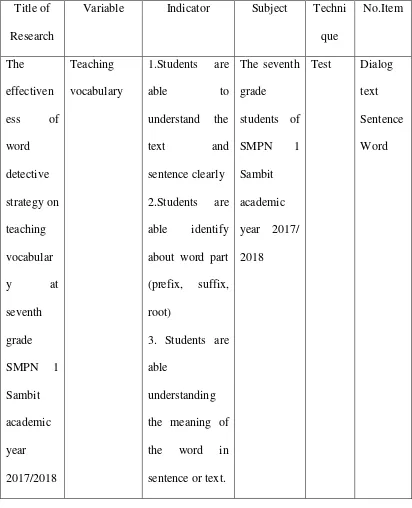
Table 3.1
Instrument of data collection can be shown as table Title of
Research
Variable Indicator Subject Techni que
No.Item
The effectiven ess of word detective strategy on teaching vocabular
y at
seventh grade SMPN 1 Sambit academic year 2017/2018 Teaching vocabulary
1.Students are
able to
understand the text and sentence clearly 2.Students are able identify about word part (prefix, suffix, root)
3. Students are able
understanding the meaning of the word in sentence or text.
The seventh grade
students of SMPN 1 Sambit academic year 2017/ 2018
D. Technique of Data Collection
Instrument is an implement used for a particular purpose especially dedicate or scientific work. In this research instrument to collected date was test. The test is constructed by the researcher based on the standardized procedures of making test. The test was divided into two parts. They are the test for students that used word detective strategy in teaching vocabulary and test for students are not used word detective strategy in teaching vocabulary.
1. Test
Test is a set of question or practice or other tools which is used to measure skill, intelligence, ability or talent individual or group. According to Brown, test is method of measuring person’s ability, knowledge or
performance in a given domain.30 According to penny Ur, it is often conventionally assumed that tests are mostly used for assessment; the test give a score which is assumed to define the level of knowledge of the tested.31 The researcher used test to get score of data from students, so it can be knew significantdifference between students before use word detective strategy and after use word detective strategy.
The researcher will use validity and reliability test to measure the test based on certain criteria. The test will explain in the following:
30
H. Douglas Brown, language Assessment (San Fransisco: Longman Itd), 3. 31
a. Validity
Validity is the most important consideration in developing and evaluating measuring instrument. Validity was defined as the extent to which an instrument measured what it claimed to measure. The focus of recent views of validity is not on the instrument itself but on the interpretation and meaning of the scores derived from the instrument.
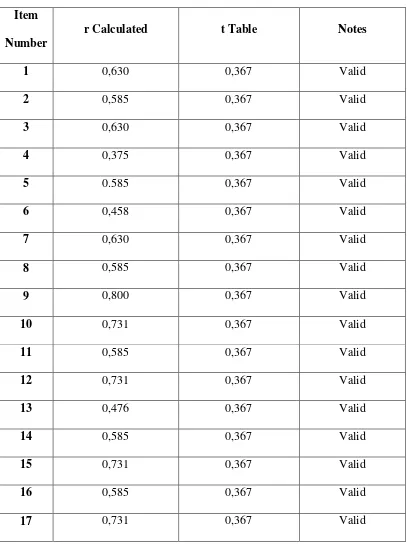
Table 3.2
The result of validity test
Item Number
r Calculated t Table Notes
1 0,630 0,367 Valid
2 0,585 0,367 Valid
3 0,630 0,367 Valid
4 0,375 0,367 Valid
5 0.585 0,367 Valid
6 0,458 0,367 Valid
7 0,630 0,367 Valid
8 0,585 0,367 Valid
9 0,800 0,367 Valid
10 0,731 0,367 Valid
11 0,585 0,367 Valid
12 0,731 0,367 Valid
13 0,476 0,367 Valid
14 0,585 0,367 Valid
15 0,731 0,367 Valid
16 0,585 0,367 Valid
18 0,731 0,367 Valid
19 0,800 0,367 Valid
20 0,800 0,367 valid
Based on the table among 20 questions, there were 20 questions were valid.
b. Reliability
The reliability of a measuring instrument is the degree of consistency with which is measure whatever it is measuring. This quality is essential in any kind of measurement. Reliability is concerned with the effect of such random errors of measurement on the consistency of scores. But some errors involved in measurement are predictable or systematic.
Table 3.3
Reliability of pre-test
Reliability Statistics
Cronbach's Alpha N of Items
.923 20
The calculation result of reliability was the value of the students‟ variable reliability instruments is 0,923. The test is
reliable becausethe index of reliability is 0,923. it is higher than r table that showed 0.367.
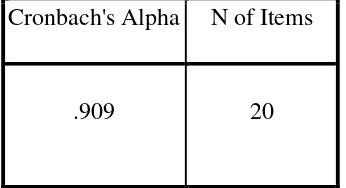
Table 3.4
Reliability of post-test
Reliability Statistics
Cronbach's Alpha N of Items
.909 20
reliable because the index of reliability is 0,909. It is higher than r table that showed 0, 367
2. Documentation
Documentation is the technique of collecting data which is taken from written such as books, newspaper, opinion, which related of the research.32 In this research, documentation as supporting data include history of school, geographies location, vision, and purpose of school.
E. Technique of Data Analysis
After the test is given to the students in the pre and post-test, it will be tested. The test is focused on students’ pre and post-test. The result from the test will be
analyzed by Assumption Test, those are: the test of normality and test of homogeneity.
a) Normality Test
Normality test is use to determine whether a data set was well-modelled by a normal distribution or not, or to compute how likely the random variable is to be normally distributed.33
Moreover, it used to analyze whether both groups have normal distribution or not. The calculation of normality test is used SPSS 16.00 program for windows. It used to find out the normality of data by followed steps:
32
Ibid, 158. 33
1) Open the SPSS program.
2) Input the data to the data view by first fill the variable view with write down the name of classes.
3) Click analyze – non parametric test – sample K-S. 4) Drag the data into test variable.
5) Click OK.
After the process calculation, it determines by the following criteria:
- If tvalue was lower than ttable (tvalue< ttable), it means that H0 is accepted and Ha is rejected.
- If tvalue was higher than ttable (tvalue> ttable), it means that H0 is rejected and Ha is accepted.
Notes:
H0 : data is normally distributed Ha : data is not normally distributed b) Homogeinity Test
Homogeneity test is use to know before we compare some of groups. It is useful to test homogeneity of variance in compared two or more groups.34
In other to find out whether there is significant effect between students’ speaking taught by using ―word detective strategy‖, the data
34
were analyzed statistically. The writer analyzed the data by using independent sample T-Test from SPSS 16.0 Version.
The steps of calculation explain below: 1) Open the SPSS 16.00 program.
2) Input the data into data view by first the variable view with write down X as the score of pre-test and post-test and Y as the kind of class.
3) Click Analyze – Compare Means – One Way Anova. 4) Drag X into dependent list and Y as factor list.
5) Click option – checklist Homogeneity of variance test – OK. The criteria of determining of homogeneity test are explains below: - If Fvalue was lower than Ftable (Fvalue <Ftable ), it means that H0 is
accepted and Ha is rejected.
- If Fvalue was higher than Ftable (Fvalue >Ftable ), it means that H0 is rejected and Ha is accepted.
a. Open the SPSS16.00 program.
b. Input data to the data view by first change the value in the variable view by change the Name, Decimals, Value and Measure.
c. Click Analyze – Compare Means – Independent Sample t-test.
d. In the dialog box of Independent Sample t-test, input the variable x in Test Variables and variable y in Grouping Variable.
e. Click Define Groups write down 1 in the Group 1 and write down 2 in the Group 2, then Continue – OK.
After calculation, the researcher proposed the alternative hypothesis (Ha) and null hypothesis (H0) which is described below:
CHAPTER IV
RESEARCH RESULT
This chapter presents the result research used in this study. It involves research location, data description, hypothesis and discussion.
A. Research Location
1. Place and Time of Reseacrh
This research takes at SMPN 1 SambitPonorogo. It located on Padjajaran Street 11 CampursariSambitPonorogo East Java. The reason for selecting the school, researcher conducted real teaching practice 11 at the school and the researcher have been know the condition of the SMPN 1 SambitPonorogo.
2. The History of SMPN 1 Sambit
In the beginning, SMPN 1 Sambit is named school of Technology (ST) Filial ST Negeri 2 before becoming SMPN 1 Sambit in 1968. It takes place at Tamansari, Sambit, Ponorogo. On 1th April 1979 ST Negeri 2 Ponorogointregated to SMPN 4 Ponorogo and changed to SMPN 1 SambitPonorogo. Based on SK No. 0299/0/1982 on 9th October 1982. On 1991 the school address moved to Campursari, Sambit, Ponorogo.
3. Vision and Mission of School
a) The vision of SMPN 1 SambitPonorogo
b) The mission of SMPN 1 Sambit Ponorogo
1. Mengembangkan KTSP yang berdiversivikasi dengan berorientasi pada peningkatan pelayanan kepada siswa sesuai dengan potensi, perkembangan, kebutuhan, dan kepentingan siswa serta tuntutan lingkungan.
2. Mengoptimalkan proses pembelajaran dengan pendekatan nonkonvensional diantaranya CTL, PAKEM (Pembelajaran, Aktif, Kreatif, Efektif, Menyenangkan).
3. Meningkatkan GSA (Gain Score Achievement) UjianNasional. 4. Meningkatkan Sumber Daya Manusia (SDM) pada pendidik dan
tenaga kependidikan.
5. Melaksanakan pengembangan fasilitas pendidikan (perangkat teknologi).
6. Melaksanakan pengembangan Manajemen Pendidikan.
7. Melaksanakan pengembangan partisipasi stake holder terhadap sekolah.
8. Melaksanakan pengembangan media pembelajaran.
B. Data Description
The population that was used in this research was the seventh grade students’ of SMPN 1 SambitPonorogo in academic year 2017/ 2018. The
rsearcher took 58 students as sample; it consists of two classes. The first group was the students who are taught using Word Detective Strategy and second groups was the students who are taught using Lecturing Technique in teaching vocabulary.
1. Data of Students’ Vocabulary Achievment Score in Experimental Class
The table below showed the score of students’ vocabulary who are
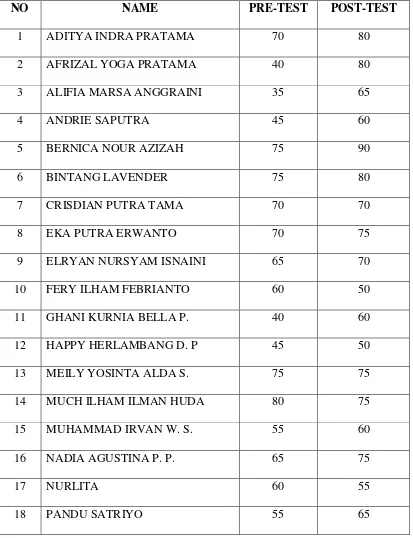
Table 4.1
The Students’ Vocabulary Learning Score of Experimental Class
NO NAME PRE-TEST POST-TEST
1 ADITYA INDRA PRATAMA 70 80
2 AFRIZAL YOGA PRATAMA 40 80
3 ALIFIA MARSA ANGGRAINI 35 65
4 ANDRIE SAPUTRA 45 60
5 BERNICA NOUR AZIZAH 75 90
6 BINTANG LAVENDER 75 80
7 CRISDIAN PUTRA TAMA 70 70
8 EKA PUTRA ERWANTO 70 75
9 ELRYAN NURSYAM ISNAINI 65 70
10 FERY ILHAM FEBRIANTO 60 50
11 GHANI KURNIA BELLA P. 40 60
12 HAPPY HERLAMBANG D. P 45 50
13 MEILY YOSINTA ALDA S. 75 75
14 MUCH ILHAM ILMAN HUDA 80 75
15 MUHAMMAD IRVAN W. S. 55 60
16 NADIA AGUSTINA P. P. 65 75
17 NURLITA 60 55
19 RAFI ALIF ACHMADAN 40 55
20 RAGIL PANGESTU 60 70
21 RANGGA ARDIANO W. 70 85
22 RISQI AULIA PUTRI 65 75
23 ROSSITA PUTRI ARDIATI 65 65
24 SEFTIAN SIGIT S 50 50
25 SILFI MARTIANA PUTRI 60 75
26 SUFYAN HARIS 55 60
27 TAUFIK VEBRYANTO 50 70
28 TRICKO WAHYU JATMIKO 50 65
29 VALENTINA ADISTYA Q 70 80
Total 1715 1985
Mean 59.13 68.44
It can be seen that the highest pre-test score of experimental class was 80 while the lowest pre-test was 35, while the highest post-test score was 90 and the lowest post-test score was 50.The mean score of pre-test was 59.13 and mean score of post-test was 68.44.The result of students’ test of experimental class can be seen clearly on the
Table 4.2
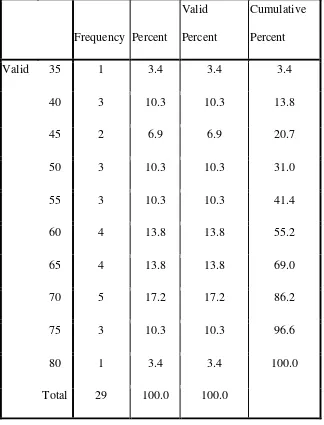
Frequency Distribution of Pre-Test in Experimental Class
From the table above, it could be seen that the score of students’ vocabulary was various. There were 3.4% students or 1 student got score 35, 10.3% students or 3 students got score 40, 6.9% students or 2 students got
Frequency Percent
Valid Percent
Cumulative Percent
Valid 35 1 3.4 3.4 3.4
40 3 10.3 10.3 13.8
45 2 6.9 6.9 20.7
50 3 10.3 10.3 31.0
55 3 10.3 10.3 41.4
60 4 13.8 13.8 55.2
65 4 13.8 13.8 69.0
70 5 17.2 17.2 86.2
75 3 10.3 10.3 96.6
80 1 3.4 3.4 100.0
score 45, 10.3% students or 3 students got score 50, 10.3% students or 3 students got score 55, 13.8% students or 4 students got score 60,13.8% students or 4 students got score 65, 17.2% students or 5 student got score 70, 10.3% students or 3 students got score 75, and 3.4% students or 1 student got score 80.
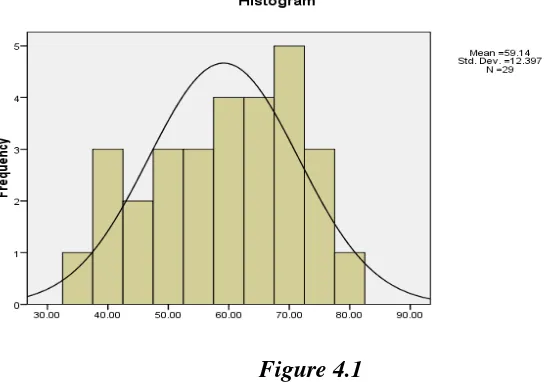
Based on the table above, the histogram can be seen as follows:
Figure 4.1
Histogram for Pre-Test in Experimental Class
From the histogram above, it is stated that M = 59.14 and SD = .12.397 To determine the category of the students’ vocabulary was good, medium or
low, the researcher grouped score using standard as follows:
a) More than M + 1.SD (59.14 + 12.397 = 71.537) is categorized into good b) Between M – 1.SD to 1.SDx is categorized into medium
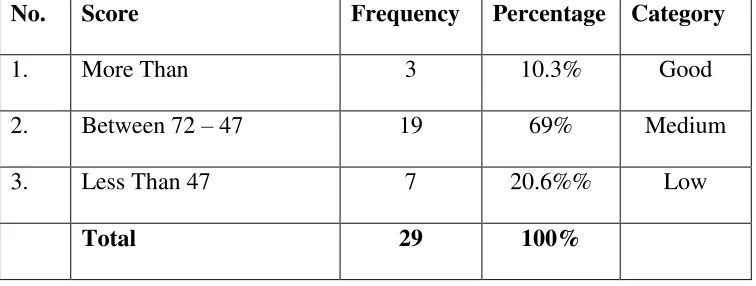
Thus, it can be seen that the scores which are more than 71.537 is categorized into good, the score between 47-72 is categorized into medium, meanwhile the score which are less than 46.743 is categorized into low. That categorization can be seen clearly in the following:
Table 4.3
The Categorization of Students’ Pre-Test in Experimental Class
No. Score Frequency Percentage Category
1. More Than 3 10.3% Good
2. Between 72 – 47 19 69% Medium
3. Less Than 47 7 20.6%% Low
Total 29 100%
From the table above, it could be seen that the score of students’ reading
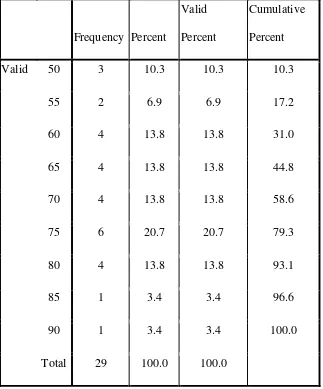
Table 4.4
Frequency Distribution of Post-Test in Experimental Class
Frequency Percent
Valid Percent
Cumulative Percent
Valid 50 3 10.3 10.3 10.3
55 2 6.9 6.9 17.2
60 4 13.8 13.8 31.0
65 4 13.8 13.8 44.8
70 4 13.8 13.8 58.6
75 6 20.7 20.7 79.3
80 4 13.8 13.8 93.1
85 1 3.4 3.4 96.6
90 1 3.4 3.4 100.0
Total 29 100.0 100.0
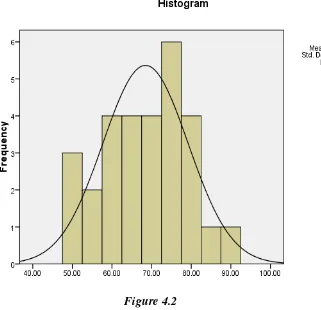
4students got score 70, 20.7% students or 6 students got score 75,13.8% students or 4 students got score 80, 3.4% students or 1 student got score 85, 3.4% students or 1 students got score 90.
Based on the table above, the histogram can be seen as follows:
Figure 4.2
Histogram for Post-Test in Experimental Class
From the histogram above, it is stated that M = 68.45 and SD = 10.782 To determine the category of the students’ vocabulary was good, medium or
a) More than M + 1.SD (68.45 + 10.782 = 79.232 ) is categorized into good
b) Between M – 1.SD to 1.SDx is categorized into medium
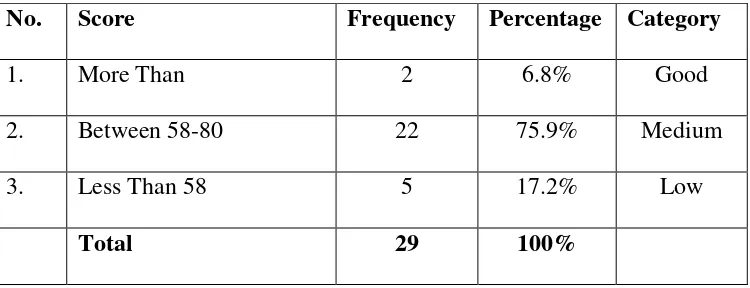
c) Less than M – 1.SD (68.45 – 10.782= 57.668) is categorized into low Thus, it can be seen that the scores which are more than 79.232 is categorized into good, the score between 58-80 is categorized into medium, meanwhile the score which are less than 57.668 is categorized into low. That categorization can be seen clearly in the following:
Table 4.5
The Categorization of Students’ Post-Test in Experimental Class
No. Score Frequency Percentage Category
1. More Than 2 6.8% Good
2. Between 58-80 22 75.9% Medium
3. Less Than 58 5 17.2% Low
Total 29 100%
From the table above, it could be seen that the score of students’
2. Data of Students’ Vocabulary Achievment Scorein Control Class The table below showed the score of students’ vocabulary who taught
by using Lecturing Technique.
Table 4.6
The Students’ Vocabulary Score of Control Class
NO NAME PRE-TEST POST-TEST
1 ABIT FAJAR ANSOTRI 50 50
2 AFIF KHOIRUL UMAM 45 40
3 ALFIAN MAHENDRA 45 50
4 ANDREAS APRILIA KUSUMA 60 65
5 ARSHANDA NANDIKA FAIZA 40 40
6 AZHAR ZAINUL ARIFIN 50 55
7 BRAMASTA WAHYU A 55 55
8 CHANDRA ARROSYID P. 30 45
9 DEWI MARIYAM 40 55
10 DIO SATRIO 50 50
11 FEBRIANTO INDRA S. 40 60
12 HANIFAH NUR RAHMAWATI 65 50
13 HENDRY WIJAKSONO 50 55
15 JOSY ADRIAN PRATAMA 50 50
16 KINGKIN CITRA R. A 45 65
17 LUISA FERNANDA PUSPA A. 65 70
18 M. IZZA PERDANA PUTRA 65 65
19 MUHAMAD ABIL GHINAYAH 55 65
20 NANDA MIA SAPUTRI 55 65
21 RENDY FERYAN MEIRANO 60 55
22 RICARDO HAIKAL N. 55 60
23 THOMAS CAHYONO 60 55
24 WAWAN EKO CAHYANI 50 60
25 WIDYA PUTRI JANUARSITY 45 55
26 WINDA DESSY RAHMAWATI 60 70
27 YUSUF AFFENDI 50 55
28 ZAHVA DWI MAZIDA 40 65
29 ZIDNA AVIANA 70 70
Total 1505 1665
Mean 51.89 57.41
score of post-test was 57.41The result of students’ test of control class can be seen clearly on the following table. It will explore about pre-test and then the result of post-test in the control class.
Table 4.7
Frequency Distribution of Pre-Test in Control Class
Frequency Percent
Valid Percent
Cumulative Percent
Valid 30 1 3.4 3.4 3.4
40 4 13.8 13.8 17.2
45 4 13.8 13.8 31.0
50 7 24.1 24.1 55.2
55 4 13.8 13.8 69.0
60 5 17.2 17.2 86.2
65 3 10.3 10.3 96.6
70 1 3.4 3.4 100.0
Total 29 100.0 100.0
score 45, 24.1% students or 7 students got score 50, 13.8% students or 4 students got score 55, 17.2% students or 5 students got score 60,10.3% students or 3 students got score 65, 3.4% students or 1 student got score 70.
Based on the table above, the histogram can be seen as follows:
Figure 4.3
From the histogram above, it is stated that M = 51.90 and SD = 9.394 To determine the category of the students’ vocabulary was good, medium or low,
the researcher grouped score using standard as follows:
a) More than M + 1.SD (51.90 + 9.394 = 61.294 ) is categorized into good
b) Between M – 1.SD to 1.SDx is categorized into medium
c) Less than M – 1.SD (51.90– 9.394= 42.506) is categorized into low Thus, it can be seen that the scores which are more than 61.294 is categorized into good, the score between 43-61 is categorized into medium, meanwhile the score which are less than 42.506 is categorized into low. That categorization can be seen clearly in the following:
Table 4.8
The Categorization of Students’ Pre-Test in Control Class
No. Score Frequency Percentage Category
1. More Than 4 13.7% Good
2. Between 42-60 20 68.9% Medium
3. Less Than 42 5 17.2% Low
Total 29 100%
From the table above, it could be seen that the score of students’
13.7% in the good category, 68.9% in the medium category and 17.2% in the low category.
Table 4.9
Frequency Distribution of Post-Test in Control Class
Frequency Percent
Valid Percent
Cumulative Percent
Valid 40 2 6.9 6.9 6.9
45 1 3.4 3.4 10.3
50 5 17.2 17.2 27.6
55 8 27.6 27.6 55.2
60 3 10.3 10.3 65.5
65 6 20.7 20.7 86.2
70 4 13.8 13.8 100.0
Total 29 100.0 100.0
3students got score 60, 20.7% students or 6 students got score 65,13.8% students or 4 students got score 70.
Based on the table above, the histogram can be seen as follows:
Figure 4.4
Histogram for Post-Test in Control Class
From the histogram above, it is stated that M = 57.41 and SD = 8.621 To determine the category of the students’ vocabulary was good, medium or low,
a) More than M + 1.SD (57.41 + 8.621 = 66.031 ) is categorized into good
b) Between M – 1.SD to 1.SDx is categorized into medium
c) Less than M – 1.SD (57.41– 8.621= 48.789) is categorized into low
Thus, it can be seen that the scores which are more than 66.031 is categorized into good, the score between 49-66 is categorized into medium, meanwhile the score which are less than 48.789 is categorized into low. That categorization can be seen clearly in the following:
Table 4.10
The Categorization of Students’ Pre-Test in Control Class
No. Score Frequency Percentage Category
1. More Than 4 13.8% Good
2. Between 47-65 22 75.8% Medium
3. Less Than 47 3 10.3% Low
Total 28 100%
From the table above, it could be seen that the score of students’
C. Data Analysis
This part explains about assumption test and testing hypothesis. There are normality test and homogeneity test in an assumption test.
1. Assumption Test
a. Normality Test
Normality test is used to find out whether the data are normally distributed or not. In deciding the data are in normal distribution or not, the highest value of significant correction is consulted to Kolmogorov-Smirnov table. If the highest value of statistic is lower than the value of Kolmogorov-Smirnov table for 5% level of significance, it can be concluded that the data are in normal distribution. On the other hand, if the highest value of statistic is higher than the Kolmogorov-Smirnov table for 5% level of significance, it can be concluded that the data are not in normal distribution. The value of Kolmogorov-Smirnov table for N = 29 at 5% level significance is between N= 20 and N = 30. In this research, the researcher decided to categorized into N = 29. So, the value of Kolmogorov-Smirnov table is 0.27
1) Normality Testing of Experimental Class
Table 4.11
Experimental Class Normality Testing
One-Sample Kolmogorov-Smirnov Test
experimental_ clas
N 29
Normal Parametersa Mean 68.4483
Std. Deviation 10.78221
Most Extreme Differences
Absolute .142
Positive .094
Negative -.142
Kolmogorov-Smirnov Z .765
Asymp. Sig. (2-tailed) .602
a. Test distribution is Normal
smaller than the Dtable with the closest Kolmogorov-Smirnov critical points of 29 is 0.27. It means that the data of experimental class was normal.
2) Normality Testing of Control Class Table 4.12
Control Class Normality Testing
One-Sample Kolmogorov-Smirnov Test
norm_control _class
N 29
Normal Parametersa Mean 57.4138
Std. Deviation 8.62106
Most Extreme Differences
Absolute .162
Positive .162
Negative -.155
Kolmogorov-Smirnov Z .872
Asymp. Sig. (2-tailed) .432
a. Test distribution is Normal
smaller than the Dtable with the closest Kolmogorov-Smirnov critical points of 29 is 0.27. It means that the data of control class was normal. b. Homogeinity Test
Homogeneity tests were used to decide whether a test was homogeneous or not. It was important because the similarity of both groups would influence the result of test. Moreover, homogeneity of a test was used as a requirement to calculate t-test. The calculation by using SPSS 16 as following:
Test of Homogeneity of Variances
Levene
Statistic df1 df2 Sig.
.790 7 19 .604
Based on the table above can be seen that sig. 0.604 >0.005, it means that the data is homogeinity.
2. Testing Hypothesis
homogeneous. The researcher conducted t-test calculation by using SPSS16.00 program. The result of the calculation as follows:
Table 4.13
The Mean Score of Experimental and Control Class
Group Statistics
kelomp ok_kela
s N Mean
Std. Deviation
Std. Error Mean
Nilai_siswa A 29 68.4483 10.78221 2.00221
B 29 57.4138 8.62106 1.60089
Based on the data in the table above, the result of data analysis shows that the mean score of students’ vocabulary learning who are taught by using word detective strategy (experimental class) was 68.44 It was higher than the result of the mean score of students’ vocabulary learning who are
Table 4.14
The Calculation of T-Test
Independent Samples Test
Levene's Test for Equality of
Variances t-test for Equality of Means
F Sig. T Df
Sig. (2-tailed) Mean Differenc e Std. Error Differenc e
95% Confidence Interval of the Difference
Lower Upper
Nilai siswa Equal variances assumed 1.73 3 .193 4.30 4
56 .000 11.03448 2.56353 5.89912 16.16985
Equal variances not assumed 4.30 4 53.41 4
From the table above, it could be seen that the value of ttest is 4.304 and the degree of freedom was 56. The value of significance 5% of ttable of db = 56 is 2.01. To interpret the data above, the researcher formulates the test of hypothesis as follows:
Ha = there was significant effect of Word Detective Strategy in teaching vocabulary
Ho = there was no significant effect of Word Detective Strategy in teaching vocabulary
The research result shows that the value of ttest = 4.304 and the value of ttable with db = 56 was 2.01. It means that 4.304> 2.01. Therefore, Ho was rejected and Ha was accepted. It can be concluded that there was significant difference between the students who are taught by using Word Detective Strategy and the students who are taught by using lecturing technique.
From the computation above, it was shown that the difference coefficient of students taught using Word Detective Strategy and students not being taught using Word Detective Strategy is 4.304. That result was use to find out whether the difference coefficient was a significant coefficient or not, and furthermore it could be used as a basic to generate the population.
Hypothesis test (to) at 4.304 from the computation above would be
compared to the ―t‖ index (tt) with the condition stated below:
2. If the to≤ Ha was refused. It means that there was no significant difference between two variables.
To determine the value of to, the researhcer is cheking db and consulted with the tt score:
Db = n1+n2−2 = 29+29−2
= 56
At the significant standard 5% the value of tt is 2.01. Than, the value of to is compared to the value of tt . The value of tt is 4.304. So, to≥tt it means that Ha is accepted and Ho is rejected.
From the calculation above, it can be seen that the students who are taught by using Word Detective Strategy got better score than those who are not. So, it can be conclude that there is significant difference to the students’ vocabulary achievment between students
who are taught Word Detective Strategy and those who are not at the seventh grade students of SMPN 1 Sambit Ponorogo.
D. Discussion
Firstly, Word De