CLASSROOM INTERACTION
IN ENGLISH LEARNING
A THESIS
Presented as a Partial Fulfillment of the Requirements
to Obtain the Magister Humaniora (M.Hum) Degree
in English Language Studies
by
SITI MURTININGRUM
Student Number: 056332023
THE GRADUATE PROGRAM IN ENGLISH LANGUAGE STUDIES
SANATA DHARMA UNIVERSITY
ACKNOWLEDGEMENTS
Alhamdulillahirobbil'alamin. Thank you, Alloh, the Almighty. It is You who can help
me. Finally, I can finish this thesis.
I would like to thank my supervisor, Dr. J. Bismoko, for his assistance and
encouragement during the writing of this thesis. I am also grateful to Dr. B.B. Dwijatmoko,
M.A., Drs. F.X. Mukarto, M.S., Ph.D., Dr. Novita Dewi. M.S., M. A. (Hons)., Ph.D., Dr. Fr.
Alip, M.Pd., M.A., and all lecturers in the Graduate Program in English Language Studies of
Sanata Dharma University.
Particular thanks are given to Mrs. Nissa and Mr. Kris for their helpful cooperation
and valuable time. Many thanks are also given to all students of 2OB for the chance given to
me to be with you in class. All of you have helped me open my mind about teaching. Much
gratitude is given to SMK “P” for giving me place to get the data for this research. Many
thanks are given to the headmaster and the curriculum staffs.
I would like to give my special thanks to my husband for his sweet encouragement,
understanding and prayers. You always love me, support me, and help me. You have given
me much time, energy, and chance to finish this thesis. May Alloh is always with us forever
and bless us and our children. I also thank my lovely daughter, Firda, and my cute son,
Hamid, for your understanding and time given to me. You are my spirit and my soul.
Last but not least, I also thank all my classmates in KBI Sanata Dharma. We have
learnt together, spent our time together, and supported each other. All of you have supported
me to encourage my teaching and learning.
Yogyakarta, May 16, 2009
TABLE OF CONTENTS
TITLE PAGE ... i
APPROVAL PAGE ………... ii
DEFENSE APPROVAL PAGE ………... iii
STATEMENT OF ORIGINALITY ………... iv
ACKNOWLEDGEMENTS ………. v
TABLE OF CONTENTS ... vi
LIST OF TABLES ………... viii
LIST OF FIGURES ………. ix
LIST OF APPENDICES ……….. x
ABSTRACT ………... xi
ABSTRAK ………... xii
CHAPTER I INTRODUCTION A. Background of the Study ... 1
B. Problem Identification ... 3
C. Problem Limitation ... 5
D. Research Question ... 6
E. Research Goals and Objectives ... 7
F. Research Benefits ... 7
CHAPTER II LITERATURE REVIEW A. Theoretical Review 1. Interaction and Communication ………. 9
2. Learning and Language Learning ……….. 18
3. Communicative Language Teaching ………... 20
4. Vocational High School ………... 22
B. Related Studies ……….... 23
C. Theoretical Framework ... 26
C. Data Sources ………... ... 34
D. Data Collection ………... 37
E. Data Processing/Analysis and Interpretation ………... 38
CHAPTER IV RESULTS AND DISCUSSION A. Data Presentation ……….... 40
1. Classroom and Multimedia Laboratory Setting ……….. 40
2. English Learning in Class 2OB SMK "P" Sleman ………... 41
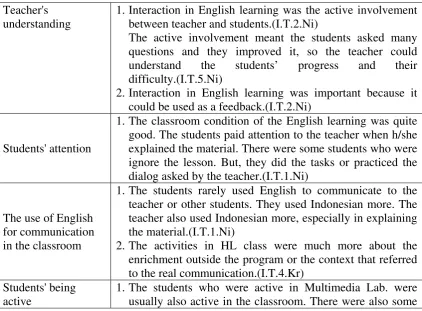
3. The Result of the Interview ………... 41
4. The Result of the Observation ……….... 47
B. Discussion and Interpretation ……….. 57
C. Findings ……… 76
CHAPTER V CONCLUSION, IMPLICATION, AND RECOMMENDATION A. Conclusion ……….. 82
B. Implication ……….. 84
C. Recommendation ………... 85
BIBLIOGRAPHY ... 87
LIST OF TABLES
Table 2.1 Flanders Interaction Analysis Coding Instrument ………... 17
Table 2.2 Research Construct Mapping ……… 27
Table 3.1 Types of Data and Source of Data ……… 32
Table 4.1 Summary of the Teacher Interview ……… 42
Table 4.2 Summary of the Student Interview ……….. .. 45
LIST OF FIGURES
LIST OF APPENDICES
Appendix 1 Observation Guide ……… 89
Appendix 2 Interview Guide ……… 91
Appendix 3 Interview Report Sheet ………. 92
Appendix 4 Summary of the Teacher Interview ………... 106
Appendix 5 Summary of the Student Interview ………... 109
Appendix 6 Observation Report Sheet ………... 111
ABSTRACT
Siti Murtiningrum. 2009. Classroom Interaction in English Learning. Yogyakarta: Graduate
Program in English Language Studies.
Interaction is becoming more and more important in English learning. It is in relation with the need of the ability of the students to communicate in English. Success or failure in classroom language learning typically has something, if not absolutely everything, to do with the nature of interaction that takes place during lessons. Language learning is the result of opportunities for meaningful interaction with others in the target language. Learning to interact in English means learning to communicate in English. Interaction is an important aspect in language learning because it is what people do in daily lives. There is a willingness to cooperate verbally as the part of the interaction.
This research question was what the meaning of classroom interaction in English learning was. It aimed to describe and interpret the meanings of classroom interaction. It would describe what the meanings of interaction were, what the content or message in the interaction was, who expressed the content or the message and to whom it was expressed, how the content or message was expressed, and why the participants did such an interaction with others. It used qualitative research approach. The observation, field note, and open-ended interview were the data collection techniques. The participants were two English teachers and three students. The teachers and the students were observed in their interaction in the English class. The data were presented in the form of descriptive and narrative report.
This research found that the teacher interacted with the whole class by accepting feeling, praising or encouraging, accepting or using ideas of students, asking questions, lecturing, and giving directions. The teacher interacted with individual students by accepting feeling, praising or encouraging, accepting or using ideas of the student, asking questions, lecturing, giving directions, reminding noisy students, and helping the student’s work. The student interacted with the teacher by giving response to the teacher’s questions, and giving initiation. The students’ silence often happened when they were asked by the teacher. The student did not directly answer or respond to the teacher’s questions. The interaction among the students happened most of the time. In relation to the English lesson, the students interacted with their friends by talking about the activity asked by the teacher, discussing the teacher’s questions, and asking about difficult words or expressions.
The results of this research were in the form of description and interpretation of the meaning of interaction. It enriched the knowledge in English Education Studies. It also gave better understanding for the students, teacher, other language learners and the researcher herself. For teachers, it would be useful as one of the references in applying the teaching method in class to get maximum result in English interaction in classroom. For students, it would be used as a reflection to make a better improvement in their participation in class and to interact more meaningfully. Interaction was not just the action of the language learners. It was an active process. There were willingness, awareness, intention, emotion, creativity, and feeling of relax in it. In the classroom, both the teacher and the students should have the willingness to participate in the interaction.
ABSTRAK
Siti Murtiningrum. 2009. Classroom Interaction in English Learning. Yogyakarta: Graduate
Program in English Language Studies.
Interaksi merupakan hal yang semakin penting dalam pembelajaran bahasa Inggris. Hal ini ada hubungannya dengan kemampuan siswa untuk berkomunikasi dalam bahasa Inggris. Kesuksesan atau kegagalan dalam pembelajaran bahasa di kelas ada hubungannya dengan kealamiahan interaksi yang terjadi selama pembelajaran. Pembelajaran bahasa merupakan hasil kesempatan interaksi bermakna menggunakan bahasa target. Belajar berinteraksi dalam bahasa Inggris berarti belajar berkomunikasi dalam bahasa Inggris. Interaksi menjadi aspek yang penting dalam pembelajaran bahasa karena inilah yang dilakukan orang dalam kehidupan sehari-hari. Ada kemauan untuk berkooperasi secara verbal sebagai bagian dari interaksi.
Pertanyaan penelitian ini adalah apa makna interaksi kelas dalam pembelajaran bahasa Inggris? Penelitian ini bertujuan untuk mendeskripsikan dan menginterpretasikan makna interaksi. Ini akan mendesdripsikan apa makna interaksi, apa isi pesan interaksi, siapa yang menyampaikan pesan dan kepada siapa ini disampaikan, bagaimana pesan ini diekpresikan, dan mengapa partisipan berinteraksi seperti itu. Penelitian ini menggunakan pendekatan penelitian kualitatif. Observasi, catatan lapangan, dan interview digunakan untuk mengumpulkan data. Partisipannya adalah dua orang guru bahasa Inggris dan tiga orang siswa. Para guru dan siswa tersebut diamati dalam interaksi mereka di dalam kelas pembelajaran bahasa Inggris. Data dipresentasikan dalam bentuk deskriptif dan naratif.
Penelitian ini menemukan bahwa guru berinteraksi dengan keseluruhan kelas dengan memahami perasaan, menghargai atau memotivasi, menerima atau menggunakan ide siswa, memberi pertanyaan, menjelaskan, dan memberi petunjuk. Guru berinteraksi dengan siswa secara individu ketika memahami perasaan, menghargai atau memotivasi, menerima atau menggunakan ide siswa, memberi pertanyaan, menjelaskan, memberi petunjuk, mengingatkan siswa yang ramai, dan membantu pekerjaan siswa. Siswa berinteraksi dengan guru ketika merespon terhadap pertanyaan dan petunjuk guru, dan mengajukan pertanyaan (seperti pertanyaan tentang tulisan yang tidak jelas, petunjuk pengerjaan latihan, atau kata-kata sulit). Kondisi diam (silence) siswa terjadi ketika siswa diberi pertanyaan oleh guru. Siswa tidak langsung menjawab ketika ada pertanyaan dari guru. Interaksi antar siswa terjadi paling sering. Dalam hubungannya dengan pembelajaran bahasa Inggris, interaksi antar siswa terjadi ketika membicarakan tentang latihan yang ditugaskan guru, berdiskusi tentang pertanyaan guru, dan bertanya tentang kata-kata sulit.
Hasil penelitian ini dalam bentuk deskripsi dan inetrpretasi makna interaksi. Ini akan memperkaya pengetahuan dalam ilmu pendidikan bahasa Inggris Ini juga memberi pemahaman yang lebih baik kepada siswa, guru, pembelajar bahasa yang lain, dan peneliti sendiri.. Bagi guru, ini akan bermanfaat sebagai salah satu referensi dalam menerapkan metode mengajar di kelas untuk dapat memperoleh hasil maksimal dalam interaksi berbahasa Inggris di kelas. Bagi siswa, ini akan digunakan sebagai refleksi untuk meningkatkan partisipasi mereka di kelas dan berinteraksi dengan lebih bermakna. Interaksi tidak hanya tindakan pembelajar bahasa. Ini sebuah proses aktif. Terdapat unsur kemauan, kesadaran, tujuan, emosi, kreatifitas, dan perasaan rileks di dalamnya. Di dalam kelas, sebaiknya guru dan siswa mempunyai kemauan ini untuk berpartisipasi dalam interaksi.
CHAPTER I
INTRODUCTION
This chapter discusses the background of the study, the problem identification, the
limitation of the problem, the research question, the research goals and objectives, and the
research benefits.
A. Background of the Study
Interaction is becoming more and more important in an English learning. Success or
failure in classroom language learning typically has something, if not absolutely everything,
to do with the nature of interaction that takes place during lessons. Interaction has an
important role to play in developing a learner’s ability in that language. By interaction, a
learner will engage with the language and master it.
Mastering a new skill needs our active participation in it and our reflection on what we
attained. Experience and reflection teach more than any manual or lecture ever could. In
learning a skill, we do some practice, see the consequences of that practice, and choose either
to continue or to take a new and different practice. It also happens in learning to communicate
in English. Learners do some practice to communicate in English. They see the consequences
of the communication. Finally, they choose either to continue or to take a new and different
form of communication.
In the classroom, the teachers and the students are the language learners. The teachers’
experiences in language learning influence what and how they teach in the classroom. The
students’ experiences in language learning also influence what and how they learn the
the meaning of interaction in English learning, how they experience the interaction, how they
interpret it, and how they actualize themselves through interaction. It also investigates how
classroom interaction develops the participants’ personal development in English learning.
A successful language learner should be able to use the language in meaningful
interaction to others. S/he is able to understand the other’s speaking. S/he is also able to
express her/his own ideas or opinion. S/he is also able to respond the other’s speaking.
Language learning is not a result of the transmission of facts about language or from a
succession of rote memorization drills. It is the result of opportunities for meaningful
interaction with others in the target language (Walqui, 2000).
Interaction is the essence of communication. Learning to interact in English means
learning to communicate in English. Interaction becomes an important aspect in language
learning because it is what people do in daily lives. They may talk, challenge, interrupt, or
query each other. There is a willingness to cooperate verbally as the part of the interaction. In
the classroom, both the teacher and the students should have the willingness to participate in
the interaction.
English is one of the adaptive subjects in Vocational Schools. The goal of the English
subject is to provide the students the English communication skills in the communication
material context needed for their vocational program, both orally and written. Communication
skill is one of the students’ competencies that the students must master in Vocational Schools.
It is as their preparation to be able to work effectively and efficiently. It also prepares for
further education level based on the vocational programs (Vocational School Curriculum,
2004). English subject provides the students' communication ability in their life as needed in
globalization era and provides the students to develop communication ability to higher level.
Vocational Schools graduates, who are prepared for employment, need this ability. The lack
Language learning is a process that involves both an individual and context as the
main elements. An individual is the learner her/himself. The context is the events and
community where the language learner is struggling to achieve communicative goals through
the means of the target language. Learners’ experience is another aspect that also plays an
important role in their language learning.
The goal of language learning based on the Vocational School Curriculum in 1994 is
the learners’ ability to communicate using the target language (in this context, English). The
essence of the communication is meaningful interaction. In interaction, a learner understands
others’ speaking, expresses his/her own ideas or opinion, and responds others’ speaking by
talking, challenging, interrupting, or querying. A learner also has a willingness to cooperate
verbally.
The understanding of the meaning of interaction may vary from one language learner
to another. This factor influences how the learners actualize themselves in interaction. It is a
need to do a research in describing and interpreting the meaning of interaction. The
description and interpretation will figure out the real interaction completely with the factors
underlying it. It is the understanding of the meaning of the interaction that based the real
interaction that happened in the classroom.
B. Problem Identification
A communication process in the classroom is similar with the one in other settings.
But, the function and pattern of the classroom communication is unique. Its primary goal is
information sharing among teacher and students.
Interaction is a necessary component in communication. The communication is in the
form of intrapersonal, interpersonal, group, and cultural. The participations and/or roles of the
quality of teacher-student interaction are affected by the communication climate in the
classroom (Barker, 1982: 14).
Intrapersonal communication takes place within the individual. In classroom, there are
two forms of the intrapersonal communication. Those are teacher to self (within a single
teacher) or student to self (within a single student). Interpersonal communication involves two
individuals. The forms of the interpersonal communication are teacher to student, student to
teacher, and student to student. Group communication involves communication between the
teacher and several students, between several students and the teacher, or between a single
student and several students. Cultural communication is the most abstract form of classroom
communication. In the classroom, the culture communicates to the teachers as well as to the
students. The influence of culture is also found in group, interpersonal, and intrapersonal
communication. Culture contains moral values, ethical consideration, and educational values
which affect perception of the communication setting (Barker, 1982: 8-14).
Classroom interaction needs the participation of both the teacher and the students. The
teacher’s role is most important in designing tasks and monitoring the process of doing it.
Whether by whole class discussion or small groups, teacher can do much to create an
interactive classroom. Students need to think, speak, and be listened to as they participate in
the classroom. Students will not get enough practice just by talking to the instructor, and very
little by just listening to the instructor. They need to practice with other students in the
classroom. They develop competency and become critical thinkers in classroom that provides
opportunities for intensive, structured interaction among students (Bishop, 2000).
Interaction involves both social and personal input, and, forms the basis of the vast
majority of everyday talking done by natives. Interaction involves the emotions; creativity;
agreement; disagreement; people waiting patiently to get in a word; sighing, nodding,
Interaction is not limited in the form of verbal response. A non-verbal interaction may
also happen. Another possibility is the combination between verbal and non-verbal
interaction. As the response to the teacher, students may answer by saying words expressing
their idea, agreement or disagreement. It can also be in the form of written. Students may also
give response by nodding, eye-contact, facial expressions, gesturing, etc. Students can also
give response by gesturing followed by saying some expression (Willson, 1999).
In the English class, many students use Indonesian language to communicate with
friend(s) and/or the teacher. Some of them try to use English. Some others mix between
Indonesian and English. It also happens to the English teacher. In classroom, some teachers
use English all the time and some use English mixed with Indonesian.
In the classroom, the content of the communication among the students or between the
teacher and the students can be about English subject, other subject (non English), or other
topics. Students also communicate about the current issue or news. A various information is
probably shared in the English class.
C. Problem Limitation
In the classroom, the main goal of the interaction between the teacher and the students
is transferring knowledge or information. Interaction is the heart of communication (Douglas,
2001: 165). The channel used in communication can be in the form of verbal or non verbal.
This research is more focused on the verbal communication. The non-verbal communication
is used to support the verbal one.
Verbal communication can be connected to talk. In the classroom, there will be
teacher's and students' talk. Other elements that support the success of transferring knowledge
This research is limited on searching about the meanings of the interaction in English
teaching learning. The meanings are based on the participants’ lived experiences. Experiences
are the personal basis in reflection. In other words, reflection concentrates on what the
experience means to the experiencer. The investigation and discussion are focused on the
students’ process of interaction and how they actualize their meaning of interaction. The
meaning is also related to the real interaction in classroom. The interaction happened in class
is seen in its content, who say the information, to whom it is transmitted, and how it is
transmitted. The content includes the topic, message, or information that is communicated by
the participants in the interaction. How the participants experienced interaction, what
interaction meant to them, what they felt about it, how they did it, what motivated them, and
how they experienced difficulties, failures, success will be discussed. All those result in better
understanding of the teachers and the students. They can understand themselves better to
become more autonomous, empowered, and self-fulfilling in interacting in English learning.
This study used the qualitative paradigm in which interpretive approach was applied to
answer the research question through the narratives of the research participants on interaction.
Classroom observation was used to collect the data. The field note and audio-video recording
were used to help to get a complete data. The observation was written in descriptive and
narrative forms. The participants were interviewed before and after the observation. The result
of the interviews was written in the form of transcript.
D. Research Questions
Interaction is important for students of vocational schools. It will influence their
success in English learning. Due to several constraints of time, availability and accessibility,
this research specifically aims to find answers to the following question:
E. Research Goals and Objectives
In line with the research question, the goals and objectives of this research are as
follows:
1. The goal of this research is to discover and interpret the meaning of classroom interaction
in English learning
2. The objectives of this research are
a. to discover what the interaction means to the students and the teacher
b. to discover the content or message in the interaction
c. to discover who express the content or the message and to whom it is expressed
d. to discover how the content or message is expressed
e. to discover and interpret why the participant(s) do such an interaction with others.
F. Research Benefits
This research describes the meaning of classroom interaction in English learning. It
also describes how the participants experience interaction, what it means to them, what they
feel about it, what motivates them, and how they experience difficulties, failures, and success.
The results of this research give some benefits for English Education Studies, English
teachers, and students.
In relation with the English Education Studies, there are some benefits. Firstly, it is
useful as reference in determining the teacher’s teaching plan before coming into classroom.
The plan influences the success of the teaching-learning. Secondly, it enriches the knowledge
about the meaning of interaction as it is reflected in the real interaction that happened in the
English learning in classroom. Thirdly, it is useful for further research about the application
of an effective method to get maximum result of learning, especially in learning to
For English teachers, the result of this research enriches the teachers’ knowledge
about the meaning of interaction as it is reflected in the real interaction that happened in
English class from the participants’ point of view. It can be used as one of the materials in
determining the teaching-learning plan. It can be used as one of the references in applying the
teaching method in class to get maximum result in English interaction in classroom.
Students use the result of this research as a reflection to make a better improvement in
their participation in class and to interact more meaningfully. The result of this research also
helps the students understand more about the meaning of classroom interaction in relation to
CHAPTER II
LITERATURE REVIEW
In this chapter, the researcher will present the theoretical review related to the
research. It will discuss the interaction and communication, learning and language learning,
communicative language teaching, Vocational High School, and some related studies. It will
also discuss about the researcher's framework of thinking that will be presented in the
theoretical framework.
A. Theoretical Review
1. Interaction and Communication
Interaction is synonymous with the learning process itself (Allwright, 2008).
Interaction develops the learner’s ability of a language. By interaction a language learner can
get more opportunity to use language successfully. Interaction also measures the learners’
progress. .
Interaction is the hearth of communication (Douglas, 2001:165). It is in the interaction
what communication all about is found. It can be in the forms of sending messages, receiving
them, interpreting them, or negotiating meanings.
Communication plays a central role in all classroom activities. Classroom
communication is similar to other communication forms. But, the classroom communication
differs as a function of unique purposes, environment, and participation forms.
The classroom communication involves some components. They are: the originator,
encoding process, transmission, message, channels, communication climate, interference,
The originator is the sender of the message, that is, teacher or students. Encoding
process is the process of transforming the message into appropriate words or movements.
Transmission is the process of sending message through specific channels. Message carries
meaning from originator to responder via words or movements. Channels are the pathways on
which messages travel – usually light or sound waves. Communication climate is the total of
social, hereditary, and personal influences which affect both originator and responder's
communication behavior.
Interference is the noise in the communication system which alters or changes
meanings of the message. Reception is the process of receiving the message by eyes, ears,
nose, and so on. Decoding is the process of transferring the raw aural or oral stimuli into
meaningful thought, or word symbols.
The responder is the person or persons who are the destination of the originator's
message. Feedback completes the communication cycle by sending messages back from
respondent to originator indicating that the message was received and/or understood (Barker,
1982: 3-8).
The nature of the classroom communication is affected by the components above. The
components also make the classroom communication differs from other communication
forms. The students' way of communication with their teacher outside the classroom differs
with the one inside the classroom. The communication among the students outside the
classroom also differs with the one inside the classroom. The classroom communication has a
very specific characteristic.
Students' communicative abilities are enhanced when they interact with each other
through oral or written discourse (Douglas, 2001: 48). Students can read or listen to authentic
to which the intended message received is the factor of speaker's production and listener's
reception. Most meaning is a product of negotiation of give and take.
In an interactive classes, there are some activities that can be found, such as doing a
significant amount of pair work and group work, receiving authentic language input in
real-world contexts, producing language for genuine, meaningful communication, performing
classroom tasks that prepare them for actual language use "out there'', practicing oral
communication through the give and take and spontaneity of actual conversations, and writing
to and for real audiences, not contrived ones. In the activity, students use the language in real
communication to others (Douglas, 2001: 48).
In the classroom interaction, teacher and students have a reciprocal effect upon each
other through which they say and do in the classroom. This aspect succeeds the transmission
of the messages between teacher and students (Metelo, 2006). The teacher and students are
not separate parts in the classroom. They are tied together.
In the classroom, the purpose of the teachers is teaching a language. Teachers mainly
focus on the verbal interaction or communicative interaction (Cummins, 1994 in Abarca,
2004). They do not separate the nonverbal interaction that presents. The nonverbal interaction
is used to support the verbal one. Students are normally expected to take an active role in the
class. They show their mastery of the language by performing it.
Meaningful interaction with others in the target language in the classroom is much
more important in language learning. The language learning is supposed to conduct activities
to get the meaningful interaction for the language learners. Lecturing and recitation are not the
most appropriate modes of language use in the second language classroom. Teachers need to
move toward more richly interactive language use, such as that found in instructional
conversations and collaborative classroom work (Walqui, 2000). Chet Meyers in Bishop
class with a controversy or problem, use silence to encourage reflection, arrange and use
classroom space to encourage interaction, and create a friendly environment.
Counihan (1998) states that interaction happen when the whole class is engaged in a
group conversation. Interaction can involve the teacher but it must involve the second
language. Interaction happens when the second languages direct the dialogue at one another
and not at or through the teacher; the second languages comment immediately on what
another second languages just said; the second languages disagree with or challenge another
second languages’ statement; the second languages don’t have to be invited (by the teacher) to
speak; the second languages speak when there is a short silence indicating the end of someone
else’s turn; the second languages interrupt one another, diplomatically, to insert an opinion or
question, etc; the second languages use the personal pronouns “I” and “You”; they use
paralinguistic, such as exclamations, gestures, body language and so on; and the second
languages are as relaxed as possible.
Most activities in the classroom are instructed by the teacher. The teacher has an
important role in designing the activities or task. The activities in the classroom can be
categorized into three basic forms (Nuthall and Snook in Barker, 1982: 58): individual work,
extended discourse, and interactive discourse.
In individual work, the student works on his or her own. Individual work accounts for
between 25 and 45 percent of all class time. The teacher talks, performs, demonstrates, or
exhibits materials in the extended discourse. It accounts for between 18 and 22 percent of all
class time. In an interactive discourse, the teacher and students are talking with each other.
The degree of teacher control varies. Interactive discourse accounts for between 34 and 53
percent of all class time
In an interactive discourse, the teacher and students talk with each other. It means that
students listen. Both the teacher and the students talk with each other. The teacher interacts
effectively with the students. The teacher can also give time to students to talk to their friends.
The interaction between the students and students also happens.
Quality of classroom communication is one of the variables that affect the level and
type of achievement – that is, the degree to which the student acquires specified knowledge,
skills and/or attitudes (Barker, 1982: 64). The classroom communication is an interactive
activity of the teacher and the students during an academic term. The primary goal of
classroom communication is information sharing among teacher and students. The vehicles of
the transmission of communication can be intrapersonal, interpersonal, group, and cultural
communication.
Intrapersonal communication takes place within the individual. It ranges from
thinking, mediating and reflecting to talking aloud to oneself or writing oneself a memo. The
forms of the intrapersonal communication are teacher to him/herself (within a single teacher)
or student to him/herself (within a single student).
Interpersonal communication involves two individuals: an originator and a responder.
The forms of the interpersonal communication are teacher to student, student to teacher, and
student to student. Both the originator and responder often change roles several times within a
communication incident. The originator will initiate a message, the responder will reply, and
the originator, in effect, may then respond to the feedback of his initial message. This implies
that the responder must be an active participant in the communication.
Group communication involves communication between the teacher and several
students, between several students and the teacher, or between a single student and several
students. The distinction between the interpersonal and group communication is that
two students, whereas group communication occurs between many students and the teacher or
among several students.
In cultural communication, the originator of the message is often unknown; it can be
in the forms of laws, mores, folkways, or art. In the classroom, the culture communicates to
the teachers as well as to the students. The influence of culture is also found in group,
interpersonal, and intrapersonal communication. Culture contains moral values, ethical
consideration, and educational values which affect perception of the communication setting.
Interpersonal and group communications are two communication forms that can be
seen clearly in the classroom. Students can inter act each other most of the time in this form
of communication. Classroom activities that need interpersonal or group communication is
useful to give students chances to interact each other.
In order to understand more about the interaction process in relation with the second
language learning, the following part will discuss about the Input hypothesis that is proposed
by Michael Long, and Krashen.
Long’s discussion is related with the input in the second language learning. Greater
attention to the interactions in which learners are engaged gives more understanding about the
nature and usefulness of input for second language learning. The interaction should not be
seen simply as a one-directional source of target language input. When learners engage with
their interlocutors in negotiations around meaning, the nature of the input might be
qualitatively changed. The more the input is queried, recycled and paraphrased, to increase its
comprehensibility, the greater its potential usefulness as input (Mitchell and Myles, 2004:
159-61).
Krashen differentiates between acquisition and learning in second language learning.
language. Learning is a conscious process; it is more related to knowing certain rules about a
language such as grammar.
There are five main hypotheses proposed by Krashen. Those are the acquisition
hypothesis, the monitor hypothesis, the natural hypothesis, the input hypothesis, and the
affective filter hypothesis.
The acquisition hypothesis states that “Learning cannot become acquisition and that
fluency in a second or foreign language is due to what learners have acquired, not what they
have learned.” (Brown in Shannon, 2005) Second language learners should attempt to acquire
linguistic rules subconsciously and in a natural way.
The monitor hypothesis sates that “Learned system acts as a monitor, making minor
changes and polishing what the acquired system has produced.”(Lightbown and Spada in
Shannon, 2005) Krashen has argued that there are three conditions which are necessary for
monitor use. They include sufficient time, focus on form, and knowing the rule.
The natural order hypothesis states that second language learners “acquire the rules of
a language in a predictable sequence.” (Lightbown and Spada in Shannon, 2005). Even
though some of the rules in a language are easy for the learner to memorize, these rules are
often most difficult for the learner to acquire.
The input hypothesis relates to acquisition not learning. In order for language
acquisition to take place, the acquirer must receive comprehensible input through reading or
hearing language structures that slightly exceed their current ability (Brown in Shannon,
2005). It is essential not to focus on explicit grammatical structures or learning activities but
rather to occupy classroom time with acquisition tasks or activities.
The affective filter hypothesis states that
down when the learner is relaxed or motivated.” (Lightbown and Spada in Shannon, 2005)
The hypothesis makes perfectly good practical sense for instructors. It makes them try and
create a low-stress, anxiety free, and relaxing language learning environment for those people
attempting to acquire a second language.
In relation with the classroom interaction, the types of tasks that promote extensive
negotiation of meaning are convergent, problem-solving tasks in which both partners control
necessary information are more likely to promote negotiation than are more open-ended
discussions. In solving the ongoing communication difficulties, some conversational tactics
such as repetitions, confirmation checks, comprehension checks, or clarification requests are
used. These collaborative efforts are very useful for language learning. By doing the efforts,
the language learners struggle to maximize comprehension and negotiate their way through
trouble spots (Mitchell and Myles, 2004: 167-8).
Interaction is a very complex process that involves many elements. It is an interrelated
process. There are some instruments that can be used to analyze the classroom interaction.
One of the instruments is developed by Ned Flanders. It is called Flanders Interaction
Analysis (Sadker,1988: 170). Using this instrument, the nature and quality of classroom
verbal interaction can be described. The result of the observation using this instrument can
give a picture of who talk in a classroom and the kind of talking that take place.
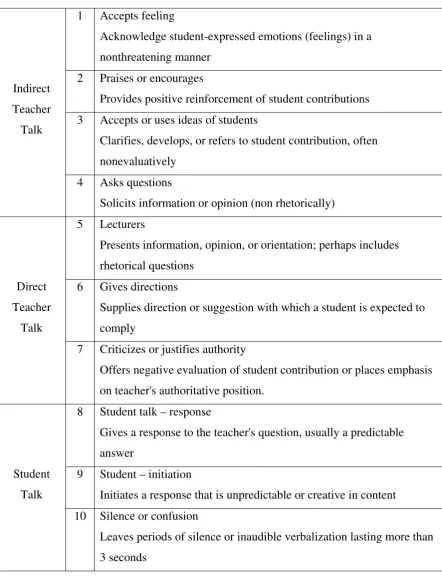
To use the Flanders Interaction Analysis, the verbal interaction is coded in 1 of 10
categories. The following are the 10 categories in the Flanders Interaction Analysis Coding
Table 2.1.
Flanders Interaction Analysis Coding Instrument.
1 Accepts feeling
Acknowledge student-expressed emotions (feelings) in a nonthreatening manner
2 Praises or encourages
Provides positive reinforcement of student contributions
3 Accepts or uses ideas of students
Clarifies, develops, or refers to student contribution, often nonevaluatively
Indirect Teacher Talk
4 Asks questions
Solicits information or opinion (non rhetorically)
5 Lecturers
Presents information, opinion, or orientation; perhaps includes rhetorical questions
6 Gives directions
Supplies direction or suggestion with which a student is expected to comply
Direct Teacher
Talk
7 Criticizes or justifies authority
Offers negative evaluation of student contribution or places emphasis on teacher's authoritative position.
8 Student talk – response
Gives a response to the teacher's question, usually a predictable answer
9 Student – initiation
Initiates a response that is unpredictable or creative in content Student
Talk
10 Silence or confusion
Classroom interaction is a reciprocal and meaningful interaction between the teacher
and students that happens in the classroom. By interaction, learners develop their language
ability. It is in the interaction what communication all about is found. In interactive classes,
students can join a discussion, problem solving tasks, or dialogue journals. The form of the
activities can be pair works or group works. In the classroom interaction, teacher and students
have a reciprocal effect upon each other through which they say and do. Meaningful
interaction with others in the target language in the classroom is much more important in
language learning. The description of the interaction between the teacher and student is seen
from the teacher and student talk. The teacher talks are accepting feeling, praising or
encouraging, accepting or using ideas of students, asking questions, lecturing, giving
directions, and criticizing or justifying authority. The student talks are student
talking-response, student-initiation, and silence or confusion.
2. Learning and Language Learning
According to Rogers’ Humanistic Psychology (Brown, 2000: 89-90), human beings
are able to adapt and to grow in the directions that enhance their existence. In a non
threatening environment, a person will form a picture of reality and will grow and learn. Its
principles have important implications for education. Learning how to learn is more important
than being taught. What is more needed for teachers is to become facilitators of learning
through the establishment of interpersonal relationships with learners.
As facilitators, teachers must be real and genuine, leaving superiority and
omniscience. They need to have genuine trust, acceptance, and a prizing of the student as a
worthy and valuable individual. They need to communicate openly and emphatically with
their students and vice versa. In a process of discovery, students should be allowed to
allowed to engage in critical thinking and to relate everything they do in school to their reality
outside the classroom. Learners understand themselves. They are able to communicate this
self to others freely and non-defensively. S/he must provide the nurturing context for learners.
The context is necessary to construct meanings in interaction. The classroom activities and
materials should utilize meaningful contexts of genuine communication (Brown, 2000:
90-91).
Learning is a process to acquire or get knowledge of a subject or a skill. It can be
fulfilled by studying, experiencing, or instruction. Learning is a relatively permanent change
in behavioral tendency. It is the result of reinforced practice. Learning needs retention of
information or skill. Retention implies storage systems, memory, and cognitive organization.
Learning involves active, conscious focus on and acting upon events outside or inside the
organism. It also involves some form of practice, perhaps reinforced practice (Brown, 2000:
7).
Learning requires more than seeing, hearing, moving, or touching to learn. We
integrate what we sense and think with what we feel and how we behave. Without that
integration, it is just passive. Passive learning does not engage higher brain functions or
stimulate senses to the point where it integrates lessons into existing schemes. Knowledge
needs something to do with it. Passivity needs to be moved to activity. Learners need to
extrapolate from experiences and see how to apply what they have done to new instances
(Kolb, 1984).
Discussing second language learning cannot be separated with discussing about first
language learning. Some aspects that are discussed in the second language learning are also
discussed in the first language learning. Although in some aspects or more, second language
learning is different from first language learning. The aspect that is usually talked about in
predetermined biological timetable. Nurture is formed by teaching. It derives from social and
cultural experiences that influence language learners (Mitchell and Myles, 2004: 12).
School is a community. Students should not be isolated in an uncomfortable desk.
They need to engage in meaningful activities in which they have to work with others on
problems. The best way to learn a new idea is by means of normal communication with
others. Students interact with the teacher and fellow students in purposeful activities or
investigations of common interest (Phillips and Soltis, 1991: 52-3).
Learning is an active process. It needs conscious focus and acting. It can be fulfilled
by studying, experiencing, or instruction. By learning, a language learner acquires or gets
knowledge of a subject or a skill. The process of learning is relatively permanent in
behavioral tendency. In learning, there is an integration of senses, thinking, feeling, and
behaving.
3. Communicative Language Teaching
The types of learning and teaching activities in communicative language teaching are
unlimited. The exercises enable learners to attain the communicative objectives of the
curriculum, engage learners in communication, and require the use of such communicative
processes as information sharing, negotiation of meaning, and interaction. Classroom
activities are designed to focus on completing tasks that are mediated through language or
involve negotiation of information and information sharing (Richards and Rodgers, 2001:
165).
The emphasis is on the processes of communication, rather than mastery of language
forms. The role of learner is as negotiator - between the self, the learning process, and the
object of learning. It emerges from and interacts with the role of joint negotiator within the
teacher has two main roles: first, to facilitate the communication process between all
participants in the classroom, and between these participants and the various activities and
texts; second, to act as an independent participant within the learning-teaching group
(Richards and Rodgers, 2001: 166-7).
In the communicative language teaching, there is a set of principles about the goals of
language teaching, how learners learn a language, the kinds of classroom activities that best
facilitate learning, and the roles of teachers and learners in the classroom (Richards, 2005: 1)
The goal of language teaching in the communicative language teaching is
communicative competence. It includes some aspects of language knowledge: the knowledge
in using language for a range of different purposes and functions, the knowledge in varying
our use of language according to the setting and the participants, the knowledge in producing
and understanding different types of texts, and the knowledge in maintaining communication
despite having limitations in one's language knowledge (Richards, 2005: 2)
Richards (2005:3) states learning a language in the communicative language teaching
is the result from the process of, such as, interaction between the learner and user of the
language, collaborative creation of meaning, creating meaningful and purposeful interaction,
negotiation of meaning, learning through attending to the feedback learners get when they use
the language, paying attention to the language one hears and trying to incorporate new forms
into one's developing communicative competence, or trying out and experimenting with
different ways of saying things.
The use of pair work activities, role plays, group work activities, and project works are
the kinds of classroom activities in the communicative language teaching. Learners have to
participate in classroom activities rather than individual approach. They listen to their peers in
group work or pair work tasks, rather than relying on the teacher for the model. The teacher
The use of English in communication in non-native speaker countries is limited on
specific contexts and speakers. Not all people can communicate in English. Also, not all
public terms use English. English can be used effectively in certain society with certain
speakers. An Indonesian person who is very fluent in English cannot communicate to all
people in English. It is impossible for him/her to bargain in the market using English. It is
also impossible for him/her to ask for help using English in a public service. English learning
in classroom is on of the efforts to meet the need to have an atmosphere and context that
stimulates the students to interact in English.
4. Vocational High School
Levels of education in Indonesia are divided into elementary school, junior high
school, senior high school, and university. Each level has its own characteristic, considering
the growth or age of a person.
The senior high school consists of two types: the public school and the vocational high
school. There are some similarities and also differences between them. The similarities are
mostly concerned on the age. Students of public and vocational high school are on the average
age of 14-17. The number of students in each class is nearly the same: around 30-40 students.
On these age of 14-17, students are very active in finding out who actually they are.
They will search from many sides and point of view. They will also want to show to others
that they have ability, responsibility, and adult-like. These can be seen from their attitude and
aptitude. They are critical and creative. They do not like to be treated as children, that
everything is instructed and fully protected.
These psychological aspects should be considered in learning. The learning or class
activity are adjusted with the aspects, so students will enjoy the process of learning. It is in
The subjects that are taught in public school are general and theoretical. They are
taught as the basic knowledge that will be continued in higher level or universities. The
students are prepared to continue their study. They are given various materials that can open
their mind and interest. It is the interest that will lead then to study further. English, in public
school, is contextual based. Students study English using texts from various field.
In vocational high school, the subjects are more specific and practical. They are
related with the future job. The portion of the lesson is much more on the practice than on the
theory. Students are prepared to have skills in work, not continue to higher level. Students are
trained with many practical lessons both in class and in industry. English is taught to make
students able to communicate. It is related with their specific future job. English is, hopefully,
used in communication with others.
B. Related Studies
This part will review some related studies in the same field, that is, classroom
interaction. Classroom interaction can be studied in a variety of contexts across the age range
from pre-school to higher education, in a variety of subject learned, or in the methodology
used.
A study done by Abarca (2004) described the interaction process that took place in an
English as a Foreign language (EFL) classroom at a public high school in the province of
Alajuela, Costa Rica. The result of the study showed that the teacher-student interaction and
student-student interaction is based on a question and answer pattern. The teacher regulates
and limits students' participation through the use of different activities which do not stimulate
meaningful learning. Students interact among themselves by using Spanish. The study
An action research done in one class of Japanese adult English learners was done by
Snell (1999). The students in the class were unresponsive and avoid interaction with the
teacher. They didn't respond voluntarily to the instructor's questions and did not participate in
class discussions. They also never asked the teacher questions outside one-on-one situations.
The teacher received little oral feedback. The teacher wanted the students to be more
demonstrative and more overtly communicative in their feedback. He wanted them to ask
questions make comments, and to respond with nods and shakes of the head, with sounds of
agreement or sounds of understanding. He wanted them to be both reactive and proactive.
Based on the preliminary investigation, the students seemed to generally understand
the teacher's questions. It was felt that there was something else that kept the students from
responding voluntarily in the class-teacher dialogues. The hypothesis of the research was that
by teaching the students that class interaction with the English teacher is not only acceptable,
but normal, useful, and beneficial, it was believed that the students would become more
interactive with the teacher in teacher-class interaction.
Following the hypothesis, two steps were taken to implement a plan: (1) the teacher
distributed an explanatory paragraph about "rules" for asking questions in class in English
speaking countries, (2) the teacher reminded the students of the "rules" at the beginning of
each subsequent class and further encouraged them to become more active in the class when
the instructor was talking.
In conclusion, some progress was definitely made. The students did interact with the
teacher by nodding, some did answer the instructor's questions, and on their own initiation,
even asked questions before the class. There seems to have been some success in instructing
and reminding and then expecting the students to become more interactive with the teacher.
ESL teachers in Japan are not just teaching a language, but also a culture, and this includes
A study about classroom interaction that used Flanders Interaction Analysis was done
in Pakistan by Inamullah (2005). The main objective of the study was explore patterns of
classroom interaction of secondary and tertiary levels in the North West Frontier Province of
Pakistan using Flanders Interaction Analysis (FIA) system. This study was significant because
its findings and conclusions may stimulate teachers to improve their teaching behavior in
order to maximize students' learning.
FIA system was designed to categorize the types and quantity of verbal interaction in
the classroom and to plot the information on a matrix so that it could be analyzed and
interpreted. The result gave a picture as to who was talking in the classroom, how much and
kind of talking that took place.
It was concluded that both at secondary and tertiary level, more than two-third of
classroom time was devoted to talking, thus talk method dominated in classes. More than
two-third of the classroom talking time was devoted to teachers talking at secondary and tertiary
levels, the teachers played the dominant role.
Other studies were conducted about classroom interaction in relation to other factors,
such as motivation (Chiang, 2000); gender, academic dominance, and teacher communication
style (Ilatov et.al., 1998); high and low achievers (Wilson, 1999); and, achievement
(Caruthers).
By reviewing those studies, this research can be placed on. This research is in one
variety in context of the learner. The learners are Vocational School students in Indonesia.
The subject learned is English. The focus is analyzing the verbal interaction but it does not
left the non verbal one. The non verbal interaction is used to support the verbal interaction.
The verbal interaction is analyzed using Flander's Interaction Analysis system. It is used to
categorize the types of the verbal interaction, to get the picture of who is talking in the
emergence categories. This research describes and interprets the meaning of interaction based
on reflection. It goes deeper than the action of the interaction itself. The understanding of the
meaning of interaction is the basis of doing the interaction.
C. Theoretical Framework
The understanding of the meaning of interaction can be reached from some aspects. It
can be seen from the definition, the characteristics, the roles of the language learners, and the
categorization.
Classroom interaction is a complex process in the class that is influenced by some
factors: the teacher, the students, or the classroom environment. Effective interaction is
needed in the second language learning. It is related with the use of the language to
communicate. The teacher and the students use the language actively in communication in the
classroom. Both the teacher and the students feel comfortable in expressing their information,
knowledge, ideas, opinion, or anything using the language.
Two important participants that determine the success of the teaching-learning are the
teacher who has effective teaching behavior and students who have good response to
classroom activities. The teacher and students build the effective interaction in the classroom.
The successful message or content transmission between teacher and students is the
goal of the classroom interaction. The message can be transferred verbally or non-verbally.
One of the factors that cannot be avoided is a unpredictable destructor that is found in the
classroom environment. Both the teacher and the students cannot avoid the destructor. What
they can do is try to minimize the effect of the destructor in the goal of the teacher-students
interaction.
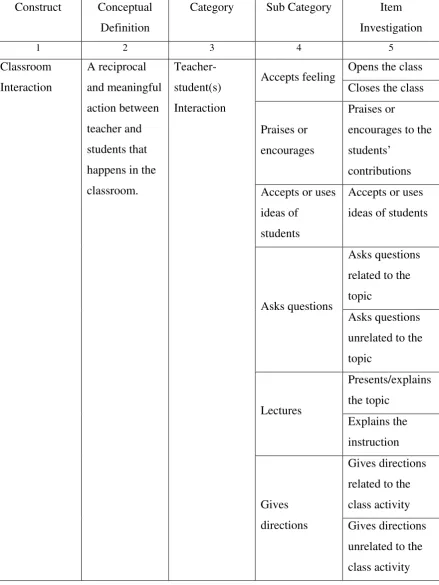
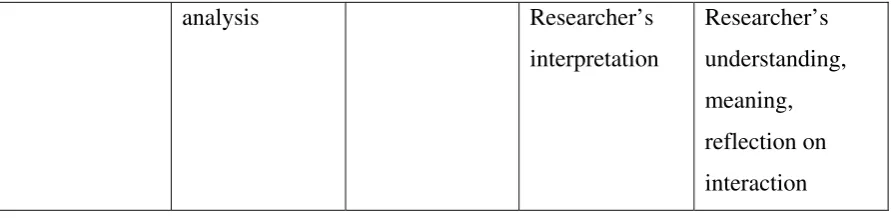
The research construct mapping is summarized in the Table 2.2. It contains the
experience, and narrative research. It is followed by the conceptual definition, category, sub
category, and item investigation.
Table 2.2
Research Construct Mapping
Criticizes or
response Gives response to the questions
Learning A process to
analysis Researcher’s interpretation
Researcher’s understanding, meaning, reflection on interaction
The interrelationship between the constructs of this research can be seen in the Table
2.2. The themes used in the discussion and interpretation are presented in the column 4 of the
Table 2.2. Later, these themes are added with the emergent themes. Those are the themes that
are not captured in the research construct mapping but they emerge in and affect the
classroom interaction. The general themes are teacher-student(s), student-teacher, and
student-student(s) interaction. The teacher-student(s) interaction contains accepts feeling,
praises or encourages, accepts or uses ideas of students, asks questions, lecturers, gives
directions, and criticizes or justifies authority. The student-teacher interaction contains student
talk-response, student initiation, and silence or confusion. The student-student(s) interaction
contains student initiation and silence or confusion.
CHAPTER III
METHODOLOGY
The purpose of this narrative interpretive study was to describe the meaning of
interaction for teachers and students at a vocational school. It described how the participants
experienced interaction, what it meant to them, what they felt about it, what motivated them,
and how they experienced difficulties, failures, and success.
This chapter would discuss the methodology that would be used to answer the
research question. It would present the research method, the nature of the data, the data
sources, the data collection, and data processing/analysis and interpretation.
A. Research Method
This research looked deep into one specific real phenomenon, that was, classroom
interaction. It tried to understand the participants and help their problems. It used the
qualitative research approach (Holliday, 2002: 6). This approach was used because it was the
suitable approach in researching about behavior. It was in line with this research that it would
observe the interaction between the teacher and the student(s) in the classroom. It would go
deeply to understand their belief, why they did that, and helped their problems.
B. Nature of Data
In qualitative research, data is what happens in a particular social setting. It can be in a
particular place or among a particular group of people. There are two broad categories of data.
The first category is what the researcher describes: description of behavior, description of
The second category is what participants say, write, or have about them. It includes account,
talk, behavior in setting, and document (Holliday, 2002: 69-72).
Holliday (2002) regards interviews as the main data. The observation notes (field
notes) are another type of data. In the observation notes, the description of behavior, event,
institution, appearance, account, talk, behavior in setting, and document are expected to enrich
the data source for qualitative research.
There could be several ways of interviewing people, but in qualitative research
interviews can be conducted face-to-face, by telephone, or focus group interviews with
unstructured and open ended questions (Creswell, 2003). This gave more freedom for the
research participants to tell their stories, express their feelings, thoughts, perspectives,
expectations, despair, failure, and success.
Types of data and source of data of this research were summarized in the following
table. It was adapted from Holliday Model (Holliday, 2002).
Table 3.1.
Types of Data and Source of Data
Types of data Definition Source of data Result Function
Description of behavior
What people are seen or heard doing or saying
Research participants
Observation notes, reflective notes
(researcher’s thought, feeling, impressions, hunches, ideas), photographs, videos
Description of visual setting
Description of events
Place of behavior,
Research participants
Observation notes, reflective
C. Data Sources
There are several inquiry approaches in qualitative research. They are ethnographies,
grounded theory, case studies, phenomenological research, and narrative research (Creswell,
2003). This research was a narrative one. The researcher studied the participants’ lives and
asked them to provide stories about their lives. The information was then retold by the
researcher into a narrative chronology. The narratives from the participants’ lives were
combined with the narratives of the researcher in a collaborative narrative.
To get the data, the researcher came into the classroom to observe the class activity.
How the teacher and the students (as the participants) interacted in the English class was
observed. The field note and audio-video recording were used. The observation was written in
the descriptive and narrative forms of report.
Interviews were done before and after the observation. The interviews were recorded.
The field note was also used to make notes for the important points. The field note and
recorded interviews were very important in transcribing the data. The interview done before
observation was used to get the teacher's and student's understanding, believe, opinion, and
experience. The open-ended interviews done after the observation would be related to what
they did in the English class, what and how they communicated each other, and why they did
or acted like that.
The observations in classroom would observe the interaction between the teacher and
the students in the classroom. By this observation, the researcher would know whether the
students and the teacher did what they have said in the interview done before the observation.
The observation was also recorded. The researcher also made field note.
To get the validity of the research, triangulation was needed. Triangulation could be
1994:241 in Holliday, 2002: 76). In this research, the triangulation could be figured out in the
following figure:
Figure 3.1 The Triangulation
The phenomenon was what happened in the classroom as the interaction among the
teacher and the students. It was seen from three sides: interview A (it was the interview done
before the observation), classroom observation, and interview B (it was done after the
observation). After the interview B, it was followed by the next observation. So, the interview
and the classroom observation was done one after another.
The data were taken in SMK "P" Sleman. It took one class at the second level in the
automotive study program, that was 2OB. The choice of the setting was based on its richness
and accessibility.
The choice of the second level was based on the discussion between the researcher and
the school principal. The researcher told the school principal about her research, what she
would do, and what she needed as the data. This research would take a period of time, not
only one or two meetings. The researcher would follow the classroom activity whether it was Interview A
Classroom Observation
Interview B
in the classroom or in the English laboratory. The first level students were not quite ready to
be taken as the subject because they were 'new comers' in the school. The third level students
were quite busy preparing the National Examination. So, the coming of the researcher in their
classroom was worried would 'disturb' them. Finally, the school principal gave the chance to
take the second level as the subject..
The choice of the class was based on the discussion between the researcher and the
English teacher. The researcher discussed with the English teacher about her research then the
English teacher suggested her to take the data in class 2OB. The English teacher also took
part in the choice of the students as the participants.
The participants of this research were two English teachers and three students. The
teachers were Mrs. Nissa and Mr. Kris. Mrs. Nissa was the teacher from the school. She had
taught in the school for two years in the second level. Mr. Kris was the teacher from "HL" (a
private English course which was incorporated with the school). He had taught for one year.
The students were Sugi, Imam, and Heru. They were from the same class. Sugi was
quite clever and diligent in class. He didn't talk much but he was diligent in doing the class
activity. He often helped his friends. Imam was a diligent student, too. He was much more
talkative than Sugi. He always sat at the front raw. Heru was very silent. He almost never
talked in class. He always sat alone at the back raw. He always did the class activity alone,
but his work was always correct. He rarely asked his friends.
Class 2OB was taught by three English teachers: Mrs. Nissa, Mr. Kris, and Miss Endi.
Mrs. Nissa was the teacher from the school. Mr. Kris and Miss Endi were the teachers from
"HL" (a private English course). The school had joined with this course in English
teaching-learning for 1 year.
Every week, class 2OB had two meetings: Monday (at 12.15 – 13.45) and Wednesday