* Corresponding author.
MONTE CARLO SIMULATIONS OF Co (II) IN WATER INCLUDING
THREE-BODY CORRECTION
Cahyorini Kusumawardani
a,*, Harno Dwi Pranowo
b, Crys Fajar Partana
a, and Mudasir
b aDepartment of Chemistry Education, Faculty of Mathematic and Natural Sciences, Yogyakarta State University, Karangmalang, Yogyakarta, Indonesia
b
Austrian-Indonesian Center for Computational Chemistry, Chemistry Department, Gadjah Mada University, Sekip Utara P.O. Box. BLS 21, Yogyakarta, Indonesia
Received 9 June 2006; Accepted 27 June 2006
ABSTRACT
In order to describe the cobalt-water interaction correctly, a new ab initio potential was developed consisting of pair interaction terms as well as three-body contributions. Within this approach, it was possible to correct for the well-known failures of pair potentials in describing solvation phenomena of such ions. A first-shell coordination number of 6 in agreement with experimental data were obtained from Monte Carlo simulations of a single cobalt (II) ion in water. The structure of hydrated ion is discussed in terms of radial density functions and coordination number, energy and angular distributions.
Keywords:MC Simulations, cobalt(II), hydration, three-body correction.
INTRODUCTION
The interaction of metal cations with water occurs in a wide variety of physical, chemical and biological phenomena [1]. For example, one-third of all proteins require a metal ion for their structure and/or function [2] and many of these protein-bound metal ions are bounded to at least one water molecule [3]. Furthermore, metalloenzymes are often active only when the metal ion is a specific one, so the knowledge of the solvation structure around the metal ion is very important for quantitative interpretation of the equilibrium and kinetic properties of the chemical reactions concerning the metal ion [4]. Numerous investigations have focused on the structural properties of hydrated ions, which can be classified into three types of methods: scattering methods such as X-ray diffraction (XD) and neutron diffraction (ND), spectroscopic methods such as extended X-ray absorption fine structure (EXAFS) and nuclear magnetic resonance (NMR), and the tools of theoretical chemistry, including a wide variety of different simulation techniques [5]. Computer simulation method have proven to be strong alternative to experiments in particular for investigations where experiments reach their limitations [6-13].
Monte Carlo simulation can be effectively used to calculate hydration structures for aqueous solution of ions, but the problem of the nonadditivity of pairwise ion – water potentials has long been recognized. It is known, however, that the assumption of pairwise additivity can lead to serious errors in the description of ions in water [8,14-16] as well, especially for double charge cations, as a significant part of the many body effects is due to polarization effects [17]. These simplification of the ion-water interaction results in overestimated structural and energetic properties of the solutions. Whenever water is
strongly bound, additional energy contributions arising from charge transfers and induction have to be taken into account. Since these terms are clearly nonadditive, they cannot be covered by pair potentials alone regardless of their quality. Consequently, even rough data as first shell coordination numbers are predicted much higher than that found by experiment as for example in the case of Fe2+[18], Fe3+[16], Be2+[19,20], Ni+ [21,22], and Cu2+ [15,23] In latter case, ab initio studies of successive hydration have indicated that three-body and even higher terms should be of major importance to correctly characterize this ion in water [8, 15,16,18-23].
The problem of the failure of pairwise additivity for cation – water potentials, especially for doubly and triply charged cations, can be dealt with in several ways. In order to limit the computational effort one approach is to define effective pair potentials [24] which consider mean many body effect to a certain extent in an empirical way. For example, simulations performed with the so called ‘nearest-neighbor ligand correction’ (NNLC) algorithm [23,25,26] include, in addition to pair potential terms, a three-body correction term based on ab initio calculations.
In this work, we have systematically studied the role of three-body effect in the hydration of Co2+. On the basis of pair potential newly developed for the Co2+ -water interaction, a three-body potential was generated. Monte Carlo simulations were performed for Co2+in water with and without three-body correction.
EXPERIMENTAL SECTION
Ab InitioPair Potential.
using the LANL2DZ (ECP) basis set [27] for cobalt ion. The 6-31G* from the Gaussian98 program [28] was employed for water whose geometry was kept rigid at a O–H distance of 0.9601 Å and an intramolecular H–O–H angle of 104.4699o [29]. From the calculations, a global minimum of the interaction energy of -84.37 kcal mol-1 has been found for theC2vconfiguration of the Co
2+
-OH2
adduct at a Co-O distance of 2.08 Å. The interaction energies,
E
2b, between cobalt and water have beenevaluated by substracting the ab initio energies of the isolated species of
E
Co2 andE
H O2 from those of the
monohydrates 2
A total 2050 points of the energy surface of the monohydrate have been considered for a representative description. The fitting process performed by the least-squares method according to the Levenberg-Marquart algorithm led to the following function (
E
2b) in analogyto analytical potential functions for hydrated metal ions previously derived as :
riMare distances between the ith atom of the water and Co2+, qiare the net charges of theith atom of the water obtained by Mulliken population analysis and qM is the atomic net charge of Co2+, the final optimized parameters from the function have been showed in Table 1. Weight factors were introduced to give special emphazis; destabilized configurations with energies above 40 kcal mol-1 were excluded. The standard deviation of the fitted values from SCF data was + 1.06 kcal mol-1. Since the Ewald sum [30] takes into account only Coloumbic interaction, further long-range contributions would left uncorrected.Three-Body Correction Function
Following the technique for generating the pair potential, first of all the geometry of the system consisting of one cobalt ion and two rigid water molecules has been optimized. The same basis sets as previously mentioned have been employed for cobalt [27] and water [28]. A global energy minimum of -79.38 kcal/mol per ligand together with a bond length enlarged by 0.1 Å in comparison to the monohydrate was found
for theD2hconfiguration clearly revealing the influences of three-body effects. Throughout all these Hartree Fock/Self Consistent Field-Molecular Orbital (HF/SCF-MO) calculations, the dihedral angle between the planes of the two ligands has been kept fixed at its optimized value of 90o. A total of 2250 configurations have been calculated in this way. The influence of the relative orientation of the hydrogen does not exert much influence on the correction energy and can therefore be ignored. Beside that, energetically unfavourable with hydrogen atoms is closer to the ionic center than the corresponding oxygen need not be considered as their highly repulsive two-body energy values prevent the occurence of such orientations during the simulation process.
The nonadditive three-body terms, E3b, were evaluated by substracting all pair potentials, E2b, calculated with the help of the pair potential functions for cobalt-water and water-water, from the ab initio energies in the following way:
, the first and the second water, respectively. All three-body data points were fitted to an analytical function to be used as correction for the pair potential. Fitting the resulting three-body corrections was performed to a potential function of the type :
where Lidenotes the ith water molecule,
2
r
denotes the distancebetween the center of mass of water Lidan Co
2+
. The parameters of the three-body correction function were obtained by fitting with the Levenberg-Marquart algorithm and the fitted values show a rather large standard deviation of +1,7 kcal mol-1.
Monte Carlo Simulation
A Monte Carlo simulation according the Metropolis algorithm [31] was carried out on the Number, Volume and Temperature (NVT) ensemble for a system consisting of one Co2+ and 215 water molecules using the newly developed two-body
Table 1.Final optimized parameters of the Co2+-H2O analytical pair potential. The atomic net
charges are given in a.u., interaction energies and distances in kcal mol-1and Å, respectively
0
Table 2.Characteristic values of the radial distributions functions g(r) for the Co(II)-water solution; rM1, rM2and rm1,
rm2 are the distances in Å, where g(r) has the first and second maximum and the first and second minimum,
respectively. n(m1) and n(m2) are the running integration numbers integrated up to rm1and rm2, respectively
rM1 rm1 n(m1) rM2 rm2 n(m2)
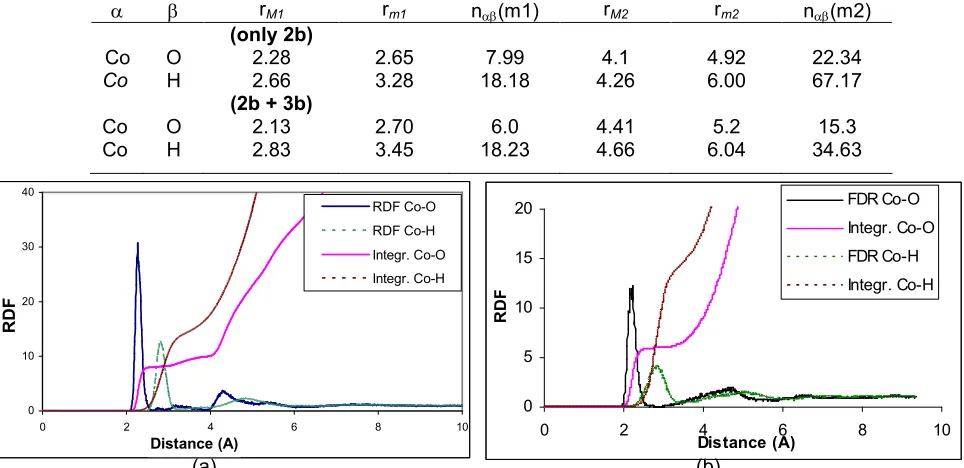
Fig 1. Co-O and Co-H radial distribution functions and their running integration numbers obtained by (a) the pair potential only and (b) contributing the three-body potential
function at temperature 298 K. For water-water interaction, the Closed Field 2 (CF2) potential by jansco and Heinzinger [32] was used as this water model.
Periodic boundary condition and a spherical cut-off at half of the box length were applied. Although the density of 0.997 g cm-3was assumed to be the same as in pure water, the conditions of the system do not refer to an infinitely dilute solution due to the periodicity required. The edge length of the box was 18.72 Å. The starting configuration was obtained by random generation. After 5 million configurations, the system had reached energetic equilibrium. For the evaluation of structural data, especially the radial distributin function (RDFs), a further 3 million configurations were generated and sampled.
A second Monte Carlo simulation was performed for Co2+/H2O system including the three-body potential
function in addition to the pair potentials described above, under the same conditions as simulation with pair potential only.
RESULT AND DISCUSSION
Monte Carlo Simulation with Pair Potential
The RDFs for cobalt-oxygen and cobalt-hydrogen are shown in Fig 1a together with the corresponding running integration numbers and the main results obtained from the RDFs of all simulations performed are
summarized in Table 2. The first hydration sphere of Co2+ is represented by a sharp peak of the Co2+-O RDF, centered at 2.06 Å, 0.8 Å beyond the minimum of the SCF Co2+-H2O potential. The average coordination
number for the first hydration shell integrated up to 2.65 Å is 8. Comparison with the value 6 for the first sphere gained from experimental data [4,5,33,35] reveals that simulations only contributing pair potential cannot be considered adequate tools for describing solutions of higher charged ions. Because of overestimating the cobalt-water interaction energy, the water-water repulsion alone is not sufficient to prevent accumulation of a large number of ligands in the first solvation sphere, even at the price of a moderate enlargement of the Co2+-O distance. Therefore, it appeared obvious to take effects of mutual ligand polarization and induction explicitly into account by introducing separate three-body terms.
The second peak in this function related to the second hydration shell appeared between 3.6 Å and 4.9 Å with a maximum value at 4.1 Å, clearly separated from the first coordination sphere. The Co2+-H RDF shifted to larger distances with respect to the corresponding oxygen peaks indicates that especially in the first shell the water molecules are well oriented to obey the dominant ion-water interactions with their oxygen atoms pointing to the ionic center.
The average coordination number of the second hydration shell is 22. This reveals that ligand
0
Pair interaction energy (kcal/mol)
O
orientation and binding is mostly, but not exclusively determined by hydrogen bonding since on average 2.8 water molecules interact with one ligand of the first shell.
Monte Carlo Simulation Including the Three-Body Correction
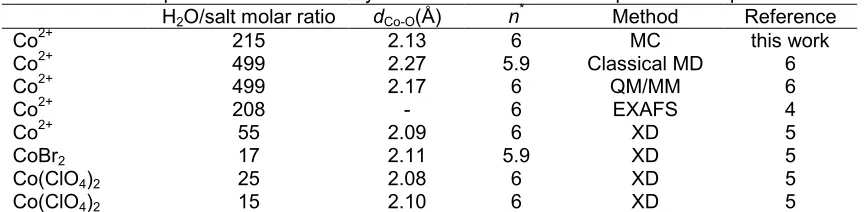
Fig 1b shows the RDFs for Co2+-O and Co2+-H together with the running integration numbers. The peak maximum of the first hydration shell is shifted by 0.07 Å to 2.13 Å, in comparison to the simulation without three-body correction. The second shell peaks are centered at 4.4 Å, 0.3 Å beyond the result of simulation with pair potential only. However, the repulsive three-body potential apparently causes a small shift of the first hydration shell to a larger distance. These results are in good agreement with Co-O distances of the first and second hydration shell determined by theoretical QM/MM and classical MD simulations [6] and obtained by EXAFS, XD and ND experiments [4,5,34,35]. The average Co-O distance obtained from MC simulation including three-body correction (2.13 Å) is only slightly higher than XD (2.09 Å) [5] and EXAFS (2.08 Å) data [4], the difference being probably due to concentration effects. The RDF obtained from the final sampling, just beginning to show water exchange between the first and second hydration sphere, as can be seen in Fig 1b.
The hydration number distribution from simulation contributing the three-body correction is showed in Fig 2.
Fig 2. First- and second shell coordination number distribution of Co2+ in water using the three-body correction
The most important change observed in the average coordination number of 6 for the first hydration shell of Co2+, which agrees with experimental findings [4,5,34,35] and the result of QM/MM and classical MD simulations [6]. Inclusion of three-body term have also reduced the coordination number for second hydration to 15.3, which is closed to the value of 14.8 estimated from XD [5].
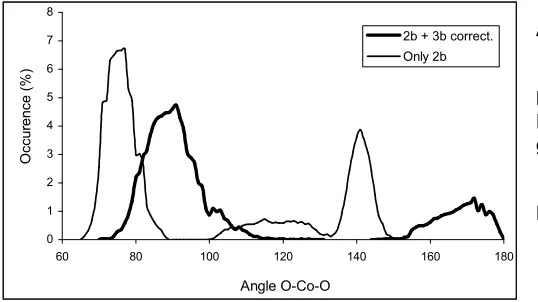
The angular distribution functions (ADFs) of O-Co2+-O angles from both simulations are shown in Fig 3, the expected drastic changes are found after the three-body corrections have been included. In the ADF obtained from the first simulation, most direct neighbours are described by the first peak between 64o and 85o with a maksimum at 74o. The more diffuse peak centered at 115o must also be ascribed to adjacent water ligands whereas the third maximum at 141ocorresponds to one neighbour water (two adjacent water between first and second shell). No angle larger than 151ooccurs in this distribution.
The ADF from MC simulation that includes the three-body potential displays two peaks located at ~90o and ~180o. The first peak is caused by two neighboring oxygens, and is in good agreement with the angle deduced from mass spectroscopic analysis (90o) [4,36]. The second peak culminates at 173o indicating an octahedral arrangement of the water molecules in the first shell of Co2+, in agreement with XD data (Table 3). Peaking at 79oand 173o, the distribution reveals that
Fig 3.Comparison of pair interaction energies of Co(II)-H2O in the first hydration shell obtained from the
simulations with (solid line) and without (dhased line) three-body correction.
0 1 2 3 4 5 6 7 8
60 80 100 120 140 160 180
Angle O-Co-O
O
c
c
u
re
n
c
e
(%
)
2b + 3b correct. Only 2b
Fig 4. Comparison of H2O(1)-Co-OH2(2) angles in the
first hydration shell obtained from the simulations with (solid line) and without (dhased line) three-body correction
the cobalt ion does not form an ideal octahedral complex in water but a rather distorted one whose destabilization favors a rather rapid water exchange as observed in experiments [36] but also during this simulation process.
Energy distributions have been calculated in order to evaluate the impact of three-body effects on the ion-ligand interaction. Fig 4 displays the result of the analysis of the energy for the coordination numbers most frequently occurring in the first shell. As expected, impelementation of three-body correction shifted the maximum peak of the pair interaction energy to higher value, namely to -69.5 kcal mol-1from -76.7 kcal mol-1for the six and eight water ligands, respectively. Since the three-body contributions weaken the ion-ligand interactions and enlarge the binding distances by 0.07 Å, the ligands are apparently less rigidly bound to the ion and thus more flexible in their coordination as expressed by the wider energy range observed.
CONCLUSION
The ab initioCo2+-H2O pair potential is inadequate
to describe the the hydration structure of Co2+and leads especially to an overestimation of the coordination number and of interaction energies.
The implementation of three-body correction appears mandatory in order to describe structural data and its stabilizing energies, which markedly improves the agreement with experimental data. While MC simulation contributing only pair potentials produce wrong structural data, a more precise description of salvation phenomena can be achieved by taking mutual ligand polarization explicitly into account. Monte Carlo simulation including three-body correction of Co2+ in water predicted six ligands in the first solvation shell, corresponding to distrorted octahedral complexes.
ACKNOWLEDGEMENT
Financial support from Indonesian Goverment by Directorate General of Higher Education (Hibah PEKERTI project No. 035/SPPP/PP/DP3M/IV/2005) is gratefully acknowledged.
REFFERENCES
1. Silva, J.J.R.Fd. and Williams, R.J.P., 1991, The Biological Chemistry of the Elements, Clarendon Press: Oxford,.
2. Trainer, J.A., Roberts,V.A., and Getzoff, E.D., 1991,Curr. Opin. Biotecnol., 2, 582.
3. Katz, A.K., Glusker, J.P., Beebe, S.A., and Bock, C.W., 1996,J. Am. Chem. Soc., 118, 5752.
4. Inada, Y., Hayashi, H., Sugimoto, K., and Funahashi, S. 1999,J. Phys. Chem. A, 103, 1401. 5. Ohtaki, H., and Radnai, T., 1993,Chem. Rev., 93,
1157.
6. Armunanto, R., Schmenk, C.F., Setiaji, B., and Rode, B.M. 2003,Chem. Phys., 295, 63.
7. Pranowo, H.D., Setiaji, B., and Rode, B.M., 1999, J. Phys. Chem. A, 103, 11115.
8. Marini, G.W., Texler, N.R., and Rode, B.M. 1996,J. Phys. Chem., 100, 6808.
9. Hannongbua, S., Ishida, T., Spohr, E., and Heinzinger, K., 1988,Z. Naturforsch.,43a, 572. 10. Hermansson, K., and Wojcik, M., 1998, J. Phys.
Chem. B, 102, 6089
11. Tongraar, A., Liedl, K.R., and Rode, B.M., 1997,J. Phys. Chem. A, 101, 6299.
12. Loeffler, H.H., Yague, J.I., and Rode, B.M., 2002, Chem. Phys. Lett., 363, 367
13. Yang, T., Tsushima, S., and Suzuki, A., 2001, J. Phys. Chem. A, 105, 10439
14. Curtiss, L.A., and Jurgen, S.R., 1990, J. Chem. Phys., 44, 5509.
15. Texler, N.R., and Rode, B.M., 1995, J. Phys. Chem., 99, 15714.
16. Curtiss, L.A., Halley, J.W., Hautman, J., and Rahman, A., 1997,J. Chem. Phys., 86, 2319. 17. Probst, M. M.Chem. Phys. Lett.1987,137, 229. 18. Gonzales-Lafont, A., Lluch, J.M., Olivia, A., and
Bertran, J., 1997,J. Chem. Phys, 111, 241
19. Probst, M.M., Spohr, E., and Heinzinger, K., 1989, Chem. Phys. Lett., 161, 405
20. Probst, M.M., and Spohr, E., Heinzinger, K., 1991, Mol. Simulation, 7, 43
21. Bounds, D.G., 1985Mol. Phys., 54, 1335.
22. Natalia, M., Cordeiro, D.S., Ignaczak, A., and Gomes, J.A.N.F., 1993,Chem. Phys., 176, 97. 23. Rode, B.M., and Islam, S.M.Z.,1991,Naturforsch.,
24. Natalia M., Cordeiro, D.S., and Goomes, J.A.N.F., 1993,J. Comput. Chem., 14, 629.
25. Rode, B.M., Islam, S.M., and Yongyai, Y., 1997, Pure Appl. Chem., 63, 1725
26. Rode, B.M., and Islam, S.M., 1992 J. Chem. Soc., Faraday Trans. l, 88, 417
27. Hay, P.J., and Wadt, W.R., 1985, J. Chem. Phys., 82, 270.
28. Frisch, M. J., Trucks, G. W., Sclegel, H. B., Gill, P. M. W., Johnson, B. G., Robb, M. A., Cheeseman, J. R., Keith, T. A., Petersson, G. A., Montgomery, J. A., Raghavachari, K., Al-Laham, M. A., Zakrzewski, V. G., Ortiz, J.V., Foresman, J. B., Cioslowski, J., Stefanov, B. B., Nanayakkara, A., Challacombe, M., Peng, C. Y., Ayala, P. Y., Chen, W., Wong, M. W., Andres, J. L., Replogle, E. S., Gomperts, R., Martin, R. L., Fox, D. J., Binkley, J. S., Defrees, D. J., Baker, J., Stewart, J. J. P., Head-Gordon, M., Gonzales, C.,
and Pople, J. A., 1999, GAUSSIAN 98, Gaussian, Inc., Pittsburgh, PA,.
29. Kuchitsu, K., and Morino, Y., 1965, Bull. Chem. Soc. Jpn, 38, 814
30. Ewald, P.P, 1921Ann. Phys., 64, 253.
31. Metropolis, N., Rosenbluth, A. W., Teller, A.H., and Teller, E. 1953,J. Chem Phys.,21, 1087.
32. Jansco, G., and Heinzinger, K.Z. Naturforsch, Part A1985, 40, 1235.
33. Rode, B.M., 1992,J. Phys. Chem., 96, 4170 34. Kuchitsu K., Morino, Y., and Maeda, M., 1976,Bull.
Chem. Soc. Jpn, 49, 701
35. Angelo, P.D., Barone, G., Chillemi, G., Meyer Klaucker, M.S.W., and Pavel, N.V., 2002, J. Am. Chem. Soc., 124(9), 1958