Effects of Pyraclostrobin on Growth and Yield of Curly Red Chili
(
Capsicum Annum
L.)
Arizal Nur Hardiansyah, Endang Sulistyaningsih*, Eka Tarwaca Susila Putra
Department of Agronomy, Faculty of Agriculture, Universitas Gadjah Mada Jln. Flora no. 1, Bulaksumur, Sleman, Yogyakarta 5528, Indonesia
*Corresponding email: [email protected]
ABSTRACT
Curly red chili was one of vegetable commodities in Indonesia used for seasoning of home cuisine, food industry, and pharmaceutical industry. Curly red chili cultivation needed fungicide to prevent fungal disease. Pyraclostrobin was a fungicide which could overcome fungal attack and improve plant growth. This research was conducted to study the effectiveness of pyraclostrobin application on vegetative growth of curly red chili plant. Research had been done in farmer’s land in Kemiriombo Village, Dukun Sub District, Muntilan District, Magelang Regency from December 2013 to June 2014. The treatments were assigned in the Randomized Complete Block Design with three replications. The treatments consisted of P1: pyraclostrobin doses 1.5 kg ha-1, 30 and 90 days after planting (dap), P2: pyraclostrobin
1.5 kg ha-1at 30, 60, and 90 dap, P3: pyraclostrobin 1.5 kg ha-1, at 15, 30, 60, and 90 dap, P4: pyraclostrobin 3 kg ha-1, at
30 and 90 dap, P5: pyraclostrobin 3 kg ha-1, at 30, 60, and 90 dap, P6: pyraclostrobin 3 kg ha-1, at 15, 30, 60, and 90
dap, and P0: control (no treatment). Data were analyzed by orthogonal contrast test with α=5%. The result indicated significant different in the dry weights of root, stem, leaf, and total yield at 12 weeks after planting; number of flower at 9-11 week after planting, 14 week after planting, and 18-21 week after planting; and number of fruits at 10-12 week after planting, 15, and 16 week after planting. The application of pyraclostrobin at all dosages could increase IAA content. The numbers of flower and fruit were influenced by the increasing of IAA content in plant tissue, but did not affect the yield.
Received: 2
ndSeptember 2016 ; Revised: 25
thNovember 2016 ; Accepted: 24
thAugust 2017
INTRODUCTION
Indonesian people use curly red chili for food seasoning, food seasoning industry, food industry, and pharmaceutical industry (Nurfalach, 2010). The consumption demand of curly red chili is increasing every year while the curly red chili production is fluctuating. From 2003-2013, curly red chili production has lowest curly red chili production for 10.67 ton ha-1 in 2003 and 10.58 ton ha-1 in
2005. The highest crop production reached up to 17.26 ton ha-1in 2013 (BPS, 2013).
Cultivating curly red chili needs optimal protection to fungal disease. Commonly, fungicide is applied to protect chili from fungal diseases. There are two mechanisms of fungicides to work. First, contact fungicide which the fungicide is taken up into plant tissue. Secondly, a systemic fungicide which the fungicide is taken up and distributed via xylem
vessels (Ekinci and Senturk, 2010). Considering some problems occurred in curly red chili, it is necessary to conduct a research to overcome the fungal disease problems. One fungicide named pyraclostrobin was reported to be able to control fungal diseases and improve activity of plant physiology and increase the number of flowers and fruits (Venancio et al., 2003). Pyraclostrobin is an emulsion systemic fungicide which can be dissolved in the water. Venancio et al. (2003) reported that the pyraclostrobin is used as a fungicide to control major diseases and to control growth. BASF (2010) reported that the pyraclostrobin based fungicides also have activity in plant mi-tochondria and could reduce respiration in the plant. Since plant’s primary source of energy comes from sunlight through photosynthesis, the decrease in respiration can have a positive effect on growth.
The application of pyraclostrobin in soybean
Keywords: Curly Red Chili, Dosage, Frequency, Pyraclostrobin
Ilmu Pertanian (Agricultural Science)
Vol. 2 No. 1 April, 2017 : 009-014
could increase the amount of carbon assimilation, nitrogen, photoassimilates division, and grain quality (Ribeiro et al., 2014). According to Zhang et al. (2010), wheat crop which was treated by pyraclostrobin application could postpone its senescence and increased the grain yield. It retarded the increase of oxygen reactive and increased the activity of antioxidant enzymes during senescence period. The senescance postpone inhibited the biosynthesis of ethylene, and stimulated the biosynthesis of IAA (Venancio et al., 2003). Other studies reported that soybean seed treatment with pyraclostrobin could increase the yield of soybean seeds by 16% compared with control plants (Monsanto, 2012). Pyraclostrobin has a positive impact on same plants, but the effect of this compound on curly red chili has not yet reported. Therefore, the aim of the study was to determine the effect of pyraclostrobin on curly red chili yields.
MATERIALS AND METHODS
This research had been conducted in farmer’s land, Kemiriombo Village, Dukun Sub District, Muntilan District, Magelang Regency and Laboratory of Plant Science, Faculty of Agriculture, Universitas Gadjah Mada, Yogyakarta from December 2013 to June 2014. The materials used were pyraclostrobin and curly red chili Kaka 99 variety.
The research was arranged in a Randomized Complete Block Design with three blocks. The treatments of Pyraclostrobin application consisted of P1: Spraying pyraclostrobin with doses of 1.5 kg ha-1when the age of the plants reached 30 and 90
days after planting; P2: Spraying pyraclostrobin with doses of 1.5 kg ha-1when the age of the plants
reached 30, 60, and 90 days after planting; P3: Spraying pyraclostrobin with doses of 1.5 kg ha-1
when the age of the plants reached 15, 30, 60, and 90 days after planting; P4: Spraying pyraclostrobin with a dose of 3 kg ha-1 when the age of the plants
reached 30 and 90 days after planting; P5: Spraying pyraclostrobin with a dose of 3 kg ha-1when the age
of the plants reached 30, 60, and 90 days after planting; P6: Spraying pyraclostrobin with a dose of 3 kg ha-1
when the age of the plants reached 15, 30, 60, and 90 days after planting; P0: Control (0 kg ha-1) no
treatment. Pyraclostrobin was applied with dosage 1400 L/ha by spraying in the morning 6.00 WIB by hand sprayer on each plant.
Plant growth analysis consisted of 1) IAA contents was analysed with HPLC method and was expressed in µg/g (ppm); 2) Dry weights of root, stem, leaf, and
total plants were observed at 6, 12, and 23 weeks after planting, using analytic scales. The root, stem, and leaf were dried in the oven with 80 oC for about
48 hours. Net assimilation rate was expressed in the equation:
Note: T1: observation of 6 week after planting,
T2 : observation of 12 week after planting, W1: total
dry weight at age 6 week after planting observation, W2: total dry weight at age 12 week after planting
observation, La1: leaf area at age 6 week after planting
observation, La2: leaf area at age 12 week after planting
observation, Number of flowers and number of fruits were observed every week from 9 to 22 week after planting; 3) Yield of chili fruits were harvested when chili fruits showed the percentage of red color around 80%-90% of the surface area of the fruit. The curly red chili was harvested once in a week from 15 to 22 week after planting.
Data were analysed using orthogonal contrast test at α=0.05 using SAS program.
RESULTS AND DISCUSSION
The results indicated no significant different found in net assimilation rate of curly red chili with the application of pyraclostrobin compared with control treatments, and between the 1.5 kg ha-1and 3 kg ha-1
dosage of pyraclostrobin of at 0-6 weeks after planting (Table 1). However, the results indicated a significant difference in net assimilation rate of curly red chili with the application of pyraclostrobin at 6-12 weeks after planting. The dosage of pyraclostrobin 1.5 kg ha-1 resulted in higher net assimilation rate
than those with the dosage of pyraclostrobin 3 kg ha-1
at 6-12 weeks after planting. The increase in net assimilasion rate was due to enhanced photosynthesis activity which then followed by an increase in total dry weight total at 12 weeks after planting. So, the application of pyraclostrobin affected net assimilasion rate. As reported by Conrath et al. (2004), several researches shown that pyraclostrobin stimulated an increase in nitrate uptake and assimilation.
The results in Table 2 indicated that there was no significant difference in dry weight of root, steam, leaf, and total of curly red chili from the application of pyraclostrobin, compared with control treatment, and between 1.5 kg ha- 1 and 3 kg ha- 1 dosage of
pyraclostrobin at 6 weeks after planting. Pyraclostrobin treatment did not influence dry weight of chili when applied in the first vegetative phase. In this case, curly red chili had low ability in
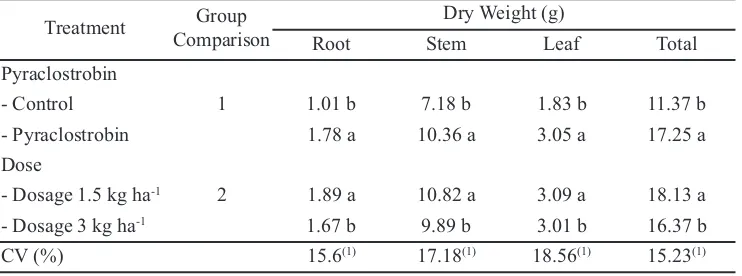
photosynthesis at age of 6 weeks after planting. The results indicated that there were significant differences in dry weight of root, stem, leaf, and total of curly red chili at the age of 12 weeks after planting. The application of pyraclostrobin tended to caused a higher weight in root, stem, leaf, and total than control. The application of 1.5 kg ha-1pyraclostrobin
resulted in a lower dry weight root, stem, leaf, and total than those with the application of 3 kg ha-1
pyraclostrobin at the age of 6 weeks after planting
(Table 3). It showed that pyraclostrobin treatment could increase the metabolic activity, resulting in high assimilates produced. According to Kyveryga et al. (2013), the pyraclostrobin’s influence on the soybean’s senescence phase might help to prolong grain filling period and increase the supply of dry matter to soybean seeds.
The results in Table 4 indicated no significant difference found in dry weight of root, steam, leaf, and total of curly red chili with the application of
Table 1.The net assimilation rate of curly red chili at 0-6 and 6-12 weeks
after planting
Remarks: Number followed by the same letter in the same column in the same group showed no significant difference by orthogonal contrast test 5%; wap= weeks after planting.
Treatment ComparisonGroup
Net assimilation rate (10-4g/cm2/weeks)
0-6 wap 6-12 wap Pyraclostrobin
1
- Control 10.4 a 8.7 a
- Pyraclostrobin 11.5 a 10.2 a Dose
2
- Dosage 1.5 kg ha-1 11.7 a 11.4 a
- Dosage 3 kg ha-1 11.4 a 9.1 b
CV (%) 9.64 19.53
Treatment ComparisonGroup Dry Weight (g)
Root Stem Leaf Total
Pyraclostrobin
1
- Control 0.45 a 1.35 a 1.19 a 2.99 a
- Pyraclostrobin 0.56 a 1.85 a 1.66 a 4.07 a Dose
2
- Dosage 1.5 kg ha-1 0.50 a 1.76 a 1.57 a 3.83 a
- Dosage 3 kg ha-1 0.62 a 1.94 a 1.75 a 4.31 a
CV (%) 16.97(1) 20.03(1) 18.97(1) 18.36(1)
Table 3.Dry weight of root, steam, leaf, and total of curly red chili at 12 weeks after planting
Treatment ComparisonGroup Dry Weight (g)
Root Stem Leaf Total
Pyraclostrobin
1
- Control 1.01 b 7.18 b 1.83 b 11.37 b
- Pyraclostrobin 1.78 a 10.36 a 3.05 a 17.25 a Dose
2
- Dosage 1.5 kg ha-1 1.89 a 10.82 a 3.09 a 18.13 a
- Dosage 3 kg ha-1 1.67 b 9.89 b 3.01 b 16.37 b
CV (%) 15.6(1) 17.18(1) 18.56(1) 15.23(1) Table 2.Dry weight of root, steam, leaf, and total of curly red chili at 6 weeks after planting.
Remarks: Number followed by the same letter in the same column in the same group showed no significant difference by orthogonal contrast test 5%; (1)= transformation √x
pyraclostrobin compared with the control treatment, and between 1.5 kg ha-1and 3 kg ha-1dosage of
pyraclostrobin at 23 weeks after planting (Table 4). This indicated that the plants had begun the fruit ripening phase, so the result of photosynthesis would be optimal to increase the number of curly red chili fruits. This was in line with the research reported by Kuswanto and Wicaksono (2011), which stated that the pyraclostrobin affected the growth of corn in the early phase. It was effective at the age of 37 until 44 days after planting. The pyraclostrobin did not affect different growth in middle and last stage of corn.
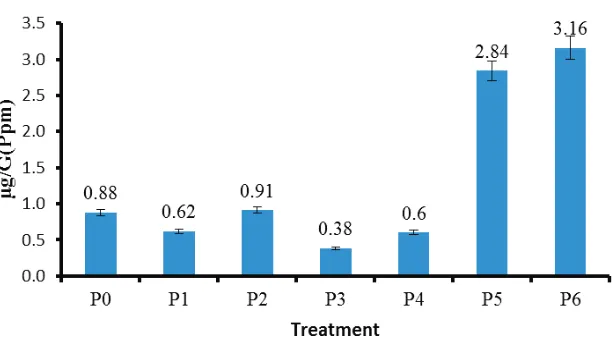
The lowest content of IAA was in the application of 1.5 kg ha-1 pyraclostrobin four times (15, 30,
60, and 90 days after planting), while the highest content of IAA was found in the treatment of 3 kg ha-1 pyraclostrobin with four times application
(16, 30, 60, and 90 days after planting). It was implied that the application of pyraclostrobin in curly red chili could increase the IAA content (Figure 1).
According to Venancio et al.(2003), pyraclostrobin
had the ability to stimulate the synthesis of IAA precursor, L-tryptophan. The conditions resulted application P6 in IAA accumulation in plant tissues by pyraclostrobin. It suggested that the application of pyraclostrobin could increase IAA content (Kanungo and Joshi, 2014). If IAA content was high, the auxin level would increase, thus stimulated the optimal growth and the formation of flowers and fruits ripening could be increased.
The results shown in Table 5 indicated that the numbers of curly red chili flowers after application of pyraclostrobin were higher compared with control (age of flowering 9-11, 14, and 18-21 weeks after planting). The dosage 1.5 kg ha-1 and 3 kg ha-1of
pyraclostrobin did not affect the number of flowers (Table 5). The results of number of the fruits of curly red chili increased significantly after the application of pyraclostrobin compared with control (plant’s age of 10-12, 15, and 16 week after planting). The dosage of 3 kg ha-1 pyraclostrobin
significantly increased the number of fruits compared with the application of 1.5 kg ha-1 puraclostrobin
Treatment ComparisonGroup Dry Weight (g)
Root Stem Total Pyraclostrobin
1
- Control 3.73 a 23.77 a 28.17 a
- Pyraclostrobin 2.24 a 18.10 a 25.77 a Dose
2
- Dosage 1.5 kg ha-1 3.78 a 25.80 a 30.24 a
- Dosage 3 kg ha-1 3.77 a 21.75 a 27.09 a
CV (%) 18.55(1) 19.17(1) 19.28(1) Table 4.Dry weight of root, steam, leaf, and total onf curly red chili at 23 weeks
after planting
Remarks: Number followed by the same letter in the same column in the same group showed no significant difference by orthogonal contrast test 5%; (1)= transformation √x
Remarks: P0 : control; P1 : 1,5 kg/ha (2x); : P2 : 1,5 kg/ha (3x); P3 : 1,5 kg/ha (4x); P4 : 3 kg/ha (2x); P5 : 3 kg/ha (3x); P6 : 3 kg/ha (4x)
(plant’s age of 10 weeks after planting) (Table 6). The application of pyraclostrobin could increase the curly red chili’s number of flowers and fruits. Enhancement of curly red chili number of flowers and fruits were to be expected because pyraclostrobin treatment caused an increase in auxin hormone composition (IAA) and obstructed the ACC-synthase production which were related in the formation of ethylene hormone. If the contents of growth hormone and inhibitors were high, plant could defer senescene preponderant (Koehle et al., 2003). This was in line with the research done by Yusria (2015), which stated that the increase in pyroclostrobin dosage up to 150 g ha-1was significantly increased
the flowers total on ICCRI 04 cacao clone.
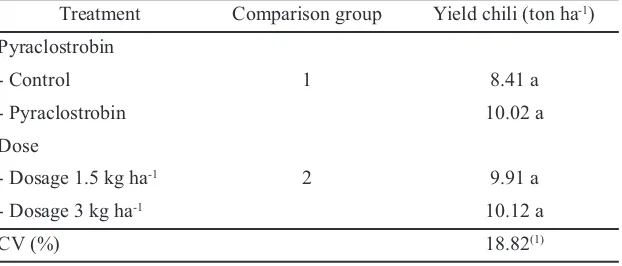
The results from Table 7 indicated that there was no significant difference in the yield of curly red chili with the application of pyraclostrobin compared with control treatment, and between the dosage of 1.5 kg ha-1 and 3 kg ha-1of pyraclostrobin (Table 7).
Application of pyraclostrobin was able to increase the number of flowers and fruits in curly red chili, but insignificantly increase the yield weight of curly red chili. This was in line with research done by Amin et al.(2013), which stated that there was no significant difference in yield of corn with the application of pyraclostrobin compared with control treatment. No significant difference in
Table 5.Number of flowers of curly red chili
Remarks: Number followed by the same letter in the same column in the same group showed no significant difference by orthogonal contrast test 5%.
Treatment ComparisonGroup Number of flowers (%) (Week)
9 10 11 12 13 14 15 16 17 18 19 20 21
Pyraclostrobin
1
- Control 9 b 11 b 14 b 24 a 25 a 19 b 27 a 26 a 26 a 18 b 18 b 12 b 7 b
- Pyraclostrobin 22 a 23 a 21 a 26 a 26 a 30 a 31 a 32 a 32 a 30 a 30 a 24 a 14 a
Dose
2
- Dosage 1.5 kg ha-1 26 a 25 a 24 a 29 a 29 a 34 a 32 a 34 a 34 a 33 a 33 a 24 a 15 a
- Dosage 3 kg ha-1 25 a 24 a 21 a 26 a 25 a 29 a 29 a 33 a 33 a 28 a 26 a 23 a 13 a
CV (%) 19.64 18.32 17.33 13.06 17.53 12.99 13.29 19.21 19.21 16.69 16.69 12.35 14.05
Table 6.Number of fruits of curly red chili
Treatment ComparisonGroup Number of fruits (%) (Week)
10 11 12 13 14 15 16 17 18 19 20 21 22
Pyraclostrobin
1
- Control 7 b 8 b 10 b 16 a 18 a 13 b 13 b 23 a 23 a 19 a 19 a 15 a 9 a
- Pyraclostrobin 14 a 16 a 16 a 19 a 20 a 22 a 18 a 25 a 25 a 23 a 23 a 17 a 11 a
Dose
2
- Dosage 1.5 kg ha-1 13 a 16 a 17 a 19 a 19 a 20 a 17 a 20 a 20 a 24 a 23 a 16 a 10 a
- Dosage 3 kg ha-1 16 a 16 a 18 a 21 a 22 a 23 a 19 a 23 a 23 a 26 a 26 a 19 a 12 a
CV (%) 15.33 12.10 18.92 16.46 19.43 13.81 13.89 15.14 15.14 14.07 14.07 14.13 14.22
Remarks: Number followed by the same letter in the same column in the same group showed no significant difference by orthogonal contrast test 5%.
Treatment Comparison group Yield chili (ton ha-1)
Pyraclostrobin
1
- Control 8.41 a
- Pyraclostrobin 10.02 a
Dose
2
- Dosage 1.5 kg ha-1 9.91 a
- Dosage 3 kg ha-1 10.12 a
CV (%) 18.82(1)
plant yield was due to the necessary nutrient elements was transclocated only to plant growth but not to the yield of curly red chili. Applying the right nutrients to crops could increase yield (Khan, 2011).
CONCLUSION
Application of pyraclostrobin with dosage of 1.5 kg ha-1was found effective to the growth of curly
red chili. Treatment used in curly red chili indicated a significant difference at 12 weeks after planting for dry weight, number of flowers, and number of fruits.
REFERENCES
Amin, A. W. B., Kuswanto dan A. Soegianto. 2013. Respon Lima Varietas Jagung (Zea mays L.) Pada Aplikasi Pyraclostrobin. Jurnal Produksi Tanaman, 1(1): 80-86.
Badan Pusat Statistik. 2013. Statistik Pertanian Hortikultura. [online] Available at: <http://www.bps.go.id> [Accessed 14 September 2014].
BASF. 2010. Intrinsic Brand Fungicides Plant Health Research. [online] Available at : <http://betterturf.basf.us/products/re lated-documents/basf-intrinsic-plant-health-research> pdf. [Accessed 25 October 2016]. Conrath, U., G. Amoroso, H. Köhle, and D. F. Sultemeyer. 2004. Non-Invasive Online Detection of Nitric Oxide from Plants and Other Organisms by Mass Spectroscopy. Plant J., 38: 1015-1022.
Ekinci, D. and M. Şentürk. 2010. Interactions of Fungicides and Pesticides with Specific Enzymes. [online] Intech. Available at : Pyraclostrobin (F500) on Crop Plants. Plant Science, 1(3): 174-178.
Khan, H. Z., S. Iqbal, N. Akbar, and D. L. Jones. 2011. Response of Maize (Zea mays L.) Varieties to Different Levels of Nitrogen. Crop and Environment,2(2): 15-19.
Köehle, H., K. Grossmann, T. Jabs, M. Gerhard, W. Kaiser, W., J. Glaab, U. Conrath, K. Seehaus, and S. Herms. 2003. Physiological Effects of the Strobilurin Fungicide F 500 on Plants. In: H. W. Dehne, U. Gisi, K. H. Juck, P. E. Russel and H. Lyr , Eds., Modern Fungicides and Antifungal Compounds III, Bonn, Germany: Agroconcept GmbH.
Kuswanto dan K. P. Wicaksono. 2011. Pyraclostrobin Effect For Nitrogen Fertilizer Efficiency On Corn (Zea mays). Report research Universitas Brawijaya [online] Available at: http://kuswanto.lecture.ub.ac.id/files/2012/02/ R e p o r t 2 0 11 P y r a c l o s t r o b i n E ff e c t - for-Nitrogen-Fertilizer-Efficiency-on-Corn.pdf [Accessed 11 November 2016]. Kyveryga, P. M., T. M. Blackmer and D. S Mueller.
2013. When Do Foliar Pyraclostrobin Fungicide Applications Produce Profitable Soybean Yield Responses. [online]. Plant Health Progress. Available at: https://www.plantmanagementnetwork.org/ph p/elements/sum2.aspx?id=10699 [Accessed 11 November 2016].
Monsanto. 2012. Evaluation of Soybean seed treatment in the Mid-South, Technology Development and Agronomy. [pdf] Mississipi: Demonstration Report Learning Center at Scott. Available at: https://monsanto.com/app/uploads/2017/05/sl c-ag-soybean-seed-treatment.pdf [Accessed 10 November 2016].
Nurfalach, D.R. 2010. Budidaya Tanaman Cabai Merah (Capsicum annum L.) Di UPTD Perbibitan Tanaman Hortikultura Desa Pakopen Kecamatan Bandungan Kabupaten Semarang. Tugas Akhir. Universitas Sebelas Maret.
Ribeiro, W. R. M., L. P. Pacheco, F. P. Monteiro, F. A. Petter, W. L. de Carvalho, T. O. Sousa, A. V. S. Gualberto, and F. A. Neto. 2014. Fungicides phytotonic action on the development of soybean. African Journal of Agricultural Research, 9: 3283-3290. Venancio, W.S., M. A. T. Rodrigues, E. Begliomini
and N.L. de Souza. 2003. Physiological Effects of Strobilurin Fungicides on Plants. Publ. UEPG Ci. Exatas Terra, Ci. Agr. Eng., Ponta Grossa, 9: 59-68.
Yusria, F. I. 2015. Pengaruh Dosis Pyraclostrobin Terhadap Gugur Bunga dan Layu Pentil Dua Klon Kakao (Theobroma cacao L.) Asal Embrio Somatik. Skripsi. Universitas Gadjah Mada.