To my wife, Sandra, and my children, Julia, Rolf and Chris, who have contributed vastly to my learning about and enjoyment of
WORLD
TELEVISION
From Global to Local
Copyright © 2007 by Sage Publications, Inc.
All rights reserved. No part of this book may be reproduced or utilized in any form or by any means, electronic or mechanical, including photocopying, recording, or by any information storage and retrieval system, without permission in writing from the publisher.
Printed in the United States of America
Sage Publications India Pvt. Ltd.
1. Television-Social aspects. 2. Group identity. I. Title. PN1992.6.S765 2007
384.55-dc22
This book is printed on acid-free pa_per.
07 08 09 10 11 10 9 8 7 6 5 Acquiring Editor: Todd R. Armstrong Editorial Assistant: Katie Grim
Project Editor: Astrid Virding Copy Editor: Jacqueline Tasch Typesetter: C&M Digitals (P) Ltd. Proofreader: Anne Rogers
Indexer: Ellen Slavitz
Cover Designer: Bryan Fishman
2006102718
Contents
Preface
Chapter 1. A Multilayered World of Television: An Overview Central Issues
Globalization and Culture
Complexity, Structuration, and Cultural Agents Structural and Cultural Process Frameworks for
World Television
Colonia lism and Imperialism Cultural Imperialism
Postcolonia l National Television Globalization
Roles and Impacts of Technology
Asymmetrical Interdependence and Asymmetrical Cultural Interpenetration: A Proposed Model Imported TV Versus Local and National:
Producers Localize, Glocalize, and Hybridize Cultural Identification and Proximity
Cultural Hybridization
Chapter 2. Hybridization and the Roots of Transnational,
Geocultural, and Cultural-Linguistic Markets Precolonial Cultural History and Television Hybridization
Emergent Change Versus Hybridization Hybridity and Television
The Roots of Transnational, Geocultural, and Cultural-Linguistic Regions and Markets
Precolonia l Forces: Before 1 492 Europea n Colonia lism
1
Broadcasting Models: From Colonial to Postcolonial The Cold War and the Major Models for Broadcasting Hybridity and National Development
Chapter 3. Creating National and Regional Television
and Cultural Industries
Dependency, the Cold War, and Television Industry Production
Cultural Imperialism and Media Imperialism Local Cultural Production
Cultural Imports
The Nation-State and Television Dependency and Ownership The State as Owner
The Ec onomic and Political Role of States Import Substitution in Cultural Industries Adaptation and Glocalization of Foreign Models
Advertising
National Conglomerates and Competition The Cultural Role of States: National Security
and National Identity Cultural Industries
Crucial Structural Conditions of National Cultural Industries
Achieving National Coverage via Satellite Supplementing National Coverage via
Satellite: Translocal Television in the Nation Television Above and Below the National Level Glocal Processes and National Identities Chapter 4. Creating Global, U.S., and Transnational
Television Spaces
Globalization Broadly Defined Economic Globalization Globalization as the Spread of
Capitalist Modernity
Economic Neoliberalism and American Empire American Empire: Film and Television Rethinking Audiences for the U.S. Empire
Globalization, Changing National Policy, and the State Deregulation, Liberalization, and Privatization
55
Global Spread of Market Capitalism
Global Economics and Advertising Direct Investment and Partnerships Resisting Liberalization and Privatization Globalization via International Trade
Regimes and Multilateral Governance Migration as Globalization
Transnational Television
Geocultural or Cultural-Linguistic Regions
Asymmetrical Interdependence and World Television Chapter 5. Increasing Complexity: The Technology of Creating
Global and National T devision Spaces 111
Television Technology as a Structuring Force Technologies Facilitate Pattern Ruptures Cycles of Technology
Technology and Production
Technology and Media Distribution and Flows Satellites
from Cross-Border Spillover to Direct Satellite Broadcasting
Satellites and Cable TV
Satellite TV at Global, Regional, and National Levels TV Technology, Access, and Choice
Economic Capital and Access to Television Technologies Cable and Satellite TV Relative to Broadcast TV
Geography, Language, and
Other Barriers to Satellite or Cable TV
Chapter 6. Producing National Television, Glocal and Local
Structuring the Producers' World Television Genre and Structure Cultural Industry Producers
Economic Boundaries on Television Genre and Program Development
Material Versus Symbolic Boundaries Complexity, Patterns, and Genres
Cultural Boundaries: Feedback to Producers Complexity, Prefiguration, and Cultural Hybridity
Complexity and Cultural Change Ricoeur and the Hybridization Process
Glocalization
Localization as Japanization or Brazilianization Structuration and Television Production in Brazil The Hybrid History of the Telenovela
Brazilianiza tion as Hybridization
National Television Flows and Production
Limits to Focusing on National Flows and Production TV Genres and TV Flow in the 1950s
TV Genres and TV Flow in the 1 960s TV Genres and TV Flow in the 1970s TV Genres and TV Flow in the 1980s TV Genres and TV Flow in the 1990s TV Genres and TV Flow in the 2000s
TV and Genre Flow Conclusions
Chapter 7. TV Exporters: From American Empire to
Cultural-Linguistic Markets Genre Imperialism?
Genres Flowed Before Programs Delocalization
Trends Toward Regionalization of Television Flows of Television Programming
a nd Genres in the 1960s Flows of Television Programming
and Genres in the 1 970s
Flows of Television Programming and Genres in the 1 980s
Flows of Television Programming
and Genres in the 1 990s World, Regional, National, and
Local Genres and Flows in the 2000s
Overall Trends in Broadcast Television Flows
Global Flows
From Program Genre and Idea Flows to Licensed Format Flows
Localization of Global and Transnational Television Channels
Broadcast Television Genre Flows
Versus Satellite, Cable, and Internet Flows
Chapter 8. Multiple Proximities Between Television Genres and Audiences: Choosing Between National,
Transnational, and Global Television
Culture-Bound Reception and Multiple Proximities Genre Proximity
Cultural Shareability Thematic Proximity Value Proximity
Cultural Capital, Cultural Proximity, and the Audience
Cultural Capital and Media Choices in Brazil Media Access, Cultural Capital, and Class in Brazil Cultural Capital in Rural Communities
Layers of Reception Within Brazil and Italy
Marimar in Rural Northeast Brazil Terra Nostra in the Italy of the North and
in the I taly of the South
Cultural Proximity Within Culturally Bound Reception Practices
Chapter 9. Making Sense of World Television:
Hybridization or Multilayered Cultural Identities?
From Local to Global
Multiple Levels of Audience Identity and Cultural Choices
The Process of Hybridization
Hybridization Versus Multiple Layers
of Identity and Culture Multiple Identifications
Researching Audiences and Their Identities Cultural Geography: Cultural Distance, Global,
National, and Local Identities
Case Example-In the Nation's Periphery:
Rejecting Cosmopoli tan Mores in National Television
Language/Culture-Defined Spaces and Markets Multilevel Identities and Social Class
Hybridization and Social Class
Television, Cultural Geography, and Poor Brazilians Working-Class Cultural Identity
Middle-Class Cultural Identi ty
195
Upper-Middle- and Upper-Class Cultura l Identity Some Broadly Shared Globalization via Television
Hybridization: Race and Ethnic Identity Gender Identity and Television
Telenovelas, Gender, Sexuality, Na tional Values, and Local Values
Layers of Identity as Boundaries for Choices and Understandings
Layers of Identities as Mediators of Media Meaning Reconfiguration and Synthesis of Identities
Appendix
References
Index
About the Author
257 R-1 1-1
Preface
T
his book reflects work conducted since the mid-1 970s by the author and more recently by him and several colleagues. The interests reflected here started in a 1 972 undergraduate class on mass media and national develop ment at Stanford University. Lectures by Emile McAnany and others kindled a strong interest that led me to graduate school at the Fletcher School of Law and Diplomacy, where Rosemary Rogers, Hewson Ryan, Ithiel de Sola Pool, and others I met or studied with gave me a strong basic sense of the impor tance of development and international relations issues in media.Although I had been very involved with anti-Vietnam politics, I had also been raised with a strong sense of interest in public service. So with some mistaken idealism about helping improve communications between countries, and with the more concrete goal of learning Spanish or Portuguese very well and having time to do extended fieldwork for a dissertation, I joined the U.S. Information Service (the culture and press service, which was then separate from the State Department) . I spent three years in Brazil and five in Washington, where many colleagues, including Rodolfo Valentini, Bob Brown, Bob Cross, David Gibson, Charles Spencer, James McGregor, and Norman Painter helped me learn a great deal about language, culture, Brazil, and social research methods, as did colleagues at a University of Michigan summer institute in survey research, which the USIS Office of Research enabled me to attend. All these forms of support (and the consid erable patience of my wife, Sandy, who was working on her own disserta tion at the time) enabled me to finish my Ph.D. dissertation in 1 9 8 1 while working at the USIS Office of Research. So one of my first real acknowledg ments of crucial support must be to the U.S. Foreign Service and the former USIS, which was foolishly scaled back and folded into the State Department in the late 1 990s.
xvi World Television
Last but not least, my colleagues and graduate students have provided enormous insight and joy in learning. Aside from colleagues mentioned above, many of my current Texas colleagues-Karin Wilkins, Rosental Alves, Shanti Kumar, Madhavi Mallapragada, Steve Reese, Joe Potter, and Bob Wilson-along with former colleagues John Downing, Nikhil Sinha, Chuck Whitney, and Horace Newcombe have been influential in this work. Equally important have been former graduate students, now colleagues: Antonio La Pastina, Viviana Rojas, Luiz Guilherme Duarte, Consuelo Campbell, Patricia McCormick, and Michael Elasmar. Current graduate students, Martha Fuentes, Juan Pinon, Jeremiah Spence, and Nobuya Inagaki, have also contributed materially to the research and ideas repre sented in this book. I would also like to thank Todd Armstrong and his staff at Sage Publications for providing encouragement and support throughout this project.
I
A Multilayered
World of Television
An Overview
T
elevision in our world is an increasingly complex system with global, transnational, translocal, national, regional, metropolitan, and local spaces, dynamics, players, and flows. The rapid global extension of eco nomic and technological changes has reframed the possibilities of television around the world. However, the realization of those possibilities is a much more complex historical process, involving the hybridization of various global and local elements and influences over time. What emerges is multi ple spaces or levels of television production, flow, and reception, corre sponding to multiple levels of culture and identity.2 Chapter 1
A key first note is what is meant by television. Allen (2004) mentioned several possibilities for what might be included in studies of television, including technological elements, programming, forms of narrative such as genre, a set of institutions, and a social experience for both producers and audiences. In this book, I look primarily at broadcast television because, taking a global view, that is what the large majority of the world's television viewers still watch; however, in several chapters, I also discuss satellite, cable, and Internet-based television because those are growing in importance for many. Programming is closely examined in terms of production, flows between cultures, and genres, whereas I include readings of specific televi sion narratives only as examples. Some excellent global television studies books examine specific narratives-for example, Kumar (2006); I take a more systemic focus. I look extensively at the institutions of television, par ticularly broadcast television, but also transnational satellite television cor porations and institutions, such as Rupert Murdoch's News Corporation or the BBC. I also look theoretically and practically at the experience of pro ducers, and I look extensively at audience experience, their identities, their choices, the ideas that inform their choices, and the sense they make of what they watch. So I take a fairly holistic approach, as urged by critical scholars from Schiller (1969) to Miller (2005), except for the close reading of texts. This analysis tries to bridge international communication and cultural stud ies, as excellent recent work by Kraidy (2005) and others have done, but the approach is probably more sociological than literary.
One of the key arguments of this book is that television, particularly national broadcast television channels, is still the dominant framework for news and for cultural forums (Newcomb & Hirsch, 1994) and discussions, for most people in most cultures and nations. Television still forms a domi nant layer of media experience for most people, although admittedly it is supplemented more and more by other layers and other media. Television also means very different things to people in various cultures and countries, as I will begin to map out in this book.
A Multilayered World of Television 3
has also expanded to almost all the world, which tends to make television a commercial vehicle for advertising and tilt its content toward entertainment in most countries. However, the meaning of capitalism and commercial media varies a great deal between China, the United States, and Russia, for example. Much of what is called globalization centers on these forces of economy and technology (Castells, 1997), which have expanded quickly across the world, leading many to focus on the recent geographic or spatial extension of global forces. However, as these forces move into a new country or cultural space, they hybridize, becoming part of the ongoing history of that country, interact ing with previous forces, and becoming localized, enacted, and received by local people with their own identities, histories, and agendas. New trends in economy and technology can be drastically rolled back; Russia, for example, has converted several major independent commercial television networks back to state enterprises to better control them politically (Mydans, 2004).
Television is a very plural phenomenon for many, with cable and satellite television dominant in the richest countries, having more than 80% penetra tion in the United States, for example. For the minority who have access to the Internet, television is becoming even more diverse, with all kinds of clips and short programs offered by a wide diversity of amateur as well as profes sional producers. For many, those new channels often come from outside their nation or culture. However, for many, if not most people around the world, television is still primarily broadcast television coming from national networks, supplemented in some places by regional networks at the provin cial or local level. Many of the programs carried on satellite, Internet or DVD originated as nationally based broadcast or satellite/cable programs. However, many national programs are based on global or regional models, so national television itself must be problematized and understood in new hybrid or glocal (local adaptations of global) forms.
Central Issues
This book is divided into chapters that address aspects of an overall argu ment. This first chapter gives an overview of that argument and lays out some underlying theoretical premises on which the whole book builds.
4 Chapter 1
1 . Nearly all television systems work within long-term patterns of language and culture that sometimes coincide with nation-states but are frequently either larger-the Arabic-speaking world-or smaller-several states in India that have distinctive systems of language, culture, religion, and television. ( Chapter 2)
2. As nation-states were created or became independent of colonial pow ers from the late 1 700s on, most of those states tried to create a sense of nationality or imagined national community (Anderson, 1 983 ), using media. Since 1 950, television has often been the primary tool in this effort, giving it a national focus. (Chapter 3)
3. That national focus of control has been strongly challenged, but not necessarily overturned, by the processes often referred to as globalization since the 1980s or 1 990s. (Chapter 4)
In the next section, I take a more contemporary focus on specific uses of technology, patterns of program development and flow, genres of television, the interaction of producers and audiences, and patterns of audience choice among emerging alternatives. The book's chain of arguments resumes:
4. Two potentially contradictory roles of satellite, cable, and Internet tech nologies have permitted greater flows of television across cultures, with impli cations often described as cultural imperialism or homogenization. However, computer and other television production technologies have also made it pos sible for television production and distribution to take place at ever smaller and simpler levels by radically increased numbers of people and groups. For example, Osama bin Laden may be videotaped in a cave in Afghanistan and broadcast by a regional Arabic network, Al-Jazeera, challenging the prior global dominance of both U.S. political and media power. (Chapter 5)
5. Producers and networks have developed diverse production formats and genres that fit their understanding of the cultural nature of their audi ences or markets, so that, in effect, culture defines markets, principally at local, national, regional, and cultural linguistic levels. Producers and audi ences interact in the production and evolution of genres: globally, within nations, and across cultural-linguistic regions. Television production and flow has changed toward greater national and transnational cultural linguistic or regional production consumption, particularly in certain specific genres such as variety and talk shows. (Chapter 6)
A Multilayered World of Television 5
television series and drama or feature films, where higher production costs make widespread production prohibitive. Global and transnational satellite channels also cross borders but have to adapt to their audiences. Instead of canned programs, genres and licensed television formats increasingly flow
/
across borders. They are adapted to local, national, and regional cultures but still bring complex transnational influences with them. (Chapter 7)
Finally, the last section of the book examines how the audience for these evolving forms of television is structured, how the audience itself restruc tures production and genres through its choices and reactions, what cultural patterns underlie audience choices, and how these forces or patterns of tele vision have an impact on both cultural formations and individual identities. The chain of arguments concludes:
7. Audiences feel competing sets of proximities or attractions to programs from different places; the Latin American telenovela is one example. Audiences are structured both by the evolving cultures they live in and by structures of class, race, gender, and cultural geography in terms of the program choices and interpretations they make of local, national, regional, and global television pro grams. The primary example discussed is the diverse audiences in Brazil, where the author and his colleagues have done fieldwork for 30 years. (Chapter 8)
8. The cultural impacts and uses of television can be understood in terms of a twin process of hybridization and formation of multiple layers of iden tity among audiences, which guides audience choices and structures impacts on them. The chapter draws on fieldwork by the author and colleagues in Brazil and among Latinos in Texas. (Chapter 9)
Globalization and Culture
Some fear that globalization implies a global cultural homogenization. Appadurai ( 1 996) thought extensive cultural homogenization was unlikely and cited as opposing evidence the anthropological record, what he called
the archive of lived actualities, found in all sorts of ethnographies . . . This archive, and the sensibility that it produces in the professional anthropologist, predisposes me strongly toward the idea that globalization is not the story of cultural homogenization. (p. 11)
6 Chapter 1
bring change, but that change is adapted into existing ways of doing things via a historical process in which existing local forces mix with new global ones, producing neither global homogenization nor authentic local culture, but a complex new hybrid with multiple layers of culture, where older, traditional forms may persist alongside new ones. This situation is neither a complete resistance to rejoice about nor a complete loss of identity to despair about, but a complex contradiction of both continuity and change.
Globalization is different in various world regions. For example, although most European and African countries continue to import television programs primarily from the United States and relatively little from each other, that is less true in Latin America and the Middle East, where cultural trade within cultural-linguistic regions is large and growing. East Asian countries, which also used to import television almost exclusively from the United States, have begun to import more from each other in the past few years. Between 2002 and 2006, for example, the hot new phenomenon in television imports in East Asia was dramas from South Korea, not Hollywood. Latin American televi sion markets are more likely to import American production ideas and gen res than American programs in prime time, although they still import many U.S. programs to fill up the rest of the 24-hour broadcast day. So they are still engaged in globalization, but in a very different way.
One of the main limits on globalization in media and culture is that relatively few people have a primarily global identity. There is a small, important global professional elite, who move easily between cultures, who probably identify more with the company or nongovernmental organization (NGO) that employs them or the cause they espouse than the nation in which they were born. For most people, however, identity still tends to be based in language, religion, geography, history, ethnicity, collective memory, and political power apparatuses (Castells, 1997). Those elements of identity tend to correspond to smaller, more discrete levels of culture than the global. Many people increasingly have multiple levels of identity, but most are still local, metropolitan, subnational/provincial (like Quebec), or national. However, many are also mlgrating or otherwise adding strong layers of tran sitional identity, which can stretch within a geocultural region. For example, a Mexican family migrates to the United States and begins to add a layer of U.S. cultural influence. At the same time, members stretch out or back within a cultural-linguistic space or market, when that family watches Mexican telenovelas on Hispanic U.S. channels to stay in touch with their cultural roots (Rojas, Straubhaar, Fuentes, & Pifion, 2004 ).
A Multilayered World of Television 7
transformed into the Latin American telenovela. Robertson ( 1 995) aptly
noted that people now tend to see the global replication of ideas and mod
els for how to express locality and local identity, a process he terms glocal
ization. However, even when a form of television is imported for explicitly commercial purposes, such as the licensing and local production of the reality show Big Brother in a number of countries, it may still end up
expressing local culture to many in its audience. Young Big Brother fans in
France, Italy, and Portugal were often pleased to see young people on screen that they felt they could identify with, even though some critics of those versions of Big Brother showed that these "local" productions imported global stereotypes in those same characters (based on reviews from those countries).
In many developing countries, media, particularly radio and television, have been powerful recent forces for consolidating national identities that had previously been nascent or fragile. In the second half of the 20th cen tury, television took up and extended the role ascribed to newspapers and novels in the 1 9th century (Anderson, 1983). This reflects a strong priority by most developing nation-states to try to use electronic media to push or even create a sense of national identity (Katz & Wedell, 1 976) .
I n this book, I argue that national cultures, national markets supported by national governments, and national television networks still dominate the television viewing reality of most audiences. Note that this is more true of television more than other media. In a new study of Brazil, the author is dis covering that film, by contrast, tends to be more of a globalizing force and that music, in recordings or on the radio, tends to be a complex force with truly local, national, and global elements all strongly visible.
One can also see the development of regions or markets, based on both geography and cultural-linguistic identity groupings, which are less than global but more than national. In fact, two types of cultural-linguistic spaces or markets can be distinguished. Geocultural markets are cultural-linguistic spaces that are also contiguous or closely linked by geography. Trans national cultural-linguistic markets can be spread all over the planet by colonization-for example, the former Portuguese empire, which has pro duced the modern Lusophone cultural-linguistic market for television-or by massive migration, such as the Chinese, Indian, or Turkish diasporas across continents. In this book, I argue that in television, this trend toward geocultural and transnational cultural-linguistic regions or spaces is perhaps just as crucial as globalization per se. In Latin America, Asia, and the Middle East, hundreds of millions of people regularly watch transnational regional soap operas, comedies, news, and variety shows-far more than watch the
8 Chapter 1
is still less important in most countries due to costs, subnational provincial or local television also grows in importance in many larger countries.
Complexity, Structuration, and Cultural Agents
In this book, I propose an analytical structure for understanding global, regional, national, metropolitan, and provincial culture industry systems such as television. The analysis focuses on three main ideas. First, that tele vision creation, flow, and reception are bounded but not determined by political, economic, and institutional structures. Second, those structures, plus similar structures of technology, provide resources as well as constraints for cultural agents, such as television producers and consumers. Third, that rules and patterns grow within those boundaries but are shaped both by institutions and those who work within them. The argument draws on com mon elements from Raymond Williams's ( 1 980) analysis of base and super structure, complexity theory (Prigogine & Stengers, 1 984; Urry, 2003), and Anthony Giddens's ( 1984) analysis of structuration.
The main structuring elements for world television are: economic frame works, technological bases, institutional forms of organization and operation, genres and forms of television content, and enduring cultural definitions and values. In terms of structuration theory (Giddens, 1 984), these structural elements form boundaries within which cultural forces and agents, such as television producers, distributors, and viewers, operate. The structures of tele vision limit what is possible. For example, commercial television systems tend to produce few documentaries, educational programs, or one-episode dramas. However, within those boundaries, the same structures also provide resources to cultural forces and agents to create and consume quite a few other kinds of television programs and other cultural products (Giddens, 1984).
A Multilayered World of Television 9
Complexity theory focuses on people, groups, and institutions as agents who employ strategies based on their experience with previous variations of work, watching, producing, interacting with and learning from others, and selecting/refining strategies as they go along (Axelrod & Cohen, 2000). These agents work within boundaries established by structural forces, such as economic and technological change, and previous cultural patterns that accumulate out of the history of their shared group experiences. They work
with patterns established over time, which complexity theorists sometimes /, ! call fractals, small patterns that reflect larger wholes, the way a soap opera
can contain both enjoyable cultural themes and commercial imperatives to buy more soap (Gonzalez, 1 987, 1 997). For example, the historical interac-tion of Latin Americans with Spain and Portugal established a pattern in which media were owned by major elite families. After the nations of Latin America achieved independence, their subsequent interactions with U.S. advertisers, agencies, and networks introduced ideas of how to construct commercial television networks, based on American patterns but adapted over time to Latin American commercial realities. U.S. companies, such as Colgate-Palmolive, introduced specific genres-for example, radio and tele vision soap operas-into Latin America to sell their soap (or other products),
but local agents (producers, writers, etc.) mixed that genre with ongoing
local traditions of melodrama, testing variations on audiences; over time, this resulted in the telenovela {Martin-Barbero, 1993). The telenovela bears
a familial resemblance to U.S. soaps but has emerged over time as a quite dis tinctive form, innovative to the point where U.S. soap producers now
bor-row format ideas back from it (Bielby & Harrington, 2005).
Structuration is remarkably similar in key points. This theory is Giddens's ( 1984) effort to reconcile the effects of structures and institutions on society with the existence of agency exercised by individuals and groups, which often seem to go against the determining effects of the structures). Giddens "proposes that we consider structure as a duality including constraining rules and enabling resources" (Mosco, 1 996). Working within constraining rules or boundaries imposed by structures and institutions, but with enabling resources and guiding patterns often provided by those same structures, indi viduals and groups produce cultural products like television, move them around the globe, and make meaning of them within other patterns provided by culture.
10 Chapter 1
in certain specific fields of endeavor, such as cultural production (Johnson, 1 993 ) or journalism (Marliere, 1998). Another is that individuals acquire certain dispositions over time about how to acquire and use capital, and groups acquire collective dispositions that Bourdieu (1998) referred to as class or group habitus. Many of these ideas are useful for examining both television producers and audiences in terms of how they work within the social structures they inhabit and how they make decisions about what to produce and what to watch.
Another compatible set of ideas comes from Raymond Williams ( 1 980), especially his discussion of classic Marxist and post-Marxist problems of structure or materialism and culture. Williams wanted to rethink Marxist analysis in which the economic bases of society were seen as determining culture outcomes; he thought this view was simplistic. As an alternative, Williams discussed the role of institutions and structures in creating rules and resources for cultural agents; television producers work with them, and audiences interpret cultural products. He also tended to view industrializa tion and commodification of culture as complex, constraining some forms of culture and enabling others (Hesmondalgh, in press).
Putting several of these ideas from complexity theory, Bourdieu, Giddens, and Williams together, I will emphasize several key underlying theoretical constructs. The first set has to do with different processes in how structures of economy, technology, and institutional organization affect the production of culture for television and its consumption by audiences.
Boundaries. A number of kinds of forces tend to create boundaries that limit, guide, and constrain (Urry, 2003). These tend be material, for exam ple, economic or geographic limits, but can be both economic and social, such as the access of different groups of class, age, gender, and ethnicity to certain kinds of media in nonlocal languages. Common boundaries are the wealth available to finance television, access to technology for production or distribution, and limits on producers imposed by institutional models. Complexity theory emphasizes how discovering the key boundaries to a phe nomenon enables understanding the limits within which that phenomenon will play out, even if the result is not precisely predictable.
A Multilayered World of Television 1 1
publicly owned television. Cultural dispositions, building on Bourdieu, can also lead individuals, groups, and societies in certain directions; for example, the policy tradition of the United States tends to prefer private initiatives over public ones, even when either would be acceptable under law.
Rules. Cultural systems tend to have either formal rules, as Williams ( 1980) observed, or patterns of behavior, as described by complexity theory, that condition or guide the way that culture is created. For example, professional socialization of producers/editors, institutional rules by networks or govern ments, and ground rules set by religion and culture all tend to define what is news or what makes for a good soap opera.
Enabling forces and conditions. Although any kind of structure imposes boundaries, limits, and conditions, it also tends to bring with it new ideas or resources (Williams, 1 980) for cultural production and broadcasting. Advertising-based, privately owned commercial networks can disrupt an exist ing public service television system, but they can also bring in new resources to make more production possible, within the new limits.
Resources. Similarly, institutions and structures place boundaries and rules around what cultural producers can do, but they also provide resources to work with, an idea common to Williams, Giddens, and complexity theory. So the classic Hollywood studio production system might have seemed a straitjacket on creativity to some, but those who were able to work within that system made quite a remarkable number and variety of films, showing what some called "the genius of the system" (Schatz, 1988).
The second set of processes and actors has to do with how cultural actors, both producers and audiences, work within structures and how actions by those cultural agents or actors cumulate into larger patterns of culture.
Cultural agents. These include both producers and consumers of cultural products like television. Although people work within structures, they also constitute and recreate what is thought of as structure (Giddens, 1 984). The structures of television require buildings and equipment, but the real struc ture is the organization and actions, person by person, of the productive processes that use the buildings and equipment.
1 2 Chapter 1
complex systems (Urry, 2003 ) . Patterns can be strong institutional models for example, the pattern of commercial broadcasting that is being driven glob· ally by economic changes-or they can be smaller patterns within that large1 one, for example, the global predominance now of soap operas, music videos, talk shows, reality shows, and variety shows because these work well as pro gram formats with newly commercialized networks and stations.
Continuity. Cultural patterns tend to show both stability and change. Much
anthropological work tends to show a bias toward continuity in cultures despite global pressures for change (Appadurai, 1 996). However, cultures are also constantly changing, both from internal forces and from external ones (Nederveen Pieterse, 2004).
Emergent change. Even without radical breakthroughs from outside, cultural sys tems tend to show gradual change from within (Urry, 2003). This is accom plished both from internal creation as people and institutions change and have ideas and from slow and gradual absorption of ideas from outside, so that change is slow and tends to be incorporated into ongoing continuities. Japan is often cited as an example of deliberate, gradual absorption of changes from outside, as when it takes American cultural forms and adapts them (lwabuchi, 1997).
Hybridization. New elements from outside a culture, whether from slow
gradual contact or major threshold change, tend to be adapted to local cul ture over time. All of the preceding forces tend to interact in a way that fos ters hybridization, in most cases. Hybridization can be a genuine synthesis of different culture elements into some new culture, as with the emergence of new Latin American cultures from indigenous, African, and European roots.
Multilayered cultures and identities. Instead of genuine synthesis between cul tural elements or parallel to it, multilayered cultures and identities can also coexist; older cultural elements survive in somewhat coherent layers while new ones are imposed or adopted over them in new layers. So cultures change in both hybrid and sedimentary ways as layers build, interact, change, and persist.
Threshold events. Outside forces of new technology or ideas (what Rogers,
A Multilayered World of Television 1 3
Cataclysmic change. Complexity theory sees some changes as extremely rapid, completely changing boundaries and patterns. Although cultures tend to persist and hang on, in many cases, change imposed from outside is cata clysmic, such that small fragile cultures simply die out or are absorbed into other larger or more powerful cultures. Dozens of small indigenous languages have died out in the past decade as speakers of the language either die off or are absorbed into other culture and language groups.
In this analysis, the chief structural factors are technological, economic, and institutional. Technology tends to enable new developments. It can also pre sent constraints, but the result over time tends to be a layering, additive effect of new possibilities. New technologies, such as broadcast or satellite television, don't necessarily eliminate other options based on earlier technologies. For example, although VCRs and satellite/cable television make accessible to developing countries many new U.S. movies and television programs, only a small number can afford access to these technologies, and many of them don't necessarily use such technologies to watch the "new" U.S. or global content. Economic factors also both enable and limit cultural developments. Economic relations with other countries and economic growth can create new possibili ties, such as bringing television broadcasting into a country. However, eco nomic relations can also create dependencies that narrow possibilities.
At the cultural level, I focus on the formation of language and cultural communities and the creation and flow of media, particularly television, within and across those communities. The key elements in the formation of communities are their own historical dynamics, particularly the develop ment of language and cultural themes, the creation and maintenance of group cultural identities as a locus of meaning, and cross-cultural interper sonal interactions such as travel and migration between communities. The media, the main focus of this study, build on, reinforce, and, by dint of the agency of both media producers and consumers, sometimes contradict both this cultural context and the larger structural context of economics, tech nology, and institutions. Both structuration and complexity emphasize that human agency and even aggregate social forces are sometimes hard to pre dict based on structural or even cultural forces.
1 4 Chapter I
attributed to modernization and globalization as driven by migration and media. Chapter 2 explores this process of hybridization, the synthesis of local cultures with the imported elements of culture brought in by globalization, through specific processes such as electronic media, migration, inflow of genres and models, and entrepreneurial action of global or regional companies.
An important question is whether the different levels raised here are relatively independent or whether some are rather more conditioned, if not determined, by others. Appadurai ( 1996) argued that media interactions diverge-or are disjunct, in his terms-from economics, technology, politics, and people flows. He noted,
Global flows occur in and through the growing disjunctures among ethn oscapes, technoscapes, financescapes, mediascapes and ideoscapes. This formu lation, the core of my model of global cultural flow, needs some explanation. First, people, machinery, money, images, and ideas now follow increasingly non-isomorphic paths; of course, there have been some disjunctures in the flows of these things, but the sheer speed, scale, and volume of these flows now are so great that the disjunctures become central to the politics of global culture. (Appadurai, 1 996, p. 37)
In this book, I argue, however, that cultural factors such as migration and media content flows are not truly independent from structural factors such as economics, technology, and institutional structures. There are separate developments and relative degrees of autonomy, owing to the kind of com plexity and disjuncture that Appadurai perceives. But factors such as eco nomics and technology affect cultural factors such as migration, historical development, and media relatively more often than vice versa. Political econ omists certainly argue the primacy of economics, and a number of scholars from McLuhan ( 1994) to Postman ( 1 986) have argued for the primacy of technology as a determining factor.
A Multilayered World of Television l 5
For example, the printing press was much more revolutionary in Western Europe, where a series of economic and cultural factors favored it, than in China or Korea, where it was also invented but where cultural and other factors did not favor its rapid diffusion. Even more dramatically, Japanese military culture largely gave up use of guns between 1 543 and 1 8 79, even after they had been proven decisively useful in battle, because they strongly threatened the dominant samurai culture (Perrin, 1979).
These structural and cultural factors interact. They often affect each other strongly, with some primacy to the structural factors. Both sets of factors influence and condition both structural and cultural interactions. Structural interactions might range from colonialism or imperialism to interdependence. Cultural interactions might range from homogenization to hybridization.
There are several important structural and cultural factors. These factors both bound and enable developments in the cultural factors. Within cultural factors, I emphasize migration, media, and cultural history or internal devel opment of cultures over time. Although these factors are bounded and enabled by the structural factors, the cultural factors also form patterns that can bound or enable structural developments.
There are also a number of possible modes of interaction at both structural and cultural levels. This book examines several possible modes of structural interaction between societies, including colonialism, imperialism, dependency, and the mode that this study sees as ascendant in increasing numbers of interactions between societies, asymmetrical interdependence. These structural forms of interaction also create boundaries that limit forms of culture. This book also examines several possible modes of cultural inter action between and within cultures. These include penetration, one-way flows of products and influences, homogenization, interpenetration or two way flows, hybridization, and the formation of multiple layers of culture. In complexity terms, these could be seen as patterns of interaction that tend to play out and replicate at different levels of the world television system.
1 6 Chapter l
relations of a significant number of societies, the tendency over time toward asymmetrical interdependence: relationships that are increasinf interactive or interdependent but often highly unequal. Societies' relatio also change so that a country may well move from colonial status to depe dency on the former colonial power to a more interdependent but st unequal or asymmetrical relationship. These trajectories vary. In the ear growth period of television in the 1 960s, Brazil imported much of its teb sion programming from the United States. Imports declined in the 1970s ar 1 980s as Brazil's own productive capacity grew; Brazil produced laq numbers of television programs and began to export them. Brazil is now dominant exporter to Portugal of cultural products. Mozambique, anoth< former Portuguese colony, is far more dependent on Portugal (than is Brazi and even somewhat dependent, especially in cultural imports, on Brazil.
At the cultural level, interactions between societies also clearly vary. Almm all societies are now penetrated by outside cultures, but many increasingly pu some influence back out to those that have penetrated them, in a form of asym metric cultural interpenetration. Robertson (1995) talked about the cultura interpenetration of the global or universal and the local or particular as one o the predominant cultural patterns of current globalization. Many countrie: have been and still are on the receiving end of largely one-way flows of culturt and information. This was highlighted during the New World Informatior. and Communication Order debate in the 1970s and 1 980s, which noted that flows of television, film, music, news, and data between countries tended to be very unequal, even one-way (UNESCO, 1 980). In some areas, notably feature film and news, this extremely asymmetric flow still seems to predominate. However, since the 1 970s, an increasing number of countries have begun to create more of their own television, video, music, biogs, and Web sites, to pro duce local, national, or regional cultural goods. In some cases, these smaller producers can export cultural goods back into the world or regional systems. In this book, I argue that few cultures are effectively homogenized by outside forces, but that hybridization of local and foreign cultural elements and forms is increasingly common. This builds on the idea of Robertson (1995) that cul tures are increasingly glocal, placing local elements within globalized forms or other combinations of the global and the local.
Structural and Cultural Process Frameworks for World Television
A Multilayered World of Television 1 7
structural process or interaction frameworks ought to be considered. These include a number of the theoretical models that have been created to analyze international media interactions: colonialism, imperialism, dependency, and asymmetrical interdependence. Several alternative cultural process types have also tried to capture the essence of cross-cultural interaction via media. These include the initial penetration of cultures by outside cultures, homogeniza tion, one-way flow or interaction, interpenetration, cultural proximity, and hybridization.
Colonialism and Imperialism
Cultures have rarely been completely isolated. Even before the European expansion in the 1400s, there was considerable trade and contact between many, if not most cultures. Abu-Lughod ( 1993) is among the scholars who have argued that, before 1492, there was in fact a world system of loosely interconnected regional empires in what are now Africa, the Arabic world, central Asia, China, Egypt, Europe, India, Iran, Japan, Russia, and Southeast Asia, a point discussed further in Chapter 2 of this book.
From 1492 (or earlier, in the case of Portuguese expansion into Africa} onward, however, the European powers raced to create empires, which in several cases spanned the globe. They colonized many formerly indepen dent areas as well as many that were already parts of other empires. These European empires greatly affected the earlier regional and national cultures, but that impact varied. The European empires went further, in some cases, creating new areas and nations with hybrid cultures, such as English-speaking North America and Spanish-speaking South America. Chapter 2 also describes this cultural hybridization process and how it forms a number of the other major cultural-linguistic markets for television.
Cultural Imperialism
One dominant tendency in international television research has been to examine the global development of media as cultural aspects of U.S. and European imperialism. This builds on the idea that although most countries are now independent of the formal colonialism that once characterized most of the world's societies, even these technically independent countries are caught up in a postcolonial web of cultural imperialism. In this view, deriving from Marx and from Lenin's analysis of imperialism, culture and communication are seen as the ideological superstructure of the world capitalist economy's expansion.
1 8 Chapter 1
seen as another product sold at high prices by First World producers Third World consumers, although as we shall see, the reality of internation television sales and flows is considerably more complex than that. The id ological role of television is to make Third World residents content wi1 their lot as lower paid consumers of First World products.
Cultural imperialism usually makes strong claims about the social < behavioral effects of media, advertising, and other cultural forces. This the< retical concept tends to see culture as only part of a holistic system, in whic imported television programs, local adaptations of U.S. genres, local an imported advertising, and commercial media models all combine to produc an attitude favoring increased consumption among viewers (Schiller, 1 991 ) The main specific critiques, according to Tomlinson (1991), are that capital ism is a homogenizing culture force and that capitalism produces and repro duces a culture of consumerism. I agree that these to be very likely macro 01
high-level effects of the globalization of television within a capitalist work system. However, Chapter 3 argues that these complex effects operate differ ently among various nations and various classes within nations.
Postcolonial National Television
In almost all countries, television formed part of postcolonial develop ment. Regular television broadcasting began to arrive in the 1 940s in some of the world's most industrialized countries. Some began to pass their pat terns of broadcasting on to their colonies or former colonies. However, most countries began television later, as post-World War II economic develop ment permitted them to afford it. This meant that television in most newly independent countries was, in fact, still highly dependent on their former colo nial powers or others.
After independence, most countries fell into structural relationships that could be characterized as dependent. Most of the countries in Africa, Asia, Latin America, and the Middle East were described this way, as were some smaller European countries. These nations depended on the industrialized world for capital, technology, models, and most imported goods. Speaking primarily of Latin America, Fox ( 1 992) observed that "cultural dependency generally was taken to mean the domination of content, financing, and adver tising of the domestic media by foreign, specifically U.S. companies" (p. 4).
A Multilayered World of Television 1 9
World media models, the uneven flow of media products (particularly television) from First World to Third World, and the effect of both imported models and programs on Third World cultures. Chapter 3 examines how television developed in a variety of nations, with different levels of depen dency or growth and autonomy, along with varying forms of adaptation and hybridization of foreign influences.
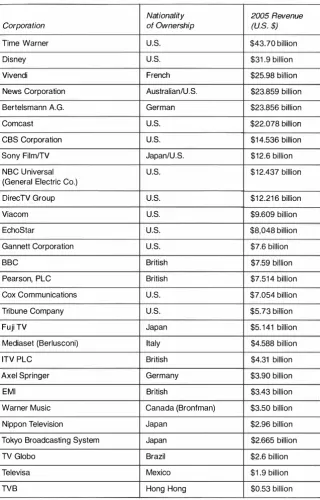
Another key research tradition focuses on cultural industries. The origi nal research by Horkheimer and Adorno (200 1 ) focused strongly on the power and integration of what they saw as a monolithic culture industry that tended to change culture into a mass culture that reinforces capitalist consumer ideology. This research analysis had a powerful effect in Latin America, Europe, and the United States, where powerful national cultural industries were growing. Quite a bit of current research on the conglomer ation and integration of cultural industries such as Time Warner follows this theme (McChesney, 1 999). However, Latin American scholars (Martin Barbero, 1 993) and others have also begun to use this basic framework to look at aspects other than power and conglomeration: the way national production has grown in some countries rather than others and incorpora tion of global models in national industries (Sinclair, 1 995 ) . Chapter 3 also looks at this body of research.
Globalization
Many observers from journalism, industry, and the academy have noticed a rapid global penetration of recent economic and technological changes. For many, and from diverse angles, globalization is now the new dominant paradigm. They look at "flows of goods, people, information, knowledge and images" which "gain autonomy at a global level" and at "third cultures" of people who are more than national or bilateral in orien tation (Featherstone, 1 990a, p. 1 ) . For those who stress political economy, globalization is the extension to the whole world of capitalism, the con sumer economy, advertising, and concentrated ownership of media groups such as Bertelsmann, Sony, and Murdoch (Herman & McChesney, 1 997). Featherstone ( 1 990a) saw globalization as "cultural integration and disin tegration processes which take place not only on an inter-state level but processes which transcend the state-society unit and can therefore be held to occur on a transnational or transocietal level" (p. 1). Writing about glob alization tends also to incorporate postmodern perspectives in focusing less on homogenizing processes, such as media imperialism or Americanization, and more on a diverse set of processes, codes, symbols, and cultural
20 Chapter I
A good example of this process is advertising. The roots of the current global trends in advertising can be traced to the U.S. advertising industry, which created a prototype of organization; models for newspaper, radio, and television ads; and a general model of how advertising might fit into an indus trial economy and a consumer society. This model and the specific ad proto types have been widely diffused, first by U.S. firms moving into new markets where they wanted to advertise, then by U.S. advertising agencies that fol lowed their clients, and finally by professionals from other countries who were trained by U.S. firms and advertising agencies. This process struck a number of observers as direct Americanization and dependency on the United States (Fox, 1 975; Janus, 1 977). However, various countries, including China and Japan (Iwabuchi, 2002), have modified advertising-based media models and further diffused those modified models to other countries. The modifica tions feed back into the increasing number of global actors, U.S., European, Japanese, and others. A slightly different global style emerges, along with very different adaptations of the advertising idea. All of these models still serve to promote an increasingly global consumer economy, but they are both gener alized to the world and specified to various localities, well beyond direct dependence on the original U.S. companies, agencies, and models.
There is a general movement away from deterministic views of the polit ical economy of television (Martin-Barbero, 1 993). In this book, I use com plexity theory and structuration as means of considering structural power without falling into determinism. It is important to neither under- nor over estimate structural power because these political economy analyses correctly stress the importance of ownership, class relations, and other economic fac tors in the shaping of television at world, regional, and local levels. Chapter 4, which discusses the creation of global media firms and the new global patterns and models for television, covers in more depth theories of global ization and presents a model for understanding the asymmetrical interdepen dence of world television.
Roles and Impacts of Technology
A Multilayered World of Television 2 1
television held the world's attention and fears for decades (de Sola Pool, 1983). Many expected technologies such as satellites to facilitate the next wave of cultural imperialism (de Sola Pool, 1 979; Jayakar, 1 993; Oliveira, 1986), and indeed, many still fear exactly that, although now most speak of a more complex scenario of both global and regional satellite forces, such as the relationship between global CNN and regional Al-Jazeera (Kraidy, 2002). Much of the fear of change focused on satellite and cable television distri bution, particularly their potential for carrying television programs and channels across borders. However, equally significant is the technological potential in changes that enable much cheaper and more flexible production and distribution. Production technology in video and sound has dropped dramatically in cost and gone up dramatically in quality. For example, a broadcast-quality production camera, which is also portable enough for exterior production, can be had for well under $5,000. A broadcast-quality editing system can be had for $5,000 or less. High-quality sound recording and simple but adequate mixing equipment can be had for under $3,000.
Another key issue with technology impacts as part of globalization is to ascertain who in what culture actually has access to what technology. When speaking of computers and the Internet, statements from world forums like the World Summit on the Information Society (2003-2005 ) clearly see that most people in the world do not have access to these new communication technologies, which greatly diminishes the potential impact they have as part of globalization (ITU, 2006). However, many of those concerned about impacts of satellite and cable television technology fail to recognize that most people in the world do not have access to them either because they can not afford them, because governments like China restrict access to them, or because they are sufficiently satisfied with broadcast television that they choose not to pay for access to them.
Asymmetrical Interdependence and Asymmetrical Cultural Interpenetration: A Proposed Model
22 Chapter 1
growth but growth or development can take place (Cardoso, 1 973; Salinas & Paldan, 1979). While the structural context, problems, and constraints for much of the world's media that dependency theory pointed out should be analyzed, consideration must also be given to the development of cultural industries that show increasing aspects of interdependence by creating .tnore cultural products, adapting and changing cultural product models, and exporting both. This concept also builds on ideas of globalization, viewing global, regional, national, and local actors as part of an interdependency that is dynamic but asymmetrical, with growth and change in uneven and chang ing degrees. Nation-states and national-level actors have a continuing role, but so do local, supranational, regional, and transnational actors.
This vision moves beyond looking at world cultural and economic relations using dichotomies between dependence and independence or narrow typolo gies, such as core, semiperipheral, and peripheral countries. In this book, I anticipate a broad range of possibilities between relative autonomy of the sort enjoyed by the United States and relatively strong dependence such as that suf fered by the smaller countries of the Caribbean. Rather than one range of pos sibilities, several interrelated levels or kinds of relationships between nations or cultures were considered, on dimensions analogous to Appadurai's ( 1 990) scapes. For example, a nation like Brazil might depend on others for the man ufacture of the more sophisticated information and communication technolo gies, which restricts its possibilities, but still be relatively autonomous in using the communications and cultural content of those imported technologies as enabling tools to create new forms of culture. Other nations might predomi nantly import both technologies and content, but perhaps from very different countries; for example, the Dominican Republic imports technology from the United States and Japan and content from the United States and Mexico.
Building on Appadurai's (1990) idea of disjuncture, I propose several levels of interaction between cultures in the world: political-economic, technological, cultural production, content, content flows, and reception of culture. Many previous analyses of these problems fail in part because they look only at one level, such as political eeonomy or media effects, without considering the others. On the other hand, Appadurai's analysis may overestimate the disjunc ture or separation between these levels of interaction. There are relationships between political and economic systems, technologies, cultural producers and media institutions, and receivers of cultural and media products. Correspond ingly, there is a range of levels of causation or explanation for both structural and cultural issues.
A Multilayered World of Television 23
tried to capture the essence of cross-cultural interaction via media, includ ing television flows and television genre development, television producer audience understandings and interactions, cultural proximity, theories of cultural action and choice (such as Bourdieu), hybridization, and the forma tion of multilayered cultures and identities. The question of the emergence of hybrid and multiple identities among television viewers is covered more thoroughly in Chapter 9.
Imported TV Versus Local and National: Producers Localize, Glocalize, and Hybridize
Nearly all societies and cultures have been affected by outside cultural influences, and few have ever been free from outside cultural influence. Extensive contacts between cultures (Nederveen Pieterse, 2004) have long existed. A combination of economic and technological changes in the 20th century have enabled mass media to reach many, if not most of the people in the world. Radio, film, television, satellite TV, and the Internet have all increased the rate of contact between societies. Radio and television, in particular, have brought most people into greater contact with the worlds outside their culture.
By the 1960s and 1970s, this technological penetration seemed to have resulted in dramatically increased, largely one-way flows of film, music, news, and television programs from the United States and Europe to other countries (Guback & Varis, 1 986; Nordenstreng & Schiller, 1979; Nordenstreng & Varis, 1 974; Stevenson & Shaw, 1 984). In 1974, Nordenstreng and Varis concluded that most of the world imported most its television programming, which was mostly entertainment and mostly from the United States. These one-way flows seemed a primary symptom of cultural dependence and media imperialism (Beltran & Fox de Cardona, 1 979; Lee, 1980).
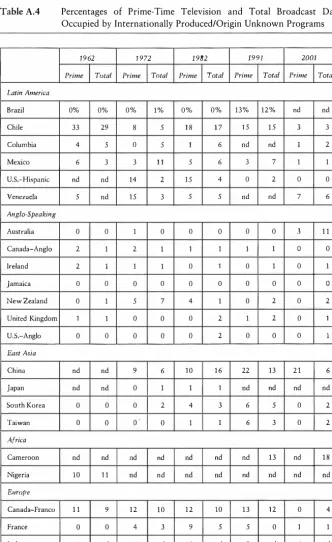
However, there is evidence, as the tables in the Appendix reveal, that the flows of television have changed considerably in the past 30 years. This study of 26 countries in 1962, 1 972, 1 982, 1 992, and 2002 shows that tele vision schedules in most countries, particularly during the prime-time hours, are increasingly filled by programming from within the country in question or from within its cultural-linguistic region or space.
24 Chapter 1
These genres have replicated as patterns across countries and are adapted to fit local circumstances, budgets, and audience interests
Chapter 6 examines how national or local producers have worked within cultural industries to produce television. It examines several more theories of globalization, localization, glocalization, reconfiguration (Ricoeur, 1984 ), and hybridization, relating them directly to how television producers and programmers might think about what to produce, what to import, where to import it from, what to export, and how to adapt television produced for one culture to the interests and demands of the audiences in another one.
Chapter 7 looks at the production and exportation of programs, genres and even whole channels, such as MTV or Discovery. It examines some theories of how programs get altered for export, such as delocalization, and it reviews what is still primarily exported from the United States both in terms of total flow and of genres. The turn from exporting programs and channels to exporting formats, such as Jeopardy or American Idol, is also covered.
Increasingly, when poor countries import much of their programming, it no longer primarily comes in a one-way flow from the United States. The Dominican Republic has imported many genres, such as comedies, variety shows, and news, from Mexico (Rogers & Schement, 1984; Straubhaar & Viscasillas, 1991 ), just as Mozambique imports entertainment from both Brazil and the United States. This constitutes a more complex flow. Programming now flows horizontally from one developing country to another quite fre quently. Some programs even flow back to the United States and Europe. Brazilian television now tends to dominate the prime-time programming of its former colonial power, Portugal (Marques de Melo, 1988, 1992; Pinto & Sousa, 2004). Mexico has long dominated the television and radio program ming of the Hispanic audience in the United States (Fernandez & Paxman, 2001). The overall flow is still asymmetric, but there is now an interpenetration of cultures, both by migration and by media, which flows largely from devel oped North to the developing South but increasingly flows back as well.