Importance of Project Procurement
Management
• Procurement means acquiring goods and/or services
from an outside source.
• Other terms include purchasing and outsourcing. • Experts predict that global spending on computer
software and services will continue to grow.
Debates on Outsourcing
• Some companies, such as Wal-Mart, prefer to do no outsourcing at all, while others do a lot of outsourcing.
• Most organizations do some form of outsourcing to meet their IT needs and spend most money within their own country.
• The U.S. temporary workforce continues to grow as
Why Outsource?
• To reduce both fixed and recurrent costs.
• To allow the client organization to focus on its core business.
• To access skills and technologies.
• To provide flexibility.
Contracts
• A contract is a mutually binding agreement that obligates the seller to provide the specified products or services and obligates the buyer to pay for them.
• Contracts can clarify responsibilities and sharpen focus on key deliverables of a project.
• Because contracts are legally binding, there is more accountability for delivering the work as stated in the contract.
Project Procurement Management
Processes
• Project procurement management: Acquiring goods
and services for a project from outside the performing organization.
• Processes include:
– Planning purchases and acquisitions: Determining what to procure, when, and how.
– Planning contracting: Describing requirements for the products or services desired from the procurement and
identifying potential sources or sellers (contractors, suppliers, or providers who provide goods and services to other
Project Procurement Management
Processes (cont’d)
• Requesting seller responses: Obtaining information, quotes, bids, offers, or proposals from sellers, as
appropriate.
• Selecting sellers: Choosing from among potential
suppliers through a process of evaluating potential sellers and negotiating the contract.
• Administering the contract: Managing the relationship with the selected seller.
Planning Purchases and
Acquisitions
• Identifying which project needs can best be met by using products or services outside the organization.
• If there is no need to buy any products or services from outside the organization, then there is no need to
Tools and Techniques for Planning
Purchases and Acquisitions
• Make-or-buy analysis: General management technique
used to determine whether an organization should make or perform a particular product or service inside the
organization or buy from someone else.
• Often involves financial analysis.
Make-or-Buy Example
• Assume you can lease an item you need for a project for $800/day. To purchase the item, the cost is $12,000 plus a daily operational cost of $400/day.
Make-or Buy Solution
• Set up an equation so both options, purchase and lease, are equal.
• In this example, use the following equation. Let d be the number
of days to use the item:
$12,000 + $400d = $800d
Subtracting $400d from both sides, you get: $12,000 = $400d
Dividing both sides by $400, you get: d = 30
Types of Contracts
• Different types of contracts can be used in different situations:
– Fixed price or lump sum contracts: Involve a fixed total price for a well-defined product or service.
– Cost reimbursable contracts: Involve payment to the seller for direct and indirect costs.
– Time and material contracts: Hybrid of both fixed price and cost reimbursable contracts, often used by consultants.
– Unit price contracts: Require the buyer to pay the seller a predetermined amount per unit of service.
• A single contract can actually include all four of these
Contract Clauses
• Contracts should include specific clauses to take into account issues unique to the project.
• Can require various educational or work experience for different pay rights.
Procurement Management Plan
• Describes how the procurement processes will be
managed, from developing documentation for making outside purchases or acquisitions to contract closure.
Contract Statement of Work (SOW)
• A statement of work is a description of the work required for the procurement.
• If a SOW is used as part of a contract to describe only the work required for that particular contract, it is called a
contract statement of work.
• A SOW is a type of scope statement.
Figure 12-2. Statement of Work (SOW)
Template
I. Scope of Work: Describe the work to be done to detail. Specify the hardware and
software involved and the exact nature of the work.
II. Location of Work: Describe where the work must be performed. Specify the
location of hardware and software and where the people must perform the work
III. Period of Performance: Specify when the work is expected to start and end,
working hours, number of hours that can be billed per week, where the work must be performed, and related schedule information.
IV. Deliverables Schedule: List specific deliverables, describe them in detail, and
specify when they are due.
V. Applicable Standards: Specify any company or industry-specific standards that
are relevant to performing the work.
VI. Acceptance Criteria: Describe how the buyer organization will determine if the
work is acceptable.
VII. Special Requirements: Specify any special requirements such as hardware or
Planning Contracting
• Involves preparing several documents needed for potential sellers to prepare their responses and determining the evaluation criteria for the contract award.
– Request for Proposals: Used to solicit proposals from prospective sellers. • A proposal is a document prepared by a seller when there are different
approaches for meeting buyer needs.
– Requests for Quotes: Used to solicit quotes or bids from prospective suppliers.
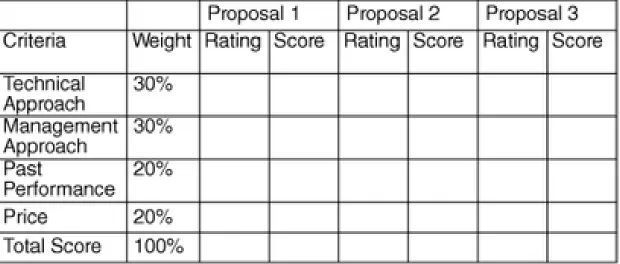
Evaluation Criteria
• It’s important to prepare some form of evaluation criteria, preferably before issuing a formal RFP or RFQ.
• Beware of proposals that look good on paper; be sure to evaluate factors, such as past performance and
management approach.
Requesting Seller Responses
• Deciding whom to ask to do the work, sending appropriate documentation to potential sellers, and obtaining proposals or bids.
• Organizations can advertise to procure goods and services in several ways:
– Approaching the preferred vendor.
– Approaching several potential vendors. – Advertising to anyone interested.
Selecting Sellers
• Also called source selection.
• Involves:
– Evaluating proposals or bids from sellers.
– Choosing the best one.
– Negotiating the contract.
Seller Selection Process
• Organizations often do an initial evaluation of all proposals and bids and then develop a short list of potential sellers for further evaluation.
• Sellers on the short list often prepare a best and final offer (BAFO).
Administering the Contract
• Ensures that the seller’s performance meets contractual requirements.
• Contracts are legal relationships, so it is important that legal and contracting professionals be involved in writing and
administering contracts.
Suggestions for Change Control in
Contracts
• Changes to any part of the project need to be reviewed,
approved, and documented by the same people in the same way that the original part of the plan was approved.
• Evaluation of any change should include an impact analysis. How will the change affect the scope, time, cost, and quality of the goods or services being provided?
• Changes must be documented in writing. Project team
Suggestions for Change Control in
Contracts (cont’d)
• Project managers and teams should stay closely involved to make sure the new system will meet business needs and work in an operational environment.
• Have backup plans.
Closing the Contract
• Involves completing and settling contracts and resolving any open items.
• The project team should:
– Determine if all work was completed correctly and satisfactorily.
– Update records to reflect final results.
– Archive information for future use.
Tools to Assist in Contract Closure
• Procurement audits identify lessons learned in the procurement process.