1
JULY 2012I N T E R N A T I O N A L S U S TA I N A B I L I T Y U N I T
R E D D + A N D T H E
A G R I C U LT U R A L D R I V E R S
O F D E F O R E S TA T I O N
K e y f i n d i n g s f r o m
t h r e e s t u d i e s i n
B r a z i l , G h a n a a n d
1
EXECUTIVE SUMMARY
In order to ensure global food security and avert dangerous climate change, the world faces the pressing dual challenge of both protecting its remaining rainforests and enhancing food production in sustainable and resilient
!"#$%&'())*$$+(,,#&")-.*/.01&2-.$&!3(,4&563/.4*&7(,2.5,*&)389*0*:2$;&.0),(4.01&$"+*1("64.01&2-*&!*,,89*.01&"04&
livelihoods of forest peoples; protecting the biodiversity and ecosystem services provided by forests; and reducing rural poverty.
<-.$& 6*5362& $**=$& 23& )3026.9(2*& 23& 2-*& ")-.*/*7*02& 3+& 2-.$& 13",& 9#& $(77"6.>.01& 2-*& :04.01$& 3+& 6*)*02& $2(4.*$&
commissioned by The Prince’s Rainforests Project and conducted in key agricultural and forest regions of Brazil, Ghana and Indonesia. The purpose of the studies, carried out by regional experts, was to examine the incentives,
*0"9,.01& 53,.).*$& "04& :0"0).",& 7*)-"0.$7$& 0*)*$$"6#& .0& *")-& 3+& 2-*$*& 6*1.30$& .0& 364*6& 23& .02*0$.+#& "16.)(,2(6",&
production without causing further deforestation. The studies also describe potential pilot initiatives which – were they to be implemented as part of broader integrated national and regional policies designed to promote lowcarbon development – could make a practical contribution to addressing this challenge in each country.
<-6**&=*#&?,*/*6$@&3+&)-"01*&!*6*&.4*02.:*4&")63$$&2-*&6*1.30$&"04&)37734.2.*$&23&2-.$&*04A&.B&2-*&563/.$.30&3+& (5+6302&5(9,.)&:0"0)*;&+3,,3!*4&9#&,3!8.02*6*$2&,3"0$C&..B&2-*&*$2"9,.$-7*02&"04&*0+36)*7*02&3+&2-*&)366*)2&*0"9,.01& 53,.)#&"04&6*1(,"236#&+6"7*!36=$C&"04&...B&2-*&0**4&+36&$.10.:)"02&5(9,.)&.0/*$27*02&.0&.0)6*"$.01&2-*&)"5").2#&3+&
agricultural producers, and smallholders in particular.
In the case of Mato Grosso, Brazil, the regional study argues that the state’s projected increases in soya production and cattle rearing by 2020 could take place on already degraded pasturelands, using agroecological techniques,
.0$2*"4& 3+& *D5"04.01& .023& )(66*02,#& .02")2& "6*"$& 3+& 6".0+36*$2%& <-*& $2(4#& :04$& 2-"2& .0/*$27*02$& .0& .7563/.01& 5634()2./.2#&,*"4&23&$.10.:)"02&:0"0).",&1".0$&+36&)"22,*&6"0)-*6$%&E*2&(52"=*&+36&2-*$*&.7563/*7*02$&.$&)(66*02,#&
impeded by the lack of capital for upfront investment, and the lack of extension services. Providing incentives for the adoption of improved systems, and linking these to reduced deforestation activities, would require political
!.,,;&)3(5,*4&!.2-&2-*&*0+36)*7*02&3+&F"23&G63$$3@$&HIJJK&,*1.$,"2.30&L)(66*02,#&(04*6&4*/*,357*02B&"04&2-*&
mechanisms it establishes. As a practical step, the study sets out a possible pilot project of ‘land neutral agricultural expansion’ in the state. Initially covering 75,000 hectares, the proposed project would cost £1.2 million per year
+36&:/*&#*"6$;&9(2&)3(,4&",$3&,*/*6"1*&(5!"64$&3+&MNO&7.,,.30&3+&56./"2*&.0/*$27*02$&9#&+"67*6$%&<-*&$2(4#&",$3&
proposes a methodology by which the outlined investments in increased agricultural production could be linked to
HIJJK&7*)-"0.$7$&.0&"&P("02.:"9,*&!"#;&"04&"446*$$&)30)*60$&3+&"44.2.30",.2#;&,*"="1*&"04&5*67"0*0)*%
In the case of the Eastern and Western Regions of Ghana, the regional study shows how cocoa and oil palm farmers could increase their incomes and productivity two to threefold whilst protecting Ghana’s remaining forests and freeing land for reforestation. The study argues that this could be achieved by providing farmers with a combination of shortterm grants, extension services, improved inputs and subsidized loans over the mid to longterm. In order
23&9*1.0&$()-&"&26"0$.2.30;&2-*6*&.$&"&0**4&+36&5(9,.)&.0$2.2(2.30",&"04&:0"0).",&$(55362&23&"$$.$2&+"67*6$&.0&"++364.01&
the upfront costs of changing their practices. A set of pilot projects – each one involving approximately 50,000
-*)2"6*$&3+&,"04;&QO;OOO&+"67*6$;&"04&)3$2.01&(5&23&RS'T%N&7.,,.30&U&.$&.4*02.:*4&"$&"&!"#&23&2*$2&2-.$&.4*"&30&2-*&
ground.
2
current land use plan to commit currently vulnerable forests to conservation status; the encouragement of agricultural expansion onto low carbon or degraded land; and smallholder yield improvement. The study suggests that one of the essential prerequisites for this to occur would be the provincial government’s implementation of a ‘land swap’, which would need to be done in a way that equitably resolves land tenure issues. The proposed ‘land swap’ would be intended to protect approximately 75,000 hectares of forest currently vulnerable to deforestation, and to make a further 240,000 hectares of already degraded land available for agricultural use, and would cost in the region of US$9.8 million. The study also demonstrates that increasing smallholder yields – through the public provision of*D2*0$.30&$*6/.)*$C&9*22*6&"))*$$&23&-.1-&P(",.2#&"04&$(+:).*02&)635&.05(2$&"04&/"6.*2.*$C&+".6*6&"04&736*&*P(.2"9,*&
access to milling capacity; and lowinterest loans – would enhance rural development and could (if supplemented
!.2-& *0-"0)*4& +36*$2& 13/*60"0)*& "04& *0+36)*7*02B& 6*4()*& 532*02.",& +(62-*6& *D5"0$.30& .023& +36*$2& "6*"$;& 2-*6*9#&
protecting a further 232,000 hectares of forest. In total, over one million hectares of highly valuable, carbonrich and biodiverse rainforest could be protected from deforestation in the coming years through the joint implementation of
2-*&7*"$(6*$&.4*02.:*4%&&<-.$&!3(,4&9*&4*5*04*02&30&53,.2.)",&!.,,;&"04&2-*&+(,,&.75,*7*02"2.30&3+&*D.$2.01&7*"$(6*$&
and legislation to protect the province’s remaining rainforests.
V,,&2-6**&6*1.30",&$2(4.*$&.04.)"2*&2-"2&(5+6302&5(9,.)&:0"0)*&U&932-&.0&2-*&+367&3+&437*$2.)&5(9,.)&+(04$;&16"02$&
from international cooperation and interim REDD+ pledges – coupled with the provision of low or even zero interest credit over a long period, is necessary in order to assist farmers in making the transition from their current
9($.0*$$8"$8($(",&56")2.)*$&23&736*&*)3037.)",,#;&$3).",,#&"04&*0/.6307*02",,#&9*0*:).",&$)*0"6.3$%&
Given the limited size of public REDD+ funds currently available, and the continuing uncertainties as to how future REDD+ mechanisms will be structured, the studies argue that other available sources of funding to effect these transitions will need to be harnessed. In particular, national funds, such as the Brazilian Development Bank’s low carbon agriculture credit line, and international funds earmarked for rural development and food security, could and should play an important role. But the studies also note that such transitions could be greatly accelerated by, and go hand in hand with, the establishment of better procurement policies, heightened consumer awareness and stronger market access and demand for sustainably sourced commodities in global supply chains.
Furthermore, the studies indicate that it is ultimately only national and local governments that can provide the policies and frameworks necessary to enable these transitions to take place at scale. This is the case for the implementation and enforcement of clear land use zoning, the safeguarding of biodiversity corridors, and the conservation of riparian areas in each region; for the provision of extension services, and capacitybuilding for farmers; and for the
"/3.4"0)*&3+&?,*"="1*@&"2&2-*&,"04$)"5*&$)",*;&.0&!-.)-&6*4()*4&4*+36*$2"2.30&.0&30*&"6*"&.$&032&0(,,.:*4&9#&.0)6*"$*4&
deforestation elsewhere. Where there are limited funds available, the studies also coincide in arguing that initial efforts should focus on the poorest producers at the forest frontier who often have the least capacity, or the least incentives within existing frameworks, to change their current production models to reduce deforestation.
In conclusion, the synthesis report argues that it would be helpful for further detailed research to be carried out on other commodities, countries and regions to explore how the challenge of sustainably increasing agricultural production without causing further deforestation could be met in other contexts. But it also states that there is a pressing need to start to implement the sorts of practical ideas proposed by the regional studies, and others like them,
"$&,301&"$&2-*#&"6*&:67,#&*79*44*4&!.2-.0;&"04&",.10*4&!.2-;&3/*6"6)-.01&0"2.30",&"04&W(6.$4.)2.30",&53,.).*$&".7*4&
3
INTRODUCTION
A recent academic paper argues that ‘a central challenge for sustainability is how to preserve forest ecosystems and the services that they provide us while enhancing food production’TB. The world does indeed face the pressing need
both to protect its remaining rainforests – and thereby to ensure the survival of forest peoples and their livelihoods; to safeguard the biodiversity and the ecosystem services forests provide; and to mitigate global climate change through the reduction of emissions from deforestation and forest degradation (REDD+XBB&U&!-.,*&"2&2-*&$"7*&2.7*&23&
enhance food production, in sustainable and resilient waysQB, and thereby to reduce rural povertyYB and ensure global
food security in the decades ahead.
In order to achieve this dual aim, forest countries, with support from the international community, need to make a concerted effort to enhance forest governance, strengthen land tenure, implement forest legislation, safeguard the rights and livelihoods of forest and indigenous peoples, and enhance agricultural productivity. Equally critically, there needs to be an international effort to reduce the impacts of global investment and consumption patterns on the world’s remaining forests.
The largest single driver of deforestation in the world today is agriculture (although the timber trade, infrastructure
4*/*,357*02;&7.0.01;&26"0$5362&"04&*0*61#&5,"#&"&$.10.:)"02&63,*&233BNB. This is because agricultural expansion,
driven largely by increasing global consumption, a changing global diet and the rise of the global populationZB,
has often occurred – and continues to occur – at the expense of forested areas in tropical countries, just as it did historically with large areas of the forests of Europe and North America[B.
<-*&56*7.$*&2-"2&2-*&!36,4&0**4$&23&:04&!"#$&3+&7**2.01&.2$&1,39",&+334&"04&6*$3(6)*&0**4$&.0&2-*&XT$2&)*02(6#&
without causing further deforestation is widely accepted, and is referred to inter alia in the United Nations Framework
\30/*02.30& 30& \,.7"2*& \-"01*& LS]^\\\B;& 2-*& _(2)37*& J3)(7*02`B of the Rio+20 Sustainable Development
Convention and in the ‘zero deforestation’ pledges made by the Consumer Goods Forum, a network comprising the world’s largest consumer goods companies and retailers.
While there is a growing academic and policy evidence base to suggest that this ‘decoupling’ is feasibleaB, there
are in practice a number of challenges that remain. The Prince’s Rainforests Project seeks to provide practical recommendations arising from dialogues with a broad range of stakeholders, including governments, civil society and the private sector, on how to make progress towards overcoming these challenges. It also starts from the premise that any such approaches must take into account the needs, wishes and interests of local communities and indigenous peoples living in forests around the world.
1‘Global land use change, economic globalization, and the looming land scarcity’, PNAS, Lambin and Meyfroidt, 2011. 2REDD+ as !"#$"!%&'%()"%*$+("!%,-(+.$/%01-2"3.14%5.$6"$(+.$%.$%57+2-("%5)-$8"9%
3Prince’s Charities’ International Sustainability Unit, ‘What Price Resilience? Towards Sustainable and Secure Food
Systems’, 2011.
4‘75% of the world’s poor live rurally and agriculture remains the largest single contributor to their livelihoods’.
!"#$%&'()*+,"-./)0'#)1$'("-2).1")%-&.&%03)-+3")+4)5'0'%&'()4+-)4++#6)0(-&%$3.$-")0'#)-$-03)#","3+*7"'.%&&^V_;&b^VJ&"04&c^d;&XOOX% 5:)"%;1+6"1/%.<%:1.=+>-7%;"<.1"/(-(+.$?%*$+.$%.<%5.$>"1$"!%@>+"$(+/(/?%ABCC9
6%DE"/.F1>"%E"6.7F(+.$G%H""(+$8%()"%3.17!I/%"$"18'?%2-("1+-7/?%<..!?%-$!%3-("1%$""!/I9%%H>J+$/"'%K%5.2=-$'9%%,.6"2&"1%%%%%%%%% % % ABCC9
7Williams, 2003.
4
The Prince’s Rainforests Project
<-*&d6.0)*@$&H".0+36*$2$&d63W*)2&LdHdB&.$&5"62&3+&<-*&d6.0)*@$&\-"6.2.*$@&b02*60"2.30",&'($2".0"9.,.2#&S0.2&Lb'SB;&
a charitable organisation which works to build consensus around durable solutions to meeting the challenges of climate change and natural resource depletion. The PRP was established in 2007 by His Royal Highness The Prince of Wales to encourage consensus on how the rate of tropical deforestation might be slowed. Following extensive consultation, in March 2009 the PRP published a report calling for an emergency funding package to reduce tropical deforestation.
At the core of the proposal stood the idea that funding to reduce deforestation should move away from traditional
".4&)-"00*,$;&"04&73/*&23!"64$&"&5"#7*028+3685*6+367"0)*&9"$.$&U&.0&2-.$&)"$*;&5"#7*02$&+36&/*6.:"9,*&*7.$$.30$&
reductions. This would then allow willing rainforest countries to use these funds to redirect their development path away from deforestation.
World leaders rallied around the proposal at a meeting convened by His Royal Highness The Prince of Wales in
V56.,&XOOa&"04&!*02&30&23&+367&2-*&?b0+367",&c36=.01&G63(5&30&b02*6.7&^.0"0)*&+36&HIJJK@&LbcG8b^HB%&&<-.$&
in turn led to pledges of US$4.5 billion in ‘Fast Start Finance’ for Reduced Emissions from Deforestation and
^36*$2&J*16"4"2.30&LHIJJKB&")2./.2.*$&9*.01&7"4*&+36&2-*&XOTO&U&XOTX&5*6.34;&"04&2-*&+367"2.30&3+&2-*&?HIJJK& d"620*6$-.5@&.0&_$,3&.0&F"#&XOTO%&&
Agriculture as a Driver of Deforestation
^3,,3!.01&2-*&+367"2.30&3+&2-*&?HIJJK&d"620*6$-.5@&.0&_$,3&"04&2-*&")-.*/*7*02&3+&2-*&.02*6.7&:0"0)*&5,*41*$;&
the PRP shifted its focus to addressing the links between commercial agriculture and deforestation. This emphasis is based on the premise that agricultural expansion continues to be the primary driver of deforestation in tropical
)3(026.*$;&"04&2-"2&"0#&$())*$$+(,&HIJJK&$26"2*1#&!.,,&2-*6*+36*&0**4&23&:04&!"#$&23&.0)*02./.$*&5634()*6$&"04&
other actors in the value chain to increase production in ways that do not cause further deforestation.
_0&]3/*79*6&T`2-&XOOa;&e.$&H3#",&e.1-0*$$&<-*&d6.0)*&3+&c",*$&)30/*0*4&"&7**2.01&3+&"16.9($.0*$$&)375"0.*$&
active in rainforest countries to discuss how this goal might be achieved. There was general agreement that it would be possible to increase agricultural production without causing further deforestation, by increasing yields, rehabilitating degraded land and reducing waste along the supply chain. It was acknowledged by all that such interventions need to be complemented by the implementation of forest protection mechanisms, improved forest governance, the equitable resolution of land tenure issues, and support for peoples and communities living in forests.
In order to test these ideas, the PRP then organised eight regional meetings in Brazil, Ghana, Malaysia and Indonesia
4(6.01& XOTO;& 96.01.01& 231*2-*6& 6*56*$*02"2./*$& +637& 2-*& 56./"2*& $*)236;& ]G_$& "04& 13/*607*02$%& &V$& 2-*& dHd@$&
synthesis report in 2010 showed, such approaches are feasible and can, in many instances, generate positive
*)3037.)&6*2(60$&+36&+"67*6$;&)375"0.*$&.0&2-*&$(55,#&)-".0;&:0"0).",&.0$2.2(2.30$;&"04&0"2.30",&13/*607*02$TOB. ^(62-*6736*;&2-*&6*5362&"61(*4;&355362(0.2.*$&23&.0)6*"$*&5634()2.30&43&032&0*)*$$"6.,#&6*P(.6*&5(9,.)&$(9$.4.*$A& !-.,*&2-*6*&.$&"&63,*&+36&5(9,.)&:0"0)*&23&6*4()*&(5+6302&6.$=;&$2.7(,"2*&2-*&f3!&3+&)6*4.2&L,30182*67&:0"0).01B;&
and create the right enabling conditions, the mid to longterm returns from increasing productivity can support the investment required. Collaboration between the public and private sector is required to ensure public and private
)"5.2",&.$&4*5,3#*4&*++*)2./*,#&"04&*+:).*02,#%
To further this work in 2011, the PRP convened a further set of meetings in which a series of project ideas intended to address this challenge in the context of particular regions and commodities were discussed amongst a number of stakeholders. Several of these attracted the interests of donors, and were held to be relevant and worthy of funding.
e3!*/*6;&2-*&43036$&)",,*4&+36&*/.4*0)*&3+&2-*&563W*)2&56353$",$@&.75")2$;&"$&!*,,&"$&),"6.:)"2.30$&30&2-*&2#5*$&3+& :0"0)*&"04&4.$26.9(2.30&)-"00*,$&6*P(.6*4;&"04&30&-3!&.$$(*$&$()-&"$&$"+*1("64$;&,*"="1*&"04&2-*&"44.2.30",.2#&3+&
private sector investments could be addressed. In parallel, the private sector and civil society actors which had developed the proposals also expressed the need for seed money or public assurance that their efforts would be recognized within emerging REDD+ frameworks.
5
This report: Brazil, Ghana, Indonesia regional studies
<-*&dHd&2-*0&)377.$$.30*4&2-6**&0*!&5.*)*$&3+&"0",#$.$&23&9*22*6&(04*6$2"04&2-*&:0"0).01&1"5$;&.0)*02./*$&"04&
complementary policies required to facilitate a transition by the agricultural sector from businessasusual to methods of production that do not require further expansion into forests. The analysis also sought to assess potential environmental, economic and social impacts of the alternative means of increasing production without causing
+(62-*6&4*+36*$2"2.30&.4*02.:*4&.0&2-3$*&56353$",$%&&
Continuing the work undertaken in 2010, the analysis focused on soya and livestock in the state of Mato Grosso, Brazil; palm oilTTB in Central Kalimantan, Indonesia; and cocoa and palm oil in the Eastern and Western Regions
of Ghana. These regions and commodities had been chosen originally because of the projected expansion of these commodities and associated deforestation; the existence of national and local government commitments to the
.75,*7*02"2.30&3+&HIJJK&$26"2*1.*$C&"04&2-*&56*$*0)*&3+&.4*02.:"9,*&56./"2*&$*)236&5,"#*6$&!.,,.01&23&5,"#&"&63,*&
in shifting to best practice.
d63/.$.30",& :04.01$& +637& *")-& $2(4#& !*6*& 56*$*02*4& 23& 163(5$& 3+& 6*,*/"02& "16.9($.0*$$& )375"0.*$& L.0),(4.01& 563)*$$36$;&26"4*6$;&.05(2&$(55,.*6$&"04&32-*6$B;&532*02.",&.0/*$236$&L.0),(4.01&43036&"04&6".0+36*$2&13/*607*02$;& 7(,2.,"2*6",&"04&)377*6).",&9"0=$;&5-.,"02-635.)&934.*$&"04&32-*6$B;&]G_$&"04&G3/*607*02$&.0&"&$*2&3+&!36=$-35$& -*,4&.0&b0430*$.";&g6">.,&"04&G-"0"&.0&^*96("6#&"04&V56.,&XOTX%&&<-.$&6*5362&56*$*02$&"&$#02-*$.$&3+&2-*&=*#&:04.01$&
and common themes that emerge from all three studies, with the full reports available on the ISU’s websiteTXB.
Limits of analysis
There are a number of limits to the analysis contained in the regional studies which are important to note at the
3(2$*2%& & ^.6$2,#;& 2-*& "0",#$.$& )302".0*4& .0& 2-*& 6*1.30",& 6*5362$& +3)($*$& 4*,.9*6"2*,#& 30& $5*).:)& )37734.2.*$;& "04&
not on agricultural systems as a whole, or indeed on whole landscapes. There is an opportunity for the analysis
56*$*02*4&.0&2-*$*&6*5362$&23&9*&"55,.*4&23&32-*6&)37734.2.*$&"04&(,2.7"2*,#&"2&2-*&,"04$)"5*&36&L$(98B&0"2.30",&,*/*,;&
and thereby to include a fuller understanding of the dynamics which exist between different commodities and other development policies and decisions.
A second limitation is that the analysis was conducted at the level of commodity producers. It does not cover the
)3$2$&"04&9*0*:2$&"))6(.01&23&32-*6&")236$&",301&2-*&$(55,#&)-".0$%&'.7.,"6&"0",#$*$&$-3(,4&2-*6*+36*&9*&)304()2*4&
for other actors along the supply chain.
A third limitation is that the analysis does not include local food security dimensions, i.e. it does not assess the value of a small producer being able to grow food crops for his/her own household consumption.
A fourth limitation is that, whilst the studies aimed qualitatively, and quantitatively where possible, to compare ‘businessasusual’ with alternative production models on a number of environmental and social indicators, they
"6*&9"$*4&56.7"6.,#&30&4"2"&)3,,*)2*4&+637&2-.64&5"62#&$3(6)*$&"04&*$2.7"2*$;&.0&"44.2.30&23&:*,4&/.$.2$&)"66.*4&3(2&9#&
each of the regional teams in charge of the regional reports. These indicators could be better assessed in the future.
Going forward
<-*&dHd&.$&032&"0&.75,*7*02.01&36&"&+(04.01&"1*0)#;&9(2&6"2-*6&"&0*(26",&)30/*036&!-.)-&".7$&23&:04&56")2.)",& $3,(2.30$& 23& *0/.6307*02",& )-",,*01*$%& & b0& 2-.$& 6*$5*)2;& .2& .$& -35*4& 2-"2& 2-*& :04.01$& $(77"6.>*4& .0& 2-.$& 6*5362&
can provide a contribution to the formation of public policy concerning REDD+, agriculture, food security, rural development and forests; to the strategies of international donors working on these issues; and to the development and implementation of individual projects addressing these challenges on the ground.
11 Throughout, the study follows standard practice by referring to ‘oil palm’ when discussing the plant, and ‘palm oil’ when referring to the
end product prepared from the plant.
6
BRAZIL
The following section is based on a 2012 study entitled ‘Increasing Agricultural Output while Avoiding Deforestation &')80.+)9-+::+2);-+*+:03:)4+-)<77"#&0.")=%.&+'>6)*-"*0-"#)4+-).1");!;)?/)@-A)B"-'0-#+)C.-0::?$-(6)@-)=('&":DE0) F0.0G&"%) 0'#) @-) !+'03#+) C"-+0) #0) 8+..0) 4-+7) .1") <'."-'0.&+'03) <':.&.$.") 4+-) C$:.0&'0?&3&./6) G&.1) :$**+-.) 4-+7) F0$-"'.)8&%+3)4-+7).1")<':.&.$.+)H"'.-+)#")I)0'#)J0?&+)!07+:)4-+7)=(-+:$&::"A))K1")4$33):.$#/)&:)0,0&30?3")+') .1")<CL>:)G"?:&."A
1. Brazil: context
Brazil is the world’s largest rainforest country, home to 60% of the Amazon Rainforest. Since 2005, deforestation in the Brazilian Amazon has decreased dramatically, resulting in arguably one of the world’s single largest reductions in greenhouse gas emissionsTQB. In 2009, the Brazilian Government made a political commitment to ensuring an 80%
reduction in deforestation by 2020.
However, whether this decline in deforestation can be sustained is debated. Currently the world’s secondlargest agricultural producer, Brazil has the largest forecast increases in agricultural output over the next four decades of any country worldwide. These increases need to be achieved through improved productivity, and by expanding into
5"$2(6*&,"04$&$5"6*4&2-63(1-&)"22,*&.02*0$.:)"2.30%&&<-*#&7($2&",$3&13&-"048.08-"04&!.2-&2-*&*0+36)*7*02&3+&g6">.,@$&
revised forest legislation, and commitments to protected areas and indigenous reserves.
2. Mato Grosso
The state of Mato Grosso, in the centre west of Brazil, has been both an agricultural powerhouse and one of the strongest epicentres of deforestation in modern Brazil. The state, one and a half times the size of France, comprises
2-6**&9.37*$A&2-*&V7">30&6".0+36*$2;&2-*&cerrado&L$"/"00"-B&"04&2-*&d"02"0",&!*2,"04$%&g*2!**0&TaaZ&"04&XOON;&
39% of deforestation in the Amazon Rainforest took place in Mato GrossoTYB, with the state losing 39% of its original
forest and 42% of the cerrado to agriculture. Deforestation in Mato Grosso then declined by 85% in the ensuing six yearsTNB, increasing again in 2011, due to a large number of clearings for soya plantations in the north centre of
the state.
Since 1990, soya production in Mato Grosso has grown by 9.5% per annum, equating to 7% of global production. In 2010, Mato Grosso’s livestock herd occupied approximately 25.8 million hectares, with an average pasture stocking of 1.1 head per hectare. According to IMEA, the state’s cattle herd is set to grow at 2% per annum, leading to 35 million heads of cattle by 2020.
_0& HIJJK;& F"23& G63$$3& .$& .0& 2-*& 563)*$$& 3+& 5"$$.01& .2$& $2"2*& ,*1.$,"2.30& 30& "/3.4*4& 4*+36*$2"2.30;& "4352.01& "&
target to curb deforestation in its forest area by 89% by 2020 compared to 1996 – 2005. It is also a member of
2-*&G3/*6036$@&\,.7"2*&"04&^36*$2$&<"$=&^36)*;&"04&!36=.01&!.2-&<-*&]"2(6*&\30$*6/"0)#&L<]\B;&2-*&b0$2.2(23& \*0263&4*&i.4"&"04&32-*6&]G_$&30&5.,32&HIJJK&563W*)2$;&$()-&"$&"&5.,32&563W*)2&.0&\326.1(")(;&"04&32-*6&HIJJK&
readiness activities.
13?g6">.,@$&$())*$$&.0&6*4().01&4*+36*$2"2.30@%&S0.30&3+&\30)*60*4&').*02.$2$&g6.*:01%&XOTT%
14The following references come primarily from IMEA, Mato Grosso’s Agricultural Economy Institute, and are cited in
Strassburg et al. 2012.
7
Figure 1: Deforestation in Mato Grosso, and soy and cattle production: 2001 – 2010.
Source: Macedo et al. (2012).
3. Analysis
The study by the International Institute for Sustainability, in collaboration with Instituto Centro de Vida and Agrosuisse, compares the economics of ‘Business as Usual’ soya and livestock production in Mato Grosso with
2-6**&",2*60"2./*&$)*0"6.3$%&^36&*")-&$)*0"6.3;&2-6**&4.++*6*02&$.>*$&3+&+"67&!*6*&)30$.4*6*4A&QOO;&TYOO&"04&XNOO&
hectares.
<-*&:6$2;&?.7563/*4@&$)*0"6.3&"$$(7*$&2-*&"4352.30&3+&"&56316"77*&2-"2&.0)6*"$*$&5"$2(6*&5634()2./.2#&"2&"&+"$2*6& 6"2*;&2-63(1-&2-*&.75,*7*02"2.30&3+&2-*&g6">.,."0&V16.)(,2(6",&H*$*"6)-&\36536"2.30&LIFgHVdVB@$&1334&56")2.)*&
guidance. This includes the introduction of ‘intensive rotated pasture systems’ (Pastejo Rotacionado IntensivoB&
and the subdivision of pastures with electric fences. This scenario leads to a doubling of the area’s base carrying capacity in three years, in addition to minor improvements in fertility rates and weight gains.
The second scenario is based on a transition to an agroecological, silvopastoral system, involving the joint management of pastoral and silvicultural activities. Silvopastoral systems contribute to alleviating the demand for additional land by providing both timber and livestock from a given area. They are also shown in some cases
4. Key findings, risks and policy recommendations
V$&"&:6$2&:04.01;&?9($.0*$$8"$8($(",@&56*$*02$&0*1"2./*&6*2(60$&30&",,&2-6**&+"67&$.>*$%&&'*/*6",&*D5,"0"2.30$&-"/*&
oduction of soy and cattle
(normalised to 2001)
Ar
ea defor
ested (thousand ha)
soybeans cattle deforestation
8
'*)304,#;&,"61*6&+"67$&,*"4&23&$.10.:)"02,#&9*22*6&6*$(,2$&")63$$&",,&$)*0"6.3$%&&^36&.0$2"0)*;&"&+"67@$&.02*60",&6"2*& 3+&6*2(60&(04*6&2-*&.7563/*4&$)*0"6.3&/"6.*$&+637&TOj&L+36&"&$7",,&+"67B;&23&XQj&L7*4.(7B;&23&QTj&L,"61*B&"$&2-*&
scale of operations is increased.
<-.64,#;&2-*&$2(4#&:04$&2-"2&.0/*$27*02$&.0&.7563/.01&5634()2./.2#&,*"4&23&$.10.:)"02&:0"0).",&1".0$%&&b0&",,&+"67&
sizes, the implementation of the improved system – or of a combined silvopastoral and improved system – turns a negative BAU result into a positive one.
In order to make the transition from BAU to the ‘improved scenario’, or the combination of ‘improved’ with ‘silvo
5"$236",@;&+"67*6$&0**4&23&7"=*&)30$.4*6"9,*&(5+6302&.0/*$27*02$%&&<-*&$-36282*67&6*$(,2$&4*),.0*&+36&2-*&:6$2&2-6**&
years in the improved scenarios; and again in years 11 – 13 when investments in pasture improvement need to be
6*5*"2*4%&&<-*&.75,*7*02"2.30&3+&$.,/385"$236",&$#$2*7$&",$3&$.10.:)"02,#&.0)6*"$*$&2-*&0*2&56*$*02&/",(*&5*6&-*)2"6*&
in each of the scenarios, but there is currently low uptake.
_+&2-*&$)*0"6.3$;&2-*&*/.4*0)*&$-3!$&2-"2&,*"$.01&.$&2-*&73$2&*)3037.)",,#&"226")2./*&352.30&23&+"67*6$;&"$&2-*&.0)37*& +637&$3#9*"0$&)"0&9*&($*4&23&5"62.",,#&:0"0)*&5"$2(6*&.7563/*7*02$%&&<-*&7".0&+")236$&)30$26".0.01&,"61*8$)",*& (52"=*&3+&2-*$*&.7563/*4&$#$2*7$&"6*&2-*&,"61*&(5+6302&.0/*$27*02$&"04&2-*&563/.$.30&3+&P(",.:*4&*D2*0$.30&$*6/.)*$&
required. Funds are potentially available (from the Brazilian Government’s low carbon agriculture development
5,"0;&?d6316"7"&Vg\@;&+36&*D"75,*B&9(2&(52"=*&.$&)(66*02,#&/*6#&,3!%&I++362$&23&2"61*2&2-*&9322,*0*)=$&.0&2-*&563)*$$& 3+&392".0.01&:0"0)*&"6*&0**4*4%&<-*&563/.$.30&*D2*0$.30&$*6/.)*$&23&5634()*&,3!&)"6930&"16.)(,2(6*&5,"0$&"04&"$$.$2&
in their implementation is another key requirement.
b0& 2*67$& 3+& 6.$=;& 2-*& 6*$*"6)-& 4*730$26"2*$& $.D& 532*02.",& $*2$& 3+& 6.$=$& !.2-& 2-*& 4.++*6*02& $)*0"6.3$A& .B& 5634()2.30h "16.)(,2(6",&6.$=$C&..B&7"6=*2&6.$=;&"$$3)."2*4&!.2-&2-*&/"6."9.,.2#&"04&$.>*&3+&g6">.,@$&1,39",&7"6=*2&$-"6*&3+&7*"2;&$3#& "04&!334C&...B&4.$*"$*&6.$=C&./B&"4352.30&6.$=;&.0&2*67$&3+&2"=*8(5&3+&2-*&56316"77*&9#&2-*&+"67$C&/B&,3"0&4*+"(,2&6.$=C& "04&/.B&6*1(,"236#&6.$=$;&"$$3)."2*4&!.2-&2-*&.75,*7*02"2.30&3+&2-*&g6">.,."0&^36*$2&\34*;&),.7"2*hHIJJK&53,.).*$&
and other related legislation.
5. Proposal for land neutral agricultural expansion (‘LNAE’
16)pilot project
To support such a transition to an improved scenario, the study proposes establishing a pilot project across Mato Grosso state in order to implement what the International Institute for Sustainability has termed a ‘land neutral
"16.)(,2(6",&*D5"0$.30@&Lk]VIB&7*)-"0.$7%
LNAE starts from the premise that, in a context of land scarcity, the expansion of one additional unit of area of a given landuse can be understood to generate deforestation proportional to that expansion elsewhere. The LNAE mechanism consists of a series of coordinated steps to link agricultural expansion in a certain area with the mitigation, compensation or ‘offsetting’ of the displacement of that production in that or another area, thereby creating a closed system with zero land leakage. There are three ways in which this can happen.
b0&2-*&:6$2;&2-*&4.$5,")*7*02&3+&2-*&36.1.0",&5634()2.30&.0&2-*&2"61*2&"6*"&+36&"16.)(,2(6",&*D5"0$.30&.$&7.2.1"2*4&/."& 2-*&"4352.30&3+&"&7(,2.5,*&,"04&($*&$#$2*7%&&b0&F"23&G63$$3;&2-.$&!3(,4&7*"0&2-"2&2-*&36.1.0",&5634()2.30&L9**+B& !3(,4&$-"6*&2-*&$"7*&"6*"&!.2-&2-*&0*!&5634()2.30&L$3#9*"0B&"04&03&4.$5,")*7*02&!3(,4&3))(6%&&b0&2-*&$*)304;&2-*& +"67&2"61*2*4&+36&"16.)(,2(6",&*D5"0$.30&!3(,4&9*&4./.4*4&.023&2!3&"6*"$A&30*&+36&2-*&*D5"0$.30&3+&0*!&5634()2.30& L$3#9*"0B;&"04&2-*&32-*6&+36&.02*0$.:)"2.30&3+&2-*&36.1.0",&5634()2.30&L)"22,*&6"0)-.01B%&&b+&2-*&5634()2.30&.0&2-*&
second area is equal to the original production of the farm, the displacement is mitigated and no leakage occurs. In the third iteration of LNAE, a consortium is formed of one or more additional farms capable of compensating for the
5634()2.30&4.$5,")*4&9#&2-*&*D5"0$.30&.0&2-*&2"61*2&+"67%&&b+&2-*&232",&5634()2.30&3+&2-*&36.1.0",&5634()2&L*%1%&9**+B&.0& 2-*&+"67$&3+&2-*&)30$362.(7&.$&2-*&$"7*&"$&9*+36*&2-*&*D5"0$.30&3+&2-*&0*!&5634()2&L*%1%&$3#9*"0B;&2-*&4.$5,")*7*02&
is mitigated and no leakage occurs. This is illustrated in Figure 2.
16The International Institute for Sustainability retains the intellectual property rights over the Land Neutral Agricultural Mechanism and
associated concepts and processes. IIS welcomes further correspondence with colleagues and interested parties about the concept moving
9
",$3& 6*P(.6*& 2-*& 9(#8.0;& )377.27*02& "04& :0"0).",& $(55362& +637& =*#& 56./"2*& $*)236& +*4*6"2.30$& "04& )375"0.*$;&
farmers’ associations and civil society groups. Financial support from the international donor community for the early phases of the project could help to demonstrate its economic feasibility and catalyze the uptake of such practices at scale.
The study also argues that another essential prerequisite for the scalingup of the LNAE or any other mechanism
"446*$$.01&4.6*)2&"04&.04.6*)2&4*+36*$2"2.30&.$&23&*0$(6*&2-"2&2-*6*&.$&$(+:).*02&4*7"04&+36&.2;&*.2-*6&+637&2-*&),.7"2*&
change or sustainable supply chain processes. Currently, initiatives aimed at excluding deforestationrelated products
+637&$(55,#&)-".0$&L$()-&"$&2-*&\30$(7*6&G334$&^36(7B&)3(,4&5,"#&"&-*,5+(,&63,*;&",2-3(1-&2-*&$2(4#&032*$&2-"2&.2&.$&
important that these initiatives demand that indirect deforestation arising from these commodities also be addressed.
The cost for such a project covering 75,000 hectares for farmers at all scales would be in the region of £1.25 million
"00(",,#&3/*6&:/*&#*"6$%&&<-*&$2(4#&"61(*$&2-"2&$()-&"&563W*)2&!3(,4&9*&"9,*&23&,*/*6"1*&"5563D.7"2*,#&MNO&7.,,.30&
from other sources of funds, such as the ‘Programa ABC’ and the Brazilian Amazon Fund.
Source: International Institute for Sustainability (2012).
1000
HEADS CATTLE
1000
HEADS CATTLE
1000
HEADS CATTLE
1000
HEADS CATTLE + SOYBEAN
(CROP LIVESTOCK SYSTEM)
SOYBEAN
SOYBEAN 1500 HEADS CATTLE 1500 HEADS CATTLE 1000 HEADS CATTLE 1000 HEADS CATTLE
1000 HEADS CATTLE
CONSORTIUM COMPENSATION IN-FARM COMPENSATION
MULTIPLE USE + INTENSIFICATIONSINGLE USES
10
6. Next steps
At the level of public policy, it is important to state that although an LNAE pilot project would provide measurable
9*0*:2$&L.0),(4.01&GeG&6*4()2.30$B;&$2"2*8!.4*&.75,*7*02"2.30&!3(,4&6*P(.6*&"&963"4&.02*16"2*4&53,.)#&+6"7*!36=;& "16**4&")63$$&$*)236$;&.02*04*4&23&")-.*/*&2-*&+3,,3!.01&2-6**&39W*)2./*$&"2&$)",*A
TB&
Conserve the remaining standing forests of the state, through tackling illegal deforestation, decreasing the9*0*:2$&"))6(.01&+637&4*+36*$2"2.30&"04&.0)6*"$.01&2-*&/",(*&3+&$2"04.01&+36*$2$C
XB&
Restore the state’s already degraded forests, through promoting the restoration of protected areas and legal forest reserves;QB&
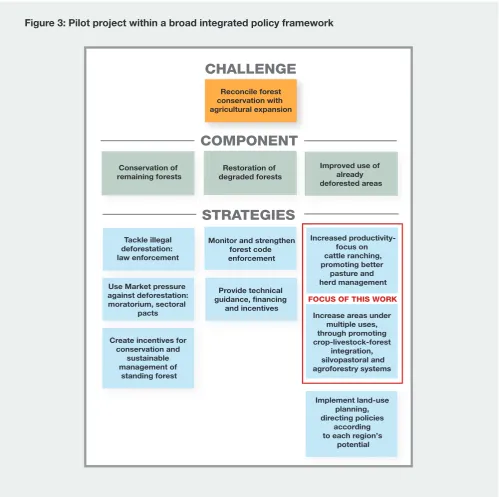
Implement landuse planning at state level to ensure that the greatest possible productivity increases, in particular of cattle ranching, occur on already deforested lands and not into forested areas.Figure 3: Pilot project within a broad integrated policy framework
Reconcile forest conservation with agricultural expansion
Restoration of degraded forests Conservation of
remaining forests
Tackle illegal deforestation: law enforcement
Use Market pressure against deforestation: moratorium, sectoral
pacts
Create incentives for conservation and
sustainable management of
standing forest
Monitor and strengthen forest code enforcement
Provide technical guidance, financing
and incentives
Improved use of already deforested areas
Increased productivity-focus on cattle ranching, promoting better
pasture and herd management
Increase areas under multiple uses, through promoting crop-livestock-forest
integration, silvopastoral and agroforestry systems
Implement land-use planning, directing policies
according to each region’s
potential
CHALLENGE
COMPONENT
STRATEGIES
11
GHANA
The following section is based on a 2012 study entitled ‘Reducing agricultural expansion into forests in the Eastern 0'#)M":."-')!"(&+':)+4)910'02)0'03/:&:)+4)&7*3"7"'.0.&+')0'#)5'0'%&'()(0*:>6)3"#)?/)F0#"33)!+??&':)+4)@+-"+) ;0-.'"-:6)G&.1):$**+-.)4-+7)=?-0107)B044+")4-+7);-+J+-":.)<'&.&0.&,"A))K1")4$33):.$#/)&:)0,0&30?3")+').1")<CL>:) G"?:&."A
1. Ghana: context
Ghana annually ranks as one of the world’s top three producers of cocoa, with cocoa historically accounting for
"5563D.7"2*,#&QOj&3+&2-*&)3(026#@$&*D5362&*"60.01$%&&_.,&5",7&*D5"0$.30&-"$&"))*,*6"2*4&.0&6*)*02&#*"6$;&!.2-&232",&
crude palm oil production from medium and large producers in 2009 estimated to be over 400,000 metric tons.T[B
Historically, the expansion of cocoa and oil palm has contributed to Ghana’s declining tropical forest cover, with the
)3(026#@$&4*+36*$2"2.30&6"2*&3+&Xj&5*6&"00(7&$.10.:)"02,#&-.1-*6&2-"0&V+6.)"@$&"/*6"1*&LO%`jB%&&
b0&2-*&)"$*&3+&)3)3";&G-"0"&-"$&2-6**&7".0&/"6.*2.*$A&.B&,3!&$-"4*&L"5563D.7"2*,#&TOj&3+&.2$&)"035#&)3/*6B;&!.2-& +*!&6*7".0.01&26**$;&,3!&5634()2./.2#&"04&,3!&)"6930&$23)=$C&..B&7*4.(7&$-"4*&L"5563D.7"2*,#&QOj&3+&.2$&)"035#& )3/*6B;& !.2-& ,3!& 5634()2./.2#C& "04& ...B& -.1-& $-"4*& L"5563D.7"2*,#& NOj& )"035#& )3/*6B;& !.2-& -.1-& )"6930& $23)=$;&
biodiversity and low productivity.T`B& & \3)3"& 5634()2.30& .0& G-"0"& 4*5*04$& 23& "& $.10.:)"02& 4*16**& 30& 2-*& 6".0+",,&
generated by local forests. Furthermore, climate change is likely to have a negative impact on cocoa through increases in temperature and changes in seasonal rainfall patterns and amounts.
The Ghanaian Government has expressed its commitment to the conservation and sustainable management of its remaining forests. Ghana’s First National Communication on Climate Change proposes two forest protection and reforestation abatement scenarios as part of the country’s contribution to global climate change mitigation. The country is also preparing a national REDD+ strategy, in addition to receiving support from the UNREDD+ Programme, the World Bank’s Forest Carbon Partnership Facility and the Forest Investment Programme, and other international donors for the furtherance of its avoided deforestation objectives, in addition to a wider rural development and poverty reduction agenda which includes climatesmart and resilient agriculture.
In the regional study, Doreo Partners and the Proforest Initiative examine the economics and enabling policies required to increase agricultural production of these two commodities without causing further deforestation, focusing in particular on two key cocoa and palm oil producing areas, the Eastern and Western Regions of Ghana.
2. The Eastern and Western Regions of Ghana
Approximately 800,000 families grow cocoa on 1.6m hectares of land in Ghana. The regional study estimates that a typical yield for a Ghanaian cocoa farmer is 350 kg/ha, which is 56% and 79% lower than the average yields in
\32*&4@b/3.6*&L`OO&=1h-"B&"04&F","#$."<[OO&=1h-"B%&&V0&*$2.7"2*4&YTN;QZZ&-*)2"6*$&3+&,"04&.$&(04*6&3.,&5",7& )(,2./"2.30&9#&7"W36&.04($26#&5"62.).5"02$<O[;QQZ&-"B&"04&$7",,&.04*5*04*02&163!*6$&LQO`;OOO&-"B%&&<-*&6*5362&
assumes an average oil palm fresh fruit bunch yield of 5.5 tons/ha for a smallholder farmer in Eastern Ghana, and
`%O&230$h-"&.0&c*$2*60&G-"0"&L[Zj&"04&ZYj&,3!*6&2-"0&"/*6"1*&#.*,4$&.0&'3(2-&I"$2&V$."&3+&XX%N&230$h-"B%TaB
V& $.10.:)"02& 0(79*6& 3+& 2-*& )3)3"& "04& 3.,& 5",7& +"67*6$& .0& 2-*$*& 6*1.30$& "6*& +")*4& !.2-& 3/*68"1*4& 26**$C& -.1-&
incidence of pests and diseases; declines in soil fertility and low fertilizer applications; and in some cases, poor maintenance practices. The advancing age of the farmers themselves is itself a threat to the longterm sustainability of their communities and productionXOB.
17<-*$*&"04&32-*6&:1(6*$&)37*&+637&H399.0$&"04&g"++3*;&XOTX%&
18The Case and Pathway toward a ClimateSmart Cocoa Future for Ghana’, Forest Trends, 2011. 19 Robbins and Baffoe, 2012.
12
3. Analysis
The study compares the economics of ‘Business as Usual’ with three alternative scenarios for a typical cocoa and oil palm smallholder in the Eastern and Western Regions of Ghana, over a 25year period. The three alternative
$)*0"6.3$&.0/3,/*&"44.2.30",&:0"0)*&9*.01&563/.4*4&23&+"67*6$&23&.0)6*"$*&2-*.6&#.*,4$&"04&.0)37*&.0&2-*&+3,,3!.01& !"#$A
Scenario 1&U&?.05(2$@&U&"$$(7*$&2-*&+"67*6$&"6*&563/.4*4&!.2-&:0"0)*&23&.0)6*"$*&2-*.6&($*&3+&"16.)(,2(6",&.05(2$&30&
their farms, thereby increasing yields.
Scenario 2& U& ?6*-"9.,.2"2*@& U& "$$(7*$& 2-*& +"67*6$& "6*& 563/.4*4& :0"0)*& 932-& 23& .0)6*"$*&2-*.6& ($*& 3+& "16.)(,2(6",&
inputs, as per Scenario 1, but also to replant all the cocoa or oil palm trees on their farms (given that these trees are
0*"6.01&36&-"/*&6*")-*4&2-*&*04&3+&2-*.6&,.+*&)#),*&"04&2-*.6&5634()2./.2#&.$&4*),.0.01B%&&
Scenario 3&U&?.02*16"2*4@&U&"$$(7*$&2-*&+"67*6$&"6*&563/.4*4&:0"0)*&932-&23&.0)6*"$*&2-*.6&($*&3+&"16.)(,2(6",&.05(2$;&
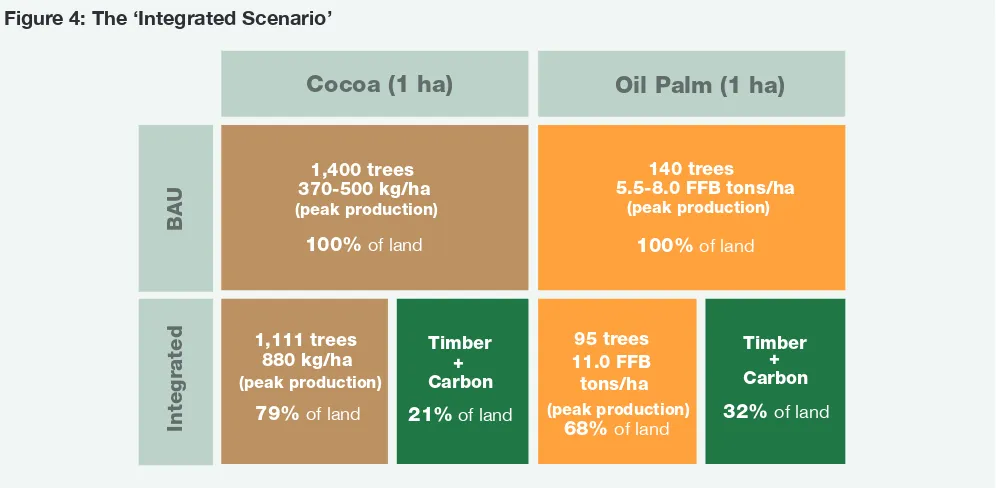
as per Scenarios 1 and 2; to replant 79% of their cocoa, and 68% of their oil palm; and to reforest their remaining land with trees, in order to generate new sources of income, both through sustainable trade from the wood and eventual income from carbon sequestration. It is important to note that whilst this has been assessed at farm level, this integrated scenario would probably be most feasible at community or landscape level.
The three models rely on a set of assumptions in their calculations, chief among them that a shortterm concessional
,3"0&L.%*%&+36&"&T&U&Y&#*"6&2*036&"04&Xj&.02*6*$2B&)3(,4&9*&563/.4*4;&.+&6*P(.6*4;&23&.0)6*"$*&.05(2$&!.2-&.77*4."2*& *++*)2;&"04&2-"2&"&,301*682*67&)30)*$$.30",&,3"0&L.%*%&+36&"&XN8#*"6&2*036B&!3(,4&",$3&9*&"/".,"9,*&23&.0)6*"$*&.05(2$&
and replant trees.
4. Key findings, risks and policy recommendations
<-*&:04.01$&+637&2-*&$)*0"6.3$&4*730$26"2*&2-"2&.2&.$&+*"$.9,*&+36&2-*&5634()2./.2#&3+&)3)3"&"04&3.,&5",7&+"67$&23&9*&
increased in both the Eastern and Western Regions of Ghana, whilst enabling an increase in forest cover either at the individual farm or landscape level.
In order for this to take place, subsidized loans and extension services would need to be provided to farmers, in part on condition that they would reduce deforestation in their neighbouring forests, and set aside a certain proportion of their other land area for eventual reforestation. In order to achieve a sustained effect, and to avoid leakage, such a commitment would ideally need to take place at the level of the community and not of individual farms.
Recognizing that not all of the land used by cocoa and oil palm by smallholder farmers requires replanting, ththe regional study estimates that if the ‘integrated’ scenario were applied to all of the approximately 1.9 million hectares of farm land used for cocoa and oil palm, then nonrecoverable setup costs of up to $US57 million and recoverable loans of $US4.5 billion would need to be made over the life of the program. The program would result in a total of 429,000 hectares currently used for oil palm and cocoa being reforested, and the remaining plantations being replaced with younger, higheryielding trees. The cocoa and oil palm farmers’ incomes would increase by a factor
3+&T%N8X%Y&L+36&)3)3"B&"04&T8Q&L+36&3.,&5",7B&3/*6&2-*&0*D2&XN&#*"6$;&9*+36*&"))3(02.01&+36&2-*&/",(*&3+&2-*&2.79*6& +637&2-*&6*+36*$2*4&,"04%&&k"$2,#;&(5&23&TO&7.,,.30&230$&3+&\_2 could be absorbed by reforesting land formerly used for cocoa and oil palm.
In the case of both cocoa and oil palm, from an economic standpoint, scenario 2 – ‘rehabilitate’ – would be the
73$2&"226")2./*&"04&563:2"9,*&352.30&35*0&23&+"67*6$&.0&2*67$&3+&)3$2$&"04&6*2(60$%&&^637&"&963"4*6&$($2".0"9.,.2#&
perspective, however, the study argues that the ‘integrated’ approach would be the best option from the point of improving both the farmers’ livelihoods and productivity, and the environment. This is because it would reduce the area of land farmed, whilst increasing productivity, reforesting other areas and increasing carbon stocks.
The upfront investment costs required to make the transition from BAU to the ‘rehabilitate’ or ‘integrated’ scenarios
!3(,4&.75,#&"&$-36282*67&,3$$&3+&.0)37*&+36&+"67*6$&+36&2-*&:6$2&Y8N&#*"6$;&6*,"2./*&23&gVS%&&<-*&?6*-"9.,.2"2*@&
and ‘integrated’ scenarios assume that the farmer would receive a minimum amount of income for labour costs
"$$3)."2*4& !.2-& 6*85,"02.01& 2-*& +"67A& -3!*/*6;& 2-*& +"67*6& !3(,4& 0**4& 23& 7"=*& (5& 2-*& ,3$2& .0)37*& 4(6.01& 2-*$*& #*"6$&!.2-&"44.2.30",&,3"0$&36&*"60.01$&+637&32-*6&$3(6)*$%&<-*&53$.2./*&3/*6",,&0*2&)"$-&f3!&1*0*6"2*4&2-63(1-&2-*&
13
Making a transition to the ‘rehabilitate’ or ‘integrated’ scenario could theoretically reduce the amount of land required to meet Ghana’s national production target of one million tons of cocoa by 464,000 – 691,000 hectares, assuming yields of 880 kg/ha – 1,100 kg/ha are achieved on every hectare of land planted for cocoa. It could$.7.,"6,#&")-.*/*&"&2-*36*2.)",&6*4()2.30&3+&\_2&*7.$$.30$&3+&XX%N&230$&5*6&-*)2"6*A&.%*%&"&232",&3+&TO%Y&8TN%N&7.,,.30& 230$&3+&\_2 could potentially be absorbed over 25 years.
For oil palm, a similar transition could theoretically reduce the amount of land required to achieve the same levels of existing production by 207,500 hectares, if yields were doubled to between 11 tons/ha and 16 tons/ha in the Eastern
"04&c*$2*60&6*1.30$&6*$5*)2./*,#%&&V$$(7.01&2-.$&,"04&.$&6*+36*$2*4&"04&")-.*/*$&"&6*4()2.30&3+&\_2 emissions of
XX%N&230$&5*6&-*)2"6*;&"&232",&3+&Y%[&7.,,.30&230$&3+&\_2 could be absorbed over 25 years.
<-*& "66"01*7*02& "04& $(9$*P(*02& 563/.$.30& 3+& )"5.2",& "6*& $.10.:)"02& )-",,*01*$& +36& $()-& "& 563W*)2%& & b0/*$27*02$& .0&)3)3"&"04&3.,&5",7&"6*&,30182*67&.0/*$27*02$&!-.)-&6*P(.6*&7"2)-.01&,30182*67&:0"0).01%&&V44.2.30",,#;&2-.$&
capital would need to be provided to farmers by implementation partners over a long period of time, alongside extension services and other support, in order to ensure the funds are both invested appropriately and then also
6*)3/*6*4%&k"$2,#;&*0+36)*7*02&3+&"16**7*02$&6*1"64.01&,"04&($"1*&"04&2-*&0**4&23&!36=&!.2-&"&$.10.:)"02&0(79*6&
5. Proposal for pilot project
In order to test the validity of the ‘integrated approach’, the study proposes that an implementing partner from the +637& 7*79*6$& 3+& 2-*& /",(*& )-".0& 6*P(.6*4& 23& .75,*7*02& 2-*& 56316"77*C& /B& *02*6.01& .023& "04& *0+36).01& ,*1",&
agreements about the amount of land which could be reforested upon achieving productivity targets and ensuring no
*0)63")-7*02&30&"44.2.30",&,"04C&/.B&4.$9(6$*7*02&3+&,3"0&563)**4$&.0&2-*&+367&3+&.05(2$&"04&$*6/.)*$&"04&5"#7*02& )3,,*)2.30&.0&)"$-&36&5634()*&.0&364*6&23&5"#&9")=&2-*&,3"0$C&/..B&563/.$.30&3+&4*2".,*4&6*)364$&23&",,&$2"=*-3,4*6$;&
including the status of accounts with each farmer.
Figure 4: The ‘Integrated Scenario’
1,400 trees 370-500 kg/ha
(peak production)
100%of land
140 trees 5.5-8.0 FFB tons/ha
(peak production)
100%of land
1,111 trees 880 kg/ha
(peak production)
79%of land
Timber
+ Carbon
21% of land
95 trees 11.0 FFB
tons/ha
(peak production)
14
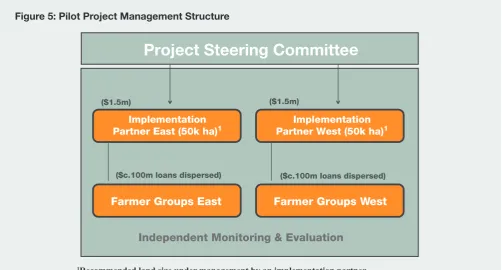
The study argues that a reasonable target for each implementing partner and therein each pilot project would be to cover 50,000 hectares of land, which equates to approximately 30,000 farmers. If the programme were to address all 1.9 million hectares of land used by smallholders, then 38 such implementing organizations would be required. Each implementing organization could be established with a $US1.2 million investment to cover operational costs(02.,&.2&9*)37*$&$*,+8$(+:).*02&+637&.02*6*$2&*"60*4&+637&,3"0$&23&2-*&+"67*6$%&V0&"44.2.30",&RS'QOO=&!3(,4&",$3&
be set aside for studies that would be required to establish effective baselines for forest cover, GHG sequestration, and productivity. The report assumes that the total initial investment of up to $US1.5 million per implementation
5"620*6&L36&(5&23&RS'N[&7.,,.30&.0&232",B&!3(,4&9*&"&$(0=&)3$2;&",2-3(1-&1./*0&2-*&532*02.",&6*2(60$&+637&5634()2./.2#&
increases that this could also be passed onto the participants over time.
6. Recommendations and next steps
<-*& 6*5362& "61(*$& 2-"2& 2-*& 532*02.",& :0"0).",& 1".0$& 2-"2& )3(,4& 9*& ")-.*/*4& 9#& .0)6*"$.01& 5634()2./.2#& !3(,4& 9*& $(+:).*02&23&",,3!&+36&6*2(60$&30&)"5.2",&+637&*.2-*6&2-*&5(9,.)&$*)236&36&56./"2*&.0/*$236$&!-.,*&",$3&.7563/.01&2-*&
income of farmers. Across the country, a concerted effort would be made to update data on the location, productivity and sizes of the cocoa and oil palm farms, as well as the other elements of supply chains including the processing facilities.
F(,2.5,*&.75,*7*02"2.30&5"620*6$&!3(,4&9*&*0)3(6"1*4&23&.75,*7*02&2-*&$(11*$2*4&563W*)2&.0&$5*).:)&"6*"$&!.2-&
the support of REDD+ related funds. It would be most effective if actors already active in the sector, such as input companies and licensed buying companies, became implementing agencies for their supply chains.
For both cocoa and oil palm, the report concludes that it would be important to situate any pilot project of this kind within the context of broader landuse and landscape planning in the country moving forward. Both oil palm, and in particular cocoa, depend on the ecological services that the forests provide to ensure their resilience to climate change variability in the future. For this reason, the report argues that it would be optimal for a more detailed
4.",31(*&23&2"=*&5,")*&9*2!**0&2-*&G-"0"."0&\3)3"&g3"64&L\_\_g_JB&"04&.2$&)3(02*65"62$&.0&2-*&V16.)(,2(6*;&
Forestry and Environment Ministries to discuss how the country’s cocoa production targets can be reached whilst also achieving REDD+ targets.
1Recommended land size under management by an implementation partner. Figure 5: Pilot Project Management Structure
Project Steering Committee
Farmer Groups East Farmer Groups West
Independent Monitoring & Evaluation
($1.5m) ($1.5m)
($c.100m loans dispersed) ($c.100m loans dispersed)
Implementation Partner East (50k ha)1
15
INDONESIA
K1")4+33+G&'():"%.&+')&:)?0:"#)+')0)NOPN):.$#/)"'.&.3"#)Q!"#$%&'()0(-&%$3.$-03)"R*0':&+')&'.+)4+-":.:)&')H"'.-03) S03&70'.0'2)0'03/:&:)+4)&7*3"7"'.0.&+')0'#)5'0'%&'()(0*:>6)3"#)?/)@-A)!&D03#&)B+"-)+4).1")H"'.-")4+-)H3&70.")!&:E) 0'#) T**+-.$'&./) 80'0("7"'.) UHH!T8V6) ?0:"#) 0.) B+(+-) =(-&%$3.$-03) L'&,"-:&./6) <'#+'":&0A) H+W0$.1+-:) 4-+7) HH!T8)&'%3$#")@+#&E)!+)X$--+%170.6)8A)=-#&0':/016)Y0-&/0#&6)Y0'#&0');$-G0G0'(:06)0'#)9&.+)9&'.&'(A)) 8+-0/)8%F"&:16)!0$4);-0:+#Z+)0'#)B".1)9&'(+3#)+4).1")M+-3#)!":+$-%":)<':.&.$.")UM!<V)03:+)*-+,&#"#),03$0?3") %+'.-&?$.&+':)0.)033):.0(":)+4).1"):.$#/A))K1")4$33):.$#/)&:)0,0&30?3")+').1")<CL>:)G"?:&."A
1. Indonesia: Context
_.,&5",7&.$&30*&3+& 2-*&73$2&.75362"02&"16.)(,2(6",&)37734.2.*$&.0&b0430*$.";&"04&5,"#$&"&$.10.:)"02&63,*&.0&2-*& )3(026#@$&*)3037.)&4*/*,357*02;&6*56*$*02.01&X%`j&3+&2-*&)3(026#@$&GJd<Y%N&9.,,.30&S'J&.0&XOO`B%&<-*&3.,&5",7&
industry employs as many as 6 million peopleXTB. Indonesia has set a target to increase its oil palm production from
25 million tonnes in 2012 to 40 million tons by 2020.
_.,&5",7&-"$&9**0&),3$*,#&"$$3)."2*4&!.2-&b0430*$."@$&-.1-&6"2*&3+&4*+36*$2"2.30&"04&2-*&,3$$&3+&.75362"02&9.34./*6$.2#A&
between 2005 and 2010, it is estimated that 26% of deforestation in Indonesia was caused by the expansion of oil palmXXB%& & _2-*6& 46./*6$& 3+& 4*+36*$2"2.30& .0& b0430*$."& .0),(4*& ,311.01& +36& 2.79*6& "04& 5(,5& "04& 5"5*6;& $(9$.$2*0)*&
agriculture, mining and commercial agriculture.
The average annual growth rate of oil palm plantations has increased rapidly, going from 14,000 hectares per year
LTaZ[8Ta`OB& 23& QZN;OOO& -*)2"6*$& 5*6& #*"6& LTaaT8XOTOBXQB%&V))364.01& 23& 2-*& ^V_8_I\J;& 1,39",& )30$(752.30& 3+&
palm oil is expected to increase over 30% in the next decadeXYB. Based on current production trends, an additional
12 million hectares of oil palm plantations may be required to meet global demand by 2050XNB. It is worth noting that 5",7&3.,&.$&2-*&73$2&*+:).*02&/*1*2"9,*&3.,&)635&.0&2*67$&3+&5634()2./.2#&L.%*%&#.*,4&5*6&-*)2"6*&3+&,"04&3))(5.*4&9#& 2-*&)635B%&<-*&"/*6"1*&5",7&3.,&#.*,4&.0&b0430*$."&"04&F","#$."&.$&6*$5*)2./*,#&a%Q;&[%Z&"04&N%`&2.7*$&-.1-*6&2-"0& 2-*&"/*6"1*$&+36&$3#9*"0&3.,;&6"5*$**4&3.,&"04&$(0f3!*6&3.,XZB.
In 2009, the President of the Republic of Indonesia announced a voluntary GHG emissions reduction target of
XZj&9#&XOXO;&"04&YTj&.+&.2&6*)*./*4&.02*60"2.30",&"$$.$2"0)*%&_/*6",,;&,"04&($*&)-"01*&.$&6*$530$.9,*&+36&`Qj&3+&
Indonesia’s GHG emissions, such that reducing forest and peatland conversion for oil palm and agriculture is key to meeting this target. In 2010, Indonesia and Norway signed a Letter of Intent to reduce deforestation and efforts to develop the country’s REDD+ efforts have continued since then.
2. Central Kalimantan
Central Kalimantan was selected as the REDD+ pilot province under the IndonesiaNorway Letter of IntentX[B.
There exists therefore a degree of political commitment to redirecting Central Kalimantan’s development path towards a low carbon economy, and a policy process to this effect is currently underway. However, there are also strong economic interests and pressures to develop coal mining and largescale agriculture in ways that are not necessarily compatible with this low carbon development model.
With available land for agricultural expansion growing scarcer in the islands of Java and Sumatra, Indonesia’s oil palm expansion is increasingly taking place in Central Kalimantan and West Papua. The Government of Central Kalimantan has established a target to increase its area of oil palm plantations from 1 million hectares to 3.5 million hectares by 2020. 44% of Central Kalimantan’s population relies directly on palm oil for their livelihoods. Most of
2-*&5",7&3.,&5634()2.30&.0&\*026",&l",.7"02"0&.$&437.0"2*4&9#&5,"02"2.30&)375"0.*$&L`ajB%&_0,#&TTj&3+&2-*&"6*"&
under palm oil production is cultivated by smallholders.
21Goenadi, 2008.
22Fahmuddin Agus et al, 2011. 23Ditjenbun, 2011.
24_I\J8^V_;&XOOa% 25Corley, 2009. 26Teoh, 2010.