Volume 5, Number 4, December 2017, pp. 145–152 pISSN: 2338-8110/eISSN: 2442-3890
How Unique Cultural Concept Translation is Made Possible
Sugeng Hariyanto
Business Administration–Politeknik Negeri Malang
Jl. Soekarno Hatta No. 9 Malang, 65141. E-mail: [email protected]
Abstract: The plethora of experience in one culture is stored in concepts which are further manifested in the lexicon, grammar and metaphors of the language. Some concepts are congruent across languages, while some are not. Theoretically, some linguists maintain that translation is impossible on the ground of linguistic relativity hypothesis. However, in practice translation is always done again and again, and this proves that translation of expressions referring to these concepts is doable. Considering the dis-cussion of the elements of conceptual systems presented here, the writer proposes three ways of trans-lating expressions to convey concepts: (a) compensating the element of a concept with another element of the same concept, (b) separating concepts from words or expression, and (c) bringing the concept and expressions into the target language using loan word/expression with or without any notes, or bringing the concept into the target language using descriptions. To help select an appropriate way of translating in a particular case, translators should consider the translation purpose. As the discussion unfolds, examples are presented to illustrate the situation.
Key Words: linguistic relativity, concept, conceptual system, grammaticization, lexicalization, metaphor, compensation
Abstrak: Kebanyakan pengalaman dalam satu budaya tersimpan dalam konsep yang terwujud dalam
leksikon, tata bahasa, dan metafora bahasa. Beberapa konsep kongruen di seluruh bahasa, sementara beberapa lainnya tidak. Secara teoritis, beberapa ahli bahasa berpendapat bahwa terjemahan itu tidak mungkin berdasarkan hipotesis relativitas linguistik. Namun, dalam praktiknya terjemahan selalu dilaku-kan berulang-ulang, dan ini membuktidilaku-kan bahwa terjemahan ungkapan yang mengacu pada konsep ini dapat dilakukan. Mengingat pembahasan tentang unsur-unsur sistem konseptual yang dipaparkan di sini, diajukan tiga cara untuk menerjemahkan ekspresi untuk menyampaikan konsep: (a) mengkompensasi unsur konsep dengan elemen lain dari konsep yang sama, (b) memisahkan konsep dari kata atau ung-kapan, dan (c) membawa konsep dan ungkapan ke dalam bahasa target menggunakan kata/ekspresi pinjaman dengan atau tanpa catatan, atau membawa konsep ke bahasa target menggunakan deskripsi. Untuk membantu memilih cara menerjemahkan yang tepat dalam kasus tertentu, penerjemah mempertim-bangkan tujuan penerjemahan. Seiring diskusi dipaparkan, disajikan contoh untuk menggambarkan si-tuasi.
Kata kunci: relativitas linguistik, konsep, sistem konseptual, gramatisasi, leksikalisasi, metafor, kompensasi
It is a truism that language and culture are in-extricably interwoven; that it affects how we think and behave, and is affected by how we think and behave (Cooper, 1973, pp. 99). It is also commonly believed, after a prolonged debate among linguists, that somehow people’s conceptual system is partly influenced by the language that they speak. This belief originates from Sapir-Whorfian hypothesis, which is popularly dubbed the linguistic relativity hypothesis.
Volume 5, Number 4, December 2017
Table 1. Lexicalization of Snow in Inuktitut, English, and Indonesian 1973, pp. 121). This strong version has been widely
rejected.
The weak version, linguistic relativity, receives warm reception from linguists. It states that the way we perceive reality is partly determined by the lan-guage we speak. This version is accepted because the evidence can be seen in many aspects of our lan-guage, for example, in vocabulary related with “time”. In English there is an expression a.m. and p.m. to re-fer to the concept of time related to clock. In Indonesia, such concept element of time (in relation to clock) does not exist. In this case, it is true that Indonesian people perceive the reality of time in relation to clock in a different way. However, English and Indonesian languages do not always differ when dealing with many other concepts.
Due to the growing popularity of Chomsky’s ideas about universal grammar, many linguists question Sapir-Whorfian idea, especially the one related to the idea of “when languages are different, the concept of reality expressed with the language is different”. There is a claim that if two languages have radically different conceptual systems, then translation from one language to the other is impossible Lakoff (I987 in , 2001, pp. 21). In a preface to Adam Schaff’s Language and Cognition (McGraw Hill, 1973. Translated from Pol-ish.), Chomsky indicates a rebuttal against this idea. In general, Chomskyan ideas states that language is created in individual human mind and the common basis for all languages is universal phonetic and seman-tics. The general ideas are the same; the difference lies in the wording. Hence, there is no reason for un-translatability. This paperstakes this position as a springboard to present how the translation of unique cultural concept is made possible. However, to better address the matter, we will start with a discussion and examples of different conceptual systems to illustrate how translation problems may arise. The discussion then concludes with a proposal on how to translate unique cultural concepts.
RESULTS
According to Harves (2004), aspects of concep-tual system include lexicalization, grammaticization,
fuzzy concepts and metaphors. Understanding con-ceptual systems will show how concepts are struc-tured, extended, and interrelated in certain languages. And if this structure and interrelation are different or expressed differently, translation problems will occur.
Lexicalization
Lexicalization is encoding of concepts in words or lexicons (Levin and Hovav, 2015). Lexicalization is the putting of concepts into word in a particular language. Lexicalization is often correlated with cul-tural factors. This is usually seen as closely related to linguistic relativity or discussion on the relation between language and thought.
Different ways of lexicalization maybe caused by (a) relative-socio-psychological distance from a particular object or (b) politeness penetrating part of the lexis (Kadarisman, 2005b, pp. 11). For the first case, Kadarisman gives an example by presenting the fact that English only has “rice” for several words like “padi, gabah, beras,” and “nasi” in Indonesian. The same case applies to the various words for “Snow” in Eskimo language as presented by Whorf. There are many words for snow in Inuktitut language(most of the examples are taken from Harves (2004)). See the Table 1.
Please notice in the table that for “aput”, “qana”, and “piqsirpoq”, the lexicalization concept is the same for English and Indonesian, but not for”qimuqsuq”. This is probably due to the fact that Indonesian culture rarely sees something accumulated by the force of wind or water, and therefore psycho-logically this concept is more alien than that of other concepts.
Now, let’s see the lexicalization of concepts relat-ed to “rice” in Indonesian, where we have “padi”, “gabah”, “beras”, and “nasi”. See the following list— the translation is taken from Stevens and Tellings’s dictionary of Kamus Lengkap Indonesia-lnggris, 2004).
padi = rice plant
gabah = dry rice in the husk
beras = uncooked rice with the husk removed nasi = cooked rice.
Inuktikut language English Indonesian
aput snow on the ground salju di tanah
qana falling snow salju jatuh
piqsirpoq drifting snow salju melayang
The difference in lexicalization is caused by the difference in relative socio-psychological distance from those concepts. For the second case, politeness penetrating part of lexis, Kadarisman (2005, pp. 10) exemplifies this by discussing of the use of “kamu”, “engkau”, “Anda”, “Saudara”, “Bapak/lbu”, “Abang or Kakak” and “Bang/Kak” as compared to the only word “you” for the same concepts in English.
The same lexicalization pattern also apply in two different languages. See the following for the lexicali-zation of motion verbs, where the pattern is conflation (Conflation is lexicalization of (wo components into one word)).English encodes motion plus manner, and so does Indonesian language.
roll = berguling (The rock rolled down the hill) slid = meluncur (The puck slid across the ice)
However, it cannot be generalized that the pattern of motion plus manner are always conflated into one word in both languages. See the following example for the divergence.
limp = berjalan terpincang-pincang (She limped throughthe house).
The above examples prompt the writer to hypo-thesize that lexicalization may be different for two different languages, but the differences are not always triggered by the culture of the language.
Grammaticization
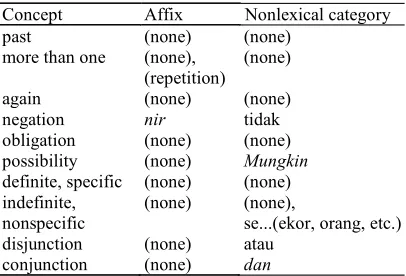
Grammaticization is the encoding of concepts in affixes or non-lexical categories (Herdan, 2005) or as grammatical markers (Slobin, 1996 in Kadarisman, 2005). Languages (or culture) have different gram-maticizations. Linguistic concept such as “plural” and the logical concept such as “space” and “time” are explicitly grammaticized in English, but not in Indonesi-an. The following chart illustrates this case (Tabel 2 and 3).
In addition, notice also the following examples (taken Kadarisman, 2005b).
Example 1
English : I went to Jakarta last month. Indonesian: Saya pergi ke Jakarta bulan lalu.
Here “time” concept is not grammaticized in Indonesian. What about space? See the following example:
Example 2
English: What are you doing up there? Indonesian: Mengapa kamu di situ?
In Indonesian language, the space is
gramma-direction or location is indicated (“up”). See an exam-ple for plural concept grammaticization (Examexam-ple 3).
Example 3
English: Students should bring their own tools. Indonesian: Siswa harus membawa peralatannya sendiri.
To mention objects in English the speaker must take into consideration whether the objects are count-able or uncountcount-able, since it will affect the verbs re-lated to the things. Another difference between En-glish and Indonesian, for instance, is the syntactic patterning. English is a subject-prominent language where almost every sentence needs a subject. Con-versely, in Indonesian language the subject can be deleted so many times.
Example 4
English: When did you arrive? Indonesian:Kapan datang? Example 5
English: it’svery easy to do the exam.
Indonesian: Mudah sekali mengerjakan ujian itu.
Fuzzy Concepts
Fuzzy concepts are ones that have no clear-cut boundaries. As there is no clear-clear-cut boundary, the concepts are indeed relative for each language
Table 2. English Grammaticization
Table 3. Indonesian Grammaticization
Concept Affix Non-lexical category
past -ed (none)
more than one -s (none)
again re- (none)
negation in-, un- Not
obligation (none) must
possibility (none) may
definite, specific (none) the
indefinite, nonspecific (none) a
disjunction (none) or
conjunction (none) and
Concept Affix Nonlexical category
past (none) (none)
obligation (none) (none)
possibility (none) Mungkin
definite, specific (none) (none) indefinite,
nonspecific
(none) (none), se...(ekor, orang, etc.)
disjunction (none) atau
Volume 5, Number 4, December 2017
Table 4. Metaphor Equivalence between English, Indonesian, and Javanese tall, beautiful, generous, etc. Eventhough Indonesian
language has the words kaya, tinggi, cantik, der-mawan, etc, which can be assumed to be the equivalents of those words, English and Indonesian people’s perception of rich, tall, beautiful, and generous tends to be different based on their expe-rience.
Metaphors and Proverbs
Concept of metaphor has been a topic of discus-sion since Aristotle (Wahab, 1995, pp. 65). It means that metaphor is one of the oldest way of expressing idea or experience. Some metaphors remain un-changed for hundreds of years and become proverbs. Thus, it is not an overstatement to say that some life-experience of a culture is stored in its metaphors. Understanding metaphors means understanding one concept in terms of another. Further, it can be stated that understanding metaphor may lead us to an under-standing of the experience stored there.
See how English language stores its concept of time in the following metaphors:
a. You’re wasting my time.
b. This gadget will save you hours.
c. How do you spend your time these days? d. I have invested a lot of time in that project. e. You need to budget your time.
f. Is that worth your while? g. He’s living on borrowed time. h. You don’t use your time profitably.
From the above metaphors, it can be inferred that “time” for English or American people is some-thing that can be saved, spent, invested, wasted, budgeted and lent. Therefore, it is easier to under-stand the proverb time is money. Now, let’s try to translate:
a. Anda membuang-buang waktu saya. b. Alat ini akan menghemat waktu Anda. c. Bagaimana Anda menghabiskan waktu di hari-hari ini?
d. Saya telah menginvestasikan waktu di dalam proyek ini*
e. Anda perlu menganggarkan waktu Anda* f. Apakah itu berharga untuk waktu Anda?* g. Dia hidup dalam waktu pinjaman*
h. Anda tidak menggunakan waktu dengan cara yang menguntungkan.*
Note: Asterisk (*) indicates that the sentence is not acceptable in the respective language.
It is clear now that for Indonesian “time” cannot be invested, budgeted, valued with money, lent, or treated like a commodity. Now, what about the translation in Javanese? It is almost impossible to translate literally all the sentences in Javanese.
a. Panjenengan namung mbucal wekdal kula.* b. Alat punika badhe nyimpen wekdal panjene-ngan.*
c. Kadospun dipanjenengan nelasaken wekdal?* d. Kula sampun nanemaken wekdal wontening proyek punika.*
e. Panjenengan perlu nganggaraken wekdal pan-jenengan*
f. Punapa pedamelan punika nyucuk kaliyan wek-dal panjenengan?
g. Piyambakipun gesang in wekdal ampilan* h. Panjenengan mboten ngginaken wekdal kanthi nguntungaken*
Note: Asterisk (*) indicates that the sentence is not acceptable in the language.
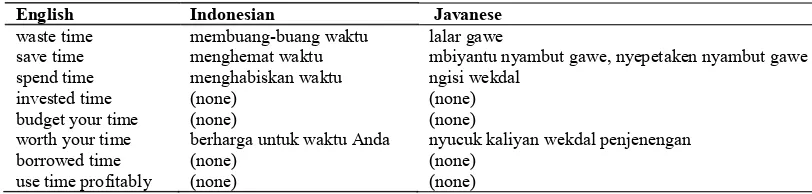
The equivalence of the metaphors in English, Indonesian and Javanese would be as in the Table 4. For the first, second and third metaphors, English and Indonesian have similar concept about time, but not for Javanese. Instead of saving or wasting time, Javanese language sees how work can be done in relation with time. For metaphor 4, 5, 7 and 8, both Indonesian and Javanese do not see “time” in the same way. Interestingly, metaphor number 6 can be translated quite successfully. This means the three languages see “time” as something whose value is comparable to that of money.
English Indonesian Javanese
waste time membuang-buang waktu lalar gawe
save time menghemat waktu mbiyantu nyambut gawe, nyepetaken nyambut gawe
spend time menghabiskan waktu ngisi wekdal
invested time (none) (none)
budget your time (none) (none)
worth your time berharga untuk waktu Anda nyucuk kaliyan wekdal penjenengan
borrowed time (none) (none)
How Unique Concept Translation is Made Possible
Based on the understanding the conceptual sys-tem described above, the author proposes that cul-ture-related expressions that spring from lexicaliza-tion of concepts, can be translated by (a) compen-sating incongruent concepts element with other con-cept element, (b) separating concon-cepts from words, and (c) bringing the concept and expression into the target language.
Compensating Incongruent Concepts Element with Other Concept Element
Earlier in this paper it is said that two lan-guages with radically different conceptual systems are impossible to translate into each other. The con-cept of “radical” itself is a fuzzy concon-cept. In this writing, “radical” means “exactly different”. “Ex-actly different concepts in two languages here are called incongruent concepts. Incongruent concepts exist if the two languages do not have the same lexicalization, or one of the languages does not lexi-calize it.
In the writer’s opinion, a concept may have several elements. In English time can be understood as something to spend, save, and invest. This is one element of concept of time. Another element of time concept is something that people can pass through. The number of elements of concept in source and target language may be the same or different. If they are different, to express the same concept a translator may choose another concept element to compensate for the absence of a certain concept element. See some example below.
Example 6
English:I have invested a lot of time in that project. Indonesian: Saya telah menghabiskan banyak waktu untuk proyek itu.
Javanese: Kula sampun dangu nggarap proyek punika.
From the example 6, it is known that the concept of “time” in English and Indonesian and Javanese are not congruent. “Time” in English can be invested. But it is not the case in Indonesian and Javanese lan-guages. Instead, Indonesian language sees and treats “time” as something that can be spent just the way English language does. This congruence makes it pos-sible to translate the English sentence into the Indone-sian sentence above. Javanese language perceives “time” as an extent of period within which work can be accomplished, just like English language does. This makes the above Javanese translation possible by using other concept of the same idea which shares the same characteristics. In other word, as Javanese does not perceive time as something that can be invested or spent or saved, then the translator can take a concept of time as something that people can “pass through” as they do their activities. This is what we call concept element compensation in this paper. This idea can be visualized as in Tabel 5.
Separating Concept form Word
Next, unique concept translation is possible if the translator separates the concept from word. So far in most discussions, concept is directly equalized to word. Referring back to Saussure, it can be said that word is equivalent to signifier and concept can be said as the signified. Further, concept is the ab-straction of reality. Thus, all concepts actually can be understood by understanding the reality they re-present. Sometimes, people use the same word (sig-nifer) to refer to different concepts (signified). En-glish has a word “interest” for both “curiosity about something” and “percentage on a loan which is paid over time”. It happens just because English only has one “signifier” for two different concept or “sig-nified”. “Interest” can be translated into Indonesian by seeing the reality it represents. When translators find it difficult to perceive such reality, they can evoke the reality with the help of context, co-text Concept element English Indonesian Javanese
time as something that can be spent, saved, and
invested
yes yes no
time as something people can pass through
yes yes
yes
Volume 5, Number 4, December 2017
Indonesian translator knows what “interest” means in a given text. With such an approach, unique con-cept translation is possible. Using this strategy, the expression used in the translation can be a particular word (term), e.g. English interest is translated into Indonesian bunga, kepentingan, or minat.
Alternatively, the translation can be a descrip-tion of the concept. Consider how the underlined words below should be translated into English.
Example 7
Indonesian: Upacara siraman dilakukan pada pagi hari sekitar pukul 09.00 Upacara siraman dilakukan oleh ibu dari anak yang diruwat dengan air kem-bang setaman. (Bratawidjaja, 1996, pp. 49)
Do the words “showering”, “various flowers”, “cleansed” and “the puppeteer” suffice here for “siraman”, “diruwat”, and “kembangsetaman” as generally those are the closest translation? Quite possibly it is not the case. This is because those words are deeply embedded in Javanese culture and the purpose of the translation is probably to explain the culture. One of the most viable solutions is to replace the particular words with a description of the concept. Therefore, the following translation can be produced.
Example 8
Indonesian: Upacara siraman dilakukan pada pagi hari sekitar pukul 09.00. Upacara ini dilakukan oleh ibu dari anak yang akan diruwat dengan air kem-bang setaman.
English: Ritual showering ceremony is done in the morning around 09.00. This ceremony is done by the mother of the child who will be cleansed ritually or set free from the curse by showering water infused with various types of flowers.
In the example above, the concept of “siram-an” is translated into a description ritual
shower-ing, and diruwat is translated as be cleansed ritu-ally or set free from the curse. Finally, the expres-sion air kembang setaman is translated into a de-scription of water infused with various types of flowers.
Bringing the concept into the target language
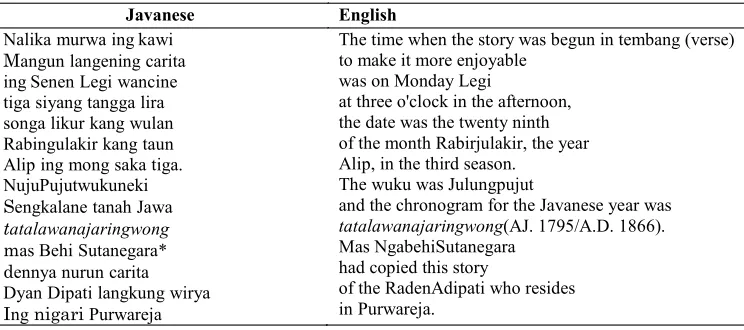
The third way to translate unique cultural con-cept is by bringing the concon-cepts and the words into the target language. Formally, the result is a loan word or expression. The excerpt in Table 6 (Exam-ple 9) illustrates this.
In the Table 6, the expression Senen Legi is translated into Monday Legi. Senen can be trans-lated easily into Monday as Javanese and English has the same concept of the particular day and it has a particular word for the particular concept of time. However, another concept of time called Legi in Javanese is not known in English. The same case also happens with another particular concept of time called wuku in Javanese. As this is a poem, the trans-lator may think that it is not appropriate to have lengthy description. Therefore, he takes the concepts and words (expression) into the target language.
Whenever the translator deems it necessary, a note can be provided after the translation. It can be seen in the following translation of Gunawan Muham-mad’s poem entitled “Asmaradana” done by Laksmi Pamuntjak.
Example 10
Indonesian: Asmaradana
la dengar kepak sayap kelelawar dan guyur sisa hujan dari daun,
karena angin pada kemuning. la dengar resah kuda serta langkah
pedati ketika langit bersih kembali menampakkan bimasakti
Javanese English
Nalikamurwaingkawi
Mangunlangeningcarita ingSenenLegiwancine tigasiyangtanggalira songalikurkangwulan Rabingulakirkangtaun Alipingmongsakatiga. NujuPujutwukuneki
SengkalanetanahJawa tatalawanajaringwong
mas BehiSutanegara*
dennyanuruncarita DyanDipatilangkungwirya
Ing nigari Purwareja
The time when the story was begun in tembang (verse) to make it more enjoyable
was on Monday Legi
at three o'clock in the afternoon, the date was the twenty ninth of the month Rabirjulakir, the year Alip, in the third season.
The wuku was Julungpujut
and the chronogram for the Javanese year was
tatalawanajaringwong(AJ. 1795/A.D. 1866). Mas NgabehiSutanegara
had copied this story
of the RadenAdipati who resides inPurwareja.
yang jauh. Tapi di antara mereka berdua, tidakada yang berkata-kata.
(Pamuntjak, 2004, pp. 38) English: Asmaradana ‘
He heard the beating of bats’ wings and the spatter of raindrops
from leaves, because of the wind upon the kemuning trees.
He heard the restive horses and the carts slowly creaking, as the
sky cleared to uncover the distant galaxy. But no words passed between them.
(Pamuntjak, 2004, pp. 39)
At the end of the book, the following endnote is found.
Asmaradana: A classical form of Javanese poetry. In the Javanese opera Damarwulan, it is used to express the hero’s farewell to his beloved, the lovely Anjasmara, before he went to meet his death in a battle against a powerful rebel under the reign of Queen Kencana Wungu in 13th century Java (Pamuntjak, 2004, pp. 221).
The translation of the first stanza above brings into English the word “Asmaradana” as this is deeply embedded into Javanese culture. If the trans-lator translate the word “Asmaradana” with its des-cription, the beauty will vanish.However, the trans-lator may think that the readers need to know the pre-text that is the story of Damarwulan and in-formation of what “Asmaradana” is. Therefore, the translator put a glossary at the end of the book as cited above.
Eventhough unique concept translation is pos-sible, they do present different levels of difficulty. In reference to the conceptual system, the degree of possibility can be attributed to the universality of the concepts. Following the logic used by Wahab in (1995, pp. 108), the writer divides concepts in one culture into two categories: (a) universal con-cept (b) culturally-bound concon-cept. However, instead of borrowing Haleys’ category, the writer bases the category on the congruence of concepts in lan-guages in question. Highest degree of incongruence takes place when one language has very detailed or specific lexicalization while the other languages do not lexicalize it at all. As lexicalization is related to cultures or motivated by people’s experience within those cultures, we cannot avoid context of culture in this discussion.
In relation to the above account, universal con-cept category includes concon-cepts that are
congruent-other language. Thus, the concept of “walk” is cong-ruent for English and Indonesian. In contrast, a culturally-bound concept is the one that is unique to a certain culture or language and there-fore not lexicalized in the other language. The deeper a con-cept is embedded in a culture, the higher is the diffi-culty. In that case, translation can be made possible by borrowing the concept and expression. And to understand such concept, the reader should refer to the context of culture.
An important note must be made about when to use the proper strategy. To answer this question, a translator should consider the purpose of the trans-lation. The purpose of the translation is frequently related to the type of the text. If the target text is written for sheer enjoyment, for example, when translating poems, compensating the concept of a certain thing with another concept of the same thing and taking the concept and the word into the target language is better. However, if the translation is done to describe or explain a particular concept in another language, description–whether in line or in foot notes or end notes–is better. This is in line with a general opinion within functionalist approach that the purpose of the translation determines the meth-ods and strategies to produce a functionally ade-quate result.
CONCLUSION
Volume 5, Number 4, December 2017
ferent for different concepts. The more a concept is embedded in its culture, the higher is the difficulty level.
REFERENCES
Bahar, I. (2001). Linguistic relativity and the translation dilemma: Reading between the lines in Malay litera-tures in English. Nottingham Linguistic Circular, 16. Retrieved from http://scholar.google.com/ scholar?hl=en&btnG=Search&q=intitle:Linguistic+ Relativity+And+The+Translation+ Dilemma+:+ Reading+Betw een+The+Lines+In+Malay+ Literatures+In+English#0.
Bratawidjaja. (1996). Upacara Tradisional Masyarakat Jawa. Jakarta: Pustaka Sinar Harapan.
Carey, P. (1974). Javanese Histories of Dipanagara: The Buku Kedhun Kebo, Its Authorship and Historical Importance. Bijdragen Tot de Taal-, Land- En Volkenkunde, 259–288.
Cooper, D. E. (1973). Philosophy and the Nature of Lan-guage. London: Longman Group Limited.
Crystal, D. (1985). A Dictionary of Linguistics and Phonet-ics. Oxford: Basil Blackwell Ltd.
Harves, S. (2004). Semantic I: Lexical Semantics. Retrieved from http://www.russian.edu/harves/LGCS-10/ Lexical-semantics.pdf.
Herdan, S. (2001). Principles of Linguistics-Semantics. Retrieved January 10, 2006, from www.sp.uconn.edu /~sihO 1001/202/fall2005/lectu re21.pdf.
Kadarisman, A.E. (2015). Linguistic relativity, cultural relativity, and foreign language teaching. TEFLIN Journal, 16(1), 1–25.
Kadarisman, E. (n.d.-b). Relativitas Bahasa dan Relativitas Budaya. Linguistik Indonesia, 23(2).
Levin, B., & Hovav, M. R. (2015). Lexicalization patterns. Retrieved from https://web.stanford.edu/~bclevin/ lexpat15.pdf.
Pamuntjak, L. (2004). Gunawan Muhamad: Selected Poems, Revised and Expanded Edition. Petaling Jaya: Kata Kita.