EDUCATI ONAL ADMI NISTRATION REVIEW VOL. I NO. 1 JUNE 2017 19
MORAL LEADERSHIP AMONG HEADS OF
DEPARTMENTS AT SELECTED PRIVATE
INSTITUTIONS IN KLANG VALLEY
Nurul Qistina Binti Abu Bakar
Department of Educational Management,
Planning and Policy Faculty of Education, University
Malaya, 50603 Kuala Lumpur, MALAYSIA
Muhammad Faizal Bin A. Ghani
Department of Educational Management
Planning and Policy Faculty of Education, University
Malaya, 50603 Kuala Lumpur, MALAYSIA
[email protected]
Abstract— This research is to study the moral leadership among heads of department at selected private institution in Klang Valley. The first objectives of this study are to determine the level of effectiveness of moral leadership; the second objective is to identify the domain attribute of moral leadership among heads of department at selected pri vate institutions in Klang Valley. To answer the research objectives, questionnaires were distributed to 260 academic and administrative staff at two selected pri vate institutions in Klang Valley. The data were analyzed using the S tatistical Package for the Social S cience (S PSS) version 21. The descriptive statistical methods, such as percentage, mean and standard deviation, were used to identify the effectiveness and to find the dominant attributes of moral leadership among heads of department. The findings showed that the effectiveness and the dominant attribute of moral leadership among heads of department are high level for trustworthiness and communication dominants with the mean for both dominants are more than 3.50, while for criticism and dissent, fairness, employee’s development, empowerment and employee’s job performance in average level when the mean is below than 3.00. This research implication indicates that, it is importance for heads of department to practice and implemented moral leadership in their leadership styles to achieve the goals of the institutions.
Keywords— Moral Leadership, Head of Department, Private Institutions
I. INT RODUCT ION
Leadership is a general term that is difficult to describe and define. However, most e xperts in the leadership field believe that leadership is an important aspect for institutional exce llence. Leadership can be seen in a person who encourages, persuades and influences people to work diligently to achieve a common vision and mission. According to [1], many studies have discussed the differences between the roles
of “manager” and “leader” and there is a lot of literature on the
differences between managers and leaders in lead ership management. In this study, we will focus on leaders for institutions. Effective leaders in institutions are crucial in leading emp loyees. [2] stated that the role of leaders in institutions includes that of being motivators, trainers, teachers, counselors and in particular situations, as parents to employees in guiding them to achieve the goals of the institution. The effectiveness of that role depends on the leadership style adopted by the leader.
According to [3], while leadership is an essential topic that needs to be discussed, at times, it appears to be a controversial topic in institutional research studies. [4] added that the common argument in leadership studies revolves around the definition of the ma in characteristics or factors that produces leadership. [5] emphasized that “an acceptable definition of leadership needs to be sound both in theory and in practice, able to withstand changing times and circumstances, and be comprehensive and integrative rather than atomistic and
narrow focus”. [6] stated that leadership is commonly known
as the process of an individual c reating influence on any individual towards working together in achieving co mmon goals. This is supported by [7] who described leadership as
“the process of influencing others to understand and agree
about what needs to be done and how it can be done effectively, and the process of facilitating individual and
collective efforts to accomplish shared objectives”.
Moral leadership refers to a leadership style that involves the process of understanding employees’ feeling and needs. Leadership refers to those who have the exact characteristics that can lead a group of people. Leaders should reflect morality in their leadership styles. This is because a leader is a person who has the power to control, give instructions and influence
his followers. Most of the time, followers’ attitudes are a
reflection of their leader’s attitude. This is supported by [8];
who highlighted that most institutions imple ment the ethical leadership concept in their institutional structures. Leaders who practice moral leadership not only have to shoulder responsibilit ies by giving instructions but they must also be able to meet needs, give aspirations and impart values to their employees. Furthermore, most people assume leadership only applies to top management. However, leadership is applicable to everyone irrespective of qualification, t itle, background or position. Besides that, one of the hardest challenges a leader must face is being able to prove that he can lead followers and give instructions in the right track.
[9] concurred that leadership is about guiding and imparting knowledge to followers and towards this end, a leader must have the strong ability to influence and gain the trust of their
followers. Only by being able to gain followers’ trust, can
EDUCATI ONAL ADMI NISTRATION REVIEW VOL. I NO. 1 JUNE 2017 20
II. RESEARCH METHODOLOGY
A. Research Design
The study was conducted using descriptive research to analyze Moral Leadership among Heads of Depart ment at Selected Private Institutions in Klang Valley. [10],[11] and [12] pointed out that descriptive studies will produce results that are more accurate and clear because these studies are usually done in detail. This research study was conducted using social survey research and the method used was quantitative research. Quantitative method emphasizes on structured and predetermined ways of collecting data.[13] Th is type of research describes aspects in numbers and measures instead of words as it focuses more on statistical summary and analysis. Moreover, social survey research also helps us to find out more
about employees’ opinions on their leaders’ style of leaderships
in workplaces.
In addition, this method was used because the researcher wanted to explore if there a re any significant re lationship between the effectiveness of mora l leadership and employee’s performance and to identify whether there are any significant differences between gender and moral leadership among heads at selected private higher institutions in Klang Valley. A quantitative method is suitable for this study because this study involves many respondents. Through quantitative methods, the information obtained could help to explain some aspects that are required as the number of respondents is large and their view and feedback are suitable in this research study.
The data was collected through questionnaires that have been created and administered by the researcher. According to [14], questionnaire is the most effective way of obtaining information fro m respondents. Each question outlined in the questionnaire was created to get feedback related to the objectives of the study. The questionnaires were distributed at two selected private institutions in Klang Valley. Nominal scale was also used in this research, as it is the most suitable level of measurement especially in answering questions.
B. Population and Sampling
Population in the context of this study is defined as employees in institutions, a community and as a group of people that has been chosen by the researcher to conduct a research study on them. For this research study, the researcher selected two private institutions to distribute the questionnaires.
The two private institutions are Taylor’s University, and
Sunway University. At both universities, the respondents were selected randomly without biases and consisted of officers, executives, senior e xecutives, assistant managers and academic staff. Respondents included employees who have been working less than five years, five years and above, ten years and above, fifteen years and above and twenty years and above. A total of 300 academic and admin istrative employees from both universities were targeted as respondents for this study. According to [15], the appropriate sample size is 269 respondents.
The sampling technique used in this research study was purposive sampling. According to [16], purposive sampling refe rs to the random selection of sampling units in the segment of a population that contains ample information
regarding the essential characteristics of the study. The selection of sampling units in the form of purposive sampling is subjective because the researcher relies on e xperience and judgment. Purposive sampling is the common form of sampling used by researchers in social sciences research studies. In purposive sampling, the researcher who understands the nature of the study population can help determine in advance the distribution and basis for selection of sample.
C. Instrumentation
The study used questionnaire as the instrument. Questionnaires from [17] and [18] were co mbined and used in this study to create the questionnaire for mora l leadership. Questionnaires were used for this study because questionnaires can measure the level of effectiveness of moral leadership among heads of department in six dimensions, which are trustworthiness, communication, c ritic ism and dissent, fairness, employee development and empowerment. The questionnaire can also be used to determine if there any significant relationships between the effectiveness of mora l leadership and
employee’s job performance. The questionnaires were
distributed to two different private institutions in Klang Valley.
III. FINDINGS ANDDISCUSSION
A. Effectiveness of Moral Leadership
In this section, the researcher discussed on the seven dimensions that contribute to the moral leadership based on the trustworthiness, communication, c ritic ism and dissent, fairness,
employee’s development, empowerment and employees job
performance a mong heads of department at private higher institutions. The first research objectives are to determine the level of the effectiveness of moral leadership among heads of department at selected higher institutions in Klang Valley. The second research objectives are to identify dominant attribute of mora l leadership among heads of department at selected private institutions based on ranking in Klang Va lley. In this section, the researcher has analyzed this study using the descriptive statistic which consists of mean, standard deviation, frequency and percentage which involved 260 respondens.
B. Dominant Attribute of Moral Leadership
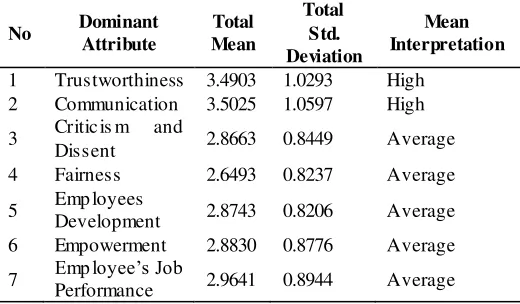
EDUCATI ONAL ADMI NISTRATION REVIEW VOL. I NO. 1 JUNE 2017 21 Dominant Attributes of Moral Leadership Among Heads
of Department at Private Institutions in Klang Valley.
No Dominant Attribute Mean Total
1 Trustworthiness 3.4903 1.0293 High 2 Communication 3.5025 1.0597 High
3 Critic is m and
Dissent 2.8663 0.8449 Average 4 Fairness 2.6493 0.8237 Average
5 Emp loyees
Development 2.8743 0.8206 Average 6 Empowerment 2.8830 0.8776 Average
7 Employee’s Job
Performance 2.9641 0.8944 Average
Table above shows the level of dominant attribute of moral leadership among heads of department at selected private institutions in Klang Valley. The h ighest dominant attribute is communication dimension where the total mean score is 3.5025 and the total standard deviation score is 1.0293. The
level of mean interpretation is “High”. Next the second highest
dominant attribute is trustworthiness with the total mean score is 3.4903 and the standard deviation is 1.0597. The level of
interpretation is “High”. The third highest is employee’s job
performance with the total mean is 2.9641 and standard
deviation is 0.8994. The level of interpretation is “Average”.
This follow by e mpowerment dimension with the total mean score is 2.8830 and standard deviation is 0.8776. The
level of interpretation is “Average”. The fifth dimensions are employee’s development with the total mean is 2.8743 and
standard deviation is 0.8206. The level of interpretation is
“Average”. The sixth dimensions are criticism and dissent with
the total mean score is 2.8663 and the standard deviation is Va lley. Two private universities were selected for this research and seven dimensions were used to measure the level of effectiveness of mora l leadership (first research question). In addition to measuring level of moral leadership, this study also aimed to identify the dominant attribute of Moral Leadership (second research question). For the third research question, the researcher looked at the significant differences between gender and moral leadership among heads of department, while for the fourth research question, the significant relationship between
the effectiveness of moral leadership and employee’s
performance at selected private higher institutions in Klang valley were e xa mined. For the last research question, the researcher exa mined significant differences between highest
level of education and employee’s job performance.
The researcher used Statistical Package for the Social Sciences (SPSS) to derive the mean, standard deviation, frequency and percentage (descriptive statistics). Each section
was analyzed and the results measured. For the first section, section B, which looked at the trustworthiness dimension, six questions was utilized. The average mean for section B is 3.4903. The results show that most of the employees agreed that the HOD can be re lied on to honor their co mmit ments. This shows that, in both institutions, the employees trust their HOD to deliver their work co mmit ments success fully. In the second section, section C which looked at communication, respondents answered six questions. The average mean for section C is 3.5025. The highest mean score was for when employees agreed that the HOD is approachable and friendly. This shows that employees can easily communicate with the HOD on any arising problems. HODs who imple ment open door policy can make e mployees feel they are important and able to share any work-related problems. Many problems can be resolved when communication between HOD and employees is strong. The next section, section D looked at critic ism and dissent. In this section, four questions were asked. The average mean for section D is 2.8663 and the average standard deviation, 0.8449. The highest mean score for this section was for when e mployees agreed that the HOD listens to ideas and suggestions for improving the department. Accepting ideas and suggestions from e mployees is very important as this may indirectly help improve a department or the institution. Bra instorming ideas and suggestions on different aspects of tasks can help a department or institution reach its mission and vision.
EDUCATI ONAL ADMI NISTRATION REVIEW VOL. I NO. 1 JUNE 2017 22
higher position people. The last section is section H which
looked at employee’s job performance. In this section, six
questions were asked to respondents. The average mean for section H is 2.9641. In this section, the highest mean was scored for my colleagues are very helpful and supportive in performing indiv idual or grouping tasks. Respondents agreed that their colleagues are very supportive to each other in delivering tasks either group-based or individual tasks. Having supportive colleagues will help e mployees feel motivated and happy in their working environment. Having healthy relationship with colleagues will also build a harmonious workplace and strong teamwork.
IV. CONCLUSSION
The first objective of this study was to exa mine the level of effectiveness of mora l leadership among heads of department at selected private institutions in Klang Valley while the second objective of this study was to find the dominant attributes of mora l leadership among heads of department at selected private higher institutions based on ranking in Klang Va lley. Based on past studies, researchers identified the dominant attributes of mora l leadership as trustworthiness, communication, critic ism and dissent, fairness, employee development, empowerment and employee’s job performance. [19] concurred that moral leadership requires any leader to display the following: trust, integrity, transparency, accountable, responsible and most importantly, innate honesty and kindness that make e mployees look up to them. This present study found that the level of effectiveness of mora l leadership among heads of department at both private institutions as high. Most of respondents agreed that their head of department practiced moral leadership in leading the department.
The mean score of trustworthiness is high which implies that employees agreed that the head of department can be trusted in handling the department and in dealing with employees. They also responded that the head of department can keep their promises and words in work –re lated matters. The heads of department also trust their employee’s credibility in handling the tasks given and have faith in their subordinates rather than those outside of their department. The result on trustworthiness is similar with past research [20],[21]. whereby trust, job satisfaction, team and organizational co mmit ment and leader effectiveness are related to mora l leadership. They also found that leaders, who always showed consistent behavior towards employees, can guide moral behavior in e mployees and able to clarify the job roles we re a lways perceived as more effective than those who did not. This clearly shows that moral leadership is strongly related to trust.
For commun ication, the mean score is high, which indicates that the head of department practice an open communication with their e mployees by being friendly and approachable to employees. In addition, the head of the department also listened to the frustration of their subordinates and try their best to help them with the problems. Besides that, the heads of department also encourage their employees to build an effective and effic ient communication culture a mong each other to build a harmonious workplace. According to [22] and [23], leaders who practice openness in communication, build enormous
influence a mong employees and practice good culture is good moral leadership built on social communication.
Motivating employees to voice out their ideas or suggestions in forma l meetings is one way to build effective communication. This corre lates with [24] and [25] who stated that effective communication practiced by heads of department can be used to give an order, express feelings, as a tool to motivate and to deliver information. Giving clear instructions and communicating clearly to emp loyees will help them understand what is required of them and the department goals that they need to accomplish. [26] stated that success and improvement of an institution depends on the effectiveness of heads of department effectiveness in handling any arising challenges or circu mstances. [27] added that successful institutions depend on the efficiency of co mmunication. Fro m there, employees would be able to measure how good a leader is.
The third dimension that was exa mined in this study is critic ism and dissent. In this section, the ability of heads of department to accept criticism and dissent from their employees was e xa mined. The study looked at things such as would heads of department be willing to listen to ideas and suggestions given by employees, if heads of department are open-minded by accepting dissent from e mployees, if heads of department are willing to accept constructive criticism fro m employees and if they are willing to consider a decision on the basis recommendation comes from their e mployees. The result of this study shows that most of the respondents partially agreed on this dimension. This shows that some of the heads of department accepted criticis m and dissent positively fro m employees for department improvement. Additionally, [28] also admitted that a leader who practices moral leadership will mostly respond to critic ism and dissent positively. They can accept criticism and dissent fro m e mployees for imp rovement purposes and they will try their best to avoid any negative criticism and dissent.
Ne xt, this study also looked at the fairness dimension. In the fairness dimension, the researcher focused on how heads of department treat their employees. The questions asked in this study includes if heads of department practice favoritism among employees especially when it comes to staff evaluation performance, if heads of department held employees accountable for problems over which they have no control and if heads of department investigated instead of blindly bla ming when something goes wrong. Besides that, do heads of department use their employees for their own benefit such as pursuit of their o wn. The results reveal that respondents claimed that some heads of department were fair in their leadership style while some we re not. [29] stated that good mora l leaders will a lways apply fairness in their re lationship with e mployees because, for a moral leader, being fa ir to a ll employees is very crucial.
For the employee’s development dimension, the researcher
EDUCATI ONAL ADMI NISTRATION REVIEW VOL. I NO. 1 JUNE 2017 23
encouraging them to undergo training that is related to their career development. Most importantly, do heads of department reward and give recognition to deserving employees. The results show that most employees partially agreed that heads of department do support employee development.
According to [30], by rewa rding e mployees, they will feel positively happy and this helps to increase good behavior in employees. This is supported by [31], [32] and [33] who stated that when heads of department focus rewarding and developing their e mployees, this will he lp to increase emp loyee motivation who would then be very willing to deliver good service.
Emp loyee development is very important in any institution as by rewarding and developing employees, they will feel motivated and feel positive in doing their job. Besides that, they will also feel more confident in delivering their tasks and feel mo re appreciated. [34] h ighlighted that development is important for employees. One way of developing employees is by providing training to them as this will indirectly help institutions grow as well.
Empowerment is another dimension that was discussed in this study. The researcher intended to find out if heads of department empower their e mp loyees in crit ical decisions, give opportunity to employees to handle challenging responsibilit ies, give opportunity to them to do their o wn planning, organizing and executing projects without any interference and trusting them in decision making. According to [35] and [36] one of the dimensions in leadership is empowerment. Empowerment is very crucial for e mp loyees in their work engagement. When leaders empower e mp loyees, there will be some changes in the employees such as increased self-efficiency and self-confidence in delivering the tasks given. The study results show that the employees partially agreed which indicated that that most heads of department rarely e mpower their e mployees especially in decision -making. [38] stated that one way of making emp loyees feel motivated in doing their tasks, is by empowering them through actions such as encouraging employees to participative in decision making, giving them opportunities to lead meetings, sharing information with them, and coaching them. [38] added that increased level of e mpowerment a mong the e mployees is a key factor in developing an institution.
The last dimension that was exa mined in this study was
employee’s job performance. In this study, the researcher
attempted to find out if heads of departments are very supportive and if the e mployees are happy working with their current head of department. Have the e mployees been given sufficient opportunities to perform in their job and career by getting full support from HODs? The results show that most respondents chose to partially agree and this shows that most employees are not really motivated in their job and this can contribute to their poor job performance. According to [39], by empowering e mployees, this will help contribute to the success of institutions as this increases job performance. [40] added that employee performance is reflected in improved production, open-mindedness in using the modern technology and highly motivated workers will appreciate being trusted by their heads of department in decision-making.
REFERENCES
[1] Alvesson, M. and Sveningsson, S. (2003). The great disappearing act: difficulties in doing ‘leadership’. Leadership Quarterly, 14, pp. 359–381. [2] Nucci, L. P. (2015). Education in the moral domain. New York, NY:
Cambridge University Press.
[3] Judge, T . & Piccolo, R. (2004).Transformational and Transactional Leadership: A Meta-Analytic Test of Their Relative Validity, Journal of Applied Psychology,5, 755-768.
[4] Allio R. J., (2012). "Leaders and leadership – many theories, but what advice is reliable?". Strategy & Leadership, Vol. 41 Issue: 1, pp.4-14, doi: 10.1108/10878571311290016.
[5] Avery, G.C. (2004). Understanding Leadership: Paradigms and Cases. London: Sage.
[6] Northouse, G. (2007). Leadership theory and practice. (3rd ed.). T housand Oak, London, New Delhi: Sage Publications, Inc.
[7] Yukl, G. A. (2002). Leadership in organizations(5th ed.). Delhi:
[12] Ku Samsu, Ku Hasnita. (2007). Patriotisme di Kalangan Generasi Muda Malaysia: Kajian Kes Ke Atas Mahasiswa Bukan Melayu di Institusi Pengajian Tinggi. Universiti Malaya.
[13] Ranjit Kumar (2014). Research Methodology (4th Ed.). London: SAGE Pulication Ltd.
[14] T uckman, Bruce W. (1999). Conducting educational research (5th ed.). Orlando, FL: Harcourt Brace & Company.
[15] Sekaran, U. and Bougie, R. (2013). Research Methods for Business: A Skill-Building Approach. 6th Edition, Wiley, New York.
[16] Guarte, J. M. & Barrios, E.B. (2006). Estimation under purposive sampling. Communications in Statistics – Simulation and Computation, 35(2), 277 – 284.
[17] Kalshoven, K. (2010). Ethical leadership: through the eyes of em ployees. Amsterdam Business School Research Institute (ABS-RI), FMG: Psychology Research Institute
[18] Northouse, G. (2015). Introduction to leadership: concept and practice. (3rd ed.). Western Michigan University, Sage Publications, Inc. [19] Barrajon, P. L. C. (2013). Religion and leadership. Retrieved from
http://integralleadershipreview.com/8297-religions-and-leadership/ [20] Brown, M. E., Trevin˜o, L. K., & Harrison, D. A. (2005). Ethical
leadership: A social learning perspective for construct development and testing. Organizational Behaviorand Human Decision Processes, 97(2), 117-134.
[21] De Hoogh, A. H. B., & Den Hartog, D. N. (2008). Ethical and despotic
leadership, relationships with leader’s social responsibility, top
management team effectiveness and subordinates’ optimism: A multi -method study. The Leadership Quarterly, 19, 297-311.
[22] Goleman, D. (2000). LeadershipThat Gets Results. Harvard Business Review, 78(2), 78-90.
[23] Yukl, G.A. (1981). Leadership in Organizations. NJ : Prentice-Hall, Englewood Cliffs.
[24] Gibson, J.W., & R.M. Hodgetts. (1991). Organizational communication – A managerial perspective. 2nd Edition. New York: HarperCollins Publishers.
[25] Robbins, S. (1993). Organisational behaviour: Concepts, controversies and applications. 6th ed. New Jersey: Prentice Hall.
[26] Fullan, M. (2001). Leading in a culture of change. San Francisco, CA: Jossey-Bass.
EDUCATI ONAL ADMI NISTRATION REVIEW VOL. I NO. 1 JUNE 2017 24 [28] Yukl, G.A. (2010). Leadership in Organizations. Thousand Oaks, CA:
Prentice Hall.
[29] Berreth, D., & Berman, S. (2007). The moral dimensions of schools. Educational Leadership, 54(8), 24-27.
[30] Cropanzano, R. & Mitchell, M.S. (2005). Social exchange theory: An interdisciplinary review. Journal of Management, 31(6), 874-900. [31] Rosen, C.C., Chang, C.-H., Johnson, R.E. & Levy, P.E. (2009).
Perceptions of the organizational context and psychological contract breach: assessing competing perspectives. Organizational Behavior and Hum an Decision Processes, 108(2), 202-17.
[32] Shore, L.M., Tetrick, L.E., Taylor, M.S., Coyle Shapiro, J.A.-M., Liden, R.C., Parks, J.M., Morrison, E.W., Porter, L.FW., Robinson, S.L. , Roehling, M.V., Rousseau, D.M., Shalk, R., Tsui, A.S.&Van Dyne, L. (2004). The employee-organization relationship: A timely concept in a period of transition. In Martocchio, J. (Ed.), Research in personnel and hum an resources m anagement (pp. 291-370). Oxford : Elsevier. [33] Tekleab, A.G., Takeuchi, R. & Taylor, M.S. (2005). Extending the chain
of relationships among organizational justice, social exchange, and employee reactions: The role of contract violations. Academy of Management Journal, 48(1), 146-57.
[34] Beardwell, I., Holden, L. & Claydon, T. (2004). Human resource m anagement: A contemporary approach. Harlow: Prentice Hall.
[35] Halbesleben, J. (2010). A meta-analysis of work engagement: relationships with burnout, demands, resources and consequence. In Bakker, A.B. & Leiter, M.P. (Eds), Work engagement: A handbook of essential theory and research. New York : Psychology Press.
[36] May, D.R., Gilson, R.L. & Harter, L.M. (2004). The psychological conditions of meaningfulness, safety and availability and the engagement of the human spirit at work. Journal of Occupational and Organizational Psychology, 77(1), 11-37.
[37] Pearce, C.L. & Sims, H.P. Jr.(2002). Vertical versus shared leadership as predictors of the effectiveness of change management teams: an examination of aversive, directive, transactional, transformational, and empowering leader behaviors. Group Dynamics: Theory, Research, and Practice, 6(2), 172-97.
[38] Mathieu, J.E., Gilson, L.L. & Ruddy, T .M. (2006). Empowerment and team effectiveness: An empirical test of an integrated model. Journal of Applied Psychology, 91(1), 97-108.
[39] Herbert, Donald, John, & Lee (2000). Personnel/Human resource m anagement, 4th ed. New Delhi :Universal Book Stall.