POOR QUALITY OF SLEEP CORRELATED WITH
ELDERLY COGNITIVE IMPAIRMENT
CONFERENCE PAPER · AUGUST 2015
READS
27
5 AUTHORS, INCLUDING:
Eka Widyadharma
Udayana University, Bali, Indonesia
18 PUBLICATIONS 0 CITATIONS
POOR QUALITY OF SLEEP CORRELATED WITH ELDERLY COGNITIVE IMPAIRMENT
Yuliantry Indah Lestari*, Utami, DK Indrasari **, Budiarsa, IGN**, Eka Widyadharma** Neurology Department, Faculty of Medicine, Udayana University/Sanglah General Hospital
Denpasar, Bali
ABSTRACT BACKGROUND
Physiologically the increasing age will reduce levels of melatonin in the body. It often causes problems in the elderly sleep quality. Impaired quality of sleep is much associated with impaired cognitive function. Research on the relationship between sleep quality of elderly with cognitive function has not been done in Indonesia.
PURPOSE
To determine poor sleep quality correlated with the cognitive impairment in the elderly.
METHOD
This is a cross sectional study that using sampling consecutive methode. The Pittsburgh Sleep Quality Index (PSQI) have been done to assess the quality of sleep and cognitive impairement assessed by Montreal Cognitive Assesment- Indonesia ( MoCA-INA). Descriptive analysis and spearman’s test were performed with SPSS 16.0 for Windows
RESULTS
Samples were obtained as many as 52 people with the proportion of 34(65,4%) of woman. The mean age of subject 67,77 ± 4,68 years old with level of education 20 (38,5%) subject mostly in elementary school. The mean PSQI score of subject 11,50 ± 5,086 and mean MoCA-INA score 23,06± 2,052. There is a weak correlation (r = -0,399) between poor sleep quality and impaired cognitive function which significant with statistical analysis (p=0,003 ).
CONCLUSION
Poor sleep quality correlated with cognitive impairment in the elderly. Keywords: cognitive function, elderly, sleep quality
===================================================================== *Resident of Neurology Department, Faculty of Medicine, Udayana University/Sanglah General Hospital, Denpasar
**Lecturer of Neurology Department, Faculty of Medicine, Udayana University/Sanglah General Hospital, Denpasar
INTRODUCTION
The world is currently experiencing demographic revolution in which the number of elderly is increasing. Elderly is defined as the age of 60 or more as defined by the World Health Organization that consists of (1) elderly 60-74 years, (2) old elderly 75-90 years, (3) very old elderly above 90 years. Currently population age 60 years or more is a tenth of total population, and by 2050 it is estimated to become a fifth
the number that is highest in the world. In 2020 the number of elderly in Indonesia will rank the fourth after China, India and the suffered from physical diseases that interfere with their independence in carrying out daily functions. A number of 30% patients who have physical diseases have psychiatric comorbidities, especially depression and anxiety. Most elderly with physical diseases and mental disorders have sleeping disorders.
Sleep and its stages is correlated to the process of consolidation of declarative and procedural memories5. REM (Rapid Eye Movement) sleep is beneficial for restoring the ability of learning, consolidation of memory, restoration of adrenergic system and restoration od reticular system to make ready for arousal6. Zimmerman et al,2006 stated that memory impairment is a cognitive impairment that is commonly found in patients with Obstructive Sleep Apnea (OSA)7.
The existence of cognitive impairment might interfere in conducting the Activities of Daily Living-ADL, and this might decrease the quality of life of elderly which implies interference in independence in carrying out the activity of daily living. The lost of social function and the function of independence in elderly will lead to problems with family members. The research concerning sleep quality which are specifically correlated to cognitive function disturbances in elderly is rarely found in Indonesia. This is the reason why this community based research was conducted. The community chosen was an elderly integrated care post (posyandu) in Banjar Batanancak and Banjar Kedaton, Tonja Village. These two locations were chosen because these two elderly posyandu is active at carrying out activities for its members.
AIM
This research aimed at determining the correlation between impaired sleep quality and the occurrence of declined cognitive function in elderly in Banjar Batanancak and Kedaton, Tonja village, Denpasar.
METHODS
This research is an analytic observational research with cross sectional design with elderly in Banjar Batanancak and Kedaton Desa Tonja Denpasar. Samples
were obtained using non random
consecutive sampling. Inclusion criteris is age of ≥ 60 years, cooperative and provided
consent to participate in this research. Elderly who were unable to do the activities
of daily living independently and
experiencing severe mental disorder (schizophrenia) were excluded. All elderly who came to Banjar Batanancak and Kedaton Desa Tonja Denpasar were noted for demographic characteristics. The sex of the research subjects were distinguished as male and female based on the interview with nominal measurement scale. The educational level was defined as the educational stage that was able to be completed, and was categorized as no school, elementary school, junior highschool, senior highschool, and higher education. The data were obtained from the interview. Sleep quality and cognitive function was determined by instruments.
be scored 1, 65-74% is scored 2, and <65% scored 3. The total score for the PSQI questionnaire was obtained by summing the scores 1-7 with the range of 0-21. High
Cognitive function was subjectively measured using Indonesian version of Montreal Cognitive Assesment (MoCa-Ina). This test is used to determine the presence of Mild Cognitive impairment (MCI). MoCA consists of 30 questions that can be completed in 10 minutes and assess some domains of cognitive functions. The research from Nasreddine dkk in 2005 to validate to detect the ones with mild cognitive impairment and early Alzheimer’s
disease using Mini Mental State
Examination (MMSE) and Montreal
Cognitive Assesment (MoCA). From those research, the cut off point of 26 was obtained to detect MCI using MoCA has sensitivity of 90% and specificity of 87% with subjects 94 people. So for MoCa, when subjects obtained value of ≥26 it was
considered normal10,11. Husein dkk,
produced the instrument MoCa in
Indonesian language (MoCA-INA) that has been validated in concordance to rules of validation, transcultural, and reliable, with total Kappa score between 2 doctors (inter rater) was 0,820. While in each domain: visuospatial/executive 0,817; naming 0,985 and attention 0,969. While for language domain 0,990; abstraction 0,957; memory 0,984 and 1,00. This instrument is able to be used in screening of cognitive function in Indonesian patients.12 Impaired cognitive function was determined if MoCA-INA score was <26. The lower the MoCA-INA score shows more impaired cognition.
DATA ANALYSIS
Data obtained were then collected then analysis was conducted statistically using
SPSS statistic software. To determine the correlation between poor sleep quality and increased impairment in cognitive function in elderly, pearson correlation test was conducted with numeric scale of sleep quality and numeric scale cognitive function, if data distribution were normal. When data was not normally distributed, spearman test was used.13 The interpretation of the result of correlation test was based on the value of p, the strength of the correlation, and the direction of the correlation. The significance of the research was measured by p value, when value of p < 0,05 this shows significant correlation between two variables being tested and if value of p >0,05 no significant correlation was found between the two variables. The strength of the correlation (r) was determined if the value of r 0,0- <0,2 the degree of correlation is very week, value of r 0,2- <0,4 shows weak correlation, r of 0,4- <0,6 shows moderate correlation, and r 0,6- <0,8 shows strong correlation, and r 0,8-1 shows very strong correlation. The direction of correlation is determined that when r is positive, it shows that the higher the value of one variable would be followed by the increased value in other variable. Negative r shows opposite direction correlation, when the higher value of one variable is followed by lower value of other variable 13.
RESULTS
The research was able to gather data from 52 elders who came to Banjar Batanancak and Kedaton, Tonja village, Denpasar, in May 31st 2015. This research used cross sectional design to determine the correlation of poor sleep quality with the occurrence of decline of cognitive function in elderly. To determine the correlation of poor sleep quality with cognitive function impairment, spearman correlation test was conducted.
A. Characteristics of Subjects
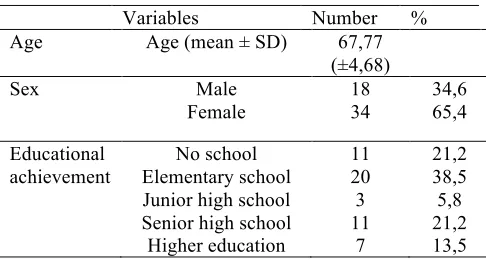
Table 1 showed that mean age of subjects was 67,77 (±4,68) years, with female overrepresentation of 34 (65,4%) and most have elementary school education of 20 (38,5%).
Table 1. Characteristics of research subjects
Variables Number % quality of 11,50 ± 5,086 and mean cognitive function of 23,06± 2,052. After analysis with Spearman correlation test, a value of r=-0,399 was obtained. This value showed weak correlation between poor sleep quality and impairment in cognitive function as dependent variable with significance of p=0,003. With negative direction of correlation, it can be concluded that poor sleep quality will lead to decreased cognitive function in elderly.
Table 2. Result of Spearman’s test between sleep quality and cognitive function
Variable Mean±SD r p quality was in concordance with the research by Khusnul Khasanah and Wahyu Hidayati
in 2012. The process of aging has been correlated to the changes in circadian sleep-wake control. Endogenous changes that is very important was significant decrease in circadian amplitude. Other than being correlated to circadian changes in sleep, aging has also been correlated to core body temperature (CBT) and sleep/wake rhythm. With the advancing age, there is a decrease in the sleeping periods. Elderly groups tend to wake up easier from their sleep. The need for sleep would decrease as the age advances. In 12 years the need for sleep is nine hours, decreases to eight hours in 20 years, seven hours in 40 years, six and a half hours in 60 years, and six hours in 80 years1. The prevalence of insomnia in elderly is about 35%3. The incidence increases as the age advances.
Physiologically, apparently the
advancing age has been correlated to the decrease in the level of melatonin hormone. This hormone is required by the body in regulating circadian rhythm in sleep/wake cycle. Total number of sleep is not changed by advancing age. But, the sleep quality has changed in most elderly. The episode of REM sleep tend to be shorter. Progressive decrease was found in stage 3 and 4 of NREM sleep. Some elderly don’t even have 4 or deep sleep. Elderly will be awaken more often at night, and it would take lots of time to fall asleep.
The decline in cognitive function will lead to disturbances in central nervous system, which is the decrease of brain mass and decrease of cerebral blood flow. This would further lead to the proliferaton of astrocytes so neurotransmitters (dopamine and serotonin) would change. The change in these neurotransmitters would increase the activity of the enzyme monoamine oxidase (MAO). This will lead to slower central process and reaction time and so decline than previous ability would be found in social and occupational aspects. This make elderly lost interest in their activities of daily living in their daily life. Elderly become needing some help to conduct some activities that they were able to do themselves before.
This research also obtained weak correlation between poor sleep quality and cognitive function impairment in elderly. This is in concordance with previous research conducted by Riza Umami in Magelang district. Weak correlation between poor sleep quality and cognitive function impairment was caused by the many other factors that might affect sleep quality in elderly. Sleep problem in elderly has been correlated to internal and external factors. Internal factors that might affect sleep quality are among others the existence of pain due the the disease they suffer, high rate of depression and anxiety in elderly, while external factors that can be correlated among others are environmental factor which is uncomfortable, lack of exercise and the use of sedatives and hypnotics9 .Between the ages 60-80 years, mean sleeping time showed positive correlation between activity and sleep quality. This research also showed negative direction correlations between poor sleep quality and cognitive function impairment. This negative direction shows that poor sleep quality will increase the possibility of the occurrence of decrease of cognitive function in elderly. This is in
concordance with the research conducted by Blackwell T in California 14,15.
This descriptive research has some weaknesses. In this research, the sleep quality was only differentiated to good sleep quality and poor sleep quality, without distinguishing whether it was insomnia or hipersomnia. The examination for cognitive function was only based on MoCA-Ina without assessing cognitive function in a more specific manner. This research is a descriptive one using cross sectional method, so it was unable to determine the degree of correlation between two variables, and this research didn’t use randomization and with small sample size. However, this research has some strength due to its nature as a community based study. In the future, it is warranted to conduct a cohort research with bigger sample size and assessment of cognitive function should be done with more specific instruments.
CONCLUSION
Poor sleep quality will increase the occurrence of cognitive function impairment in elderly in Banjar Batanancak and Banjar Kedaton, Tonja Village, Denpasar.
REFERENCES
1. Prayitno A. Gangguan Pola Tidur pada
Kelompok Usia Lanjut dan
Penatalaksanaannya. J Kedokter
Trisakti. 2002;21 (1):23-30
2. Departemen Kesehatan RI. Profil
Kesehatan Masyarakat Edisi Tahun 2001. Jakarta: Direktorat Jenderal Bina
Kesehatan Masyarakat Departemen
Kesehatan RI;2001.
3. Kementrian Koordinator Bidang
Kesejahteraan Rakyat. Lansia Masa Kini
dan Mendatang .2009.
http:/www.menkokesra.go.id
4. Kraksono D. Insomnia sebagai faktor risiko gangguan kognitif pada kelompok usia lanjut RS. Ludira Husada Tama Yogyakarta. Yogyakarta: Universitas Gadjah Mada; 2009.
Theta, and the Consolidation of Human Emotional Memory. Cerebral Cortex.
2009;19:1158-1166. Available
from:http://cercor.oxfordjournals.org. Accessed Maret 24, 2015.
6. Joesoef, AA. Mengenal Fisiologi dan Patologi Tidur. Simposium Gangguan Tidur;1997; Surabaya: FK Universitas Airlangga/RSUD Dr Soetomo. Hal 1-18. 7. Zimmerman ME,Arnedt JT, Stanchina
M, Millman RP, Aloia MS.
Normalization of Memory Performance and Positive Airway Pressure Adherence in Memory-Impaired Patients With
Obstructive Sleep Apnea. Chest.
2006;130:1772-1778. Available from: http://chestjournal.chestpubs.org.
Accessed Maret 24,2015.
8. Buysse, D., Reynold, C., Monk, T., Berman, S., Kupfer, D. The Pittsburgh Sleep Quality Index : a new instrument for psychiatric practice and research. Psychiatry Res; 28(2):193-213.1989. 9. Umami, Riza. Sigit Priyanto.Hubungan
Kualitas Tidur dengan Fungsi Kognitif dan Tekanan darah pada Lansia di Desa
Pasuruhan Kecamatan Mertoyudan
Kabupaten Magelang 2013. .Available from jurnal.ummgl.ac.id
10. Nasreddine Z. Montreal Cognitive Assesment (homepage on internet). Cited 2014,September 14. Available from : www.mocatest.org
11. Nasreddine ZS, Phillips NA, Bedirian V,Charbonneau S, Whitehead V, Collin
I, et al. The Montreal Cognitive Assesment.MoCA: a brief screening tool for Mild Cognitive Impairment. AGS Journal.2005;53(4): 695- 9.
12. Husein,N Lumempow S, Ramli Y,
Herqutanto. Uji validitas dan
Reliabilitas Montreal Cognitive
Assesment versi Indonesia
(MoCA-INA) untuk skrining gangguan
fungsi kognitif.
Neurona;2010;27(4):15-21
13. Dahlan,MS. Besar sampel dan cara pengambilan sampel dalam penelitian kedokteran dan kesehatan ed 2. Jakarta: Salemba Medika. 2009
14. Miyata,Seiko.
Noda,Akiko.Iwamoto,Kunihiro. Et al. Poor sleep quality impairs cognitive performance in older adults. J Sleep Res. (2013) 22, 535-541
15. Blackwell,Terry. Poor sleep quality associated with cognitive decline in older men. Sleep. 2014;doi:
10.1176/appi.ps.201300216