Received December 5th, 2013, 1st Revision February 28th, 2014, 2nd Revision May 20th, 2015, 3rd Revision June 1st, 2015, Accepted for publication June 20th, 2015.
Copyright © 2015 Published by ITB Journal Publisher, ISSN: 2337-5760, DOI: 10.5614/j.math.fund.sci.2015.47.3.3
Embryo Incision as a New Technique for Double Seedling
Production of Indonesian Elite Coconut Type “Kopyor”
Sisunandar1,*, Alkhikmah1, Arief Husin1 & Aman Suyadi2
1
Biology Education Department, University of Muhammadiyah Purwokerto Jl. Raya Dukuhwaluh, Kembaran, Purwokerto, 53182, Indonesia 2
AgrotechnologyDepartment, Faculty of Agriculture, University of Muhammadiyah Purwokerto, Jl. Raya Dukuhwaluh, Kembaran, Purwokerto, 53182, Indonesia
Email : [email protected]
Abstract. One of the present major limitations of seedling production of kopyor -type coconuts using embryo culture is that only one seedling can be produced from a single embryo. Therefore, we report on the development of a new breakthrough technique for the production of double seedlings from a single embryo. The technique consists of four steps, viz. (i) germination; (ii) incision; (iii) splitting; and (iv) recovery. A histological study was carried out on the development of the halved embryo into a new shoot. The best recovery process was obtained when the incised embryo was split into two and recovered into Murashige and Skoog (MS) medium supplemented with 2 µM IBA and 15 µM kinetin. Following this protocol, an average of 56 shoots was successfully recovered from 30 zygotic embryos. The histological study also revealed that the meristem tissue of the halved embryo was able to produce a new meristem and primordial leaf. Most of the shoots then went on to produce normal seedlings and could be acclimatized successfully after having developed 2 or 3 leaves. This protocol is useful for routine seedling production of the kopyor-type coconut.
Keywords: embryo culture; embryo splitting; in vitro culture; meristem; multiplication.
1 0BIntroduction
The coconut (Cocos nucifera L.) is a major Indonesian crop, grown on ca. 3 million ha and producing ca. 19.5 million tons of dehusked coconuts per annum [1]. However, about 96% of coconut farmers are smallholders cultivating less than 0.5 ha, which many of them do not own. As a consequence, the coconut growers are marginalized, having a per annum income amounting to less than US$ 600 [2].
used in the production of flavorsome foods. The demand for this type of coconut is very high and becomes even higher during special seasons such as Ramadhan (fasting month) or Christmas and New Year. The price for kopyor-type coconuts can reach up to 10 times the price of a normal nut, ca. 30-40 thousand IDR.
The potential of the kopyor-type coconut, however, still needs to be developed because it has a non-functional, jelly-like endosperm. Consequently, it cannot germinate. Most kopyor plantations originate from mutant seedlings that appear at random among normal coconuts through spontaneous mutation. The percentage of kopyor nuts produced at random is less than 30% [3].
Since the embryo of the kopyor-type coconut can be rescued through tissue culture and nurtured to produce seedlings, this percentage can be increased up to 95% [4]. However, an embryo culture protocol for the seedling production of kopyor-type coconuts still needs to be developed, especially considering the low rate of conversion of plantlets established under in vitro conditions compared to ex vitro conditions [5]. Furthermore, embryo culture currently has a major limitation in that only one seedling can be produced from a single embryo.
Several techniques have been tried out to increase the number of seedlings produced from a single zygotic coconut embryo, e.g. somatic embryogenesis. However, the somatic embryogenesis protocols so far developed for coconuts are inconsistent and the success rate of seedling production has been very low and found to be highly variable between cultivars [6,7]. As a consequence, no field-growing plants have ever been established. An easier approach to double coconut seedling production compared to somatic embryogenesis is using the embryo splitting technique [8-10]. However, the success rate during regeneration and acclimatization remains low [11]. The difficulty in applying the splitting technique to produce double seedlings is to find the right position for the cutting site. The shoot apical meristem of the zygotic embryo remains invisible until the embryo starts to germinate.
The present paper reports on a new technique for double seedling production of the kopyor-type coconut using embryo incision.
2 Materials and Methods
2.1 Plant Material
surface sterilization of the embryos was applied with minor modifications. After cracking the nuts, the zygotic embryos (Figure 1(A)) with a small portion of endosperm were isolated from a specific region of the endosperm using a metal spoon. After washing with running tap water, the endosperm was quickly rinsed with 70% (v/v) ethanol. The zygotic embryos were then aseptically isolated from the endosperm in a laminar airflow cabinet, followed by surface sterilization for 15 mins using a 5% (w/v) calcium hypochlorite solution, followed by several rinses in sterile water.
Figure 1 (A) Example of the nut of a kopyor-type coconut with abnormal endosperm (white, friable) and a zygotic embryo (red arrow); (B) embryos began germination after 4 weeks of culture and were ready to be incised up to halfway of the embryo; (C) incised embryos after 4 weeks of culture ready to be split into two shoots.
2.2 Embryo Incision Protocol
producing 2-3 leaves, the seedlings were then subjected to acclimatization for another 2 months before being planted in a nursery.
2.3 Histological Study
Histological procedures were carried out on embryos and incised embryos according to the Sass method [15] with minor modifications. Tissue samples were fixed in 70% ethanol for 48 h under negative pressure, followed by stepwise dehydration (each step 1 h) using 50, 70, 80, 90, 96 and 100% ethanol in water. After the ethanol was replaced with xylene and the samples were embedded in paraffin, they were cut into sections of 6 µm using a rotary microtome (Hestion ERM 4000, Germany). The sections were double-stained with safranin and fast green. Finally, the slices were visualized under an Olympus BX 61 microscope (Olympus Corporation, Tokyo, Japan) and photographed using an Olympus DP 72 camera.
2.4 Statistical Analysis
The number of halved embryo produced seedlings, the length of the shoots and the number of roots were counted from three replicated trials, each with 30 explants. The data sets were statistically analyzed for variance using ANOVA and the means were compared according to Fisher’s Least Significant Difference (LSD) using the statistical software package Minitab (Release 15).
3 Results and Discussion
3.1 Embryo Incision
The number of embryos that produced two shoots (Figure 1(C)) was very high during the preliminary experiment (95%; data not shown). The germinated embryos were incised to create two parts and recovered directly into the hybrid embryo culture medium [13]. However, only one of the shoots survived while the other one died after 8 weeks of culture (95%; data not shown) and finally only one seedling could be produced from a single zygotic embryo.
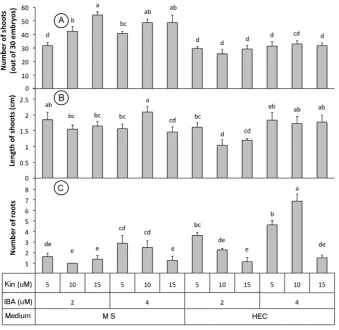
embryos was low (ca. 30 shoots out of 30 zygotic embryos) when HEC medium was used in the recovery process. Moreover, the number of shoots remained steady even when the HEC medium was added with more IBA or kinetin (Figure 2(A)).
Figure 2 Effects of MS basal medium and hybrid embryo culture (HEC) medium supplemented with 2-4 µM indole butyric acid (IBA) and 5-15 µM kinetin (Kin) on number of shoots produced from 30 zygotic embryos (A), length of shoots (B), and number of primary and secondary roots (C) after 8 weeks in recovery medium. In each bar chart and each data series, treatments that are ascribed with different letters differed significantly at p-value ≤ 0.05.
secondary roots, while other combinations of medium produced less than 3 roots per shoot. This can be another advantage, because one of the major limitations of using embryo culture for kopyor seedling production is the low success rate of root induction [5,8]. This medium then, may also be used for root induction in coconut embryo culture.
Figure 3 Example of two shoots coming from a single zygotic embryo after being halved and recovered into MS medium added with 2 µM IBA and 15 µM kinetin. (A) Shoots showed browning after 4 weeks of culture, and (B) started to grow after 8 weeks of culture in the same medium. Most shoots were successfully acclimatized in a screen house for 4 months before being ready for field planting (C).
as nitrogen (in the form of NO3- and NH4+) play an important role in both
morphogenesis and growth.
During the first four weeks, the growth of the halved embryos was affected by browning in the wound tissue (Figures 3(A) and 3(B)), but then became normal in the following 8 weeks in recovery medium (Figure 3(C)). Almost all of the recovered shoots were then successfully acclimatized in a screen house over a 4-month period with an overall survival rate of more than 80% (Figure 3(D)).
3.2 Histological Study
Histological analysis of the zygotic embryos showed that the meristem tissue was completely inside the embryo (Figure 4(A)). This creates a slight possibility of producing two shoots from a single embryo by splitting the embryo at the right site. When the meristem tissue is split into two at the right site using the embryo incision technique, the meristem produces new primordial leaves and new active meristem tissue (Figure 4(B)). This new tissue emerges from the edge of the cutting site (CT), followed by growing and recovering processes to produce a new shoot with new meristem tissue (NMR) and a new primordial leaf (NPL).
Previously proposed methods [8-10] have a low success rate because it is not possible to determine the right position of the cutting site from the outside. Germinating the embryos for about 4 weeks followed by incision can maximize the visibility of the cutting site. The results show that the success rate of double seedling production increased to more than 90% when the halved embryos were subcultured into MS medium supplemented with 2 µM IBA and 15 µM kinetin.
4 Conclusion
Embryo incision can be applied to produce double seedlings of kopyor-type coconuts. The best protocol is to first incise the germinated embryos at the meristem site, followed by splitting the embryo into two after 4 weeks of culture and then recovering the embryos in Murashige and Skoog (MS) medium supplemented with 2 µM IBA and 15 µM kinetin.
Acknowledgements
This research was funded by the Directorate General of Higher Education with 2013 Hibah Bersaing Research Grant, Contract No. A.11-III/263-SPj./LPPM/VI/2013. We would like to thank Ms. Prapti, Faculty of Biology, University of Gajahmada, Yogyakarta, Indonesia for her assistance in the histological work.
References
[1] FAO, FAOSTAT Data, http://faostat.fao.org/ (3 March 2011).
[2] Mahmud, Z. & Ferry, Y., Prospects of Byproduct Processing of Coconut Perspektif, 4, pp. 55-63, 2005. (Text in Indonesian)
[3] Maskromo, I., Mashud, N. & Novarianto, H., Potential Development of
Kopyor Coconut in Indonesia, Warta Penelitian dan Pengembangan, 13,
pp. 4-6, 2007. (Text in Indonesian)
[4] Samosir, Y., Mashud, N., Novarianto, H., Lien, V.T.M., Rillo, E.P., Magdalita, P.M., Damasco, O.P., Kembu, A., Faure, M.G. & Adkins, S.W., A New Embryo Culture Protocol for Coconut Germplasm Conservation and Elite-Type Seedling Production, Australian Centre for International Agricultural Research, Canberra, 2008.
[5] Sukendah, Sudarsono, Witjaksono & Khumaida, N., Developing Embryo
Culture Technique for Kopyor Coconut (Cocos nucifera L.) Originated
from Sumenep, East Java, through the Addition of Additive Substances
and Testing Subculture Periods, Buletin Agronomi, 36, pp. 16-23, 2008.
(Text in Indonesian)
[6] Perez-Nunez, M.T., Chan, J.L., Saenz, T., Gonzales, T., Verdeil, J.L. & Oropeza, C., Improved Somatic Embryogenesis from Cocos nucifera L.
Plumule Explans, In Vitro Plant Cellular & Developmental Biology, 42,
pp. 37-43, 2006.
[7] Perera, P.I.P., Hocher, V., Verdeil, J.L., Doulbeau, S., Yakandawala, D.M.D. & Weerakoon L.K., Unfertilized Ovary: A New Novel Explant
for Coconut (Cocos nucifera L.) Somatic Embryogenesis, Plant Cell
[8] Mashud, N., Developing More Efficient (30%) Embryo Culture Method for Kopyor Coconut, Laporan Penelitian Program Insentif Riset Terapan, Balai Penelitian Tanaman Kelapa dan Palma Lain, Manado, 2010. (Text In Indonesian)
[9] Sukendah, In Vitro Multiplication and Molecular Analisys of Kopyor
Coconut, Ph.D Dissertation, Postgraduate School Institut Pertanian
Bogor, Bogor, 2009.
[10] Nunez, T.C., Doubling Macapuno Seedling Production thru Embryo Splitting, Philippine Journal of Crop Science, 22(Suppl. No. 1), pp. 64, 1997.
[11] Sisunandar, In Vitro Propagation Method of Kopyor Coconut Through Embryo Incision Technique, Patent Pending No. P00201201185, 2012. [12] Sisunandar, Rival, A., Turquay, P., Samosir, Y. & Adkins, S.W.,
Cryopreservation of Coconut (Cocos nucifera L.) Zygotic Embryos does not Induce Morphological, Cytological or Molecular Changes in
Recovered Seedlings, Planta, 232, pp. 435-447, 2010.
[13] Rillo, E.P., Importing and Growing Embryos for the Coconut Genebank, Germplasm Health Management for COGENT’s Multi-site International Coconut Genebank, Ikin, R. & Batugal, P. (eds), International Plant Genetic Resources Institute-Regional Office for Asia, the Pacific and Oceania (IPGRI-APO), Serdang, Selangor DE, Malaysia, pp. 62-68, 2004.
[14] Murashige, T. & Skoog, F., A Revised Medium for Rapid Growth and
Bioassays with Tobacco Tissue Culture, Physiologia Plantarum, 15, pp.
473-497, 1962.
[15] Sass, J.E., Bitanical Microtechnique, The Iowa State College Press, Iowa, pp. 69-71, 1951.
[16] Sisunandar, Sopade, P.A., Samosir, Y., Rival, A. & Adkins, S.W., Dehydration Improves Cryopreservation of Coconut (Cocos nucifera L.), Cryobiology, 61, pp. 289-296, 2010.
[17] Sisunandar, Sopade, P.A., Samosir, Y., Rival, A. & Adkins, S.W.,
Conservation of Coconut (Cocos nucifera L.) Germplasm at Sub-zero
Temperature, CryoLetters, 33, pp. 465-475, 2012.