SOCIOLOGY AND WELFARE
DEVELOPMENT
Edited by:
Muhamad Fadhil Nurdin
Centre for Socioglobal Studies Padjadjaran University
Foreword by:
Dr. Afriadi Sjahbana Hasibuan, MPA, M.Com (Ec)
SOCIOLOGY AND WELFARE DEVELOPMENT © 2015 Muhamad Fadhil Nurdin et. al.
First Published May, 2015
Published By
Centre for Socioglobal Studies Padjadjaran University
In Cooperation With
Penerbit Samudra Biru (Member of IKAPI)
Jomblangan Gg. Ontoseno Blok B No 15 Rt 12/30 Banguntapan Bantul Yogyakarta Indonesia 55198 Telp. (0274) 9494 558
E-mail/FB: [email protected]
ISBN: 978-602-9276-56-5
CONTENTS
Contents ... iii
List of Contributors ... v
Acknowledgement ... ix
Foreword ... xi
Introduction ... xiii
Chapter 1 Welfare Development: Meanings, Issues and Challenges Muhamad Fadhil Nurdin ... 1
Chapter 2 Poverty and Social Development Muhamad Fadhil Nurdin, Ali Maksum, Indri Indarwati ... 19
Chapter 3 The Emergence of Jakarta-Bandung Mega-Urban Region and Its Future Challenges Agung Mahesa Himawan Dorodjatoen, Forina Lestari and Muhamad Fadhil Nurdin .... 39
Chapter 5
Baitul Mal wat Tamwil: a Sociological and Social Welfare Movement ?
Hery Wibowo & Muhamad Fadhil Nurdin ... 79
Chapter 6
Environmental Participation among Youth: Challenges, Issues and Motivating Factors
Lim Jen Zen & Muhamad Fadhil Nurdin ... 97
Chapter 7
Indonesian Workers Health Condition: A Sociological Analysis
Bintarsih Sekarningrum, Desi Yunita
and Muhamad Fadhil Nurdin ... 125
Chapter 8
he Delivery System of Education Programs
Mahathir Yahaya, Ali Maksum,
Muhamad Fadhil Nurdin and Azlinda Azman ... 135
Chapter 9
Child Brides, Not Our Pride:
Looking Into Child Marriage Incidences in Malaysia
Mitshel Lino, Muhamad Fadhil Nurdin and
Azlinda Azman ... 143
Chapter 10 Concluding Remarks
LIST OF CONTRIBUTORS
Agung Mahesa Himawan Dorodjatoen, is aPhD candidate at West Australia University, Perth – Australia. He is a Planning Staf, Directorate of Spatial Planning and Land Afairs, Indonesia National Development Planning Agency (Bappenas). He is a Best Graduate Student in Regional and Planning Department, Bandung Institute of Technology (2006) and Utrecht Excellence Scholarships Awardee 2007-2009 on Research Master Human Geography & Planning, Faculy of Geoscience, Utrecht University.
Ali Maksum, is a Ph.D candidate at the Centre for Policy Research and International Studies (CenPRIS), Universiti Sains Malaysia, Penang. His current project is about the Indonesia-Malaysia relations from defensive realism perspective. He has written articles have been published in such publisher as Kajian Malaysia: Journal of Malaysian Studies, Springer (ISI), Indonesia national newspapers and conferences.
HIV/AIDS and drug related issues.
Bintarsih Sekarningrum, a leturer at Social Welfare Departement in Social and Political Sciences Faculty, University of Padjadjaran. She obtained Bachelor degree, master degree and Doctoral degree from University of Padjadjaran. Some scientiic papers had been published at national or international level. Currently, he is focusing on waste management problem in society who life near the Cikapundung river at Bandung City.
Desi Yunita, oicially join the Departemen of Sociology at Social and Political Science Faculty University of Padjadjaran since 2014. She got Magister degree in Sociology also from University of Padjadjaran and focusing the research on development and environmental problem.
Forina Lestari, obtainedB.Sc.Eng. (ITB, 2006), MSc in Housing, School of Housing, Building and Planning, University of Science Malaysia (USM, 2008). Lecturer at Indonesian Institute of Technology (ITI). She has published a book: Alam Takambang Jadi Guru: Merajut Kearifan Lokal dalam Penanggulangan Bencana di Sumatera. Consultant and expertise at Directorate of Rural and Urban Afairs, Indonesia National Development Planning Agency (Bappenas) and Directorate General of Spatial Planning, Ministry of Public Works(2013), Directorate General of Regional Development Assistance, Ministry of Home Afairs and Expert, Deputy of the Area Development, Ministry of Public Housing (2012), Expert Staf, Commission V (Infrastructure), he Indonesian House of Representatives (DPR, 2011). Junior Expert, Directorate of Rural and Urban Afairs, Indonesia National Development Planning Agency (Bappenas, 2010).
Hery Wibowo, S.Psi, MM, PhD isa leturer at Departement of Social Welfare Faculty of Social and Political Science, Padjadjaran University.
Mitshel Lino is a Master of Social Sciences (Psychology) candidate under the supervision of Assoc. Prof. Dr. Intan Hashimah Mohd Hashim from the Department of Social Work, Universiti Sains Malaysia. Her research interest surrounds the ield of Social Psychology. She was a Graduate Assistant, serving as a Psychology tutor in the university. She was invited to the Golden Key International Honour Society for academic excellence and awarded Second Upper Class Honours from her undergraduate. Her past researches included the area of Multicultural Psychology and Child Marriage in Malaysia, collaboration project with UNICEF.
Mohd. Haizzan Yahaya MSW is Ph.D scholars from University Sains Malaysia. He is currently researching on Urban Poor Housing and being supervised by. Muhamad Fadhil Nurdin, PhD and associate professor Azlinda Azman, PhD
Mohd Tauik Mohammad is a Ph.D scholar at the Social Work Programme, School of Social Sciences, Universiti Sains Malaysia. His current Ph.D studies regarding on Specialization Social Work, Forensic Social Work/Victims’ Studies/Restorative Justice, being supervised by associate professor Azlinda Azman, PhD.
Muhamad Fadhil Nurdin, MA and Ph.D. from University of Malaya. He is a leturer at Departement of Social Welfare (1982-2011) and Departement of Sociology (2011-present), Head Departement of Sociology in Faculty of Social and Political Science, Padjadjaran University (2014- present). Visiting Associate Professor at University of Malaya (2008) and Visiting Associate Professor at Univerisiti Sains Malaysia (2012- present).
Current Public Services are Facilitator, Comprehensive Maternal Village Program in West Java, West Java Province Health Department (2006 – 2008), Facilitator for Sustainable Capacity Building for Decentralization (SCBD) Project in Bau-bau City and Buton Regency (2008 – 2012), District Advisory Team Capacity Building Program Minimum Service Standard Basic Education at Sorong West Papua (2014-2016), tdevianty@ rocketmail.com.
ACKNOWLEDGEMENT
Alhamdulillah. hanks to Allah SWT, whom with His willing
giving me the opportunity to complete this book entitled Sociology and Welfare Development. he publication of this book would not have been possible without the guidance and knowledge wich I have acquired from my honourable professors; Professor A.D Saefullah - University of Padjadjaran and Professor Abd. Hadi Zakaria - University of Malaya. I would also like to dedicate this book to my beloved wife, Tuty Tohri and our lovely children Tofan Rakhmat Zaky, Forina Lestari, Fitaha Aini and Tamal Arief Ihsan - their support in my life.
he publication of this book would not be possible without the assistance and cooperation that we have received over the years from the many individuals and organization in various parts of the world. In particular, we wish to thank our team, all authors - Department of Sociology Padjadjaran University and Universiti Sains Malaysia. Specially thanks especially to Ali Maksum for his excellent assistance during the editorial process of this book. Dr. Arry Bainus the Dean of Faculty of Social and Political Sciences, Padjadjaran University. All of my Masters-PhD students and colleagues at Padjadjaran University as well as USM whom I would like to thanked for providing continuous support towards my success.
Wassalam.
FOREWORD
Dr. Afriadi Sjahbana Hasibuan, MPA, M.Com (Ec)
Head of Research&Development Ministry of Home Afairs,Republic ofIndonesia
First of all, I am honored to write this foreword and to give my warm endorsement to this book edited by my colleague Muhamad Fadhil Nurdin, Ph.D. In my point of view, Indonesian harmony is urgent and should be achieved soon. he government and all stakeholders are pushed to react and formulate a strong policy to reach the national goals.
his book provides a comprehensive assessment regarding sociology and welfare development discourses with a new paradigm and approaches to build Indonesian future. his compilation chapter divided into ifteen chapters, conclusion and also given constructive policy recommendations. Although, all authors in this book are depart from various background and issues, yet they produce and extent some challenges should become serious attention especially the government. I can argue that this book is very multidisciplinary and discussed from various angle.
welfare development discourses is smartly promoting the ideas of “spiritual development” which in some extent isolated from main discussion. his is important and also to alerting as well as to underscore that Indonesia is a religious country.
Finally, I am pleased to congratulate to Muhamad Fadhil Nurdin, PhD which successfully publish this book and demonstrated that he is a productive scholar. As academician, lecturer and researcher he has more than thirty years professional experiences in the ield of social and political sciences in Indonesia as well as recognized in the broad. I hope, the collaboration between the agency of research and development in the Ministry of Home Afairs of the Republic Indonesia with the Centre for Socioglobal Studies - Padjadjaran University become more efective, fruitful and sustain in the future.
hank you and Wassalam.
INTRODUCTION
In the Name of God, the Most Gracioeus, the Most Merciful
his book provides a thematic issues and challenges in the new era, sociology to develop human welfare. he main objective of the Sociology and Welfare Development is to present an integrated analysis of how the discipline of sociology can contribute to our wider understanding of the variety of welfare development issues, practices and institutions approachs, policies and philosophy wich exist in our society and countries. his explanatory chapters expected to examine and understand as well as ofer choices for human beings in the dinamics world to build a human welfare.
his book depart from the point of view that sociology is as applied social science can contribute to the development of human life through many perspectives. he various theme have been selected are discussed from philosophy to policy models. Each chapter attempt to understand with a core idea namely welfare development.
policy implementation, bureaucracy and corruption. Yet, all indicates that Indonesian government has taken a serious strategic action in order to struggle to eradicate poverty as well as eradication policy against chronic of corruption.Related withpoverty phenomena, in the chapter nine, concern on historical and inherited problems such as the disabled people, the pursuit of full employment in urban areas and overstaing in the public sector, were important causes for urban poverty. However, these historical problems did not result in serious poverty under the well planned economic system. he number of poor people inherited from the previous period was also relatively small.
In the third chapter focus onhuman geography and planning as part of human life. Sociologically, this study concludesthat the relationships between two adjacent metropolitan centres are two geographical phenomena occurred in the Jakarta-Bandung Mega-Urban Region (JBMUR). However, a rapid urbanization process has also been occurring in the corridor area between both metropolitan centers. here are both direct and indirect relations between these two geographical phenomena which inally lead to the emergence of the Jakarta-Bandung mega-urban region. In the fourth chapter, that in addition, the struggle of urban poor communities in Malaysia for housing and land rights is closely related to the development and history of the country. After the British colonial period, Malaysia’s priority was to develop its economy by focusing on the manufacturing and export industry in urban areas. his resulted when people from rural areas migrating from village to the city, in search of opportunities and to ill the workforce demand. Most of the urban migrants would build their own house near the manufacturing factories, because the surrounding lands were unoccupied and unused. With hard work and their own resources they would clean the area (wilderness) and build houses; this would encourage the development in the area and hence they are known as urban pioneers.
obtained inancial assistant from micro LKMS or BMT.
Chapter six examines the environmental destruction of young generation to protect and conserve the natural environment. As such, the key actors in engaging youth participation in environmental action, be it the government, non-governmental organizations (NGO’s) or the community, should address the multi-dimensional issues that are obstacles towards the involvement of the young and come up with strategies to develop a more intrinsically-motivated participation. Generally, environmental awareness among youth worldwide is at an adequate level but it is the translation into action that is still lacking. A review of the implementation strategies of current environmental action programs involving youth should be done by the respective organizers in order to create programs that are fun, hands-on and allows as well as entrusts youth to apply their environmental knowledge and personal skills to make key decisions for the future of then environment which they shall inherit from the present. Hence, there is a need to move beyond the present, traditional top-down institutionalized approach of implementing programs towards a more dynamic and lexible approach in which youth are viewed stakeholders, knowledge sharers and leaders, and not mere passive participants who carry out the aims dictated by the organizers.
rural community towards education as a strategy for improving life. At the same time, the delivery system of the education programs must be enhanced and it is all depend on the commitment of the school and teachers of the rural schools as well.
Finally, the last chapter focus on the incidences of child marriage are no longer pertinent only for less developed country; it actually happens extensively in diferent parts of the world. Due to psychological and biological immaturity, children are insuiciently mature to make an informed decision about a life partner.
his book examines the welfare development issues in the broader “sociology of welfare development” perspective. It is compiled from travelers and knowledge experiences in international seminars, talks and forum of researchers, supervisions and other discussion with my PhD and Master students. hat experiences, together with their personal values and interests extremely inluence to all authors in this book. Personally, I hope that those who engage and read this book will obtain fruitful knowledge. All errors are the author’s responsibility.
Wassalam.
Readers Guide
his chapter explains on human geography and planning as part of human life. his study explores the relationships between two adjacent metropolitan centers, Jakarta and Bandung, over the past ten years. he merging process between both of the metropolitan areas has been forecasted by many studies, yet the variables that lead to the process are still not very clear. his present study will try to ill the gap by undertaking two approaches. First, “measure” the relationships between Jakarta and Bandung by looking at the lows of people, investment and commodity. Secondly, step a bit further by examining the implications of the relationships between both centers to the corridor area between them. his present study ends up with indings that over the
The Emergence of
Jakarta-Bandung
Mega-Urban Region and Its
Future Challenges
Agung Mahesa Himawan Dorodjatoen, Forina Lestari and Muhamad Fadhil Nurdin
Chapter
past ten years there have been an intensifying relationship between Jakarta and Bandung in the lows of people, investment and commodity. On the same period, a rapid urbanization process has also been occurring in the corridor area between both metropolitan centers. here are both direct and indirect relations between these two geographical phenomena which inally lead to the emergence of the Jakarta-Bandung mega-urban region.
Introduction
here are already several studies on how both Jakarta and Bandung are connected and interacting (for example: Firman [8], Firman & Dharmapatni [9], Hidayati & Kuncoro [13], Manaf [22]); however, none of them have described concretely and comprehensively the consequences of the connection between the two metropolitan areas. Hidayati & Kuncoro [13] did well in highlighting the process of industrial agglomeration along the corridor between Jakarta and Bandung, however, they only focused on the labor impacts and industrial activities, whereas changes in other activities and types of land use may also happen in the corridor (e.g. housing). Manaf [22] identiied the implications of commuting activities between Jakarta-Bandung in relation to the role of the toll road that connects both metropolitan areas. However, as argued by McGee [24], commuting is only one aspect in identifying the emergence of mega-urban regions. Both studies by Firman & Dharmapatni [9] and Firman [8], whereas the later is a continuation study of the former, try to put the development in the “Jakarta Bandung region” [9] in the appropriate framework, however, it rather discusses Jakarta Metropolitan Area (JMA) and Bandung Metropolitan Area (BMA) as separate entities.
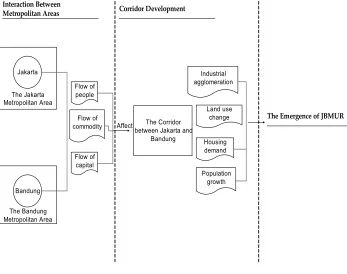
process of Jakarta and Bandung, the corridor areas between these two cities become important. If a megalopolis (or mega-urban regions) refers to continuous urbanized areas that connect metropolitan centers, and if there is an intensiied relationship between Bandung and Jakarta, the implications of that relationship to the corridor areas need to be explored. For this matter, a ield trip in Purwakarta District has been conducted. he analysis of this research applies especially to the period after the monetary crisis, which is 1997 until present. he conceptual model below (igure 1) will guide the steps in our study.
The Jakarta
he conceptual model also leads to the main research questions to be answered:
Is there any intensiied relationship between Jakarta and Bandung that can lead to the merging process of both metropolitan areas over the past ten years? If it is the case, in what sense the relationships can be measured?
the implications for the socio-spatial restructuration of the municipalities and districts located in the corridor area?
he JBMUR is a unique case, particularly in Southeast Asia. he mega-urban region can be diferentiated from other metropolitan areas such as Singapore and Kuala Lumpur in terms of population density. he JBMUR, particularly the Jakarta Metropolitan Area (JMA) has higher population density compared to both of them. Compared to Bangkok and Manila Metropolitan Areas, the JBMUR is slightly diferent in terms of cities primacy. In both Bangkok and Manila, the capital city of the country is the primate city of the metropolitan areas. As for the JBMUR, Jakarta may still be the main international gate to the global network; however, adjacent metropolitan area, the Bandung Metropolitan Area (BMA), has also inluences in the development of the JBMUR as a whole, as indicated by Firman & Dharmapatni [9] and Firman [8]. Furthermore, the country is in the early period of implementing the regional autonomy (since 2001). Fragmented administrative authorities will deinitely be a main challenge for the development of inter-regional areas, such as the JBMUR. his research aims to shed light on these issues by unravelling the socio-spatial restructuration happened in the corridor area between Jakarta and Bandung.
Secondary data collection, interviews with key informant oicials (and other related stakeholders), and a ield trip in Purwakarta District1
have been conducted; however, due to the data and time limitation, it should be admitted that not all of the plans outlined by the conceptual model can be answered and be explained. here are no precise data on the lows of commodities and capital (investments) between Jakarta and Bandung. herefore, this present study uses several approaches to explain the phenomena, i.e. by using interviews with key informant oicials and the structure of Gross Regional Domestic Products (GRDP) of both centers. Also, due to the data limitation, several igures (i.e. housing demand) related to the corridor development cannot be properly presented and will be accompanied by several interviews to complete the picture. Finally, this thesis tries as much as possible to collect the data for the last 10 years (1997-2007), however, due to the data limitation, not all of the data could be presented in that timeframe.
mainly on how such regions develop in Asian countries by outlining their diferences from Western countries. he third section will give an overview on the study area and reveal how Bandung and Jakarta inluence each other as well as the type of their interaction. In this section it will also be made clear that whether there is an intensiied relationship between these two cities or not. he ifth section will probe what the impacts of the Bandung-Jakarta relationship are on the corridor areas between them. A full report of the ield survey conducted in one of these areas, Purwakarta District, will be presented. From the result of these sections, it will be possible to test whether the “mega-urban region development” hypotheses presented in this study are real or not. he inal section, the conclusion, will discuss indings from other sections and answer the research questions posted before.
heoretical Framework
Major Cities Peri Urban Desakota
Densely Populated Rural Sparsely Populated Frontier Smaller Cities and Towns Communication Routes
Spatial coniguration of a hypothetical Asian urban
Figure 2
system (adapted from McGee, [23], p.6)
(1) the major cities; (2) the peri-urban regions, which are areas within a daily commuting reach of the city core; (3) the “desakota” regions; (4) densely populated rural regions, and (5) the sparsely populated frontier regions. All of these are clearly outlined in the igure 2.
Looking underneath the emergence of mega-urban regions, Douglass [6] pointed at two interwoven processes as the main causes. he irst one is “globalization”, deined in economic terms as “accumulation of the three major circuits of capital; production, commodity trade and inance; at the global scale” (p. 2316). his leads to the international division of labor marked by the shift of labor-intensive assembly operations to a select number of newly industrializing economies. Globalization of production, commerce and inance requires “a physical geography of cities, urban networks and transport and communication linkages to efect its expanding spatial reach” ([6], p. 2318). Hence, the second process, which involves urban agglomeration, also plays a role. Urban agglomerations in the MURs ofer perfect sites for the accumulation of those circuits of capital, e.g. manufacturing sectors [31]. he MURs, thus, are becoming “the sites of major tensions between the economics of globalization and local politics over the quality of the city for daily living” ([6], p. 2320). Consequently, many of the MURs are reported to dominate a large share of their national economies. MURs, along with the international development corridors and trans-border regions, are part of what can be called “a trans-nationalization of territorial space through an accelerated urban transition organized into extensive spatial networks that transcend the nation-state in all forms of economic interaction” ([6], p. 2321). hese forces of globalization and urban agglomeration are reinforced by international competition of metropolitan centers in several ields (cf. [10]).
movements of goods, people and information on a global network” (p. 155). It consists of:
Low-speed transportation to accommodate commercial transactions (i.e. shipping, trucks);
High-speed transportation to accommodate the movements of individuals and the transfer of complicated information that needs a face-to-face contact (i.e. cars, airplanes, trains);
Telecommunication networks for the transmission of uncomplicated oral and written information.
Although Rimmer [28] talked about global networks, a similar network could also be established between two or more major metropolitan centers in the megalopolitan areas. Intensiied relations between the major centers of two or more metropolitan areas can be measured in terms of people movements (commuting), commodities trading (i.e. freight volume), capital low (i.e. bank transfers) and information lows, for which Staple [33] proposed the use of Minutes of Telecommunication Traic (MiTT) to measure the low’s volume. Otherwise, Rimmer [29] also argued that the low of information can also be assumed to be embodied in goods or people movement. For the purpose of this study, we shall use the lows of people (approached by average daily low of vehicles between Jakarta and Bandung), capital (approached by domestic investment igures) and commodity (approached by GRDP structures of both centers).
he size and composition of the lows of commodities and capital lead to the second characteristic of MURs, which is their function as a hinge for the national economy in the global networks ([11], [13]). he corridor between two metropolitan areas is the best location to see how this economic function is performed. Industrial agglomeration, land use change and the increasing demand for residential areas will likely be spreading along the corridor. he corridor will likely also attract either domestic or foreign investments. In the end, the corridor, together with its adjacent metropolitan areas, is becoming one of the biggest contributors to the national economy as relected by their share in the Gross National Products (GNPs) or Gross Regional Domestic Products (GRDPs).
and technology because of the composition of their population and their dynamic character, which can also inluence other cities. On the other hand, as also noted by Douglass [7], MURs are currently facing the contradictory issues of environment sustainability and economic resilience. Mutually reinforcing linkages between these two important aspects should be established in order to maintain the sustainability of the MURs.
Bandung and Jakarta: Bridging the Two Centers
Bandung and Jakarta are connected by toll roads as well as artery roads; and as mentioned before in the irst section, in the year 2005 a new toll road was constructed, shortens time travel between two centers (from 3.5-4 hours to 2-2.5 hours). he toll road, namely Cipularang, gives a hint that perhaps there has already been increasing lows between two centers so that demands of a new toll road also arise. his research then will measure the low of vehicles between Jakarta and Bandung over the past ten years by using data collected from Jasa Marga (Indonesia Highway Corporation). he data set provides the number of the vehicles (cars, buses and trucks) that use the toll roads.
here are two toll roads that connect Jakarta-Bandung, which are: Jakarta-Cikampek and Purwakarta-Bandung-Cileunyi (Purbaleunyi). he irst one has been built since the year of 1988, connecting Jakarta to the sub-district Cikampek (Karawang District). he second one, Purbaleunyi, consists of two sections. he irst section, Padaleunyi toll road, is the toll road that connects two sub-districts under the jurisdiction of Bandung District; Padalarang and Cileunyi. he toll-road is by-passing the city of Bandung with several interchanges. he Padaleunyi (Padalarang-Cileunyi) toll road is built on the year of 1991. he second section, which is built on the year 2005, is the toll road that connects Cikampek to Purwakarta District until Padalarang (sub-district under the jurisdiction of Bandung District), thus it is named Cipularang (Cikampek-Purwakarta-Padalarang) toll road. he Cikampek toll road made the continuous toll-road access from Jakarta to Bandung complete (see igure 3 overleaf ). Before 2005, people would have to exit at Cikampek and then continue their journey through artery roads before entering the Padaleunyi toll road.
Bandung and Jakarta can be divided into two sections, as illustrated in igure 4 (overleaf ). here are also more alternatives for the journey after the construction of the Cipularang toll road in 2005. his present study calculates the growth of average daily low (ADF) between toll gates that correspond to the Bandung-Jakarta journey. he calculation is done on the basis of three points of observation: May 1998, March 2003 and April 2007. Based on the calculation, it is found that over the past ten years there has been a huge increase in the ADF in every pair of toll gates that correspond to the Bandung-Jakarta journey (see igure 52 overleaf )
over the past ten years. he growth averagely reaches more than 100%. It is also can be seen, particularly in toll gate pairs A and B that the ADF increase higher after 2003. Both pairs are the main gates for Bandung-Jakarta journey. Preliminary conclusion is perhaps people preferred to go through the main gates after the establishment of the Cipularang toll road.
In the ADF report from Jasa Marga, the types of vehicle can be divided into three. Type I are cars, small buses and pickups; type II are big buses and trucks with four pairs of wheels; type III are bigger trucks (more than four pairs of wheels). Despite the increase of ADF in all of these three types, type I dominate the ADF with more than 80%. his indicates that the traic low between Bandung and Jakarta is dominated by the individual purposes or matters that do not relate to the transportation of goods and commodities, which can only be handled by vehicles type II and III. It is becoming important, therefore, to know the motives of those travelers and to ensure whether they are really coming from Jakarta to Bandung, and vice versa, or not. A study on the identiication of the Cipularang toll road’s3 users by Umbou [35] revealed that most of the
Jakarta-Bandung Mega-Urban Region (
Figure 3 Inset Map Source: htp://
en.wikipedia.org/wiki/ File:IndonesiaWestJava.png (assessed July 25, 2009))
(Left) Illustration of Jakarta-Bandung, and vice versa, journey
Figure 4
(Right) The growth of average daily low (ADF) at toll gates that
Figure 5
correspond to the Jakarta- Bandung (up) and vice versa (below) journey ([19], [20], [21])
there is an average of 3.3 million people who made annual trips between the two cities. hese people used airplanes, trains, private cars or buses. From those means of transportation, the proportion of the people who traveled for the purpose of business or working were 71.3%, 43.9%, 60% and 31.7% respectively. Business tends to correlate strongly with investments. Indeed, at least for the last 6 years, investments in Bandung have been growing tremendously, especially in the investment sectors that correspond with services and tourism, which is the tertiary sector4. his
can be seen from two tables below (table 1 and 2) that explain the growth of domestic investments1 for the last 10 years as well as of non- facility investments for the last 6 years in Bandung.
Domestic investments in Bandung (in million Rupiahs)
Table 1
Sectors 1997 1998 2000 2003 2004 2005 2006 2007
Primary - - -
-Secondary 37,829 191,706 6,489 24,213 10,553 52,693 19,202 10,500
Tertiary 108,319 32,876 21,764 20,308 1,133,200 - 7,611
-Total 146,148 224,582 28,253 44,521 1,143,753 52,693 26,813 10,500
Source: [16], [1]
Non-facility investments in Bandung (in million Rupiahs)
Table 2
Sectors 2002 2003 2004 2005 2006 2007
Primary n.a. n.a. 765 - -
-Secondary n.a. n.a. 114,846 193,715 488,471 316,950
Tertiary n.a. n.a. 1,566,282 3,225,415 3,441,860 4,857,593
Total 538,963 808,002 1,681,892 3,419,130 3,930,331 5,174,543
Source: [16], [1]
Since either the Indonesian Investment Coordinating Board (BKPM) or the Bandung Investment Coordinating Board (BPMMPT) did not record the origin of the investments, our study conducted interviews with the BPMPPT’s oicials and the head of KADIN (Indonesia Chamber of Commerce and Industry) Bandung. From these interviews it was revealed that among six economic categories under the tertiary sector of investment, the tourism and the oices sectors were the two top contributors for the yearly investment in Bandung. he activities classiied under the oices sector is including building new branch or headquarter company oices in Bandung. he investment comes from municipalities/regencies nearby
Bandung, i.e.: Bandung District, Purwakarta and Jakarta. he tourism sub-sector is including building hotels, shopping facilities, and attraction places. From these investments, according to the head of KADIN Bandung, the majority came from Jakarta with a proportion averagely around 60-70% for the last 10 years. For these investments, he referred to the newly-built and on-going constructions of 26 hotels in Bandung. All of them built by investors who came from Jakarta. Especially for the last 5 years, since Bandung is oicially designated as a tourist destination city and after the establishment of the Cipularang toll road, investments in services and tourism have been increasing more quickly than before. here are several reasons why Jakarta investors dominate investments in the tourism (and services) sub-sectors. he irst reason is because of decreasing distance. Since Jakarta and Bandung are neighboring metropolitan cities and Bandung is now easily accessible, it becomes easier for the investors to see the locations and opportunities, to decide whether to invest or not. he second reason is due to technical aspects. Investors from Jakarta are considered easier to deal with administration procedures such as applying for permits to the BKPM, which is located in Jakarta. Moreover, Jakarta entrepreneurs/investors are considered to perform better than other investors in Indonesia.
of the Bandung GRDP. he prominence of the tourism is becoming clearer when we look at the income generated by taxes from hotels, restaurants, entertainments as well as regional tourism retributions. From the year of 2001 until 2007, income from those sources has been increasing 130.4%, 136.54% and 72.11 % respectively ([2], [3], [4]).
In the context of the Bandung-Jakarta relationships, it becomes important to know more about the origin of these tourists. Where are they coming from? Are domestic tourists coming mainly from Jakarta? Soewondo [33] conducted a survey of 150 people who stayed overnight on several hotels in Bandung during long and short weekends and on weekdays. She came up with the result that around 81.3% respondents were coming from Jakarta. Another inding comes from the Bandung Tourism Oice. In 2007 it conducted a study called he Proiles of Bandung Tourists 2007. he study aimed at gaining a macro picture regarding geographical distribution, psychographic and behavioral characteristics of Bandung tourists. he study was conducted on the 12 places of interests all around Bandung and one of its results came up with similar indings as Soewondo [33], the largest domestic tourist group (45.3%) came from Jakarta. In both studies, tourists who came to Bandung also preferred to use private cars through the toll road5 rather than other means of transportation. he growth of either commuting or staying overnight tourists increased especially after the establishment of the Cipularang toll toad. It can also be observed by the growth of the shuttle service companies that serve the journey between Jakarta and Bandung. Until the year 2004-2005 the companies still numbered not more than ive. Today, they are everywhere around Bandung or Jakarta. hese companies use mini-buses with a capacity of 7-10 people. hey make use of the Cipularang toll road and provide door-to-door services for the people either on weekends or weekdays. Some of them even depart for every half-hour and ofer more than ive diferent routes between Bandung and Jakarta, relecting the high traic low between these two cities.
cement, timber, concrete iron, luxury goods, cars, etc) from other parts of Indonesia and abroad. Jakarta is the only center that can ofer the necessary outlets to foreign markets (harbor, airport, trade houses, and banks) or the necessary import channels. hus, the increasing average daily low of big vehicles (such as trucks, containers, etc) indicates the presence of the intensiied trade relationships between Bandung and Jakarta. Materials have been transported from Jakarta to Bandung, and in return, products have been transported back to Jakarta for either the domestic needs or foreign needs. his phenomenon can also be seen from the GRDP growth and structure of both cities (See Appendix 3). During the past 10 years, the top 3 sectors in Jakarta have been (1) Finance, Ownership and Business Services, (2) Trade, Hotels and Restaurants, and (3) Manufacturing Industry. In Bandung, the top 3 sectors have been (1) Trade, Hotels and Restaurants, (2) Manufacturing Industry, and (3) Transport and Communication (which replaced Finance, Ownership and Business Services). he prominence of Manufacturing Industry as well as Trade, Hotels and Restaurants in both Bandung and Jakarta seems could never have been achieved without increasing interaction between the two major economic centers. Moreover, the availability of many business facilities and services in Jakarta has been increasing the need to travel between from Bandung to Jakarta, which is relected by the growth in Transport & Communication sector in Bandung.
he increasing low of tourists from Jakarta to Bandung and the presence of trade relationship between the two cities explain, partly, the growth of the average daily low at the gates that correspond to the Bandung-Jakarta journey (see igure 5). Altogether with the indings on the origin of the bulk part of investments in Bandung, they prove that indeed there obviously is an intensiied relationship between Bandung and Jakarta over the last 10 years. In the context of the emergence of a new mega-urban region, issues on how this intensiied relationship afects the corridor area between both of them need to be further clariied. he next two sections will be devoted to this task.
Economic and Social Developments in the JBMUR
1.17% in the period of 1995-20066. Concentration of people in the
mega-urban regions, as argued by Gottmann [12], is also apparent in the JBMUR. In 2006, 10.15% of the national population lived in the region, which has a size of only 0.38% of the country’s size. Most of this population lives in the urbanized areas and the proportion has been increasing from 74.67% to 81.61%, grew more than 15%, for the period of 1990-20057.
he Gross Regional Domestic Product (GRDP) igures of the JBMUR also reveal the increasing prominent role of the region. he GRDP growth of each sub-region of the JBMUR, most of the time, has been outnumbering either West Java Province or the national igures during the last ten year period8, with the exception of the year 1998, when
Indonesia was severely hit by the economic crisis. Besides surpassing the national per capita igures, the GRDP of the JBMUR also constantly contributes more than 20% of the total GDP of Indonesia during the past ten years. he contribution of the JBMUR reached its highest level in 2006 and 2003 with 23.31%, while the contributions for other years were also notably high: 22.67% (1997), 21.35% (1998), 21.31% (1999), 23.13% (2004), and 23.21% (2005)9. Given that there are more
than 400 municipalities/regencies in Indonesia, and that JBMUR only comprises of 2 municipalities, 4 regencies and 1 special region/province, this fact relects that the JBMUR has indeed been acting as a hinge for the national economy over the past ten years.
For the past ten years, JBMUR has also been the main destination of both foreign and domestic investments. In 1997 the region attracted 57.72 % and 46.31% of respectively the foreign and domestic investments in Indonesia. he share of foreign investments increased for the year 2002 to 61.83% and decreased to 55.71% for the year of 2007; albeit this still represented the bulk of the national foreign investments. he share for domestic investments decreased for the year 2002 to 30.99% but it increased again to 43.66% in 2007 [16].
most desired investment destinations in this year. Foreign investment igures indeed decreased for the years 2002 and 2007, however they still contributed a big part of the national foreign investments, where Bekasi District, Purwakarta District and Bandung District ranked as the top-three among the other corridor areas.
According to the BKPM most of either foreign or domestic investments in the corridor areas are in the secondary sector, such as: textile industry in Bandung District and Purwakarta District; metal goods, engine and electronic industry in Karawang District and Bekasi District. However, this is not the case for both city centers, Jakarta and Bandung, where tertiary sectors such as Hotels and Restaurants, Transport, Storage and Communication, Trade and Reparation are dominating the types of investments. his phenomenon becomes even clearer when we take a look at the growth igures of the large and medium size industries in the JBMUR10. Most sub-regions of JBMUR experienced an increase
in the number of large and medium size industries, with the exception of Bandung and Jakarta, as well as Bandung District. he growths are: 14.58%, 70.21%, 16.28%, 25% respectively for Purwakarta District, Karawang district, Bekasi District and Bekasi Municipality. Due to a strong decrease in Jakarta and Bandung (11.56 % and 15.7 % respectively), the number of large and medium industries in JBMUR as a whole declined with 8.88% from 1996 to 2006. However, the decrease manifested itself also in West Java Province.. Moreover, in proportion to the national igure, JBMUR contributed more than 20% of the number or enterprises in the year 2002 and 2005. his fact shows, again, that the corridor areas outside Bandung and Jakarta, are facing a process of massive industrial growth. he presence of 58 industrial estates11, out of 225 in Indonesia,
in the JBMUR [15] also supports the conclusion.
and industrial areas in the JBMUR have clearly inluenced the land use patterns in the region. he growth of industrial and settlement areas have been increasing 20.33% and 22.19% respectively from 1994 to 2005 (West Java Bapeda, 2008). Settlement areas were mushrooming especially in Bekasi Municipality, Bandung Municipality and Bekasi District for the last ten years, while industrial areas are mostly located in Bekasi District and Karawang District12.
he Impacts of the Relationships between Bandung and
Jakarta on Purwakarta
A ield trip in Purwakarta District has been conducted to explore the relationships between the emergence of JBMUR and the development of a Bandung-Jakarta corridor area. he reason for choosing Purwakarta is because it is located exactly on the intersection between the Cikampek and Cipularang toll roads (see igure 3 & 4 in section 3). Since the reason for building Cipularang toll was to accommodate the increasing low of vehicles from Bandung to Jakarta, Purwakarta might be the best location to study the impact of the increasing relationships between the two cities. Moreover, Purwakarta is not so close to Jakarta in comparison with either Karawang or Bekasi. hus, the efects of Bandung and Jakarta might be more balanced in this district. Another reason is because developments in Purwakarta resemble those which McGee (1991) has called “desakotasi”. It is a place where the dominant type of land use still is rural or agricultural. However, recent development has shown that urban- industrial types of land use are increasing in a high pace. herefore, agricultural and non-agricultural types of land use now are being mixed intensely and sometimes even may conlict.
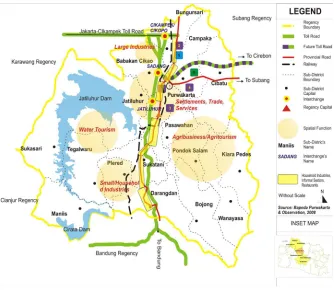
Looking at the spatial-functional division in Purwakarta (igure
137.44 to 787.73 ha in the period of 1985-2000 (National Land Agency Purwakarta Oice 2008). During 1996-2005, the number of large and medium size industries in Purwakarta has been increasing almost 15 % (see Appendix 4). According to our interviews with the Executive Director of the Indonesian Industrial Estate Association (HKII), the head of Indonesian Entrepreneurs Association (APINDO) Purwakarta Oice and the Estate General Manager of Bukit Indah Industrial Estate (KIBIC)13 indeed the proximity to Jakarta and the presence of the Cikampek-Jakarta toll road which have been the main reasons for many industrial entrepreneurs to locate their factories in the corridor area. heir preferences for Purwakarta in particular are based on its comparative advantages, such as: cheaper labor and land than Bekasi or Karawang, a better environment and the presence of the container train station. One clear example is the newly established garment factory Eins Trends (see igure 6, box number 6).he construction of the Cipularang toll road yet makes it easier for entrepreneurs and industrial workers to live in Jakarta or Bandung and commute daily. his factor, however, does not seem to be decisive in establishing new factories. Hence, the relationship between Bandung and Jakarta has only played a minor role in the industrial development in Purwakarta.
Clear cases of the impact of the growing relationship between Bandung and Jakarta on Purwakarta, however, can be clearly seen in the growth of housing or settlement areas and other infrastructural facilities established mainly after the presence of the Cipularang toll road. Our study found that recently four settlement areas have been built and two of them currently are on sale already. he two housing estates, Kota Permata and Bumi Inti Persada, are located along the provincial road (number 1 and 2 in igure 6) and have a size of 30 ha and 20 ha respectively. Interviews have been conducted with both of the estate managements. Bumi Inti Persada received its location permits in April 2007 and already started to sell their units by the end of 2007. By the time of the interview (November 2008), 80% of total 1,674 units had been sold out.
buying houses there are varying from their strategic location, cheap prices compared to Bandung and Jakarta or investment purposes. Two other settlement areas, named Pesona Purwakarta and Sadang District, were located nearby the Sadang interchange and city center (boxes number 3 and 4 in igure 6).
Land use around major axis in Purwakarta
Figure 6
Albeit they have not built any units yet (because of a few permit problems), there are some interesting features in their proile. According to the Head of the Infrastructures and Physical Planning Section of Purwakarta Planning Agency (Bapeda), the planned prices of their units are higher than the ones normally ofered to Purwakarta residents14.
phenomenon is getting more pronounced since the establishment of the Cipularang toll road. Based on ield observations in the early morning there are many people standing along the provincial road, waiting for the buses. hese people are workers who commute daily to either Jakarta or Bandung. Most of the buses go to Jakarta via the Cikampek gate, serving almost the entire provincial road between the southern part and the northern part of Purwakarta (see igure 6).
Another supportive fact about the impacts of the Bandung-Jakarta relationships on Purwakarta is the establishment of a private type B hospital, named hamrin hospital, beside the provincial road (box number 5 in igure 6) in 2008. Type B hospitals, in Indonesia, serve inter-regional residents. As for this case, according to an oicial of Bapeda Purwakarta, the hospital is aiming to serve also expatriates who work for factories in Purwakarta as well as commuters from Jakarta and Bandung. Considering that none of such hospitals were present in Purwakarta before, it is clear that the establishment of the type B hospital also took into account the presence of the Cipularang toll road. Another evidence for this is supplied by the fact that the Purwakarta government, by implementing a spatial division of functions (in igure 6), also established a water recreation area near the Jatiluhur dam in 2004, named “Water World”. he recreation area with a size of 1.6 hectares indicates that even the local government anticipated the increasing traic low between Bandung and Jakarta, which it seeked to tap to develop its tourism sector. his eventually became true, for nowadays many tourists from the big cities come to the recreation area by using the Cipularang toll road.
Conclusions
here are two geographical phenomena occurred in the Jakarta-Bandung Mega-Urban Region (JBMUR). First, the growth of the average daily low at the toll gates that correspond to the Bandung-Jakarta journey (1)16, caused by the increasing low of tourists from Jakarta to Bandung and the presence of trade relationship between the two cities, and the origin of the bulk part of investments in Bandung (2) prove that indeed there obviously is an intensiied relationship between Bandung and Jakarta over the last ten years. his has led to the establishment of the Cipularang toll road (3), which in turn encourages as the lows of more people, goods and investments (4). Secondly, on the same period, it can also be seen that there has indeed been a rapid urbanization process occurring along the corridor between Jakarta and Bandung. he growth of the population, the growth of region’s GRDP and the expansion of urbanized areas in the region conirm this. he JBMUR also played a role as the hinge for the national economy, as argued by Gottmann ([11], [13]) and Douglass [6], given its constant huge contribution to the GRDP of Indonesia. Moreover, there was also a rapid growth of industrial and settlement areas along the corridor during the past ten years.
afected the establishment of informal sector activities, restaurants, and household industries in Purwakarta (6). All these processes are displayed in the schematic diagram overleaf (igure 7). he numbers refer to each of the corresponding processes described in the irst two paragraphs of this conclusion section.
Schematic diagram of relationships between Bandung, Jakarta and
Figure 7
Purwakarta
Acknowledge
he author would like to thank dr. Milan Titus and dr. Bart Wissink for their valuable comments and inputs in the previous draft of.
Administratively, Indonesia is divided into ive tiers with diferent authorities and jurisdiction areas: national level, provincial level, kabupaten (district) or kota (municipality) level, kecamatan (sub-district) and desa (village) level. Kabupaten and Kota are on the same level; however, kabupaten is used to refer to the bigger and less-urbanized areas (regions). he regional autonomy enables the national government to give more authorities to the districts and municipalities, compared to provinces, sub-districts and villages, so that these administrative tiers now are able to carry on their own afairs.
Reasons for choosing Purwakarta will be outlined in the ifth chapter of this paper.
In igure 5, letter A-F represent toll gate pair; for example, A represents Cipularang/Cikampek and Pondok Gede Timur toll gates, B represents Pasteur and Padalarang/Padalarang Barat (please refer to Appendix 1 for detail explanations).
In his study, Umbou (2006) uses the term “Cipularang toll road’s users” to refer to the travelers that used the toll road access continuously between Jakarta and Bandung; and it is not limited only to the Cipularang toll road.
A complete list the composition of the economic sectors in each of investments sector (primary, secondary tertiary) is outlined in the Appendix 2.
here are 3 categories of investments in Indonesia: foreign investments, domestic investments and non-facility investments. Foreign investments come from abroad, while domestic investments come from local parties. Both of them gain beneits from facilities provided by the government, such as cheaper import taxes, etc. In the other hand, non-facility investments are the investments that come from local parties, just as the domestic investments, but, without facilities provided by the government. All of these three categories, however, can either come from the public sector or the private sector.
86-90% of the respondents on Soewondo (2006) and 68.4% of the respondents on Bandung Tourism Oice (2007)
idtabel,111/Itemid,165/)
Sources: National Bureau of Statistics/BPS (1990, 1995, 2000, 2005), West Java Bureau of Statistics (1990, 1995, 2000, 2005)
See Appendix 4.
Sources: various statistics published by BPS and IMF Report on Indonesia; retrieved February 12, 2009 from: http://www.imf.org/ external/pubs/ft/weo/2006/01/data/dbcoutm.cfm?SD=1996&ED=200 6&R1=1&R2=1&CS=3&SS=2&OS=C&DD=0&OUT=1&C=536&S =NGDP_RPCH-NGDP_R-NGDP-NGDPD-NGDP_D-NGDPRPC- NGDPPC-NGDPDPC-PPPWGT-PPPSH-PPPEX-PPPPC-PCPIPCH-PCPI-BCA_NGDPD-BCA&CMP=0&x=89&y=12
See Appendix 5
Industrial estate is a location set aside for industrial development, where third parties provide industrial infrastructures and facilities.
See Appendix 6 for maps of settlements and industrial areas change in the JBMUR.
KIBIC is an industrial estate located in the northern part of Purwakarta, nearby the Cikampek/Cikopo interchange
his is, however, in line with the new policy issued by the Purwakarta Regent. he regent, by the beginning of 2009, started to limit the housing developments for low and middle income groups, because these were already abundant. he regent now is encouraging the developments of middle and upper income groups houses in Purwakarta (Tempo
Interaktif; retrieved February 20, 2009 from: http://www.tempointeraktif.
com/hg/nusa/2009/01/20/brk,20090120-156162,id.html)
Example of household industries: ceramic; examples of restaurants are the ones who sell Purwakarta traditional foods.
References
Bandung Investment Coordinating Board (BPMPPT), Foreign, Domestic and Non-Foreign/Domestic Investments in Bandung 2002-2008, BPMPPT, Bandung, 2008.
Bandung Regional Income Oice, Target and Realization of Income from Regional Taxes 2001, Bandung Regional Income Oice, Bandung, 2001.
Bandung Regional Income Oice, Target and Realization of Income from Regional Taxes 2001, Bandung Regional Income Oice, Bandung, 2007.
Bandung Tourism Oice, Recapitulation: Tourism Tax and Retribution Contribution to the Bandung Regional Income (Realization) 2002-2007, Bandung Tourism Oice, Bandung, 2008.
Bandung Tourism Oice, he Proiles of Bandung Tourists 2007, Bandung Tourism Oice, Bandung, 2007.
Douglass, M., Mega-urban regions and world city formation: globalisation, the economic crisis and urban policy issues in Paciic Asia, Urban Studies, vol. 37, no. 12, pp. 2315-2335, 2000.
Douglass, M., Globalization, inter-city competition and the rise of civil society: toward livable cities in Paciic Asia, Critical relections on cities in Southeast Asia, eds. Bunnell, T., Drummond, L.B.W & Cho, K.C., Times Academic Press, Singapore, pp. , 2002
Firman, T., he continuity and change in mega-urbanization in Indonesia: a survey of Jakarta-Bandung Region (JBR) development, Habitat International, 33, pp. 327-339, 2009.
Friedmann, J., World city futures: the role of urban and regional policies in the Asia Paciic region, Regional change in industrializing Asia, ed. van Grunsven, L., Ashgate Publishing Ltd., Aldershot, pp. , 1998.
Gottmann, J., he opening of oyster shell, Since megalopolis: the urban writings of Jean Gottmann, eds. Gottmann, J. & Harper, R.A., he John Hopkins University Press, Baltimore, pp. , 1990a. Gottmann, J., How large cities can grow?, Since megalopolis: the urban writings of Jean Gottmann, eds. Gottmann, J. & Harper, R.A., he John Hopkins University Press, Baltimore, pp. , 1990b.
Gottmann, J., Megalopolitan system around the world, Since megalopolis: the urban writings of Jean Gottmann, eds. Gottmann, J. & Harper, R.A., he John Hopkins University Press, Baltimore, pp. , 1990c.
Hidayati, A. & Kuncoro, M., Konsentrasi geograis industri manufaktur di greater jakarta dan bandung periode 1980-2000: menuju satu daerah aglomerasi? (Geographical Concentration of Manufacturing Industry in the Greater Jakarta-Bandung 1980-2000: On the Way to the Agglomeration?), Empirika, vol. 17, no. 2, 2004, http://www.scribd. com/doc/13698835/Journal-Amini-Aglomerasi (23 July 2009).
Indonesia Industrial Estate Association (HKII), Indonesia Industrial Estate Directory 2006, HKII, Jakarta, 2006.
Indonesia Investment Coordinating Board (BKPM), Realization of Foreign and Domestic Investment Based on Location, BKPM, Jakarta, 2008.
Jakarta Bureau of Statistics, Jakarta in Figures, Jakarta BPS, Jakarta, 2007.
Jakarta Bureau of Statistics, Jakarta in Figures, Jakarta BPS, Jakarta, 1998.
Jasa Marga, Traic Volume Data, Jasa Marga, Jakarta, 2007.
Jasa Marga, Traic Volume Data, Jasa Marga, Jakarta, 2003.
LPPM-ITB (Citizen Empowerment Research Institute of Bandung Institute Technology) and Balitbangda Jawa Barat (the West Java Regional Development and Research Agency), Penelitian Dampak Pembangunan Jalan Tol Purbaleunyi di Jawa Barat (Study on Impacts of the Construction of Purbaleunyi Toll Road in West Java), LPPM ITB & Balitbangda Jawa Barat, Bandung, 2007.
Manaf, M., he Impact of Jakarta Bandung Mega Urban Development on he Performance of Jakarta Bandung Highway, Master hesis, Bandung Institute of Technology, Bandung, 1998.
McGee, T.G., he emergence of desakota regions in Asia: expanding a hypothesis, he extended metropolis: settlemet transition in Asia, eds. Ginsburg, Koppel & McGee, University of Hawaii Press, Honolulu, pp. , 1991
McGee, T.G., Metroitting the emerging mega urban regions of Asean: an overview, he Mega Urban Regions of Southeast Asia, eds. McGee, T.G. & Robinson, I.M., UBC Press, Vancouver, pp. , 1995.
National Bureau of Statistics (BPS), National Intercensal Population Survey (SUPAS), BPS, Jakarta, 2005.
National Bureau of Statistics (BPS), National Population Census (SP), BPS, Jakarta, 2000.
National Bureau of Statistics (BPS), National Intercensal Population Survey (SUPAS), BPS, Jakarta.National Bureau of Statistics (BPS) 1990, National Population Census (SP), BPS, Jakarta, 1995.
Rimmer, P. J., Moving Goods, People and Information, he Mega Urban Regions of Southeast Asia, eds. McGee, T.G. & Robinson, I.M., UBC Press, Vancouver, pp. , 1995.
Rosmiyati, R., Perilaku Perjalanan Bisnis Dinas Antar Kota Jakarta dan Bandung (he Behaviour of Business Traveler between Jakarta and Bandung), Undergraduate hesis, Bandung Institute of Technology, Bandung, 1990.
Scott, A.J. et.al, Global city-regions, Global city-regions: trends, theory, policy, ed. Scott, A.J., Oxford University Press, New York, pp. , 2001.
Soewondo, P., Dampak beroperasinya tol Cipularang terhadap pola kunjungan wisatawan ke Kota Bandung (he Implications of the Cipularang Toll Road to the Tourism in Bandung), Undergraduate hesis, Bandung Institute of Technology, Bandung, 2006.
Staple, G. C., he new demands for telecoms traic data: From MiTT to maps, Telecommunication Policy, vol. 20, no. 8, pp. 623-631, 1996.
Umbou. L. M. I, Identiikasi Perjalanan Pengguna Tol Cipularang (Journey Identiication of Cipularang Toll Road’s Users), Master hesis, Bandung Institute of Technology, Bandung, 2006.
West Java Bureau of Statistics, GRDP Districts/Municipalities in West Java 2004-2006, West Java BPS, Bandung, 2006a.
West Java Bureau of Statistic, Regional Socio Economic Survey (Suseda), West Java BPS, Bandung, 2006b.
West Java Bureau of Statistics, West Java Intercensal Population Survey (SUPAS), West Java BPS, Bandung, 2005.
West Java Bureau of Statistics, West Java in Figures 2002, West Java BPS, Bandung, 2002.
West Java Bureau of Statistics, West Java Population Census (SP), West Java BPS, Bandung, 2000.
1996-1999, West Java BPS, Bandung, 1999.
West Java Bureau of Statistics, West Java Intercensal Population Survey (SUPAS),
West Java BPS, Bandung, 1995.
West Java Bureau of Statistics, West Java Population Census (SP), West Java BPS, Bandung, 1990.
![Figure 2 Spatial coniguration of a hypothetical Asian urban system (adapted from McGee, [23], p.6)](https://thumb-ap.123doks.com/thumbv2/123dok/509759.57792/23.454.60.405.56.283/figure-spatial-coniguration-hypothetical-asian-urban-adapted-mcgee.webp)