“
“
STRENGTHENING FOOD AND FEED SECURITY
AND ENERGY SUSTAINABILITY
TO ENHANCE COMPETITIVENESS
STRENGTHENING FOOD AND FEED SECURITY
AND ENERGY SUSTAINABILITY
TO ENHANCE COMPETITIVENESS
PROCEEDING
PROCEEDING
PROCEEDING
OF ISAE INTERNATIONAL SEMINAR
OF ISAE INTERNATIONAL SEMINAR
OF ISAE INTERNATIONAL SEMINAR
BANDAR LAMPUNG, AUGUST 10-12, 2017
BANDAR LAMPUNG, AUGUST 10-12, 2017
BANDAR LAMPUNG, AUGUST 10-12, 2017
i
PROCEEDING
OF ISAE INTERNATIONAL SEMINAR
BANDAR LAMPUNG
AUGUST 10-12, 2017
“Strengthening Food and Feed
Security and Energy Sustainability to
Enhance Competitiveness”
DEPARTEMENT OF AGRICULTURAL ENGINEERING
FACULTY OF AGRICULTURE
iii
PROCEEDING
OF ISAE INTERNATIONAL SEMINAR
BANDAR LAMPUNG
AUGUST 10-12, 2017
“Strengthening Food and Feed
Security and Energy Sustainability to
Enhance Competitiveness”
EDITORIAL TEAM :
Dr. Ir. Agus Haryanto, M.P.
Dr. Ir. Sugeng Triyono, M.Sc
Sri Waluyo, S.T.P., M.Si., Ph.D.
Dr. Ir. Sandi Asmara, M.Si
Dr. Diding Suhandy, S.T.P, M.Agr.
Dr. Mareli Telaumbanua, S.T.P., M.Sc.
Cicih Sugianti, S.T.P., M.Si.
Winda Rahmawati, S.T.P., M.Sc.
iv
PROCEEDING OF ISAE INTERNATIONAL SEMINAR
BANDAR LAMPUNG, AUGUST 10-12, 2017
“Strengthening Food and Feed Security and Energy Sustainability to Enhance
Competitiveness”
ISBN
: 978-602-72006-2-3
Published by
: Departement of Agricultural Engineering, Faculty of Agriculture,
University of Lampung
Address
:
Prof. Dr. Ir. Sumantri Brojonegoro street, No. 1, Gedong Meneng, Rajabasa,
Bandar Lampung, Lampung, Indonesia 35141
:
[email protected]
Published date
: February 2018
This work is subject to copyright. All rights are reserved by the Publisher, wether the whole or part of
the material is concerned, specifically he rights of translation, reprinting, reuse of ilustrations, recitation,
broadcasting, reproduction on microfilms or in any other physical way, and transmission or information
storage and retrieval, electronic adaptation, computer software, or by similar or dissimilar methodology
now known or hereafter developed.
The use of general descriptive names, registered names, trademarks, service marks, etc. In this
publication does not imply, even in the absence of a specific statement, that such names are exempt from
the relevant protective laws and regulations and therefore free for general use.
Proceeding of ISAE International Seminar, Bandar Lampung, August 10-12, 2017
xvi
D.5 RESPONSE OF SEVERAL SOYBEAN VARIETIES ON ACID DRY LAND IN GUNUNG GEULIS
BOGOR
Junaedi Prasetiyo, Prihanti Kamukten, Reza Y Purwoko, M. Muchlish Adie
357
D.6 NITROGEN, PHOSPHOR AND CALCIUM UPTAKE ON PADJADJARAN CORN HYBRID AS
FEED FORAGE INTERCROPPED WITH SOY BEAN
Nyimas Popi Indriani, Yuyun Yuwariah, Sudarjat, Dedi Ruswandi, Anne Nuraini, Hepi Hapsari, Muhamad Kadapi
361
D.7 THE SELECTION OF LOCAL GENETIC SOURCE RICE POPULATION DIFFERENTIATED BY
THEIR GENETIC MARKERS IN LOWLAND AND UPLAND ORGANIC ENVIRONMENT Saiful Hikam, Paul B. Timotiwu, Denny Sudrajat
365
D.8 COMPOSTING OF RICE STRAW
Sumiyati, I Wayan Tika, Yohanes Setiyo, I Putu Gede Budisanjaya
373
D.9 QUALITY OF POTATO SEEDS FROM SOME MODELS OF CULTIVATION AFTER STORAGE
Yohanes Setiyo, Dewa Gde mayun Permana, IGA lani Triani, IBP Gunadnya
377
D.10 PRELIMINARY RESEARCH ON THE EFFICACY OF BIOLOGICAL AGENTS INDUCING
RESISTANCE IN MAIZE PLANTS TO CONTROL DOWNY MILDEW AND LEAF BLIGHT Cipta Ginting, Joko Prasetyo, Tri Maryono, Mila Safitri, Ika Ayuningsih
383
D.11 STRUCTURE, BEHAVIOR, AND PERFORMANCE OF RUBBER MARKETING IN SINTANG
DISTRICT ON WEST KALIMANTAN
Dhanang Eka Putra, Slamet Hartono, Masyhuri, Lestari Rahayu Waluyati
389
D.12 A STUDY OF VIGOR OF STORABILITY OF SEEDS OF SOME SORGHUM (Sorghum bicolor L. Moench.) GENOTYPES WITH ACCELERATED AGEING
Eko Pramono, Muhammad Kamal, F. X. Susilo, Paul B. Timotiwu
399
D.13 CHEMICAL AND PHYSICAL PROPERTIES OF CASSAVA STARCH CM-CHITOSAN-ACRYLIC
ACID HYDROGEL PREPARED FROM RADIATION-INDUCED CROSSLINKING Gatot Trimulyadi Rekso
405
D.14 APPLICATION OF ONE CYCLE RED-BLUE ARTIFICIAL LIGHT IMPROVED THE PRODUCTIVITY OF CHRYSANTHEMUM
I Made Anom Sutrisna Wijaya, Ni Wayan Anik Wahyuni, I Made Nada
411
D.15 ENDOPHYTE FUNGAL EXPLORATION FROM GRAMINAE ROOT WITH PLANT GROWTH
PROMOTER POTENTIAL
Mamat Kandar, I. Nyoman P. Aryantha, Sony Suhandono
419
D.16 ACTIVITY OF SOIL MICROORGANISMS DURING THE GROWTH OF SWEET CORN (Zea
mays saccharata Sturt) IN SECOND PLANTING TIME WITH THE APPLICATION OF COMBINATION ORGANONITROFOS, INORGANIC FERTILIZERS, AND BIOCHAR Nyang Vania Ayuningtyas Harini, Dermiyati, Agus Karyanto, Ainin Niswati
425
D.17 THE SHIFTING OF WEED COMPOSITION AT SOME PLANT SPACING SETTINGS AND THE
PROPORTION OF INORGANIC NITROGEN AND COMPOST NITROGEN OF WHEAT CROP Yosefina Mangera
433
D.18 THE EFFECT OF RATION BASED OF THE FERMENTED PALM OIL BY PRODUCT AND
ZN-LYSINATE ON THE PERFORMANCE AND DIGESTIBILITY GOAT
Muhtarudin, K. Adhianto, A. Haryanto, Liman, S. Tantalo. A. Ramadhani, M. T. Aldhi
441
D.19 CORN CROP WASTE PRODUCT ABSORPTION of N, P, and Ca at VARIOUS ALTITUDES IN THE WEST JAVA
Ana Rochana, Nyimas Popi Indriani, Rachmat Wiradimadja, Budi Ayuningsih, Dedi Rahmat, Tidi Dhalika, Heryawan Kemal Mustafa, Iin Susilawati
Proceeding of ISAE International Seminar, Bandar Lampung, August 10-12, 2017
399
D.12
A STUDY OF VIGOR OF STORABILITY OF SEEDS OF SOME SORGHUM
(
Sorghum bicolor
L. Moench.) GENOTYPES WITH ACCELERATED AGEING
Eko Pramono
1, Muhammad Kamal
1, F. X. Susilo
2, Paul B. Timotiwu
11Department of Agronomy and Horticulture, College of Agriculture University of Lampung, Indonesia 2Department of Plant Protection, College of Agriculture University of Lampung, Indonesia
E-mail: [email protected]
ABSTRACT
An experiments evaluating vigor of storability of seeds of several genotypes of sorghum were conducted
during March - October 2015. The sorghum seeds harvested from the planting area in Village of
Marhaen, Sub district of Sulusuban, District of Central Lampung, Lampung Province, Indonesia were
used in this experiment. The accelerated ageing method with temperature of 40
OC and relative humidity
of 100% for 0 (control), 2, 4, …, 16 days we
re used to make seed ageing took place fast. After each
treatment applied, viability of sorghum seeds were evaluated to measure percentage of normal seedling
(PNS), germination speed (GS), seed leakage (SL), and percentage of dead seeds (PDS). Grouping
genotype based on vigor of storability was conducted using cluster analysis with similarity of 70% by
variable of PNS. Result showed that the 34 genotypes can be grouped into four groups of vigor of
storability, namely high vigor (9 genotypes), medium-high vigor (7 genotypes), medium-low vigor (9
genotypes), and low vigor (9 genotypes).
Keywords: accelerated ageing, sorghum seed, vigor of storability.
I. INTRODUCTION
Sorghum (Sorghum bicolor [L.] Moench.) is one of the species of the open-seeded plant class (Spermatophyta, Angiospermae), single-seeded cotyledone (Monocotiledonae), order of Poales, family of graminae (poaceae), genus of Shorghum (Iriany and Makkulawu, 2013) which has potential to be developed in Indonesia. The potential of the sorghum includes a) it is annual crops of C4 metabolism plant; b) it can produce grain 2.8-3.0 tones/ha (Pabendon et al., 2013) with good nutrition (71% carbohydrate, 10.4% protein, and 3.1% fat) (Ministry of Health of Republic of Indonesia, 1992) (Pabendon et al., 2013), c) it can produce livestock feed (17.1-21.4 ton / ha fresh forage) (Pabendon et al., 2013), d) it can produce bioethanol (3900-5700 L/ ha) (Pabendon et al., 2013); e) it is more water-efficient crop (332 kg water per kg of dry matter) than corn (368 kg water per kg of dry matter) (House 1995, Reddy et al. 2005);f) its ratun plants can produce grain and fresh stover enough high (Setyowati et
al., 2005; Efendi et al., 2013); and g) it can keep high production at high level of CO2 -1) and at high
temperature (26-36OC) (Prasad et al., 2006).
Level of CO2 recorded increased 35% (Keeling and Whorf, 2003) from pre-industry to 2002. In 2016, CO2 levels became 0.04%, or increased 33%, and the world average temperature increased 1.1 CO from before Industrial
revolution 1860-1899 (Kompas.com, 2017). The monthly average temperature in Indonesia 2000-2011 was between 26.0-27,5OC, with a maximum temperature of 30.2-32.1OC and a minimum temperature of 23.4-24.4 0C
(Fadholi, 2013)
Up to now, a lot enough of superior varieties of Indonesia sorghum had been released since 1970-2013 by Cereals Plant Research Institute in Maros (Aqil et al., 2013), among others 1) No.6C, 2) UPCA-S2, 3) KD4, 4) Keris, 5) UPCA-S1, 6) Badik, 7) Hegari Genjah, 8) Mandau, 10) Numbu, 11) Kawali, 12) Super-1, and 13) Super-2, 14) Suri-3, 15) Suri-4; and 3 varieties released from breeders of the National Atomic Energy Agency (BATAN) have also been released by the Government of Indonesia, namely Pahat, Samurai-1, and Samurai-2 (Human, 2012). The improved line (IL) of sorghum produced by sorghum breeders from BATAN was also a lot enough.
Pramono et al. : A Study of Vigor of Storability...
400
can be stored (Sadjad, 1989) which retains high viability and vigor upon replanting. The storability can also mean the time period required by viability of a seeds lot to decrease to a certain viability value in a certain storage condition (Pramono, 2009b). The higher the VSA the higher the storability (SA) of a seed lot.
The accelerated aging method was to accelerate aging of seeds by giving seeds with treatments of high
temperature (40OC) and high relative humidity (100%) over a certain time interval, as introduced by Delouche
and Baskin (1973). This method has been used by many researchers to differentiate the vigor of storability among seed lots, among others radish (Neeru, Kopaar, and Saxena, 2006), peanut seeds (Pramono, 2008), and soybean seeds (Pramono 2000 and 2001 ). This accelerated aging method can also evaluate the difference of soybean seed vigor due to differences in storage environment (Mbofung et al., 2013).
This study aimed to determine the VSA of seeds from 34 genotypes of sorghum using accelerated aging method. Furthermore, the 34 genotypes of sorghum were grouped into high, medium, and low based on the vigor of storability of its seeds. By knowing VSA with this accelerated aging method, the relative storability of the seed can be predicted. Seeds that have high relative storability can be stored longer than those with lower relative storability.
II. MATERIALS AND METHODS
A. Seed preparation
The sorghum seeds of 34 genotypes were harvested from late July to early August 2015 from the cultivated land in Village of Marhaen, Subdistrick of Anak Tuha, Districk of Central Lampung, Lampung Province, Indonesia were used in this experiment. The seeds were from monoculture cultivation of sorghum with spacing of 80cm x 20cm, and fertilized with Urea 200kg/ha, SP36 100kg/ha, and KCl 100 kg/ha. The seeds were harvested at the maturity level 41 days after flowering. The sorghum seeds in panicles were dried until the water content reached 9-10% and then the seeds were threshed from the panicles, and the clean seeds were packed in a plastic bag with clip and stored in a refrigerator at ± 8°C until the seeds were treated with an accelerated ageing treatment. Testing seed vigor of storability was done at Laboratory of Seed and Plant Breeding, Department of Agronomy and Horticulture, Faculty of Agriculture, University of Lampung, and it was held from September to October 2015.
B. Application of Accelerated Aging Treatment
Seed of sorghum, 50 grains in a bag of strimin cloth dipped in a fungicide solution (2 g/l) for one minute, then
drained. Then put in an incubator chamber with 100% relative humidity and 40OC temperature, following
accelerated aging method by Delouche and Baskin (1973). Viability and leakage of seeds were observed at each accelerated aging interval of 0 day (control), 2, 4, 6, 8, 10, 12, 14, and 16 days.
C. Seed germination test
A number of 50 seeds were placed between the moist straw-paper which was then rolled together with the moist straw-paper according to the rolled paper test layered with plastic (ISTA rule modified by Sadjad, 1972), then this rolled paper was placed in a germinator Type IPB 72-1 under room temperature (26 ± 2.2 OC) with upright position. Observations and calculations of normal seedlings were performed at 2, 3, 4, and 5 days after seeds germinated. The variables measured in the viability test were 1) the percentage of normal seedling (PNS), 2) the speed of germination (SG), and 3) percentage of dead seed (PDS). The PNS was the normal percentage of
seedling that appear during the test period up to 5 days, which is the total count of 2, 3, 4, and 5 days, so PNS = Σ
Pi with Pi = the percentage of normal seedling that appeared on the i-day observation and i= {2, 3, 4, 5]. The speed germination (SG) was calculated as the cumulative number of percentage of daily normal seedlings, up to 5 days.
By mathematical formula, SB was calculated as follows (Maguire, 1962), SG= Σ Pi / Ti; with Pi = the percentage of
normal seedling that appeared on i-day observations and Ti = number of days since the germinated seed on observation i-day, {i = 2, ..., 5}
D. Measurement of electric conductivity (EC) for seed leakage
Electric conductivity measured seeds leakage that indicate the deterioration of seeds. A number of 25 grains of sorghum seeds were soaked in 50 ml distilled water for 24 hours. The EC value was measured in the water
immersion of the seeds with a EC-meter device TypeCyber Scan Con 11, by dipping the end of the sensor in the
water until an EC value appeared on the display screen. The measured variable was EC water immersing the seeds
reduced by EC distilled water, in units of
S.cm-1, which was an indicator of seeds leakage.E. Experimental design and data analysis.
Proceeding of ISAE International Seminar, Bandar Lampung, August 10-12, 2017
401 III. RESULTS AND DISCUSSION
A. Grouping genotypes based on vigor of storability
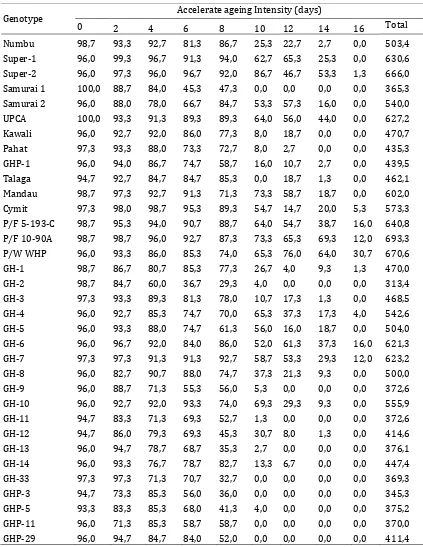
Percentage of normal seedling (PNS) data from seeds of 34 sorghum genotypes was presented in Table 1. Grouping the 34 sorghum genotypes based on seed vigor of storability was done by PNS variable using cluster dendogram analysis. Result of the dendogram cluster analysis was presented in Fig. 1. The cluster divided the 34 genotypes of sorghum into 4 groups of VSA, namely:
- Group A consisted of 7 genotypes, namely Numbu, Samurai 2, Cymit, GH-4, GH-5, GH-8, and GH-10);
- Group B consisted of 9 genotypes, namely Super-1, Super-2, UPCA, Mandau, P / F 5-193-C, P / F 10-90A, P / W
WHP, GH-6, and GH- 7)
- Group C consisted of 9 genotypes, namely Samurai-1, GH-2, GH-9, GH-11, GH-13, GH-33, 3, 5,
GHP-11; and
- Group D consisted of 9 genotypes (Kawali, Pahat, 1, Talaga Bodas, GH-1, GH-3, GH-12, GH-14, and
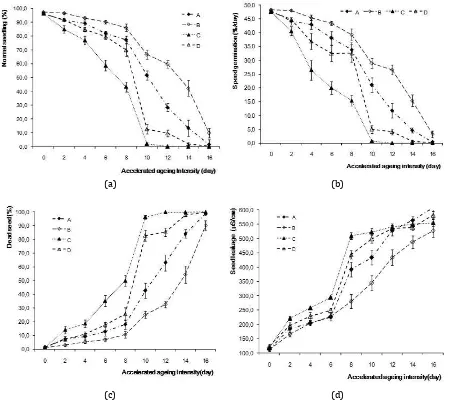
GHP-29). The vigor line of seed of storability of the four different groups was presented in Fig. 2.
According to Fig. 2, group B were genotypes that have a high vigor of storability, group A was genotypes that have a medium-high vigor of storability, group D was genotypes that have a low-storage vigor of storability, and group C was genotypes that have low vigor of storability. Consistently, the genotypes that have high seed vigor of storability also have higher percentage of normal seedlings, higher speed germination, lower percentage of dead seeds, and lower electric conductivity than those genotypes with lower vigor of storability. Vigor of storability, sequentially from the highest to the lowest was group B > A > D > C.
This difference in vigor of storability (VSA) was a genetic vigor, because the VSA was comparing among 34 genotypes of sorghum. Some properties of genetic factors that may be the cause of VSA differences were a) the chemical content of seeds and b) the physical traits of the seed. In rice seeds reported by Kapoor et al. (2011), the dissolved protein content decreased proportionately as the intensity of rapid aging was increase, but did not show any apparent correlation to the decrease in germination percentage. The decrease in germination percentage was not only influenced by the protein content of the seeds, but also by the carbohydrate content as indicated by the decline of java bean seed (Cicer arietinum L.) (Kapoor et al., 2010). Arief and Saenong (2006) reported that the smaller-seed size of corn variety of Lamuru had lower vigor storability than large ones. The different in seed size in sorghum seeds may affect VSA of sorghum seeds. The Penaloza et al. (2005) study on lettuce seed (Lactuca
sativa L.) showed that large seeds had higher germination, higher SSAA (Saturated Salt Accelerated Aging) values,
higher index of SVIS (Seed Vigor Imaging System), and faster and more uniform in the greenhouse emergence. Black-seed varieties of lettuce had higher seed quality and fewer fungus attack when evaluated by SSAA test. In
relation to Penaloza et al. (2005) research, it can be estimated that physical seed size seeds, and other physical
properties of seeds, may affect seed vigor of storability. Mohammad-Yasseen et al. (1994) stated that the seed coat was very influential, both physically and biochemically, on seed viability, and this wuld certainly affect the seed vigor of storability . In soybean seeds (De Souza and Marcos-Filho, 2001) seed coat permeability was closely related to porosity, and colors that affect seed vigor, storability, fungal attack, and sensitivity to imbibition damage.
Pramono et al. : A Study of Vigor of Storability...
402
Table 1. Percentage of normal seedling (PNS) of seeds of 34 genotypes of sorghum during deterioration by accelerated ageing.
Genotype Accelerate ageing Intensity (days)
0 2 4 6 8 10 12 14 16 Total
Numbu 98,7 93,3 92,7 81,3 86,7 25,3 22,7 2,7 0,0 503,4
Super-1 96,0 99,3 96,7 91,3 94,0 62,7 65,3 25,3 0,0 630,6
Super-2 96,0 97,3 96,0 96,7 92,0 86,7 46,7 53,3 1,3 666,0
Samurai 1 100,0 88,7 84,0 45,3 47,3 0,0 0,0 0,0 0,0 365,3
Samurai 2 96,0 88,0 78,0 66,7 84,7 53,3 57,3 16,0 0,0 540,0
UPCA 100,0 93,3 91,3 89,3 89,3 64,0 56,0 44,0 0,0 627,2
Kawali 96,0 92,7 92,0 86,0 77,3 8,0 18,7 0,0 0,0 470,7
Pahat 97,3 93,3 88,0 73,3 72,7 8,0 2,7 0,0 0,0 435,3
GHP-1 96,0 94,0 86,7 74,7 58,7 16,0 10,7 2,7 0,0 439,5
Talaga 94,7 92,7 84,7 84,7 85,3 0,0 18,7 1,3 0,0 462,1
Mandau 98,7 97,3 92,7 91,3 71,3 73,3 58,7 18,7 0,0 602,0
Cymit 97,3 98,0 98,7 95,3 89,3 54,7 14,7 20,0 5,3 573,3
P/F 5-193-C 98,7 95,3 94,0 90,7 88,7 64,0 54,7 38,7 16,0 640,8
P/F 10-90A 98,7 98,7 96,0 92,7 87,3 73,3 65,3 69,3 12,0 693,3
P/W WHP 96,0 93,3 86,0 85,3 74,0 65,3 76,0 64,0 30,7 670,6
GH-1 98,7 86,7 80,7 85,3 77,3 26,7 4,0 9,3 1,3 470,0
GH-2 98,7 84,7 60,0 36,7 29,3 4,0 0,0 0,0 0,0 313,4
GH-3 97,3 93,3 89,3 81,3 78,0 10,7 17,3 1,3 0,0 468,5
GH-4 96,0 92,7 85,3 74,7 70,0 65,3 37,3 17,3 4,0 542,6
GH-5 96,0 93,3 88,0 74,7 61,3 56,0 16,0 18,7 0,0 504,0
GH-6 96,0 96,7 92,0 84,0 86,0 52,0 61,3 37,3 16,0 621,3
GH-7 97,3 97,3 91,3 91,3 92,7 58,7 53,3 29,3 12,0 623,2
GH-8 96,0 82,7 90,7 88,0 74,7 37,3 21,3 9,3 0,0 500,0
GH-9 96,0 88,7 71,3 55,3 56,0 5,3 0,0 0,0 0,0 372,6
GH-10 96,0 92,7 92,0 93,3 74,0 69,3 29,3 9,3 0,0 555,9
GH-11 94,7 83,3 71,3 69,3 52,7 1,3 0,0 0,0 0,0 372,6
GH-12 94,7 86,0 79,3 69,3 45,3 30,7 8,0 1,3 0,0 414,6
GH-13 96,0 94,7 78,7 68,7 35,3 2,7 0,0 0,0 0,0 376,1
GH-14 96,0 93,3 76,7 78,7 82,7 13,3 6,7 0,0 0,0 447,4
GH-33 97,3 97,3 71,3 70,7 32,7 0,0 0,0 0,0 0,0 369,3
GHP-3 94,7 73,3 85,3 56,0 36,0 0,0 0,0 0,0 0,0 345,3
GHP-5 93,3 83,3 85,3 68,0 41,3 4,0 0,0 0,0 0,0 375,2
GHP-11 96,0 71,3 85,3 58,7 58,7 0,0 0,0 0,0 0,0 370,0
Proceeding of ISAE International Seminar, Bandar Lampung, August 10-12, 2017
403
(a) (b)
(c) (d)
Fig. 2. Curves of vigor of storability of seed 4 groups of sorghum genotype, based on percentage of normal seedling (a); Speed Germination (b); Percentage of dead seed (c); and electrical conductivity of seed leakage (d).
Bars were standar error of mean.
IV. CONCLUSION
The vigor of storability of seed of 34 genotypes of sorghum could be grouped into 4 groups based on the total percent normal germination percentage. The four groups were,
1. Genotypes having high vigor of storability, consisting of 9 genotypes, namely 1) Super-1, 2) Super-2, 3) UPCA,
4) Mandau, 5) P / F 5-193-C, 6) P / F 10-90A, 7) P / W WHP, 8) GH-6, and 9) GH-7;
2. Genotypes having a medium-high vigor of storability, consisting of 7 genotypes, namely 1) Numbu, 2) Samurai-2, 3) Cymit, 4) GH-4, 5) GH-5, 6) GH-8, 7 ) GH-10,
3. Genotypes having a medium-low vigor of storability consisting of 9 genotypes, namely 1) Kawali, 2) Pahat, 3)
GHP-1, 4) Talaga Bodas, 5) GH-1, 6) GH-3, 7) GH-12, 8) GH-14, and 9) GHP-2,
4. Genotypes having a low vigor of storability, consisting of 9 genotypes, ie 1) Samurai-1, 2) GH-2, 3) GH-9, 4)
GH-11, 5) GH-13, 5) GH -33, 7) GHP-3, 8) GHP-5, and 9) GHP-11.
The relationship between the vigor of storability of sorghum seed and the components of genetic factors of physical properties and physiological properties is suggested for further investigation. The nest research will be to find out the variables directly related to seed vigor of storability.
ACKNOWLEDGEMENT
Pramono et al. : A Study of Vigor of Storability...
404
REFERENCES
Aqil, M., Zubachtirodin, and C. Rapar. 2013. Description of superior varieties of corn, sorghum, and wheat. 2013 Edition. Cereals Plant Research Institute. Maros.
Arief, R. and S. Saenong. 2006. Effect of Seed Size and Seed Storage Periods on Growth and Maize Results. Agricultural Crops
Research 25 (1): 52-56.
Delouche, J. C., and C.C. Baskin. 1973. Accelerated aging technique for predicting the relative storability of seed lots. Seed Sci. And Technol. I: 433.
De Souza, F. h. D., snd J. Marcos-Filho. 2001. The seed coat as a modulator of seed-environment relationships in Fabaceae.
Brazilian Journal of Botany 24(4): 365-375.
Efendi, R., Fatmawati, and Bunyamin Z. 2013. Prospects of Ratun Sorgum Management. Pp. 205-221. In Sumarno, D. S. Damardjati, M. Sham, and Hermanto (Editors). Sorgum: Technological Innovation and Development. Agency for Agricultural Research and Development. Ministry of Agriculture Republic of Indonesia. Jakarta.
Fadholi, A. 2013. Test of Average Change of Air Temperature and Rainfall in Pangkalpinang City. Journal of Mathematics, Science
and Technology 14 (1): 11-25.
House, L.R. 1995. A Guide to sorghum breeding. International Crops Research Institute for Semi-Arid Tropics. Andhra Pradesh, India. 238p
Human, S. 2012. Breeding of Sorghum with Nuclear Science and Technology. National Nuclear Energy Agency (Batan). Https:\\www.batan.go.id.
Iriany, R. N. and A. T. Makkulawu, 2013. The Origins and Taxonomy of Sorghum Plants. Pp. 38-47. In Sumarno, D. S. Damardjati, M. Sham, and Hermanto (Editor). Sorgum: Technological Innovation and Development. Agency for Agricultural Research and Development Ministry of Agriculture Republic of Indonesia. Jakarta.
Kapoor, N., A. Arya, M. A. Siddiqui, A. Amir, and H. Kumar. 2010. Seed deterioration in chickpea (Cicer arietinum L.). American
Journal of Plant Sciences 9(3):158-162.
Kapoor, N., A. Arya, M. A. Siddiqui, H. Kumar, and A. Amir. 2011. Biochemical and physiological changes during seed deterioration in aged seeds of rice (Oryza sativa L.). American Journal of Plant Physiology 6(1):28-35.
Keeling, C.D., Whorf, T.P., 2003. Atmospheric CO2 records from sites in the SIO air sampling networks. Carbon Dioxide Inf. Anal.
Center Commun. 30, 4.
Kompas.com. 2017. Earth Temperature Rises 1.1 Degrees Celsius. Kompas.com - 20/01/2017, 14:50 WIB
Maguire, J.D. 1962. Speed of germination aid in selection and evalua¬tion for seedling emergence and vigor. Crop Science 2: 176 177.
Mbofung, G. C. Y., A. S. Goggi, L. F. S. Leandro, and R. E. Mullen. 2013. Effects of Storage Temperature and Relative Humidity on Viability and Vigor of Treated Soybean Seeds. Crop Science, 53: 1086-1095.
Ministry of Health Republic of Indonesia. 1992. List of ingredients. Jakarta: Bhratara.
Mohamed-Yasseen, Y., S. A. Barringer, W. E. Splittstoesser, and S. Costanza. 1994. The role of seed coats in seed viability. The
Botanical Review 60(4): 426–439
Neeru, J., R. Kopaar, S. Saxena. 2006. Effect of Accerelated Aging on Seed of Radish (Raphanus sativus L.). Asian J. of Plant Sci. 5 (3): 461-464.
Pabendon, M.B., S. Mas'ud, R.S. Sarungallo, and Amin Nur. 2013. Phenotypic appearance and stability of sweet sorghum for bioethanol feedstock. Journal of Agricultural Crops Research, 31 (1): 60-69
Peñaloza, P., Ramirez-Rosales, G., McDonald, M. B., and Bennett, M. A. 2005. Lettuce (Lactuca sativa L.) seed quality evaluation using seed physical attributes, saturated salt accelerated aging and the seed vigour imaging system. Electronic Journal of
Biotechnology 8(3):299-307
Pramono, E. 2000. Estimation of storability of soybean seed by using chemical accerelated ageing method. Proceedings of the 3rd National Seminar on Dry Land Area Development. pp. 180-187. University of Lampung. Bandar Lampung, Indonesia. Pramono, E. 2001. Equivalence between deterioration and devigoration of physical rapid ageing method on soybean seed
(Glycine max [L.] Merill.). J. Agrin 5: 18-25.
Pramono, E. 2008. Equivalence between natural of storage period (NSP) and rapid ageing intensity (RAI) on peanut (Arachis
hipogaea L.). Research Report. Fac. Agriculture Univ. Lampung. Bandar Lampung. 23 p. Not published.
Pramono, E. 2009a. Measurement of Vigor of Seed of storability of Five Superior Varieties of Rice (Oryza sativa L.) with Fast Chemical Methods of Etanol Steam Removal (MPCKU). Research Report. Fak. Agriculture Univ. Lampung. Bandar Lampung. 23 p. Not published.
Pramono, E. 2009b. Estimated storability 90% (ESA-90) of intensity of chemical accelerated ageing with ethanol vapour (IPCKU) on peanut seeds (Arahis hypogaea L.). Proceedings of Seminar on Research Result & Community Service. Pp. B12-18. University of Lampung. Bandar Lampung. Indonesia.
Pramono, E. 2010. Effect of organic fertilizer, micro fertilizer, and varieties on vigor of storability of rice seed (Oryza sativa L.). Proceedings of the National Seminar of SMAP 8-9 December 2010. pp. 48-57.
Prasad P.V. V., K J. Boote, L. H. Allen Jr. 2006. Adverse high temperature effects on pollen viability, seed-set, seed yield and harvest index of grain-sorghum [Sorghum bicolor (L.) Moench] are more severe at elevated carbon dioxide due to higher tissue temperatures. Agricultural and Forest Meteorology 139: 237-251.
Reddy, B.V.S., S. Ramesh, P.S. Reddy, B. Ramaiah, P.M. Salimath, and R. Kachapur. 2005. Sweet sorghum-a potential alternate raw material for bio-ethanol and bio-energy. Int. Sorghum Millets Newslett. 46: 79-86.
Sadjad, S. 1972. Straw Paper for Test of Seed Viability in Indonesia. Doctoral dissertation. Faculty of Graduate School of Bogor Agric. University. Bogor. 281 p. (Unpublished).
Sadjad, S. 1989. The Steinbauer-Sadjad Conception as the foundation of seed mathematic in Indonesia. Scientific Speech. Bogor Agricultura University. Bogor. Indonesia. 42 p.