43
COUNTRY VS SOCIETY SOCIAL REALITY OF COPYRIGHT LAW ENFORCEMENT IN
PROTECTING MUSIC, SONG, AND CINEMATOGRAPHY WORK IN INDONESIA
OK Saidin
Department of Private Law
Law Faculty, University of North Sumatera Contact Number: (+6281) 264798135 Email: [email protected]
ABSTRACT
Copyright protection in music, song, and cinematography in Indonesia has been given by the government. But the country is often unable to enforce the Copyright Law when facing the society. Many parts of Indonesian legal system need to be improved or revised. The improvement and revision are in the legal substance, the country bureaucracy structure perfection and in the management of the society legal culture.
Keyword: Copyright, Law Enforcement, Legal Culture, Cinematography
A. Introduction
Indonesian Copyright Law enforcement, seems to have to wait for another several years to have an exact place in legal system and Indonesian legislation. The issue faced by the musician of musical work and song and also the creators and copyright holder in cinematography today is the unprotected rights of theirs as ordered by Copyright Law number 28 of 2014. Why is this happening? The assumption that can be said is that because the law enforcement system in Copyright Law is powerless. Powerless because the legal substance is not adjusted with the legal understanding of the society. The weak law enforcement bureaucracy structure is also happening, because the legal enforcers do not have sufficient legal ability in understanding Copyright Law in effect. The third factor is, the society legal culture is not supporting the enforcement of related legislation in the field of Copyright Law in music, song, and cinematography.
By choosing doctrinal research method and non-doctrinal research method1, this research tries to explain some factors which become the obstacles of copyright law enforcement. How can the country be defeated by the society? Why is the music, song, and cinematography work piracy popular everywhere in almost cities and villages in the country?
Finally, this research is important to open many situation around Indonesian copyright law enforcement and then to search for the solutions as an offer to perfect the Indonesian Copyright law system, for an effective legal enforcement, to provide justice, legal certainty, and to be beneficial as stated as the legal goals by Gustav Redbruch2. These are what bring the author to conduct this research.
B. Music, Song, and Cinematography Work Protection in Indonesia
The protection in music, song, and cinematography work in Indonesia, is based on the Copyright Law number 28 of 2014. The music and song, also cinematography works are part of what is protected in copyright. Copyright itself is one of the intellectual property protected as private right on immaterial object. 3 copyright in song, music, and cinematography is supported by the
works of right brain in producing imagination in art. 4The protection is including the protection in private matter that is private rights protection such as economic right, and moral right of the creators or the right receiver which is attached to the music, song, and cinematography work. Every person who violates those rights can be charged privately in Commercial Court. The charge to recover the rights is by compensation including the loss experienced by the creator or right holder because of the copyright violation in music, song, and cinematography. In Indonesian legal system, the charge can be done because of 2 (two) things: 1. Events against the law (unlawful)
2. Tort5
1
See Tashakkori, Abbas, Charles Teddlie, Hand Book Of Mixed Methods In Social &Behavioral Research, (TerjemahanDaryatno), PustakaPelajar, Yogyakarta, 2010. Also see Wignjosoebroto, Soetandyo,Penelitian Hukum Normatif : Analisis Penelitian Filosofikal dan Dogmatikal, Yayasan Obor Indonesia, Jakarta, 2009. Soerjono Soekanto, Disiplin Hukum dan Disiplin Sosial, Rajawali, Jakarta, 1988.
2 Gustav Radbruch, Rechts-Philosophie, K.F. Koehler Verlag Stuttgart, Germany, 1956. See furher in Bernard L.Tanya
(et.all), Teori Hukum Strategi Tertib Manusia Lintas Ruang dan Generasi, Genta Publishing, Yogyakarta, 2010.
3
See further Cornish & Llewelyn, Intellectual Property : Patents, Copyright, Trade Marks and Allied Rights, Thomson, Sweet & Maxwell, 2003. See also Paul Goldstein, Copy Rights Highway, From Gutenberg to the Celestial Jukebox (1994) translated by Masri Maris, dengan judul Hak Cipta Dahulu, Kini dan Esok, Yayasan Obor, Jakarta, 1997.
4 See Mario, J. Valdes, (ed), Reflection and Imagination : A Ricour Reader, Harvester Wheatsheaf, New York, 1991 5
Journal of Education and Social Sciences, Vol. 4, (June.)
ISSN 2289-9855
2016
44
In the context of unlawful events, the charge must be proved that the person or the violation does has really violated the law or the Copyright law number 28 of 2014.6
The violated law, for example: the violation of Article 9 (1) and Article 113 of Act number 28 of 2014. Those article stated that every person without right or consent, conducting these activities (this part is only related to the copyright violation in music, song, and cinematography):
1. Adaptation, arrangement, or transformation of the works; 2. Duplication of the works in any form;
3. Distribution of the works;
4. Announcement of the works, will be punished with imprisonment in maximum of 10 (ten) years and fine of Rp. 1 billion to Rp. 4 billion.
The charge for the criminal violation is conducted through District Court with procedural steps of investigation, prosecution by the prosecutor and verdict by the judges. The procedural provision for the criminal court is regulated in Criminal practical law of Indonesia in Act number 8 of 1982. Is it over yet after this? The answer is no. the next phase, the copyright holder or the right receiver in musical work, song, and cinematography, can proceed the charge of compensation to recover the private right (economical right) in accordance to the experienced loss because of the copyright violation. The charge can be conducted through special judicial institution which is known in Indonesia as Commercial Court. The charge procedure is regulated in Private Practical law of Indonesia. This legislation is still referring to the law book by the Dutch-Indies government of HIR (HerzienInlandschReglement) and RBG (Rechtreglementvoor de Buitengewesten). These all can be done for the compensation of the unlawful event. But when the loss is happening because of the torts, for example it has been agreed first to pay the royalty on the music, song, and cinematography works, then the producer cannot fulfill it, the charge can be done through Commercial Court or through Arbitration Institution. The charge through arbitration institution can only be conducted if in the contract is stated that in the event of dispute, both parties have agreed to solve the matter in Arbitration institution. The chosen arbitration institution can be a national or international one. For Indonesian Arbitration Institution, is called as BadanArbitraseNasional Indonesia (BANI), whereas for the foreign one, for example, the Arbitration Institution in Singapore can be chosen, of course once again, if this has been agreed upon the contract.
In Indonesian legal system, the charge of the unlawful event is based on Article 1365 in Private Law Book, and the charge of the torts is regulated in Article 1237, 1238, 1243. Both the unlawful event and the tort are regulated in Chapter III Private Law Book. The basis of the charge because of the unlawful event or the torts is in the contract or the agreement. The agreement is born from the Act and the contract. If the loss experienced by the creator or the right holder of Copyright in music, song, and cinematography work is from the violation of the law, then the charge can be conducted through the unlawful event, but if the loss is from the violation of the agreement of the contract then the charge can be conducted through torts.
So is the protection in music, song, and cinematography in Indonesian legislation system. The protection is given by the country. The country guarantees the rights of the creator or the copyright holder given by the country.
Beside the criminal sanction and the private charge,7 the country also give administrative sanction to the doer of the violation, or the copyright pirate. For example to the pirate conducted by legal entity or individual, which in his or their business is provided with the official consent of the country, then the consent to do the business can be revoked. In the matter of the doer did not provided with the official consent to the activity, then the country would sentence with another criminal punishment, for example when violating the consent necessary for the activity. For example, for voice recording activity of the producer or cinematography producer. This activity need permission or consent by the country. Even though the company has the consent, but if their activity is to do copyright piracy, such as adapting or duplicating music, song, or cinematography work, then the consent can be revoked. So is when the company operates as the distributor, if in the company distributes music, song, or cinematography work conducted from unlawful event, then the country can sentence administration punishment by revoking the consent of the company to do business.
C. Copyright Registration System
Indonesian Copyright Law adhere negative declarative registration system. It means that without applying it to the Republic Indonesia Ministry of Justice, the copyright of music, song, and cinematography is still protected by the country. The registration is a mere administrative listing, which will come in handy when evidence is necessary in front of the judges in court if the third party is pressing charges (the other party who is also claim the same thing). Even if the copyright holder has listed his right in Ministry of Justice of Republic Indonesia, if there is another party who can prove that the music, song, or cinematography work is his, then the right of the party who listed it is revoked, and the court will order the Ministry of Justice of Republic Indonesia to cancel or revoke the copyright on music, song, or cinematography in the general list of works in Intellectual Property General Directory (Copyright office). The confirmation regarding negative-declarative registration adhered by Copyright Law Indonesia can be seen in article 69 (4) Act number 28 of 2014
6
Furthermore see OK. Saidin, Aspek Hukum Hak Kekayaan Intelektual, Intellectual Property Rights, PT. RajaGrafindo Persada, Jakarta, 2015
7
45
So is the provision of the deletion of Copyright because it is revoked by the Court through the verdict, confirmed in Article 74 (1) Act number 28 of 2014.
D. Piracy of Music, Song, and Cinematography in Indonesia
The piracy of music, song, and cinematography in Indonesia is already at the highest rate of piracy in the world. Indonesia is in the second place as pirate country on music, song, and cinematography after China. This situation worries the producer countries of copyright especially America. This is also what made President Ronald Reagan, former American actor, came visit Indonesia and spoke, face to face with the President of republic Indonesia, Soeharto in June, 1986 in Nusa Dua Hotel, Denpasar, Bali. The presence of the President of America in Indonesia that time, was started with the massive piracy of music, song, and
cinematography of American authors and producers. One popular case that time was the piracy of Bob Geldof’s songs in the Humanity Concert ‘life aid’ to help the hunger in Africa. After the concert was held, millions of VCD and DVD of piracy were
in the market of Indonesia and China. Finally America took repressive action to deal with this violation.
In China, Reagan threatened to put and embargo on export of Chinese made product. In Indonesia, beside the threat of embargo of garment which will be exported to America, President Reagan asked Indonesian government to revise the national Copyright law that time (Act number 6 of 1982).
The revision of Copyright Law was soon conducted,8 right after President Soeharto ordered the Ministry Cabinet Secretary that time, Moerdiono to lead the team to revise the Copyright Law.9
Less than one year, Copyright Law number 6 of 1982 has been revised. The government (initiative right of the president) proposed the revision of Copyright Law number 6 of 1982 to the House of Representative with the letter number R-03/PU/III/1987, of 25 March 1987.
Precisely in September 9th 1987, finally the House of Representative validated the enactment of Act number 7 of 1987 as the perfection of Act number 6 of 1982. The important part which has been perfected that time was regarding the sanction on copyright violation which is heavier than before. So was the kind of crime on complaint has become regular crime. That means if at the beginning the copyright can be investigated when there is a complaint on the revised regulation, without any complaint from the creator or copyright holder, investigation can still be conducted. But what had happened after the enactment of the revised legislation on the request of President Reagan was the revision did not show any significant number by stopping or reducing the piracy. The number of copyright violation is increasing each year. The loss of the producers (in music and song) and also the movie producer is also increasing. Because of this, many houses of production in Indonesia closed their business. National movie production is also decreasing. The musician, actor, and actress chose to work in another sector. This was because
the job as musician, music artist, actor and actress, wouldn’t guarantee a better life anymore. They who work as artist in music, song, and cinematography, who spent time, energy and money, didn’t get any benefit economically. They would only obtain the moral right, but the economic right is being enjoyed by the pirates.
The alteration in the punishment by making heavier sanction didn’t stop the piracy. The piracy of music, song, and cinematography work is sophisticated, not easy to be detected by the legal enforcer. Beside doing it silently in remote places, the also do it by using technology which is hard to be detected.
In some cases in medan city, it is known that the piracy of music, song, and cinematography was conducted in houses, such in household. The researcher has witnessed hundreds of VCDs and DVDs of music, song, and cinematography produced and traded
in the shops in the sidewalk. It doesn’t stop there. The illegal VCDs and DVDs are also traded in counters in supermarkets and malls which are often visited by middle to high class customers.
A heavy legal sanction is not sufficient to stop the piracy of music, song and cinematography work.
This consideration can be proven, after the alteration of Copyright Law in 1987, Indonesian Copyright Law has been revised for many times in 1997, 2012, and 2008. The reason of the alteration was still the same that was to stop, or at least reduce the piracy. The altered substance was the quality of the punishment. But until today, year 2016, the piracy is still happening. But what is worse is that the indifferent legal enforcers to this matter. It seems like there is something wrong in Indonesian copyright law enforcement system.
If we take an example from other country, such as from America, there was a piracy case of music and song online. The doer was
Jamie Thomas. The piracy was from October 2007. Thomas has pirated 24 songs and uploaded the songs to ‘Kazza’ line which
enabled the internet users to download those songs. This activity by Jamie Thomas has of course put many people in
disadvantages, even though Jamie Thomas didn’t obtain any personal benefit from it. The disadvantaged companies, Capital
Record, Sony BMG Music, Arista Record, Interscope Records, Warner Bros Record, and UMG Recording then pressed charges to the court. Through the court of Minneapolis, USA, Jamie Thomas was stated guilty and punished to pay for 9.250 USD for each song. Even though the case was re-opened, because the jurists said that there was something wrong with the verdict, since
8
See J.C.T. Simorangkir, Beberapa Catatan Mengenai Perubahan UU Mengenai Hak Cipta, Jakarta, Kompas, 25 Februari 1987. see also Yudo F. Nugroho, Tanda Tanya Menyertai UU Hak Cipta, Jakarta, Kompas, 15 September 1987.
9
Journal of Education and Social Sciences, Vol. 4, (June.)
ISSN 2289-9855
2016
46
Jamie Thomas did not have any economic motive in dong the action. But the action was still considered as guilty. What interesting from the case was, American Congress was advised to amend the Copyright Law, especially regarding the piracy in internet. Today in America, it is very common that the charge is being pressed by the Copyright holder of the song and music on the piracy done both through internet or duplication by using optical media through recording copy with the charge of approximately 3000 USD – 5000 USD for every song.10
In America, law enforcement in Copyright tends to be effective, because the legal enforcer and the supporting structure is supporting it, and also the awareness of the society to not ‘take it for granted’ from other’s right illegally is high. The structure and culture factor in enforcing Copyright, especially in music, song, and cinematography in Indonesia, are dominant, beside the issue in the legal substance, especially piracy of music, song, and cinematography through internet which need to be anticipated with the amendment of Copyright law number 28 of 2014.
E. The Role of the Country in Copyright Law Enforcement
When the society stated that they subject to the law in the country, then the country will have the obligation to protect the right of
the society. Every person in the society who doesn’t subject to the law, the country will be able to punish him. The country have to guarantee the secure, comfortable life of the society, including the protection of the human right. 11
Indonesian constitution contains some basic regulation in protecting human rights. So is in the goal of the nation contained in the Preamble of the Constitution: that shall protect the whole people of Indonesia and the entire homeland of Indonesia, and in order to advance general prosperity.
The protection on the belongings, in this research, of course is included in the Copyright of the author. The country is obliged to protect those rights from anyone who attempt to take the rights illegally. The country may not ignore this situation since the ignorance means to violate the constitutional rights trusted by the society to the country.
How can the country protect those rights? The country is obliged to provide every regulation agreed by the society (through House of Representative as the representative from the society) in the context of Acts or legislation. Second, the country have to provide the professional law enforcer to enforce it. These professional law enforcer beside knowing the copyright law enforcement, also have to possess personality integration, means that they may not do things such as corruption in money, time, energy, and so on. Honest, trustworthy, and worth to be put as the law enforcer. They are the police, investigators, judges, prosecutors, solicitors, and arbiters.
Every party related to the law enforcer must fulfill the criteria of personality integrity. The country must facilitate for the creation of those law enforcer mentioned. Third, the country must also understand the society, provide clear explanation to the society,
that the action to take someone else’s right is illegal and unlawful. Some clarity must be conducted by the country through non formal education and socialization. Religion teaching must also be conducted early. In education curriculum since primary school, an understanding of unlawful action which violate the Copyright Law need to be introduced. The understanding of the society need to be brought to an understanding to appreciate everyone’s right. This is the most important factor to build the legal culture to a better Indonesian law civilization.
Not only that, the country also need to provide the jobs, educations, and the chances to do business and decent life, so the society can be avoided from illegal action as the cause of poverty. The society must not be allowed to live in poverty without the guidance from the government to have a job.
This is what had happened for years in the life of poor countries in the world. the ignorance from the government happened. In this situation, everything can happen. Law violation will be able to find everywhere. Not only in remote or hidden places, but also in luxurious chambers. The country should take responsibility for the society in poverty in some actions and policies.
The action of ignorance by the country will also be done by the society, even though it is known that the society is not the ones who live in poverty. For example, before now, a beggar is someone who is really poor, but now many state officials are becoming beggars. Only, the form and the way to do so is different. The researcher found and interviewed some businessmen in Indonesia who happened to experience this kind of situation.12
In the case of VCD and DVD trading of music, song, and cinematography, it turns out that it wasn’t just conducted by the middle to low class society, but also conducted by middle to high class society. Because of that the trading of VCD and DVD of piracy is popular. The acknowledgement of the middle-high class society regarding this and also this is already considered as a common thing to but pirated VCD and DVD.13
10
See Saddam Shauqi, Perlindungan Hak Cipta Karya Musik dan Lagu Dalam Undang-undang Hak Cipta Indonesia (Studi Terhadap Kesadaran Hukum Mahasiswa Fakultas Hukum USU Tentang Pengunduhan Hak Cipta Musik dan Lagu Melalui Intranet dan Internet), Thesis S2 Master Program USU, Medan, 2015.
11 See Jimly Asshiddiqie, Konstitusi Ekonomi, Kompas, Jakarta, 2010. 12
Interview with Faris Bashel, SE, 48 years old, one of the Director of a company in Property and Trading, interview in March 3rd 2016 in Medan
13
47
The researcher found that the trading of DVD and VCD of the piracy is conducted in front of the police station.14 This is happening in Medan city of Indonesia (furthermore, see OK. Saidin in his dissertation). This situation do not just bring us to one conclusion that the ignorance is conducted by the country, but also, this is much further show the apathetic attitude by the law enforcer and an easy-going culture has been in the life of the society.
F. The Easy-Going Culture of the Society
The forming of the easygoing culture in the society is a culture built without direction, and goal. The culture formed naturally with no format. This kind of culture was built form the ignorance action by the country and it is causing the society to just grow. This kind of culture will affect the forming of legal culture as the part of civilization. The researcher witnessed many ignorance
happened in many places in Indonesia on many cases of the violation of the society’s right conducted by the society itself. The case of Copyright piracy is one of the many of the ignorance by the country happened in the middle of the society. Re-organization must be done to the structure of law enforcer institution to change the culture of the society which rather pragmatist and instant. Every action of the society in the situation where the law is no longer as the instrument to regulate the behavior of the society, must be stopped.
A complicated issue faced by the country in Indonesian cases today who can stop it? How to stop it? The society can no longer hope to the law enforcer by the country. To lay the hope to the non-governmental organization or humanity activist who protect the rights of the creator is also useless. The case in 2013, the doer who violate the copyright was one person who work as an activist in society in protecting the authors. He was Malikul Akbar Atjil, he admitted that he was a Malaysian and did a
Copyright on a song by Indonesian musician, Wali Band, ‘Cari jodoh’. The song by Wali Band was in contract with the
recording producer of PT. Nagaswara. According to the explanation by Atjil, the song was bought by “Malaysia Incitech”. Finally the case was brought to the District Court of Malang on Wednesday, 1st May 2013.15 So there is no guarantee that
humanity activist in copyright protection will be consistent in fighting and protecting form the piracy of copyright.
The latter mentioned is an issue in legal culture. It is not so simple to connect the legal behavior of the society to what really is becoming the legal goal formulated by the country. It is often that the law formulated by the country is contradicting with the soul of the society which is according to Von Savigny teaching, needs to be concerned by the legislator institution. The legislation in product should concern the values living in the middle of the society which can be made as legal principle.16 Those values would be abstracted and then made as the basic in formulating a national law which is known as the original paradigmatic values of Indonesian culture and society.17
G. Song and Music Copyright Piracy Phenomenon
In many news followed by many seminars and research, almost every single one of it concluded that the practice of music and song piracy has been arrived in a very dangerous level. These all will of course cause specific problem between musicians and recording company.18
The musicians, like Anang Hermansyah and the performer (the holder of neigbouring rights) also like Delon, has proposed some objections on the piracy of music and songs which has become their living source. In days, or even months, the musician spent their time to be able to create notes and song lyrics to become a music and song. Time, energy, and money spent was not worth the result achieved because of the piracy.
To handle this, the President of Republic Indonesia Joko Widodo got involved with the musicians and ordered the police departments to handle the pirates. Even though in the statement of President Jokowi assert to punish the high scale pirates, in the real law, there is no high or small scale discrimination because, the small scale can cause a big loss also.
Here is a table regarding the view and action of the musicians and the government and the legal enforcer to the music and song piracy.
Table 1 :
The view and action of the musicians and the government and the legal enforcer to the music and song piracy
Date Speaker Content
14
See further. OK.Saidin, Transplantasi Hukum Asing ke Dalam Undang-undang Hak Cipta Nasional dan Penerapannya Terhadap Perlindungan Karya Sinematografi (Studi Kritis Terhadap Dinamika Politik Hukum Dari Auteurswet 1912 ke TRIPs Agreement 1994), Dissertation, Doctoral Program Law Faculty, Universitas Sumatera Utara 2013.
15
Darwiszantika, Kasus pelanggaran Hak Cipta, tribun news.com., Jakarta, posted on June 29th 2014
16
See further, OK.Saidin, Mencari dan Menjadi Hukum Indonesia, Reflekfsi Pemikiran Prof. Mahadi, Rajawali Pers, Jakarta, 2016, p.79,137,213.
17
See further OK.Saidin, Sejarah dan Politik Hukum Hak Cipta. Rajawali Pers, Jakarta, 2016, p.41
18 See further OK. Saidin, Transplantasi Hukum Asing ke Dalam Undang-undang Hak Cipta Nasional dan Penerapannya
Journal of Education and Social Sciences, Vol. 4, (June.)
ISSN 2289-9855
2016
48
21 May 2015 Jokowi Big scale copyright piracy
3 December 2014 Delon & Tantowi The hope of the musician for a
new legislation to reduce piracy
20 April 2015 Anang & Kusplus Complain the piracy to Polda
Metro Jaya
18 September 2015 Bambang Waskito (director of
economic criminal and criminal institution of Police Department)
Bareskrim will punish the pirate of music
18 Mei 2015 General leader Assiri Gumilang
Ramadhan
Indonesian loss 2,8 billion illegal songs in Indonesia
17 Mei 2013 Gita Wirjani Ministry SBY Period Indonesian loss of 4.4 billion each year
In some copyright piracy cases has proven that the doer has never easy to ‘detect’. The action of VCD and DVD was started with the download from internet and intranet. This phenomenon has never been found in the beginning of voice recording technology in using cassette. But with the development of human civilization, also held by the development of the company, information and optical technology caused many downloader easier to download the music and song via internet and intranet to get the music and song without have to pay for royalty.
H. The Case of Music, Song, and Cinematography Piracy in Court.
Some cases in Indonesian court can only be explained in this manuscript as a prove that legal enforcement is still in effect, even though it is not effective in handling music, song, and cinematography piracy. The first case is the case of Song piracy in July 13th North Jakarta District Court.
The case was started with the Inul Vista Karaoke that used music, song, and cinematography which copyright is held by the recording company PT. Nagaswara. PT. Nagaswara which was represented by the director, Rahayu, reported the piracy to the police department in North Jakarta territory. In his report, Rahayu stated that Inul Vista, which now is managed by Kim Sung
Ku, has violated mechanical right (duplication of copyright) by replacing the video clip of songs in the karaoke screen. ‘many pictures in the video is different with the origin. For example the song of Zaskia Gotik which clip is replaced with the picture of
land or animal. They (inul vista) does not want to pay for the original video, so they replace it as they like,’, said Rahayu. According to rahayu, this action has violated the rule of royalt made by National Collective Management Institution. If Inul Vista does not want to pay for te royalty, nagaswara will pull back every song of the artist from all Inul Vista karaoke. 19
In the report, Rahayu added that, at least 3000 songs are available in inul Vista karaoke. If they don’t replace the video clip with the original ones and take care of the consent properly, his party will take serious step to take down all of their songs. Even though the owner of Inul Vista stated that they are not afraid to face the legal action of Nagaswara. This suit is still rolling in the
court today and still hasn’t reach any legal solution.20
This issue, today is not just a topic in court, but furthermore has become a serious concer of Jokowi. The president asks so that the polices and another legal enforcer take serious action to handle the issued of copyright piracy
The second case was the ‘Cari Jodoh’ song piracy popular by the Wali Band in court of Malang, East java on Wednesday, 1st May 2015. It was attended by the Director of PT Nagaswara, Rahayu Kertawiguna as the witness of the reporter. In the suit, as the defendant was malikul Atjil Akbar who was suspected to pirate the songs. This incident reported was unlawful action on song, music, and cinematography which copyright held by PT. Nagaswara. The action was categorized as a crime that violate economy right and even moral right of the creator, that is to change the video clip. The action was categorized by the defendant and known since 2009. The defendant stated that the action he conducted was by the consent from Malaysia Incitech which has bought those songs. The action put some people in great loss as stated by Rahayu21 : the action conducted by Atjil by pirating the
works by other people clearly put them in great loss, it will be greater loss when the piracy is being allowed.” Said Rahayu. As
the owner of the label which distribute Indonesian musicians’ song, including artists and singers of Nagaswara, he stated that he has the duty and obligation to be involved in taking care of the work of his musicians.
19
Tribunews.com.Jakarta downloaded 11 March 2016.
20
By Rahayu Karta Kertawiguna, who orbited Kerispatih, Wali, and Zaskia Gotik, he want to have a proper verdict from
the court. “If peace is the answer, there will no wary effect” said he. The firm action of the government, according to rahayu, made the trade center of illegal CD in Glodok, Central Jakarta, distraced. “Glodok is better, after the investigation and the report of the doer and the places. Even though there is some who do the action in secret.” Said Rahayu. Rahayu calculated, the loss of music industry with the trade of illegal CD in Glodok alone has reached hundreds trillion each year see further Tempo, Suara.com Friday, 10 July 2015.
49
The case of ‘Cari Jodoh’ of Wali Band, he stated that he didn’t aware of the action in the first place since Atjil did not even tell or ask for permission of the song. Because of this incident, as the holder of the Copyright, his company suffered great loss of Rp. 1 billion.
In the police report which was originally made in 2010, Rahayu stated the loss. As long as the suit was being held, and the verdict has not been made by the judges in Malang District Court, said Rahayu, the Malaysia Inchitech can keep selling the song
of Wali Band ‘Cari Jodoh’ Atjil version without any clear consent while the recording company suffered great loss.
Referring to the two cases above, it can be analyzed that the factor of legal culture seem to dominate the copyright violation in Indonesia. The level of legal awareness in Indonesia is still very low and the bureaucracy culture and also the choice of policy from legal enforcer in implementing the legal enforcement is still ‘half hearted’.
It is said to be ‘half-hearted’ because, if the police or the legal enforcer and also the related institution handle the copyright
violation properly, this wouldn’t be difficult. The government would create a team, then prepare legal instrument that give right to the team to confiscate the illegal music, song, and cinematography. The sellers will be investigated and asked to find where he get the illegal stuff from. Such as the police when finding out regarding terrorist. We judge today that the government is lack of concern in handling this kind of copyright violation. Especially when today the copyright infringement is a crime included in crime on complaint. It means that the investigator may do the investigation when there is complaint from the party at loss. Of course this cause the merrier of copyright violation. It is impossible that Datuk Siti Nurhalijah or the copyright holder in Malaysia or Sonu Nigam or the copyright holder in India or Adele in London, or Britney Spears, Jenifer Lopez, katy perry, Taylor Swift, Shakira, Rihanna, Beyonce, or Kesha will have to complaint to the police in Indonesia regarding the violation on
their copyright. As long as they don’t report the violation on the song, music, and cinematography of theirs, then the pirates in Indonesia are free to do piracy. They would be free to get the benefit economically from economy right of the creator or copyright holder which should be protected.
I. Testing the Behavior of a Group that Understand Law
This research is showing the reflection from a group which should have high awareness in law enforcement in Copyright. They who were chosen as respondents are the students in Law Faculty USU who actually have wide knowledge in law, if compared with another group in society. This research is conducted to 100 respondents wih these characteristics:
Table 2
Respondent Characteristic
No Respondent Origin Portion Percentage
1. Undergraduate Students 60 persons 60%
2. Master Students 30 persons 30%
3. Doctoral Students 10 persons 10%
Source : Primary Data N = 100 Respondents
Based on the questioner, it is found that every respondent is aware of the existence of internet and intranet and the rest of the respondents also stated to have ever downloaded music and song via intranet and internet. The songs they downloaded was from the local and foreign music.
All of the respondents also stated that they are aware of the existence of Copyright Law, but only some of the respondents who are aware that to download songs and music via intranet and internet is prohibited according to Copyright Law number 28 of 2014. The percentage of the knowledge of the students in Law Faculty North Sumatera regarding the prohibition in downloading song through intranet and internet can be seen in this table:
Table 3
Distribution of the Knowledge Frequency of the Students in Law Faculty Universitas Sumatera Utara regarding the Prohibition in Downloading Music and Song via Intranet and Internet.
No Category Portion Percentage
1. Know 85 85%
2. Do not Know 15 15%
Amount 100 100%
Source : Primary Data N = 100 Respondents
From the total of 100 respondents, 85% of them are aware of the action of downloading without consent from the creator or copyright holder is a prohibited action by Law. When asked to them who know, regarding why do they keep doing the downloading, here is the result:
Journal of Education and Social Sciences, Vol. 4, (June.)
ISSN 2289-9855
2016
50
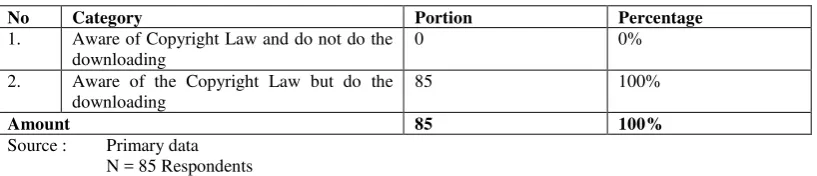
Obedience of Law faculty Students of USU on downloading without Consent
No Category Portion Percentage
1. Aware of Copyright Law and do not do the downloading
0 0%
2. Aware of the Copyright Law but do the downloading
85 100%
Amount 85 100%
Source : Primary data N = 85 Respondents
Referring to the table above, from 85 respondents who are aware of the Copyright Law that prohibits downloading without consent, all of them still do the downloading nevertheless.
The reasons of the students in Law Faculty Universitas Sumatera Utara who are aware that the action of downloading via intranet and internet on songs and music without the consent of the creator or right holder is an unlawful action but still do it anyway, are:
1. It is conducted accidentally;
2. To add some understanding regarding the download process through information technology; 3. More practical;
4. There is no firm legal sanction of legal enforcement in the crime in downloading the music and song via intranet and internet;
5. Because some of the songs are not sold in Indonesia, so to get it, intranet and internet are the media; 6. Because it is free, everything can be downloaded;
7. Un-intentionally; 8. Easier to download;
9. It can be done anytime and anywhere.
After that, only some of the students who also aware of the criminal punishment on the downloading of music and song via intranet and internet as can be seen in this table:
Tale 5
Distribution the Knowledge of The Students of Law Faculty USU Frequency on the Criminal Punishment of Downloading Music and Song via Intranet and Internet
No Category Portion Percentage
1. Know 44 44%
2. Do not Know 56 56%
Amount 100 100%
Source : Primary Data N = 100 Respondents
Even though they are aware of the criminal punishment, but they still do the downloading. From the table above, it can be explained that the amount of students of Law Faculty USU who understand that copyright downloading without right (without the consent from the creators or copyright holder) is an action which can be punished with criminal punishment (even private compensation), the amount would be high enough that is 56%. Even though the answer is not consistent with the answers of the respondents in table 4, that was 85%. If in table 4, they were only asked regarding the existence of prohibition of downloading without consent, in table 5, the question is more specific regarding the awareness of criminal punishment. They who are aware of the criminal punishment, are only 56%. Based on this answer, socialization is still necessary on the National Copyright Law. the reason is that among the students of Law Faculty, only 56% who are aware of the downloading without right and it can be punished with criminal punishment. Respondents in this research involve the students of Master and Doctoral program which means, they have already graduated from undergraduate. The question is, how is it with the society outside them, who never know of National Copyright Law or never be socialized with Copyright.
To 56% respondents who are aware of criminal punishment regarding the downloading without consent, the total of them (100%) did the downloading as seen in this table below:
Table 6
The Obedience of Students in Law Faculty USU Regarding the Awareness of Criminal punishment, but Still do the Downloading of Music, Song via Intranet and Internet
No Category Portion Percentage
1. Aware of the criminal punishment and do not do the downloading
0 0%
2. Aware of the criminal punishment but still do the downloading
51
J u m l a h 56 100%
Source : Primary data N = 56 Respondents
When to them who questioned regarding what became the reason for them to do the downloading, this is the result: 1. Un-intentionally;
2. Want to know the development of downloading technology through internet; 3. Because the goal wasn’t to trade (private purpose);
4. Because there is no firm implementation from the legal sanction;
5. Because it has never been written in the downloading system that it is prohibited to download and consent from the creator for the music and song is necessary.
J. Country VS Society
After studying the issue and the cause of the Copyright violation especially in music, song and cinematography, it can be understood that the root was not only regarding the legal substance but also regarding the structure of legal enforcement bureaucracy and legal enforcement culture and the legal culture of the society. The country has been beaten by the society. The society kept thinking that they are innocent when they do the piracy on copyright on music, song, and cinematography. Substantively, legal norm regarding copyright protection, is not a legal norm from Eastern culture22 which affect Indonesian culture.23 Eastern tradition which is communal where volunteer with individual character in interpreting the rights of economic
right, made Indonesian when taking the music, song, and cinematography, as something legal. The tradition, as: harmony, qasidah, zikir XII, sinden’s songs in wayang, from generation to generation can be performed freely by anyone who would like
to take advantage from it. In adat law system of Indonesia which incenturies has been the law model of Indonesia, it doesn’t
recognize the difference between material and immaterial object. It is hard to explain to the society that to take right on
immaterial right is a crime, even though there is nothing seem ‘missing’ from the object. The western law is who introduced that difference. The substance of Indonesian Copyright Law doesn’t refer to the law tradition values of adat which is known as the original paradigmatic values of Indonesian culture and society. Because of this, the legal norm of Indonesian Copyright law is not attached to the soul of Indonesian society. In the implementation context, Indonesian society gave a special meaning to the
legal norm. the meaning was, it is not a ‘sin’, nor something that violate morality, when someone take a music, song, and
cinematography of another person. It will all end in the loss of the country by the society in the battle to enforce the legal norm of Indonesian Copyright Law.24 Law supposed to not only providing certainty to the society but also law is demanded to prosper the society.25
The legal enforcer also seem to not able to do a lot. Especially it is known that legal enforcer only see the merchants on sideways as the supplier of illegal VCD and DVD who only take benefit from economic right of the creators or copyright holder with a rather cheap price, for example 5 pieces for 1 USD, with a very small benefit that is 05 to 1 cent USD for each piece. The police can no longer morally enforce the law to the buyer, because the buyers are not from the group of people who will benefit from it,
which in Indonesian terminology can be said with ‘buyer with good will’. The basic weakness is also experienced by Indonesian
legal enforcer institution that is the investigators who not everyone of them understand the situation of law enforcement in Copyright. They who do the job in the sectors in villages are they who have the experience and background that still not enough
to support copyright law enforcement. The high point of the country’s role in copyright law enforcement now has become so
weak, the creativityof the creators are decreasing and affecting the slow development of creative industry and the decreasing of nation income in tax.
K. Conclusion
1. The weak position of the country when facing the society in enforcing the copyright law on the violation or music, song, and cinematography piracy is caused by many factors, first, legal substance which do not contain adat law
22
According to Seidman, the takeover of law in one nation cannot be taken only in the substance, but also need to be adjusted with the structure and culture where the law is enacted, even Donald Black said the law is appointed by social structure where the law is enacted. See further Seidman, Ann dan Robert B. Seidman, State and Law in The Development Process Problem-Solving and Institutional Change in the Third World, St. Martin’s Press, 1994. See also Seidman, Robert B., The State, Law and Development, St. Martin's Press, New York, 1978. Compare with the opinion of t Black, Donald, Sociological Justice, Oxford University Press, New York, 1989.
23
That Indonesian has their own cultural structure. Furthermore see Bachtiar, Harsya W., SistemBudaya Indonesia, BudayadanManusia di Indonesia, Hanidita, Yogyakarta, 1985. See also Koetjaraningrat, Kebudayaan Mentalitas dan Pembangunan, PT. Gramedia, Jakarta, 1987. See further T.O. Ihromi, Antropologi Hukum Sebuah Bunga Rampai, Yayasan Obor Indonesia, Jakarta, 1993.
24
This is what according to Soedjatmoko need to be handled appropriately by the government in managing the national development including development of law because to build is not just by doing something, but also by learning something. See Kathleen Newland and Kemala Candrakirana Soedjatmoko, Menjelajah Cakrawala, PT. Gramedia Pustaka Utama, Jakarta, 1994. See further Kleden, Ignas, Sikap Ilmiah dan Kritik Kebudayaan, LP3ES, Jakarta, 1987.
25
See further Satjipto Rahardjo, Negara Hukum Yang Membahagiakan Rakyatnya, Genta Publishing, Jakarta, 2009. See also Lili Rasjidi and Ira Thania Rasjidi, Dasar-dasar Filsafat dan Teori Hukum, Citra Aditya Bakti, Bandung, 2007.
Journal of Education and Social Sciences, Vol. 4, (June.)
ISSN 2289-9855
2016
52
values, the factor of the legal substance do not adopt the value of original paradigmatic value of Indonesian culture and society. Second, the bureaucracy structure of law enforcement which is still powerless both in the facility and professionalism based on academic ability and personal integrity, and third, legal legal culture of the society which is
formed based on ‘easy-going’ culture without ever feel guilty when doing copyright piracy in music, song, and cinematography works of others.
2. In educated society which relatively understand on how to treat and respect the rights of people, there are als some who do not have the awareness, and it prove that there is no significant relation between the level of knowledge with the level in law obedience.
3. The role of the country in copyright law enforcement to protect the creators and right holders in music, song, and cinematography is still necessary, especially in perfecting the substance of Copyright Law number 28 of 2014 and in forming special team to handle the piracy conducted by the party who intended to benefit illegally.
4. Substantively the provision that urgently need to be altered is he provision regarding the character of the crime from crime on complaint to regular crime, because the crime in Intellectual property is included in general crime with public vibe (different from crime on the honor of someone such as mocking privately, or stealing in family privately) which impact on public moral corruption is huge with the loss on the creator and country (tax sector) which is for trillions of rupiah.
5. To build back the passion of the creators, including the musicians, producers, actor and actress and all of the artists, to push the development of creative industry, law enforcement and the application of sanction is necessary to the doer of piracy in music, song, and cinematography (private compensation is also needed), without all of these, the civilization
in art work will be worse and so will the moral as the result of no appreciation to other people’s rights.
Refferences
Books :
Bachtiar, Harsya W. (1985), SistemBudaya Indonesia, BudayadanManusia di Indonesia, Hanidita, Yogyakarta. Badrulzaman,Mariam Darus (1983) Mencari Sistem Hukum Benda Nasional, BPHN - Alumni, Bandung, Black, Donald, (1989) Sociological Justice, Oxford University Press, New York,
Cornish & Llewelyn, (2003) Intellectual Property : Patents, Copyright, Trade Marks and Allied Rights, Thomson, Sweet & Maxwell,.
Goldstein,Paul, (1994) Copy Rights Highway, From Gutenberg to the Celestial Jukebox translated by Masri Maris, with title Hak Cipta Dahulu, Kini dan Esok, 1997 Yayasan Obor, Jakarta.
Ihromi, T.O., (1993) .Antropologi Hukum Sebuah Bunga Rampai, Yayasan Obor Indonesia, Jakarta, Kleden, Ignas, (1987) Sikap Ilmiah dan Kritik Kebudayaan, LP3ES, Jakarta,.
Kathleen Newland dan Kemala Candrakirana Soedjatmoko, (1994) Menjelajah Cakrawala, PT. Gramedia Pustaka Utama, Jakarta.
Koetjaraningrat, (1986) Pengantar Ilmu Antropologi, Aksara Baru, Jakarta.
Koetyaraningrat, (1987) .Kebudayaan Mentalitas dan Pembangunan, PT. Gramedia, Jakarta, Mahadi, (1985) Hak Milik Immateril, BPHN, Jakarta,.
---, ( 1981) Hak Milik Dalam Sistem Hukum Perdata Nasional., Jakarta, BPHN,. Radbruch, Gustav, (1956) .Rechts-Philosophie, K.F. Koehler Verlag Stuttgart, Germany,
Rahardjo, Satjipto, (2009) Negara Hukum Yang Membahagiakan Rakyatnya, Genta Publishing, Jakarta,.
Rasjidi, Lili dan Ira Thania Rasjidi, (2007) Dasar-dasar Filsafat dan Teori Hukum, Citra Aditya Bakti, Bandung,. Saidin, OK, (2015) Aspek Hukum Hak Kekayaan Intelektual (Intellectual Property Rights), Rajawali Pers, Jakarta,. ---, (2016) .Mencari dan Menjadi Hukum Indonesia, Refleksi Pemikiran Prof. Mahadi, Rajawali Pres, Jakarta,
---, (2015) Transplantation of Foreign Law into Indonesian Copyright Law : The Victory of Capitalism Ideology on Pancasila Ideology, Journal of Intellectual Property Rights, National Institute of Sciences Communication and Information Resources, CSIR, New Delhi, India.
---, (2016) Sejarah dan Politik Hukum Hak Cipta, Rajawali Pres, Jakarta,.
---, (2013).Transplantasi Hukum Asing ke Dalam Undang-undang Hak Cipta Nasional dan Penerapannya Terhadap Perlindungan Karya Sinematografi (Studi Kritis Terhadap Dinamika Politik Hukum Dari Auteurswet 1912 ke TRIPs Agreement 1994), Dissertation, Doctoral Program, Law Faculty, Universitas Sumatera Utara,
Seidman, Ann dan Robert B. Seidman, (1994) .State and Law in The Development Process Problem-Solving and Institutional Change in the Third World, St. Martin’s Press,
Seidman, Robert B., (1978) The State, Law and Development, St. Martin's Press, New York,
Shauqi, Saddam, (2015) Perlindungan Hak Cipta Karya Musik dan Lagu Dalam Undang-undang Hak Cipta Indonesia (Studi Terhadap Kesadaran Hukum Mahasiswa Fakultas Hukum USU Tentang Pengunduhan Hak Cipta Musik dan Lagu Melalui Intranet dan Internet), Thesis, Master Program Law Faculty, USU, Medan.
Simorangkir, J.C.T., (1987) BeberapaCatatanMengenaiPerubahan UU MengenaiHakCipta, Jakarta, Kompas, 25 Februari Soedewi, Sri Masjchoen Sofwan, (1981) Hukum Perdata : Hukum Benda, Liberty, Yogyakarta,.
53
Tanya, Bernard L. (et.all), (2010) Teori Hukum Strategi Tertib Manusia Lintas Ruang dan Generasi, Genta Publishing, Yogyakarta,.
Tashakkori, Abbas, Charles Teddlie (2010), Hand Book Of Mixed Methods In Social &Behavioral Research, (Translation by Daryanto), Pustaka Pelajar, Yogyakarta,.
Valdes, Mario J., (ed), (1991) Reflection and Imagination : A Ricour Reader, Harvester Wheatsheaf, New York.
Wignjosoebroto, Soetandyo, (2009) Penelitian Hukum Normatif : Analisis Penelitian Filosofikal dan Dogmatikal, Yayasan Obor Indonesia, Jakarta,.
Yudo, F. (1987) NugrohoTanda Tanya Menyertai UU HakCipta, Jakarta, Kompas, 15 September.
Lain-lain :
Harian Suara Karya, Musisi Sudah Apatis, Jakarta, Friday, 17 April 2015.
Republik Indonesia, Copyright Law number 28 of 2014 regarding Copyright, State Gazette of 2014 number 266 of October 2014.
Suara.com downloaded 10 Juli 2015.