VAN DER WAERDEN’S THEOREM AND AVOIDABILITY IN WORDS
Yu-Hin Au1
Department of Combinatorics and Optimization, University of Waterloo, Waterloo, Ontario Canada
Aaron Robertson2
Department of Mathematics, Colgate University, Hamilton, New York [email protected]
Jeffrey Shallit
School of Computer Science, University of Waterloo, Waterloo, Ontario Canada [email protected]
Received: 8/3/10, Revised: 11/11/10, Accepted: 11/26/10, Published: 1/13/11
Abstract
Independently, Pirillo and Varricchio, Halbeisen and Hungerb¨uhler and Freedman considered the following problem, open since 1992: Does there exist an infinite word
w over a finite subset of Zsuch thatw contains no two consecutive blocks of the same length and sum? We consider some variations on this problem in the light of van der Waerden’s theorem on arithmetic progressions.
1. Introduction
Avoidability problems play a large role in combinatorics on words (see, e.g., [11]). By a square we mean a nonempty word of the form xx, where x is a word; an example in English is murmur. A classical avoidability problem is the following: Does there exist an infinite word over a finite alphabet that contains no squares? It is easy to see that no such word exists if the alphabet size is 2 or less, but if the alphabet size is 3, then such a word exists, as proven by Thue [15, 16] more than a century ago.
Anabelian square is a nonempty word of the formxx′ where |x|= |x′| andx′ is a permutation of x. An example in English is reappear. In 1961, Erd˝os [3] asked: Does there exist an infinite word over a finite alphabet containing no abelian
1Research supported in part by an OGSST Scholarship and an NSERC scholarship.
squares? Again, it is not hard to see that this is impossible over an alphabet of size less than 4. Evdokimov [4] and Pleasants [14] gave solutions for alphabet size 25 and 5, respectively, but it was not until 1992 that Ker¨anen [9] proved that an infinite word avoiding abelian squares does indeed exist over a 4-letter alphabet.
Independently, Pirillo and Varricchio [13], Halbeisen and Hungerb¨uhler [7], and Freedman [5] suggested yet another variation. Let a sum-squarebe a factor of the form xx′ with |x| =|x′| and !
x=!
x′, where by!
xwe mean the sum of the entries ofx. Is it possible to construct an infinite word over a finite subset ofZthat contains no sum-squares? This very interesting question has been open for 18 years. Freedman [5] showed that the answer is “no” in the case when the infinite word is over 4 real numbers{a, b, c, d}such thata+d=b+c. Halbeisen and Hungerb¨uhler observed that the answer is also “no” if we omit the condition |x| = |x′|. Their tool was a famous one from combinatorics: namely, van der Waerden’s theorem on arithmetic progressions [17].
Theorem 1. (van der Waerden) Suppose N is colored using a finite number of colors. Then there exist arbitrarily long monochromatic arithmetic progressions.
In this note we consider several variations on this problem (thesum-square prob-lem, for short). In Section 2, we show there is no infinite abelian squarefree word in which the difference between the frequencies of any two letters is bounded above by a constant. Section 3 deals with the problem of avoiding sum-squares, modulo k. While it is known there is no infinite word with this property (for any k), we show that there is an infinite word over{−1,0,1}that is squarefree and avoids all sum-squares in which the sum of the entries is non-zero.
In Section 4, we provide upper and lower bounds on the length of any word over Zthat avoids sum-squares (and higher-power-equivalents) modulo k. We conclude with some computational results in Section 5.
2. First Variation
We start with an infinite word w already known to avoid abelian squares (such as Ker¨anen’s, or other words found by Evdokimov [4] or Pleasants [14]) over some finite alphabet Σk ={0,1, . . . , k−1}. We then choose an integer baseb ≥2 and replace each occurrence of i in w with bi, obtaining a new word x. If there were no “carries” from one power of b to another, then x would avoid sum-squares. We can avoid problematic “carries” if and only if, whenever xx′ is a factor with
More generally, we consider the frequencies of letters in abelian power-free words. By anabelianr-powerwe mean a factor of the formx1x2· · ·xr, where|x1|=|x2|=
· · ·=|xr|and eachxiis a permutation ofx1. For example, the English worddeeded is an abelian cube.
We introduce some notation. For a finite word w, we let |w| be the length of w and let |w|a be the number of occurrences of the letter a in w. Let Σ =
{a1, a2, . . . , ak}be a finite ordered alphabet. Then forw∈Σ∗, we letψ(w) denote the vector (|w|a1,|w|a2, . . . ,|w|ak). The mapψis sometimes called theParikh map.
For example, ifΣ={v,l,s,e}, then ψ(sleeveless) = (1,2,3,4).
For a vectoru, we letuidenote the (i+ 1)st entry, so thatu= (u0, u1, . . . , uk−1). Ifuandv are two vectors with real entries, we define theirL∞ distanceµ(u, v) to be
max
0≤i<k|ui−vi|.
Ifw =b1b2· · · is an infinite word, with each bi ∈Σ, then byw[i] we mean the symbolbiand byw[i..j] we mean the wordbibi+1· · ·bj. Note that ifi=j+ 1, then
w[i..j] =ǫ, the empty word.
Theorem 2. Letw be an infinite word over the finite alphabet{0,1, . . . , k−1}for somek≥1. If there exist a vectorv∈Qk and a positive integerM such that
µ(ψ(w[1..i]), iv)≤M (1) for alli≥0, thenw contains an abelianα-power for every integerα≥2.
Proof. First, note that
"
0≤i<k
vi= 1. (2)
For otherwise we have !
0≤i<kvi = c %= 1, and then µ(ψ(w[1..i]), iv) is at least
|c−1|i
k, and hence unbounded asi→ ∞. Fori≥0, defineX(i)=ψ(w[1..i])
−iv. Then
X(i+j)−X(i) = (ψ(w[1..i+j])−(i+j)v)−(ψ(w[1..i])−iv)
= ψ(w[i+ 1..i+j])−jv (3) for integersi, j ≥0. Fori≥0, defineΓ(i) to be the vector with#k
2 $
entries given byXl(i)−X
(i)
m for 0≤l < m < k.
From (1), we know thatΓ(i)∈[−M, M](k2). LetLbe the least common multiple
of the denominators of the (rational) entries of v. Then the entries of LΓ(i) are integers, and lie in the interval [−LM, LM]. It follows that {Γ(i) : i≥0} is a finite set of cardinality at most (2LM+ 1)(k2).
NowΓ(n+id) =Γ(n+ (i+ 1)d) for 0≤i <α, so Xl(n+id)−X
(n+id)
m =X
(n+(i+1)d)
l −X
(n+(i+1)d)
m ,
for 0≤l < m < kand hence
Xl(n+(i+1)d)−Xl(n+id)=Xm(n+(i+1)d)−X (n+id)
m . (4)
for 0 ≤l < m < k. Actually, it is easy to see that Eq. (4) holds for all l, mwith 0≤l, m < k.
Using Eq. (3), we can rewrite Eq. (4) as
(ψ(w[n+id+ 1..n+ (i+ 1)d])−dv)l= (ψ(w[n+id+ 1..n+ (i+ 1)d])−dv)m for 0≤l, m < k. It follows that
|w[n+id+ 1..n+ (i+ 1)d]|l−dvl=|w[n+id+ 1..n+ (i+ 1)d]|m−dvm and hence
|w[n+id+ 1..n+ (i+ 1)d]|l−|w[n+id+ 1..n+ (i+ 1)d]|m=d(vl−vm) (5) for 0≤l, m < k.
Now letz=w[n+id+ 1..n+ (i+ 1)d]. Then Eq. (5) can be rewritten as
|z|l−|z|m=d(vl−vm) (6)
for 0≤l, m < k. Note that
|z|0+|z|1+· · ·+|z|k−1=|z|=d. (7) Fixingl and summing Eq. (6) over allm%=l, we get
(k−1)|z|l− "
m&=l
|z|m=d(k−1)vl−d "
m&=l vm
and hence by (2) and (7) we get
(k−1)|z|l−(d−|z|l) =d(k−1)vl−d(1−vl). Simplifying, we havek|z|l−d=dkvl−d, and so|z|l=dvl.
We therefore have ψ(w[n+id+ 1..n+ (i+ 1)d]) = dv, for 0 ≤ i <α. Hence
w[n+ 1..n+αd] is an abelianα-power.
The following special case of Theorem 2 is of particular interest.
Proof. Givenw, letp(i) (resp., q(i)) denote the number of occurrences of the most
Our second variation is based on the following trivial idea: We could avoid sum-squares if we could avoid them (modk) for some integer k≥2. That is, instead of trying to avoid factors with blocks that sum to the same value, we could try to avoid blocks that sum to the same value modulok. The following result shows this is impossible, even if we restrict our attention to blocks that sum to 0 (mod k). More general results are known (e.g., [8]; [11, Chap. 4]), but we give the proof for completeness.
is an infinite word over the finite alphabet Σk, and hence by van der Waerden’s theorem there exist indicesn, n+d, . . . , n+rdsuch that so interesting, since the word 0ω
= 000· · · satisfies the conditions. If we also impose the condition that the avoiding word be not ultimately periodic, or even squarefree, however, then it becomes more interesting. As we will see, we can even avoid both squares and factorsxx′ with!x
Theorem 5. Let the morphismϕbe defined by
0 → 0 1 0′
−1 1 → 0 1−1 1 0′
→ 0′
−1 0 1
−1 → 0′
−1 1−1 and letτ be the coding defined by
0,0′→0 1→1
−1→ −1. Then the infinite word w =τ(ϕω
(0)) avoids both squares and factors of the form xx′ where!x=!x′%= 0.
Proof. The fact thatϕω(0) exists follows from 0
→0 1 0′−1, so thatτ(ϕω(0)) is a
well-defined infinite word.
To make things a bit easier notationally, we may write 1 for−1.
First, let us show that w avoids squares. Assume, to get a contradiction, that there is such a squarexx′ inw, withx=x′, and without loss of generality assume
|x|is as small as possible. Letn=|x|, and writex=x[1..n],x′=x′[1..n].
We call 4 consecutive symbols ofw that are aligned, that is, of the formw[4i+ 1..4i+ 4], a block. Note that a blockB can be uniquely expressed asτ(ϕ(a)) for a single symbola. We callatheinverse imageofB.
Case 1: |xx′|≤25. It is easy to verify by exhaustive search that all subwords of length 25 ofware squarefree. (There are only 82 such subwords.)
Case 2: |x|≥13. Then there is a block that begins at either x[5], x[6], x[7], or x[8]. Such a blocky has at least 4 symbols ofxto its left, and ends at an index at most 11. Thus there are at least 2 symbols of xto the right ofy. We call such a block (with at least 4 symbols to the left, and at least 2 to the right) a centered block.
Case 2a: |x| ≡ 1,3 (mod 4). Then x contains a centered block y. Hence x′ contains an occurrence ofy (call ity′) starting at the same relative position. Since
y
y
′z
x
x
′Figure 1: Case 2a
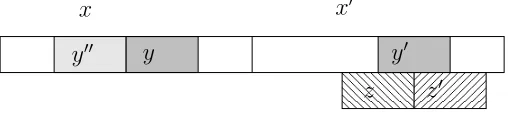
Case 2b: |x|≡2 (mod 4). By the same reasoning,xcontains a centered blocky, so x′ contains an occurrence ofy (called y′) starting at the same relative position. Since |x|≡2 (mod 4),y′ overlaps a blockz starting at 2 positions to its left, and z lies entirely withinx′. But by inspection, this can only occur if
(i) ystarts with 01 andz ends with 01; or (ii) ystarts with 01 andz ends with 01.
In case (i),yis either 0111 or 0101, andz= 0101. Ify= 0111, then consider the block z′ that followsziny′. It must begin 11, a contradiction. Hencey= 0101.
Now the first two symbols of z precede y′ in x′ and hence must also precede y′ =y inx. Thus the blocky′′ that precedesy inxmust end in 01; it is entirely contained inxbecausey is centered. Hencey′′= 0101, andy′′y is a shorter square inw, a contradiction. See Figure 2.
x
x
′y
y
′′y
′z
z
′Figure 2: Case 2b(i)
In case (ii),y is either 0111 or 0101, andz = 0101. If y = 0111, then consider the blockz′that followsziny′. It must begin 11, a contradiction. Hencey= 0101. Now the first two symbols of z precedey′ inx′ and hence must also precede y′ inx. Thus the blocky′′that precedesyinxmust end in 01; it is entirely contained inxbecausey is centered. Hencey′′= 0101. Hencey′′y is a shorter square inw, a contradiction.
Case 2c: |x|≡0 (mod 4). Then we can writex=rx1x2· · ·xjl′,x′=r′x′
1x′2· · ·x′jl′′, where lr = x0 (this defines l), l′r′ = x′
0, l′′r′′ = xj+1′ , andx1, . . . , xj, x′0, . . . x′j+1 are all blocks. Furthermore, since x= x′ and τ◦ϕ is injective, we have r = r′, x1 = x′
x
x
′x
1x
2· · ·
x
jx
′0x
′2· · ·
x
′jx
′j+1r
l
l
′r
′l
′′r
′′x
′1
x
0Figure 3: Case 2c
Subcase (i): i≡1,2 (mod 4). Then|r|=|r′|=|r′′|= 2 or 3. Since any block is uniquely determined by a suffix of length 2, we must haver=r′ and sox0=x′
0. Hencex0· · ·xjx0· · ·xj corresponds to a shorter square inw, by taking the inverse image of each block, a contradiction.
Subcase (ii): i ≡ 3 (mod 4). Then |l| = |l′| = |l′′| = 3. Again, any block is uniquely determined by a prefix of length 3, so l′ = l′′. Thus x′
0 = x′j+1 and x1· · ·xjx′
0x′1· · ·x′j+1 is a square. But each of these terms is a block, so this cor-responds to a shorter square in w, by taking the inverse image of each block, a contradiction.
Subcase (iii): i ≡ 0 (mod 4). In this case both xand x′ can be factored into identical blocks, and hence correspond to a shorter square in w, by taking the inverse image of each block, a contradiction.
This completes the proof thatw is squarefree.
It remains to show that if xx′ are consecutive factors of w, then !x cannot equal!x′ unless both are 0.
First, we prove a lemma.
Lemma 6. Let ζ be the morphism defined by
0,0′ → 0 1 0′−1 1 → 0 1−1 1 0′−1
−1 → 1−1. Then
(a) ϕn
◦ζ=ζn+1 for all n≥0. (b) ϕn(0) =ζn(0) forn
≥0.
Now assume the result is true for somen≥1; we prove it forn+ 1: ϕn+1◦ζ = (ϕ◦ϕn)◦ζ
= ϕ◦(ϕn
◦ζ)
= ϕ◦ζn+1 (by induction) = ϕ◦(ζ◦ζn)
= (ϕ◦ζ)◦ζn = ζ2◦ζn = ζn+2.
(b): Again, the result is trivial forn = 0,1. Assume it is true for somen≥1; we prove it forn+ 1. Then
ζn+1(0) = ϕn(ζ(0)) (by part (a)) = ϕn(ϕ(0))
= ϕn+1(0).
⋄
Now letβ:{0,1,−1}∗→{0,1,−1}∗ be defined as follows: 0 → 0 1 0−1
1 → 0 1−1 1 0−1
−1 → 1−1
Note thatβ is the map obtained fromζby equating 0 and 0′, which is meaningful becauseζ(0) =ζ(0′). Then from Lemma 6 we get
τ(ϕn(0)) =βn(0) (8) for alln≥0.
Now form the wordvfromwby taking the running sum. More precisely, define
v[i] = !
0≤j≤iw[j]. We first observe that v takes its values over the alphabet
{0,1}: From Eq. (8) we see thatw=βω
(0). But the image of each letter underβ sums to 0, and furthermore, the running sums of the image of each letter are always either 0 or 1. From this the statement about the values ofvfollows.
Letxx′ be a factor of w beginning at position i, with|x|=n, |x′|=n′. Then
w[i..i+n−1] has the same sumsasw[i+n..i+n+n′−1] if and only ifv[i+n+ n′
Corollary 7. For everyk≥3, there exists a squarefree infinite word over{0,1, . . . , k−1} avoiding all factors of the form xx′ with !x = !x′ = a for all a
%≡
0 (mod k).
Proof. Take the wordw=βω
(0) constructed above, and map−1 tok−1.
4. Upper and Lower Bounds
We call a word of the form x1x2· · ·xr where |x1|=|x2|=· · · =|xr|and !x1 ≡ !x2
≡· · ·≡!xr (mod k) acongruentialr-power (modulo k). As we have seen, the lengths of words on{0,1, . . . , k−1}avoiding congruentialr-powers, modulok, are bounded. We now consider estimating how long they can be, as a function ofr andk.
Our first result uses some elementary number theory to get an explicit lower bound for congruential 2-powers.
Theorem 8. If pis a prime, there is a word on{0,1, . . . , p−1}of length at least p2−p−1avoiding congruential 2-powers (modulop).
Proof. All arithmetic is done modulop. Letc be an element of order (p−1)/2 in (Z/(p))∗. Ifp≡5,7 (mod 8), letabe any quadratic residue ofp. Ifp≡1,3 (mod 8), letabe any quadratic non-residue ofp. Lete(k) =ck+ak2 for 1≤k≤p2−p, and definef as the first difference of the sequence of e’s; that is, f(k) =e(k+ 1)−e(k) for 1≤k≤p2
−p−1. Then we claim that the wordf =f(1)f(2)· · ·f(p2
−p−1) avoids congruential squares (modp).
To see this, assume that there is a congruential square inf. Then the sequence e would have three terms where the indices and values are both in arithmetic progression, say k, k+r, and k+ 2r. Then (ck+r+a(k+r)2)−(ck +ak2) = (ck+2r+a(k+ 2r)2)
−(ck+r+a(k+r)2). Simplifying, we get ck(cr
−1)2=−2ar2. (9)
Ifcr
%≡1 (modp), then
ck/(−2a)≡(r/(cr−1))2 (modp). (10) Now the right-hand side of (10) is a square (modp), so the left-hand side must also be a square. Butck is a square, since c=g2 for some generator g. So
−2amust be a square. But if p≡1,3 (mod 8), then −2 is a square modp, so −2ais not a square. If p≡5,7 (mod 8), then−2 is a nonsquare mod p, so −2ais again not a square.
Hence it must be thatcr
(modp), we must havej≡0 (modp). Soj≥p. Then 2ris≥p(p−1). This gives the lower bound.
We now turn to some asymptotic results. For the remainder of this section, as is typical in the Ramsey theory literature [10], we use the language of colorings: instead of saying the ith letter of a string xis j, we’ll intepret it as coloring the integeriwith colorj.
We first investigate the growth rate, ask→ ∞, of the minimum integernsuch that every word of lengthnover{0,1, . . . , k−1}has a congruential 2-power modulo k.
We start with some definitions. LetΩ(3, k) be the smallest integern such that every set {x1, x2, . . . xn}with xi ∈ [(i−1)k+ 1, ik] contains a 3-term arithmetic progression. LetL(k) be the minimum integernsuch that everyk-coloring of [1, n] that uses the colors 0,1, . . . , k−1 admits a congruential 2-power (modulok). Let w(k, r) be the classical van der Waerden number, that is, the least positive integer w such that for all n≥w, every r-coloring of {1,2, . . . , n}has an monochromatic arithmetic progression of length k. Finally, letw1(3, k) be the minimum integern such that every 2-coloring of [1, n] admits either a 3-term arithmetic progression of the first color, orkconsecutive integers all with the second color.
Lemma 9. For any k∈N, we haveL(k)≥Ω#3,'k 2
($ −1. Proof. Consider a maximally valid set of sizen=Ω#
3,'k 0 is not used in this construction). We claim that D has no congruential 2-power. Assume, for a contradiction, that it does. Let !y
i=xdi ≡
!2y−x+1
y+1 di (modk). Then, by construction ofD, we have
Since the length of each of these intervals is the same and is at mostk−1, we see that (11) is satisfied as an equality. Hence,sx, sy+1, s2y−x+2 is a 3-term arithmetic progression inS, a contradiction. Thus,L(k)>|D|=n−1 =Ω(3, k)−2 and we are done.
Continuing, we investigate the growth rate ofL(k) throughΩ(3, k). We have the following result.
Lemma 10. For allk∈N,w1(3, k)≤kΩ(3, k).
Proof. Letm=Ω(3, k) and letn=km. Letχbe any (red, blue)-coloring of [1, n]. Assume there are no k consecutive blue integers. So, for each i, 1 ≤i ≤ m, the interval [(i−1)k+ 1, ik] contains a red element, sayai. Then, by the definition of Ω(3, k), there is a 3-term arithmetic progression among theai’s.
Recently, Ron Graham [6] has shown the following.
Theorem 11. (Graham)There exists a constantc >0such that, forksufficiently large, w1(3, k)> kclogk.
As a corollary, using Lemma 10, we have
Corollary 12. There exists a constant c > 0 such that, for k sufficiently large, Ω(3, k)> kclogk.
Proof. From Theorem 11 and Lemma 10 we have, for somed >0,
Ω(3, k)≥w1(3, k)k > kdlogk−1> kd
2logk.
Takingc=d
2 gives the result.
We now apply Corollary 12 to Lemma 9 to yield the following theorem, which states thatL(k) grows faster than any polynomial ink.
Theorem 13. There exists a constant c > 0 such that, for k sufficiently large,
L(k)> kclogk.
Proof. We have (suppressing constant terms)
L(k)≥Ω
-3, *
k 2
+. >
-k 2
.dlogk2
for somed >0, providedkis sufficiently large. Since k 2 >
√
kfor k >4 this gives, for sufficiently largek,
L(k)> kd2logk2 > kd4logk.
Takingc=d
We now turn from congruential 2-powers to the more general case of congruential t-powers. To this end, defineL(k, t) to be the minimum integer nsuch that every k-coloring of [1, n] using the colors 0,1, . . . , k−1 admits a congruential t-power modulok.
Adapting the proof of Lemma 9 to this setting, we immediately get
Lemma 14. For anyk, t∈N, we have L(k, t)≥Ω#
t+ 1,'k 2
($ −1. Now, a result due to Nathanson [12] gives us the following result.
Theorem 15. For anyk, t∈N, we have
Ω
-t+ 1,/k 2
0. ≥w
-12t
k 2
+ 1;/k 2
0. .
Whenk= 4, this gives us the following.
Corollary 16. For any t∈Nwe haveL(4, t)≥w%1t 2 2
+ 1; 2&−1.
Hence, this says, roughly, thatL(4,2ℓ) serves as an upper bound for the classical van der Waerden number w(ℓ,ℓ).
A recent result of Bourgain [1] implies the bound w(3;k) = o(kck3/2
) for some constantc >0.
Hence, for sufficiently largek, there exist constantsc, d >0 such that kclogk<L(k)< kdk3/2
so that we have a very rough idea of the growth rate.
5. Computational Results
r k l(r, k) xr,k
2 2 3 010
2 3 7 0102010
2 4 16 0130102013101201
2 5 33 010214243213143040102142432131430 2 6 35 01024021240241402401024021240241402
2 7 47 01021614636032312426404301021614636032312426404 3 2 9 001101100
3 3 67 001021011202120010202212101120212001020101210112021200102 1002210112
4 2 88 001100011000100111001000110001100010011100100011000110001 0011100100011000110001001110011
It remains an interesting open problem to find better upper and lower bounds on the length of the longest word avoiding congruential powers.
Note added in proof (November 10, 2010): Recently, Cassaigne, Richomme, Saari, & Zamboni [2] have found results similar to, but stronger than, our Theorem 2.
AcknowledgmentsWe thank Thomas Stoll for a helpful observation. Theorem 8 was inspired by some related empirical calculations by Richard (Yang) Peng.
References
[1] J. Bourgain Roth’s theorem on progressions revisited. J. Anal. Math104(2008), 155–192.
[2] J. Cassaigne, G. Richomme, K. Saari, and L. Q. Zamboni. Avoiding Abelian
powers in binary words with bounded Abelian complexity. Preprint, available at
http://arxiv.org/abs/1005.2514.
[3] P. Erd˝os. Some unsolved problems. Magyar Tud. Akad. Mat. Kutat´o Int. K¨ozl.6(1961),
221–254.
[4] A. A. Evdokimov. Strongly asymmetric sequences generated by a finite number of symbols. Dokl. Akad. Nauk SSSR179(1968), 1268–1271. In Russian. English translation inSoviet
Math. Dokl.9(1968), 536–539.
[5] A. R. Freedman. Sequences on Sets of Four Numbers,. Preprint(2010)
[6] R. Graham. On the growth of a van der Waerden-like function.
IN-TEGERS: Elect. Journ. Comb. Number Theory 6 (2006), #A29 (electronic),
http://www.integers-ejcnt.org/vol6.html
[7] L. Halbeisen and N. Hungerb¨uhler. An application of Van der Waerden’s theorem in
ad-ditive number theory. INTEGERS: Elect. Journ. Comb. Number Theory0 (2000), #A7
[8] J. Justin. G´en´eralisation du th´eor`eme de van der Waerden sur les semi-groupes r´ep´etitifs.J. Combin. Theory. Ser. A12(1972), 357–367.
[9] V. Ker¨anen. Abelian squares are avoidable on 4 letters. In W. Kuich, editor,Proc. 19th Int’l Conf. on Automata, Languages, and Programming (ICALP), Vol. 623 ofLecture Notes in Computer Science, pp. 41–52. Springer-Verlag, 1992.
[10] B. M. Landman and A. Robertson. Ramsey Theory on the Integers. Amer. Math. Society,
2004.
[11] M. Lothaire. Combinatorics on Words, Vol. 17 of Encyclopedia of Mathematics and Its
Applications. Addison-Wesley, 1983.
[12] M. Nathanson Arithmetic progressions contained in sequences with bounded gaps. Canad.
Math. Bull.23(1980), 61–68.
[13] G. Pirillo and S. Varricchio. On uniformly repetitive semigroups. Semigroup Forum 49
(1994), 125–129.
[14] P. A. B. Pleasants. Non-repetitive sequences.Proc. Cambridge Phil. Soc.68(1970), 267–274.
[15] A. Thue. ¨Uber unendliche Zeichenreihen. Norske vid. Selsk. Skr. Mat. Nat. Kl.7(1906),
1–22. Reprinted inSelected Mathematical Papers of Axel Thue, T. Nagell, editor, Univer-sitetsforlaget, Oslo, 1977, pp. 139–158.
[16] A. Thue. ¨Uber die gegenseitige Lage gleicher Teile gewisser Zeichenreihen.Norske vid. Selsk. Skr. Mat. Nat. Kl.1(1912), 1–67. Reprinted inSelected Mathematical Papers of Axel Thue,
T. Nagell, editor, Universitetsforlaget, Oslo, 1977, pp. 413–478.
[17] B. L. van der Waerden. Beweis einer Baudet’schen Vermutung.Nieuw Archief voor Wiskunde