U
N
I
T
E
D
N
A
T
I
O
N
S
E
N
V
I
R
O
N
M
E
N
T
P
R
O
G
R
A
M
M
E
BANK AND
INVESTOR
RISK POLICIES
ON SOFT
COMMODITIES
SUMMARY
A f r a m ewo r k t o eva l u a t e
d e f o r e s t a t i o n a n d f o r e s t
d e g r a d a t i o n r i s k i n t h e
a g r i c u l t u r a l va l u e c h a i n
Copyright © United Nations Environment Programme, July 2015 This publication may be reproduced in whole or in part and in any form for
educational or non-proit purposes without special permission from the copyright holder, provided acknowledgement of the source is made. UNEP would appreciate receiving a copy of any publication that uses this publication as a source.
No use of this publication may be made for resale or for any other commercial purpose whatsoever without prior permission in writing from the United Nations Environment Programme.
Disclaimer
The designations employed and the presentation of the material in this publication do not imply the expression of any opinion whatsoever on the part of the United Nations Environment Programme concerning the legal status of any country, territory, city or area or of its authorities, or concerning delimitation
of its frontiers or boundaries. Moreover, the views expressed
do not necessarily represent the decision or the stated
policy of the United Nations Environment Programme, nor does citing of trade names or commercial processes constitute endorsement.
UNEP
promotes
environ-mentally sound practices
globally and in its own activities.
This publication is printed on 100%
recycled paper, using vegetable-based
Bank and Investor Risk Policies on Soft Commodities 3
A C K N O W L E D G E M E N T S
Contributing Authors: K. Morrison (Sustainalytics), I. Pinnington (Sustainalytics), A. Nordheim (UNEP FI and NCD). Edited: L. van Ast (Global Canopy Programme and NCD) and I. Mulder (UNEP)
This project has been made possible through funding of the UN-REDD Programme and support and guidance by UNEP Finance Initiative.
Acknowledgements:
We would like to thank the following signatories to the Natural Capital Declaration (NCD) for contributing to the study by sharing information about their policies and participating in interviews:
◾ ASN Bank, The Netherlands ◾ Banorte, Mexico
◾ Calvert, USA
◾ FMO, The Netherlands
◾ International Finance Corporation (World Bank Group) ◾ MN Services, The Netherlands
◾ Pax World, USA
◾ Rabobank, The Netherlands ◾ Standard Chartered, UK
◾ Sumitomo Mitsui Trust Bank, Japan
We would also like to thank: Iain Henderson, Programme Oficer REDD+ and Sustainable Land Use at UNEP FI for his valuable input and feedback; Joshua Levin, Senior Program Oficer in Finance & Commodities at WWF for contrib -uting to the research framework and criteria for evaluating inancial institu -tions’ policies; Andrew Voysey, Director, Finance Sector Platforms, University of Cambridge Institute for Sustainability Leadership; and Paul Chandler, Manager of Investor Engagement, Environmental Issues, at the UN-supported Principles for Responsible Investment, for participating in interviews.
External reviewers:
NCD Advisory Network: Ben Caldecott, Smith School of Enterprise and the Environment; Hilde Jervan, Norwegian Government Pension Fund – Global; Hayden Morgan, UK Green Investment Bank; Jared Osoro, Kenya Bankers Association; Andrew Voysey, University of Cambridge Institute for Sustainability Leadership
NCD Signatories: ASN Bank, Banorte, FMO, Pax World, Rabobank, Standard Chartered
NCD Supporters: CDP, Clarmondial, WWF
Principles for Responsible Investment: Paul Chandler and Titia Sjenitzer Zoological Society of London: James Horne
UN-REDD Programme: Mirey Attalah
F O R E W O R D
The continuing loss of the world’s tropical rainforests represents a signiicant threat to the security of water, food, energy, health and climate for millions worldwide. To be involved in such wholescale erosion of natural capital1 is simply bad business. Banks and investors can drive deforestation and land conversion through their lending and investment practices, exposing them-selves to potentially signiicant risks. These include regulatory, reputational, legal, operational, biophysical and market risks, which in turn could affect the credit risk or market value of the underlying asset. Meanwhile, new opportuni-ties are emerging to curb deforestation and produce sustainable value chains for commodities. Financial institutions can be part of the solution by adopting new products and services.
Addressing deforestation is high on the twenty-irst century policy agenda, as seen at the Conference of the Parties to the UN Framework Convention on Climate Change (UNFCCC) and other high-level events such as the 2014 Climate Summit. A signiicant driver of tropical deforestation is the clearing of land to satisfy growing global demand for agricultural commodities, including beef, soy, and palm oil. With this in mind, many developing countries have committed to reduce emissions from agriculture and forestry activities as major foundations of their Nationally Appropriate Mitigation Actions, or NAMAs, under the UNFCCC. As such, they are reducing emissions from deforestation and forest degradation through conservation and enhancement of forest carbon stocks and sustainable management of forests.
For its part, the United Nations Environment Programme (UNEP) is actively supporting efforts to reduce deforestation and forest degradation in more than 50 partner countries through REDD+, a global initiative co-managed with the United Nations Development Programme (UNDP) and the Food and Agriculture Organization of the United Nations (FAO).2
Bank and Investor Risk Policies on Soft Commodities 5
This study, commissioned by UNEP as part of the UN-REDD Programme, aims to provide greater clarity on policies that banks and investors can adopt to reduce deforestation and forest degradation from the production of soy, palm oil and beef. The study and the accompanying tool are produced by the Natural Capital Declaration (NCD). A unique global inance-led and CEO-endorsed initiative, NCD seeks to accelerate the integration of natural capital consider-ations into inancial products and services such as loans, bonds and equities.
This study and the tool lay the foundation for linking inancial sector decisions to deforestation and forest degradation. They will help inancial institutions better understand the dependencies of soft commodity producers on forest ecosystems, and how their businesses affect these ecosystems. This, in turn, allows inancial institutions to gain more insight into their own risks and opportunities. Ultimately, this more profound inancial analysis would be included in accounting, disclosure and reporting.
Achim Steiner
United Nations Under-Secretary-General
S U M M A R Y
3
Palm oil, soy and beef are valuable soft commodities,4 but their production often drives deforestation and forest degradation. Banks, investors and other
types of inancial institutions can be exposed to risks from companies in soft commodity production value chains by providing debt, equity and other forms of capital to activities that contribute to the destruction of forest ecosystems.
This report examines the types of risk policies on soft commodities banks and
investors have developed to reduce or limit the chance of clients signiicantly
eroding tropical forests. It also provides recommendations on how inancial
institutions can strengthen approaches to manage these risks. Banks and fund managers can use an analytical framework developed by the Natural Capital Declaration (NCD) - the Soft Commodity Forest-risk Assessment (SCFA)
tool - to benchmark, inform, develop or update their risk policies. Financial institutions are encouraged to identify how they can improve their own risk policies to systematically consider and value natural capital in the credit poli-cies of speciic sectors, including commodities, that may have a major impact on natural capital either directly or through supply chains.5
Why are risks linked to soft commodity production relevant for
inancial institutions?
Increasing incidence of extreme weather due to climatic changes, natural resource scarcity, changing consumer preferences and demographics, and tighter regulations by governments to protect forest ecosystems and carbon storage may affect the competitiveness and resilience of companies that cause signiicant loss or degradation of ecosystems or have large dependencies on them. This creates environmental risk, which can become material if there is a probability that they will affect standard inancial performance metrics such as costs and revenue.
Financial institutions, especially those whose portfolios are signiicantly exposed to sectors with high direct or indirect impacts or dependencies on forest ecosystems, need to be aware of how this environmental risk may affect corporate lending, investment, advisory and other inancial operations and transactions. For example, on the lending side it may impede a client’s ability to service its debt and therefore impair the credit quality of the portfolio. On the investment side it may affect valuations. In insurance it may affect risk exposure. Banks, traders and investment managers have a considerable indi-rect natural capital footprint by lending to or investing in companies involved in unsustainable production, trade or sale of soft commodities. While it is at present dificult to calculate portfolio exposure to entities with signiicant forest footprints and the value at risk from environmental issues such as water scar-city or deforestation impacts, developing soft commodity policies represent a way for banks and investors to better manage their exposure through lending to or investment in companies or projects that potentially have high deforest-ation impacts.
A rapidly-emerging trend among consumer goods companies recognising these risks is to aim to develop commodity value chains with minimal or no deforest-ation impacts. These corporate initiatives and interndeforest-ational policy efforts to reduce deforestation and forest degradation – such as through the UN-REDD Programme – will increasingly place a spotlight on the role of the inancial sector in inancing activities that lead to deforestation, and its potential contri -bution to avoiding this.
Bank and Investor Risk Policies on Soft Commodities 7
forest degradation, as well as to stimulate conservation and enhancement of forest carbon stocks and sustainable management of forests (REDD+). This can create opportunities for inancial institutions if they align their risk policies with emerging trends to incentivize a shift to more sustainable production of commodities. Enhanced due diligence through more robust policy development and implementation can provide the foundation for innovation to develop prod-ucts and services that support the collaborative efforts by agricultural and consumer goods companies to remove deforestation from their supply chains.
Financial institutions may therefore apply policies to manage exposure to a range of risks through loans to or investments in companies involved in soft commodities. Banks providing inancing and advisory services for the production, processing and trade of soft commodities can adopt or strengthen policies to relect changing market and regulatory conditions. In addition, many investors can use policies to address signiicant asset exposure to corporate bonds and stocks in the broader agricultural value chain such as food and beverage companies as well as consumer goods companies. Providers of debt (such as a bank engaged in trade inance of soft commodities or lending to infrastructure development in a rainforest) or equity capital to agri-businesses and their customers (such as an investor with shares in a palm oil production company or a company using palm oil derivatives in its products) need to better understand how to embed environmental factors in risk management in order to control their exposure to the risks from deforestation. Fund managers and banks can strengthen policies to incentivize a shift towards more sustaina-ble soft commodities value chains, in turn contributing to a net reduction in deforestation and forest degradation.6
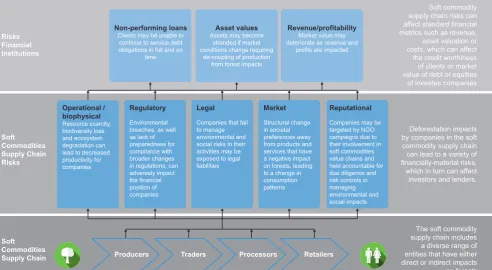
Throughout this study, risk refers to the inancial risks linked to deforesta -tion and forest degrada-tion, and related environmental and social issues. By lending to or investing in companies involved in the upstream production or downstream consumption of soft commodities, inancial institutions can be exposed to these risk factors, which are set to increase in the long term. Figure 1 below shows how inancial institutions’ decisions directly and indirectly affect the environment in and around forests. This inluence leads to a variety of risks for inancial institutions – both as a direct consequence of the inancing decisions and indirectly through their afiliation with companies in the sector.
Figure 1: The impact of inance lows on forests and the risks created for inancial institutions7 by companies in the soft commodity supply chain can lead to a variety of financially-material risks, which in turn can affect investors and lenders. value of debt or equities of investee companies
Forests Consumers Producers Traders Processors Retailers
Non-performing loans
Clients may be unable to continue to service debt obligations in full and on
time deteriorate as revenue and
What is the scale of the challenge?
Land-use conversion to produce agricultural commodities is the most signii -cant driver of deforestation, accounting for an estimated 55 to 80% of global forest loss.8,9 Palm oil, soy and beef are soft commodities that are grown or produced in the tropics on a large scale and are therefore major drivers of deforestation and forest degradation. In the agriculture sector, land clearance for livestock (mainly beef), soy, and palm oil resulted in around one-third of global deforestation between 1990 and 2008 (See igure 2).10
Figure 2: Global deforestation drivers (1990-2008)11
The countries that are the largest producers of these three soft commodities are mainly located in the Amazon Basin, South-East Asia, and increasingly the Congo Basin, all of which contain the largest continuous expanses of tropical forests in the world. Tropical forests store 42% of all carbon contained in the world’s forests, while covering only 33% of global forest area. They provide habitats for at least half of the earth’s terrestrial biodiversity, facilitating vital ecosystem services such as freshwater supplies and climate regulation,12 and support the food security and livelihoods of more than one billion people. Environmental and social impacts of deforestation and forest degradation include greenhouse gas (GHG) emissions that contribute to climate change, biodiversity loss, ecosystem degradation and the loss of livelihoods by commu-nities that depend on forest resources. Forests are a renewable but exhaustible natural resource that can be rendered inite by mismanagement and over-exploitation. The World Trade Organization (WTO) warns that trade may contribute to the exhaustion of resources by accelerating their depletion.13 Demand for soft commodities is increasing due to population growth, and from increasing per capita real income that leads to dietary changes. As produc-tion increases to meet rising demand for food and non-food crops, the social, environmental and economic beneits that they support will continue to be threatened.
Bank and Investor Risk Policies on Soft Commodities 9
How can inancial institutions contribute to the solution?
So far most attention has centred on corporations that contribute to deforest-ation through their value chains. However, as companies work to address the issue attention is increasingly extending to the role of the inancial sector in driving deforestation, and its potential to contribute to halting it. A 2011 report by UNEP FI and the UN-backed Principles for Responsible Investment (PRI) found that environmental costs that are externalised to society equate to about one-third of the proits of the 3,000 largest publicly listed companies. These costs can potentially rebound onto portfolio companies or corporate clients through inlated input prices, higher taxes, stricter insurance terms and the physical costs of environmental degradation and resource depletion that can affect the operating costs of portfolio companies.14 The Norwegian Government Pension Fund (Global), one of the world’s largest sovereign wealth funds, announced it was divesting from holdings following a review of its investment policies relating to deforestation.15 Such actions may increasingly become
a factor through which inancial institutions can differentiate themselves for responsible investment mandates, thereby reducing risk and increasing opportunities.
To respond to this trend, a growing number of banks, investment irms and other inancial institutions have started to develop policies that describe under what conditions they engage with companies and clients in environmental-ly-sensitive sectors. These include producers of palm oil, soy and beef. However, there is limited need to strengthen understanding of how inancial institutions can monitor and mitigate this risk. This project aims to close some of the gap by providing a clear understanding of risks from soft commodities for inancial institutions, and offering a tool to help benchmark and strengthen policies to manage this risk.
The NCD project developed the following outputs:
◾ A Soft Commodity Forest-risk Assessment (SCFA) tool for inancial
institutions that want to develop or update their policies for clients that are active in the palm oil, soy or beef business to address the issues of natural capital, deforestation or forest degradation, focusing on corporate lending, public equities, and advisory services. The tool, based on an existing
frame-work by WWF and developed further with input from inancial institutions,
experts and academics, is freely available on the NCD website, together with a guide on how to use it and how institutions can interpret the results to enable mainstreaming.
◾ The SCFA was used to evaluate 30 inancial institutions on policies
and processes to manage deforestation and forest degradation risk, based on publicly available information, associated with the three soft commodities: palm oil, soy and beef. In addition, Sustainalytics conducted interviews with 11 inancial institutions. This snapshot provides insight into the current state-of-play within the sector.
◾ Results of the evaluation were used to develop recommendationson mini-mum standards and leading practice in how banks and investors can develop risk policies and increase transparency and understanding of expo-sure to credit risk from deforestation.
◾ A preliminary attempt to describe how deforestation impacts or foot-prints of inancial institutions can be linked to material risks they may be exposed to, to provide the rationale for adopting policy recommendations developed under the project.
The full report also identiies a number of factors that can affect inancial
Key indings from the assessment of inancial institutions
Financial institutions were evaluated on a framework comprised of weighted criteria for three pillars: policy scope; policy strength; and implementation, monitoring and reporting. While this report focuses on three soft commodi-ties, the tool can also be extended to other commodities that cause risk from deforestation and forest degradation.
The average overall score for the inancial institutions reviewed was 58 out of 100, which can be regarded as an initial benchmark against which to evaluate individual inancial institutions. Many of the inancial institutions evaluated have strong policies and processes relative to the benchmark to address sustainability risks in soft commodities. Scores cover a wide range, with the highest score being 93 out of 100 and the lowest score being 10 out of 100. Nine inancial institutions achieved scores above 80, and eight scored between 30 and 39.
Bank and Investor Risk Policies on Soft Commodities 11
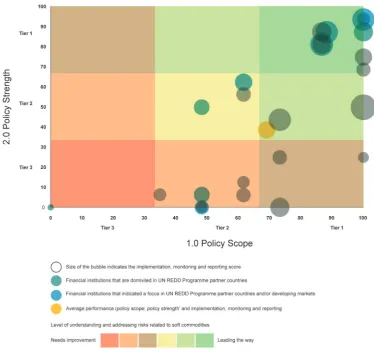
Figure 3: Benchmark results: how the risk policies on soft commodities of 30 inancial institutions score on scope, strength and implementation, monitoring and reporting
◾ There is broad awareness in the sample that the inancial sector is exposed
to risks from deforestation linked to the production and processing of soft commodities.
◾ Scores between inancial institutions differed widely, ranging from 10 – for
a bank that did not disclose sustainability information – to 93 (out of a total possible score of 100).
◾ On average, the 30 inancial institutions reviewed scored 58 across the three
categories.
◾ A threshold score of 67/100 was established as a benchmark for best practice
across all three categories analysed, with 12 top-scoring inancial institu
-tions grouped into this Tier 1. 15 inancial institu-tions with scores between
33 and 67 are grouped in Tier 2, while three with limited policies or disclo-sure that score below 33 are grouped in Tier 3.
◾ Financial institutions that scored highly on the policy scope pillar also tended to do well on policy strength. Implementation, monitoring and report-ing scores were positively correlated with policy scope and policy strength.
Few if any inancial institutions systematically quantify exposure to risks
related to soy, palm oil and beef at the portfolio level. Challenges in doing so include access to information, limited resources, and the complexity of
calculating and deining risk levels.
◾ Almost all inancial institutions disclose some evidence of processes to imple
-ment their soft commodity or general sustainability policies, both internally
and externally. However, many do not disclose evidence of speciic activities
to monitor clients’ compliance with their policies on an ongoing basis, which is an important area for improvement.
◾ Almost half of the 30 inancial institutions evaluated have policies in place to
identify, manage and control or mitigate risks linked to loans or investments in companies involved in soft commodities.
◾ 37% of inancial institutions assessed refer to legal compliance in their
policies. The majority of policies assessed do not explicitly require a client
or investee to comply with applicable laws and regulations. Some inancial
institutions include this requirement in agreements with clients rather than in public documents. Publicly disclosing requirements for compliance
in inancial transactions can provide an important signal to companies,
particularly in countries with weak regulatory enforcement.
◾ 13% of inancial institutions assessed have developed inancial products
and services aimed at promoting the production and trade of sustainable commodities. There is appetite to develop further opportunities for
sustain-able inance.
Bank and Investor Risk Policies on Soft Commodities 13
Minimum and best practice recommendations
Financial institutions can use the Soft Commodity Forest-risk Assessment (SCFA) tool to benchmark their policies against the average score or thresholds for each Tier, with results against speciic criteria indicating potential areas for improvement.
Minimum and best practice recommendations have been developed for inancial institutions based on the analysis of the policies of 30 inancial institutions. The minimum standards can be used by inancial institutions seeking a basic risk policy framework, whereas best practice standards can be used for more institutions seeking a more advanced framework. For example, the minimum standards can be used by inancial institutions that do not have any kind of policy in place yet, whereas the best-practice standards can be used by insti-tutions to improve their existing risk policies. Almost all inancial instiinsti-tutions disclose some evidence of processes to implement their soft commodity or general sustainability policies, both internally and externally. However, many do not disclose evidence of speciic activities.
Minimum:
◾ Disclose a general sustainability policy or detailed statement addressing environmental and social issues broadly.
◾ Reference relevant commodity roundtables and other credible sustainability certiications when assessing the performance of clients or investees.
◾ Outline some speciic environmental and social requirements.
◾ Disclose implementation and monitoring efforts within the organization that are focused on environmental, social and governance (ESG) or sustainability issues.
Best-practice:
◾ Disclose a formal policy that addresses the environmental and social impacts associated with speciic soft commodities. Apply the policy to all inancial services offered by the inancial institution, and to all stages of the value chain.
◾ Require (or strongly encourage) upstream companies to achieve or commit to a time-bound plan to achieve certiication under the relevant commodity roundtables: Roundtable on Sustainable Palm Oil (RSPO), Roundtable on Responsible Soy (RTRS) or other credible sustainability certiications.
◾ Disclose efforts to implement and monitor compliance with policies within companies that the institution provides inancial services to or invests in, speciically in relation to soft commodities. Such activities may include the development of environment action plans with companies, engagement, screening, and audits/company visits.
Limitations of the report
The soft commodity risk policies of 40% of the 30 inancial institutions that were reviewed for this study are considered best practice. However, there are three main caveats to this. First, limited information is available on what proportion of their loan and investment portfolios banks and investors apply such policies. Second, better evidence and causation is needed on how risk poli-cies by banks and investors can lead to a reduction in deforestation and forest degradation (especially in the absence of a level legal playing ield provided through government regulation). Third, banks and investors require stronger evidence on how deforestation by clients or through the agricultural supply chain can lead to enhanced credit risk for the lender or investor.
Next Steps
natural capital risks and opportunities. In order to build a stronger business case for inancial institutions to evaluate ecosystem impacts it is necessary to develop and test practical and where possible quantitative tools, methods and frameworks that enable banks and other institutions to integrate risks related to deforestation and forest degradation in the inancial analysis of loans, bonds and equities. While the SCFA tool is qualitative, future work aims to integrate risks from degradation of natural capital into credit assessments, cash-low analysis and other inancial metrics used for everyday decisions in the inancial sector. In this way, natural capital considerations may become a more integral part of inancial sector decision-making.
Additional Resources
For further information and full references please consult the full version of this report. The spreadsheet tool and guidance on how to use it is available from the Natural Capital Declaration website:
Bank and Investor Risk Policies on Soft Commodities 15
G U I D A N C E F O R U S I N G T H E
SOFT COMMODITY
FOREST-RISK ASSESSMENT (SCFA) TOOL
About The SCFA Tool
This lexible Excel-based tool draws from the Natural Capital Declaration (NCD) policy framework and research to assess inancial institutions’ policies and processes to manage exposure to deforestation and forest degradation risks associated with three soft commodities: palm oil, soy, and beef. The NCD contracted Sustainalytics to develop a research framework to create the tool. Sustainalytics conducted desk-based research and interviewed 11 inancial institutions to inform the tool’s development.
This tool can be used to:
Assess your inancial institution’s policies and processes to manage exposure to deforestation and forest degradation risks associated with palm oil, soy, and beef, across three research categories:
1.0 Policy Scope; 2.0 Policy Strength;
3.0 Implementation, Monitoring and Reporting.
Compare the results of your policy assessment to 30 inancial institutions, which have been researched by Sustainalytics and are presented anonymously, and evaluate your scores against speciic criteria to identify strengths and potential areas for improvement. Use the tool to assess the potential effect of policy changes on your score.
How to Use This Tool
Step 1: Review the 2.0 Assessment Framework Overview and 3.0 Assessment Framework tabs. These tabs provide an overview of the individual research indicators under each of the four research categories. The 3.0 Assessment Framework tab outlines the answer categories associated with each indica-tor, as well as the weights and scores associated with each indicator. (Note: the indicator weights can be changed in the 3.0 Assessment Framework tab; however, the total indicator weight (cell G37) must add up to 100%.)
Step 2: In the 4.0 Assessment Inputs tab, under each indicator listed in row 2, choose the answer category that is best suited to your inancial institution’s current policies or processes. This information should be illed out across row 4, title [Your Financial Institution], using the dropdown menus that appear in the Answer Category cells. When an answer category is selected under a research indicator, the score associated with that answer category will automatically appear. The Comment Text and Source cells under each indicator heading can be used to document your inputs.
Step 3: Once the 4.0 Assessment Inputs tab has been illed out, the results
can be viewed in three different formats in the following tabs: 5.0 Assessment Results – Table, 6.0 Assessment Results – Matrix, 7.0 Assessment Results – Bar Chart.
Interpreting results:
A B O U T T H I S S T U D Y
This study should be cited as: United Nations Environment Programme (2015). Bank and Investor Risk Policies on Soft Commodities – A framework to eval-uate deforestation and forest degradation risk in the agricultural value chain.
This publication may be reproduced in whole or in part and in any form for educational or non-proit purposes without special permission from the copy -right holder, provided acknowledgement of the source is made.
UNEP would appreciate receiving a copy of any publication that uses this publication as a source. No use of this publication may be made for resale or for any other commercial purpose whatsoever without prior permission in writing from the United Nations Environment Programme.
A B O U T T H E N AT U R A L C A P I TA L D EC L A R AT I O N
The Natural Capital Declaration (NCD) was launched at the UN Conference on Sustainable Development (Rio+ 20 Earth Summit) in 2012 by UNEP FI and the UK-based non-governmental organization, Global Canopy Programme (GCP). It is a worldwide inance-led initiative to integrate natural capital considera -tions into inancial products and services, and to work towards their inclusion in inancial accounting, disclosure and reporting. The NCD is the cumula -tive result of in-depth consultations with the inance community and other stakeholders and is endorsed by the CEOs of inancial institutions. Signatory inancial institutions are working towards implementing the commitments in the Declaration through NCD projects. These are overseen by a steering committee of signatories and supporters and supported by a secretariat formed of the UNEP FI and GCP.
ABOUT THE GLOBAL CANOPY PROGR AMME (GCP)
The Global Canopy Programme (GCP) is a tropical forest think tank working to demonstrate the scientiic, political and business case for safeguarding forests as natural capital that underpins water, food, energy, health and climate security for all. GCP works through its international networks – of forest communities, science experts, policymakers, and inance and corporate leaders – to gather evidence, spark insight, and catalyse action to halt forest loss and improve human livelihoods dependent on forests. The Global Canopy Programme is a registered UK charity, number 1089110.
A B O U T U N E P F I N A N C E I N I T I AT I V E
Bank and Investor Risk Policies on Soft Commodities 17
A B O U T S U S TA I N A LY T I C S
Sustainalytics supports investors around the world with the development and implementation of responsible investment strategies. The irm partners with institutional investors that integrate environmental, social and governance information and assessments into their investment decisions. Headquartered in Amsterdam, Sustainalytics has ofices in Boston, Bucharest, Frankfurt, London, New York City, Paris, Singapore, Timisoara and Toronto, and representatives in Bogotá, Brussels, Copenhagen and Washington D.C. The irm has 200 staff members, including more than 120 analysts with varied multidisciplinary expertise and thorough understanding of more than 40 industries. In 2012, 2013 and 2014, Sustainalytics was voted best independent sustainable and responsible investment research irm in the Extel IRRI survey.
This report was drafted in accordance with the agreed work to be performed and relects the situation as on the date of the report. The information on which this report is based has – fully or partially – been derived from third parties and is therefore subject to continuous modiication. Sustainalytics observes the greatest possible care in using information and drafting reports but cannot guarantee that the report is accurate and/or complete. Sustainalytics will not accept any liability for damage arising from the use of this report, other than liability for direct damage in cases of an intentional act or omission or gross negligence on the part of Sustainalytics.
E N D N O T E S
1. Natural capital comprises Earth’s natural assets (soil, air, water, lora and fauna), and the ecosystem services resulting from them, which make human life possible.
2. Reducing Emissions from Deforestation and Forest Degradation (REDD) is an effort to create a inancial value for the carbon stored in forests, offering incentives for developing countries to reduce emissions from forested lands and invest in low-carbon paths to sustainable development. “REDD+” goes beyond deforestation and forest degradation, and includes the role of conservation,
sustainable management of forests and enhancement of forest carbon stocks. 3. For the full version of the report, the SCFA tool and a user guide please see:
http://www.naturalcapitaldeclaration.org/softcommoditytool/
4. Soft commodities generally refers to commodities that are grown, rather than extracted such as metals and fossil fuels and include coffee, palm oil, wheat, soy, etc.
5. See: www.naturalcapitaldeclaration.org for an overview of inancial institution signatories and to download the Declaration.
6. See also UNEP FI (2011). REDDy SET GROW Part 1 – A brieing for inancial institutions. UNEP Finance Initiative (Geneva)
7. See also Mulder, I. & Koellner, T. (2011). Hardwiring green: how banks account for biodiversity risks and opportunities. Journal of Sustainable Finance and Investment. 103 -120; Vol. 1 8. Brack, D., & Bailey, R. (2013). Ending Global Deforestation: Policy Options for Consumer
Countries. Chatham House (London)
9. Kissinger, G., Herold, M., & De Sy, V. (2012). Drivers of Deforestation and Forest Degradation: A Synthesis Report for REDD+ Policymakers. Lexeme Consulting (Vancouver)
10. European Commission (2013). The impact of EU consumption on deforestation: Comprehensive analysis of the impact of EU consumption on deforestation. European Commission (Brussels) 11. Ibid
12. Rautner, M., Leggett, M. & Davis, F. (2013). High Conservation Value Forests: the concept in theory and practice. WWF International (Gland)
13. World Trade Organization (2010). World Trade Report 2010 – Trade in natural resources. World Trade Organization (Geneva)
14. PRI & UNEP FI (2011) Universal Ownership – Why environmental externalities matter to institutional investors. PRI Association and UNEP Finance Initiative
15. NBIM (2015). Norges Bank’s letter to the Norwegian Ministry of Finance, 5 February 2015. Available: http://www.nbim.no/en/transparency/submissions-to-ministry/2015/hearin---report-from- expert-group-on-instrumets-andinvestments-in-coal-and-petroleum-companies-of-the-government-pensionfund-global/
For more information, contact:
UNEP Finance Initiative
15, Chemin des Anemones CH-1219 Chatelaine, Geneva Switzerland
Tel: +41 (0) 22 917 8178 Fax: +41 (0) 22 796 9240
E-mail: [email protected] www.unepi.org
The continuing loss of the world’s tropical rainforests and the result-ing contribution to climate change, biodiversity loss and ecosystem degradation represents a significant threat to the security of water, food, energy, health and climate for millions worldwide. Banks and investors indirectly contribute to this when financing companies that drive deforestation and land conversion in their operations or supply chains. This can create both material risks for financial insti-tutions, as well as business opportunities to be part of the move to curb deforestation by stimulating the creation of sustainable value chains for soft commodities. This study provides a) greater clarity on policies that banks and investors can adopt to reduce forest impacts from the production of soy, palm oil and beef; b) an Excel-based tool allowing financial institutions to assess their own policies; c) a benchmark for financial institutions by evaluating the policies of 30 financial institutions. The study and tool are produced by the Natural Capital Declaration (NCD), a unique finance-led initiative that seeks to accelerate the integration of natural capital considerations into the finance sector. The tool and more information is available from: www.naturalcapitaldeclaration.org/softcommoditytool