Bacterial and Antibiotic Susceptibility Patterns in Patient with
Pediatric Urinary Tract Infection at Dr. Hasan Sadikin General Hospital
Muhammad Ilham Muttaqin,1 Dany Hilmanto,2 Neneng Syarifah Syafei3
1Faculty of Medicine Universitas Padjadjaran, 2Department of Child Health Faculty of Medicine
Universitas Padjadjaran/Dr. Hasan Sadikin General Hospital Bandung, 3Department of
Microbiology and Parasitology Faculty of Medicine Universitas Padjadjaran
Abstract
Background: Pediatric urinary tract infection (UTI) should become attention due to high prevalence, severe complication, and high cost treatment. Bacterial pattern and its susceptibility are different in every region.The objective of this study was to discover pattern of bacteria causing UTI and their susceptibility to antibiotics.
Methods: This study was an observational descriptive study. The data was obtained from medical records and susceptibility testing results of pediatric UTI in Department of Child Health at Dr. Hasan Sadikin General Hospital in period of 2014. Data taken was presented in table.
Results: There were 26 cultures which had microbiological findings among 79 cultures taken from 106 patients with UTI. The majority of findings were Escherichia coli (10 cases), Pseudomonas aeruginosa (4 cases), and Klebsiella pneumoniae (4 cases). Antibiotic classes with high susceptibility level were aminoglycoside, sulfonamide, and fluoroquinolone. Resistance level were higher in cephalosporin class than others.
Conclusions: Most common bacterial found are Escherichia coli, Pseudomonas aeruginosa, and
Klebsiellapneumoniae. The result of susceptibility testing for cultures shows variance of susceptibility pattern to antibiotics in pediatric patients with UTI at Department of Child Health Dr. HasanSadikin General Hospital. [AMJ.2017;4(1):52–7]
Keywords: Antibiotic susceptibility, bacteria, pediatric urinary tract infection
Correspondence: Muhammad Ilham Muttaqin, Faculty of Medicine, Universitas Padjadjaran, Jalan Raya
Bandung-Sumedang Km.21, Jatinangor, Bandung-Sumedang, Indonesia, Phone: +62 85721383075 Email: [email protected]
Introduction
Attention should be focused on pediatric urinary tract infection (UTI) due to high prevalence, severe complication, and high cost treatment. Urinary tract infection is one of the most bacterial infection in children. Urinary tract infection prevalence is higher in boys than in girls, 2.7% and 0.7%, respectively.1
Besides of high prevalence, UTI causes several complications, such as renal scars,
hypertension, and end-stage renal disease.2
Expense on UTI treatment creates another burden. UTI treatment costs are more than
total ≥180$ million per year in United States.3
Urinary tract infection in pediatric patients should be treated with antibiotics as soon as possible. Most cases need antibiotic therapy before the culture and susceptibility testing are done. Antibiotic therapy is started
with empirical therapy, then matched with susceptibility testing result. The selection
of antibiotics depends on the most frequent
pathogen causing UTI in previous cases.4
Since the bacteria and antibiotic susceptibility patterns are different in each region, knowledge of these pattern in each region is essential to provide clinically appropriate therapy.5
Incorrect antibiotic empirical therapy, such as overuse, misuse, or underuse, may increase bacterial resistance to antibiotic.6,7
The objective of this study was to investigate bacterial pattern and antibiotics susceptibility in pediatric patients with UTI.
Methods
Sadikin General Hospital Bandung from September to November 2015. The population in this study was all taken from medical records and laboratory exam results of pediatric patients which diagnosed as UTI and admitted to hospital in 2014. This study was approved by the ethical standard approval from Faculty of Medicine of Universitas Padjadjaran
and Health Research Ethics Committee Dr.
Hasan Sadikin General Hospital Bandung, no. LB.04.01/A05/EC/307/VII/2015.
The inclusion criterion of this study was all the medical records and laboratory exam results of pediatric patients who were admitted to Dr. Hasan Sadikin Hospital Bandung and diagnosed as UTI, either as primary diagnosis or additional diagnosis. The exclusion criteria were UTI pediatric patients without complete or available antimicrobial susceptibility test results. Samples were collected through total sampling. Urine samples were collected from midstream urine or catheter. This study
required access to obtain database of Clinical
Pathology Laboratory of Dr. Hasan Sadikin General Hospital to observe microbiological cultures and antibiotics susceptibility testing results. Susceptibility testing results were interpreted with Clinical & Laboratory Standard Institute.
Results
There were 106 pediatric patients with UTI in Dr. Hasan Sadikin General Hospital in period
of 2014. There were 79 urine cultures to be
examined taken from patients with diagnosis of UTI. There were 26 urine cultures from which were found microorganisms tested for its susceptibility to antibiotics later on.
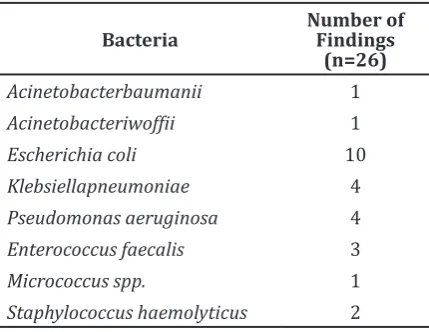
The results showed that three most frequent
bacteria causing UTI in pediatric patient were Escherichia coli, Klebsiellapneumoniae, and Pseudomonasaeruginosa (Table 1).
Urine cultures with positive bacterial colonization were tested for their susceptibility
to antibiotics and classified according to
criteria from CLSI. Susceptibility testing results showed variance of susceptibility level (Table
2). Aminoglycoside and fluoroquinolone had
high susceptibility to bacteria causing UTI,
while the findings of cephalosporin showed
high level of resistance to bacteria causing UTI (Table 2).
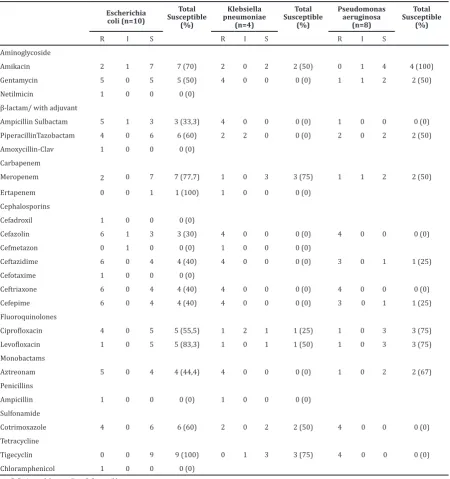
The data which became the most common pathogen (Escherichia coli, Klebsiellapneumoniae, and Pseudomonas aeruginosa) were presented in detail result (Table 3).
Escherichia coli fndings was known to be susceptible more than 50% to Amikacin,
PiperacillinTazobactam, Ertapenem,
Meropenem, Levofloxacin, Cotrimoxazole,
and Tigecycli, while the cephalosporin class have low susceptibility, such as Cefadroxil, Cefmetazon, Cefotaxime, Cefazolin, Ceftriaxone, and Cefepime.
Klebsiellapneumoniae was fully resistant to cephalosporin class antibiotic, such as Cefazolin, Cefmetazon, Ceftazidime, Ceftriaxone, andCefepime. While Klebsiellapneumoniae was susceptible to Amikacin, Meropenem,
Ciprofloxacin, Levofloxacin, Cotrimoxazole,
and Tigecyclin. Pseudomonas aeruginosa
were susceptible to Amikacin, Piperacillin-Tazobactam, Ciprofloxacin, and Levofloxacin.
While Pseudomonas aeruginosa was fully resistant to Ampicillin Sulbactam, Cefazolin, Ceftriaxone, Cotrimoxazole, and Tigecyclin.
Discussion
This study discovers the most common bacteria causing UTI in pediatric patient at Department of Child Health was Escherichia coli, followed by Klebsiellapneumoniae and Pseudomonas aeruginosa. This result was similar to the recent study by Edlin et al.8 and
Garout et al.9 which showed that the most common uropathogen was Escherichia coli.
These findings were different from the study
conducted by Rezaeet al.5 and Waadallah et
al.10 which showed that Klebsiellapneumoniae
and Enterococcus spp were the second and third most common uropathogen, respectively. It might be due to Pseudomonas
Table 1 Bacterial Pattern from Urine Cultures of Pediatric Patients with Diagnosis of UTI
Table 2 Susceptibility Patterns of Bacteria to Antibiotics from Urine Culture of Patients with Diagnosis of UTI
Acineto-bacter Baumanii
(n=1)
Acineto-Bacter Iwoffii (n=1)
Eschericia Coli (n=10)
Klebsiella Pneumoniae
(n=4)
Pseudo-Monas aeruginos
(n=4)
Entero-Coccus faecalis (n=3)
Strepto-Coccus haemolyticus
(n=2)
Micro-Coccus (n=1)
Total Susceptible (Persentase)
Aminoglycoside
Amikacin 1 (100) 1 (100) 7 (70) 2 (50) 4 (100)
Gentamycin 1 (100) 0 (0) 5 (50) 0 (0) 2 (50) 2 (100) 1 (50) 0 (0)
Netilmycin 1 (100) 0 (0) 0 (0)
β-lactam/ with adjuvant
Ampicillin Sulbactam 0 (0) 1 (100) 3 (33,3) 0 (0) 0 (0) 3(100)
PiperacillinTazobactam 1 (100) 1 (100) 6 (60) 0 (0) 2 (5)
Amoxycillin-Clav 0 (0) 0 (0) 3(100)
Carbapenems
Ertapenem 1 (100) 0 (0)
Imipenem 2 (100) 0 (0)
Meropenem 1 (100) 1 (100) 7 (77,7) 3 (75) 2 (50) 0 (0)
Cephalosporins
Cephadroxil 0 (0) 0 (0) 0 (0) 0 (0)
Cefoxitin 0 (0)
Cefazolin 0 (0) 0 (0) 3 (30) 0 (0) 0 (0) 0 (0) 0 (0) 0 (0)
Cefmetazon 0 (0) 0 (0) 0 (0)
Cefuroxime 0 (0) 0 (0)
Ceftazidime 1 (100) 0 (0) 4 (40) 0 (0) 1 (25) 0 (0) 0 (0) 0 (0)
Cefixime 0 (0) 0 (0)
Cefotaxime 0 (0) 0 (0) 0 (0) 0 (0)
Cefoperazone 0 (0) 0 (0)
Ceftriaxone 0 (0) 4 (40) 0 (0) 0 (0) 0 (0) 0 (0) 0 (0)
Cefepime 1 (100) 1 (100) 4 (40) 0 (0) 1 (25) 0 (0) 0 (0)
Fluoroquinolones
Ciprofloxacin 1 (100) 0 (0) 5 (55,5) 1 (25) 3 (75) 1 (50) 0 (0)
Levofloxacin 1 (100) 5 (83,3) 1 (50) 3 (75) 3 (100) 1 (50) 0 (0)
Moxifloxacin 2 (100)
Macrolides
Erythromycin 1(33,3) 0 (0) 0 (0)
Monobactams
Aztreonam 1 (100) 4 (44,4) 0 (0) 2 (67)
Penicillins
Ampicillin 0 (0) 0 (0) 0 (0)
Sulfonamide
Cotrimoxazole 1 (100) 0 (0) 6 (60) 2 (50) 0 (0) 1 (50) 1(100)
Tetracycline
Tigecyclin 1 (100) 9 (100) 3 (75) 0 (0) 3 (100) 2(100)
Chloramphenicol 0 (0) 0 (0) 1(100)
Linezolid 3 (100) 1 (100)
aeruginosa which had been colonizing at the hospital which causing nosocomial infection or previous antibiotic therapy in pediatric patients.11
Escherichia coliis is susceptible to Amikacin (70%), PiperacillinTazobactam (60%),
Levofloxacin (83.3%), and Cotrimoxazole
(60%). E. coli is susceptibility to Amikacinin. This study is similar to the rates observed
by Reeza et al.5 (70.3%) Comparable
figures of Escherichia coli susceptibility
to PiperacillinTazobactam, Levofloxacin,
Cotrimoxazolewere found by Magliano et al.12 (95.4%; 77.1%; 72.9%, respectively). Amikacin,
Piperacillin Tazobactam, and Cotrimoxazole usage should be considered in pediatric patient with UTI management.13 Escherichia coli had
low level of susceptibility to cephalosporin class, such as Cefadroxil (0%), Cefazolin (30%), Ceftazidime (40%), Ceftriaxone (40%),
Table 3 Result of Antibiotic Susceptibility Testing in 3 Most Common Bacteria Causing UTI in Pediatric Patient
Escherichia coli (n=10)
Total Susceptible
(%)
Klebsiella pneumoniae
(n=4)
Total Susceptible
(%)
Pseudomonas aeruginosa
(n=8)
Total Susceptible
(%)
R I S R I S R I S
Aminoglycoside
Amikacin 2 1 7 7 (70) 2 0 2 2 (50) 0 1 4 4 (100)
Gentamycin 5 0 5 5 (50) 4 0 0 0 (0) 1 1 2 2 (50)
Netilmicin 1 0 0 0 (0)
β-lactam/ with adjuvant
Ampicillin Sulbactam 5 1 3 3 (33,3) 4 0 0 0 (0) 1 0 0 0 (0)
PiperacillinTazobactam 4 0 6 6 (60) 2 2 0 0 (0) 2 0 2 2 (50)
Amoxycillin-Clav 1 0 0 0 (0)
Carbapenem
Meropenem 2 0 7 7 (77,7) 1 0 3 3 (75) 1 1 2 2 (50)
Ertapenem 0 0 1 1 (100) 1 0 0 0 (0)
Cephalosporins
Cefadroxil 1 0 0 0 (0)
Cefazolin 6 1 3 3 (30) 4 0 0 0 (0) 4 0 0 0 (0)
Cefmetazon 0 1 0 0 (0) 1 0 0 0 (0)
Ceftazidime 6 0 4 4 (40) 4 0 0 0 (0) 3 0 1 1 (25)
Cefotaxime 1 0 0 0 (0)
Ceftriaxone 6 0 4 4 (40) 4 0 0 0 (0) 4 0 0 0 (0)
Cefepime 6 0 4 4 (40) 4 0 0 0 (0) 3 0 1 1 (25)
Fluoroquinolones
Ciprofloxacin 4 0 5 5 (55,5) 1 2 1 1 (25) 1 0 3 3 (75)
Levofloxacin 1 0 5 5 (83,3) 1 0 1 1 (50) 1 0 3 3 (75)
Monobactams
Aztreonam 5 0 4 4 (44,4) 4 0 0 0 (0) 1 0 2 2 (67)
Penicillins
Ampicillin 1 0 0 0 (0) 1 0 0 0 (0)
Sulfonamide
Cotrimoxazole 4 0 6 6 (60) 2 0 2 2 (50) 4 0 0 0 (0)
Tetracycline
Tigecyclin 0 0 9 9 (100) 0 1 3 3 (75) 4 0 0 0 (0)
Chloramphenicol 1 0 0 0 (0)
and Cefepime (40%). Mirsoleymani et al.14
reported higher susceptibility percentage of Escherichia coli to Ceftriaxone (52.2%). High resistance to Ceftazidime and Ceftriaxone was supported by the study by Haris et al.15
High level susceptibility to Amikacin (50%),
Levofloxacin (50%), and Cotrimoxazole (50%)
was found on Klebsiellapneumoniae isolates. In comparison, the study by Waadallah et al.10
showed Klebsiellapneumoniae was susceptible to Amikacin (100%) and Cotrimoxazole (80%). Other studies conducted by Magliano et al.12 discovered 93.0% of
Klebsiellapneumoniae was susceptible to
Levofloxacin. Klebsiellapneumoniae was fully
resistant to cephalosporin antibiotic class, such as Cefazolin, Cefmetazon, Ceftazidime, Ceftriaxone, and Cefepime.On the other hand, study by Gracia et al.16 showed that 0% was
resistant to Cefepime and 26% was resistant to Ceftazidime on Klebsiellapneumoniae isolates. The study by Waadallah et al.10
showed that 93% of Klebsiellapneumoniae
was susceptible to Ceftriaxone. There were
2 isolates which were classified as
ESBL-producing Klebsiellapneumoniae. The study by Maslikowska et al.17 showed that there
were ESBL-producing K. pneumonia causing
UTI. Pediatric patients with diagnosed
of UTI which caused by ESBL-producing
KlebsiellaPneumoniae had high risk mortality and severe clinical outcomes with high cost of treatment for UTI.17
Pseudomonas aeruginosais considered to be fully resistant to Ampicillin Sulbactam, Cefazolin, Ceftriaxone, Cotrimoxazole, and Tigecyclin. Pseudomonas aeruginosa were found naturally resistant to Cotrimoxazoleand Cephalosporin antibiotic, including Ceftazidime.11,18 Antibiotics susceptible
to Pseudomonas aeruginosa isolates are
Ciprofloxacin (75%)and Levofloxacin (75%). These findings are supported by the study
conducted by Pobiega et al.19 showed that most of Pseudomonasaeruginosa are susceptible
to fluoroquinolone, such as Ciprofloxacin (80.8%) and Levofloxacin (77%).This
study discovered Amikacin (100%) and PiperacillinTazobactam (50%) are susceptible on Pseudomonas aeruginosa cultures. This
study is similar with a study by Rezaee et
al.5 which found Pseudomonas aeruginosais
susceptible to Amikacin (100%). The study by Maglianoet al.12 found similar result that
Pseudomonas aeruginosa was susceptible to Piperacillin Tazobactam (88%).
The limitations of this study are the small range of population involved and short research
period. Other important things to notice are the physician should neatly write the medical record and the hospital should collect the data completely. This study recommends the next study to obtain larger scale of population and to spend longer research period in order to reach more accurate and reliable result to represent present circumstances.
The possibility colonization of bacteria causing UTI should increase health care worker awareness to prevent nosocomial infection (now it is known as health care related infection). Aseptic and antiseptic procedures should be done according tostandard procedures. High susceptibility level on
Amikacin, Cotrimoxazole, Ciprofloxacin, and Levofloxacin become evidence that these
antibiotics should be considered as antibiotic empirical therapy for UTI in pediatric patients. This study recommends the antibiotic empirical therapy to be given after the sample is taken for culture test, and matched with the culture and susceptibility result.
In conclusion, microorganisms causing urinary tract infection are mostly Escherichia coli, Pseudomonas aeruginosa, and Klebsiellapneumoniae at Department of Child Health, Dr. Hasan Sadikin General Hospital, Bandung. The susceptibility level of aminoglycoside, sulfonamide,
and fluoroquinolone are high on most
microorganisms. Meanwhile, the resistance level of microorganisms is high on cephalosporin class. These susceptibility and resistance level should be considered in pediatric patient with UTI therapy. The
findings showed diverse susceptibility to
antibiotics in pediatric patients with diagnosis of UTI. The culture and susceptibility test are important to do in pediatric patients with UTI management to prevent antibiotic resistant development.
References
1. WHO. Urinary tract infections in infants and children in developing countries in the context of IMCI.Geneva: World Health
Organization; 2005.
2. Chang SL, Shortliffe LD. Pediatric urinary tract infections. Pediatr Clin North Am.
2006;53(3):379–400.
2015;10(5):1–12.
4. Beetz R, Westenfelder M. Antimicrobial
therapy of urinary tract infections in children. Int J Antimicrob Agents.
2011;38(1):42–50.
5. Rezaee MA, Abdinia B. Etiology and
antimicrobial susceptibility pattern of pathogenic bacteria in children
subjected to UTI: a referral
hospital-based study in Northwest of Iran.
Medicine.2015;94(39):1–4.
6. Theuretzbacher U. Global antibacterial
resistance: The never-ending story. J Glob Antimicrob Resist. 2013;1(2):63–69.
7. Cantón R, Horcajada JP, Oliver A, Garbajosa
PR, Vila J. Inappropriate use of antibiotics
in hospitals: The complex relationship between antibiotic use and antimicrobial resistance. Enferm Infecc Microbiol Clin.
2013;31(4):3–11.
8. Edlin RS, Shapiro DJ, Hersh AL, Copp HL.
Antibiotic resistance patterns of outpatient
pediatric urinary tract infections. JURO. 2013;190(1):222–227.
9. Garout W, Kurdi H, Shilli A, Kari J. Urinary tract infection in children younger than 5 years: etiology and associated urological
anomalies. Saudi Med J. 2015;36(4):497–
501.
10. Waadallah S, El-naggari M, Al-nabhani
D. Incidence of antibiotics resistance among uropathogens in Omani children presenting with a single episode. J Infect
Public Health. 2015;1(5):1–8.
11. Bitsori M, Maraki S, Koukouraki S, Galanakis E. Pseudomonas aeruginosa urinary tract infection in children: risk factors and
outcomes. JURO. 2012;187(1):260–264.
12. Magliano E, Grazioli V, Deflorio L, Leuci
AI, Mattina R, Romano P, et al. Gender and age-dependent etiology of community-acquired urinary tract infections. Scientific
World J. 2012;2012(1):3–5.
13. Stein R, Dogan HS, Hoebeke P, Kočvara
R, Nijman RJM, Radmayr C, et al. Urinary
tract infections in children: EAU/ESPU
guidelines. Eur Urol. 2015;67(3):546–558.
14. Mirsoleymani SR, Salimi M, Brojeni MS,
Ranjbar M, Mehtarpoor M. Bacterial
pathogens and antimicrobial resistance patterns in pediatric urinary tract
infections: a four-year surveillance study (2009 –2012). Int J Pediatr. 2014;2014(1):3–6.
15. Syafruddin Haris, Anisah Sarindah. Kejadian infeksi saluran kemih di ruang
rawat inap anak RSUD Dr. Zainoel Abidin Banda Aceh. Sari Pediatri. 2012;14(4):235–
240.
16. Arredondo-garcía JL, Soriano-becerril
D, Solórzano-santos F, Arbo-sosa A. Resistance of uropathogenic bacteria to first-line antibiotics in Mexico City :
a multicenter susceptibility analysis.J
Pediatr Urol. 2007;68(2):120–126.
17. Maslikowska JA, Walker SAN, Elligsen M, Mittmann N. Impact of infection
with extended-spectrum
β-lactamase-producing escherichia coli or klebsiella species on outcome and hospitalization
costs. J Hosp Infect. 2016;92(1):33–41.
18. Hemalatha, Dhasarathan P. Multi-drug
resistant capability of pseudomonas aeruginosa isolates from nasocomal and
non-nasacomal sources. J Biomed Sci. 2010;2(4):236–239.
19. Pobiega M, Maciag J, Chmielarczyk A,
Romaniszyn D, Ziolkowski G, Heczko PB,
et al. Urinary tract infections caused by pseudomonas aeruginosa among children in Southern Poland: virulence factors and antibiotic resistance. J Pediatr Urol.