307
Transaction Exposure
Transaction exposure exists when the anticipated future cash transactions of a fi rm are affected by exchange rate fl uctuations. A U.S. fi rm that purchases Mexican goods may need pesos to buy the goods. Though it may know exactly how many pesos it will need, it doesn’t know how many dollars will be needed to be exchanged for those pesos. This uncertainty occurs because the exchange rate between pesos and dollars fl uctuates over time. A U.S.-based MNC that will be receiving a foreign currency is exposed because it does not know how many dollars it will obtain when it exchanges the foreign currency for dollars.
If transaction exposure exists, the fi rm faces three major tasks. First, it must iden- tify its degree of transaction exposure. Second, it must decide whether to hedge this ex- posure. Finally, if it decides to hedge part or all of the exposure, it must choose among the various hedging techniques available. Each of these tasks is discussed in turn.
Identifying Net Transaction Exposure
Before an MNC makes any decisions related to hedging, it should identify the indi- vidual net transaction exposure on a currency-by-currency basis. The term net here refers to the consolidation of all expected infl ows and outfl ows for a particular time and currency. The management at each subsidiary plays a vital role in reporting its ex- pected infl ows and outfl ows. Then a centralized group consolidates the subsidiary re- ports to identify, for the MNC as a whole, the expected net positions in each foreign currency during several upcoming periods.
The MNC can identify its exposure by reviewing this consolidation of subsid- iary positions. For example, one subsidiary may have net receivables in Mexican pesos 3 months from now, while a different subsidiary has net payables in pesos. If the peso appreciates, this will be favorable to the fi rst subsidiary and unfavorable to the second
11: Managing Transaction Exposure
Recall from the previous chapter that a multinational corporation (MNC) is exposed to exchange rate fl uctua- tions in three ways: (1) transaction exposure, (2) eco- nomic exposure, and (3) translation exposure. This chap- ter focuses on the management of transaction exposure, while the following chapter focuses on the management of economic and translation exposure. By managing transaction exposure, fi nancial managers may be able to increase cash fl ows and enhance the value of their MNCs.
The specific objectives of this chapter are to:
■ compare the techniques commonly used to hedge payables,
■ compare the techniques commonly used to hedge receivables,
■ explain how to hedge long-term transaction exposure, and
■ suggest other methods of reducing exchange rate risk when hedging techniques are not available.
subsidiary. For the MNC as a whole, however, the impact is at least partially offset.
Each subsidiary may desire to hedge its net currency position in order to avoid the possible adverse impacts on its performance due to fl uctuation in the currency’s value.
The overall performance of the MNC, however, may already be insulated by the off- setting positions between subsidiaries. Therefore, hedging the position of each indi- vidual subsidiary may not be necessary.
Eastman Kodak Co. uses a centralized currency management approach to manage its transaction exposure. Kodak bills its subsidiaries in their local currencies. The rationale behind this strategy is to shift the foreign exchange exposure from the subsidiaries to the par- ent company. The parent receives foreign currencies from its subsidiaries overseas and con- verts them to U.S. dollars. It can maintain the currencies as foreign deposits if it believes the currencies will strengthen against the U.S. dollar in the near future. ■
Adjusting the Invoice Policy to Manage Exposure
In some circumstances, the U.S. fi rm may be able to modify its pricing policy to hedge against transaction exposure. That is, the fi rm may be able to invoice (price) its exports in the same currency that will be needed to pay for imports.
Stovall, Inc., has continual payables in Mexican pesos because a Mexican exporter sends goods to Stovall under the condition that the goods be invoiced in Mexican pe- sos. Stovall also exports products (invoiced in U.S. dollars) to other corporations in Mexico. If Stovall changes its invoicing policy from U.S. dollars to pesos, it can use the peso receivables from its exports to pay off its future payables in pesos. It is unlikely, however, that Stovall would be able to (1) invoice the precise amount of peso receivables to match the peso payables and (2) perfectly time the inflows and outflows to match each other. ■
Because the matching of infl ows and outfl ows in foreign currencies does have its limi- tations, an MNC will normally be exposed to some degree of exchange rate risk and, therefore, should consider the various hedging techniques identifi ed next.
Aligning Manager Compensation with Hedging Goals
If managers of a subsidiary are compensated according to the subsidiary’s earnings, the managers will want to hedge some currency positions that could adversely affect their earnings.
For an MNC with many subsidiaries, some currency positions at subsidiaries will offset each other, so that a hedge by one subsidiary could actually increase the MNC’s overall exposure.
An MNC can use a centralized system for assessing and hedging exposure to ensure that its subsidiaries do not hedge. However, this system can affect the cash flows and performance of each subsidiary and, therefore, may affect the compensation to the managers of each subsid- iary. The MNC’s parent can implement a compensation system that does not penalize the man- agers of subsidiaries if their cash flows are reduced due to adverse currency movements. ■
Hedging Exposure to Payables
An MNC may decide to hedge part or all of its known payables transactions so that it is insulated from possible appreciation of the currency. It may select from the follow- ing hedging techniques to hedge its payables:
• Futures hedge • Forward hedge • Money market hedge • Currency option hedge E X A M P L E
E X A M P L E
E X A M P L E E X A M P L E
G O V E R N A N C E G O V E R N A N C E
Chapter 11: Managing Transaction Exposure 309 Before selecting a hedging technique, MNCs normally compare the cash fl ows that would be expected from each technique. The proper hedging technique can vary over time, as the relative advantages of the various techniques may change over time. Each technique is discussed in turn, with examples provided. The techniques can be com- pared to determine the appropriate technique to hedge a particular position.
Forward or Futures Hedge on Payables
Forward contracts and futures contracts allow an MNC to lock in a specifi c exchange rate at which it can purchase a specifi c currency and, therefore, allow it to hedge pay- ables denominated in a foreign currency. A forward contract is negotiated between the fi rm and a fi nancial institution such as a commercial bank and, therefore, can be tailored to meet the specifi c needs of the fi rm. The contract will specify the:
• currency that the fi rm will pay • currency that the fi rm will receive
• amount of currency to be received by the fi rm
• rate at which the MNC will exchange currencies (called the forward rate) • future date at which the exchange of currencies will occur
Coleman Co. is a U.S.-based MNC that will need 100,000 euros in one year. It could ob- tain a forward contract to purchase the euros in one year. The one-year forward rate is
$1.20, the same rate as currency futures contracts on euros. If Coleman purchases euros one year forward, its dollar cost in one year is:
Cost in $5Payables3Forward rate 5100,000 euros3$1.20
5$120,000 ■
The same process would apply if futures contracts were used instead of forward con- tracts. The futures rate is normally very similar to the forward rate, so the main dif- ference would be that the futures contracts are standardized and would be purchased on an exchange, while the forward contract would be negotiated between the MNC and a commercial bank.
Forward contracts are commonly used by large corporations that desire to hedge.
For example, DuPont Co. often has the equivalent of $300 million to $500 million in forward contracts at any one time to cover open currency positions, while Union Car- bide has more than $100 million in forward contracts.
Money Market Hedge on Payables
Amoney market hedge involves taking a money market position to cover a future pay- ables or receivables position. If a fi rm has excess cash, it can create a simplifi ed money market hedge.
Recall that Coleman Co. needs 100,000 euros in one year. If it has cash, it could con- vert dollars into euros and deposit them in a bank for one year. Assuming that it could earn 5 percent on this deposit, it would need to deposit euros today, as shown here:
Deposit amount to hedge payables5100,000 euros
11.05 595,238 euros Assuming a spot rate today of $1.18, the dollars needed to make the deposit today are esti- mated below:
Deposit amount in dollars ⴝ 95,238 euros ⴛ $1.18 ⴝ $112,381 ■ E X A M P L E
E X A M P L E
H T T P : //
http://www
.bmonesbittburns.com/
economics/fxrates Forward rates for the euro, British pound, Canadian dollar, and Japanese yen for 1-month, 3-month, 6-month, and 12-month maturities.
These forward rates indicate the exchange rates at which positions in these currencies can be hedged for specifi c time periods.
E X A M P L E
In many cases, MNCs prefer to hedge payables without using their cash balances.
A money market hedge can still be used in this situation, but it requires two money market positions: (1) borrowed funds in the home currency and (2) a short-term in- vestment in the foreign currency.
If Coleman Co. did not have cash available, it could borrow the funds that it needs. As- suming that Coleman can borrow dollars at an interest rate of 8 percent, it would bor- row the funds needed to make the deposit, and at the end of the year it would repay the loan:
Dollar amount of loan repayment ⴝ $112,381 ⴛ (1 ⴙ .08) ⴝ $121,371 ■ Hedging with a Money Market Hedge versus a Forward Hedge. Should an MNC implement a forward contract hedge or a money market hedge? Since the results of both hedges are known beforehand, the fi rm can imple- ment the one that is more feasible. If interest rate parity (IRP) exists, and transaction costs do not exist, the money market hedge will yield the same results as the forward hedge. This is so because the forward premium on the forward rate refl ects the inter- est rate differential between the two currencies. The hedging of future payables with a forward purchase will be similar to borrowing at the home interest rate and invest- ing at the foreign interest rate.
The hedging of future receivables with a forward sale is similar to borrowing at the foreign interest rate and investing at the home interest rate. Even if the forward premium generally refl ects the interest rate differential between countries, the exis- tence of transaction costs may cause the results from a forward hedge to differ from those of the money market hedge.
Call Option Hedge
Firms recognize that hedging techniques such as the forward hedge and money mar- ket hedge can backfi re when a payables currency depreciates or a receivables currency appreciates over the hedged period. In these situations, an unhedged strategy would likely outperform the forward hedge or money market hedge. The ideal hedge would insulate the fi rm from adverse exchange rate movements but allow the fi rm to benefi t from favorable exchange rate movements. Currency options exhibit these attributes.
However, a fi rm must assess whether the advantages of a currency option hedge are worth the price (premium) paid for it. Details on currency options are provided in Chapter 5. The following discussion illustrates how they can be used in hedging.
Hedging Payables with Currency Call Options. A currency call option provides the right to buy a specifi ed amount of a particular currency at a specifi ed price (called the strike price, or exercise price) within a given period of time.
Yet, unlike a futures or forward contract, the currency call option does not obligate its owner to buy the currency at that price. If the spot rate of the currency remains lower than the exercise price throughout the life of the option, the fi rm can let the option expire and simply purchase the currency at the existing spot rate. On the other hand, if the spot rate of the currency appreciates over time, the call option allows the fi rm to purchase the currency at the exercise price. That is, the fi rm owning a call option has locked in a maximum price (the exercise price) to pay for the currency. Yet, it also has the fl exibility to let the option expire and obtain the currency at the existing spot rate when the currency is to be sent for payment.
Cost of Hedging with Call Options Based on a Contingency Graph. The cost of hedging with call options is not known with certainty at the time that the options are purchased. It is only known once the E X A M P L E
H T T P : //
http://www.phlx.com/
products/currency/currency .html
Provides various currency option contracts that can be used to hedge positions.
Chapter 11: Managing Transaction Exposure 311 payables are due and the spot rate at that time is known. For this reason, an MNC at- tempts to determine what the cost of hedging with call options would be based on various possible spot rates that could exist for the foreign currency at the time that payables are due.
This cost of hedging includes the price paid for the currency, along with the pre- mium paid for the call option. If the spot rate of the currency at the time payables are due is less than the exercise price, the MNC would let the option expire because it could purchase the currency in the foreign exchange market at the spot rate. If the spot rate is equal to or above the exercise price, the MNC would exercise the option and pay the exercise price for the currency.
An MNC can develop a contingency graph that determines the cost of hedging with call options for each of several possible spot rates when payables are due. It may be especially useful when a MNC would like to assess the cost of hedging for a wide range of possible spot rate outcomes.
Recall that Coleman Co. considers hedging its payables of 100,000 euros in one year.
It could purchase call options on 100,000 euros so that it can hedge its payables. As- sume that the call options have an exercise price of $1.20, a premium of $.03, and an expi- ration date of one year from now (when the payables are due). Coleman can create a con- tingency graph for the call option hedge, as shown in Exhibit 11.1. The horizontal axis shows several possible spot rates of the euro that could occur at the time payables are due, while the vertical axis shows the cost of hedging per euro for each of those possible spot rates.
At any spot rate less than the exercise price of $1.20, Coleman would not exercise the call option, so the cost of hedging would be equal to the spot rate at that time, along with the premium. For example, if the spot rate was $1.16 at the time payables were due, Coleman would pay that spot rate along with the $.03 premium per unit. At any spot rate more than or equal to the exercise price of $1.20, Coleman would exercise the call option, and the cost of hedging would be equal to the price paid per euro ($1.20) along with the premium of $.03 per euro. Thus, the cost of hedging is $1.23 for all spot rates beyond the exercise price of
$1.20. ■
Exhibit 11.1 Contingency Graph for Hedging Payables with Call Options
$1.15
$1.23
Cost of Hedging (Includes Price Paid per Euro Plus Option Premium)
$1.15 $1.20 $1.25 $1.30
Excercise Price = $1.20 Premium = $.03 E X A M P L E
E X A M P L E
Exhibit 11.2 Use of Currency Call Options for Hedging Euro Payables (Exercise Price $1.20, Premium $.03)
(1) (2) (3) (4) (5) ⴝ (4)ⴙ (3) (6)
Total Amount
Amount Paid per Paid per Unit $ Amount Paid Spot Rate Premium per Unit When (Including the for 100,000 Euros When Payables Unit Paid on Owning Call Premium) When When Owning Scenario Are Due Call Options Options Owning Call Options Call Options
1 $1.16 $.03 $1.16 $1.19 $119,000
2 1.22 .03 1.20 1.23 123,000
3 1.24 .03 1.20 1.23 123,000
Exhibit 11.1 illustrates the advantages and disadvantages of a call option for hedging payables. The advantage is that the call option provides an effective hedge, while also allowing the MNC to let the option expire if the spot rate at the time pay- ables are due is lower than the exercise price. However, the obvious disadvantage of the call option is that a premium must be paid for it.
To compare a hedge with a call option to a hedge with a forward contract, recall from a previous example that Coleman Co. could purchase a forward contract on eu- ros for $1.20, which would result in a cost of hedging of $1.20 per euro, regardless of what the spot rate is at the time payables are due because a forward contract, un- like a call option, creates an irrevocable obligation to execute. This could be refl ected on the same contingency graph in Exhibit 11.1 as a horizontal line beginning at the
$1.20 point on the vertical axis and extending straight across for all possible spot rates. In general, the forward rate would result in a lower cost of hedging than cur- rency call options if the spot rate is relatively high at the time payables are due, while currency call options would result in a lower cost of hedging than the forward rate if the spot rate is relatively low at the time payables are due.
Cost of Hedging with Call Options Based on Currency Forecasts. While the contingency graph can determine the cost of hedging for various possible spot rates when payables are due, it does not consider an MNC’s cur- rency forecasts. Thus, it does not necessarily lead the MNC to a clear decision about whether to hedge with currency options. An MNC may wish to incorporate its own forecasts of the spot rate at the time payables are due, so that it can more accurately estimate the cost of hedging with call options.
Recall that Coleman Co. considers hedging its payables of 100,000 euros with a call option that has an exercise price of $1.20, a premium of $.03, and an expiration date of one year from now. Also assume that Coleman’s forecast for the spot rate of the euro at the time payables are due is as follows:
• $1.16 (20 percent probability) • $1.22 (70 percent probability) • $1.24 (10 percent probability)
The effect of each of these scenarios on Coleman’s cost of payables is shown in Exhibit 11.2.
Columns 1 and 2 simply identify the scenario to be analyzed. Column 3 shows the pre- mium per unit paid on the option, which is the same regardless of the spot rate that occurs when payables are due. Column 4 shows the amount that Coleman would pay per euro for the payables under each scenario, assuming that it owned call options. If Scenario 1 occurs, Coleman will let the options expire and purchase euros in the spot market for $1.16 each.
E X A M P L E E X A M P L E
Chapter 11: Managing Transaction Exposure 313 If Scenario 2 or 3 occurs, Coleman will exercise the options and therefore purchase euros for
$1.20 per unit, and it will use the euros to make its payment. Column 5, which is the sum of columns 3 and 4, shows the amount paid per unit when the $.03 premium paid on the call option is included. Column 6 converts column 5 into a total dollar cost, based on the 100,000 euros hedged. ■
Consideration of Alternative Call Options. Several different types of call options may be available, with different exercise prices and premiums for a given currency and expiration date. The tradeoff is that an MNC can obtain a call op- tion with a lower exercise price but would have to pay a higher premium. Alternatively, it can select an option that has a lower premium but then must accept a higher exer- cise price. Whatever call option is perceived to be most desirable for hedging a partic- ular payables position would be analyzed as explained in the example above, so that it could then be compared to the other hedging techniques.
Summary of Techniques Used to Hedge Payables
The techniques that can be used to hedge payables are summarized in Exhibit 11.3, with an illustration of how the cost of each hedging technique was measured for Coleman Co. (based on the previous examples). Notice that the cost of the forward
Exhibit 11.3 Comparison of Hedging Alternatives for Coleman Co.
Forward Hedge
Purchase euros 1 year forward.
Dollars needed in 1 year payables in € forward rate of euro 100,000 euros $1.20
$120,000 Money Market Hedge
Borrow $, convert to €, invest €, repay $ loan in 1 year.
Amount in € to be invested €100,000 1 .05 95,238 euros Amount in $ needed to convert into € for deposit €95,238 $1.18
$112,381
Interest and principal owed on $ loan after 1 year $112,381 (1 .08) $121,371
Call Option
Purchase call option. (The following computations assume that the option is to be exercised on the day euros are needed, or not at all. Exercise price $1.20, premium $.03.)
Total Price
Possible Spot Premium (Including Option
Rate in per Unit Paid Exercise Premium) Paid Total Price Paid
One Year for Option Option? per Unit for 100,000 Euros Probability
$1.16 $.03 No $1.19 $119,000 20%
1.22 .03 Yes 1.23 123,000 70
1.24 .03 Yes 1.23 123,000 10
hedge or money market hedge can be determined with certainty, while the currency call option hedge has different outcomes depending on the future spot rate at the time payables are due.
Selecting the Optimal Technique for Hedging Payables
An MNC can select the optimal technique for hedging payables by following these steps. First, since the futures and forward hedge are very similar, the MNC only needs to consider whichever one of these techniques it prefers. Second, when comparing the forward (or futures) hedge to the money market hedge, the MNC can easily deter- mine which hedge is more desirable because the cost of each hedge can be deter- mined with certainty. Once that comparison is completed, the MNC can assess the feasibility of the currency call option hedge. The distribution of the estimated cash outfl ows resulting from the currency call option hedge can be assessed by estimat- ing its expected value and by determining the likelihood that the currency call option hedge will be less costly than an alternative hedging technique.
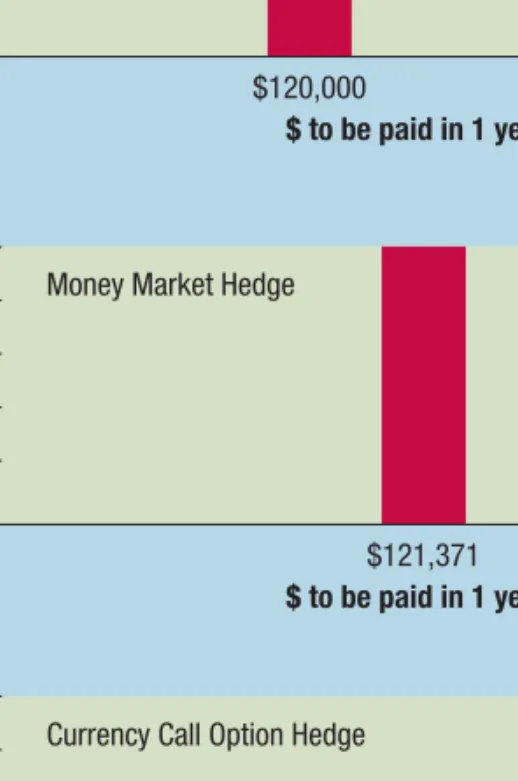
Recall that Coleman Co. needs to hedge payables of 100,000 euros. Coleman’s costs of different hedging techniques can be compared to determine which technique is opti- mal for hedging the payables. Exhibit 11.4 provides a graphic comparison of the cost of hedg- ing resulting from using different techniques (which were determined in the previous examples in this chapter). For Coleman, the forward hedge is preferable to the money market hedge be- cause it results in a lower cost of hedging payables.
The cost of the call option hedge is described by a probability distribution because it is dependent on the exchange rate at the time that payables are due. The expected value of the cost if using the currency call option hedge is:
Expected value of cost5 1$119,000320%2 1 1$123,000380%2 5$122,200
The probability of the future spot rate being $1.22 (70 percent) and probability of the future spot rate being $1.24 (10 percent) are combined in the calculation because they result in the same cost. The expected value of the cost when hedging with call options exceeds the cost of the forward rate hedge.
When comparing the distribution of the cost of hedging with call options to the cost of the forward hedge, there is a 20 percent chance that the currency call option hedge will be cheaper than the forward hedge. There is an 80 percent chance that the currency call option hedge will be more expensive than the forward hedge. Overall, the forward hedge is the opti- mal hedge. ■
The optimal technique to hedge payables may vary over time depending on the prevailing forward rate, interest rates, call option premium, and the forecast of the fu- ture spot rate at the time payables are due.
Optimal Hedge versus No Hedge
Even when an MNC knows what its future payables will be, it may decide not to hedge in some cases. It needs to determine the probability distribution of its cost of payables when not hedging as explained next.
Coleman Co. has already determined that the forward rate is the optimal hedging tech- nique if it decides to hedge its payables position. Now it wants to compare the forward hedge to no hedge.
E X A M P L E E X A M P L E
E X A M P L E E X A M P L E
Exhibit 11.4 Graphic Comparison of Techniques to Hedge Payables
Probability
Forward Hedge
$ to be paid in 1 year
$120,000
$ to be paid in 1 year 100%
80%
60%
40%
20%
0%
100%
80%
60%
40%
20%
0%
100%
80%
60%
40%
20%
0%
100%
80%
60%
40%
20%
0%
Probability
Money Market Hedge
$121,371
$ to be paid in 1 year
Probability
Currency Call Option Hedge
$123,000
$119,000
$ to be paid in 1 year
Probability
No Hedge
$124,000
$122,000
$116,000
Based on its expectations of the euro’s spot rate in one year (as described earlier), Cole- man Co. can estimate its cost of payables when unhedged:
Dollar Payments When Not Possible Spot Rate of Euro Hedging ⴝ 100,000 Euros ⴛ
in One Year Possible Spot Rate Probability
$1.16 $116,000 20%
$1.22 $122,000 70%
$1.24 $124,000 10%
This probability distribution of costs when not hedging is shown in the bottom graph of Exhibit 11.4 and can be compared to the cost of the forward hedge in that exhibit.
The expected value of the payables when not hedging is estimated as:
Expected value of payables5 1$116,000320%2 11$122,000370%2 1 1$124,000310%2
5$121,000
This expected value of the payables is $1,000 more than if Coleman uses a forward hedge.
In addition, the probability distribution suggests an 80 percent probability that the cost of the payables when unhedged will exceed the cost of hedging with a forward contract. Therefore, Coleman decide to hedge its payables position with a forward contract. ■
Evaluating the Hedge Decision
MNCs can evaluate hedging decisions that they made in the past by estimating the
real cost of hedging payables, which is measured as:
RCHp5Cost of hedging payables2Cost of payables if not hedged After the payables transaction has occurred, an MNC may assess the outcome of its decision to hedge.
Recall that Coleman Co. decided to hedge its payables with a forward contract, result- ing in a dollar cost of $120,000. Assume that on the day that it makes its payment (one year after it hedged its payables), the spot rate of the euro is $1.18. Notice that this spot rate is different from any of the three possible spot rates that Coleman Co. predicted. This is not un- usual, as it is difficult to predict the spot rate, even when creating a distribution of possible out- comes. If Coleman Co. had not hedged, its cost of the payables would have been $118,000 (computed as 100,000 euros $1.18). Thus, Coleman’s real cost of hedging is:
RCHp5Cost of hedging payables2Cost of payables if not hedged 5$120,0002$118,000
5$2,000 ■
In this example, Coleman’s cost of hedging payables turned out to be $2,000 more than if it had not hedged. However, Coleman is not necessarily disappointed in its deci- sion to hedge. That decision allowed it to know exactly how many dollars it would need to cover its payables position and insulated the payment from movements in the euro.
Hedging Exposure to Receivables
An MNC may decide to hedge part or all of its receivables transactions denominated in foreign currencies so that it is insulated from the possible depreciation of those currencies. It can apply the same techniques available for hedging payables to hedge E X A M P L E
E X A M P L E
Chapter 11: Managing Transaction Exposure 317 receivables. The manner by which each technique is applied to hedge receivables is slightly different from its application to hedge payables. The application of each hedg- ing technique to receivables is discussed next.
Forward or Futures Hedge on Receivables
Forward contracts and futures contracts allow an MNC to lock in a specifi c exchange rate at which it can sell a specifi c currency and, therefore, allow it to hedge receivables denominated in a foreign currency.
Viner Co. is a U.S.-based MNC that will receive 200,000 Swiss francs in 6 months. It could obtain a forward contract to sell SF200,000 in 6 months. The 6-month forward rate is $.71, the same rate as currency futures contracts on Swiss francs. If Viner sells Swiss francs 6 months forward, it can estimate the amount of dollars to be received in 6 months:
Cash inflow in $5Receivables3Forward rate 5SF200,0003$.71
5$142,000 ■
The same process would apply if futures contracts were used instead of forward con- tracts. The futures rate is normally very similar to the forward rate, so the main dif- ference would be that the futures contracts are standardized and would be sold on an exchange, while the forward contract would be negotiated between the MNC and a commercial bank.
Money Market Hedge on Receivables
A money market hedge on receivables involves borrowing the currency that will be re- ceived and using the receivables to pay off the loan.
Recall that Viner Co. will receive SF200,000 in 6 months. Assume that it can borrow funds denominated in Swiss francs at a rate of 3 percent over a 6-month period. The amount that it should borrow so that it can use all of its receivables to repay the entire loan in 6 months is:
Amount to borrow5SF200,000/111.032 5SF194,175
If Viner Co. obtains a 6-month loan of SF194,175 from a bank, it will owe the bank SF200,000 in 6 months. It can use its receivables to repay the loan. The funds that it borrowed can be converted to dollars and used to support existing operations. ■
If the MNC does not need any short-term funds to support existing operations, it can still obtain a loan as explained above, convert the funds to dollars, and invest the dol- lars in the money market.
If Viner Co. does not need any funds to support existing operations, it can convert the Swiss francs that it borrowed into dollars. Assume the spot exchange rate is presently
$.70. When Viner Co. converts the Swiss francs, it will receive:
Amount of dollars received from loan5SF194,1753$.705$135,922 Then the dollars can be invested in the money market. Assume that Viner Co. can earn 2 per- cent interest over a 6-month period. In 6 months, the investment will be worth:
$135,922311.022 5$138,640 E X A M P L E
E X A M P L E
E X A M P L E E X A M P L E
E X A M P L E E X A M P L E
Thus, if Viner Co. uses a money market hedge, its receivables will be worth $138,640 in 6 months. ■
Put Option Hedge
A put option allows an MNC to sell a specifi c amount of currency at a specifi ed exer- cise price by a specifi ed expiration date. An MNC can purchase a put option on the currency denominating its receivables and lock in the minimum amount that it would receive when converting the receivables into its home currency. However, the put op- tion differs from a forward or futures contract in that it is an option and not an obli- gation. If the currency denominating the receivables is higher than the exercise price at the time of expiration, the MNC can let the put option expire and can sell the cur- rency in the foreign exchange market at the prevailing spot rate. The MNC must also consider the premium that it must pay for the put option.
Cost of Hedging with Put Options Based on a Contingency Graph. The cost of hedging with put options is not known with certainty at the time that they are purchased. It is only known once the receiv- ables are due and the spot rate at that time is known. For this reason, an MNC at- tempts to determine the amount of cash it will receive from the put option hedge based on various possible spot rates at the time that receivables arrive.
An estimate of the cash to be received from a put option hedge is the estimated cash received from selling the currency minus the premium paid for the put option.
If the spot rate of the currency at the time receivables arrive is less than the exercise price, the MNC would exercise the option and receive the exercise price when selling the currency. If the spot rate at that time is equal to or above the exercise price, the MNC would let the option expire and would sell the currency at the spot rate in the foreign exchange market.
An MNC can develop a contingency graph that determines the cash received from hedging with put options depending on each of several possible spot rates when receivables arrive. It may be especially useful when an MNC would like to estimate the cash received from hedging based on a wide range of possible spot rate outcomes.
Recall that Viner Co. considers hedging its receivables of SF200,000 in 6 months. It could purchase put options on SF200,000, so that it can hedge its receivables. Assume that the put options have an exercise price of $.70, a premium of $.02, and an expiration date of 6 months from now (when the receivables arrive). Viner can create a contingency graph for the put option hedge, as shown in Exhibit 11.5. The horizontal axis shows several possible spot rates of the Swiss franc that could occur at the time receivables arrive, while the vertical axis shows the cash to be received from the put option hedge based on each of those possible spot rates.
At any spot rate less than or equal to the exercise price of $.70, Viner would exercise the put option and would sell the Swiss francs at the exercise price of $.70. After subtracting the
$.02 premium per unit, Viner would receive $.68 per unit from selling Swiss francs. At any spot rate more than the exercise price, Viner would let the put option expire and would sell the francs at the spot rate in the foreign exchange market. For example, if the spot rate was $.75 at the time receivables were due, Viner would sell the Swiss francs at that rate. It would receive
$.73 after subtracting the $.02 premium per unit. ■
Exhibit 11.5 illustrates the advantages and disadvantages of a put option for hedging receivables. The advantage is that the put option provides an effective hedge, while also allowing the MNC to let the option expire if the spot rate at the time re- ceivables arrive is higher than the exercise price.
E X A M P L E E X A M P L E
Chapter 11: Managing Transaction Exposure 319
However, the obvious disadvantage of the put option is that a premium must be paid for it. Recall from a previous example that Viner Co. could sell a forward con- tract on Swiss francs for $.71, which would allow it to receive $.71 per Swiss franc, regardless of what the spot rate is at the time receivables arrive. This could be re- fl ected on the same contingency graph in Exhibit 11.5 as a horizontal line beginning at the $.71 point on the vertical axis and extending straight across for all possible spot rates. In general, the forward rate hedge would provide a larger amount of cash than the put option hedge if the spot rate is relatively low at the time Swiss francs are re- ceived, while currency put options would provide a larger amount of cash than the forward rate if the spot rate is relatively high at the time Swiss francs are received.
Cost of Hedging with Put Options Based on Currency Forecasts. While the contingency graph can determine the cash to be received from hedging based on various possible spot rates when receivables will arrive, it does not consider an MNC’s currency forecasts. Thus, it does not necessarily lead the MNC to a clear decision about whether to hedge receivables with currency put op- tions. An MNC may wish to incorporate its own forecasts of the spot rate at the time receivables will arrive, so that it can more accurately estimate the dollar cash infl ows to be received when hedging with put options.
Viner Co. considers purchasing a put option contract on Swiss francs, with an exercise price of $.72 and a premium of $.02. It has developed the following probability distribu- tion for the spot rate of the Swiss franc in 6 months:
• $.71 (30 percent probability) • $.74 (40 percent probability) • $.76 (30 percent probability)
Exhibit 11.5 Contingency Graph for Hedging Receivables with Put Options
$.80
$.75
Excercise Price = $.70 Premium = $.02
$.65
$.70
$.70 $.75
$.65
Cash Received (after Deducting Option Premium)
$.80
E X A M P L E E X A M P L E
The expected dollar cash flows to be received from purchasing the put options on Swiss francs are shown in Exhibit 11.6. The second column discloses the possible spot rates that may occur in 6 months according to Viner’s expectations. The third column shows the option premium that is the same regardless of what happens to the spot rate in the future. The fourth column shows the amount to be received per unit as a result of owning the put options. If the spot rate is $.71 in the future (see the first row), the put option will be exercised at the exercise price of $.72. If the spot rate is more than $.72 in 6 months (as reflected in rows 2 and 3), Viner will not exercise the option, and it will sell the Swiss francs at the prevailing spot rate. Col- umn 5 shows the cash received per unit, which adjusts the figures in column 4 by subtracting the premium paid per unit for the put option. Column 6 shows the amount of dollars to be re- ceived, which is equal to cash received per unit (shown in column 5) multiplied by the amount of units (200,000 Swiss francs). ■
Consideration of Alternative Put Options. Several different types of put options may be available, with different exercise prices and premiums for a given currency and expiration date. An MNC can obtain a put option with a higher exercise price, but the tradeoff is that it would have to pay a higher premium. Alternatively, it can select a put option that has a lower premium but then must accept a lower exercise price. Whatever put option is perceived to be most desirable for hedging a particular receivables position would be analyzed as explained in the example above, so that it could then be compared to the other hedging techniques.
Selecting the Optimal Technique for Hedging Receivables
The techniques that can be used to hedge receivables are summarized in Ex hibit 11.7, with an illustration of how the cash infl ow from each hedging technique was mea- sured for Viner Co. (based on previous examples).
The optimal technique to hedge receivables may vary over time depending on the specifi c quotations, such as the forward rate quoted on a forward contract, the inter- est rates quoted on a money market loan, and the premium quoted on a put option.
The optimal technique for hedging a specifi c receivables position at a future point in time can be determined by comparing the cash to be received among the hedg- ing techniques. First, since the futures and forward hedge are very similar, the MNC only needs to consider whichever one of these techniques it prefers. For our example,
Exhibit 11.6 Use of Currency Put Options for Hedging Swiss Franc Receivables (Exercise Price = $.72; Premium = $.02)
(1) (2) (3) (4) (5) ⴝ (4)ⴚ (3) (6)
Dollar Amount Received Amount Net Amount from Hedging
Spot Rate When Received Received SF200,000
Payment on Premium per Unit When per Unit (after Receivables Receivables Is per Unit on Owning Accounting for with Put Scenario Received Put Options Put Options Premium Paid) Options
1 $.71 $.02 $.72 $.70 $140,000
2 .74 .02 .74 .72 144,000
3 .76 .02 .76 .74 148,000
Chapter 11: Managing Transaction Exposure 321 the forward hedge will be considered. Second, when comparing the forward (or fu- tures) hedge to the money market hedge, the MNC can easily determine which hedge is more desirable because the cash to be received from either hedge can be determined with certainty.
Once that comparison is completed, the MNC can assess the feasibility of the currency put option hedge. Since the amount of cash to be received from the cur- rency put option is dependent on the spot rate that exists when receivables arrive, this amount can best be described with a probability distribution. This probability distri- bution of cash to be received when hedging with put options can be assessed by es- timating the expected value and determining the likelihood that the currency put option hedge will result in more cash than an alternative hedging technique.
Viner Co. can compare the cash to be received as the result of applying different hedg- ing techniques to hedge receivables of SF200,000 in order to determine the optimal technique. Exhibit 11.8 provides a graphic summary of the cash to be received from each hedging technique, based on the previous examples for Viner Co. In this example, the forward hedge is better than the money market hedge because it will generate more cash.
Exhibit 11.7 Comparison of Hedging Alternatives for Viner Co.
Forward Hedge
Sell Swiss francs 6 months forward.
Dollars to be received in 6 months receivables in SF forward rate of SF SF200,000 $.71
$142,000
Money Market Hedge
Borrow SF, convert to $, invest $, use receivables to pay off loan in 6 months.
Amount in SF borrowed
SF200,000 1 .03 SF194,175
$ received from converting SF SF194,175 $.70 per SF $135,922
$ accumulated after 6 months $135,922 (1 .02) $138,640
Put Option Hedge
Purchase put option. (Assume the options are to be exercised on the day SF are to be received, or not at all.
Exercise price $.72, premium $.02.)
Received per Total Dollars Possible Spot Premium Unit (after Received from
Rate in per Unit Paid Exercise Accounting for Converting
6 Months for Option Option? the Premium) SF200,000 Probability
.71 $.02 Yes $.70 $140,000 30%
.74 .02 No .72 144,000 40
.76 .02 No .74 148,000 30
E X A M P L E E X A M P L E
Probability
$ to be received in 6 months
$142,000
$ to be received in 6 months 100%
80%
60%
40%
20%
0%
100%
80%
60%
40%
20%
0%
100%
80%
60%
40%
20%
0%
Probability
$138,640
$ to be received in 6 months
Probability
$152,000
$148,000
$142,000 100%
80%
60%
40%
20%
0%
$ to be received in 6 months
Probability
$148,000
$144,000
$140,000
Forward Hedge
Money Market Hedge
Currency Put Option Hedge
No Hedge
Chapter 11: Managing Transaction Exposure 323 The graph for the put option hedge shows that the cash to be received is dependent on the exchange rate at the time that receivables are due. The expected value of the cash to be received from the put option hedge is:
Expected value of cash to be received51$140,000330%2 1 1$144,000340%2 1 1$148,000330%2 5$144,000
The expected value of the cash to be received when hedging with put options exceeds the cash amount that would be received from the forward rate hedge. ■
When comparing the distribution of cash to be received from the put option to the cash when using the forward hedge (see Exhibit 11.8), there is a 30 percent chance that the currency put option hedge will result in less cash than the forward hedge.
There is a 70 percent chance that the put option hedge will result in more cash than the forward hedge. Viner decides that the put option hedge is the optimal hedge.
Optimal Hedge versus No Hedge
Even when an MNC knows what its future receivables will be, it may decide not to hedge in some cases. It needs to determine the probability distribution of its revenue from receivables when not hedging as shown in the following example.
Viner Co. has already determined that the put option hedge is the optimal technique for hedging its receivables position. Now it wants to compare the put option hedge to no hedge. Based on its expectations of the Swiss franc’s spot rate in one year (as described ear- lier), Viner Co. can estimate the cash to be received if it remains unhedged:
Dollar Payments When Not Possible Spot Rate of Swiss Hedging ⴝ SF200,000 ⴛ
Franc in One Year Possible Spot Rate Probability
$.71 $142,000 30%
$.74 $148,000 40%
$.76 $152,000 30%
The expected value of cash that Viner Co. will receive when not hedging is estimated as:
Expected value of cash to be received51$142,000330%2 11$148,000340%2 11$152,000330%2 5$147,400
When comparing this expected value to the expected value of cash that Viner Co. would re- ceive from its put option hedge ($144,000), Viner decides to remain unhedged. In this exam- ple, Viner’s decisions to remain unhedged creates a tradeoff in which it hopes to benefit from the appreciation of the Swiss franc against the U.S. dollar over the next 6 months but is sus- ceptible to adverse effects if the franc depreciates. ■
Evaluating the Hedge Decision
Once the receivables transaction has occurred, an MNC can assess its decision to hedge or not hedge.
E X A M P L E E X A M P L E
Recall that Viner Co. decided not to hedge its receivables. Assume that 6 months later when the receivables arrive, the spot rate of the Swiss franc is $.75. Notice that this spot rate is different from any of the three possible spot rates that Viner Co. predicted. This is not unusual, as it is difficult to predict the spot rate, even when creating a distribution of possible outcomes. Since Viner did not hedge, it receives:
Cash received5Spot rate of SF3SF200,000 at time of receivables transaction 5$.753SF200,000
5$150,000
Now consider what the results would have been if Viner Co. had hedged the receivables posi- tion. Recall that Viner would have used the put option hedge if it hedged. Given the spot rate of $.75 when the receivables arrived, Viner would not have exercised the put option. Thus, it would have exchanged the Swiss francs in the spot market for $.75 per unit, minus the $.02 premium per unit that it would have paid for the put option. Its cash received from the put op- tion hedge would have been:
Cash received5$.733SF200,000
5$146,000 ■
In this example, Viner’s decision to remain unhedged generated $4,000 more than if it had hedged its receivables. The difference of $4,000 is the premium that Viner would have paid to obtain put options. While Viner benefi ted from remaining un- hedged in this example, it recognizes the risk from not hedging.
Comparison of Hedging Techniques
Each of the hedging techniques is briefl y summarized in Exhibit 11.9. When using a futures hedge, forward hedge, or money market hedge, the fi rm can estimate the funds (denominated in its home currency) that it will need for future payables, or the funds that it will receive after converting foreign currency receivables. The outcome is certain. Thus, it can compare the costs or revenue and determine which of these hedging techniques is appropriate. In contrast, the cash fl ow associated with the cur- rency option hedge cannot be determined with certainty because the costs of pur- chasing payables and the revenue generated from receivables are not known ahead of time. Therefore, fi rms need to forecast cash fl ows from the option hedge based on possible exchange rate outcomes. A fee (premium) must be paid for the option, but the option offers fl exibility because it does not have to be exercised.
E X A M P L E E X A M P L E
Exhibit 11.9 Review of Techniques for Hedging Transaction Exposure
Hedging Technique To Hedge Payables To Hedge Receivables
1. Futures hedge Purchase a currency futures contract (or Sell a currency futures contract (or contracts) representing the currency and contracts) representing the currency and amount related to the payables. amount related to the receivables.
2. Forward hedge Negotiate a forward contract to purchase Negotiate a forward contract to sell the the amount of foreign currency needed to amount of foreign currency that will be cover the payables. received as a result of the receivables.
3. Money market hedge Borrow local currency and convert to Borrow the currency denominating the currency denominating payables. Invest receivables, convert it to the local currency, these funds until they are needed to cover and invest it. Then pay off the loan with the payables. cash infl ows from the receivables.
4. Currency option hedge Purchase a currency call option (or options) Purchase a currency put option (or options) representing the currency and amount representing the currency and amount related to the payables. related to the receivables.
Chapter 11: Managing Transaction Exposure 325
Hedging Policies of MNCs
In general, hedging policies vary with the MNC management’s degree of risk aver- sion. An MNC may choose to hedge most of its exposure, to hedge none of its expo- sure, or to selectively hedge.
Hedging Most of the Exposure. Some MNCs hedge most of their exposure so that their value is not highly infl uenced by exchange rates. MNCs that hedge most of their exposure do not necessarily expect that hedging will always be benefi cial. In fact, such MNCs may even use some hedges that will likely result in slightly worse outcomes than no hedges at all, just to avoid the possibility of a major adverse movement in exchange rates. They prefer to know what their future cash in- fl ows or outfl ows in terms of their home currency will be in each period because this improves corporate planning. A hedge allows the fi rm to know the future cash fl ows (in terms of the home currency) that will result from any foreign transactions that have already been negotiated.
Hedging None of the Exposure. MNCs that are well diversifi ed across many countries may consider not hedging their exposure. This strategy may be driven by the view that a diversifi ed set of exposures will limit the actual impact that exchange rates will have on the MNC during any period.
Selective Hedging. Many MNCs, such as Black & Decker, Eastman Kodak, and Merck choose to hedge only when they expect the currency to move in a direc- tion that will make hedging feasible. Zenith hedges its imports of Japanese compo- nents only when it expects the yen to appreciate. Merck has worldwide sales of over
$6 billion per year with substantial receivables denominated in foreign currencies as a result of exporting. Since Merck wants to capitalize on the possible appreciation of these foreign currencies (weakening of the dollar), it uses put options to hedge its receivables denominated in foreign currencies. If the dollar weakens, Merck lets the put options expire because the receivables are worth more at the prevailing spot rate. Meanwhile, the put options provide insurance in case the dollar strengthens.
If Merck feels very confi dent that the dollar will strengthen, it uses forward or fu- tures contracts instead of put options because it must pay a premium for the put options.
The following quotations from annual reports illustrate the strategy of selective hedging:
The purpose of the Company’s foreign currency hedging activities is to reduce the risk that the eventual dollar net cash inl ows resulting from sales outside the U.S.
will be adversely affected by exchange rates.
—The Coca-Cola Co.
Decisions regarding whether or not to hedge a given commitment are made on a case-by-case basis by taking into consideration the amount and duration of the ex- posure, market volatility, and economic trends.
—DuPont Co.
We selectively hedge the potential effect of the foreign currency l uctuations related to operating activities.
—General Mills Co.
Selective hedging implies that the MNC prefers to exercise some control over its ex- posure and makes decisions based on conditions that may affect the currency’s future value.
H T T P : //
http://www.ibm.com/us/
The websites of various MNCs provide fi nancial statements such as annual reports that disclose the use of fi nancial derivatives for the purpose of hedging inter- est rate risk and foreign ex- change rate risk.
Limitations of Hedging
Although hedging transaction exposure can be effective, there are some limitations that deserve to be mentioned here.
Limitation of Hedging an Uncertain Amount
Some international transactions involve an uncertain amount of goods ordered and therefore involve an uncertain transaction amount in a foreign currency. Conse- quently, an MNC may create a hedge for a larger number of units than it will acutally need, which causes the opposite form of exposure.
Recall the previous example on hedging receivables, which assumed that Viner Co. will receive SF200,000 in 6 months. Now assume that the receivables amount could actu- ally be much lower. If Viner uses the money market hedge on SF200,000 and the receivables amount to only SF120,000, it will have to make up the difference by purchasing SF80,000 in the spot market to achieve the SF200,000 needed to pay off the loan. If the Swiss franc appreciates over the 6-month period, Viner will need a large amount in dollars to obtain the SF80,000. ■
This example shows how overhedging (hedging a larger amount in a currency than the actual transaction amount) can adversely affect a fi rm. A solution to avoid overhedging is to hedge only the minimum known amount in the future transac- tion. In our example, if the future receivables could be as low as SF120,000, Viner could hedge this amount. Under these conditions, however, the fi rm may not have completely hedged its position. If the actual transaction amount turns out to be SF200,000 as expected, Viner will be only partially hedged and will need to sell the extra SF80,000 in the spot market.
Alternatively, Viner may consider hedging the minimum level of receivables with a money market hedge and hedging the additional amount of receivables that may occur with a put option hedge. In this way, it is covered if the receivables exceed the minimum amount. It can let the put option expire if the receivables do not exceed the minimum, or if it is better off exchanging the additional Swiss francs received in the spot market.
Firms commonly face this type of dilemma because the precise amount to be re- ceived in a foreign currency at the end of a period can be uncertain, especially for fi rms heavily involved in exporting. Based on this example, it should be clear that most MNCs cannot completely hedge all of their transactions. Nevertheless, by hedg- ing a portion of those transactions that affect them, they can reduce the sensitivity of their cash fl ows to exchange rate movements.
Limitation of Repeated Short-Term Hedging
The continual hedging of repeated transactions that are expected to occur in the near future has limited effectiveness over the long run.
Winthrop Co. is a U.S. importer that specializes in importing particular CD players in one large shipment per year and then selling them to retail stores throughout the year.
Assume that today’s exchange rate of the Japanese yen is $.005 and that the CD players are worth ¥60,000, or $300. The forward rate of the yen generally exhibits a premium of 2 per- cent. Exhibit 11.10 shows the yen/dollar exchange rate to be paid by the importer over time.
As the spot rate changes, the forward rate will often change by a similar amount. Thus, if the spot rate increases by 10 percent over the year, the forward rate may increase by about the same amount, and the importer will pay 10 percent more for next year’s shipment (assuming no change in the yen price quoted by the Japanese exporter). The use of a one-year forward contract during a strong-yen cycle is preferable to no hedge in this case but will still result in E X A M P L E
E X A M P L E
E X A M P L E E X A M P L E
Chapter 11: Managing Transaction Exposure 327 subsequent increases in prices paid by the importer each year. This illustrates that the use of short-term hedging techniques does not completely insulate a firm from exchange rate expo- sure, even if the hedges are used repeatedly over time. ■
If the hedging techniques can be applied to longer-term periods, they can more effectively insulate the fi rm from exchange rate risk over the long run. That is, Win- throp Co. could, as of time 0, create a hedge for shipments to arrive at the end of each of the next several years. The forward rate for each hedge would be based on the spot rate as of today, as shown in Exhibit 11.11. During a strong-yen cycle, such a strategy would save a substantial amount of money.
Exhibit 11.10 Illustration of Repeated Hedging of Foreign Payables When the Foreign Currency is Appreciating
Forward Rate
Year
Forward Rate and Spot Rate
Spot Rate
Savings from Hedging
0 1 2 3
Exhibit 11.11 Long-Term Hedging of Payables When the Foreign Currency Is Appreciating
Year
Forward Rate (FR) and Spot Rate (SR)
SR
Savings from Hedging
0 1 2 3
1-yr. FR 2-yr. FR 3-yr. FR
This strategy faces a limitation, however, in that the amount in yen to be hedged further into the future is more uncertain because the shipment size will be depen- dent on economic conditions or other factors at that time. If a recession occurs, Win- throp Co. may reduce the number of CD players ordered, but the amount in yen to be received by the importer is dictated by the forward contract that was created. If the CD player manufacturer goes bankrupt, or simply experiences stockouts, Winthrop Co. is still obligated to purchase the yen, even if a shipment is not forthcoming.
Given the greater uncertainty surrounding the amount of currency to be hedged, some MNCs focus more on hedging receivables or payables that will occur in the near future. Symantec commonly has forward contracts valued at more than $100 mil- lion to hedge transaction exposure, and all or most of the contracts have maturities of less than 35 days. Conversely, Procter & Gamble commonly uses forward contracts with maturities up to 18 months. In some cases Procter & Gamble hedges exposure 5 years ahead.
Hedging Long-Term Transaction Exposure
Some MNCs are certain of having cash fl ows denominated in foreign currencies for several years and attempt to use long-term hedging. For example, Walt Disney Co.
hedged its Japanese yen cash fl ows that will be remitted to the United States (from its Japanese theme park) 20 years ahead. Eastman Kodak Co. and General Electric Co.
incorporate foreign exchange management into their long-term corporate planning.
Thus, techniques for hedging long-term exchange rate exposure are needed.
Firms that can accurately estimate foreign currency payables or receivables that will occur several years from now commonly use two techniques to hedge such long- term transaction exposure:
• Long-term forward contract • Parallel loan
Each technique is discussed in turn.
Long-Term Forward Contract
Until recently, long-term forward contracts, or long forwards, were seldom used. To- day, the long forward is quite popular. Most large international banks routinely quote forward rates for terms of up to 5 years for British pounds, Canadian dollars, Japanese yen, and Swiss francs. Long forwards are especially attractive to fi rms that have set up fi xed-price exporting or importing contracts over a long period of time and want to protect their cash fl ow from exchange rate fl uctuations.
Like a short-term forward contract, the long forward can be tailored to accom- modate the specifi c needs of the fi rm. Maturities of up to 10 years or more can some- times be set up for the major currencies. Because a bank is trusting that the fi rm will fulfi ll its long-term obligation specifi ed in the forward contract, it will consider only very creditworthy customers.
Parallel Loan
Aparallel loan (or “back-to-back loan”) involves an exchange of currencies between two parties, with a promise to reexchange currencies at a specifi ed exchange rate on a future date. It represents two swaps of currencies, one swap at the inception of the loan contract and another swap at the specifi ed future date. A parallel loan is inter- preted by accountants as a loan and is therefore recorded on fi nancial statements. It is covered in more detail in Chapter 18.