i
AN UNDERGRADUATE THESIS
THE IMPLEMENTATION OF DOUBLE ENTRY JOURNAL STRATEGY TO INCREASE STUDENTS’ WRITING ABILITY
OF THE EIGHTH GRADE AT SMP MUHAMMADIYAH 1 TRIMURJO CENTRAL LAMPUNG
BY :
PUTRI DESI WULANDARI STUDENT NUMBER : 1501070098
Tarbiyah and Teacher Training Faculty English Education Department
INSTITUTE OF ISLAMIC STUDIES (IAIN) METRO
1441 H / 2019 M
ii
THE IMPLEMENTATION OF DOUBLE ENTRY JOURNAL STRATEGY TO INCREASE STUDENTS’ WRITING ABILITY
OF THE EIGHTH GRADE AT SMP MUHAMMADIYAH 1 TRIMURJO CENTRAL LAMPUNG
Presented as a Partial Fulfillment of the Requirements for the Degree of Sarjana Pendidikan (S.Pd)
In English Department
By:
PUTRI DESI WULANDARI Student Number 1501070098
Tarbiyah and Teacher Trainning Faculty English Education Department
Sponsor : Ahmad Subhan Roza, M.Pd Co. Sponsor : Trisna Dinillah Harya, M.Pd
STATE INSTITUTE OF ISLAMIC STUDIES OF METRO
1441H / 2019 M
iii
THE IMPLEMENTATION OF DOUBLE ENTRY JOURNAL STRATEGY TO INCREASE STUDENTS’ WRITING ABILITY
OF THE EIGHTH GRADE AT SMP MUHAMMADIYAH 1 TRIMURJO CENTRAL LAMPUNG
ABSTRACT
BY : PUTRI DESI WULANDARI
The purpose of this research was to increase the students‟ writing ability and their learning activity at SMP Muhammadiyah 1 Trimurjo, Central Lampung.
The researcher expects that Double Entry Journal Strategy could help the students in learning process and becomes one of the strategies to increase the students‟
writing ability.
In this research, the researcher conducted classroom action research (CAR) that was done in two cycles. Each cycle consists of planning, acting, observing and reflecting. The subjects of this research were 21 students of the eighth grade at SMP Muhammadiyah 1 Trimurjo. In collecting data, the researcher used test including of pre-test, post test I and post test 2, observation and documentation. The research was conducted collaboratively with the English teacher of SMP Muhammadiyah 1 Trimurjo.
The results of this study showed that the Double Entry Journal strategy has positive results in increasing the writing ability of the students of VIII grade SMP Muhammadiyah 1 Trimurjo. It can be known by the average student score from pre test to post test. The average value in pre test is 33, post test 1 is 60 and post Test 2 is 74. This means that the Double Entry Journal strategy can increase students‟ writing ability.
The results of this research prove that Double Entry Journal strategy can increase writing ability and learning activity at the eighth grades of SMP Muhammadiyah 1 Trimurjo. It was investigated that the percentage of students‟
writing ability got from post-test 2 of cycle 2 is 81%. Meanwhile, the percentage of learning activity of cycle 2 is 75%. It means that result of students‟ writing ability and learning activity in cycle II had already achieved the indicator of success that is 75 % of the students achieve the Minimum Mastery Criteria (MMC).
Keyword: double entry journal, strategy, writing, ability, learning.
iv
PELAKSANAAN STRATEGI MEMASUKKAN DUA JURNAL UNTUK MENINGKATKAN KEMAMPUAN MENULIS SISWA KELAS DELAPAN DI SMP MUHAMMADIYAH 1 TRIMURJO
LAMPUNG TENGAH
ABSTRAK OLEH :
PUTRI DESI WULANDARI
Tujuan dari penelitian ini adalah untuk meningkatkan kemampuan menulis siswa di SMP Muhammadiyah 1 Trimurjo, Lampung Tengah. Peneliti berharap Strategi Memasukkan dua Jurnal dapat membantu siswa dalam proses pembelajaran dan menjadi salah satu strategi untuk meningkatkan kemampuan menulis siswa.
Dalam penelitian ini, peneliti melakukan penelitian tindakan kelas (PTK) yang dilakukan dalam dua siklus. Setiap siklus terdiri dari perencanaan, tindakan, pengamatan dan refleksi. Subjek penelitian ini adalah 21 siswa kelas VIII SMP Muhammadiyah 1 Trimurjo. Dalam mengumpulkan data, peneliti menggunakan tes (pre-test, post test I dan post test 2), observasi dan dokumentasi.
Penelitian ini dilakukan secara kolaboratif dengan guru Bahasa Inggris SMP Muhammadiyah 1 Trimurjo.
Hasil penelitian ini menunjukkan bahwa strategi Memasukkan Dua Jurnal memiliki hasil positif dalam meningkatkan kemampuan menulis siswa kelas VIII SMP Muhammadiyah 1 Trimurjo. Hal ini dapat diketahui dengan skor rata-rata siswa dari pre test hingga post test. Nilai rata-rata dalam pre test adalah 33, post test 1 adalah 60 dan post test 2 adalah 74. Ini berarti bahwa Strategi Double Entry Journal dapat meningkatkan kemampuan menulis siswa.
Hasil penelitian ini membuktikan bahwa strategi Memasukkan Dua Jurnal dapat meningkatkan kemampuan menulis dan aktivitas belajar pada siswa kelas VIII SMP Muhammadiyah 1 Trimurjo. Diselidiki bahwa persentase kemampuan menulis siswa yang didapat dari post-test 2 siklus 2 adalah 81%.
Sementara itu, persentase aktivitas pembelajaran siklus 2 adalah 75%. Artinya hasil kemampuan menulis siswa dan aktivitas belajar pada siklus II sudah mencapai indikator keberhasilan yaitu 75% siswa mencapai Kriteria Penguasaan Minimum (MMC).
Kata Kunci : memasukkan dua jurnal, strategi, menulis, kemampuan, pembelajaran.
v
vi
vii
viii
ix
x
xi MOTTO
“Those who belive, and whose hearts find satisfaction in the remembrance of Allah. For without doubt in the remembrance of Allah do hearts find
satisfaction.”
(Q.S Ar-Ra‟d : 28)
“Orang-orang yang beriman dan hati mereka manjadi tenteram dengan mengingat Allah. Ingatlah, hanya dengan mengingat Allah-lah hati menjadi
tenteram.”
(Q.S Ar-Ra‟d : 28)
xii
DEDICATION PAGE
This an undergraduate thesis is dedicated to:
Allah SWT
My beloved parents Mr. Kuslan Hadi Prayetno, and Mrs. Nurhayati. Thank you for all of the love, care, pray, support, and kindness given to me.
My beloved brother Heri Kuswanto, and sister Prastica Ariyanti for the support and motivation.
My dearly nephew and niece: Elninno, Sahla, and Aira.
My beloved big family of “Mbah Kaji Fams” and “Mbah Ramli
xiii
ACKNOWLEDGEMENT
Thanks to Allah SWT who has given the researcher mercies and blessing, so that the researcher can complete this undergraduate thesis under the title “The Implementation Of Double Entry Journal Strategy To Increase Students‟ Writing Ability Of The Eighth Grade At Smp Muhammadiyah 1 Trimurjo Central Lampung”.
Peace and salutation always be given to our beloved prophet Muhammad SAW was a great revolutionary and true educator who guided us from the darkness to the brightness.
However, this success would not be achieved without the support, guidance, advice, help and encouragement from individuals and institutions.
Therefore, the writer would like to express the deepest gratitude to:
1. Prof. Dr. Enizar, M.Ag.as the Rector of State Institute for Islamic Studies of Metro.
2. Dr. Akla, M.Pd., as the Dean Tarbiyah and Teacher Training Faculty.
3. Ahmad Subhan Roza, M.Pd., as the Head of English Education Department 4. Ahmad Subhan Roza, M.Pd as my sponsor and Trisna Dinillah Harya, M.Pd as
my co sponsor also as a consultant of this graduating paper. Thanks for all of your suggestion, recommendation and support for this graduating paper from beginning till now.
xiv
5. All of the lectures in English Education Department of Tarbiyah Faculty who had given valuable knowledge.
6. All of the staffs who have helped the writer in processing of graduating paper administration and Academic Department.
7. My beloved parents who always educate me in doing good thing. They are my hero, thanks for all generosity, finance, and encouragement, and also thanks for your love, trust, and everlasting praying. Allah bless you mom and dad.
8. My friends in TBI 2015 especially my classmates of TBI A members. Keep our friendship.
9. The big family of SMP Muhammadiyah 1 Trimurjo who allowed me to conduct the observation there.
Finally, this undergraduate thesis is expected to be able to provide useful knowledge and information to the readers.
Metro, December 2019 The writer,
Putri Desi Wulandari 1501070098
xv
TABLE OF CONTENT
COVER ... i
TITLE... ii
ABSTRACT ... ... iii
ABSTRAK ... ... iv
RATIFICATION PAGE ... v
NOTIFICATION PAGE ... vi
NOTA DINAS ... vii
APPROVAL PAGE ... viii
STATEMENT OF RESEARCH ORIGINALITY ... ix
MOTTO ... ... xi
DEDICATION PAGE ... xii
ACKNOWLEDGMENT... xiii
TABLE OF CONTENTS ... xiv
LIST OF TABLES ... xv
LIST OF FIGURES ... xviii
LIST OF APPENDICES... xix
CHAPTER I INTRODUCTION ... 1
A. Background of Study... 1
B. Problem Identification ... 6
C. Problem Limitation ... 6
D. Problem Formulation ... 6
E. The Objective and Benefit of Study ... 6
1. The Objectives of the Research ... 7
2. The Benefits of the Research ... 7
F. Prior Research ... 8
CHAPTER II THEORICAL REVIEW ... 11
A. Concept of Writing Ability ... 11
1. The Concept of Writing ... 11
2. The Concept of Writing Ability... 17
xvi
B. Concept of Double Entry Journal Strategy ... 19
1. The Nature of Double Entry Journal Strategy ... 19
2. The Benefits of Double Entry Journal Strategy ... 20
3. The Implementation of Double Entry Journal Strategy.. ... 21
4. Example of Double Entry Journal Strategy ... 21
C. Action Hypothesis... 22
CHAPTER III RESEARCH METHODOLOGY ... 23
A. The Variables and Operational Definition of Variables ... 23
1. Variables of Research... 23
2. Operational Definition of Variable ... 23
B. The Research Setting ... 25
C. The Subject of The Research ... 25
D. Research Produce ... 26
1. Cycle 1... 29
2. Cycle 2... 31
E. Data Collecting Technique ... 33
1. Test ... 34
2. Observation ... 34
3. Documentation ... 35
4. Field Note ... 36
F. Research Instrument ... 36
1. Written Test ... 36
2. Observation Sheet ... 36
3. Documentation Sheet ... 37
4. Field Note Sheet ... 37
G. Data Analysis Method ... 38
H. The Indicator of Success... 39
CHAPTER IV RESULT OF THE RESEARCH AND INTERPRETATION ... 40
A. Result of the Research ... 40
1. Description Of SMP Muhammadiyah 1 Trimurjo ... 40
xvii
2. Description of the Research ... 43
a. Pre-test activity... 43
b. Cycle I ... 46
c. Cycle II ... 55
B. Interpretation ... 65
1. The Result of Sudents‟ Learning... 65
2. The Result of Sudents‟ LearningActivities in Cycle I and II ... 69
C. Discussion ... 72
CHAPTER V CONCLUSION AND SUGGESTION ... 74
A. Conclusion ... 74
B. Suggestion ... 75 BIBLIOGRAPHIES
APPENDICES
CURRICULUM VITAE
xviii
LIST OF TABLES
Table 1 The Result of Pre- survey data ... 3
Table 2 The Pre-survey result ... 4
Table 3 The Condition of Teacher and Official Employers at SMP Muhammadiyah 1 Trimurjo... 41
Table 4 The Students‟ Quantity at SMP Muhammadiyah 1 Trimurjo in the Academic Year of 2019/2020 50 ... 42
Table 5 The Building of SMP Muhammadiyah 1 Trimurjo ... 42
Table 6 Students‟ Pre-test Grade ... 44
Table 7 Note of Writing Criteria Symbol ... 44
Table 8 Frequency of students‟ grade in Pre-test ... 45
Table 9 The Students‟ Grade of Post-Test 1 ... 48
Table 10 Frequency of students‟ grade in Post-test I ... 49
Table 11 The Students‟ Learning Activities Observation in Cycle I... 50
Table 12 The Frequency of Students‟ Activities in Cycle I ... 51
Table 13 The Comparison between Pre-Test and Post-Test1 Grade in Cycle 1 ... 53
Table 14 The Comparison of Students‟ Pre-Test and Post-Test I in Cycle I... 53
Table 15 The Students‟ Writing Post Test II grade ... 57
Table 16 The Frequency of students‟ grade in Post-test II ... 58
Table 17 The Students‟ Learning Activity Result in Cycle II ... 60
xix
Table 18 The Frequency Students‟ Activity in Cycle II ... 61 Table 19 The Comparison between Post-Test I Grade and Post-Test II
Grade ... 62 Table 20 The Comparison of Students‟ Grade in Post-Test I and Post-
Test II ... 63 Table 21 The Comparison of Writing essay of Pre-Test, Post-Test I in
Cycle I and Post-Test II in Cycle II ... 67 Table 22 The Comparison of Students‟ Pre-Test, Post-Test I Grade in
Cycle I and Post-Test II Grade in Cycle II ... 68 Table 23 The Presentage of Students Activities in Cycle I and Cycle II ... 69
xx
LIST OF FIGURES
Figure 1 Total Students of the Eighth grade SMP Muhammadiyah 1
Trimurjo ... 26
Figure 2 Kurt Lewin‟s Action Research Design ... 27
Figure 3 The Precentage of The Students‟ Grade in Pre-Test ... 45
Figure 4 The Precentage of The Students‟ Grade on Post-Test I ... 49
Figure 5 The Precentage of The Students‟Activities in Cycle I ... 52
Figure 6 The Comparison of Precentage of The Students‟ Completness Grade on Pre-Test and Post-Test I ... 54
Figure 7 The Precentage of The Students‟ Completness Grade on Post- Test II... ... 59
Figure 8 The Precentage of The Students‟ Speaking Performance in Cycle II.... ... 61
Figure 9 The Precentage of Comparison of Students‟ Grade on Post- Test I and Post-Test II ... 64
Figure 10 The Comparison Grade of Students‟ Speaking Performance in Pre-Test, Post-Test I in Cycle I, and Post Test II in Cycle I ... 69
Figure 11 Figure of Learning Activity in Cycle I and Cycle II ... 70
xxi
LIST OF APPENDICES
APPENDICES I
1. Syllabus ... 78
2. Lesson Plan ... 86
3. Worksheet of Meeting 1 in Cycle 1 ... 100
4. Worksheet of Meeting 1 in Cycle 2 ... 102
5. Worksheet of Meeting 2 in Cycle 1 ... 104
6. Worksheet of Meeting 2 in Cycle 2 ... 106
7. The Observation Sheet of Students‟ Learning Activities I . 108 8. The Observation Sheet of Students‟ Learning Activities II 110
9. Scoring Table Of Writing Pre Test ... 112
10. Table of test specification Pre Test ... 113
11. Instrument Pre Test... 114
12. Scoring Table Of Writing Post Test 1 ... 115
13. Table of test specification Post Test 1 ... 116
14. Instrument Post Test 1 ... 117
15. Scoring Table Of Writing Post Test II ... 118
16. Table of test specification Post Test II ... 119
17. Instrument Post Test II ... 120
18. Documentation ... 121
19. Field Note ... 125
20. List of Attendees ... 126
xxii
APPENDICES II
1. Surat Izin Survey ... 127
2. Surat Balasan Survey... 128
3. Sk Bimbingan Skripsi ... 129
4. Surat Tugas ... 130
5. Surat Izin Research ... 131
6. Surat Balasan Research ... 132
7. Surat Keterangan Bebas Kaprodi ... 133
8. Surat Keterangan Bebas Pustaka ... 134
9. Kartu Konsultasi Bimbingan Skripsi ... 135
10. Curriculum Vitae ... 137
1 A. Background of the Study
English is one of the important languages used all over the world whether as the first, second or foreign language. English teaching covers four skills, namely listening, speaking, reading and writing. All these components are taught in integrated ways. The four skills that writer tries to take as an object of this research is writing, that is the basic in mastery language and communication.
English mastery should be achieved by providing some great efforts in order to the students‟ motivation for learning English, so that the learning goal can be achieved. The good English instruction can receive with many factors, for the first factor is learning media, which is in this factor so many students especially if the media used is very foreign, of course it makes students more interested.
In addition, teaching strategy is an important learning writing.
Another factor is the environment, the majority of learners would have been more effective if the environment supports the learning English, besides learners feel motivated, these environmental factors can accelerate the level of learning English excellently.
In English, there are four skills that should be mastered, they are listening speaking, reading and writing. Those skills in English should be
integrated well including writing skill. Writing helped students master other skills and mastering English completely. The students are sometimes afraid and shy to speak what they want to say but they can tell what they think and what they want to say into draft or writing before speaking.
Moreover, one of the important productive language skills is writing.Writing is one of the language skills that should be taught besides the other skills. Therefore, writing is regarded as a productive skill it aims at assisting students in expressing their idea written. It is allows the students to put their feelings and ideas on paper, to organize their knowledge and beliefs into convincing arguments, and to convey meaning through well-argument.
By the implementation of the beneficial teaching strategy, the students can improve their writing ability. In this case, the researcher uses Double Entry Journal strategy for teaching English. In line, according by Angelo and Cross in Trisha state that the double-entry journal is a strategy to help students summarize what they read and connect the reading with their own words and understanding.1
In addition, Double Entry Journal strategy has many great benefits.
They can be able to analyze, synthesize, question, and write about what they are reading as well as personalize and reflect on what they have learned by drawing on information in the text to support their analyses.
However, writing in English is not easy. There are many problems that writers get in the process of writing. The researcher had conducted a pre-
1 Angelo and Cross in Trisha Brummer and Sarah Kartchner Clark, Writing Strategies for Mathematics Second Edition, (Huntington Beach : Shell Education, 2014), p112.
survey on March 11that SMP Muhammadiyah 1 Trimurjo in order to know the student‟s problem in writing. The result of pre-survey is provided, as follows:
Table 1
The result of Pre- survey data on March11th, 2019 SMP Muhammadiyah 1 Trimurjo
(Archived from the students‟ assignment of descriptive text given by the English teacher taken on march 11th 2019.)
No Name C O V LU M TotalScore Criteria
1 AK 13 7 12 5 3 40 Incomplete
2 AP 14 10 6 17 3 50 Incomplete
3 AR 22 15 17 18 3 75 Complete
4 AS 13 9 13 17 3 55 Incomplete
5 AT 22 8 12 16 3 61 Incomplete
6 DR 15 7 6 15 2 45 Incomplete
7 DS 13 10 8 17 2 50 Incomplete
8 ES 21 12 11 13 3 60 Incomplete
9 FA 14 8 13 15 3 53 Incomplete
10 IM 16 7 8 6 2 39 Incomplete
11 KV 19 12 15 17 3 66 Incomplete
12 KP 18 13 9 15 3 58 Incomplete
13 MK 20 10 10 12 3 55 Incomplete
14 NN 13 12 8 13 2 48 Incomplete
15 RA 15 7 7 10 2 41 Incomplete
16 RM 22 18 15 17 3 75 Complete
17 SM 13 10 9 7 3 42 Incomplete
18 TK 15 8 7 5 2 37 Incomplete
19 TY 14 9 8 11 3 44 Incomplete
20 YD 21 13 9 15 3 61 Incomplete
21 YP 17 7 7 13 2 46 Incomplete
Min. Score 37
Max. Score 75
Average 52,43
Incomplete 19
Complete 2
Table 2
The pre-survey result from the
test score of the Eighth students in SMP Muhammadiyah 1 Trimurjo No Grade Explanation Frequency Percentage
1. ≥ 70 Complete 2 students 10%
2. < 70 Incomplete 19 students 90%
Total 21 students 100%
Source : pre-survey result.
From the table above, it was investigatedthat most of students cannot achieve minimum mastery criteria (MMC) yet, so they have to do remedial.
According to the table, there were 2 students who achieve MMC. Meanwhile, there were 19 students who were not able to achieve MMC. It means that total of students who achieve MMC was less than that who were not able to achieve MMC. Therefore, itconcluded that the students of the eighth grade at SMP Muhammadiyah 1 Trimurjo had insufficient writing ability.
Based on the problems above, the reseacher found the students‟
problems in writing. The students still difficult in writing their idea in their mind. The students were not creative to write some vocabularies to be sentences in paragraph. They do not understandgrammar concept. Moreover, the students‟ motivation was lack in learning English. The eighth graderswere not confident with their result of paragraph in descriptive text.
Based on the problem above, the researcher was implement the appropiate teaching strategy. It was the solution to make them develop their
ability to writing english, namely double entry journal. Double entry journal is a beneficial teaching strategy to be used to teach writing. Double entry journal strategy enables students to record their responses to text as they read.
Therefore, students write down phrases or sentences from their assigned reading and then write their own reaction to that passage. The purpose of this strategy is to give students the opportunity to express their thoughts and become actively involved with the material they read.
In addition, double entry journal had a lot benefits. It was improve students‟ comprehension, vocabularies, and content retention. This strategy had been found to be an effective and productive means of arousing interest in writing, which, at the same time, develops fluency of expression. It also helps students to become aware of why they wish to communicate their ideas and to regard writing not only as a means of personal expression, but also a dialogue in written language with the reader. Double entry journals strategy also provides students with good opportunities to improve their writing skill individually and good chances to record their thoughts and feelings.
To solve the problem, the researcher tried to using double entry journal strategy to increase the students‟ writing ability. Based on the description above the researcher was conduct a classroom action research in the title of “The Implementation of Double Entry Journal Strategy to Increase Students‟ Writing Ability of the Eighth Grade at SMP Muhammadiyah 1 Trimurjo Central Lampung.”
B. Problem Identification
Based on the background of the study above, the problems can be identified, as follows:
1. The students have insufficient descriptive writing ability.
2. The students have lack grammar mastery.
3. The students have low motivation in writing the English text.
4. Some of students are not confident with their result of paragraph in descriptive text.
5. The students have insufficient vocabulary mastery.
C. Problem Limitation
Based on the problem identification, the researcher limits the problems by focusing the research problem of number one that is the students‟
insufficiency in descriptive writing ability. The writer used double entry journal as a teaching strategy toward the students‟ writing ability among the eighth graders of SMP Muhammadiyah 1 Trimurjo.
D. Problem Formulation
Based on the background above, it is necessary to formulate the problem of this research as follows: can double entry journal increase the students‟ ability in writing descriptive text and their learning activities at the eighth grades of SMP Muhammadiyah 1 Trimurjo?
E. The Objectives and Benefits of the Research
Dealing with the problems statement, the objective and the benefits of this classroom action research are as follow:
1. The Objective of the Research
The objective of this research is to investigate whether the implementation of double entry journal increases the students‟ ability in writing descriptive text and their learning activities at the eighth grades of SMP Muhammadiyah 1 Trimurjo.
2. The Benefits of the Research
The benefits of the research as follows:
a. For the teacher
As information to the teacher, so the teacher could apply double entry journal in the process of teaching and learning.
b. For the students
As the solution for the students, so the so the students not only can write descriptive text in writing easily, but also can be the positive contribution for increasing and developing their ability in writing by usingDouble Entry Journal strategy.
c. For the headmaster
As information and suggestion for the headmaster, so that he/she give motivation in English learning process by preparing the facilitation and instrument.
F. Prior Research
To solve this problem, the researcher finished based on consideration of some prior researches. The first prior research was done by Khairani. The aim of the first prior research is giving students the opportunity to express their thoughts and become actively involved with the material of writing skills. The research method of the prior research is quantitative research method in the form of experimental study. Sample of the first prior research is SMPN 1 Indralaya Utara. Finding of the first prior research is the double entry journal strategies are this unit plan will work the students through the provides with good opportunities to increas their writing ability individually and good chances to record their thoughts and feelings of writing.2
The second prior research was done by Soleha. The aim of the second prior was to find out the effectiveness of double entry journal strategy toward students‟ ability in writing analytical exposition text of the eleventh grade of MA Alkhairaat Pusat Palu.The research method is Classroom Action Research method.
The finding of this research was the results showed that after implementing double entry journal strategy in experimental group, the students‟ ability in writing analytical exposition text has increased significantly. It is shown by the means of pretest that was 43.47 and posttest which was 77.78. While the result of control group that taught without double
2Dian Khairani, Using Double Entry Journals To Improve Reading Comprehension And Descriptive Writing Achievement,(2016).
entry journal strategy was lower. Therefore, the effect on mean indicate that the use of double entry journal is better than without double entry journal.3
The third prior research was done by Sarma and Rosa. The aim of the third prior research is effects on writing quality, the strategies for supporting the writing process. The research method is quantitative. Sample of the third prior research is Junior High School. Finding of the third prior research is the English teacher at Junior High School are suggested to use double entry diary as an alternative medium in teaching writing descriptive text. Moreover, they suggested to use double entry diary for more than one meeting.4
The similarity and differentiation between this research and first prior research are both of these researches are researching Junior High School students and improving the quality of writing to students. This research has similarity compared by the second prior research. The similarity is in form of the same strategy to improve writing ability that is double entry journal. The differentiation between this research and the second prior research is the sample of the research. This research will conduct the research by increasing the eighth graders at SMP Muhammadiyah 1 Trimurjo as the sample.
Meanwhile, the sample of the second prior research is eleventh grade of MA Alkhairaat Pusat Palu.
3Yayuk Soleha, The Effectiveness of Double Entry Journal Strategy in Writing Analytical Exposition Text, (2017).
4Devita Sarma and Rusdi Noor Rosa, Teaching Writing a Descriptive Text By Using Doble Entry Diary to Junior High School Students, (2014).
Based on all of the illustration above, it is concludethat this research and all of the prior researches concern on the implementation of double entry journalstrategy in teaching writing. The differences are about different research method, research sample and research finding.
In this case, the writer would like to continue the second prior research by conducting the same research method that is classroom action research by the implementation of double entry journal strategy to increase students‟ writing ability.
CHAPTER II
THEORITICAL REVIEW
A. Concept of Writing Ability 1. The Concept of Writing
a. Definition of Writing
Writing is one of language skills that has to be mastered by students, especially in English teaching learning process. Some experts provide the different meaning of writing, as follows:
Jordan states that writing is method of human intercommunication by means of conventional visible marks.5 It means that writing is a medium communicate one‟s thought, feeling, wanted, and opinion by nonverbal mean.
According to Hyland, writing is a way of sharing personal meanings and writing courses emphasize the power of the individual to construct his or her own views on a topic.6
Moreover, Peter states that writing is the most efficiently acquired when practice in writing parallels practice in other skills.7 It means that writing can train the ability of verbal and non-verbal.
5Douglas Brown, Principle by Language Learning and Teaching, ( New York: Edison Wesley longman. Inc, 2000), Fourth edition, p.30
6Ken Hyland, Second Language Writing, ( USA: Cambridge University Press, 2003), p.9
7M.F. Parel Dr. and Praveen M. Jain, English Language Teaching: Methods, Tools
&Techniques, ( Jaipur: Sunrise Publishers & Distributors, 2008), p.125 11
Besides that, John M. Swales and Christine B. Feak define that Writing is a complex socio cognitive process involving that construction of recorded messages on paper or on some material and more recently on a computer screen. The skills needed to write range from making the appropriate graphic marks, through utilizing the resources of the chosen language, to anticipating the reactions of the intended readers.8 It means that writing is a record process through an essay that needs a skill, good diction in order to understand by the reader easily.
Based on the definition above, the writer assumes that writing is an activity to transfer the ideas and to express someone‟s thinking through written form.
b. Purposes of Writing
Terminologically, Kate explains that any piece of writing will be trying to do at least one of the following things. The purposes of writing are classified into three: they are writing to entertain, writing to inform and writing to persuade. Each of three purposes is the basic aim of getting ideas from one brain into another.9
1) Writing to entertain
Writing to entertain generally takes the form of so-called
„imaginative writing‟ or „creative writing‟ (of course, all writing
8M. John Swales & Christine B. Feak, Academic Writing, ( New York: Oxford University Press, 1993), p.34
9Kate Greenville, Writing From Start To Finish A Six-Step Guide, ( Australia: Griffin Press, 2001), p.1
requires some imagination and creativity). Examples of imaginative writing are novels, stories, poems, song lyrics, plays and screenplays.
2) Writing to inform
Writing to inform means that the text as the information from some task. The text can give the information for the reader.
Examples of writing to inform are newspaper articles, scientific or business reports, instructions or procedures, and essays for school and university.
3) Writing to persuade
This includes advertisements, some newspaper and magazine‟s articles, and some types of essay. This type of writing might include your opinion, but as part of a logical case backed up with evidence, rather than just as an expression of your feelings.
In other word, writing has many functions in text. Writing can help students for making the text more useful.
c. Process of Writing
Writing is a never one-step action, but it is a process that has several steps. It starts from the beginning of what the topic is going to write until the publication of the writing. There are at least three steps of writing process, they are:
1) Prewriting (Planning)
Prewriting is the first step in the writing process. 10Before we start to compose a writing a, some ideas should be thought as a topic of product writing. In this step, writers are challenged to think and gather the topic will be written. In deciding the subject of writing, the writers should consider who will be the reader of the writing.
Every writer should read appropriate references as their warming up to get an adequate topic. Unfortunately, the information which is invented from reading is imperfectly remembered.
Therefore, it is extremely important that writers make note-taking from what they have read. Taking a few sentences might be done to set them aside for a later draft. These sentences will be literal ideas of possible topics to be composed11
In addition, reading commonplace book can make the writers get easy to find idea for their writing. Common place book provides new perceptions and more quotations which will make writing product become strong and more alive.12 The other reference to enrich the subject of writing is journal. Many outstanding writers use journal to create an interesting writing because it contains of good
10Alice Oshima & Ann Hogue, Introduction to Academic Writing, (New York:
Longman, 1997), Second Edition, p. 2.
11 Alastair Fowler, How to write, (New York: Oxford University Press, 2006), p.12.
12 Thomas. S. Kane, The Oxford Essential Guide to Writing, (New York: Oxford University Press, 1988), p.21.
perceptions, ideas, emotions, and actions13. It can make writers interest in writing even they don‟t have any ideas.
2) Drafting
Before the writers begin to write well, they should make a format of the writing and put the words down on paper.14 This step is often called drafting. Kristine argued that drafting is the step that the writers really begin to write. In this step, the writers put their words into the paper without worrying about spelling, grammar punctuation, or the best wording15.
Actually, drafting is tentative and imperfect writing. Drafting product can be refined to develop by putting down all the term related to the topic in the margin to make the writers easily to check an appropriate word in elaborating the topic. Moreover, in drafting phase, rereading and correcting are required to improve the product of writing.
3) Revising
Revising is the next step of writing process. Revising makes the writers correct the product of writing in the reader side that looks forward to a perfect writing.When the writers examine the product writing in side of their own place, revising is demanded the writers
13Ibid.
14 Beverly Ann Chin, How to Write Great Research Paper, (USA: John Wiley & Sons, Inc., 2014), p. 57
15 Kristine Brown and Susan Hood, Writing Matters, (New York: Cambridge University Press, 1989), p. 14.
to read and equalize the product by expecting themselves what will be expecting the reader.
They should consider the questions which are likely to appear when the readers read their product. Revising includes checking that the content and purpose are clear. The checking can be in spelling, punctuation, and grammar. It is important that the writers ask their friends to reread their writing to get good checking. Harmer also argued that revising is often helped by the readers who comment and make suggestions of the writing16.
Furthermore, revising fundamental aspect is a right way to make intelligibility of the writing. Moreover, it can be carried out by strengthening the main points by using brief statements, omitting the similar words in the writing product, and being alert for grammatical error. To revise effectively, the writers should be forced to read slowly in order to notice the clumsiness in sentence structure or a trembling repetition in a sentence which can make the reader confuse to read the writing product.
Then, striking out imprecise words and inserting more fixed terms of the previous drafting are being the next step in this phase. In addition, in revising, punctuation and grammar usage are carefully
16 Jeremy Harmer, How to Teach Writing, (England: Longman, 2004), p.5.
considered in arranging the sentences because they will make the sentences be fixed in a product of the writing.17
2. Concept of Writing Ability a. Definition of Writing Ability
According to Bridgeman and Carlson, writing ability is even more important to professional than to academic success.18 In other word, writing ability in one of the way to make the writing text is meaningful. The term of ability is defined as skill or power. The meaning of writing ability is the skill to express ideas, thoughts, and feeling to other people in written symbol to make other people or readers understand the ideas conveyed.
b. Measurement of Writing Ability
The details of writing ability
Grade Level Criteria
Content 30-27 Excellent to very good
Knowledgeable-substantive-etc.
26-22 Good to
average
Some knowledge of subject- adequate range-etc.
21-17 Fair to poor Limited knowledge of subject - little substance-etc.
16-13 Very poor Does not show knowledge of subject-non-substantive-etc.
Organization 20-18 Excellent to very good
Fluent expression-ideas clerly stated-etc.
17-14 Good to Average
Somewhat choppy-loosely organized but main ideas stand out-etc.
13-10 Fair to poor Non-fluent-ideas confused or disconnected-etc.
17 Thomas S. Kane, Essential Guide to Writing, (New York: Oxford University Press, 2000) p. 37.
18 Peter L. Cooper, The Assessment of Writing Ability: A Review of Research, (Princeton: Educational Testing Service, 1984) p.7.
9-7 Very poor Does not communicate-no organization-etc.
Vocabulary 20-18 Excellent to very good
Sophisticated range-effective word/idiom choice and usage- etc.
17-14 Good to Average
Adequate range-occasional errors of word/idiom form, choice, usage but meaning not obscured.
13-10 Fair to poor Limited range-frequent errors of word/idiom form, choice, usage- etc.
9-7 Very poor Essentially translation-little knowledge of English vocabulary.
Language Use 25-22 Excellent to very good
Effective complex construstion- etc.
21-19 Good to Average
Effective but simple construstion-etc.
17-11 Fair to poor Manjor problems in simple /complex construstion-etc.
10-5 Very poor Virtually no mastery of sentence construction rules-etc.
Mechanics 5 Excellent to very good
Demonstrates mastery of convention-etc.
4 Good to Average
Occasional errors of spelling, punctuation-etc.
3 Fair to poor Frequent errors of spelling punctuation, capitalization-etc.
2 Very poor No mastery of convention- dominated by errors of spelling, punctuation,
capitalization,paragraphing-etc.
Source: Adapted from J.B Heaton Writing English Language Test.
Based on the table above, the result of score can get from the total of every aspects, the score depends on the ability of the
students. The students can measure about their ability from the score of the table above.
B. Concept of Double Entry Journal Strategy
1. The Nature of Double Entry Journal Strategy
Angelo and Cross in Trisha state that the double-entry journal is a strategy to help students summarize what they read and connect the reading with their own words and understanding. 19Based on explanation this strategy is so helpful that remind students about their writing by their own words.
Trisha explains that a double-entry journal is a teaching strategy that has two columns: one for notes, paraphrasing, summaries, and textual evidence from the mathematics reading; and the other for entries that express students‟ thoughts in their own words.20In other word, this strategy will change the writer to compose the students to be good because it will follow general concept of writing.
According to Vaughn, the double entry journal is another form of journal writing that requires students to initially respond. The double entry journal requires a notebook that allows students to begin with two facing page. Student can use the left page for initial brainstorming ideas, understanding, interpretations, drawing, maps, or notes. The right page is reserved for refined understandings and interpretations of the information
19 Angelo and Cross in Trisha Brummer and Sarah Kartchner Clark, Writing Strategies for Mathematics Second Edition, (Huntington Beach : Shell Education, 2014), p112.
20 Trisha Brummer and Sarah Kartchner Clark, Writing Strategies for Mathematics Second Edition, (Huntington Beach : Shell Education, 2014), p112
recorded on the lefft page.21 It is explained that strategy is used for initially respond in writing.
Furthermore, Vacca explain that double entry journal is to facilitate students while they read for deeper meaning.22 It means that is strategy has a purpose for helping students to write their idea.
Besides that, Lindfors defined that the double entry journal strategy provides students with an opportunity to engage in written responses to the literature thet have read. After students read a story, they write their responses in a journal.23 It means that the students can explore their idea and they can connect to the story in different ways in journal.
2. The Benefits of Double Entry Journal Strategy
The benefits of double entry journal strategy, as follows:24
a. This strategy focuses on the prewriting skills of note taking and information analysis. It also allows teachers to immediately measure student comprehension of the objectives and use that information to inform future instruction.
b. By using double entry journal strategy, students can analyze, synthesize, question, and write about what they are reading as well as
21 Mary Riordan-Karsson, Ed. D, Teaching Reading Across the Curriculum, (Westminster: Teacher Created Resources, 2005) p23
22Judy Tilton Brunner, Now I get it!: differentiate, engage, and read for deeper meaning, (New York: Rowman and Littlefield Education, 2012) p77
23 Patricia A. Antonacci and Catherine M. O‟Callaghan, Promoting Literacy Development: 50 Research-Based Strategies for K-8 Learners, (United States: Sage Publisher, 2012) p144
24Trisha Brummer and Sarah Kartchner Clark, Writing Strategies for Mathematics Second Edition, (Huntington Beach : Shell Education, 2014), p113
personalize and reflect on what they have learned by drawing on information in the text to support their analyses.
3. The Implementation of Double Entry Journal Strategy a. The researcher give a text,
b. After giving the text, students read the text,
c. They then record key ideas, passages, or quotes and the page number from the text on the left side,
d. Finally, after they have completed the left side of their journal, they use the right side of the page to reflect on what they have written, recording their own feelings, ideas, thoughts, or question about the text.25
4. Example of Double Entry Journal Strategy
There is an example about double entry journal strategy:26 Title: Favorite Colors and Bar Graphs
Text Passage Students Responses
“Jill and Tony decided to take a survey of their classmates‟ favorite colors. There were 19 students in their class. They found that 4 people liked red, 3 people liked blue, 6 people liked purple, and 6 people liked green. It is important to be able to show data in different ways. One way to show data is by creating a bar graph. To make a bar graph of this data, you would start by naming the colors along the bottom of the graph. Along the left side of the graph, with even spacing, you would label the numbers 1–10.”
This reminds me of when my family was trying to order pizza. I have 3 sisters, 2 brothers, my parents, my grandma and me all living at my house. We had to take a survey of the different pizza toppings everyone wanted so that we could decide what kind of pizza to order. That would have made a good bar graph, too. I could put the toppings along the bottom and the numbers on the left side. I can think of many ways we could gather data for a bar graph.
25 Roberta L. Sejnost, Tools for Teaching in the Block, (London : Corwin, 2009), 152
26 Trisha Brummer and Sarah Kartchner Clark, Writting Strategies for Mathematics Second Edition, (Hungtington Beach: Shell Education Publishing, 2014) p113
C. Action Hypothesis
Based on the theoretical review above, the writer formulates the action hyphotesis, as follows:
“If the implementation of double entry journal strategy, it can increase writing ability and their learning activities among class eighth at SMP Muhammadiyah 1 Trimurjo Central Lampung.”
CHAPTER III
RESEARCH METHOD
A. The Variables and Operational Definition of Variables 1. Variables of Research
This research consists of two variables; they are independent and dependent variables. The independent variable in this research is double enter journal that was implemented to increase the students‟ writing ability in easy way. This strategy is useful to make their writing become excellent in paragraphs of sentences.
The dependent variable of this research is writingas one of the four of language skills that has to be mastered by the students in order to be able to write their ideas effectively.
2. Operational Definition of Variable
Operational definition is the definition that based on characteristic of the things that defined, and it can be observed or measured. Meanwhile, variable can be defined as an attribute of a person or a subject which varies from object to object.27 According to Raymond mark the definition an operational tells us what activities or operation we need to perform to measure a concept or variable.28
27John creswell, Research Design Qualitative, Quantitative, and Mixed Method Approaches, (Lincoln: SAGE Publications,2002), p.24.
28 Allen Rubin & Earl R Babie, Esential research Method for Social Work, ( Engaged Learning: United State of America,2010), p.70.
23
Based on the statement above, the definition operational of the variable in this research are:
a. Dependent Variable
According to Evelyn Hatch, dependent variable is the major variable that will be measure in the research. Dependent variable is a variable that can improve by an independent variable.29 The dependent variable of this research is students‟ writing ability that focuses on the students‟ ability.
To measure writing ability of students, the researcher tookthe writing test by gave the exercise. The students made descriptive text in 25 minutes about their favorite things. It was a simple test as a sample to know about the students‟ writing ability. The indicators of a written test in this variable are:
1) The students are good in content of writing. The content should be relevant to the topic.
2) The students are good in organization of writing. The students are able to compose descriptive text based on the appropriate generic structure of descriptive text.
3) The students are able to write descriptive text by using good mechanics writing.
29 Ibid, p.63
b. The Independent Variable
According to Evelyn, independent variable is variable that the researcher suspects may relate to or improve the dependent variable. In a sense, the dependent variable “depends” on the independent variable. 30
This variable would be measured by observation. To observe this variable the writer would use observation sheet. The indicators of this variable are:
1) The students are good respond to learn writing using double entry journal strategy.
2) The students have more concern to write the descriptive text in English.
B. The Research Setting
The researcher conducted the Classroom Action Research (CAR) at SMP Muhammadiyah 1 Trimurjo. The object of this research is the students‟
writing ability at VIII of SMP Muhammadiyah 1 Trimurjo, consists of 21 students.
C. The Subject of the Research
This research is the Classroom Action Research (CAR). The subject of this action research is the students of VIII at SMP Muhammadiyah 1 Trimurjo.
The teacher chose one of his classes that the students had a lower average score in writing. Based on the teacher‟s experience during teaching and learning activities in writing of English subject, the teacher indicated that the students
30 Evelyn Hatch and Anne Lazaraton, The Research Design and Statistics For Applied Statistic,( USA: Heinle Publisher, 1991), p.64
are difficult lack in vocabularies for making sentences in paragraph, exactly the double entry journal strategy is the problem solution for making the students better.
Figure 1
Total students of the eighth grade SMP Muhammadiyah 1 Trimurjo D. Research procedure
The design of this research is classroom action research. It is called CAR because the research is aimed at developing a certain instructional technique to solve problems in a class.
According to Glenda Mac, Action research is a cyclical process of
„think-do-think‟ to research and create change. We think about what we do at present, then we do something to create change, then we think again about what we‟ve done and its effects.31
Jean Mc Niff Also stated that, “Action research is a name given to a particular way of researching your own learning. It is a practical way of
31 Glenda Mac Naughton and Patrick Hughes, Do Action Research in Early Childhood Studies: A Step by Step Guide, (New York: Open University Press, 2009), p.1
9 12
Students
Male Female
looking at your practice in order to check whether it is as you feel it should be.”32
Based on the statement above, the writer can say that Classroom Action Research is a reflective study done by the teacher in a classroom for getting solution about the problem until it can be solved. In addition, classroom action research helps the teacher to solve problem by applying a new method, strategy, or technique as an alternative way leading to innovation.
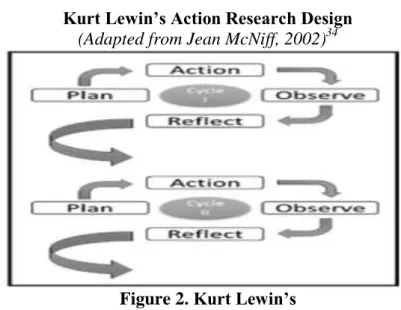
In this Classroom Action Research (CAR), consisted33 of the cycle and consisted of four steps, namely planning, acting, observing and reflecting.
The writer describes the cycles through the scheme of action research design by Kurt Lewin as follows:
Kurt Lewin’s Action Research Design (Adapted from Jean McNiff, 2002)34
Figure 2. Kurt Lewin’s
CAR was applied in this research since it was regarded important to develop writing ability of the eighth grader of SMP Muhammadiyah 1
32 Jean McNiff and Jack Whitehead, Action Research: Principles and Practice, (New York: Routledge Falmer, 2002) Second Edition, p.15
33Ibid, p.41
34Jean McNiff and Jack Whitehead, Action Research: Principles and Practice, (New York: RoutledgeFalmer, 2002) Second Edition, p.15
Trimurjo by double entry journal strategy applying, by applying this strategy it was expected to solve students‟ problems in teaching-learning process of writing ability.
The classroom action research design applied in this research was a collaborative classroom action research. In conducting the research, the researcher collaborated with the real English teacher of SMP Muhammadiyah 1 Trimurjo as an observer and collaborator.
The researcher played a role as an English teacher who teaches writing ability trough double entry journal to the students, while the real English teacher‟s role is as an observer who observes the action of the research while teaching-learning activities happen in the classroom. Also the real English teacher acts as a collaborator when helps the researcher in designing lesson plan, carrying out the reflection, and determining the follow up of the study.
Here, the researcher was not only as an observer but the researcher also took actions by making lesson plan and giving assessment. Then, the researcher also collecting and analyzing data together with the teacher to know the result of their student writing result.
According to the Kurt Lewin‟s action research design, the writer wants to describe a plan for Classroom Action Research (CAR) as follows:
1. Cycle 1 a. Planning
After interviewing, observing and conducting test before CAR.
The teacher and the researcher make instruments, as follows:
1) The researcher prepared the lesson plan based on the 2013 curriculum and English syllabus.
2) The researcher prepared the observational note and guidelines 3) The researcher prepared the instrument of written tests before and
after CAR.
b. Acting
In this phase, the researcher acted as the teacher and the real teacher becomes the observer. The researcher conducted some activities in the class as follows:
1) Pre-Teaching
a) The researcher greeted the students and checked the attendance list.
b) The researcher gave warm up activities.
c) The researcher explained general overview related to the topics of descriptive text.
d) The researcher confirmed the students their comprehension about the descriptive text.
2) While Teaching
a) The researcher implemented double entry journal strategy.
b) The researcher gave the students descriptive text.
c) The researcher applieddouble entry journal, and the students wrote the summaries or write notes in the left side on journal activity sheet.
d) The researcher applied the second step that was the students wrote their own passages on the right side.
e) The researcher applied the third step that was students have completed both sides of their journal entries, have them draw arrows to show the connections and relationships between the summary of the content and their personal thoughts and reflections.
3) Post-Teaching
a) The researcher gave a conclusion about descriptive text.
b) The researcher closes the class.
c. Observing
In this phase, the researcher conducted some activities as follows:
1) The real teacher observers teaching learning activity in the classroom, such as class situation, teacher‟s performance, and students‟ response.
2) Identifies the students‟ achievement in learning writing ability by giving the test after CAR in cycle 1.
3) The researcher calculates students‟ improvement scores from test before CAR to test after CAR in cycle 1 whether improving or not.
d. Reflecting
In this phase, the researcher and teacher have some activities as follows:
1) The teacher and the researcher discuss not only about the result of the implementation of CAR, but also students‟ achievement and the media.
2) The teacher and the researcher prepared the lesson plan for the next cycle and for test after CAR in cycle 2 in order to know the improvement of students‟ score and to solve the problem unfinished yet.
2. Cycle 2 a. Planning
After interviewing, observing and conducting test before CAR.
The teacher and the researcher made instruments, as follows:
1) The researcher prepared the lesson plan based on the 2013 curriculum and English syllabus.
2) The researcher prepared the observational note and guidelines.
3) The researcher prepared the instrument of written tests before and after CAR.
b. Acting
In this phase, the researcher acted as the teacher and the real teacher becomes the observer. The writer conducted some activities in the class as follows:
1) Pre-Teaching
a) The researcher greeted the students and checked the attendance list.
b) The researcher gave warm up activities.
c) The researcher explained general overview related to the topics of descriptive text.
d) The researcher confirmed the students their comprehension about the descriptive text.
2) While Teaching
a) The researcher implemented double entry journal strategy.
b) The researcher gave the students descriptive text.
c) The researcher applieddouble entry journal, then the students wrote the summaries or wrote notes in the left side on journal activity sheet.
d) The researcher applied the second step that was the students wrote their own passages on the right side.
e) The researcher applied the third step that was students have completed both sides of their journal entries, have them draw arrows to show the connections and relationships between the summary of the content and their personal thoughts and reflections.
3) Post-Teaching
a) The researcher gave a conclusion about descriptive text.
b) The researcher closed the class.
c. Observing
1) The real teacher observed of teaching learning activity in the classroom, which included class situation, teacher‟s performance, and students‟ response.
2) Students were given the test after CAR in cycle 2.
3) The researcher calculated students‟ improvement scores from test before CAR to test after CAR in cycle 1 to test after CAR in cycle 2.
d. Reflecting
1) The researcher and the teacher discuss about the result of the implementation CAR by modifying a new strategy in action, about students‟ response with the media, about improvement students‟
score in writing and about analyzing the result from test after CAR in cycle 1 to test after CAR in cycle 2.
2) Then, the researcher and the teacher made an agreement, if the target was not achieved, the action continued to cycle 3, but if the target was achieved, the action stopped.
E. Data Collecting Technique
There are two type of collecting data: qualitative data and quantitative data. The researcher uses observation dealing with the qualitative data. On the other side, the researcher uses the students‟ final result score of writing as a pre-test and post-test to obtain the quantitative data.
Some instruments applied to obtain the data in this study. The completely explanation of those instruments as follow: