Strategic
Management and
Marketing
DEREK F. CHANNON
,'WITHDRAWN
#?Tf
DUE RETURS f DaTE DATE
DUE RETURW DATE DUE
#
AUG i>? 1QPT ...
F'*j; ? C 104 fM hii 2 9 IW14 --
•-T*5
to
(UUL “ ^ fitt i 6 19%
iMJ2.5 1*91 f»r rf / -,
rp~~DEC 031996
yny n * 19911
mjcC § & M OCf 2 8 iyy)
* ftr,; -5 JifcjgT
m 1 2 1992.
i* ' v
* • f ;t 4 ‘ \ . *
y?.R 1 6 --
i
Bank
Strategic Management
and Marketing
Bank
Strategic Management and Marketing
Derek F. Channon Professor of Marketing International Banking Centre
Manchester Business School,
Manchester, UK
JOHN WILEY & SONS
Chichester • New York • Brisbane • Toronto . Singapore
All rights reserved.
No part of this book may be reproduced by any means, nor transmitted, nor translated into a machine language without the written permission of the publisher.
Library of Congress Cataloging-in-Publication Data:
Channon, Derek F.
Bank strategic management and marketing.
Includes index.
1. Bank management. 2. Bank marketing. I. Title HG1615.C46 1985 332.1'068 85-20182
ISBN 0 471 90383 3
British Library Cataloguing in Publication Data:
Channon, Derek F.
Bank strategic management and marketing.
1. Banks and banking—Planning 2. Strategic planning
I. Title
332.1'068'4 HG1616.P5/
ISBN 0 471 90383 3
Typeset by Activity Ltd, Salisbury, Wiltshire Printed and bound in Great Britain
Contents
Preface . ix Chapter 1 Introduction . 1 1.1 Changing Patterns of Bank Strategy . 1 1.2 Banking in the 1980s . 3 1.3 The Need for Market Planning . 6 1.4 The Role of this Book . 6 Chapter 2 Bank Strategic Planning . 8 2.1 Introduction . 8 2.2 Strategic Plan Content . 8 2.3 The Process of Bank Planning . 9
2.4 Strategy Testing . 44
Chapter 3 Implementing Strategic Planning Successfully . 49 3.1 Introduction . 49 3.2 Conditions for Successful Implementation . 49 3.3 When Does Planning Fail? . 58 3.4 Evaluating the Strategic Planning System . 59 Chapter 4 Competitor Analysis . 62 4.1 Importance of Competitor Analysis . 62 4.2 Developing a Competitor Intelligence System . 63 4.3 Competitor Identification . 64 4.4 Sources of Competitor Intelligence . 65 4.5 Competitor Analysis Data Base . 68 4.6 Analysing Competitor Strategy . 68 4.7 Assessing Competitor Strategic Capability . 79 4.8 Summary . 80 Chapter 5 Purchasing Financial Services . 81 5.1 Basic Purchase Motivation . 81 5.2 Specific Needs and Wants . 84
v
5.3 Corporate Purchasing Process . 86 5.4 The Organization of the Corporate
Treasury Function . 87 5.5 The Bank Choice Decision . 91 5.6 Middle Market Treasury Organization . 93 5.7 Conclusion . 96
Chapter 6 Planning Corporate Account Strategy . 97 6.1 Introduction . 97 6.2 Basic Account Screening . 97 6.3 Prospecting . 100 6.4 Needs Identification . 104 6.5 Account Strategy Assessment . 107 6.6 Account Action Planning . 108 6.7 Call Plan Development . 113 6.8 Consolidation Plans . 114 6.9 Summary . 117 6.10 Account planning checklist . 117
Chapter 7 Product Range and Development Strategy . 121 7.1 Product Range . 121 7.2 Deposit Services . 122 7.3 Lending and Credit Services . 123 7.4 Other Services . 132 7.5 Developing Bank Products and Services . 135 7.6 Developing Service and Product Knowledge . 138 7.7 Other Factors Affecting Communication . 139 7.8 Checklist for Developing New Banking and Financial
Service . 140
Chapter 8 Bank Pricing Strategy . 142 8.1 Introduction . 142 8.2 Pricing Objectives . 143 8.3 Estimating Cost Structure . 144 8.4 Strategic Impact and Cost Analysis . 146 8.5 Pricing Method Selection . 150 8.6 Factors Modifying Price Structures . 155 8.7 Summary . 157 8.8 Pricing Strategy Checklist . 158
Chapter 9 Delivery System Strategy . 160 9.1 Introduction . 160
9.2 Types of Delivery System . 160 9.3 Trends in Delivery System Strategy .. 172
9.4 The Outlet Location Decision . 173
9.5 Summary . 177
9.6 Evaluating Delivery System Strategy . 177 Chapter 10 Communications Strategy . 178
10.1 Introduction . 178
10.2 Developing Communications Strategy . 180 10.3 Personal Selling . 180 10.4 Promotion and Public Relations . 182 10.5 Advertising . 188
10.6 Summary . 196
10.7 Communications Strategy Checklist . 197
Chapter 11 Bank Organization Structure . 200 11.1 Introduction . 200 11.2 Forms of Bank Organization . 200 11.3 Organization for Corporate Banking . 204 11.4 Assessing Account Officer Needs . 212 11.5 Specialized Organizational Skills . 213 11.6 Trends in Organization Structure . 222 11.7 Problems of Organizational Change . 226 11.8 Summary . 228 11.9 Bank Organization Checklist . 228
Index . 230
Preface
This book and its accompanying casebook have developed over a number of years largely as a result of the development of the International Banking Centre at the Manchester Business School and from work undertaken with many individual banks. The banking industry is presently undergoing a revolution world wide. Due to the twin impacts of deregulation and technology an industry that even quite recently in many countries operated as a relatively undifferentiated cartel is now learning to operate in a much more competitive environment. Under such competitive conditions marketing and the process of strategic management suddenly become much more important.
The banking and financial services industry thus provides a fascinating area to observe the effects of rapid industrial structure change. The introduction and use a marketing and strategic management concepts are important ingredients in this change process. However, it has been our experience that such concepts need to be adjusted specifically for the industry and this has been the intent in the case of this book. There is also an accompanying casebook, all the material in which was developed from real banking situations, and disguise has been used to the minimum. Given the relative secrecy of the industry we would like to thank sincerely all those banks who have kindly released material for publication.
The text for the book is based on experience in the areas of marketing and strategic management and how these concepts can be specifically applied to the banking industry. Similarly all the cases in the casebook have been classroom tested with bankers at Manchester and around the world. We hope that both text and the case books will provide a useful contribution to the area of management education for banking.
In its preparation we have received much support from many bankers and banks. We would very much like to thank all those who have helped us. In addition I would like to thank my colleagues at the International Banking Centre and especially its Director, Dr Jim Byrne. I must also thank my research assistants who have helped collect and prepare data used in the cases. In particular thanks are due to John Desmond, Sally Falshawe and Makoto Showda. My secretary Avril Rathbone has also been responsible for much help in preparing the manuscript and I would like to thank her for
IX
patience and efficiency. Finally, while the work is the result of the efforts of many, any errors that may occur are regretted, with the responsibility being solely mine.
Derek F. Channon
Manchester Business School
June, 1985
CHAPTER 1
Introduction
1.1 CHANGING PATTERNS OF BANK STRATEGY
The world banking industry has been changing rapidly since the end of the 1960s. During the 1970s the industry in the developed countries of the world experienced a substantial change in competitive conditions as a result of a number of factors. First, the industry tended to go international, led by the leading US money center banks. This resulted in market interpenetration by established overseas competitors and led to substantial challenges to existing indigenous banks, notably in the corporate market. Moreover, the new entrants brought with them new approaches to servicing corporate accounts, while the growing internationalization of the large corporations from all the developed countries led in turn to customer demand for new banking services to meet the specific needs of multicountry operations.
Secondly, new capital markets opened which transformed the traditional patterns of funding for both banks and corporations. By the end of the 1970s large percentages of bank deposits were being provided by funds from other banks via the interbank market and the burgeoning growth of the deregulated Euromarkets. Initially centered on London, the Euromarkets had evolved as the world’s largest capital market, operating in an increasing number of major financial centers around the world. Moreover, the instruments available within the market had developed to provide a wide range of sophisticated products meeting more or less any specific financial need in a growing variety of currencies or currency combinations.
Third, in response to competition, indigenous banks in Europe reacted and began to build up their own multinational presence, attacking notably the US domestic market, where via aquisitions and new openings, they brought their own brand of counterattack to the US indigenous banks with significant success in many cases. Here it was the US banks that were on the receiving end of an aggressive attack which some believed to be unfair, in that the regulations affecting the new competitors appeared to give them advantages on interstate branching and the like which were denied to US domestic banks.
1
Next, the banking industry, despite the constraints of banking law in many countries, began to diversify. Again in the USA the constrictive corset of Glass Steagall prevented a number of the moves that banks were able to undertake in some other countries, but in general commercial banks moved into the areas of asset-based finance, consumer credit finance, merchant banking, trust and pension management, Eurocurrency operations and syndications, credit cards and the like, while at the same time proliferating the range of products offered in conventional banking services. Where legal constraints did not apply, further areas for diversification included insurance broking and underwriting, travel, securities management and computer services. As a result, by the end of the 1970s banks had become more complex in the range of services offered while competitive pressures had eroded margins on commercial lending such that fee-based services were becoming of increasing importance.
Fifth, the industry was identified, largely because of the regulatory constraints, by a growing number of non-banks as being especially attractive to corporations with potential operating advantages in specific areas of activity.
Thus, automobile companies such as General Motors, which had long been engaged in dealer and personal finance for automobile purchase, saw the opportunity to extend leasing and credit finance business to non-General Motors customers. Travel card companies like American Express saw the opportunity to offer a variety of financial services to its existing account-hol¬
ders at little additional cost. And retail companies like Sears Roebuck saw its established chain of nationwide retail outlets as an obvious point of sale for a range of interstate financial services which banks were inhibited from providing.
Sixth, technology began to affect the banking industry. Most notably this appeared in retail banking as, faced with a mounting tide of paper and rising administrative costs, banks turned to plastic cards and electronic machinery in an effort to maintain their ability to handle an increase in transaction volume while controlling costs. Further, the need to provide increased service, especially outside opening hours, led to the increased use of first cash dispensers and later automated teller machines. Similarly, the back office gradually became more automated and from the operations centres of many banks the possibility of selling information-processing services began to emerge as a potential new product market in its own right.
In retail banking too, competition increased. Savings and loan banks initiated the interest-bearing transaction account to bring them into direct competition with commercial banks. Outside the USA, savings banks and building societies also offered a growing range of services to attract small depositors. Larger depositors were lured by the attraction of money market funds or by the development of new sophisticated integrated financial service products such as the Merrill Lynch Cash Management Account. In retail lending, competition also increased. Credit card companies, collectively owned and operated by banks, offered easy credit, stores offered retail
revolving systems, credit finance companies offered loans for specialized assets, second mortgages and the like.
By the end of the 1970s, therefore, the banking industry had become much more competitive. The traditional demarcation lines between the classes of financial institutions were rapidly breaking down, while a number of major competitors were operating on a global scale rather than as the regional or national competitors they had been previously. Moreover, many new market entrants were emerging which, uninhibited by the legal constraints of the industry established as appropriate for an earlier age, allowed the newcomers a competitive advantage. Finally, new technology and substitute products threatened the traditional mode of banking operations.
1.2 BANKING IN THE 1980s
While change within the banking industry in the 1970s was very rapid, the 1980s seem likely to bring an acceleration in the pace of this change. Amongst the trends discernible for the present decade are the following.
1.2.1 Retail Banking
(a) Increased segmentation of consumer groups
A number of segments are already emerging as being especially important such as:
The rich. A growing number of banks are establishing or are operating specialist private banking units to provide a customized service for personal clients with assets available for investment or management of over $100,000.
Such units are often located in no- or low-tax areas and build upon the traditional secrecy and personal service long practised by the Swiss banks.
HNWIs. Below the level of the very rich, a segment has been developed to cater for the special needs of those individuals of moderate wealth. Making use of sophisticated computer systems, Merrill Lynch introduced its Cash Management Account to provide an effective money market interest rate for deposits of $20,000 or more coupled with a Visa card and checking account and the ability to generate loans automatically based on the value of securities contained in the account. The rapid success of this type of account has forced banks to respond and offer interest on current account balances at money market rates, while other securities companies have entered the market with similar products to that of Merrill Lynch. As a result, the traditional deposit base of the commercial banks has been substantially eroded.
Account Stratification. In response to attacks on their traditional deposit base.
banks have begun to interrogate their existing account base with the view to identifying accounts with potential for various specific services such as personal loans, credit finance, insurance, first and second mortgages, insurance or deposits. There will also be strong pressure to discard the unprofitable segments of most banks’ retail customer base.
(b) Replacement of Paper-Based Systems
The trend of the 1970s toward machine banking is increasing as banks work to reduce the cost of consumer banking using bricks-and-mortar branches and human resources. Not only is the growth of more sophisticated automated teller machines occurring but the development of home banking seems likely by the end of the decade. At the same time, credit and debit cards are expected to continue to grow and offer an increasing range of services as more information is contained on a card in the striping or in an inbuilt microchip. The substitution of machinery for human labor will continue and probably accelerate as the relative cost of new technology delivery systems falls while that of human tellers and back office personnel continues to rise.
(c) Increased competition for both deposits and loans
The pattern of increased competition between banks and other institutions providing financial service to consumers experienced at the end of the 1970s will continue. In the United States interstate banking will become finally established, with large money center banks entering other states, especially in growth areas of the country such as the Sun Belt and the south-west. At the same time interstate card systems shared by multibank organizations can be expected in an effort to counter the moves by out-of-state banks. In states such as California and New York foreign banks such as the Japanese and the British will provide growing competition for indigenous organizations.
In addition to the banks, new entrants will continue to penetrate against selected retail market segments. The pattern established by Merrill Lynch will be repeated by all major securities companies in combination with banks or other institutions such as insurance companies, American Express and the like.
Similarly, retail groups like Sears Roebuck with a natural synergy with financial services due to an established customer base and distribution coverage may be expected to increase their threat to traditional bank business.
The patterns of competitive behavior in the USA will be similarly repeated in many other countries. In the UK, additional competition can be expected from securities companies, building societies, foreign banks and retailers. In Germany, late to introduce card-based systems, the savings banks, foreign banks, card companies and retailers can be expected to increase competition.
In Japan the securities companies and the Post Office offer the greatest threat to the commercial banks.
1.2.2 Wholesale Banking
(c) Continued Intensive Competition
The intensive competition that developed in the 1970s will continue and even increase during the 1980s as banks increasingly strive for competitive advantage and in so doing tend to cancel out one another’s efforts.
As multinational corporations find they increasingly need banks less as they add internally the skills traditionally provided by banks and demand ever lower rates for money, banks themselves are turning their attention to the ‘middle market’. In so doing, however, they are forcing interest rates down in this sector for attractive accounts while reducing customer loyalty as the companies adopt multibank relationships. Smaller banks such as South East and Standard Chartered have opted to concentrate on specific services such as trade finance or geographic territories such as the Far East or the Caribbean basin. Other banks like the Texas banks have concentrated on specific areas of lending such as real estate and energy lending.
Further, while the American international banks led the competitive attack in the 1970s, the 1980s have begun with the counter-attack of the large European banks such as Barclays, Banque Nationale de Paris, Credit Lyonnais, Algemene Bank and Deutsche Bank. As these banks build up their global networks to match those of the leading US money center banks or build upon already established branches, the number of major competitors entered in all the major corporate and wholesale business centers will increase to an average of over 50 major banks.
Still to come as major global competitors by the end of the decade are the large Japanese commercial banks and leading specialist banks such as the Industrial Bank of Japan and the Bank of Tokyo. These banks, which are normally at the center of massive industrial groups, can be expected to emerge as extremely powerful and important competitors as their industrial group associates continue to expand overseas and develop the Japanese international economic position. By the mid-1980s the large Japanese banks had already achieved five positions among the top ten global banks.
Finally, a number of new important financial institutions are emerging from the newly industrializing countries and those countries with substantial petrodollar surpluses. Banks such as Banco do Brasil, Hong Kong & Shanghai and those of the Gulf States can be expected to play a greater role in the world of international banking in the future.
(b) Development of Systems Products
In the same way that banks are turning to technology to change their approach to consumer markets, so in the corporate and wholesale markets the development of systems-based products is becoming of increased importance.
Making use of their global networks and advanced communications, computer
and information processing capabilities, the largest banks are endeavoring to build customer loyalty and fee-based income by offering cash management, and, in future, comprehensive data/information processing services.
(c) Further Competition from Non-Banks
Non-banks such as American Express, Merrill Lynch and the major credit finance companies have already established a significant position in the corporate market and can be expected to continue to do so. In addition, a growing number of industrial companies are broadening the scope of their financial services operations to enter external markets. Thus organizations like General Motors Acceptance Corporation offer industrial credit finance, leasing and the like to companies outside General Motors, many captive insurance companies now legitimately trade with third party organizations, and in the coming decade the emergence of trading companies such as those of Japan can be expected in the West in major corporations like General Electric.
1.3 THE NEED FOR MARKET PLANNING
As a result of the growing level of competition and the rapid pace of change, more and more banks are increasing their strategic planning efforts in an attempt to allocate resources in a way which provides them with a competitive advantage or reduces external threats. At the same time marketing is emerging as an especially important element in bank planning. Traditionally banks have not really paid adequate attention to either strategic planning or marketing and as a consequence most have turned to external consultants or industrial companies for their concepts and methodologies. During the 1970s, however, although banks paid some attention to the new concepts, their main emphasis remained on traditional ‘banking’ rather than on management skills. The competitive environment of the 1980s is forcing the reappraisal of this position and management skills are growing in importance.
1.4 THE ROLE OF THIS BOOK
While most of the conceptual skills being introduced into banks have their origin in manufacturing industry, it is important to recognize that in many respects banking is a very different industry. As a consequence, a number of the concepts and relationships established in manufacturing may not be wholly applicable in banking or have a different emphasis. This book is therefore devoted to strategic management and marketing in the banking industry, with particular emphasis on international corporate banking. It builds upon the years of work undertaken by the International Banking Centre at the Manchester Business School, probably the largest institution for specialist education in international banking in the world. This work, which has been
undertaken in conjunction with many of the world’s leading banks, has always been practical in nature and courses have been designed in conjunction with practicing line bankers. We are extremely grateful for all the help and assistance these bankers have provided over the years and hope this may in some small way repay their help.
The text examines techniques of bank strategic planning and marketing based upon working systems in leading banks. In addition, the importance of techniques such as competitor analysis and product development are discussed from a banking perspective. A detailed analysis of corporate financial service purchasing is included to try and emphasize the position of the bank customer.
To supplement and reinforce the text a comprehensive collection of up-to-date banking cases is provided in an accompanying casebook. These range from cases outlining various aspects of the strategy of many important named banks and non-banks from around the world to a series of operational cases drawn from the experiences of a number of cooperating banks. Nearly all the material has been tested with line bankers drawn from many countries attending the many programs run by the International Banking Centre, while others have been prepared for specific banks’ internal management needs. We hope that you will find the results helpful to your bank.
CHAPTER 2
Bank Strategic Planning
2.1 INTRODUCTION
Strategic planning is an essential ingredient in the process of strategic management of the bank. It results in the development of the bank’s long-term objectives and the design of action plans throughout the bank which lead to the achievement of these objectives. Specifically, the bank’s strategic plan makes explicit:
• The market priorities, which determine resource allocation
• The assumptions behind the choice of market priorities
• The changes required to capitalize on market opportunities
• The timing of strategic moves
• An estimate of the environment in which the bank will act
• The expected rate of progress in strategy implementation
The plan thus describes the strategic direction the bank will take by assigning specific objectives and investment priorities to particular market segments in which the bank operates, so committing resources to the desired mix of businesses which will result in achievement of the bank's long-term objectives.
As a guide to management, the bank’s plan also describes the strategies to be pursued in the form of action plans leading to changes in business variables under the control of management. These variables are the levers which can be manipulated to arrive at the desired strategic position for each bank business.
The desired changes themselves define the implementation tasks of managers.
2.2 STRATEGIC PLAN CONTENT 1 he strategic plan should include the following components.
1. Mission. This states the overall purpose or raison d'etre of the bank. It also applies at the level of the organizational subunit, stating in addition the nature of activities and any self-imposed constraints.
8
2. Objectives. These are usually measurable characteristics and their future value should be stated. Typically, objectives are cited for variables such as financial return, size, efficiency and service quality.
3. Environment!market assumptions. These contain explicit statements about future trends in strategic market segments in which the bank participates together with factors which may affect these trends or impact upon the bank’s organization or its freedom to act.
4. Competitive strength evaluation. The plan should explicitly assess the bank’s relative strengths and weaknesses for specific factors such as market share, service quality and relative costs.
5. Assessment of opportunity. For each market segment, the plan should assess threats to and opportunities for the achievement of mission and objectives on the basis of the environment and market assumptions and relative competitive strength.
6. Market portfolio strategy. This ingredient identifies the desired investment strategies for each of the markets in which bank units participate and the objectives to be attained for each.
7. Strategic changes in controllable factors. Objectives and goals for action plans stating changes in capabilities or resources under the control of unit management and selected as most likely for achieving the desired market results.
8. Action plans for change implementation. Specific programs includ¬
ing measurable goals, events and timing which will result in the changes specified in action plan objectives.
9. Expected financial results. These indicate the anticipated financial outcome in terms of revenue, profits and return on assets for the units.
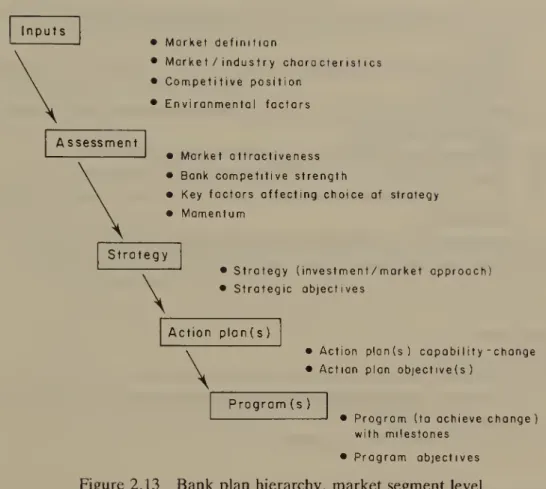
The plan also needs to be developed for each organizational level of the bank. The normal starting point for bank analysis is the individual market segment. However, the bank’s organization structure may affect the responsi¬
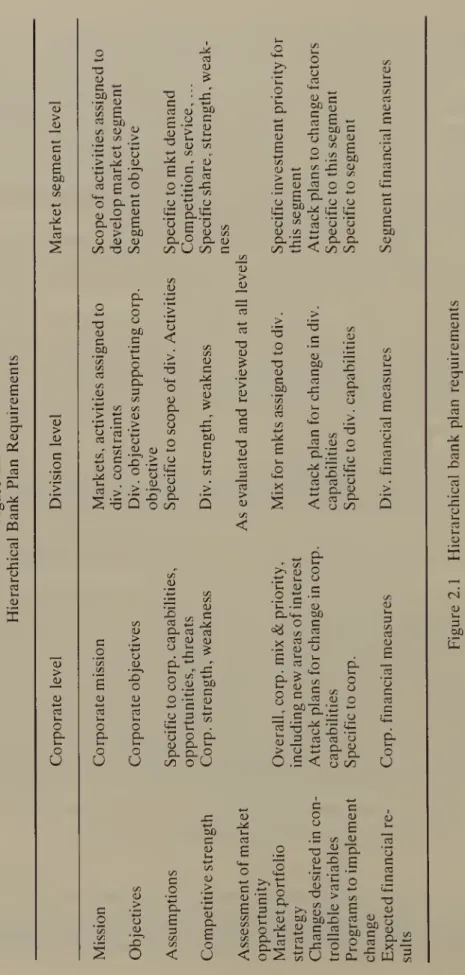
bilities for making changes in market strategic variables. Further, organization structure itself is a major variable under management control, and indeed it turns out to be a key factor for bank differentiation. For major international banks the question of market and business unit definition can be difficult to resolve, due to conflicting claims of product and geography. In practice country units are logical organizational planning centers, but for products and/or customers which span national boundaries coordination or planning control should focus on the customer/product segment. The differences between plan content at various organizational levels are illustrated in Figure 2.1.
2.3 THE PROCESS OF BANK PLANNING
The process of bank strategy planning at the corporate level is illustrated in Figure 2.2. At the corporate level it begins with an assessment of mission and
Figure 2.1 HierarchicalBankPlanRequirements
'O d>
c p OX) c <D
cd M C/3 CD (D d) C/3 >
d) *4—>
D
’> X O 4—*
CJ V- cd X cd
<4-4 E o 4—*
o CX c CD O-
_o
"S CD S O > OX) CJ u CD GO TD GO
Cd <D
. ?
*2 : -c c »- 4—»
cd d> wi cj “ E d>
,5 E
c
d>
c is
d> c/3 c/3 - 0)
„ o 5 e b 2:5-5 U U .a
‘G p ‘G 0) g o>
o-O cl G0 U C/5
C/3 d>
"O
d>
C
.SP ’55 C/3
■ — on
.S c 4-* .p y cd
cd s- 4—> C d> o
^ cj i—i cd >
2^5
o o
OX)
o CL CL O
C/3 C/3 <L)
>
<
cj>
tj
<4-1
O
d>
CL o cj cj d> (U
x\>
o re
5 o
u <u on CX
c o
o CX u, o
U
<u
>
u <u
• —5
X>
o
<o
o ex <—
o
u
d>
X c
cd 0)
&
OX) a
d>
V-.
d)
>
d>
T3 d>
£ 0)
’>
CD v*—
T3 C
cd T3 d>
cd 3 Id >
d>
X d>
X C 5
CX « cs
rt <D <u
O 1-1 >
. X >
CX^ --
§ u op _ -*-» c O ■— u
•*-* C u.
**- t. . 2 ^ 5 o a
<0 CX £ a. a o
co o U
<-»—I o
cj cd
<4-1 CD £
c CD E C/3 CD > C
C *D
.5 i)
'tS <D
‘o c/3
d) C/3
cl;p
go 3
cd x u E p ox c
1) V
" E OX) d>
C/3 X c «-*
i5 o o
°-o o i ■‘■<2 XS c j kp x cd o o
+•* d) CD P a a.
< c/5 go
>
o
"O d>
c
■a OX) C/3 cd 4-> C/3
—<2
E 1—.
£
X
>
_c
d) OX)
C c/3 cd d>
#>
’-5 o O- «-* x: cj
-X X X o X x cd cd d j-1 Q. d)
P cs a.
< CJ GO
, L2 U— (U
i~ d)
■g.E
Cxc-i
# °
« g
E E ex ^ U. (U
O C
^ C W)
P ^ F- S CD 3
> CJ
o.s
o o
d) OX) c x cd CJ
C/3 O C C/3 <->
_cd d) O
51 .a o b:
cd cd D
^ n . d>
cd d) E
CJ c cd C c d>
B OX) d) C/5
rp «D X b
cd 5
O-
cd CJ
cd d>
E
CJ C
cd c
>
5
d)
cd d>
E CL
O U
'O c C/3 C/3
§
Figure2.1Hierarchicalbankplanrequirements
_c OO '5 c i2 cx
<D H CN
(N
<L>
.2O ? E
process of bank corporate
objectives, which are matched against opportunities and resources. At the departmental or divisional level current market priorities, objectives and strategies are evaluated and compared with corporate strategies and options to develop an integrated corporate strategy. This in turn indicates desired changes in the positions of the bank’s business portfolio, in its levels and direction of resource allocation and in organizational capabilities. These are ultimately translated into action programs for implementing the changes.
2.3.1 Setting the Bank Mission
The first stage in developing the plan is the establishment of the bank’s mission statement. Each organization has such a mission or reason for existence. This only changes very slowly and has a major impact on what the organization chooses to do or not to do and the way it decides to act. Understanding your own bank’s mission and those of your competitors is an important ingredient in establishing successful strategies, by recognizing the constraints within your own organization and the opportunities offered by those within your competitors’. The actual mission of the bank is determined by a number of factors:
Corporate history
The past history of the bank will have a significant impact on behavior. Past successes will influence the choice of future directions whilst past failures will tend to lead to areas of avoidance. The bank’s origins will also affect its position in relation to particular geographic areas, customer classes, and so on. Hong Kong and Shanghai Bank thus sees its zone of influence to be the Pacific Basin and also the USA and UK; Credit Agricole is strongly attached to its farming depositors.
Corporate culture
Every organization has its own unique internal culture made up of the way things are normally done, the type of people employed and the set of organizational norms and practices which condition and govern both formal and informal behavior. J. P. Morgan bankers thus see themselves as financial consultants, compared with Citibank corporate bankers who are much more lending-oriented.
Power structure
The power structure of the bank will significantly influence behaviour. This again applies to both the formal and informal organization structure. Thus, for example, despite protestations to the contrary, not all executives in Barclays are perceived as equal, especially if they are descended from one of the bank’s founding families. Similarly, a branch-oriented bank such as Bank of America tends to structure its activities around geography, by comparison
with most of its New York-based competitors where organization around customers is more usual.
Key decision-makers
The style, aspirations and values of key decision-makers have a significant effect on the basic purpose of the bank. Virtually no major shifts in strategy or organization occur without a prior change of leadership, and this is normally a prerequisite for any attempt to shift the organizational purpose.
For example, the recent change in the strategic direction of Chase Manhattan and First Chicago Corporation required such a change of leadership.
The basic mission of the bank can thus act as a serious deterrent to shifts in strategy but usually represents a deep strength providing some overall distinctive competence which can be built upon for the development of future strategy. It must, however, be recognized that to change a basic organizational purpose is usually very difficult and takes a significant time. Strategies which expect to make such changes quickly are therefore unlikely to be realistic. This concept of overall purpose for the bank needs to be identified and set down in an overall corporate mission statement. The statement sets out the overall direction the bank wishes to pursue and identifies the nature of the activities it will engage in and self-imposed constraints that may apply as a result of history, culture and management values.
2.3.2 Setting Objectives
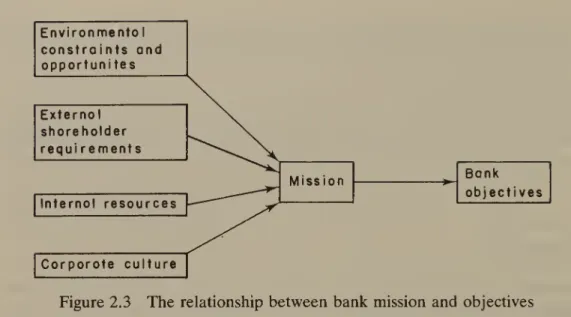
The second stage of developing the overall bank plan is the setting of objectives. These are set by top management, taking into account the potential of the external environment, any self-imposed constraints identified by the overall mission statement, the internal resources of the bank and the requirements of external shareholders as shown in Figure 2.3.
The corporate objectives usually remain relatively stable over the medium term and should consist of quantified variables, although many banks also include non-quantified objectives. Later in the planning process at other levels within the bank, strategic groups, divisions or departments will also set out their own mission statements and objectives as part of the detailed bank plan.
In evaluating the objectives of the bank and its operating units it is extremely important to check that they are internally consistent and that the achievement of one does not automatically exclude the achievement of another. All too often internal consistency is missing. Similarly, in reviewing the overall plan check that the objectives of the operating units are consistent with those of the bank as a whole. Again it is common to find inconsistencies. One often encountered is that operating units will still be seeking to grow their businesses while the bank, as part of its market portfolio strategy, might actually require
Figure 2.3 The relationship between bank mission and objectives
some businesses to contract in order to generate the resources required for other elements in the portfolio to grow. In the event that inconsistencies are identified in the bank’s objectives, aim to remove them by checking which objectives are paramount.
2.3.3 Market Definition
The next stage in developing the bank strategic plan is strategy development.
The first step in this is to assess, and order, potential market opportunities as shown in Figure 2.4. A market is defined as an intersection between a class of customers and a bank product or service group. Defining the markets the bank is engaged in is actually a very difficult task and requires a substantial degree of creative effort. In practice, virtually no bank endeavors to service all the needs of all potential customers. Instead the bank operates in a series of ‘served’
markets, each of which is a subset of the total market as illustrated in Figure 2.5. The concept of ‘served’ market breaks down the total market to that segment or segments to which the bank will purposively try and sell products or services.
Each market the bank is engaged in, therefore, should be sufficiently defined such that you can answer each of the following questions:
• Who precisely are the customers?
• What are their needs?
• What products or services of the bank meet these needs?
• Can we provide these efficiently, profitably and at an acceptable level of risk?
• What resources does the bank need to deliver these services?
• How will the bank manage these resources?
MarketdefinitionMarnerMarket -industry—r+~ andsegmentation. . . ..+attractiveness 3rhnrnrroricfirc Figure 2.4The process of strategy development
In order to evaluate the potential of served markets first complete a customer/product needs grid such as those shown in Figure 2.6(a) and (b).
In practice, both corporate and consumer customer segments should be subdivided and separate needs matrices completed for each key customer class. The more precise the identification of market segment boundaries the better but ensure that these are actually meaningful. An adequate description of a market segment should constitute a set of boundaries to which strategies can be specifically targeted and where a defendable position can ultimately be established. Note the geographic boundaries for many of these served markets will differ sharply, and it is not uncommon for banks to offer different geographic served markets to different customer classes. Thus many banks will provide certain worldwide services to large corporate accounts and to some others from specific industry sectors, while services to average consumers will be usually confined to a local area or country. A bank like Chase Manhattan provides consumer banking services in and around New York but offers a worldwide service to private banking clients with deposits of over $100,000 and to large corporations with international service requirements.
2,3.4 Corporate Market Segmentation
For the large corporate market plans are created mainly by building up from the marketing plans for individual accounts (see Chapter 6 on account marketing planning), while for those larger groups of customers and prospects marketing planning is based on aggregate strategies. Middle market corporate accounts are usefully planned by a combination of these techniques, using improved segmentation screening variables to initiate marketing plans supplemented by individual account plans for those organizations whose potential, based on the screening criteria, justifies the expense.
Suissaaojd eieq 3u;5(Ojq souEjnsu]
JU3UI3SCUBIU UOISU3J 3DIApR XCX SuinpiEq amqaBjAl S331AJ3S J3jnduiC0
|E}idE3 ajnjus^
suro| uoipnjjsuo3
sjipajo jaXng JU3U138bUEUI qSE3 |BUOI)EUJ3JUI 30UEU1J XiEipisqns uSisjoj sjuaiuXEd sSb^\
sjuaui33B|d ajBAud ip spuog S3DIAJ3S aSuEqoxa u3|3joj 33UEUIJ psfoJJ S331AJ3S 3pBJJ uSlSJOJ SUOIJISinbOB pus SJ3Sj3pj 3DIApR JU3U1JS3AUI |RUOUGUJ3JUI SUOIJBDipuXs UEOg (?UlpU3| XDU3JjnO 1RUOIJRUJ3JU]
S3D1AJ3S 33JS0JX 33|ApC JU3U1JS3AUI sueo| ssEqojnd ssnoj-]
S33IAJ3S PJBO JtpSJg S331AJ3S 33IApE XjtlSESJX S3D1AJ3S 1U31U3SEUCUI qSEg Suuopnj |EDOg SuiSE3] |E30g SU0tp3||03 |E30g sijpjp uSpjoj
S3! ^qpuEJS
33unuy jjodui|
33UEU1J podxg
SJtpSP 33UB)d333V SUEO| U1J3J |E30g JJEJPJ3A0 |BDOg S33IAJ3S Jisodsp |EOOg sjuiupdb Sutjpaqo inner]
z X>
l-t P3
£ oj rt
o
e* o
u LocalMNCs ForeignMNCs Aerospace cos
z o
o o Cl z c
C3 l-
H Trading cos Energycos Consumer product cos Engineeringcos Construction cos Property cos Shippingcos 1 Insurance cos Correspondent banks Other financialinstns
z JV
£ X
CC Government f State&localauthorities Stateenterprises Other middlemarkets RegionA RegionB RegionC Smallbusiness markets
<
c
o 0/ <u
oc RegionB U
c
c O/J
<D
Figure2.6(a)Bankmarketcorporatecustomer/productneedsmatrix
S30UJ3S qsodap Ajunoag aaiApB SupunoDoy Supjuuq auiqoBpv aoiApe UOISU3J [BjidBD aanjua^
suboj ssauisnq [[Burg S33IAJ3S J3ABJ} J3qiO sqoaqo tsj3jpABJX
spjBa Jipai3
aouBjnsui ajij-uojq aouBjnsui ajiqj saDlAjas aajsrnj^
S3DIAJ3S XBX 33lApB JU3U1JS3AUJ s3§b§jjoui puooag SUBOJ JBUOSJ3J suboj uoijBonpg suboj aouBuq jipai^
SUBOJ 3§B§JJOJM SUBOJ JJBjpjaAO sjunoooB jisodap uuax sjunooaB spajpjiq^
sjunoaoB psodap jBooq sjunoDOB guojaaqa jBooq
CL)
J-H CD
G
U O bO C
J3
G cd X
>
(DO CD G O
x cd G G O
C
<D
"O G C/5
cd
E
bD C G O
C o
CD i C/5 bO C
>
cd C/3
Figure2.6(b)Bankmarketretailcustomer/productneedsmatrix
Useful variables for this initial approach to market segmentation include:
Turnover
Turnover provides a simple crude means of segmentation. For example:
Some banks determine their mode of organization based upon turnover measures such as accounts above $100m turnover being handled by a director or senior vice president; some international banks will not pursue accounts of less than $50m sales.
Turnover gives an indication of the size of business available for many products and is perhaps the widest used single segmentation variable.
However, most banks when designing key account target lists make overuse of this variable without coupling it with other factors such as geography, probability of dislodging a competitor, etc. As a result, many banks are pursuing the same key accounts and often neglecting potentially more profitable and more readily penetrable accounts with perhaps a somewhat lower volume of total business. The largest apparent volume segment is seldom the easiest to penetrate or the most profitable.
Turnover is also an important variable when used in conjunction with others to create ratios. However, remember turnover is not an available measure in many service and public sector organizations.
Geography
Corporate accounts in fact tend to be geographically clustered. Geography can thus be used as a variable to decide upon the allocation of business development resources, new branches, etc., and for assessing market potential within particular regions.
Industry classification
This is a somewhat difficult variable to use, since many companies are very diversified and operate in a number of product market areas. Crude industry measures are, however, useful both in terms of assigning account responsi¬
bly and developing specific products. For example, insurance broking companies and commodity traders would be especially interested in rapid money transfer systems. Industry specialization by account executives is a real alternative to a geographic branch-based system of business develop¬
ment, and even if not practised it is important for bank executives to learn about the specific financial needs of key industries.
Competitor bank relationship
One of the most useful segmentation variables is ‘Who does an account bank with at present?’ From this knowledge it is possible to conduct competitor analysis to assess your relative strengths and weaknesses compared with your competitor and attack the account with those services you are especially
good at. Remember, whenever you take new business, it has to come either from growth in the overall market or from a competitor.
Subsidiary structure
The majority of larger companies or industrial groups consist of different subsidiaries and/or are multisite operations. It may be possible to gain an early foothold at an account by taking business at a subsidiary or specific plant. The decision process for bank appointments can rely heavily on the attitude of subsidiary units, especially for some services, and this may therefore represent a significant potential route for building a lead bank relationship. It is, however, important to understand the decision process for banking appointments before spending too long trying to gain business at a subsidiary of a larger group.
Number of employees
A useful indicator of organization size, this can also be used to indicate sensitivity to wage demands, and when taken in conjunction with other factors provides a number of useful derived variables such as value added per employee, capital employed per employee, etc. It can be used in the design of service packages incorporating personal services, which often form a suitable starting point for account penetration.
Level of export sales
This is an important indicator of the level of international activity, both in absolute size and also when used as a percentage of turnover to indicate the relative importance of this. An obvious indicator for forex and acceptance credit business, it may also point to network matching possibilities, multicurrency lending, confirming business, and the like.
Number and location of overseas offices and subsidiaries
This is another indicator of the level of multinational activity. It is also useful for network matching against the bank’s own overseas network and with reference to the location of specific branches.
Current assets
Subdivided into major components, with stocks and debtors being singled out for specific attention, these indicate managerial ability when compared with industry averages, degree of working capital intensity, and the like.
They also suggest specific types of banking service such as factoring, overdraft lending, acceptance credits, transaction services, and the like.
Current liabilities
Subdivided into major components, with creditors and short debt being singled out for specific attention, these indicate debt capacity level and managerial control over creditors.
Fixed assets
Subdivided into property and plant and equipment for use in security evaluation and identification of capital funding needs and capital intensity, fixed assets can be usefully examined to explore financing opportunities in all forms including leasing commercial paper and the like.
Interest paid
Subdivided into long and short interest, this, in conjunction with earnings, indicates capacity to repay lending. Short interest should be checked against actual year-end balance-sheet short debt to identify seasonal overdraft requirements.
Long and short debt
Used on their own and as a component in debt/equity and other financial ratios, these indicate debt requirements and capacity. They may also indicate specific service opportunities such as the conversion of short to term debt or leasing possibilities.
Profitability
Several versions are used. EBIT indicates absolute level of earnings, also used in conjunction with other variables to indicate gross margin and return on investment.
Earnings before tax may also be used on its own and as a measure of ROI.
Earnings after tax indicates levels of tax paid. Industry average is useful as an indicator of tax saving potential, managerial capability and corporate viabilty.
In markets where suitable data are available, the preliminary screening of corporate accounts can be usefully computerized and coupled with basic credit assessment to evaluate market potential and relative risk.
In practice, using only one or two segmentation variables is usually ineffective. For example, a bank might identify all multinational accounts over
$250m turnover as key accounts and devote the bulk of its business development effort to penetrating these. Yet, if the bank does not have the specialist services and skills required by this type of account it will often be wasting its resources. Instead it might be better off attacking high export oriented, medium sized companies selling mainly to Eastern Europe and the developed countries and needing specialist foreign exchange and export credit services if these are areas the bank is well equipped to service.
In order to home in on a narrow market segment, therefore, banks should make use of several variables at the same time. This is where computerization proves most helpful, since from a data base this can be done very quickly.
Usually employing three or four of these indicators or ratios derived from
them, it is possible to subdivide the corporate market into very small segments which can be assigned priorities and attacked systematically. In addition, it is possible to monitor your own accounts to assess the impact of changing market conditions and to identify possible targets which your competitors might seek to exploit.
For example, your bank might be interested in accounts with an overall level of sales of more than $50m, exports of more than $8m, a debt/equity ratio of not more than 50 per cent and interest cover of at least five times. In most countries the number of accounts fulfilling this set of criteria would actually be extremely small and could be quickly isolated and serviced.
2.3.5 Retail Market Segmentation
In addition to the need to segment the corporate model, there is a growing requirement in banks to look carefully at their retail account base and aim at segmenting this with the view to isolating special groups of customers particularly suited to specific products or services. The traditional method used has been to segregate out high net worth individuals or the rich and offer a special service to this group. However, today this group has in turn been subdivided further, as follows:
Superich
Customers with a deposit capability or net worth of $1 million and above.
While such individuals are seen as a primary source of relatively low-cost deposits, they are also attractive prospects for investment management services, tax advice, insurance and large loans.
Private banking group
These customers are similar to the first group but in some banks a lower cutoff is established at, say, $100,000 or more. Again these individuals are a primary source of deposits and require investment and taxation advice. They may also be candidates for lending.
HNWI
Today this segment is virtually a mass market group. They provide a substantial element of the endowment in current account balances and have for years been neglected by traditional banks, who have offered low or no interest on deposits. This group has been the principal segment attacked by money market funds, Amex Gold Card and Merrill Lynch with dramatic success, causing a massive drain on bank deposits in the USA, especially for savings and loan banks. It is not merely a source of deposits, however: its members are also active purchasers of investment management services, insurance, travel services, large mortgages and other loan products. Banks will have to look carefully at this customer group in the coming years to try to
win them back from the attractive package of financial services offered by the broking houses.
Professionals
This group of specialist, professionally qualified self-employed such as dentists, doctors, lawyers and accountants are attractive prospects not merely because of their net worth but also as good potential for small business loans, data processing and pension planning services, which need to be carefully packaged to meet their specific needs. Thus, although they overlap with the HNWI group, they form a specific subsegment which can be addressed separately.
Self-employed
A wider segment than the professional group and usually associated with higher risk lending, this group is also attractive not only for loan services but for insurance pension planning, tax advice and possibly data processing.
Students
A large number of banks make specialized marketing appeals to students in the expectation that capturing their accounts at this stage will ultimately leave the bank with valuable up-market accounts after the student graduates. Regrettably, this anticipated long-term loyalty is breaking down as other banks attempt to provide specialist services to postgraduation groups such as professionals.
Senior citizens
A generally neglected segment until recently, senior citizens actually have a high propensity to save. A number of savings and loan banks have found that this segment can be kept very loyal by providing specialist services such as group travel, social events and the like to meet a real need for companion¬
ship often felt by such customers.
Youth
Many banks are attempting to generate loyalty very early by picking off the child and youth market. This forms a significant small savings market in aggregate, which banks have attempted to attract with offers of higher interest rates and free gifts.
Conventional market research techniques for segmentation can also be used to attack the consumer market. These would involve both demographic and psychographic variables. As a first step your bank might stratify its accounts using consumer demographics and bank data such as average balances and transaction rates to identify if the accounts are profitable. As a rule high deposit, low transaction accounts are very profitable, as are accounts with a
substantial loan commitment. The accounts which are unprofitable are those with a low balance and high transaction rate. Some such as student accounts may be tolerated at this stage in the expectation that they will subsequently mature and become attractive. Others can be improved by efforts at service cross-selling, bearing in mind that the type of services required by particular individuals will vary according to demographics and lifestyle. You will also usually find a smaller group of accounts with low balances, a high level of transactions and limited future potential. With these accounts you will have to decide if you can raise the cost of transactions to make them economically viable, encourage the accounts to bank elsewhere or maintain the loss-makers on social grounds. This group of unprofitable accounts may represent some 30 per cent of the average retail customer base. An illustration of consumer segmentation variables and their impact is given in Table 2.1, which shows how lifestyles and demographics have been combined to create consumer segments which account for a known percentage of the population and can be specifically addressed as a part of bank strategy. Such segment sizes and characteristics will of course vary according to location and it is therefore important to conduct detailed market research before adopting specific strategies aimed at individual segments.
Many banks pay insufficient attention to segmentation of either corporate or consumer markets. However, segmentation is crucial to strategic management and will be of paramount importance in the coming decade as banks strive to differentiate themselves in a relatively fragmented and highly competitive marketplace. In these conditions, without specialization and service differen¬
tiation, most banking activities will become price-sensitive commodity services with few opportunities for attractive margins.
2.3.6 Market/Industry Characteristics
Having identified the appropriate customer segments for your bank, plot their service usage on the customer/service needs matrix and for each market endeavor to assess the following market/industry characteristics.
Market characteristics
• Market size
• Historic growth rate
• Projected growth rate
• Number of accounts in total
• Number making up 50 per cent and 80 per cent of the market
• Trend in market concentration
• Buying decision process
• Service usage characteristics
• Service delivery process
• Financial characteristics of customers
Service characteristics
• Degree of service differentiation
• Relative capital intensity
• Value added
• Level and type of risk to the bank
• Relative profitabilty of the service
• Rate of service change/innovation
• Details of add-on service characteristics
• Cross-selling potential
• Impact on shared cost structures
• Service integration with other bank services Competitive characteristics
• Identity of major competitors and their market shares (including non¬
banks where relevant)
• Bank’s market share and relative share
• Changes in number of competitors
• Trends in market share
• Degree of competitor concentration
• Relative service quality (assess the full concept of the service, including delivery, time, accuracy, etc.)
• Relative service price
• Relative service cost
• Relative capital intensity
• Relative marketing effort
• Relative delivery system capability (includes network size and coverage, account officer skill, etc.)
• Relative employee skills
• Relative resource availability
• Relative systems capability
• Barriers to entry or exit Environmental characteristics
• Economic trends and their impact on the market
• Social trends and their impact
• Political trends and their impact
• Technological trends and their impact
The quality of your plans will be heavily dependent upon the information you use to generate them. The careful selection of information is therefore important. Japanese banks can teach Western banks a great deal about information gathering and analysis, while the intelligence systems developed by their associate trading companies have no parallel amongst Western