Black Men and Women’s Self-Esteem:
The Consequences of a College Education and Friend Emotional Support
By
Whitney Frierson
Thesis
Submitted to the Faculty of the Graduate School of Vanderbilt University
in partial fulfillment of the requirements for the degree of
MASTER OF ARTS in
Sociology August 13, 2021 Nashville, Tennessee
Approved: Date:
__________________________________________________ __________________
André Christie-Mizell, Ph.D.
___________________________________________________ __________________
Bianca Manago, Ph.D.
TABLE OF CONTENTS
Page
LIST OF TABLES……….iii
Section I. Introduction………..1
II. Literature Review………...3
Black People and Self-Esteem………..3
Education and Self-Esteem………...4
Social Support………...5
Black Women, Social Support, and Self-Esteem………..7
Black Men, Social Support, and Mental Health………....8
III. Current Study……….9
IV. Methods………...10
Narrowing the Sample………11
Dependent Variable………11
Independent Variables………11
Moderating Variables……….12
Control Variables………....12
Analytic Strategy………14
V. Findings………15
VI. Discussion & Conclusion………17
VII. REFERENCES………..21
LIST OF TABLES
Table Page
1. Means, Proportions, and Standard Deviations (SD) for All Study Variables by Gender Status, National Longitudinal Survey of Youth – Young Adult Sample,
(2016)……….15 2. Self-Esteem Regressed on All Study Variables, National Longitudinal Survey
of Youth – Young Adult Sample, (2016)………..……….16 3. Self-Esteem Regressed on All Study Variables by Gender Status, National
Longitudinal Survey of Youth – Young Adult Sample, (2016)……….17
I. Introduction
For decades, scholars have documented the importance of self-esteem for mental health (Zuckerman 1989; Orth, Robins, and Roberts 2008; Ida and Christie-Mizell 2012). Self-esteem is the extent a person perceives himself or herself to be a worthy individual (Rosenberg and
Simmons 1972), and research shows that Black people often have high levels of self-esteem (Hughes and Demo 1989). Additionally, education has been credited as an important resource that plays a role in one’s self-worth (Crocker et al. 2003). Going to college and earning a degree is often framed as important to individuals’ personal growth (Lundgwen and Schwab 1979).
More specifically, some scholars find evidence that educational attainment is an important predictor of self-esteem for Black adults (Alang 2014). The pursuit of education becomes particularly salient for Black people, given the historical barriers they have faced with schooling in the United States. Unequal access to education, attending racially isolated schools, and differential treatment by teachers are just a few of the challenges that Black people face in their schooling (Tenenbaum and Ruck 2007; Diamond 2006; Morris 2012).
Although Black people have not always had positive experiences with educational institutions, education may be important to how Black people view themselves. Some studies find that academic competence is important to one’s self-esteem from elementary school onward (Rosenberg et al., 1995). Though other research concludes that educational success becomes less important as people age (O’Malley and Bachmann 1979). In addition, social support from friends may augment education’s positive influence on self-esteem, as social support has many positive benefits to well-being (Wang and Castañeda-Sound 2008).
With two aims, I examine whether a college degree is positively related to self-esteem among Black people. My first aim is to investigate whether there are gender differences in the
relationship between having a college degree and self-esteem. My second aim is to discover whether friend emotional support by gender boosts the impact of a college degree on self-esteem.
This study adds to the literature in three important ways. First, much of the literature on education and self-esteem has focused on academic competence or ability (Rosenberg et al.
1995) and elementary and high school students (Hoge, Smit, and Hanson 1990). In this study, I focus on college attainment to understand whether this status is meaningful to the self-esteem of Black adults. Academic competence and ability are concepts that are highly similar to one another and often measures an individual’s skills and behavior in the classroom. College attainment, on the other hand, captures more than an educational outcome. Studies have found that degree holders are more likely to secure a job than high school graduates (Georgetown University 2016); degree holders have increased earning potential than high school graduates (Torpey 2018); degree holders also have higher job satisfaction than high school graduates (Pew Research Center 2011). People who are college graduates adopt a unique identity tied to their educational status.
Next, research often finds that Black men and women have different educational
trajectories. Black women consistently surpass Black men in high school and college completion (Slater 1994; Cohen and Nee 2000; McDaniel, DiPrete, Buchmann, and Shwed 2011). Given differences in their educational trajectories, I investigate whether gender moderates the impact of educational attainment on self-esteem.
Finally, I seek to clarify the mechanism through which educational attainment is related to self-esteem among Black men and women. There is ample research on the role of social support for Black women’s psychological well-being (Linnabery, Stuhlmacher, and Towler 2014; Elliott Brown, Parker-Dominguez, and Sorey 2000; Brown and Gary 1987). However,
fewer studies have examined the significance of social support for Black men’s well-being.
Given that social support is often related to better mental health in Black communities (Dressler 1985; Lincoln, Chatters, and Taylor 2003; 2005), more studies should consider the gendered aspects of social support on self-esteem. In addition, I focus on a specific mechanism by
examining emotional support from friends. Scholars consistently note the importance of friends in the informal network systems of African Americans (Myers 1980; Taylor, Chatters, and Jackson 1997). Some studies also claim that friends are more likely to be a source of emotional support than family members (Taylor, Chatters, and Jackson 1997). Still, less is known about the role of friendships in self-esteem and how friendships moderate the association between college attainment and self-esteem.
Using the concept of social support, I examine the moderating role of friend emotional support on the relationship between college attainment and self-esteem for men and women. I also examine the effect of a number of demographic variables on self-esteem (age, region, urbanicity, and marital status) given that prior research indicates that these factors are associated with psychological well-being and, more specifically, self-esteem (Orth, Robins, and
Trzesniewski 2010; Crain and Weissman 1972; Brase and Guy 2004).
II. Literature Review
Black People and Self-Esteem
Prior research on Black people and self-esteem have often reported a similar narrative.
Despite the systemic inequalities that have plagued Black people for years, researchers have consistently found that Black people have self-esteem equal to or greater than White people (Hughes and Demo 1989; Gray-Little and Hafdahl 2000). However, fewer studies have investigated the importance of self-esteem for young Black adults. Research suggests that self-
esteem increases in one’s twenties and thirties to middle adulthood (Orth and Robins 2014; Orth, Erol, and Luciano 2018). Being that many adults graduate from college in their twenties,
educational attainment may help to explain Black adults’ self-esteem.
Education and Self-Esteem
Research suggest that education may play a role in one’s self-esteem (Alang 2014). Self- esteem is, in part, gained from our specific competence or abilities (Crocker et al. 2003).
Academic outcomes such as school grades, evaluations by teachers, and passing or failing an exam are associated with self-esteem (Rosenberg et al. 1995; Hoge, Smit, and Hanson 1990).
Much of the earlier research on education and self-esteem focused on academic ability and competence. These concepts are different from educational attainment, the highest level of education that an individual has completed (U.S. Census Bureau 2016). Nonetheless, academic ability and competence are related to educational attainment. Studies about academic
competence may show how educational attainment is connected to self-esteem.
Studies report mixed findings when investigating the relationship between education and self-esteem. Prior research suggested that academic ability is associated with self-esteem among elementary school children (Rogers, Smith, and Coleman 1978), early adolescents (Demo and Savin-Williams 1983), and later adolescents (O’Malley and Bachmann 1977). As time
progressed, educational accomplishments were viewed as less influential in shaping self-esteem.
However, Crocker and colleagues (2003) suggested that academic competence was likely to be an important source of young adults’ self-esteem, specifically during college.
Studies on young adults and self-esteem often focus on college students. Demo and Parker (1987) examined the relationship between grade point average and self-esteem among Black and white college students. They argue that not much is known about the effects of
academic achievement on self-esteem and how these effects might differ by race and gender.
With the exception of white women, they found no association between academic achievement and self-esteem. Further, they suggest that college degrees might be more relevant to students’
self-esteem and call for a more specific measure to examine how young adults evaluate themselves.
Recent studies call attention to the role of educational attainment to one’s self-esteem.
Drawing from a nationally representative sample of adults in the United States, Alang (2014) found that educational attainment was a stronger predictor of self-esteem for African Americans than for White people. In another study, Thomas Tobin, Erving, and Barve (2021) found that having a college education or higher lead to higher self-esteem among Black and White adults.
However, higher education benefitted white people’s self-esteem more than Black people. They note that few studies have examined the role of SES (i.e., education) and race in shaping
psychosocial resources, such as self-esteem.
Additionally, studies indicate that a number of other variables are implicated in shaping self-esteem. For example, researchers have found that age is positively related to self-esteem (Orth, Robins, and Trzesniewski 2010). Married individuals have higher self-esteem compared to those who are not married (Brase and Guy 2004; MacDonald, Ebert, and Mason 1986). In
addition, earlier studies found region (Crain and Weissman 1972) and urbanicity (Tharenou and Harker 1982) predicted self-esteem among Black adults.
Social Support
Multiple definitions have been put forward to describe the concept of social support (Pearlin et al. 1981) (Turner 1999). Social support is typically conceptualized as the aid, specifically the supply of tangible or intangible resources, that individuals gain from their
network members (Song, Son, and Lin 2011). It is often a reciprocal process that helps to regulate thoughts, feelings, and behaviors in everyday life (Oh, Ozkaya, and LaRose 2014).
Social support can be divided into separate forms: emotional support (liking, loving, empathy), instrumental support (goods and services) informational support (information about the
environment), or appraisal support (information relevant to self-evaluation) (Song, Son, and Lin 2011:118). For the purpose of this paper, I focus on emotional social support from friends.
Emotional support is the “verbal and nonverbal processes by which one communicates care and concern for another, offering reassurance, empathy, comfort, and acceptance” (American Psychological Association 2020).
Social support from friends has positive effects on well-being and mental health
outcomes (Gray and Keith 2003) and is thought to function through various pathways to promote positive outcomes. Expressions of high emotional intimacy, such as emotional support, are known to bolster emotional well-being and promote feelings of competence and self-worth (Taylor et al. 2014:148). Emotional support from friends is also recognized as useful with combatting negative messages received among Black communities (Middleton 2020).
In general, findings point to two main hypotheses about social support and well-being.
These are the “direct effect” hypothesis (Mackie 1998) and the “buffering” hypothesis (Thomas 2002). The direct effects hypothesis centers on the perception that others will provide aid in stressful situations (or as a result of membership in a social network). This social support will lead people to have higher self-esteem and feel more control over their environment (Cohen and Syme 1985:6). The buffering hypothesis suggests that social support is beneficial in stressful situations, as it may “intervene between the stressful event and a person by attenuating or preventing a negative stressful response” (Cohen and Syme 1985:7). For the purpose of this
study, I focus on the buffering hypothesis. When studying young Black adults, how might social support influence the relationship between college attainment and self-esteem?
Young adults offer a unique perspective when examining the relationship between college attainment, social support and self-esteem. They encompass a distinct stage in the life course, early adulthood, in which social support may be particularly beneficial to their self- esteem. Early adulthood is characterized by major shifts. Young adults experience changes in housing, family and social relationships, independence, identity, and work demands (Watkins et al. 2020). As young adults meet new people, move to different cities, enter college, and form romantic relationships, they may become further integrated in friend support networks and receive increased emotional support. For example, Griffin and colleagues (2006) found that education and age were associated with varied measures of social support. Specifically, more education was associated with larger networks of emotional support, closer relationships, and more friends. In addition, friendship networks are also a prominent feature in Black communities (Taylor et al. 2014). For example, a number of studies suggest that friend social support is an important factor to Black women’s self-esteem (Patterson 2004; DeFrancisco and Chatham- Carpenter 2000). However, less is known whether friend social support influences Black men’s self-esteem. This is an important gap in the literature. Given that social support has a number of benefits to Black women’s self-esteem, do men’s self-esteem also benefit from the resource?
Black Women, Social Support, and Self-Esteem
Emotional support is a type of social support. Yet, few studies investigate the influence of emotional support, in particular, on Black women’s self-esteem. Instead, researchers often
identify support networks for developing and growing Black women’s self-esteem.
Consequently, support networks, particularly from friends, are often viewed as important to
Black women’s well-being. In one study, DeFrancisco and Chatham-Carpenter (2000) found that social support was an important factor for Black women’s self-esteem. Friends played an
important role in equipping women with the tools to survive and persist in an oppressive society.
In another study, Patterson (2004) found that Black women maintained high levels of self-esteem over a 14-year period, in part because of friend support networks. Friendship networks were one of the most consistent predictors of self-esteem in both 1979 and 1992. Patterson argues that Black women validate each other within social networks. As a result, the bonds they form within these networks partially operate to build themselves up (Patterson 2004:321). As these studies, suggest, friend social support play an important role in Black women’s self-esteem. Given the influence of friend social support in Black women’s lives, emotional support may moderate the relationship between college attainment and self-esteem.
Black Men, Social Support, and Mental Health
Compared to Black women, fewer studies have investigated the relationship between social support and self-esteem among Black men. In fact, scholars claim that social support is
“grossly understudied” among Black men (Watkins et al. 2020). Studies that examine social support often focus on mental health. Mental health among Black men is frequently viewed as a pressing issue. Compared with other racial/ethnic men, young Black men experience
disproportionately higher levels of mental health challenges. This is largely due to an exposure to a greater frequency of psychosocial stressors (Watkins et al. 2020:2). When Black men seek help for mental health problems, they are more often to rely exclusively on informal help (Woodward 2011). For example, a 2006 study by Plowden and colleagues found that shared characteristics (e.g., age and economic status) among Black men were influential in helping them navigate through their health needs.
Studies that examine social support and mental health among Black men often find a relationship between social support and depression. In one study, Greene (2013) found that social support from friends lowered depression levels. Compared to Black women, Black men received more benefits to their mental health as a result of friend social support. In another study, Okwumambua, Baker, Wong, and Pilgram (1997) examined risk factors for depression among community-dwelling Black elders 60 years and older. The total sample consisted of 96 Black people, of whom 48 were African American men. They found that social network was a significant predictor of depressive symptoms. Individuals who had poor or few relations with friends were more likely to report depressive symptoms. These studies are relevant to self- esteem, as poorer self-esteem is associated with depression (Mereish et al. 2016). Given the limited research on social support and self-esteem among Black men, I anticipate that emotional support from friends will moderate the association between educational attainment and self- esteem.
III. Current Study
Using the concept of social support, I examine the relationship between educational attainment, friend emotional support, and self-esteem. For a nationally representative sample of Black men and women, I developed four hypotheses:
Hypothesis 1: Having a college degree is positively associated with self-esteem.
Hypothesis 2: Gender moderates the relationship between college degree and self-esteem, such that the size of the association between college degree and self-esteem is larger for women compared to men.
Hypothesis 3a: Friends’ caring moderates the relationship between college degree and self- esteem for Black men, such that higher friends’ caring increases the positive association between having a college degree and self-esteem.
Hypothesis 3b: Friends’ caring moderates the relationship between college degree and self- esteem for Black women, such that higher friends’ caring increases the positive relationship between having a college degree and self-esteem.
IV. Methods
The data for this study are drawn from the National Longitudinal Survey of Youth 1979 – Young Adult Sample (NLSY79-YA). The NLSY is a national probability sample of Americans.
It is part of a larger project sponsored by the U.S. Departments of Labor and Defense under a grant to the Center for Human Resource Research at The Ohio State University (Center for Human Resource Research 2004). The survey researchers include measures of psychosocial resources, educational attainment, and other demographic factors. The original sample over- represents African American, Hispanic, and economically disadvantaged white youth.
Participants were interviewed annually from 1979 to 1994 and biennially after 1994. Initial ages ranged from 14 to 22 years old.
In 1986, children born to the women of the NLSY were surveyed. The children have been interviewed every two years since 1986. In 1994 and biennially thereafter, youth who were 15 years of age and older (NLSY—YA) were surveyed separately from their younger counterparts.
The survey gathered information relevant to this current study, such as self-esteem, social support, and educational attainment. From the NLSY-YA, I utilized data from the 2016 wave.
Narrowing the Sample
I narrowed the sample to Black participants who have at least graduated from high school. These participants are more likely to attend college. Additionally, listwise deletion was used for all variables with missing data. The final analytic sample consists of 190 Black men and 274 Black women (N = 464). Descriptive statistics are displayed in Table 1.
Dependent Variable
Self-esteem is the dependent variable for this study and is a 10-item Rosenberg Self- esteem Scale, a well-known valid and reliable measure (Rosenberg 1965). Each item of the scale ranges from strongly disagree to strongly agree and include: 1) I am a person of worth; 2) I have a number of good qualities; 3) I am inclined to feel that I am a failure; 4) I am as capable as others; 5) I feel I do not have much to be proud of; 6) I have a positive attitude; 7) I am satisfied with myself; 8) I wish I had more friends; 9) I feel useless at times; J) I sometimes think I am
“no good at all.” I reverse coded the appropriate items1. To create a measure of self-esteem, I sum all items and recode so that the result is a scale that ranges from 10 (lower self-esteem) to 40 (higher self-esteem). Black men in the sample have an average self-esteem score of 33.83. Black women in the sample have an average self-esteem score of 33.59. Self-esteem did not vary significantly between men and women in the sample.
Independent Variables
Educational attainment is the main independent variable. In 2016, the survey asked respondents to indicate the highest grade that he or she completed. Responses range from high school to completed post-baccalaureate professional education (e.g. law school, medical school,
1 The following items were reverse coded for self-esteem: I am inclined to feel that I am a failure; I feel I do not
or nursing). I recode education as a binary variable, splitting the sample between those that had completed a bachelor’s degree or more (1=Yes) and those that had not. Of Black men, 14%
reported having a college degree. Of Black women, 24% reported having a college degree.
Education varied significantly between men and women in the sample.
Moderating Variables
Gender is a moderating variable in this study. It is dummy coded as female (1=Yes) and male. 59% of the sample are women, and 41% are men. Friends’ caring is another moderating variable in this study. It is assessed through one-item that evaluates friend emotional support:
“How much do you feel loved and cared for by your friends?” The measure ranges from 1 (not at all) to 5 (a great deal). Higher scores indicate a greater perception of feeling loved and cared for by friends. For Black men, the average for friends’ caring is 4.25. For Black women, the average for friends’ is 4.27.
Control Variables
In line with previous research, I control for age, region, urbanicity, and marital status.
Examinations of age show that self-esteem increases during young and middle adulthood (Orth, Robins, and Trzesniewski 2010). Studies have also found that married people have higher self- esteem compared to those who are not married (Brase and Guy 2004; MacDonald, Ebert, and Mason 1986). While there are inconsistent findings about the effect of region on self-esteem, earlier studies found that region was an important predictor of self-esteem among Black adults (Crain and Weissman 1972; Baughman and Dahlstrom 1968). There is also some evidence that urbanicity is associated with self-esteem among young adults (Tharenou and Harker 1982). I also include another measure of social support as a control variable to examine the effect of talking to
friends about worries, called “friend support.” I conducted a correlation analysis to confirm that friend support was not highly related to the friends’ caring variable.
Age is measured in years and ranges from 17 to 34. In 2016, only certain age groups were asked questions about self-esteem. As a result, I recode education as an ordinal variable. The responses are separated into categories that captures the life trajectory of young adults. These categories are late adolescents (17-18-year olds), young adults (23-25-year olds), and adults (33- 34-year olds). In my analyses, late adolescents are the reference group. They are compared to the young adult and adult groups. Of Black men, 6% are late adolescents, 50% are in their twenties, and 44% are in their thirties. Of Black women, 4% are in their late teens, 42% are in their twenties, and 54% are in their thirties.
I use region data from the NLSY79—YA to construct a measure of whether respondents lived in the southern United States. Using the labels defined by the Census in 1997, participants reported their current region as living in the South, Northeast, North Central, or the West. Of Black men, 69% lived in the South, 15% lived in the North Central, 9% lived in the Northeast, and 7% lived in the West. Of Black women, 59% lived in the South, 20% lived in the North Central, 13% lived in the Northeast, and 8% lived in the West. Region is recoded as whether the participant live in the South (1=yes) or the Northeast, North Central, and West.
Respondents were also asked whether they lived in an urban or rural residence. Urban residence is recoded as whether the respondent reported living in an urban residence (1=urban) or a rural residence. Of Black men, 91% reported living in an urban residence, compared to a rural residence. Of Black women, 90% reported living in an urban residence, compared to a rural residence.
The data provide a categorical measure of official marital status. Marital status is recoded as whether participants reported being married (1=yes) or never married, separated, divorced, and widowed. Of Black men, 15% were married, compared to being non-married. Of Black women, 16% were married, compared to being non-married.
Last, friend support is assessed through one-item. Specifically, participants are asked:
“How much can you open up to your friends if you need to talk about your worries?” The
measure ranges from 1 (not at all) to 5 (a great deal). The higher the score, the more participants perceived that they can open up to friends about worries. For Black men, the average for friend support is 4.10. For Black women, the average for friend support is 4.14.
Analytic Strategy
Linear regression is first used to examine the relationship between having a college degree and self-esteem. I further explore whether this relationship is moderated by gender.
Finally, I assess whether friends’ caring moderates the relationship between a college degree and self-esteem for men and women.
The analytic strategy for this study proceeds in three steps. First, I estimate a linear regression to establish the effect of having a college degree on self-esteem. Next, I include an interaction term in the model to examine whether gender moderates the relationship between having a college degree and self-esteem. Then, I separate the sample by gender. I include an interaction term in the models to examine whether friends’ caring moderates the relationship between a college degree and self-esteem for men and women.
Table 1 Means, Proportions, and Standard Deviations (SD) for All Study Variables by Gender Status, National Longitudinal Survey of Youth – Young Adult Sample (2016)
Black Men (N=190)
Black Women (N=274)
Mean/Prop. S.D. Mean/Prop. S.D.
Self-Esteem 33.83 4.14 33.59 4.68
College degree or more (1 = yes) .14 .24**
Friend social support
Friend support: 1 (low) to 5 (high) 4.10 1.21 4.14 1.20
Friends’ caring: 1 (low) to 5 (high) 4.25 1.02 4.27 1.06
Demographics Age
Late adolescents .06 .04
Young adults .50 .42
Adults .44 .54
Married (1=yes) .15 .16
South (1=yes) .69 .59
Urban (1=yes) .91 .90
a Asterisks denote significant differences between Black men and women at p < .01.
V. Findings
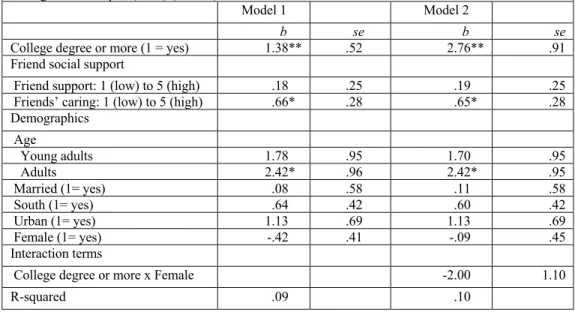
Table 2 presents two regression models to examine the association between having a college degree and levels of self-esteem. The models include the unstandardized regression coefficients, standard errors, and statistical significance. Model 1 illustrates whether having a college degree is positively associated with self-esteem. Model 2 illustrates whether gender moderates the relationship between a college degree and self-esteem. In model 1, I find that having a college degree (b = 1.38, se = .52, p < .01) is positively associated with self-esteem.
Friends’ caring (b = .66, se = .28, p < .05) is also positively associated with self-esteem. The results for age show that compared to late adolescents, adults have significantly higher self- esteem (b = 2.42; se = .96, p < .05). In model 2, I find that gender does not moderate the relationship between having a college degree and self-esteem. In other words, the relationship between holding a college degree and self-esteem did not differ by gender.
Table 2 Self-Esteem Regressed on All Study Variables, National Longitudinal Survey of Youth – Young Adult Sample, (2016) (N=464)
Model 1 Model 2
b se b se
College degree or more (1 = yes) 1.38** .52* 2.76** .91
Friend social support
Friend support: 1 (low) to 5 (high) .18 .25*** .19 .25
Friends’ caring: 1 (low) to 5 (high) .66* .28 .65* .28
Demographics Age
Young adults 1.78 .95 1.70 .95
Adults 2.42* .96 2.42* .95
Married (1= yes) .08 .58 .11 .58
South (1= yes) .64 .42 .60 .42
Urban (1= yes) 1.13 .69 1.13 .69
Female (1= yes) -.42 .41 -.09 .45
Interaction terms
College degree or more x Female -2.00 1.10
R-squared .09 .10
Note: Unstandardized regression coefficients (b) and standard errors (se).
* p < .05
** p < .01
*** p < .001
a Reference group for age is late adolescents.
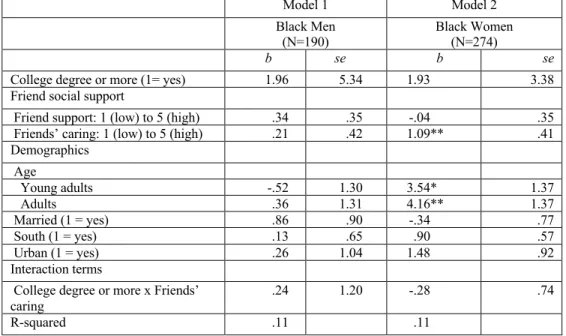
In Table 3, Models 1 and 2, I test for whether friends’ caring moderates the association between having a college degree and self-esteem. I assess this separately for men and women (Model 1 examines men, and Model 2 examines women). In model 1, the interaction term between college degree and friends’ caring is not statistically significant. For men, the
relationship between having a college degree and self-esteem did not differ by friends’ caring.
The other measures in the model are also not statistically significant. In model 2, the interaction term between college degree and friends’ caring is not statistically significant. In other words, for women, the relationship between having a college degree and self-esteem did not differ by friends’ caring. However, a few measures in the model are significant. Compared to late adolescents, young adults (b = 3.54; se = 1.37, p < .05) and adults (b = 4.16; se = 1.37, p < .01) have significantly higher self-esteem. In addition, friends’ caring is also positively associated with self-esteem (b = 1.09; se = .41; p < .01).
Table 3. Self-Esteem Regressed on All Study Variables by Gender Status, National Longitudinal Survey of Youth – Young Adult Sample, (2016)
Model 1 Model 2
Black Men (N=190)
Black Women (N=274)
b se b se
College degree or more (1= yes) 1.96 5.34 1.93 3.38
Friend social support
Friend support: 1 (low) to 5 (high) .34 .35 -.04 .35
Friends’ caring: 1 (low) to 5 (high) .21 .42 1.09** .41
Demographics Age
Young adults -.52 1.30 3.54* 1.37
Adults .36 1.31 4.16** 1.37
Married (1 = yes) .86 .90 -.34 .77
South (1 = yes) .13 .65 .90 .57
Urban (1 = yes) .26 1.04 1.48 .92
Interaction terms
College degree or more x Friends’
caring
.24 1.20 -.28 .74
R-squared .11 .11
Note: Unstandardized regression coefficients (b) and standard errors (se).
* p < .05
** p < .01
*** p < .001
a Reference group for age is late adolescents.
VI. Discussion and Conclusion
The present study aimed to examine the relationship between a college degree and self- esteem among young Black adults, investigate whether there were gender differences in the relationship between college attainment and self-esteem, and discover whether friend emotional support by gender boosts the impact of a college degree on self-esteem. This study found that having a college degree was positively related to self-esteem. Thus, Black adults with a college degree reported higher self-esteem scores. These findings are consistent with the work of Alang (2014) who investigated whether the effects of psychological resources on depressive symptoms vary by race. One finding was that educational attainment was a stronger predictor of self-esteem for African Americans than for whites. Research on Black people’s self-esteem may contribute to literature and expand our understanding of what factors precede a high-self-esteem and,
supported, Thomas Tobin, Erving, and Barve (2021) notes that few studies examine the role of race and SES (e.g., education) on psychosocial resources such as self-esteem. More investigation is needed on the relationship between educational attainment and self-esteem among different racial and ethnic groups.
There was no significant gender variation when examining the effect of a college degree on Black adults’ self-esteem. Additionally, there were no significant variations in friend
emotional support when examining the effect of a college degree on self-esteem. This was true for both men and women. However, the effect of friend emotional support on Black women was significant and positive. Studies consistently report the significance of social support for Black women’s self-esteem and psychological well-being (Patterson 2004; DeFrancisco and Chatham- Carpenter 2000; Warren 1997). However, emotional support specifically is often not the focus in studies about social support and self-esteem. Instead, conversations about emotional support are often grouped with discussions about general social support and support networks. Emotional support from friends is a distinct type of social support. As Black women navigate early adulthood, they often encounter shifts in careers, identity, and family and social relationships (Watkins et al. 2020). Emotional support from friends offers a safe space for women to feel loved and appreciated and can build confidence and self-esteem.
Further, my findings support the differential responses to friend emotional support based on gender. Some studies suggest that social support from friends positively impact Black
people’s self-esteem (Hughes and Demo 1989). Yet, it is important to note that there may be important gendered differences. Future studies should investigate how different models of social support (e.g., family emotional support) impact Black men’s self-esteem.
Although emotional support from friends did not moderate the relationship between having a college degree and self-esteem, age was a significant predictor of self-esteem among Black women. Specifically, being a young adult (23-25-year olds) was a significant predictor of Black women’s self-esteem. Additionally, being an adult (33-34-year olds) was an important predictor of self-esteem. These findings are consistent with research suggesting that self-esteem tends to increase from late adolescence to middle adulthood (Orth et al. 2012). Interestingly, however, age was not an important predictor of self-esteem for Black men. Perhaps it is that Black men enter adulthood with very high levels of self-esteem. In one study, Hunter and Davis (1992) investigated the meaning of manhood among Black men. Men rated sense of self (e.g., self-esteem, independence) as one of the most important attributes to being a man. Still,
compared to Black women, there are far fewer studies on sources of self-esteem for Black men.
Future studies should consider mechanisms that impact Black men’s self-esteem. Such an analysis could contribute to important findings about Black men’s psychological well-being.
This study includes a few limitations. First, the study would be strengthened by an increased sample size. The small sample size (N=474) limits the statistical power. Although the sample size provided sufficient power to detect the results reported, additional differences may have emerged had the sample size been larger. Second, this study was cross-sectional. As a result, it is difficult to make causal inference or predictions. Reverse causality is a possibility.
The statistical patterns observed may actually reflect the impact of self-esteem on educational attainment. Longitudinal studies are needed to investigate the impact of educational attainment on self-esteem over time among Black adults. Such studies would help rule out the possibility of reverse causation. Last, another potential limitation involves the age of the sample. I limit the sample to participants who have graduated from high school. However, there are a small number
of participants who are in their late teens and did not have the time to attend college. I attempt to address this limitation by controlling for age. Despite the limitations, this study adds to the limited research on education, social support, and self-esteem among Black men and women.
In conclusion, having a college degree is an important predictor of self-esteem for young Black adults. Emotional support from friends does not moderate the relationship between having a college degree and self-esteem for men or women. However, emotional support from friends and age are important predictors of self-esteem for Black women.
REFERENCES
Alang, Sirry. 2014. “Racial Variations in the Effects of Structural and Psychological Factors on Depressive Symptoms: A Structural Equation Modeling Approach.” Mental Health and Prevention 2:2-10.
American Psychological Association. 2020. “Emotional Support.” Washington, DC: American Psychological Association (https://dictionary.apa.org/emotional-support).
Baughman, E. Earl and W. Grant Dahlstrom. 1968. Negro and White Children, A Psychological Study in the Rural South. Social Psychology: A Series of Monographs, Treatises, and Texts. New York: Academic Press.
Brase, Gary L. and Emma C. Guy. 2004. “The Demographics of Mate Value and Self-Esteem.”
Personality and Individual Differences, 36(2):471-484.
Brown, Diane and Lawrence E. Gary. 1987. “Stressful Life Events, Social Support Networks, and the Physical and Mental Health of Urban Black Adults.” Journal of Human Stress 13(4):165-174.
Center for Human Resource Research. 2004. NLSY79 Child and Young Adult: Data User’s Guide: A Guide to the 1979 National Longitudinal Survey of Youth 1979; 1986–2002 Child Data; 1994–2002 Young Adult Data. Columbus: The Ohio State University.
Cohen, Sheldon and S. Leonard Syme. 1985. “Issues in the Study and Application of Social Support.” In Social Support and Health, edited by Sheldon Cohen and S. L. Leonard.
Orlando, FL: Academic Press.
Cohen, Cathy J. and Claire E. Nee. 2000. “Educational Attainment and Sex Differences in African American Communities: The American Behavioral Scientist 43(7):1159-1206.
Crain, Robert L. and Carol Sachs Weisman. 1972. Discrimination, Personality, and Achievement: A Survey of Northern Blacks. Quantitative Studies in Social Relation Series. New York: Seminar Press.
Crocker, Jennifer, Riia K. Luhtanen, M. Lynne Cooper, and Alexandra Bouvrette. 2003.
“Contingencies of Self-Worth in College Students: Theory and Measurement” Journal of Personality and Social Psychology 85(5):894-908.
DeFrancisco, Victoria L. and April Chatham-Carpenter. 2000. “Self in Community: African American Women’s Views on Self-Esteem.” The Howard Journal of Communication 11:73-92.
Demo, D.H. and C.R. Savin-Williams. 1983. “Early Adolescent Self-Esteem as a function of Social Class: Rosenberg and Pearlin Revisited” American Journal of Sociology 88(4):763-774.
Demo, David H. and Keith D. Parker. 1987. “Academic Achievement and Self-Esteem among Black and White College Students” The Journal of Social Psychology 127(4):345-355.
Diamond, John B. 2006. “Still Separate and Unequal: Examining Race, Opportunity, and School Achievement in ‘Integrated’ Suburbs.” The Journal of Negro Education 75(3):495-505.
Dressler, William E. 1985. “Extended Family Relationships, Social Support, and Mental Health in a Southern Black Community.” Journal of Health and Social Behavior 26:39-48.
Elliott Brown, Karin A., Tyan Parker-Dominguez, and Marcia Sorey. 2000. “Life Stress, Social Support, and Well—Being among College-Educated African American Women.”
Journal of Ethnic and Cultural Diversity in Social Work 1-2(9):55-73.
Georgetown University. 2016. “America’s Divided Recovery: College Have and Have Nots.”
Georgetown University: Center of Education and the Workforce.
(https://cew.georgetown.edu/cew-reports/americas-divided-recovery/).
Gray, Beverly A. and Verna M. Keith. 2003. “The Benefits and Costs of Social Support for African Americans.” Pp. 242-257 in In and Out of Our Right Minds: The Mental Health of African American Women, edited by Diane Brown and Verna Keith. New York:
Columbia University Press.
Gray-Little, Bernadette and Adam R. Hafdahl. 2000. “Factors Influencing Racial Comparisons of Self-Esteem: A Quantitative Review.” Psychological Bulletin 26(1):26-54.
Greene, Kevin Mortimer. 2013. “The Complex Relationship Between Race, Gender, and Smoking Behavior.” PhD Dissertation, Department of Sociology, Emory University.
Griffin, Margaret L., Maryann Amodeo, Cassandra Clay, Irene Fassler, and Michael A. Ellis.
2006. “Racial Differences in Social Support: Kin Versus Friends.” American Journal of Orthopsychiatry. 76(3):374-380.
Hoge, Dean R., Edna K. Smit, Sandra L. Hanson. 1990. “School Experiences Predicting Changes in Self-Esteem of Sixth- and Seventh-Grade Students.” Journal of Educational
Psychology 82(1):117-127.
Hughes, Michael and David H. Demo. 1989. “Self-Perceptions of Black Americans: Self-Esteem and Personal Efficacy.” American Journal of Sociology 95(1):132-159.
Hunter, Andrea G. and James Earl Davis. 1992. “Constructing Gender: An Exploration of Afro- American Men’s Conceptualization of Manhood.” Gender and Society 6(3):464-479.
Ida, Aya Kimura and C. André Christie-Mizell. 2012. “Racial Group Identity, Psychosocial Resources, and Depressive Symptoms.” Sociological Focus 45(1):41-62.
Lincoln, Karen D., Linda M. Chatters, and Robert Joseph Taylor. 2003. “Psychological Distress among Black and White Americans: Differential Effects of Social Support, Negative Interaction and Personal Control.” Journal of Health and Social Behavior 44(3):390-407.
Lincoln, Karen D., Linda M. Chatters, and Robert Joseph Taylor. 2005. “Social Support, Traumatic Events, and Depressive Symptoms Among African Americans.” Journal of Marriage and Family 67(3):754-766.
Linnabery, Eileen, Alice F. Stuhlmacher, and Annette Towler. 2014. “From Whence Cometh Their Strength: Social Support, Coping, and Well-Being of Black Professionals.” Cultural Diversity and Ethnic Minority Psychology 20(4):541-549.
Lundgren, David C. and Mary R. Schwab. 1979. “The Impact of College on Students:
Residential Context, Relations with Parents and Peers, and Self-Esteem.” Youth and Society 1:316-318.
MacDonald, Nancy E., Patricia D. Ebert, and Susan E. Mason. 1986. “Marital Status and Age as Related to Masculine and Feminine Personality Dimensions and Self-Esteem.” The Journal of Social Psychology 127(3):289-298.
Mackie, Sarah E. 1998. “Jumping the Hurdles.” Paper presented at the Higher Education Close Up Conference, July 6-8, University of Central Lancashire.
McDaniel, Anne Thomas, Thomas A. DiPrete, Claudia Buchmann, and Uri Shwed. 2011. “The Black Gender Gap in Educational Attainment: Historical Trends and Racial
Compositions” Demography 48(3):889-914.
Mereish, Ethan H., Hammad S. N’cho, Carlton E. Green, Maryam M. Jernigan, and Janet E.
Helms. 2016. “Discrimination and Depressive Symptoms among Black American Men:
Moderated-Mediation Effects of Ethnicity and Self-Esteem.” Behavioral Medicine 42(3):190-196.
Middleton, Tanya J. 2020. “The Relationship between Racial Microaggressions, Social Support, and the Self-Esteem of African American Women Enrolled at Predominantly White Institutions.” PhD Dissertation, Department of Counselor Education and Supervision, The University of Akron.
Morris, Edward. 2012. “‘Tuck in that Shirt!’” Race, Class, Gender, and Discipline in an Urban School.” Sociological Perspectives 48(1):25-48.
Myers, Lena Wright. 1980. Black Women: Do They Cope Better? Englewood Cliffs, NJ:
Prentice-Hall.
Oh, Hyun Jung, Elif Ozkaya, and Robert LaRose. 2014. “How Does Online Social Networking Enhance Life Satisfaction? The Relationships among Online Supportive Interaction, Affect, Perceived Social Support, Sense of Community, and Life Satisfaction.”
Computers in Human Behavior 30:69-78.
Okwumambua, Jebose, F. M. Baker, S. P. Wong, Beverly O. Pilgram. 1997. “Characteristics of Depressive Symptoms in Elderly Urban and Rural African Americans.” The Journals of Gerontology 52(4):241-246.
O’Malley, P.M. and J.G. Bachman. 1979. “Self-Esteem and Education: Sex and Cohort Comparisons among High School Seniors.” Journal of Personality and Social Psychology 37(7):1153-1159.
Orth, Ulrich and Richard W. Robins. 2014. “The Development of Self-Esteem.” Current Directions in Psychological Research 23(5):381-367.
Orth, Ulrich, Richard W. Robins, and Brent W. Roberts. 2008. “Low Self-Esteem Prospectively Predicts Depression in Adolescence and Young Adulthood.” Personality Processes and Individual Differences 95(3):695-708.
Orth, Ulrich, Richard W. Robins, and Kali H. Trzesniewski. 2010. “Self-Esteem Development from Young Adulthood to Old Age: A Cohort-Sequential Longitudinal Study.”
Personality Processes and Individual Differences, 98(4):645-658.
Orth, Ulrich, Richard W. Robins, and Keith F. Wildaman. 2012. “Life-Span Development and its Effects on Important Life Outcomes.” Journal of Personality and Social Psychology 102(6):1271-1288.
Orth, Ulrich, Ruth Yasemin Erol, and Eva C. Luciano. 2018. “Development of Self-Esteem From Age 4 to 94 Years: A Menta-Analysis of Longitudinal Studies.” Psychological Bulletin 144(10):1045-1080.
Patterson, Kelly L. 2004. “A Longitudinal Study of African American Women and the Maintenance of a Healthy Self-Esteem.” Journal of Black Psychology 3(3):307-328.
Pearlin, Leonard I., Elizabeth G. Menaghan, Morton A. Lieberman, and Joseph T. Mullan. 1981.
“The Stress Process.” Journal of Health and Social Behavior 22:337-356.
Pew Research Center. 2011. “Is College Worth It?” Washington, DC: Pew Research Center (https://www.pewresearch.org/social-trends/2011/05/15/is-college-worth-it/).
Plowden, Keith O., Wendell John, Elias Vasquez, and James Kimani. 2006. “Reaching African American Men: A Qualitative Analysis.” Journal of Community Health Nursing
23(3):147-158.
Rogers, Carl M., Monte D. Smith, and J. Michael Coleman. 1978. “Social Comparisons in the Classroom: The Relationship between Academic Achievement and Self-Concept”
Journal of Educational Psychology 70(1):50-57.
Rosenberg, Morris. 1965. Society and Adolescent Self-Image. Princeton, New Jersey. Princeton University Press.
Rosenberg, Morris and Roberta G. Simmons. 1972. Black and White Self-Esteem: The Urban School Child. Washington, D.C..: American Sociological Association.
Rosenberg, Morris, Carmi Schooler, Carrie Schoenbach, and Florence Rosenberg. 1995. “Global Self-Esteem and Specific Self-Esteem: Different Concepts, Different Outcomes.”
American Sociological Review 60(1):141-156.
Slater, Robert Bruce. 1994. “The Growing Gender Gap in Black Higher Education” The Journal of Blacks in Higher Education 3(52):1-8.
Song, Lijun, Joonmo Son, and Nan Lin. 2011. “Social Support.” Pp. 116-128 in The Sage Handbook of Social Network Analysis, edited by John Scott and Peter J. Carrington.
SAGE Publications.
Taylor, Robert Joseph, Ivy Forsythe-Brown, Harry Owen Taylor, Linda M. Chatters. 2014.
“Patterns of Emotional Social Support and Negative Interactions among African
American and Black Caribbean Extended Families.” Journal of African American Studies 18:147-163.
Taylor, Robert Joseph, Linda Marie Chatters, and James S. Jackson. 1997. “Changes Over Time in Support Network Involvement Among Black Americans.” Pp. 295-318. in Family Life in Black America, edited by Robert Joseph Taylor, James S. Jackson, and Linda Marie Chatters. Thousand Oaks, CA: Sage.
Tenenbaum, Harriet R. and Martin D. Ruck. 2007. “Are Teachers’ Expectations Different for Racial Minority than for European American Students? A Meta-Analysis.” Journal of Educational Psychology 99(2):253-273.
Tharenou, Phyllis and Phillip Harker. 1982. “Organizational Correlates of Self-Esteem.” Journal of Applied Psychology 67(6):797-805.
Thomas, Liz. 2002. “Student Retention in Higher Education: The Role of Institutional Habitus.”
Journal of Educational Policy 17(4):423-442.
Thomas Tobin, Courtney S., Christy L. Erving, and Apurva Barve. 2021. “Race and SES Differences in Psychosocial Resources: Implications for Social Stress Theory.” Social Psychology Quarterly 84(1): 1-25.
Torpey, Elka. 2018. “Measuring the Display of Education.” U.S. Bureau of Labor of Statistics.
(https://www.bls.gov/careeroutlook/2018/data-on-display/education-pays.htm).
Turner, R. Jay. 1999. “Social Support and Coping.” Pp. 198-210 in A Handbook for the Study of Mental Health: Social Contexts, Theories, and Systems, edited by A. V. Horwitz and T.
L. Scheid. New York: Cambridge University Press.
United States Census Bureau. 2016. “Educational Attainment.”
(https://www.census.gov/topics/education/educational-attainment/about.html).
Wang, Chia-Chih DC and Carrie Castañeda-Sound. 2008. “The Role of Generational Status, Self-Esteem, Academic Efficacy, and Perceived Social Support in College Students’
Psychological Well-Being.” Journal of College Counseling 11:101-118.
Warren, Barbara Jones. 1997. “Depression, Stressful Life Events, Social Support, and Self- Esteem in Middle Class African American Women.” Archives of Psychiatric Nursing 11(3):107-117.
Watkins, Daphne C., Janelle R. Goodwill, Natasha C. Johnson, Allura Casanova, Tao Wei, Julie Ober Allen, Ed-Dee G. Williams, Nkemka Anyiwo, Zachary A. Jackson, Lloyd M.
Talley, and Jamie M. Abelson. 2020. “An Online Behavioral Health Intervention Promoting Mental Health, Manhood, and Social Support for Young Black Men: The YBMen Project.” American Journal of Men’s Health 14(4):1-17.
Woodward, Amanda Toler. 2011. “Discrimination and Help-Seeking: Use of Professional and Informal Support Among African Americans, Caribbeans, and Non-Hispanic Whites with a Mental Disorder.” Race and Social Problems 3(3):146-159.
Zuckerman, Diane M. 1989. “Stress, Self-Esteem, and Mental Health: How Does Gender Make a Difference?” Sex Roles, 20(7):429-44.