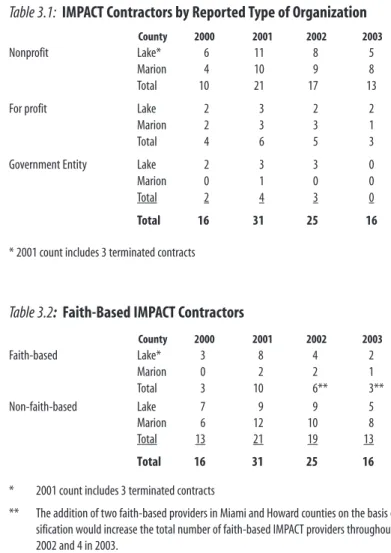
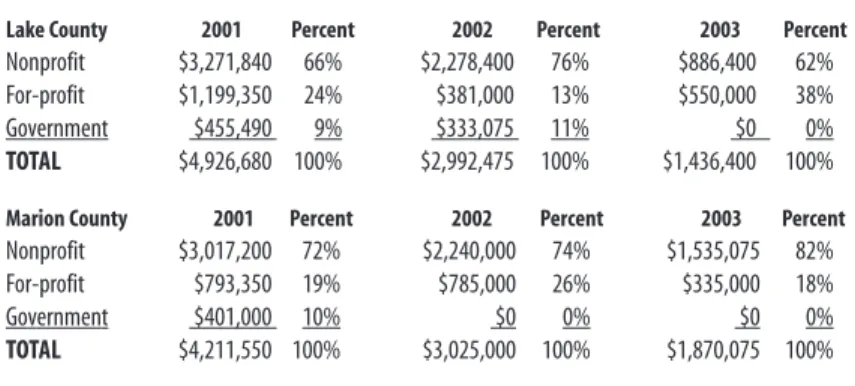
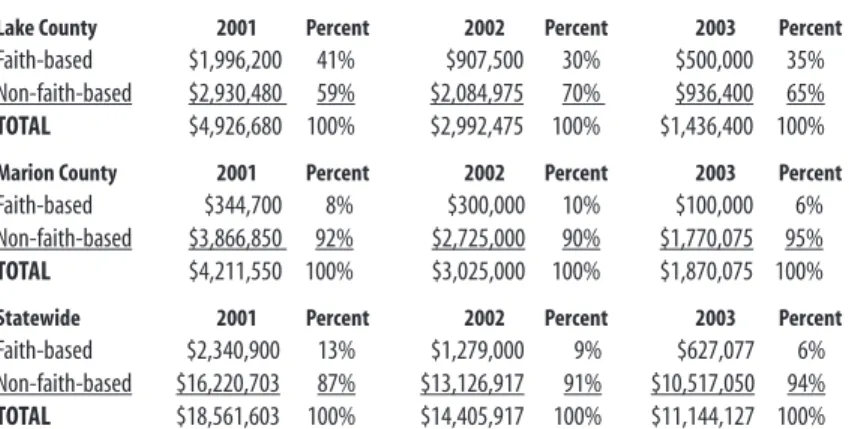
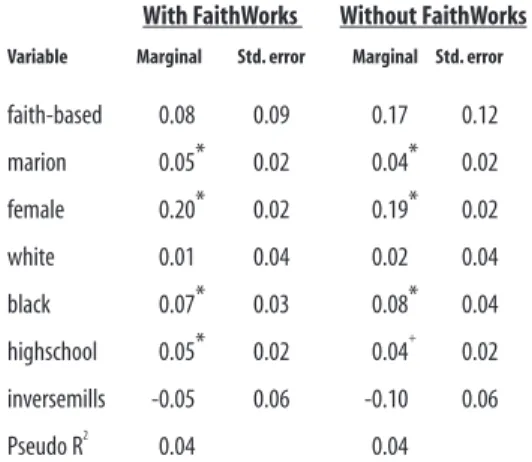
These dimensions of Charitable Choice are examined from several perspectives: that of the consumer/customer, the provider organizations and the state. The results are reflected in the state's ongoing budget crises and reductions in services to the poor, including the elimination or freeze of the faith community coordinator positions in several counties.
Empirical Reports
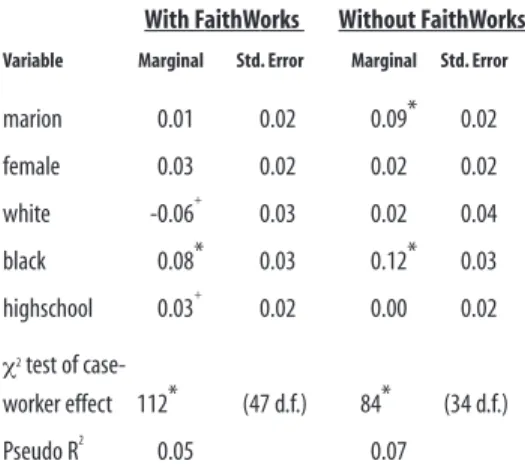
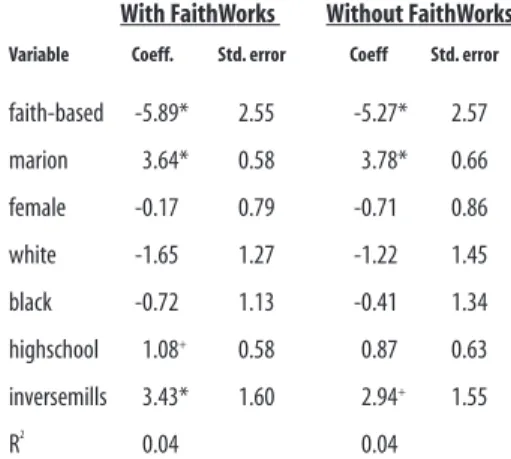
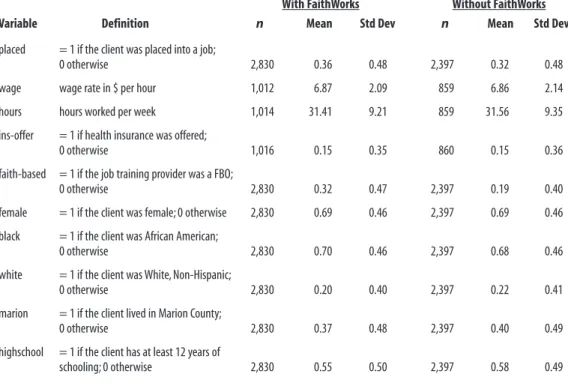
Finally, the inverse of the Mills ratio is included as an additional covariate in the outcome regressions. All personnel providing IMPACT services between IFJ and MFI organizations possess professional credentials used in the provision of services. However, only 17 percent of SFI providers report such reimbursement, compared to 60 percent of MFIs and 63 percent of IFJ providers.
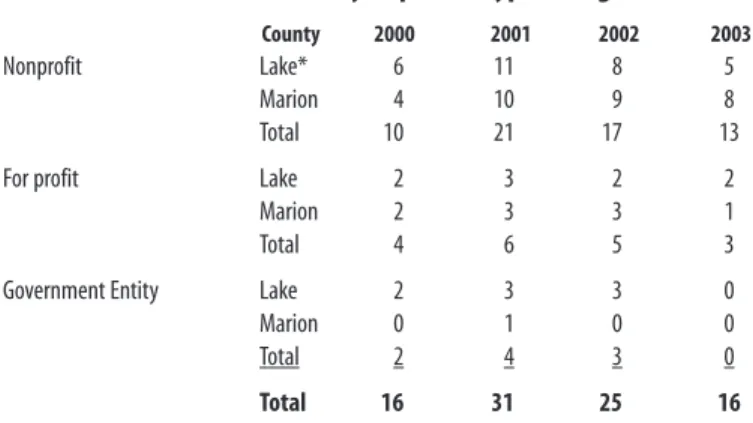
More than 70 percent of NFI organizations report revenues above $1 million, and all MFI providers report annual revenues above $500,000. Half of SFI providers receive 100 percent of their funding from IMPACT compared to 7 percent of NFI providers. Has the geographic focus of the organization changed in the last 3 years? yes no I don't know IF YES, in what way.
To what extent do each of the following characteristics contribute to your organization's religious or faith identity? 30. What percentage of your IMPACT contract do you expect to deliver at the end of the contract. Within the last 3 years, has your organization made any of the following changes to NON-IMPACT service delivery in response to this change?.
Introduction
Personal Responsibility and Work Opportunity Reconciliation Act of 1996,” [FN1] encourages states to contract with faith-based organizations (FBOs) to provide social services to welfare recipients. FN2] The relevant wording of the law ensures that such FBOs can retain their pervasive sectarian character. The Charitable Choice legislation was based on the assumption that FBOs do better work at a lower cost than traditional social service providers, an assumption that is neither supported nor contradicted by the available data, as no comprehensive research on the subject is available.
Charitable Choice is thus inviting a large number of faith-based organizations to participate in a trend that has been reshaping government — particularly at the state and local levels — for at least the past 20 years. FN5] Charitable choice legislation is the most recent example of the most prominent of these methods for "reinventing" government: the greatly increased use of private for-profit and nonprofit providers to provide government services under contractual agreements. Although the state has always purchased goods and services from the market, this practice has increased significantly [FN6].
As outsourcing becomes a more common method of delivering government services, the nature of 'the state' and therefore of 'state action' is changing.
State Action in the Era of Privatization and Public–Private Partnerships
- Context of the Inquiry: The Invisible State
- Current State Action Doctrine In a 1995 case, Lebron v. National Railway
- A Better Approach
- Conclusion
In traditional political discourse, we consider the nature of government and debate the proper role of the state. We argue that the impact of this transformation on the future of the American well-. We rely on our understanding of the state action doctrine to know when we can ask the courts to limit state authority.
Yaretsky [FN57] is an excellent example of the inadequacy of current state action doctrine. This raises a paradox: how do we understand the use of the Establishment Clause without state action. When the government is responsible for the provision of services, there must be at least a rebuttable presumption of government action.
Independent contractors differ from agents in that: (a) they are engaged in a particular profession or business; (b) the work is skillfully and/or typically done by specialists without supervision; (c) the contractor provides the tools and workplace; (d) the contractor provides services within a relatively short period of time; (e) payment is per job, or per item, and not for time spent; (f) the work is part of the separate, regular business of the contractor; and (g) the intention of the parties.
The Administrative Challenges of Charitable Choice
Justice, Fairness & Difference Politically, the level playing field has been
Public Administration Meets Legal Theory
Fourteenth Amendment Equality In the United States, discussions of equality
The Fourteenth Amendment prohibited states from denying to persons within their jurisdiction “the equal protection of the laws.”17 The relevant language reads. All persons born or naturalized in and under the jurisdiction of the United States are citizens of the United States and of the country in which they reside. No State shall make or enforce any law abridging the privileges or immunities of citizens of the United States; nor shall any State deprive any person of life, liberty, or property without due process of law; nor shall it deny to any person within its jurisdiction the equal protection of the laws.18.
Equal protection analysis thus begins with the question of whether there has been state action without which there is no Fourteenth Amendment violation.23. As the somewhat cursory review of equal protection analysis above makes clear, the Supreme Court has developed a highly technical template for determining whether a Fourteenth Amendment violation has occurred. If large segments of citizens perceive the rules promulgated by the state to differ significantly from their internalized notions of fair play and equal treatment, the consequences for legal legitimacy and voluntary compliance can be very negative.
The difference between popular understanding of equality and its legal or constitutional definition takes on added urgency as government becomes a more pervasive element of the everyday experiences of citizens.
Neutrality and Equality
Categories that require strict scrutiny are those where group members share an immutable characteristic, have historically suffered widespread discrimination, and where efforts to defend their rights in the political arena are unlikely to succeed. It should come as no surprise, then, that equal protection jurisprudence is anything but coherent, nor that political constituencies unschooled in the arcane language of legal analysis see much of it as unfair and ultimately inequitable. The disparity between the popular understanding of equality and its legal or constitutional definition takes on increased urgency as government becomes a more pervasive element of citizens' everyday experiences. where the state's operations extend more and more into fields that were formerly entirely private, the way in which that state conducts its business, the ways in which it uses its power to shape law and secure the common welfare , become critical elements in the formation of a society and the degree to which that society values or devalues particular notions of equality. 33. barriers, but does nothing to remedy the personal and structural effects of those experiences.
Because formal neutrality, like equality, is highly valued but rarely defined, it is often argued that the application of specific rules to certain groups actually promotes more general neutrality.36 As Alan Brownstein has noted, charitable choice advocates use “neutrality theory” to justify forms of affirmative action for religious organizations.37Brownstein stated:. This goal is best achieved by reducing government influence on personal decisions regarding religious beliefs and practices. The goal is achieved when the government is neutral about the religious choices of its citizens.
So, regardless of whether it is a consideration of the constitutionality of exemptions from regulatory burdens or of equal treatment regarding benefit programs, in both situations the unifying principle is neutralizing the influence of government measures on personal religious choices. 38.
Affirmative Action and Charitable Choice
The extent of the "tilt," the extent to which racial identity should be a factor in employment or education decisions, has been the subject of considerable litigation.50 Judicial opinion has been closely divided. Indeed, as Ashutosh Bhagwat noted, three of the most important affirmative action cases, Regents of the. Texas, the Court of Appeals for the Fifth Circuit determined that diversity of the student body at a state university's law school was not sufficiently compelling to justify an admissions policy granting preferential treatment to African-American and Hispanic applicants.57 The court found that absent of a history of discrimination by the school that would justify corrective measures, the program.
In addition, the Ninth Circuit upheld an elementary-level laboratory school admissions process that made race and ethnicity part of the admissions decision, agreeing with the university that research goals required a representative student body.61 The interest in securing those goals was sufficiently compelling with for the purposes of an equal treatment analysis.62. There are numerous additional cases in which federal circuit and district courts have had to determine whether a given interest was sufficiently "compelling" to meet the constitutional standard under the facts of the case.63 Such determinations are necessarily ad hoc, and the resulting case law for equal protection demonstrates—if demonstration were necessary—the inherent difficulty of using technical legal formulas as a proxy for equality.64. In 1996, Section 104 of the Personal Responsibility and Work Opportunity Act, popularly called "Charitable Choice," addressed a perceived state bias against contracting with religious social service providers.65 Supporters of greater grassroots involvement of religious providers in the complex network of state social assistance argued that section 104 was needed to "level the playing field" although religious providers such as Catholic Charities, Lutheran.
Charitable Choice.69 Others, such as Indiana, have instituted extensive and relatively expensive programs designed to introduce small faith-based providers to opportunities to work with governments.70 These efforts to engage faith-based organizations [“FBOs”] have raised many of the same issues as traditional affirmative action. programs.
Implications for Public Administration What are the implications for government legit-
The original position, with the characteristic I have called "the veil of ignorance," is this position. Gottlieb notes that "the Court's treatment of governmental interests has become largely intuitive, a sort of. The author develops the instrumental paradox hypothesis which states that "the more instrumentally oriented a person is, the less the psychological or social rewards of religious faith."
An exploratory study of four AIDS organizations in the New York City area and the changing nature of "faith." The author examines the extent to which organizations adhere to their religious orientation. 1998). The Devil's in the Details: Emerging Issues in Religion-Government Relations. Paper presented at the Symposium on Nonprofit Organizations and Government, Indianapolis. In an attempt to define the meaning of "faith-based," the author briefly presents the religion clause of the First Amendment and its interpretations.
1998). The Pitfalls of Contracts to Fund Faith-Based Ministries. (Religious Social Sector Project Policy Note).