This study deals with the analysis of a contrastive analysis of prefixes between English and Guyanese. The objectives of this study were to investigate the differences and similarities of prefixes in English and Guyanese and to elaborate on the morphological process involved in prefixing in both languages. First, the researcher would like to thank Allah SWT for giving her the opportunity to complete this study.
The title of this study is A Contrastive Analysis of Prefixes between English and Gayonese Language for the purpose of submitting the partial fulfillment of the requirement to obtain the degree of sarjana Pendidikan from English Department. Yenni Hasnah, S.Pd., M.Hum., as her supervisor who had given her suggestions, idea, advice, critics and guidance in writing this study. Bambang panca, S.Pd, M.Hum as his examiner who had provided guidance in writing this study.
The finding of this research is expected to be theoretically and practically useful. Theoretically, this study has been a valuable reference for readers to know about prefixes, especially the differences and similarities of prefixes in English and Gayon language.
INTRODUCTION
The Background of the Study
According to Wibowo (2001), language is a system of symbols that is meaningful and articulating sound (generated by said instrument) that is arbitrary and conventional, used as a means of communication by a group of men to give birth to feelings and thoughts . There are so many types of languages in the world and they are created by their own culture. For example, in Gayonese "nome" and in English "drag" in the meaning of "tidur" in Bahasa Indonesia.
And there are also so many people who lack the understanding of the prefixes between both languages, especially in the Gayonese language. The researcher was interested in analyzing Gayonese because it is used as a native language and the researcher found that there are some differences between English and Gayonese.
The Identification Of Problems
The Scope and Limitation
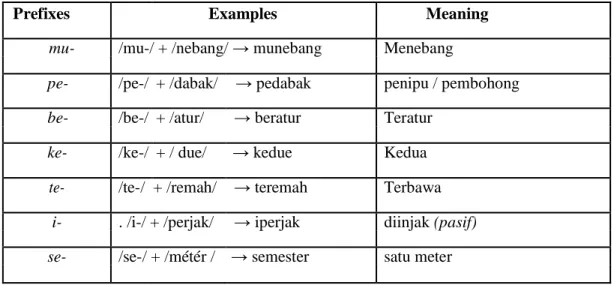
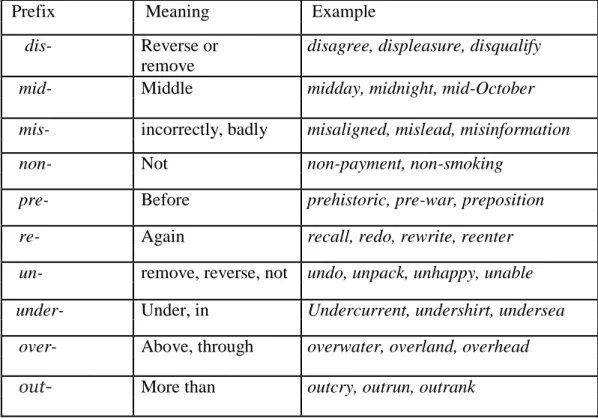
Examples for each prefix in English and Ghanaian, as seen in the table below. For example, as in the word "uncover" it consists of the prefix "un-" and the base "cover". For example, in the word "nebang" the prefix /mu-/ does not change form when the base word begins with the consonant /n/ remains mu- as in the word.
The prefix ke was split into numerals, as it changed to 'ketulu' in the base word 'tulu' and to 'keopat' in the base 'opat'. The same example in the prefix again this prefix shows the meaning "repeat" as in the base "check" changing its meaning. And the same example in the prefix be-to, which shows the meaning "to do", for example as in the base .. buet' changes the meaning to "bebuet".
Even in the prefix se-, this prefix shows the meaning of "a", as in the base "kuren", which changes its meaning to "sekuren". As in English prefixes, the prefix un- was split into a verb after that prefix paired with the base 'pack' became. As in the English prefix, the prefix misrepresents the meaning "bad" when this prefix is connected to the base "action" and automatically changes its meaning to.
In this case, the process of forming a word in the English and Gayonese prefixes is the same. And also in the base 'able' after adding a prefix, then change the form and the meaning becomes 'unable'. In the morphological process of prefixes in English and Gayonese language we have basically the same process in forming or producing a word, for example in English prefix, as in basic after adding a prefix does not automatically 'follow' the form changes and the meaning becomes 'unfollow'. '.
Run Outrun Shows the meaning of more Cry Outcry than listed in the.
Formulation of the Problem
Objectives of the study
The same case in the prefix Gayonees, prefix pe- cannot stand alone and must be paired with base "bengis" in "pebengis" to form a new word. And that process also applies to Gayonese prefixes, for example in the base 'dere' hereafter.
The Significances of study
REVIEW AND LITERATURE
Theoritical Framework
- Contrastive analysis
- Morphology
- Morphemes
- Free morphemes
- Bound morphemes
- Affixes
- Prefixes
Rerevant studies
Conceptual Framework
METHOD OF RESERACH
- Research design
- Source of the data
- Technique of Data Collecting
- Technique of Data Analysis
In English prefixes, prefix negates the meaning of "opposite" when this prefix is paired with the base .. can' and changes its meaning to "inability". In Gayonese prefix, prefix mu- shows the meaning of "to have" when this prefix paired with the base 'reta', then its meaning changes to 'mureta'. Under- Done Under Done Shows the meaning of less Land Underground Shows the meaning of in.
Mu- Reta Mureta Shows the meaning of having Nusuh Munusuh Shows the meaning of doing Be- Gule Begule Shows the meaning of seeing. Upuh Berupuh Shows the meaning of carrying Se- Belanga Sebelanga Shows the meaning of a. And also the prefix mis- not being able to show the meaning of "wrong", when paired with the base "number", changes its meaning to "wrong".
While the similarities in English and Gayonese prefix have more than one meaning of each other.
DATA AND DATA ANALYSIS
Data
Before analyzing the data, the first step was to present the data by classifying them into English and Guyanese prefixes. The data was obtained from various books and reliable sources related to English and Gayonese prefixes.
Data analysis
English and Guyanese language research data are detailed in the appendix. The following data shows the difference between English and Ghanaian prefixes. The same case when the prefix "un-" meets a vowel in the word "able" then there is no change of form in the prefix. This is the different case in the word "kucak" the prefix /mu-/ meets the base word starting with the consonant /k/ in /mung-/ and the consonant /k/ is deleted as in the word "mung-ucak".
The prefix i- has spread to the numerator, since basically both in 'sara' becomes 'musara' and 'roa' in 'muroa'. And the prefix se- was also divided into the numerator, if only in a pair with the base 'sara' it became 'sesara'. Just like the prefix se- has changed nouns to count, just as the base 'rilah' has changed to 'serila', 'tem' to 'setem', 'guni'. in 'seguni' and 'cemca' it becomes 'secemca'.
And in the prefix ke-, it has the function of forming a number level when the prefix ke- is connected to the base 'sara'. has changed the function to 'kesara' and in the base 'roa' is changed to 'keroa' and. And the final prefix i- changed numerals to verbs, such as in the base 'opat' the change of function to the verb "iopat" and in the base .. lime' the change of function to 'ilime'. d) Meaning. In English and Gayon, the similarity of the two languages is that each prefix of the two languages must be connected to a base to form different forms and different meanings, as can be seen from the data.
The same case in the Gayonese prefix, prefix pe- cannot stand alone and must be paired with base to form a new word, although it is sometimes transformed into per-, peng-, peny- or pen-. The same case in the Gayonese prefixes, the prefix be- was distributed in word class verbs followed by base 'ama' becomes 'berama', distributed in nouns followed by base 'weh'. The same case in the Gayonese prefixes, for example in the prefix mu- could change the noun of the word class to a verb when this prefix.
Research Findings
Discussion
Munaru Bening /pe-/ does not change when it is Pebening Cogah attached to base forms beginning with Pecogah Jamah consonant /b/, /c/, /j/, /l/, /m/, /n/, Pajamas. Kayuh /pe-/ changes to /peng-/ when it is Pengayuh Goer attached to base forms beginning with Penggoer Kemas consonant /g/, /k/, and the Pengemas 2. Ine /pe-/ changes to / per-/ when it is Perine Ama attached to base forms beginning with Perama.
Sesah /pe-/ changes to /peny-/ when Penyesah Suen is attached to base forms beginning with the consonant Penyuen Simak /s/ and the consonant /s/ Penyimak. Dere /pe-/ changes to /pen-/ when Pendere Telong is attached to base forms beginning with Penelong. Empus /be-/ changes to /ber-/ when Berempus Uak is attached to base forms beginning with Beruak 3.
Onom /ke-/ does not change to when it is Keonom Sara attached to base forms starting with Kesara 5. Iup /te-/ changes to /ter-/ when it is Teriup Ulu attached to base forms starting with Terulu. Bedil /te-/ does not change when Tebedil is attached to base forms beginning with.
Are /se-/ changes to /sen-/ and /seng-/ Senare Kal when added to the word 'are' Sengkal. Uku /se-/ does not change when it comes to Seuku Pingen, linked to basic forms that started with Sepingen. Join Enjoin Do not change the word Force Enforce class if it is linked to.
CONCLUSION AND MEANING
Conclusion
In the first step, the research reduced all the data obtained from the first step to focus on the certain problem. In contrast, there was some Guyanese prefix distributed after numeral as presented in the following data. In terms of difference function, English and Gayonese prefixes have many functions and each prefix has changed the function in the word classes. but there is a significant difference and that is in English prefix, every prefix cannot change function in numbers.
As in English prefixes, the prefix un-be able to change the noun class word into a verb when this prefix is paired with the base "chain" as a noun, becoming "un-chain" as a verb. And in the Gabonese prefix, as in the base "dere" after this base adding a prefix mu- and then changing its form and meaning from that base become "mudere".
Suggestion
Beru /be-/ does not change into when it is attached Beberu Geral to base forms beginning Begeral Tikon with consonant /b/, /c/, /d/, /g/, /t/, Betikon. Necessary Unnecessary Do not change class word as Beautiful Unbeautiful it is attached by adjective. Pack Pack out Do not change word class Punished Unpunished word if attached by verb,.
Mature too early Somehow don't change Pay prepay the word class if it is.