Copyright © 2023 Andrew Michael Moore
All rights reserved. The Southern Baptist Theological Seminary has permission to reproduce and disseminate this document in any form by any means for purposes chosen by the Seminary, including, without limitation, preservation or instruction.
DEVELOPING A DISCIPLE-MAKING PROGRAM FOR ROSS BAPTIST CHURCH IN GARY, INDIANA
__________________
A Project Presented to the Faculty of
The Southern Baptist Theological Seminary
__________________
In Partial Fulfillment
of the Requirements for the Degree Doctor of Educational Ministry
__________________
by
Andrew Michael Moore May 2023
APPROVAL SHEET
DEVELOPING A DISCIPLE-MAKING PROGRAM FOR ROSS BAPTIST CHURCH IN GARY, INDIANA
Andrew Michael Moore Read and Approved by:
Faculty Supervisor: Donald S. Whitney
Second Reader: Joseph C. Harrod
Defense Date: April 4, 2023
To my wife, Amanda, who is a wonderful partner and mother as well as a constant reminder of God’s love and grace.
TABLE OF CONTENTS
Page
LIST OF TABLES . . . vi
PREFACE . . . vii
Chapter 1. INTRODUCTION . . . 1
Context . . . 1
Rationale . . . 5
Purpose . . . 7
Goals . . . 7
Research Methodology . . . 7
Definitions and Limitations/Delimitations . . . 8
Conclusion . . . 9
2. BIBLICAL AND THEOLOGICAL BASIS FOR DISCIPLE-MAKING . . . 10
Matthew 28:16-20 . . . 10
Deuteronomy 6:4-9 . . . 16
Second Timothy 2:1-8 . . . 21
Ephesians 4:1-12 . . . 27
Conclusion . . . 32
3. THEORETICAL AND PRACTICAL ISSUES RELATED TO DISCPLE-MAKING . . . 33
The Gospel and Evangelism . . . 34
Scripture . . . 38
Chapter Page
Prayer . . . 45
Church Membership . . . 52
Conclusion . . . 58
4. DETAILS AND DESCRIPTION OF DEVELOPING DISCIPLE-MAKERS . . . 60
Curriculum Development . . . 60
Curriculum Evaluation . . . 61
Project Promotion . . . 62
Pre-Project Disciple-Making Survey . . . 63
Teaching the Curriculum . . . 66
Conclusion . . . 74
5. EVALUATION OF THE PROJECT. . . 75
Evaluation of the Project’s Purpose . . . 75
Evaluation of the Project’s Goals . . . 76
Strengths of the Project . . . 82
Weaknesses of the Project . . . 84
What I Would Do Differently . . . 85
Theological Reflections . . . 87
Personal Reflections . . . 88
Conclusion . . . 90
Appendix 1. DISCIPLE-MAKING ASSESSMENT . . . 91
2. CURRICULUM EVALUATION TOOL . . . 95
3. T-TEST: PAIRED TWO SAMPLE FOR MEANS . . . 97
BIBLIOGRAPHY . . . 98
LIST OF TABLES
Table Page
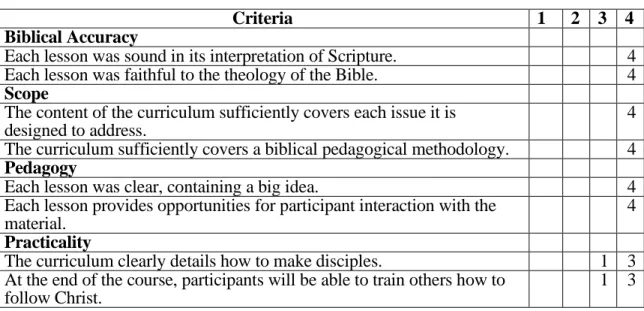
1. Evaluation of the curriculum . . . 61
2. Ages of the participants . . . 64
3. Highest pre-project survey scores . . . 64
4. Lowest pre-project survey scores . . . 65
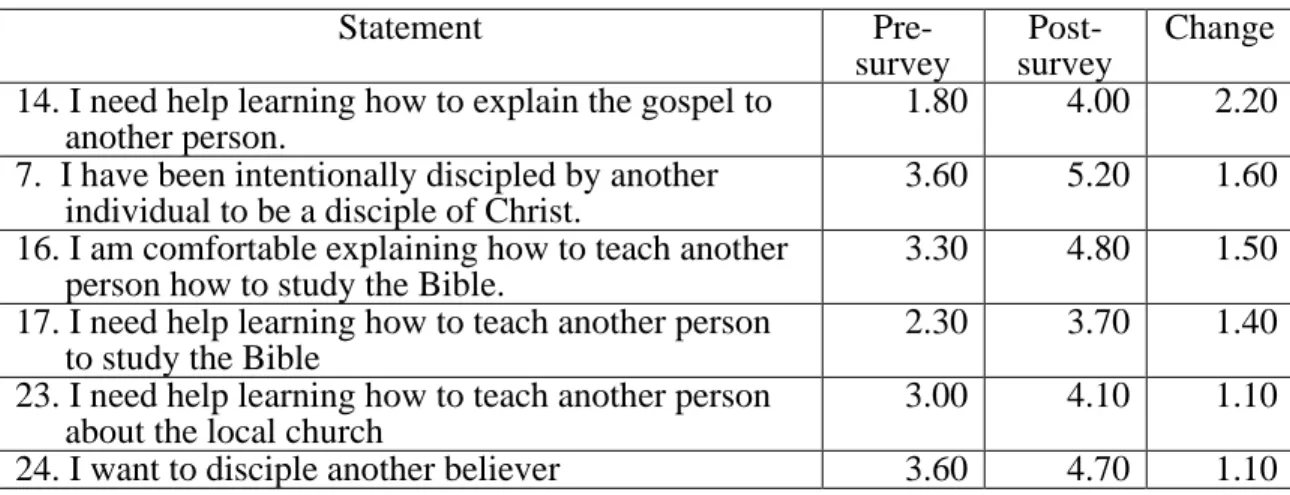
5. Largest changes in scores . . . 79
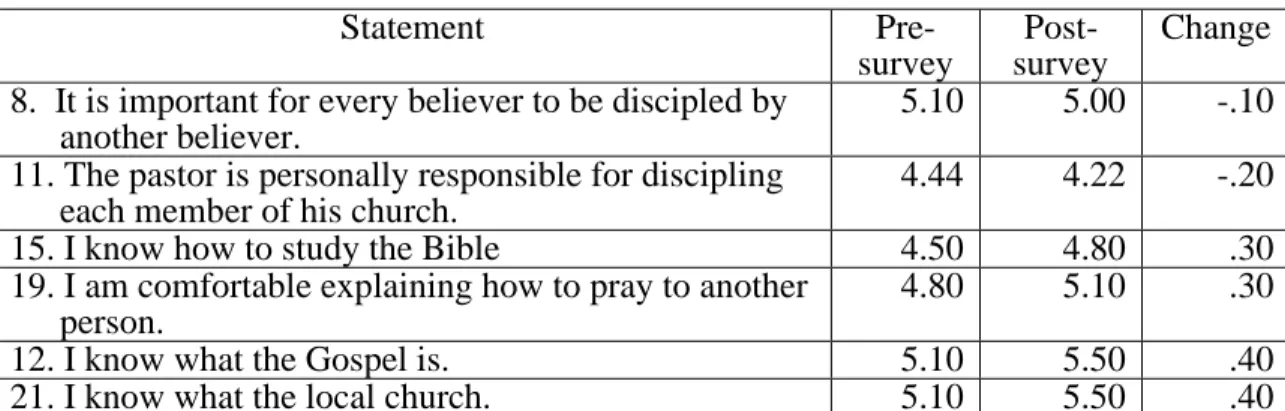
6. Smallest changes in scores . . . 81
PREFACE
This ministry project would not have been possible without the support of so many individuals. First, I am thankful for God saving me and calling me into pastoral ministry. This doctoral program has allowed me to grow in my understanding and application of biblical spirituality and will impact me long into the future.
I want to also thank my supervisor, Dr. Donald Whitney. I first read his book Spiritual Disciplines for the Christian Life many years ago and it became so formative for my own Christian growth. To study under him during my masters program and now to have him as an advisor for my doctorate has been an incredible blessing.
I also am so grateful for the support of Ross Baptist Church. The church has cared for me for a decade and I am so thankful for their support generally and specifically with the completion of this project. I am truly honored to serve as the pastor of RBC.
I want to thank my local association of pastors. They have provided friendship and guidance to me, as well as constructive feedback on my survey and curriculum. It is truly good to have brothers in ministry.
Finally, I want to thank my family. My wife Amanda has been such an encouragement throughout the process. I am thankful for my three children, who are a true blessing from the Lord. Thank you to my parents and in-laws who continue to support me. God has truly been good to me and I am incredibly and eternally grateful.
Andrew Moore Gary, Indiana
May 2023
CHAPTER 1 INTRODUCTION
Several years ago, the members of Ross Baptist Church adopted a new mission statement: “To Make and Develop Passionate Followers of Jesus Christ.” To this point, that mission statement has been aspirational. While the practice of making and developing disciples has been neglected, Jesus made it clear in both his lifestyle (Matt 4:19) and in his teachings (Matt 28:18-20) that this task is essential and the means by which he builds his church (Matt 16:17-18). To minister biblically and effectively to the people of Northwest Indiana, it was essential that Ross Baptist Church develop a mentality and practice of disciple-making.
Context
Ross Baptist Church (RBC) is a congregation of about sixty active members in Gary, Indiana. The church came out of a church planting endeavor several decades ago.
In the 1950s and 1960s, several Southern Baptist churches were planted in the area to meet the need of migrating evangelicals from the south, who moved north for work in the steel mills. That constant migration kept churches full as people looked for churches similar to what they experienced back home. In the last several decades, most of the churches in the area have plateaued or declined. Northwest Indiana is currently home to about twenty Southern Baptist churches.
I was called as a youth and education pastor in the summer of 2013. During my time at RBC, the church has experienced some challenging times. In 2015, the senior pastor retired and I was asked to serve as interim pastor. In 2017, a new senior pastor was called but his tenure lasted only six months. During these four years, several individuals left the
church either because of the absence of a pastor, a lack of satisfaction with the new pastor, or frustration with how the new pastor’s tenure ended. In 2018 I was approached to take on the role of senior pastor. The transition has been difficult, but the church members are desirous to be faithful to God’s call to serve the area of Northwest Indiana.
Since I became senior pastor, we have also had to endure the COVID pandemic. We chose to follow state guidelines as much as possible, which was popular with some members and not with others. While attendance has been slowly rising, we are still not back to pre-pandemic attendance or giving levels.
Taking on the role of senior pastor was a daunting task. RBC has had much pastoral turnover since the retirement of its founding pastor, a situation that has often caused the church to lose its sense of mission or purpose. Some of that loss has been attributed to calling pastors who were poor leaders, and some of it to an unwillingness of some of the members to be led. With no previous pastoral experience andin a church with no recent history of stable leadership, I endeavored to become deeply
knowledgeable of the church membership. I knew change was necessary, but first wanted to ensure that I knew the people and dynamics of the church well. As a result, during my time as pastor, I have come to experience the blessing of a congregation that loves and supports me.
One of the strengths of RBC is its history in this area. Over the years, hundreds of people have been helped by this church in various ways. Many people in the community have a sense of respect for the church and what it has done for the community. Over time, different relationships have formed, allowing the church to work with others outside the four walls of the building. The church has a particularly good relationship with the local school system, where the church helps with various tasks and provides Christmas gifts for children.
Another strength of the church is the commitment of its members. Almost every person who attends corporate worship also attends a Sunday school class. A substantial
number also attend both Sunday and Wednesday evening services. With the onset of COVID-19 and members being unable to attend, giving has not fallen off significantly.
There is a strong sense of community among the members. While the church cannot offer all of the programs that a larger church can, the church has done well with building personal connections among members. The church is a friendly place where guests feel welcome. Church members do a good job reaching out to all who attend.
Another strength of the church is its emphasis on prayer. Corporate gatherings contain public prayer for confession and petition. The church has a Wednesday night prayer meeting where time is spent praying each week for the church, its ministries, lost individuals by name, and various church and societal needs. The church has a detailed prayer list that is sent out and updated frequently. Also, members regularly contact each other with various prayer requests. Prayer is regarded by the members as an important part of the Christian’s life.
An additional strength of the church is an increasing flexibility to change. The church has functioned with the same programs and protocols for several years. Two years ago, the church agreed to enter into an intentional revitalization process. That process meant bringing in outside pastors and local association workers to evaluate everything about the church. RBC agreed to look and evaluate almost everything about the church except its commitment to Scripture and the Baptist Faith and Message 2000. Since then, a few changes have been proposed and implemented. While not everything has been unanimous, there is an increased willingness to distinguish between what is essential and what is not for ministry in Northwest Indiana. This increase in flexibility is important as the church looks to make needed changes.
The primary weakness of RBC is its lack of intentional disciple-making. The church’s mission statement is an aspirational statement. The church has not had much success in making disciples. That is shown in the fact that while many have been baptized and joined the church over the last several decades, the church has been in decline for a
long time. The official membership is full of names of individuals who no longer attend.
In the past, disciple-making was attempted through classes and programs, like Sunday school, but the idea of walking alongside another believer in intentional mentoring and training has not been part of the church culture. The lack of intentional disciple-making has resulted in many shallow believers who are weak in both theology and practice, as well as individuals falling away from the church. RBC needs to take more seriously the call of Hebrews 10:24 to “consider how to stir up one another to love and good works” and to grow in the belief that the Christian life is lived with intentional and meaningful connection with other believers.1
Discipleship programming at RBC has historically had an over-emphasis on moralism and an under-emphasis on gospel transformation. Most RBC members are blue collar, very task-oriented people. They gravitate to sermons and teaching that emphasize behavior modification. While the Bible does teach the importance of right behavior, that work is always to be the product of a God-centered life (Phil 2:12-13). Members
understand checking off daily Bible reading but few understand deep meditation on the Word of God. It is difficult to get members to understand that Christianity is not primarily about what believers do, but what Christ does. The lack of understanding that Christianity is primarily a work of God’s grace can lead to a pharisaical attitude among some members, and lead others to look condescendingly on the immorality of the outside community but fail to grow in inward holiness themselves.
The lack of training in intentional disciple-making has also resulted in church members becoming reliant on the church service as the primary place that evangelism occurs. The thought among many members is that lost individuals will come to the church on their own initiative, hear the gospel presented from the pulpit, and respond. The worship service then exists primarily as a salvation opportunity for the lost. While this
1 All Scripture quotations are from the English Standard Version, unless otherwise noted.
understanding of worship was always a questionable strategy since the Bible indicates that the worship service is primarily for the edification of believers (1 Cor 14:12), it has become even less helpful as fewer people visit the church. Since members are not trained to make disciples, there is little evangelism outside corporate gatherings.
Rationale
The first reason that the church needed to develop a method of producing disciples is because the Bible commands it. The Great Commission serves as a mandate for all believers to make disciples (Matt 28:18-20). Since the Bible commands it, there needs to be a system to do it. For far too long RBC has been concerned with making converts, but not disciples. Ephesians 4 tasks church leadership with equipping church members for the work of ministry. There needs to be a return to the biblical calling to make disciples.
Another reason the church needed to develop a method of producing disciples was that the membership is made up of individuals who are relatively immature in their faith. COVID-19 has shown how reliant members are on the pastor and leaders. There needs to be a deepening of personal faith and an individual ownership of it. The church is aging rapidly. Like many churches, RBC is reliant on older members as leaders and teachers. This will not work long term. Titus 2 makes it clear that the church should see to it that older men and women teach and pass on what they have learned to younger men and women. It is imperative that older members are equipped to pass on what they have learned to younger members.
A third reason the church needed to develop a method of producing disciples was because the members are already being discipled by other sources. People are inundated with television, radio, social media, and other sources of information. Those sources of information have a catechizing effect on the congregation. The results are seen in the rejection of biblical morality, embracing a political ideology over a theological
preaching and teaching is not enough to drown out the other hours that are at work in the hearts of RBC members. Proverbs 11:14 states that where there is no biblical guidance, people fall. RBC needs to provide spiritual guidance.
A fourth reason that the church needed to develop a method of producing disciples was that the RBC leadership needed to prepare members for whatever the future brings. Most RBC members have attended this church almost every Sunday morning for decades. COVID-19 has shown that believers cannot assume the ability to always gather.
If that is true, then it is imperative that the RBC leadership prepare its members to take disciple-making out of the confines of corporate gathering into their homes and social circles. Christianity cannot be compartmentalized to Sunday morning but needs to be worked out, in various avenues and relationships, all week long (Deut 6; Eph 4).
A fifth reason RBC needed to develop a method of making disciples is that generations are being lost. The average age of the membership skews much older than it should. An entire row of children’s classrooms is no longer being used because we do not need the space with current makeup of the church. Not only do we need parents to bring their children to church, but we need parents who are equipping their children at home.
Disciple-making is not only for adults discipling adults, but it must also include church and home discipling of children how to follow Christ as well.
A sixth reason that the church needed to develop a method of producing disciples was the imperative of making disciples outside the current membership. For years, the model for RBC has been to only disciple those who stepped onto campus.
Discipling outside the church will enable members to reach people who, for whatever reason, do not attend RBC. This change in strategy would set the members up to serve as missionaries in their separate families and communities. The members of RBC need to be trained and equipped in such a way to be willing to go, as Isaiah was, wherever God will send them to reach people with the gospel (Isa 6:8).
Purpose
The purpose of this project was to develop a disciple-making program for Ross Baptist Church in Gary, Indiana.
Goals
To fulfill the purpose of this project the following goals needed to be completed.
1. The first goal was to assess the understanding of disciple-making among members of Ross Baptist Church.
2. The second goal was to develop a training curriculum for disciple-making.
3. The third goal was to equip members of Ross Baptist Church by teaching a disciple- making curriculum over eight weekly sessions.
Research Methodology
Successful completion of this project depended upon the completion of the three goals. The first goal was to assess the understanding of disciple-making among members of Ross Baptist Church. This was measured by administering a Disciple- Making Survey (DMS) to members of the church to analyze their understanding and practice of disciple-making.2 This goal was considered successfully met when thirty members completed the survey and the results were evaluated to determine the current understanding and practices of disciple-making among the membership of Ross Baptist Church.
The second goal was to develop a training curriculum for disciple-making.
This curriculum was developed by incorporating biblical and historical methods of disciple-making. This curriculum was assessed by an expert panel of local pastors who evaluated the curriculum for biblical fidelity and practicality.3 This goal was considered successfully met when a minimum of 90 percent of the evaluation criteria met or
2 See appendix 1. All of the research instruments used in this project were performed in compliance with and approved by The Southern Baptist Theological Seminary Research Ethics Committee prior to use in the ministry project.
3 See appendix 2.
exceeded the sufficient level. If the 90 percent benchmark had not been met, then I would have revised the material until it met the standard.
The third goal was to equip members of Ross Baptist Church by teaching a disciple-making curriculum over eight weekly sessions. This goal was measured by readministering the DMS, which was used to measure the change in the biblical and historical understanding of disciple-making before and after the curriculum was presented.4 This goal was considered successfully met when a t-test of the group surveyed demonstrated a statistically significant difference in the pre- and post-DMS scores.
Definitions and Limitations/Delimitations
The following definitions of key terms are used in the ministry project:
Disciple. In his book Disciple, seminary professor Chuck Lawless describes a disciple as “simply a follower of Christ in the process of being conformed to his image.”5 In Deep Discipleship, pastor J.T. English describes a disciple as “someone who has received the identity of the Triune God through baptism and who follows the teachings of Christ through obedience.”6 Consistent with these definitions, in this project a disciple is defined as one who has been saved through faith in Jesus Christ and who follows in the teachings of Christ through obedience.
Disciple-making. The Great Commission calls every Christian to be a disciple who makesdisciples. Mark Dever, author of Discipling, rightly observes that disciples should be dedicated to helping others follow Jesus. The implications of these statements lead to the definition of disciple-making used in this project. Disciple-making is the
4 See appendix 1.
5 Chuck Lawless, Disciple: How to Create a Community That Develops Passionate and Healthy Followers of Jesus, Church Answers (Carol Stream, IL: Tyndale, 2022), 6.
6 J. T. English. Deep Discipleship: How the Church Can Make Whole Disciples of Jesus (Nashville: B & H, 2020), 62.
intentional training of another believer to follow the teachings of Christ though obedience.7
One limitation of this project was the honesty of the individuals on the survey regarding their knowledge and understanding of disciple-making. To mitigate this, the survey was administered anonymously. A second limitation was the consistency of attendance for all of the training sessions. To mitigate this limitation, the sessions were on a consistent day at a consistent time. The sessions were also recorded so that if a session was missed by a participant, he or she could watch the session later.
One delimitation of this project was that it was open only to RBC members. A second delimitation was that the training was held in person on the campus of RBC. A third delimitation was that the project was confined to a seventeen-week period. A fourth delimitation was that the curriculum was taught in eight sessions.
Conclusion
In the Great Commission, every believer is called to not only be a disciple of Jesus Christ, but to also teach others how to be a disciple of Jesus Christ. It was imperative that RBC develop a culture and practice of disciple-making. Moreover, the declining age of the church members added a further urgency to passing on what has been learned so that RBC could continue to serve the local community. The biblical call to make disciples brings glory to God and edifies believers. Chapter 2 provides biblical support for
disciple-making, while chapter 3 focuses on practical components of disciple-making.
Chapter 4 details the development, elements, and timeline of the disciple-making project, while Chapter 5 provides statistical and theological analysis of the project.
7 Mark Dever, Discipling: How to Help Others Follow Jesus, Building Health Churches (Wheaton, IL: Crossway, 2016), 13.
CHAPTER 2
BIBLICAL AND THEOLOGICAL BASIS FOR DISCIPLE-MAKING
Christians are called to be disciples who make disciples. In his commentary on the Gospel of Matthew, D. A. Carson writes, “It is binding on all Jesus’ disciples to make others what they themselves are—disciples of Christ.”1 This chapter will examine four passages to give insight to the concept of making disciples. Matthew 28:16-20 teaches that Christ has called and empowered believers to go and make disciples of all nations, which includes baptizing them and teaching them to observe all that Christ has
commanded. Deuteronomy 6:4-9 reminds believers that disciple-making includes teaching the things of God diligently to those God has placed in one’s life so they will lovingly obey God. Second Timothy 2:1-8 teaches that disciple-making, while difficult at times, is worth it as it is God’s ordained method to pass on the faith to future generations. Ephesians 4:1- 12 reminds believers that the triune God has called pastors and leaders to equip the saints to be disciple-makers for the work of ministry and the building up of the body of Christ.
Matthew 28:16-20
Jesus’s words in Matthew 28:16-20 (commonly known as the Great
Commission), maybe more than any other passage, define the mission of the people of God.2 The Great Commission is the clearest passage on the command for all believers to
1 D. A. Carson, Matthew, in The Expositor’s Bible Commentary, vol. 9, Matthew and Mark, ed.
Tremper Longman and David E. Garland (Grand Rapids: Zondervan, 2010), 666.
2 Matt 28:16-20 reads,
Now the eleven disciples went to Galilee, to the mountain to which Jesus had directed them. And when they saw him they worshiped him, but some doubted. And Jesus came and said to them, “All authority in heaven and on earth has been given to me. Go therefore and make disciples of all nations,
“go and make disciples.” This passage, while understood by many Christians today as part of an ongoing mandate to go and make disciples, was not always viewed as such.3 William Carey (1761-1834), the father of the modern missionary movement, argued strongly for an ongoing call to make disciples in An Enquiry into the Obligations of Christians to Use Means for the Conversion of the Heathens (1792).4 At the time of Carey’s ministry, some pastors saw little need for mission work, viewing the task as no longer binding on the church.5 Carey was famously rebuked by many, including a minister named John Ryland. Ryland told Carey, “Young man, sit down. When God pleases to convert the heathen, He will do without your aid or mine.”6 Thankfully, Carey was undeterred, and evangelicals today see the call in Matthew 28 as a mandate for modern times. Even still, some compartmentalize the text to be only about evangelism.
While evangelism is a part of disciple-making (one cannot be a disciple without being saved by the gospel message), Matthew 28:16-20 goes beyond that. An exegesis of Matthew 28:16-20 shows that Jesus has called and empowered believers to go and make disciples of all nations, which includes baptizing them and teaching them to observe all that Christ has commanded.
Called and Empowered
The narrative begins after Jesus’s death and resurrection. Christ appeared to the women at the tomb and told them to have his disciples meet him in Galilee (Matt 28:10).
baptizing them in the name of the Father and of the Son and of the Holy Spirit, teaching them to observe all that I have commanded you. And behold, I am with you always, to the end of the age.”
3 Michael A. G. Haykin, The God Who Draws Near: An Introduction to Biblical Spirituality (Darlington, England: Evangelical, 2007), 1.
4 William Carey, An Enquiry into the Obligations of Christians, to use Means for the Conversion of the Heathens (Leichester: Ann Ireland, 1792), accessed March 27, 2023,
https://www.wmcarey.edu/carey/enquiry/anenquiry.pdf.
5 Haykin, The God Who Draws Near, 1.
6 Daniel L Akin, 10 Who Changed the World (Nashville: B & H, 2012), 2.
The disciples go to the mountain to meet Jesus. There the text says that “when they saw him they worshipped him, but some doubted” (Matt 28:17). Commentators are divided on who the “some” in this text is referring to. Carson believes the “some” here is a reference to disciples outside the Eleven. He believes it is unlikely that it is the Eleven who doubted because Jesus had already appeared to them at other times.7 Others, like New Testament scholar R. T. France believe that “some” is a reference to the Eleven, who are trying to process this new situation.8 Jesus calling the disciples to such a public space indicates there were probably many more than just the Eleven gathered there. Still, the fact that Matthew mentions only the Eleven and adds the comment that some doubted indicates that some of the Eleven actually did doubt.
The word translated “doubt” here, ἐδίστασαν, refers more to hesitation than intellectual disbelief.9 Much had changed for the disciples in the time since Jesus was arrested. Their ideas of what the work of Christ on earth would look like suddenly changed when Christ was betrayed, tried, and crucified. Now before them stood a resurrected Christ, once dead now alive, with all power and majesty. It is natural the disciples would feel conflicted at this moment. They were obedient to the call of Christ to the mountain and they were worshipful in his presence, yet they were still unsure of what the events of the crucifixion and resurrection fully meant.10
Aware of this, Christ spoke the powerful declaration that “all authority in heaven and on earth has been given to me” (Matt 28:18). Carson notes that the word “all”
7 Carson, Matthew, 664.
8 R. T. France, The Gospel of Matthew, The New International Commentary on the New Testament (Grand Rapids: Wm. B. Eerdmans, 2007), 1112.
9 Carson, Matthew, 663.
10 Daniel M. Doriani, Matthew, in The Expository Commentary, vol. 8, Matthew-Luke, ed. Iain M. Duguid, James M. Hamilton Jr, and Jay Sklar (Wheaton, IL: Crossway, 2021), 442.
ties the entire passage together: “All authority, all nations, all things, all the days.”11 The fact that all authority has been given to Christ may appear a bit confusing to some. After all, throughout the Gospel of Matthew Jesus shows authority on many occasions, whether referring to himself as Lord (7:21), teaching with authority (7:28-29), or healing and casting out demons (8:14-17). So, what can it mean that authority has been given now?
There appears to be a connection between the authority of Jesus given here and his work of redemption.12 There was a time in his humanity where Jesus appeared limited in his authority. For example, Jesus was limited by suffering death on a cross. However, in Matthew 28 he has been vindicated by the Father in such a way that his authority cannot be denied. Paul affirms this in Philippians 2:5-11:
Have this mind among yourselves, which is yours in Christ Jesus, who, though he was in the form of God, did not count equality with God a thing to be grasped, but emptied himself, by taking the form of a servant, being born in the likeness of men.
And being found in human form, he humbled himself by becoming obedient to the point of death, even death on a cross. Therefore God has highly exalted him and bestowed on him the name that is above every name, so that at the name of Jesus every knee should bow, in heaven and on earth and under the earth, and every tongue confess that Jesus Christ is Lord, to the glory of God the Father.
While Christ had authority prior to the ending of the Gospel of Matthew, in his death and resurrection his full authority is revealed. In this power, this vindicated power, disciples are to go forth and make disciples. While the disciples had doubts and were hesitant, Jesus reminded them that he is the one who sends and empowers his disciples.
In disciple-making, the power is not in the discipler. If it were, then there would be no chance of success. But because God is at work, the task of disciple-making can be done.
Make Disciples by Going, Baptizing, and Teaching
In examining verses 19-20 it is important to note that the only verb in the imperative form is the verb μαθητεύσατε, translated as “make disciples.” Pastor John
11 Carson, Matthew, 665.
12 Carson, Matthew, 665.
MacArthur writes in his commentary on this passage that
mathēteuō (make disciples) is the main verb and the central command of verses 19- 20, which form the closing sentence of Matthew’s gospel. The root meaning of the term refers to believing and learning. Jesus was not referring simply to believers or simply to learners, or He would have used other words. Mathēteuō carries a
beautiful combination of meanings. In this context it relates to those who place their trust in Jesus Christ and follow Him in lives of continual learning and obedience.13
Carson also argues in his commentary that while the command was originally given to the Eleven (and possibly the others that were initially there), in this passage the Eleven are “paradigms for all disciples.”14 It is binding today on all of Christ’s disciples to make disciples.15 Making disciples is accomplished by going, baptizing, and teaching.16
In making disciples, one must go. There is debate on how to understand the word “go” in verse 19. The only imperative in the passage is to “make disciples.” Some believe that “go” should be understood more like “as we go,” indicating that disciple- making is to occur only where we are and that there is no call to go. Making disciples as we go is the primary focus.17 While we should make disciples where we are, Carson points out that the call to make disciples of all nations necessitates the need to actually go beyond where we are.18 The Great Commission does not rule out missions work at all, but rather implies it.
The call to baptize in verse 19 is the call to baptize in the name of the Father and the Son and the Holy Spirit. Craig Blomberg, long tenured professor at Denver Seminary, believes that this is one of the most explicit texts in all of Scripture detailing
13 John F. MacArthur, Matthew 24-28, The MacArthur New Testament Commentary (Chicago:
Moody, 1989) 340.
14 Carson, Matthew, 666.
15 Carson, Matthew, 666.
16 Doriani, Matthew, 442.
17 Craig L. Blomberg, Matthew, The New American Commentary, vol. 22 (Nashville:
Broadman, 1992), 432.
18 Carson, Matthew, 666.
the doctrine of the Trinity.19 It is worth noting that there are not three baptisms (one for each name) nor are there three names. Instead, the one name underscores the unity of the Godhead. Baptism is a public declaration of one’s allegiance to God. It is also the way one declares oneself connected with other believers. In Acts 2, Peter preached at Pentecost, prompting the crowd to ask what they should do:
And Peter said to them, “Repent and be baptized every one of you in the name of Jesus Christ for the forgiveness of your sins, and you will receive the gift of the Holy Spirit. For the promise is for you and for your children and for all who are far off, everyone whom the Lord our God calls to himself.” And with many other words he bore witness and continued to exhort them, saying, “Save yourselves from this crooked generation.” So those who received his word were baptized, and there were added that day about three thousand souls. (vv. 38-41)
Baptism is the outward sign that one is connected to Christ and to the body of Christ.20 It is the first step in obedience for a new believer.
That initial step of obedience is not the end but the beginning. In Matthew 28, Jesus tells the disciples to teach others “to observe all that I have commanded you” (v. 20).
As previously noted, the “all” here should be understood in connection to the “all” power Jesus claims in verse 18. Just as his power is absolute, the obedience of disciples of Christ should be absolute as well.21 Disciples are to teach other disciples all the truths of God so that they can obey them. This teaching must go beyond corporate worship to other spaces and times in life, to make sure the whole counsel of God is taught. In
keeping the Word of God, disciples show allegiance to God. In the Gospel of John, Jesus promised that one part of the ministry of the Holy Spirit would be to bring to his
disciples’ remembrance the words of Jesus. In that same passage Jesus asserted what he would reaffirm in the Great Commission; namely, that his disciples must be characterized by keeping his words—words which ultimately came from God the Father:
19 Blomberg, Matthew, 432.
20 Bobby Jamieson, Why Should I Be Baptized?, Church Questions (Wheaton, IL: Crossway, 2020), 21.
21 MacArthur, Matthew 24-28, 340.
Jesus answered him, “If anyone loves me, he will keep my word, and my Father will love him, and we will come to him and make our home with him. Whoever does not love me does not keep my words. And the word that you hear is not mine but the Father’s who sent me. These things I have spoken to you while I am still with you.
But the Helper, the Holy Spirit, whom the Father will send in my name, he will teach you all things and bring to your remembrance all that I have said to you.” (John 14:23-26)
Not Alone
Jesus concludes the Great Commission by promising to always be with his followers (Matt 29:20). This powerful phrase bookends the Gospel of Matthew well, as the book begins with the declaration that Christ is Immanuel, which means, God with us (Matt 1:23). Although Jesus physically ascended shortly after these words (Acts 1:9), his
promised presence with his people is a reality through the indwelling of the Holy Spirit.
Jesus promised in John 14 that he will abide in those who keep his word. Paul tells the church at Ephesus that Christ resides in their hearts through faith (Eph 3:17). This underscores that fact that God is ultimately at work in the heart of one being discipled.
The emphasis on God’s Word and God’s presence reminds that it is his power that causes spiritual growth. There should be an emphasis on prayer in disciple-making so that God’s power is accessed. Carson points out that the encouragement to ask, seek, and find are meant to encourage the believer who is overwhelmed in spiritual growth to turn to God.
Jesus did not leave the believers with an impossible task. He instead offered them his strength through prayer.22 Disciples can have confidence in the task of disciple-making because they are not alone. Matthew 28:16-20 teaches that all believers are to be disciples who make disciples.
Deuteronomy 6:4-9
Deuteronomy 6:4 begins what is known as the Shema, which means “to hear.”
This passage, along with the subsequent instructions, served as a crucial passage for the Israelites during the Old Testament period. While the focus in the passage is on family
22 Carson, Matthew, 222.
teaching within the Old Covenant, it shows New Covenant believers that God has always prioritized teaching others the things of God. Believers can understand its first
application to parents of the Old Covenant and also understand that it provides some common themes of passing on faith that are supported in the New Testament and are relevant for New Covenant believers today. An exegesis of Deuteronomy 6:4-9 shows that disciple-making includes teaching the things of God diligently to those whom God has placed in people’s lives so they lovingly obey God.
Supremacy of God
Deuteronomy 6 occurs at an important time in the history of the people of Israel.
The people have been rescued by the hand of God from their affliction in Egypt. They have been given the law of God and have been chosen to be his people. The book of
Deuteronomy comes after years of the people neglecting the will and Word of God and focuses on the call of the people to renew their covenant with God. The Decalogue of Exodus 20 is repeated in Deuteronomy 5. Commentator John Currid points out that the calling in Deuteronomy 6:4 to monotheism connects this passage with the first
commandment in the Decalogue to have no other gods.23
The focus of this section is Deuteronomy 6:4-9, which reads,
Hear, O Israel: The LORD our God, the LORD is one. You shall love the LORD your God with all your heart and with all your soul and with all your might. And these words that I command you today shall be on your heart. You shall teach them diligently to your children, and shall talk of them when you sit in your house, and when you walk by the way, and when you lie down, and when you rise. You shall bind them as a sign on your hand, and they shall be as frontlets between your eyes.
You shall write them on the doorposts of your house and on your gates.
A foundational truth of this passage is found in verse 4: “The Lord is one.” This emphasizes the dedication to monotheism for God’s people. Christopher Wright explains in his commentary on the book of Deuteronomy that the priority is not as much on
23 John D. Currid, A Study Commentary on Deuteronomy, Evangelical Press Study Commentary (Darlington, England: Evangelical, 2006), 162.
denying the existence of other deities but on making it clear the God of Israel is
supreme.24 Contrary spiritual forces are not denied, but instead the Israelites are called to reject allegiance to them and to give total allegiance to God. There is no room for
polytheism and divided obedience. It is Yahweh and him alone that they are to love and follow. From a New Covenant perspective, in disciple-making it is important to today teach who God is and what he has done. It also important to teach disciples that one cannot be divided in allegiance to God.25 In the New Testament, Jesus reiterated this principle that one cannot serve two masters (Matt 6:24).
Love through Obedience
An emphasis in Deuteronomy 6:4-9 is on loving God through obedience. The connection with the Decalogue must be remembered, as Moses is tying the importance of keeping commands with the call to love God. Biblical scholar J. A. Thompson points out that Israel’s obedience was not merely to be a form of legalism, but to be based on a relationship of love.26 Disciple-makers need to teach that following God’s commands is not a way to earn God’s love. In the first giving of the Decalogue in Exodus 20, the passage begins with a reminder that God has freed the people from the bondage of Egypt (Exod 20:1-2). God’s people have never related to God on the basis of merit, but always by grace. As the New Testament teaches, “We love because he first loved us” (1 John 4:19).
Both Old and New Testaments make clear, however, that a relationship of love is not inconsistent with following a moral law. In the proceeding chapter, God tells the
24 Christopher J. H. Wright, Deuteronomy, New International Biblical Commentary, vol. 4 (Peabody, MA: Hendrickson, 1996), 96.
25 August H. Konkel, Deuteronomy, in The Expository Commentary, vol. 2, Deuteronomy- Ruth, ed. Iain M. Duguid, James M. Hamilton Jr., and Jay Sklar (Wheaton, IL: Crossway, 2021), 111.
26 J. A. Thompson, Deuteronomy, Tyndale Old Testament Commentaries, vol. 5 (London:
InterVarsity, 1979), 138.
people that he gives his love to those who love him and keep his commandments (Deut 5:10). Jesus repeats this concept when he states, “If you love me, you will keep my commandments” (John 14:15). Disciples demonstrate their love for God in obedience to God. Loving submission in Deuteronomy 6 is grounded in the specific words of the Decalogue, but it can reasonably be more broadly applied to the entirety of the
commands of God.27 Christian love results in obedience, and a lack of obedience suggests a lack of Christian love.
The total obedience of the disciple is reiterated with the call to love God “with all your heart and with all your soul and with all your might” (v. 5). This grouping of heart, soul, and mind is repeated at least eight times in the book of Deuteronomy. It symbolizes the totality of the commitment of the disciple to God.28 God is not to be one of many options; he is to have the place of preeminence. The term heart (ָ֥ ך ְב ָב ְל) is used in the Bible to describe the place of will or volition.29 It also contains the idea of emotion, but it is more than the modern Western idea of the heart as mainly the seat of the emotions. The Bible teaches that emotions are not to rule our lives but our will and intellect are to control our emotions.30 The Hebrew word for soul (ָ֥ ך ְש ְפַנ) has the idea of the inner self. Psalm 103 uses the word soul in parallel with the phrase “all my inmost being.”31 Again, the idea of comprehensiveness is present in calling the disciple to love with heart and soul. The call to love God with all of one’s might (׃ך ֶֽ דֹא ְמ) can be
translated “with all your very-muchness.”32 The instruction is clear: the disciple is to be
27 Michael A. Grisanti, Deuteronomy, in The Expositor’s Bible Commentary, vol. 2, Numbers- Ruth, ed. Tremper Longman and David E. Garland (Grand Rapids: Zondervan, 2012), 557.
28 Grisanti, Deuteronomy, 556.
29 Grisanti, Deuteronomy, 556.
30 Thompson, Deuteronomy, 138.
31 Wright, Deuteronomy, 99.
32 Wright, Deuteronomy, 99.
totally committed to loving and obeying God in every area of life.
Diligence
Deuteronomy 6 reminds believers that disciple-making, whatever the context, must be done with intentionality and diligence. In this passage, the things of God are being taught “when you sit in your house, and when you walk by the way, and when you lie down, and when you rise” (Deut 6:7). While the immediate context is parents being diligent in teaching their own children, this concept of intentionality and diligence is applicable to other New Covenant spheres of disciple-making. Disciple-makers should take the task of making disciples seriously and look to incorporate disciple-making into every area of life.33 There is no compartmentalization of faith to only designated times of specific religious duties or ceremonies. Instead, faith should be brought to bear on
everyday life. Disciple-making sees every part of life in relation to who God is and obedience to him. Writing on Deuteronomy 6:4-9, Pastor Mark Dever describes disciple- making as “transmitting the knowledge of God and his Word through every moment of life.34
God commands the believer to take his words and “bind them as a sign on your hand, and they shall be as frontlets between your eyes” (Deut 6:8). Many Jews attempted to literally fulfill this passage by wearing small leatherboxes containing this Scripture on both their left arms and on their foreheads.35 Although Christians understand this as an Old Covenant practice not required of New Covenant believers, they do receive it as a metaphor for internalizing the Word of God.36 Wright notes that there is a progression in
33 Konkel, Deuteronomy, 111.
34 Mark Dever, Discipling: How to Help Others Follow Jesus, Building Health Churches (Wheaton, IL: Crossway, 2016), 28.
35 Thompson, Deuteronomy, 139.
36 Wright, Deuteronomy, 100.
the text in the application of the Word of God. First, the Word is applied to the individual, then to the family, and then to the community at large. Faith is not merely for personal consumption—believers are called to take the faith out to others. Not every believer can go and take the gospel to the nations, but every believer can make disciples as he or she is going. The call to disciple those close by means that the homemaker, the businessman, and retiree all have opportunities to disciple others. Christians reading Deuteronomy through the lens of the redemption that is in Christ can apply many of the same principles to making disciples today. Deuteronomy 6:4-9 reminds believers that disciple-making includes teaching the things of God diligently to those God has placed in one’s life so that they lovingly obey God as well.
Second Timothy 2:1-8
In 2 Timothy 1-8, the apostle Paul writes to his younger protégé, Timothy:
You then, my child, be strengthened by the grace that is in Christ Jesus, and what you have heard from me in the presence of many witnesses entrust to faithful men, who will be able to teach others also. Share in suffering as a good soldier of Christ Jesus. No soldier gets entangled in civilian pursuits, since his aim is to please the one who enlisted him. An athlete is not crowned unless he competes according to the rules. It is the hard-working farmer who ought to have the first share of the crops. Think over what I say, for the Lord will give you understanding in
everything. Remember Jesus Christ, risen from the dead, the offspring of David, as preached in my gospel.
Paul serves as an example of one who learned directly from Christ (Gal 1:11- 12) and passed on that teaching to others. An exegesis of 2 Timothy 2:1-8 shows that disciple-making, while difficult at times, is worth the effort as it is God’s ordained method to pass on the faith to future generations.
Paul was a committed disciple-maker. His most significant disciple was Timothy. Paul met Timothy while traveling through Lystra and, after spending time with him and hearing of his good reputation, desired to take him along with him on his
missionary work (Acts 16:2-3). The text of Scripture makes little mention of Timothy’s father, other than that his father was a Gentile, implying that possibly he had passed away
by the time Paul met Timothy.37 Thus, in many ways Paul served as a father figure to Timothy. Paul even tells the Philippian church that he views Timothy as a son (Phil 2:22). Here in 2 Timothy 2, he explicitly calls Timothy his child (v. 1). The book of 2 Timothy is generally agreed upon by evangelical scholars to be the last of Paul’s canonical writings. Paul notes in the letter that he believes his time of departure is at hand, which scholar Philip Towner sees as a reference to Paul’s impending death.38 Paul is writing with the purpose of seeing Timothy continue on in the faith after he is gone.
Pass the Torch
While this text was written to a pastor involved in pastoral ministry, it is broadly the task of all believers to spread the gospel.39 In 2 Timothy 1:5 Paul reminds Timothy that Timothy first heard the gospel from his mother and his grandmother. Paul has also invested much in the life of Timothy. He tells Timothy to pass on “what you heard from me in the presence of many witnesses” (2 Tim 2:2). As Paul nears the end of his life, he calls Timothy to be faithful to continue the legacy of faith.40
What Paul taught to Timothy, Timothy is then to pass on to other faithful men (2 Tim 2:2). Theologian Donald Guthrie points out that that the term faithful (πιστοῖς) indicates that believers are in view here.41 As discussed with the Great Commission,
37 Acts 16:1-3 reads, “Paul came also to Derbe and to Lystra. A disciple was there, named Timothy, the son of a Jewish woman who was a believer, but his father was a Greek. He was well spoken of by the brothers at Lystra and Iconium. Paul wanted Timothy to accompany him, and he took him and circumcised him because of the Jews who were in those places, for they all knew that his father was a Greek.”
38 Philip H. Towner, The Letters to Timothy and Titus, The New International Commentary on the New Testament (Grand Rapids: Eerdmans, 2006), 611.
39 Denny Burk, 1-2 Timothy and Titus, in The Expository Commentary, vol. 11, Ephesians- Philemon, ed. Iain M. Duguid, James M. Hamilton Jr., and Jay Sklar (Wheaton, IL: Crossway, 2018), 467.
40 John Stott, The Message of 1 Timothy and Titus, The Bible Speaks Today (Downers Grove, IL: Intervarsity, 1996).
41 Donald Guthrie, The Pastoral Epistles, 2nd ed. Tyndale New Testament Commentaries, vol.
14 (Leicester, England: InterVarsity, 1990), 506.
disciple-making is not just evangelism. Evangelism is a prerequisite, but disciple-making involves further teaching of believers. Guthrie also contrasts the faithfulness of these men with those Paul had previously warned Timothy about who follow after foolish myths (1 Tim 1:4). The teaching that Paul calls Timothy to in 2:1-2 differs from the preaching Timothy is called to in chapter 4. While preaching occurs as the church gathers, the teaching that Timothy is called to here in chapter 2 is of a more intimate and personal nature.42
The text of 2:1-2 clarifies that Timothy is not merely to teach these faithful men the truth for the sake of their own personal knowledge. He is to teach these men the truth in such a way that they will be able to pass it down. Each generation of disciples should be trained to pass on the teaching to the next generation. This has been the formula throughout the history of the church. Jesus had in his earthly ministry only twelve close disciples (including Judas). Yet, from this small group the Christian faith has expanded for two millennia. In a manner similar to that of his Savior Jesus with the Twelve, Paul invested in Timothy as a disciple. Timothy is called to guard the good deposit of his faith (2 Tim 1:14), guarding the faith so that it can be passed on to others who will pass it on to others. This stands in stark contrast to much of contemporary ministry which is often focused only on current numbers and filling the pews in the moment. It seems however that a better metric for ministry is not in the attendance figures of the moment, but how well the church is passing on the truth of the gospel to future generations of believers.
Difficulty in Disciple-Making
Paul is clear in 2 Timothy 2 that making disciples is not an easy task. The
42 Tony Merida, 1 & 2 Timothy and Titus, Christ Centered Exposition Commentary (Nashville:
B & H, 2013), 162.
phrase “you then” that begins chapter 2 connects this passage with the end of chapter 1.43 There, Paul recounts how Phygelus and Hermogenes had abandoned him. One of the challenges of disciple-making is that some disciples will turn away. Jesus himself had one of his twelve turn away from him. The work of disciple-making can be discouraging.
It is important for disciples to know that if Paul and Jesus had disciples abandon them, modern Christians should not be surprised if disciples abandon modern disciple-makers.
In fact, Paul follows up the call for Timothy to make disciples with the call to “share in suffering” (2 Tim 2:3). The task of disciple-making is of paramount importance: nothing could be more crucial than passing on the faith. The task however, has challenges. Paul dealt with such apostasy with the church at Galatia:
I am astonished that you are so quickly deserting him who called you in the grace of Christ and are turning to a different gospel—not that there is another one, but there are some who trouble you and want to distort the gospel of Christ. But even if we or an angel from heaven should preach to you a gospel contrary to the one we preached to you, let him be accursed. As we have said before, so now I say again: If anyone is preaching to you a gospel contrary to the one you received, let him be accursed.
(Gal 1:6-9).
As disciple-makers teach the gospel and train others, they must be aware of the vital nature of the task, while knowing that it will not be an easy one.
Encouragement to Endure
Paul begins his letter greeting Timothy in “grace, mercy, and peace from God the Father and Christ Jesus our Lord” (2 Tim 1:2). Throughout chapter 1 he writes to encourage Timothy to remain steadfast in the faith (vv. 6-7), in contrast to others who have turned away from Paul, and by extension, away from Christ as well (v. 15). In chapter 2, Paul tells Timothy to “be strengthened by the grace that is in Christ Jesus (v. 1).
This focus on Christ encourages disciple-makers to continue in the faith.
One helpful point to remember in disciple-making is to look for individuals
43 Burk, 1-2 Timothy and Titus, 467.
who are faithful and teachable.44 Paul calls Timothy to find men who are faithful
(πιστοῖς). The word indicates that in discipling others one should look for those willing to commit to growth. Paul encourages Timothy to invest in those who want to grow. Many times in his ministry Jesus had the opportunity to lower the standards of discipleship to meet the desires of those around him. Yet, time and again, Jesus called out fickle loyalty and commitment. Luke 9:57-62 reads,
As they were going along the road, someone said to him, “I will follow you wherever you go.” And Jesus said to him, “Foxes have holes, and birds of the air have nests, but the Son of Man has nowhere to lay his head.” To another he said,
“Follow me.” But he said, “Lord, let me first go and bury my father.” And Jesus said to him, “Leave the dead to bury their own dead. But as for you, go and proclaim the kingdom of God.” Yet another said, “I will follow you, Lord, but let me first say farewell to those at my home.” Jesus said to him, “No one who puts his hand to the plow and looks back is fit for the kingdom of God.”
Not only should disciples be faithful, but they should be teachable with an ability to also teach others (2 Tim 2:3). Every disciple must be teachable. If a disciple is not willing to learn, then the disciple-maker cannot force the disciple to grow. If one will not listen, often it is best to move on to a disciple who will (Matt 10:14). The disciple should be teachable and also have a willingness to teach others.45 The gospel should produce in believers a desire to tell others what God has done.46 Disciples are to receive knowledge and pass it on.
Paul uses illustrations of different types of individuals to teach about the importance of dedication in disciple-making: a soldier, an athlete, and a farmer (2 Tim 2:4-6). Each example involves an individual under tremendous pressure that endures for a season. Each example makes sacrifices for the work to get done. Disciple-making means
44 Andreas Köstenberger, 2 Timothy, in The Expositor’s Bible Commentary, vol. 12,
Ephesians-Philemon, ed. Tremper Longman and David E. Garland (Grand Rapids: Zondervan, 2006), 574.
45 Every disciple should teach, but not all are gifted to teach in the same way. One should be faithful to pass on the faith with the natural and spiritual gifts God has given.
46 See Luke 8:26-39 where a man was healed of a demon possession. His first instinct was to go with Christ wherever he was going. When Christ instead called him to go home and testify to what had happened, he joyfully went and proclaimed the restorative power of God.
inconveniences; it means giving up personal time to invest in others. It requires emotional vulnerability as others are invested in.
Paul uses the example of a soldier as one who does not get “entangled in civilian pursuits” (2 Tim 2:4). Many things can distract from the task of disciple-making. In some ways, the current generation has a greater challenge than ever before because of the onslaught of technology that serves to divert and dull. The soldier, however, is not preoccupied by things that are unessential to his mission. He has a singular focus: to follow the commands of the one over him.47 The soldier does not work a 9 to 5 job, but instead is a soldier 24/7.48 Disciple-makers recognize that the call from God is to be faithful at all times.
Another illustration used in this passage is that of the athlete (2 Tim 2:5). The athlete had to compete according to the rules. In his commentary on this passage, author Warren Wiersbe explains,
In the Greek games in particular, the judges were most careful about enforcing the rules. Each competitor had to be a citizen of his nation, with a good reputation. In his preparation for the event, he had to follow specific standards. If an athlete was found defective in any matter, he was disqualified from competing. If, after he had competed and won, he was found to have broken some rule, he then lost his crown.49
In the case of 2 Timothy 2, the rule is a reference to a willingness to suffer.50 To be a disciple-maker means a willingness to endure oneself and the willingness to let disciples know that to follow Christ can and will be costly. Later in 2 Timothy Paul writes,
“I have fought the good fight, I have finished the race, I have kept the faith” (4:7). In Hebrews 12, the believer is called to run the race of faith with endurance (v. 2). Disciple-
47 Towner, Letters to Timothy and Titus, 493.
48 John MacArthur, 2 Timothy, The MacArthur New Testament Commentary (Chicago: Moody, 1995), 43-44.
49 Warren Wiersbe, The Wiersbe Bible Commentary: New Testament (Colorado Springs: David C Cook, 2001), 776.
50 Burk, 1-2 Timothy and Titus, 468.
making takes focus and endurance.
The third analogy Paul uses in this passage is that of a farmer (2 Tim 2:6). The farmer is characterized as “hard-working.” Making disciples is hard work. Paul never minimizes the difficult nature of disciple-making, but he does remind Timothy that there is a reward for those who do the work.51 He describes the farmer working that he might
“have the first share of the crops.” There is great joy in disciple-making. While it is challenging, being used by God to see another believer walk in obedience is gratifying.
Disciple-makers work, but they work as ones anticipating a bountiful harvest.
Paul never minimizes the challenge that disciple-making is, but he graciously reminds believers why it is important. The call in verse 8 to “remember Jesus Christ, risen from the dead” serves as motivation for the task. If Christ is risen, then nothing is more important than making disciples. If Christ is risen, then he is worthy of all allegiance and obedience.52 While the task is challenging, God has called his people to be disciple-makers and pass the faith down to the next generation.
Ephesians 4:1-12
The last passage to be examined in this chapter is from the book of Ephesians.
Theologian John Stott calls the book a “concise, yet comprehensive, summary of the Christian good news and its implications.”53 An exegesis of Ephesians 4:1-12 shows that the triune God has called pastors and leaders to equip the saints to be disciple-makers for the work of ministry and the building up of the body of Christ.54
51 Köstenberger, 2 Timothy, 575.
52 Burk, 1-2 Timothy and Titus, 468.
53 John R. W. Stott, God’s New Society: The Message of Ephesians, The Bible Speaks Today (Leicester: InterVarsity, 1979), 15.
54 Eph 4:1-12 reads,
I therefore, a prisoner for the Lord, urge you to walk in a manner worthy of the calling to which you have been called, with all humility and gentleness, with patience, bearing with one another in love, eager to maintain the unity of the Spirit in the bond of peace. There is one body and one Spirit—just
Triune God
The word “therefore” at the beginning of chapter 4 signifies a transition from doctrinalto the practical section of the letter.55 Paul, in chains, urges the church at Ephesus to “walk in a manner worthy of the calling to which you have been called” (Eph 4.1) This is a reminder that all believers are called by God and are recipients of his grace.56 Paul describes how this life should appear in verse 2: “With all humility and gentleness, with patience, bearing with one another in love.” Paul uses those nouns to build to his central point, which is a desire for unity in the church (v. 3).57 For many, unity in a church might sound like an impossible dream, but Paul grounds the expectation for unity in the fact that God is a triune God. In verses 4-6 Paul gives one of the clearest descriptions of the Trinity in all of the Bible: “There is one body and one Spirit—just as you were called to the one hope that belongs to your call—one Lord, one faith, one baptism, one God and Father of all, who is over all and through all and in all.”
Here Paul states that because God is one, the church should also be one. Each member of the Trinity promotes unity. In fact, the presentation of each member of the Godhead pairs well with the discussion of the diversity within the “one body” (v. 4). In addition to calling attention to each member of the Trinity, Paul also stresses their unity.
Commentator Frank Thielman notes that there are seven uses of the word “one” in 4:4-
as you were called to the one hope that belongs to your call— one Lord, one faith, one baptism, one God and Father of all, who is over all and through all and in all. But grace was given to each one of us according to the measure of Christ’s gift. Therefore it says, “When he ascended on high he led a host of captives, and he gave gifts to men.” (In saying, “He ascended,” what does it mean but that he had also descended into the lower regions, the earth? He who descended is the one who also
ascended far above all the heavens, that he might fill all things.) And he gave the apostles, the prophets, the evangelists, the shepherds and teachers, to equip the saints for the work of ministry, for building up the body of Christ.
55 R. Albert Mohler, ed., NASB, The Grace and Truth Study Bible (Grand Rapids: Zondervan, 2022), 1669.
56 Benjamin L. Merkle, Ephesians, in The Expository Commentary, vol. 11, Ephesians- Philemon, ed. Iain M. Duguid, James M. Hamilton Jr., and Jay Sklar (Wheaton: Crossway, 2018), 69.
57 Merkle, Ephesians, 68.
6.58 The number seven indicates completion and underscores the total unity of God.
Denial of the oneness of God diminishes the awareness of churches to have unity of vision and purpose. Denial of the trinitarian nature of God diminishes the ability of the church to understand that different members have different roles.59
Paul makes it clear that while all believers should be united, that does not mean everyone has the same gifts. God gives each member of the body different grace gifts that are to be used for the good of the church (Eph 4:7). In Romans, Paul warns believers,
For by the grace given to me I say to everyone among you not to think of himself more highly than he ought to think, but to think with sober judgment, each according to the measure of faith that God has assigned. For as in one body we have many members, and the members do not all have the same function, so we, though many, are one body in Christ, and individually members one of another. Having gifts that differ according to the grace given to us, let us use them. (12:3-6a)
Paul emphasizes that God gives different gifts to the members of the church (Eph 4:7), and believers can trust that the Lord will do what is right.60 It is not for believers to fight over various gifts. Paul reprimands the church at Corinth for despising certain gifts and reminds them that every gift is essential in the church of Jesus Christ (1 Cor 12:21-26).
Different Gifts
This passage gives significant insight into the role the local church has in the task of making disciples. Other passages examined thus far have included the entire body of believers in the disciple-making, but this passage gives clear delineation into what leaders in the church are to do. In 4:11, Paul lists five groups in the church: apostles, prophets, evangelists, shepherds, and teachers. This list is similar to a list in 1 Corinthians
58 Frank Thielman, Ephesians, Baker Exegetical Commentary on the New Testament (Grand Rapids: Baker, 2010), 255.
59 Thielman, Ephesians, 256,
60 John MacArthur, Ephesians, The MacArthur New Testament Commentary (Chicago:
Moody, 1986), 137.