i
THE USE OF DISCOVERY LEARNING METHOD IN WRITING DESCRIPTIVE TEXT AT ELEVENTH GRADE OF
SMA NEGERI 8 PINRANG
( A Pre Experimental Research )
A Thesis
Submitted to the Faculty of Teacher Training and Education Makassar Muhammadiyah University in Part Fulfillment
Of the Requirement for the Degree of Sarjana Pendidikan
NURPAHMI 10535 5536 13
ENGLISH EDUCATION DEPARTMENT
FACULTY OF TEACHER TRAINING AND EDUCATION MUHAMMADIYAH UNIVERSITY OF MAKASSAR
2018
ix
Descriptive Text at Eleventh Grade of SMA Negeri 8 Pinrang (A Pre- Experimental Research) under the thesis of English Education Department, the Faculty of Teachers Training and Education, Makassar Muhammadiyah University, guided by Sulfasyah and Awalia Azis.
This research aimed to find out how the use of Discovery Learning Method able to improve the students’writing skill in descriptive text.A pre experimental design was employed with one class of the class XI IPA 1 students of SMA Negeri 8 Pinrang selected purposively as sample. The data were obtained through a pre-test and a post-test. The findings were analyzed statistically using t-test and t-table procedure.
The research findings indicated that the use of Discovery Learning Method could improvethe students‘ writing skill in descriptive text. It was proved by the students’ mean score in pre-test was (5.15) and in post-test was (6.75). The findings of this research shows that the value of t-test in the post test is higher than t-table (7.31 > 2.069). It means that there was significant difference of the students’ writing skill in descriptive text before and after being taught using Discovery Learning Method at the eleventh grade students of SMA Negeri 8 Pinrang.
The statistical computation showed that Discovery Learning Method was likely effective in inproving the students’ writingskill in descriptive text.
Key words: Discovery learning method, descriptive text, writing.
x
ACKNOWLEDGEMENT
Alhamdulillahi Robbil Alamin. The researcher expresses her highest gratitude to the almighty Allah SWT, who has given guidance, blessing and mercy to her in completing this thesis. Salam and Shalawat are addressed to the final, chosen, religious messenger, the prophet Muhammad S.A.W.
Further, the researcher also expresses sincerely deepest gratitude to her beloved parents (Alm. Ali Maljam and Rosdiana) for their prayer, financial, motivation and sacrificed for her success, and their love sincerely and purely without time.
The researcher realized that in carrying out the research and writing this thesis, many people have contributed their valuable suggestion, guidance, assistance, and advice for the completion of this thesis. Therefore he would like to acknowledgment them:
a. Dr. H. Abd Rahman Rahim, SE., MM, the Rector of Muhammadiyah University of Makassar for his advices during his study at the university.
b. Erwin Akib, S.Pd., M.Pd., Ph.D, the Dean of FKIP Unismuh Makassar for all advices and motivations.
c. Ummi Khaerati Syam, S.Pd., M.Pd, the head of English education department of FKIP UNISMUH Makassar, who gave him valuable authorities and suggestion in doing this thesis.
xi guidance to finish this thesis.
e. Her greatest thanks to her family for their prayer, financial and motivation for her success.
f. Her greatest thanks to her classmates (CRINEXT) which gives experiences and amazing memories in developing her character.
g. He greatest thanks to Musdalifah and Sucitra who always gave valuable suggestions and advices to completion this thesis.
h. Thanks to Muh Aidil Fitrah who always accompanies the researcher to give support, motivation and suggestion in completing this thesis i. Her greatest thanks to her bestfriends Nurul Magfirah, Nirmala Ashari,
Meidi Cita Lestari, Andi Nirwana, Sri Mawar and other friends that could not be written who have given experiences in a friendship.
j. Finally, for all everybody who gave valuable suggestion, guidance and assistance to completing this thesis may Allah SWT be with us.
Aamiin.
Billahi Fi Sabillil Haq Fastabiqul Khaerat
January 2018, Makassar The Researcher
Nurpahmi
xii
TABLE OF CONTENT
TITLE... i
LEMBAR PENGESAHAN ... ii
APPROVAL SHEET ... iii
COUNSELLING SHEET ... iv
SURAT PERNYATAAN ... vii
SURAT PERJANJIAN ... viii
ABSTRACT... ix
ACKNOWLEGMENT... x
TABLE OF CONTENT ... xii
LIST OF TABLE ... xiv
LIST OF GRAPHICS ... xv
LIST OF FIGURE... xvi
LIST OF APPENDICES ... xvii
CHAPTER I INTRODUCTION ... 1
A. Background ... 1
B. Research Problem... 3
C. Objectives of the Study ... 4
D. Significances of the Study... 4
E. Scope of the Study ... 4
CHAPTER II REVIEW OF RELATED LITERATURE ... 5
A. Previous Research Findings ... 5
B. General Concept of Writing ... 7
1. Writing Purpose ... 8
2. Writing Process... 8
C. Descriptive Text ... 11
1. Definition of Descriptive Text... 11
2. Purpose of Descriptive Text ... 12
3. Structure of Formal Description ... 12
xiii
5. Procedure of Discovery Learning... 20
E. Teaching Descriptive Text by Using Discovery Learning... 22
F. Conceptual Framework ... 23
G. Hypothesis... 24
CHAPTER III RESEARCH METHOD ... 25
A. Research Design... 26
B. Research Variables and Indicators ... 27
C. Population and Sample... 27
D. Research Instrument... 28
E. Procedure of Data Collection ... 28
F. Technique of Data Analysis ... 31
CHAPTER IV FINDINGS AND DISCUSSION ... 34
A. Findings... 34
1. The Improvement of Students’ Writingin Content ... 34
2. The Improvement of Students’ Writing in Organization ... 35
3. Significance Testing ... 38
B. Discussion ... 39
1. The Students’ Increase of Writing in Content ... 39
2. The Students’ Increase of Writing in Organization... 40
3. The Significant Difference of T-Test and T-Table ... 41
CHAPTER V CONCLUTION AND SUGGESTION ... 42
A. Conclutions ... 42
B. Suggestions ... 43 BIBLIOGRAPHY
APPENDICES
xvii
LIST OF APPENDICES
Appendix A: Research Instrument Appendix B: Lesson Plan
Appendix C: Teaching Material Appendix D: Data Analysis Appendix E: Documentation
xiv
Table 3.2 Criteria of content ... 30
Table 3.3 Criteria of organization ... 31
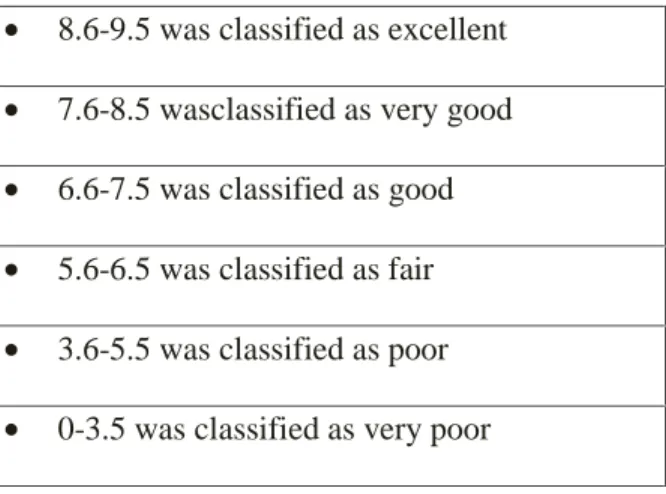
Table 3.4 Classifying the score of the students... 31
Table 4.1 The rate percentage of content ... 34
Table 4.2 The rate percentage of organization... 36
Table 4.3 Total mean score of students’ writing in content and organization ... 37
Table 4.4 T-test value of the students’ writingskill ... 38
xv
LIST OF GRAPHICS
Chart 4.1 Mean score of pre-test, post-test and improvement of content ... 35 Chart 4.2 Mean score of pre-test, post-test and improvement of organization ... 36 Chart 4.3 Total mean score of students’ writing descriptive text in content and
organization... 37 Chart 4.4 Comparison of t-test and t-table of students’ writing skill... 38
xvi
1 CHAPTER I INTRODUCTION
A. Background
English is one of the subject matter learned by students that are given any educational level. It covers four language skills that must be mastered if someone wants to be successful in studying English, they are listening, speaking, reading and writing.
Writing becomes an important skill to be mastered because our life cannot be separated from communication. As we know that communication can be in the forms of oral and written. The importance of writing is also supported by Harmer (1991) who states that there are four reasons for teaching writing. First, some students, instead of acquiring a language in oral way, benefit greatly from seeing the language that is written down. Second, writing process helps students to think and select words as well as sentences to construct good written text. The difference on students’ learning styles is the third reason to teach writing, by writing the students may have more time to think and produce a language in a slower way to reflect what they have learned. Finally, it is essential for students to know how to write letter, how to write descriptive text, how to write an essay, etc. Because in this research will discuss one of the important skill in English, so the researcher intend to clarify about writing.
To face the modern era, the students should be able to write using English, because after graduating from Senior High School or University they
can use the writing skill to applying for a job. Nowadays, there are so many companies which use English application letter as an instrument to requirement becomes the employee. By writing also business can easy to go on, a businessmen have to master writing skill, they can use business letter when they make a conversation with their partner in a long distances it needs a letter for communicating in literature forms. Writing descriptive text is needed in this case also, a good literatures forms to describe the product of some companies that is why teaching writing descriptive text is needed in this case.
Teaching writing is rather difficult. In conducting writing class, one of the important things which should be considered for the teachers is that they have to let their students to write. If the students have difficulties to write even to select the appropriate sentence to write, it will become the big problem for the teachers. The teacher uses one way method that is preaching method in their teaching English in can be seen when the researcher took Magang and P2K (Pemantapan Profesi Keguruan), the researcher saw the teaching and learning process in which the teacher explained the material to students and then gave them assignment. Students have no any motivation to learn it and sometimes they fell bored, they confused when they asked to start to write it is caused by grammatical in English. Descriptive text is one of the genres that must be taught in Junior High School and Senior High School. Descriptive text here is a lesson in Senior High School at first semester in academic year 2017/2018. Descriptive text is a text which explains the characteristics and
3
evidences of people, place and thing. By descriptive text, students can describe all things around them.
Because of the writing is important, but difficult to be learnt, so the teacher should choose the best method in teaching writing in order to make students easier to write descriptive text. Based on the phenomena in this research, the researcher use Discovery learning Methodin improving students’
writing descriptive text. Discovery Learning Method emphasize on the learning process, not in the result of the learning by Susan (2009). So in this case, students are as problem solver because the model is going to be students- centered.
Therefore, the researcher conducted pre experimental research under the title“The Use of Discovery Learning Method in Writing Descriptive Text at Eleventh Grade of SMA Negeri 8 Pinrang”.
B. Research Problems
Based on the background above, then the research problem can be seen as follows:
1. Does Discovery Learning Method improve the students’ writing descriptive text at eleventh grade of SMA Negeri 8 Pinrang?
2. Is there any significant difference in the students’ writing descriptive text by using Discovery Learning Method at eleventh grade of SMA Negeri 8 Pinrang?
C. Objectives of the Research The objectives of the study are:
1. To find out the use of Discovery Learning in improving the students’
writing descriptive text at eleventh grade of SMA Negeri 8 Pinrang.
2. To find out is there any significant difference in the students’ writing descriptive text at eleventh grade SMA Negeri 8 Pinrang.
D. Significances of the Research
1. For students, the finding of this research can be used to be more active to discover and investigate its own concepts are studied.
2. For teacher, the result of this study is directly intended to provide more understanding of the use of discovery learning in writing descriptive text.
3. For the researcher, the result of the study is expected to be used as reference for the researcher in conducting research, especially which is related to the use of discovery learning in writing descriptive text.
E. Scope of the Research
The scope of this research concentrate on the use of Discovery Learning Method in improving students’ writing skill focused on descriptive text at eleventh grade of SMA Negeri 8 Pinrang in academic year 2017/2018.
To write descriptive text this study will focus on content (unity) and organization (cohesion and coherence).
5 CHAPTER II
REVIEW OF RELATED LITERATURE A. Previous Research Findings
There are some researchers conducted in improving students’ descriptive text writing. Related to this research, the researcher chooses some literatures about previous research which are relevant to the improving students’
descriptive text writing.
1. The Use Discovery Learning in Improving Students’ Descriptive Text Writing by Mukharomah IAIN Walisongo Semarang. In her research she had a strategy to teach students’ writing skill by using discovery learning.
She conducted an action research as the methodology and the research conducted at VIIA grade students of MTs NU 08 Gemuh Kendal in academic year 2014, the result of the test showed that the students were successful and effective in writing descriptive text by using discovery learning.
2. Improving Students’ skill in Writing Descriptive Text through Clustering Technique by Mumtazati UIN Syarif Hidayatullah Jakarta academic year 2014 and pre experimental as the methodology of her research. The result of her research were successful and effective in writing descriptive text.
The similarities are both her research and the researcher concern in improving students’ writing skill in descriptive text and use pre experimental as the methodology.
3. The Effect of Using Discovery Learning Strategy in Teaching Grammatical Rules to First Year General Secondary Student on developing Their Achievement and Metacognitive Skill by Mahmoud, Professor of curriculum and teaching methods, Faculty of Education, Fayoum University, Egypt. The purpose of this research is to determine the effectiveness of discovery learning strategy in the teaching of grammatical rules in the development and skills beyond the knowledge of students in the first grade secondary. The result of this research is Discovery learning strategy succeeded in teaching grammatical rules in the development of skills beyond the knowledge of students in the first grade secondary school year, which is reflected in the level of the students in the test scores.
4. Improving Students’ Writing Organization of Descriptive Text Through The Use of Teams Games Tournament by Nurafiyani, IAIN Walisongo Semarang. The purpose of the research is to know how much the improvement of students’ writing organization of descriptive text after being taught through TGT (Team Games Tournament). She used an Action Research method. Data was collected through documentation, observation, and test. Her research built the use of TGT to improve students’ writing organization of descriptive text. The result of this research showed the improvement of the students’ability in writing descriptive text.
5. Thesis under the title The Effectiveness of Using Discovery Learning Method in Teaching Writing Skill Viewed from the Students’ Creativity by Prawerti, Universitas Sebelas Maret Surakarta. In her research, She had a
7
strategy to teach students’ writing by using discovery learning and conducted an pre experimental research as the methodology of her research. The result of the test showed that the students were successful an effective in writing descriptive text by using discovery learning. The similarities are both her research and the researcher concern in improving students’ writing skill in descriptive textby using discovery learning.
B. General Concept of Writing
Writing as one of the four skills of listening, speaking, reading and writing has always formed part of the syllabus in the teaching of English.
Writing is the way to express ideas in written form using letters, words, art or media and it requires mental process in order to express the ideas. Harmer (1991) states that there are four reasons for teaching writing. First, some students, instead of acquiring a language in oral way, benefit greatly from seeing the language that is written down, writing reinforces the grammatical structures and vocabulary that students have learned. Second, writing process helps students to think and select words as well as sentences to construct good written text. The difference on students’ learning styles is the third reason to teach writing. Not all people can deliver what they think orally and quickly and the last is it is essential for students to know how to write letter, how to write descriptive text, how to write an essay, etc. Students would achieve the writing skill after they understood and capable to write but many students are lazy to start to write. It will make students to be pessimist in writing, because they do not know at all about the grammar. By using discovery learning, it will help
students to write without any worry to begin it, because they can write step by step, it will reduce students’ difficulty. Discovery learning does not emphasize in the result, but the process of students’ learning, especially to write descriptive text in this case.
1. Writing Purpose
The first thing that teacher do before teaching writing is be sure that students have some writing aim. Before students write, they usually have aims in mind and construct their writing with a view to achieving that purpose. According to Jeremy, there are two purpose in writing. The first, real purpose is precisely the ones that teacher can predict. Students have to write formal and semi-formal letters of the same type. Similarly, teacher might well get students to take at the language of e-mail and have them practice writing their own, or get them to write a report of a process or situation. Second, invented purposes are those which, however engaging, are unlikely to be directly relevant to students’ futureneeds. Writer adds that the purpose of writing is to make teacher more creative to teach writing, so teacher can improve students’ writing based on the students’ needs.
2. Writing Process a. Prewriting
Before starting to write, writer try and decide what it is he/she is going to say. This is the name of prewriting. When planning, writers have to think about three main issues. In the first place they have to consider the purpose of their writing since this will influence (among
9
other things) not only the type of text they wish to produce but also the language they use and information they choose to include. Secondly, experienced writers think of the audience they are writing for. Thirdly, writers have to consider the content structure of the piece-that is, how best to sequence the fact, ideas or argument which they have decided to include.
b. Drafting
Some students will fly through the planning stage of their writing, giving it the minimum required effort and inserting ideas on the fly as they draft. Here, the process of drafting:
1) Drafting need not be perfect writing
Many students will focus on the fact that their draft doesn‘t sound published as it flows off their pen. They know that words are misspelled, certain things could have been better said and maybe the punctuation is sketchy at best and they won‘t be able to continue until they fix the problem. While some drafters may simply be perfectionists, the majority of writers fear exposing a perceived lack of writing ability. In this stage, let the students to give their word even though it is wrong, but as many as they give as many as ideas they will get.
2) Drafting is Cyclical
A pre-write is a valuable road map, but if students hit a traffic jam along the way, encourage them to be flexible in determining an alternate route.
3) The Teacher’s role while Playing
As students are drafting, teacher will be giving individual and small group help as needed. However, be wary of distracting students in this step. Give encouragement but not at the expense of breaking a student‘s concentration. As teachers circulate, also ask students if they would mind sharing interesting parts of their draft with the class toward the end of the period.
c. Revising
Revising is often neglected in the writing process. Students often feel that they have already written the paper, and they see any extra work, such as revising, as just that extra work. But in revising lies the greatest potential for learning. While revising, students learn techniques to make their writing better techniques they can apply the next time they draft.
Students will see before and after versions, by comparing the two they will demonstrate to themselves the specific elements that make for a better piece of writing.
11
d. Proofreading/ Editing
Editing as part of the writing process should first be done by the author and then again by a peer or adult, using the appropriate editing marks. The students check their work to make sure that their grammar or punctuation is correct.
e. Publishing
After all of the process done, the last step is publish their work into mass, or submit it to their teacher. The neatness and presentation of a piece of writing will help ensure that readers take it seriously. Below are ideas for publishing student work with purpose:
1) Publish in the school 2) Create a class magazine 3) Submit to the local newspaper C. Descriptive Text
1. Definition of Descriptive Text
Descriptive text is a text which explains the characteristics and evidences of people, place and thing. The genre of describing is one of the fundamental functions of any language system and one of the first skills emergent language users learn to control. Description enables the categorization or classification of an almost infinite range of experiences, observations and interactions into a system that orders them for immediate and future reference, and allows teacher to know them either objectively or subjectively, depending on the learning area or intent of the
writer. Describing is also a central feature of narrative texts providing the means for developing characterization, sense of place and key themes.
2. Purpose of Descriptive Text
Every writing form has purpose, descriptive text has own purpose as well. According to Andrew and James the purpose of descriptive text is to present a measured and verified. Most objective description in descriptive text are aimed at relatively narrow audiences and people who will design. According to Dietsch there are three general purposes of descriptive text: First to create imagery, a mood or and aura of place.
Second to stimulate understanding and convince. Third to urge the listener to action. It means that the purpose of descriptive text is to guide the emotional responses of readers by describing details and imagine within story that readers read.
3. Structure of Formal Description a. Classification
Language enable classification of the concrete world of experience through its ability to apply names to things, thus the naming process is a way of taxonomsing and ordering things into common sense (everyday) or technically determined categories.
b. Personal Description
Personal descriptions are not usually as formal in their organization as technical description. A young writer‘s description of her toy, for example, might classify it as a particular of toy.
13
D. Discovery Learning Method
One of the cognitive instructional model is discovery learning from Jerome Bruner. He regards that discovery learning agree with searching knowledge actively by human being, and automatically gives the best result.
Jerome Bruner is a Psychologist from Harvard. He and his friend state that discovery learning is important, they state: Discovery learning is a learning model that emphasizes the importance of helping students to understand the structure of the key ideas or discipline, the need for active involvement of students in the learning process, and the belief that true learning occurs through personal discovery (personal discovery). The writer adds that, the best result here should not force students to get the best mark in the end of teaching learning process. The students are given chance by the teacher to try solves the problem by themselves that they are facing. It means that learning output is independently.
According to Murphy, Malloy, and O’Brien (2010), Discovery learning is a learner centered mode of teaching most widely discussed by John Dewey and Jerome Bruner. In discovery learning students become active participants in learning by exploring concepts and answering their own questions through testing and experience. Discovery learning is a method that encourages students to arrive at a conclusion based upon their own activities and observations. Inclusion of activities based on discovery learning in science teaching in Turkey is important for meaningful and lifelong learning. The activities in science teaching raise the curiosity of students and drive them to
inquire their priorities and perceive the natural phenomena from different aspects. Such activities help to correct the conceptual errors of students.
Discovery learning model emphasize the important of structure comprehend or the important ideas to a science discipline, through involvement of students’
activity in teaching learning process. Discovery learning model is a model to improve the way of the active students’ learning by discovering and investigating themselves, so the result that will get is permanent and memorable in their mind, it is unforgettable to students. By using discovery learning, students can also think analysis and try to solve their problem by themselves.
When students are asked to write, they got stress and worried, because of the grammatical rule in English uses in writing. Here, the writer use discovery learning is to reduce students’ worry about the grammatical rule.
The students would write without any grammatical rule as usual at the first time, but they would face the fact thing that must be assumed to be a thing that must be written. People who use self discovery in learning turn out to be more self confident. Discovery is a way from the unknown to the known by the learners themselves. The active participation of the learner in the learning process is called discovery learning. In discovery learning, students construct knowledge based on new information and data collected by them in an explorative learning environment.
Discovery learning occurs whenever the learner is not provided with the target information or conceptual understanding and must find it independently
15
and with only the provided materials. Within discovery learning methods, there is an opportunity to provide the learners with intensive, conversely, minimal guidance, and both types can take many forms (e.g., manuals, simulations, feedback, example problems).
Discovery Learning can be called as an active learning. Here, strategy for active learning has a purpose to make independent and creative growing in studying, so that students can make innovations. Learning aim is hope to make students enable to understand a concept through their discovery by doing experiment. For this, it only can be achieved by using strategy in grouping to make a report as well as communication.Mallinson suggest that ― If the main goal of science program is to get children to understand, remember, and apply science concept, there‘s probably no more powerful tool than having writing science. Research indicate that writing about science improves not only science vocabulary, but also performance in reading and thinking in the discipline.
1. The Benefits of Discovery Learning Method
According to Marzano (1992), the benefits of discovery learning are as follows:
a. Students can participate actively in teaching learning, b. Developing and planting inquiry in the students.
c. Supporting students’problem solving ability.
d. Giving interaction field in each-students and students teacher, so that students can use language well.
e. The material which is learnt can achieve the high level students’
ability. It is also more unforgettable because the students are involved directly in the discovery process.
f. Students learn how to learn.
g. Learning appreciate themselves.
h. Motivating themselves and it is easier to transfer.
i. Knowledge will be permanent and remember able.
j. The result of discovery learning has more transfer effect than other result.
k. Developing students’ intellectual activity and students‘ ability to think free.
l. Training students’cognitive to discover and solve the problem without people‘s helping.
2. The Aims of Discovery Learning Method
Bell (1978) in Praweti (2014) states that there are many specific aims in discovery learning, as follow:
a. Students have a chance to involve actively in teaching learning.
b. Students learn to discover rule in concrete as well as abstract situation, also students extrapolate information that have given.
c. Students learn to formulate answer question strategy that not confused and use answer question to obtain information.
d. Students form the way of working together effectively, giving information each other, and listening and using people‘s ideas.
17
e. Students’ concept skills and principles that have been learnt are meaner.
f. Students’skill in discovery learning is easier to transfer in new activity and to apply in new learning situation.
3. Attributes of Discovery Learning Method
Bicknell-Holmes and Hoffman (2000) describe the three main attributes of discovery learning as 1) exploring and problem solving to create, integrate, and generalize knowledge, 2) student driven, interest- based activities in which the student determines the sequence and frequency, and 3) activities to encourage integration of new knowledge into the learner’s existing knowledge base.
The first attribute of discovery learning is a very important one.
Through exploring and problem solving, students take on an active role to create, integrate and generalize knowledge. Instead of engaging in passively accepting information through lecture or drill and practice, students establish broader applications for skills through activities that encourage risk-taking, problem solving, and an examination of unique experiences. In this attribute, students rather than the teacher drive the learning. Expression of this attribute of discovery learning essentially changes the roles of students and teachers and is a radical change difficult for many teachers to accept.
The second attribute of discovery learning is that it encourages students to learn at their own pace. Through discovery learning, some
degree of flexibility in sequencing and frequency with learning activities can be achieved. Learning is not a static progression of lessons and activities. This attribute contributes greatly to student motivation and ownership of their learning.
The third major attribute of discovery learning is that it is based on the principle of using existing knowledge as a basis to build new knowledge. Scenarios with which the students are familiar allow the students to build on their existing knowledge by extending what they already know to invent new ideas.
4. The Principles of Discovery Learning Method
According to Brown (1978), the principles of discovery learning are as follows:
a. In discovery learning, students are active. Learning is not defined as simply absorbing what is being said or read, but actively seeking new knowledge. Students are engaged in hands-on activities that are real problems needing solutions. The students have a purpose for finding answers and learning more.
b. The focus shifts from the end product, learning content, to the process, how the content is learned. The focus in discovery learning is learning how to analyze and interpret information to understand what is being learned rather than just giving the correct answer from rote memorization. Process-oriented learning can be applied to many different topics instead of producing one correct answer to match one
19
question that is typically found in content oriented learning. Discovery learning pushes students to a deeper level of understanding. The emphasis is placed on a mastery and application of overarching skills.
c. Failure in discovery learning is seen as a positive circumstance.
Discovery learning emphasizes the popular lesson learned from Thomas Edison. Thomas Edison is said to have tried 1,200 designs for light bulbs before finding one that worked. Discovery learning does not stress getting the right answer. Cognitive psychologists have shown that failure is central to learning. The focus is learning and just as much learning can be done through failure as success. In fact, if a student does not fail while learning, he or she probably has not learned something new.
d. An essential part of discovery learning is the opportunity for feedback in the learning process Student learning is enhanced, deepened, and made more permanent by discussion of the topic with other learners.
Without the opportunity for feedback, learning is left incomplete.
Instead of students learning in isolation, as is typical in the traditional classroom where silence is expected, students are encouraged to discuss their ideas to deepen their understanding.
e. Incorporating all of these differences, discovery learning provides for deeper learning opportunities. Learners internalize concepts when they go through a natural progression to understand them. Discovery learning is a natural part of human beings. People are born with
curiosities and needs that drive them to teach. Infants learn to talk by discovery. They listen to others around them talk, mimic sounds, and try putting together the pieces of language they have discovered.
5. Procedure of Discovery Learning Method
According to Mendikbud (2013), there are several procedures of Discovery Learning. In Discovery Learning, teacher should must give a change to students to be a problem solver, mathematician and historian.
Lesson material is not given in the beginning of teaching learning but students should do some activities collect information, comparing, category, analyzing, integrating, reorganizing material as well as making conclusions.
a. Stimulation
First of all, in this stage students are hoped on thing which makes confusing, then it does not give generalization, in order there is desirability to investigate by themselves. Besides, teacher can begin the activity by proposing questions, read a book, etc. That will give direction on the starting of problem solving. The function of this stage is to Problem statement Data collection Verification Data processing Generalization Students Stimulation supply learning interaction condition which can develop and help students in exploring material.
21
b. Problem Statement
After that, teacher gives a change to students to identify as many as possible the agendas of problem that related with the material, then one of them is chosen and arranged in form of hypothesis.
c. Data Collection
When the exploring is going, teacher also gives a change to students to collect the information as many as possible. Students are given a change to collect many relevant information, read literature, observe object, interview, and do experiment.
d. Data Processing
Data processing is activity of process data and information that has been gotten from students through interviewing, observing, etc.
Then interpreted. All of the information from the result of reading, interview, observation etc. All of them are processed, classified, tabulated, even if it needs, calculated with particular way as well as interpreted in believed level.
e. Verification
In this stage, all of students do investigate accurately to prove whether hypothesis is right or no that is decided with alternative discovery, direct coupled with data processing result. According to Bruner, verification has purpose in order learning process would run well and creative if teacher gave a change to students to discover a
concept, theory, rule or comprehension through the example of their daily activity.
f. Generalization
Generalization is process of draw the conclusion that can be common principle and valid for all events or same problems, by attending verification result. Based on the verification result, so it is formulated principles of generalization.
E. Teaching Descriptive text by Using Discovery Learning Method
Teaching writing in the first learning did not need to give them a difficult theme for writing, they are just need to give an abstract thing like animal or people who they like for their assignment to write. Teaching writing in the first learning did not need to use grammatical structure, just write as they can as for their improvement. It would be suitable for second grade as subject in this research. Learning happens by discovery, which prioritizes reflection, thinking, experimenting, and exploring. That is why People who use self discovery in learning turn out to be more self confident. Here, discovery learning is important to students’ confident in their writing, so that students did not need afraid to start it because of less grammatical.
From the explanation above, it can be concluded that Discovery Learning is needed in teaching writing, especially in writing descriptive text, because Discovery Learning is one of the learning model that emphasize in contextual teaching, so that students can learn subject deeply and actively.
23
F. Conceptual Framework
Figure 2.1 Conceptual Framework
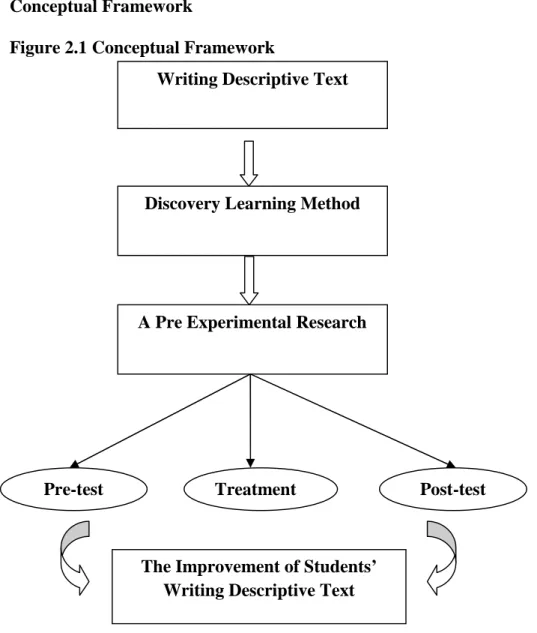
In other avoid the misunderstanding, the writer use conceptual framework as follows:
1. Input : It refers to give material of writing descriptive text 2. Process : It refers to use Discovery Learning in teaching writing.
3. Output :It refers to the students’ writing descriptive text after Discovery Learning is used.
Writing Descriptive Text
Discovery Learning Method
A Pre Experimental Research
Pre-test Treatment Post-test
The Improvement of Students’
Writing Descriptive Text
G. Hypothesis
1. Null Hypothesis ( )
There is no significant improvement on students’ writing descriptive text after being taught by using Discovery Learning Method.
2. Alternative Hypothesis ( )
There is significant improvement on students’ writing descriptive text after being taught by using Discovery Learning Method.
25 CHAPTER III RESEARCH METHOD
A. Research Design
A Pre Experimental method was chosen in conducting this research, it investigated the effectiveness of using discovery learning method in improving students’ writing descriptive text.The design can be seen in the following chart:
One-Group Pretest–Posttest Design
Pretest Treatment Posttest
O1 X O2
(Sugiyono:2016) Where :
O1 :Pretest
X : Treatment
O2 :Posttest 1. Pre test (O1)
The pre test was given before doing treatment it was held to find out the prior ability of students in writing descriptive text. In the pre test researcher gave students writing test about descriptive text, the researcher use essay test.
2. Treatment (X)
After giving the pre-test the researcher gave treatment. It was in the form of teaching and learning process by using discovery learning method. In discovery learning method, the researcher gave changed to students to be a problem solver and historian. Lesson material was not given in the beginning of teaching learning. The steps as follows:
a. The researcher gave stimulation by beginning the activity by proposing questions to the students (direction to students to be a problem solver) . b. After that, the researcher gave changed to students to identified as many as
possible the agendas of problem that related with the material.
c. The researcher gave changed to students to collected information as many as possible.
d. The data was processed and information that had been gotten from the students through interviewing and observing.
e. After that all of students done investigated accurately to prove whether hypothesis was right or not that was decided with alternative discovery.
f. The researcher asked the students to made conclusion.
27
3. Post test (O2)
In the post test, the researcher gave writing test to the students to find out the students’ achievement of writing descriptive text based on the method after treatment was given, students asked to write descriptive text about their idol.
B. Research Variables and indicators
1. The independent variable was the use of Discovery Learning Method.
2. The dependent variablewas students’ writing skill in descriptive textin term content and organization. With the indicators are :
a. The indicator of content is unity.
b. The indicator of organization is cohesion and coherence.
C. Population and Sample 1. Population
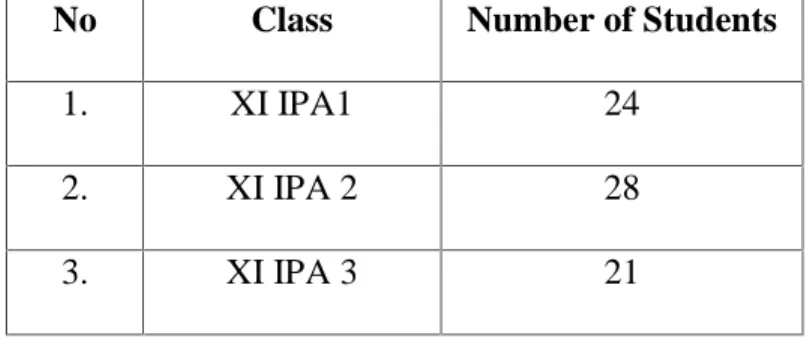
The population of this research is the eleventh grade students of SMA Negeri 8 Pinrang in academic year 2017/2018. It consists of 7 classes.
Obviously, described by the following table:
Table 3.1 Population of eleventh grade of SMA Negeri 8 Pinrang No Class Number of Students
1. XI IPA1 24
2. XI IPA 2 28
3. XI IPA 3 21
4. XI IPA 4 36
5. XI IPS 1 30
6. XI IPS 2 29
7. XI IPS 3 35
Total 203
(Source: SMA Negeri 8 Pinrang) 2. Sample
This research used purposive sampling technique. In this research the researcher chose one class to represent all of the population. The researcher chose class XI IPA 1 consisted of 24 students SMA Negeri 8 Pinrang in academic year 2017/1018 as the sample based on the reason :
a. The researcher considers class XI IPA 1 has many passive students and low in writing descriptive text based on the observation that been done by the researcher.
b. The researcher considers class XI IPA 1 has a few students which makes the researcher is easier to collect the data.
D. Research Instrument
In this research, the researcher used writing test as the instrument, before and after treatment. There were two tests in this research pre test and post test.
Pre test to find out the students’ prior knowledge while post test to find out the students’ achievement of writing descriptive text based on the method which has
29
given. In the pre test researcher gave students writing test about descriptive text, the researcher use essay test. The researcher gave writing test also in the post test, students asked to write descriptive text about their idol.
E. Procedure of Data Collection
In collecting data, the researcher used pre-test before treatment and last is post-test. The researcher collected the data by giving a test to students. The test technique is one of the data collecting techniques in a quantitative research. In collecting the data, the researcher used the following procedures:
1. The researcher gave pre-test to students.
2. The researcher applies the treatment for six times by discovery learning method.
3. After giving treatment, the researcher gave post-test to the students.
4. The researcher used writing test in the pre-test about descriptive text, the researcher used essay test.
5. The researcher used writing test also as the post-test, the researcher asked students to wrote descriptive text about their idol.
6. The teacher analyzed and scores the data by using the following criteria.
7. Scoring and classifying the students’ skill the following criteria.
a. Content
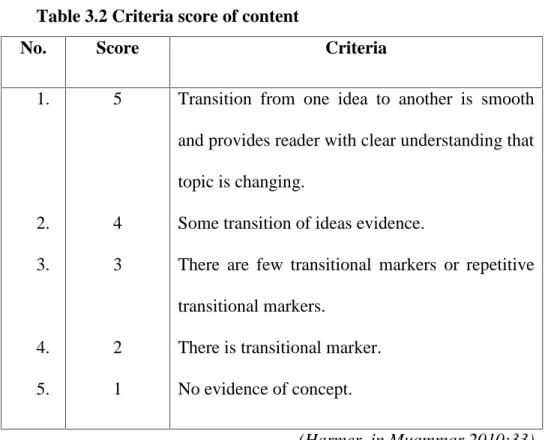
To evaluate the score of the content, the researcher used the following criteria
1) Unity
Table 3.2 Criteria score of content
No. Score Criteria
1.
2.
3.
4.
5.
5
4 3
2 1
Transition from one idea to another is smooth and provides reader with clear understanding that topic is changing.
Some transition of ideas evidence.
There are few transitional markers or repetitive transitional markers.
There is transitional marker.
No evidence of concept.
(Harmer, in Muammar 2010:33)
31
b. Organization
1) Cohesion and Coherence
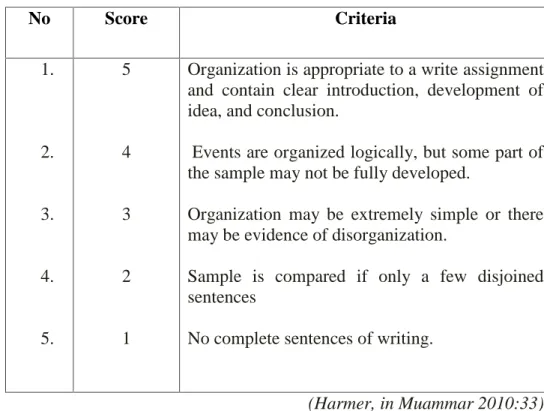
Table 3.3 Criteria score of Organization
No Score Criteria
1.
2.
3.
4.
5.
5
4 3
2 1
Organization is appropriate to a write assignment and contain clear introduction, development of idea, and conclusion.
Events are organized logically, but some part of the sample may not be fully developed.
Organization may be extremely simple or there may be evidence of disorganization.
Sample is compared if only a few disjoined sentences
No complete sentences of writing.
(Harmer, in Muammar 2010:33)
c. Classifying the score of the students into the following measurement scale
Table 3.4 Classifying the score of the students
8.6-9.5 was classified as excellent
7.6-8.5 wasclassified as very good
6.6-7.5 was classified as good
5.6-6.5 was classified as fair
3.6-5.5 was classified as poor
0-3.5 was classified as very poor
(Depdikbud, 1985:6)
F. Technique of Data Analysis
In this research, the data obtained from the test is analyzed by using the procedures as follows:
1. Calculating the mean score of the students’ achievement by using this formula :
X =∑ , Where:
X = the mean score
∑X = the sum of all score
N = the total number of students
(Gay, 2006: 298 in Hasyim:2010)
2. Finding the improvement’s percentage of students’achievement in writing after using discovery learning method. The formula as follows:
P = x 100%
Where :
P = The percentage of thestudents’ improvement X1 = The mean score of pre-test
X2 = The mean score of post-test
33
3. Finding out the significant difference between the pre-test and post-test by calculating the value of the test using the following formula:
t = D
) 1 (
2 2
N N
N D D
Where:
t = text of significance
D = the mean score
D = the sum of differencesN =the total number of the students
(Gay, 1981: 331)
34
This chapter discusses about the findings and discussion. The findings describe about the result of the data collected from the test. And discussion explains and interprets the findings. The result of the research will be described in the following description:
A. Findings
The results of the data findings found that teaching writing in descriptive text through Discovery Learning Method can improve the students’in writing skill at eleventh grade of SMA Negeri 8 Pinrang.
1. The Improvementof Students’ Writing Descriptive Text in Content The use of Discovery Learning Method effective to improve the students’ writingskill in descriptive text focused in content. It can be seen from the table below in which it describes the students’ score ofcontent.
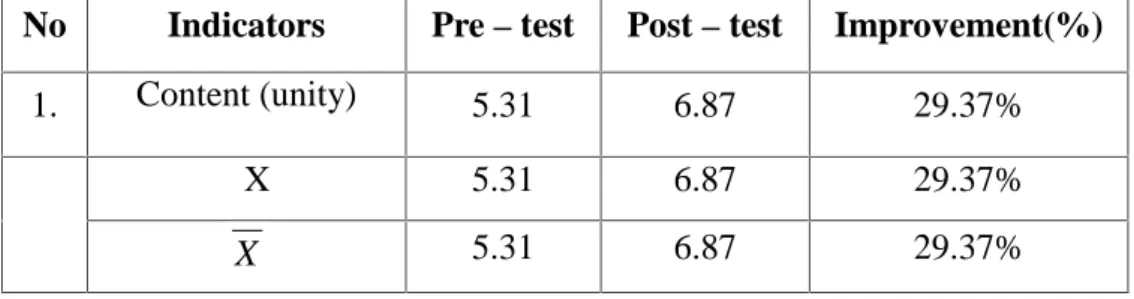
Table 4.1 The rate percentage of Content
No Indicators Pre–test Post–test Improvement(%)
1. Content (unity) 5.31 6.87 29.37%
ΣX 5.31 6.87 29.37%
5.31 6.87 29.37%
X
35
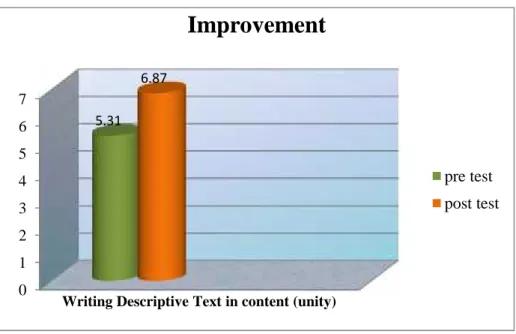
Table above indicates that the maen score of the content in term unity has increased from pre-test to post-test, where the score of the content has increased 29.37 % from the mean score 5.31 becomes 6.87 in post test. The improvement of the students’ writing skill could be described as follows chart:
Chart 4.1 Mean score of pre-test, post-test and improvement of content
2. The Improvement of the Students’ Writing Descriptive Text in Organization
The improvement of the students’ writing skill in descriptive text which focused on organization at eleventh grade of SMA Negeri 8 Pinrang as result of the students’ assessment of Pre-test and Post-test can be seen clearly in the following table:
0 1 2 3 4 5 6 7
5.31 6.87
Writing Descriptive Text in content (unity)
Improvement
pre test post test
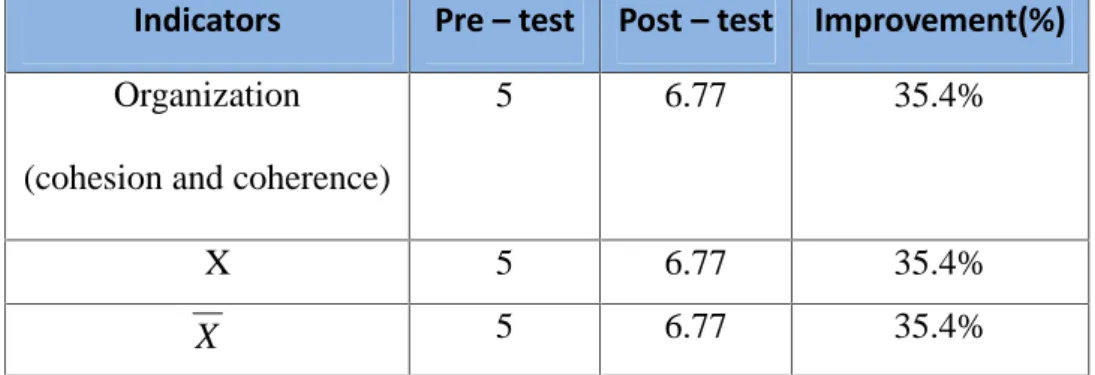
Table 4.2 The rate percentage of Organization
Indicators Pre – test Post – test Improvement(%) Organization
(cohesion and coherence)
5 6.77 35.4%
ΣX 5 6.77 35.4%
5 6.77 35.4%
The table indiacates that there is increase of the students in writing skill descriptive text in term organization from pre-test to post-test. The score of organization has increased (35.4%) from the mean 5 in pre-test and becomes 6.77 in post test. It is more clearly shown the increasing of the students, following chart is presented:
Chart 4.2 Mean score of pre-test, post-test and improvement of organization
X
0 2 4 6
8 5 6.77
Organization (cohesion and coherence)
IMPROVEMENT
Pre test post test
37
After being calculated the students’ result in content and organization in writing descriptive text above, reseracher calculated the mean score of pretest and post-test of content and organization, presented in the following table:
Table 4.3 Total mean score of students’ writing descriptive text in content and organization
Variable
Mean Score Pre- test Post Test Total mean score of students’writing
descriptive text in content and organization
123.75 162.00
N 24 24
X 5.15 6.75
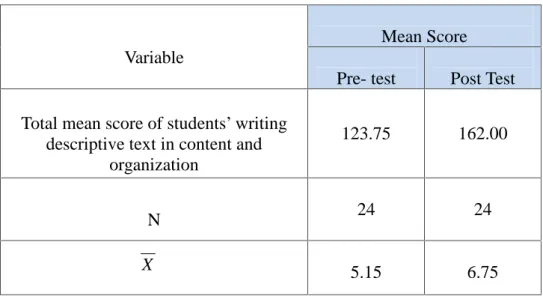
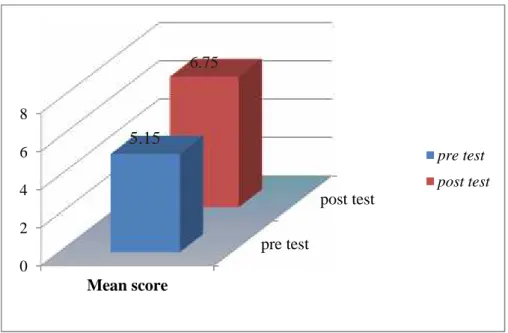
The data on the table above shows that there’s an increase of students’ score from pre-test to post post-test. In pre-test, the mean score is 5.15 but after the implementation of Discovery Learning Method, it becomes 6.75. it is more clearly shown in the chart:
Chart 4.3 Total mean score of students’ writing descriptive text in content and organization
3. Significance Testing
Analyzing t-test is used to find out the significant difference of the students’ result of pre-test and post-test. In order to know the level of significance 5% (0.05), degree of freedom df=N-1 (df is N - 1 = 24-1 = 23) it is found that the t-table value is 2.069 the result of the calculation is shown as follows:
Table 4.4: T-testvalue of the students’ writing skill
Variables t-test t-table
Writing Descriptive Text 7.31 2.069 pre test
post test
0 2 4 6 8
Mean score 5.15
6.75
pre test post test
39
The table above shows about the comparison between the students’
t-test and t-table to improve writing skill in descriptive text in term content and organization after using Discovery Learning Method . The value of the t-test is greater than t-table. The score variable of writing (7.31 > 2.093) Chart 4.4 Comparison of t-test and t-table of students’ writing skill
It can be concluded that there is significant difference between the results of the student writing skill before and after using Discovery Learning Method. This also means that null hypothesis (Ho): The use of Discovery Learning Method does not effective in improved the students’
writing descriptive text at eleventh grade of SMA Negeri 8 Pinrang is rejected and the alternative hypothesis (H1)The use of Discovery Learning Method does not effective in improved the students’ writing descriptive text at eleventh grade of SMA Negeri 8 Pinrang is accepted.
0 5 10
T-test
T-table 7.31
2.069
COMPARISON
B. Discussion
In this part, the result of findings would be explained clearly about students’ increase in writing descriptive text focused on content and organization. In findings, the data shows that the increase of students in writing descriptive text is significant after analysing t-test and t-table value.
1. The Students’ Increaseof Writing Descriptive Text in Content
The result of the data analysis through the writing test shows that the students’ writing decriptive text in term of the unity of text has increased. It is indicated by the students’ score in pre-test and post-test.
The mean score of the students in pre-test was 5.31. It is lower than the mean score of the students in post-test, it was 6.87. In pre test there were 3 (12.5%) out of students classified into very poor score, 13 (54.16%) out of them classified into poor score, 8 (33.33%) out of them classified into good score, none of them classified into very good and excellent score.
While in post test there were 5 (20.83%) out of them classified into poor score, 16 (66.66%) out of them classified into good score, 3 (12.5%) out of them classified into very good score, none of them classified into very poor, fair and excellent score.
2. The Students’ Increaseof Writing Descriptive Text in Organization The increase of students’ writing desriptive text which focused on organization (cohesion and coherence) has increased significantly. After the implementation of treatment in six meetings, students had been known write descriptive paragraph. In Discovery Learning Method, lesson
41
material is not given in the beginning of teaching learning but students must do some activities to collect the information, comparing, category, analyzing, integrating, reorganizing material as well as making conclutions.
The result of the data analysis through the writing test shows that the students’writing skill in descriptive text in term organization (cohesion and coherence) has increased. It is indicated by the students’ score in pre- test and post-test. The mean score of the students in pre-test was 5. It is lower than the mean score of the students in post-test, it was 6.77. In pre test there were 6 (25%) out of students classified into very poor score, 9 (37.5%) out of them classified into poor score, 2 (8.33%) out of them classified into fair score, 7 (29.16%) out of them classified into good score, none of them classified into very good and excellent score. While in post test there were 7 (29.16%) out of them classified into poor score, 14 (58.33%) out of them classified into good score, 3 (12.5%) out of them classified into very good score, none of them classified into very poor, fair and excellent score.
3. The Significant Difference of T-test and T-table
Through the result of pre-test and post-test, the result of t-test value of the level of the significant 5 % = 0.05, degree of the freedom (df) = 23 indicated that t-table value was 2.069 and t-test value was 7.31. Therefore, it can be concluded that statistically hypothesis of HIwas accepted and the statistically hypothesis of HO was rejected. It means that the using of
Discovery Learning Method in teaching writing descriptive text can improve the students’writing skill.
Discovery Learning Method was interesting and beneficial for the students who studied English as foreign language because can improve the students’ writing skills. It’s caused by the involvement of the students’
during the process. It also made English became joyful subject to be learnt.
From the discussion above, it could be concluded that the eleventh grade students of SMA Negeri 8 Pinrang in academic year 2017 / 2018 have good skills in writing after being taught through Discovery Learning Method especially in writing descriptive text.
43 CHAPTER V
CONCLUSION AND SUGGESTION
This chapter consists of two parts. The first part presents some conclusions based on the data analysis and findings in the previous chapter. The second part presents some suggestions based on the findings and conclusions of this research.
A. Conclutions
1. The students writing skill of the eleventh grade students of SMA Negeri 8 Pinrang in terms of content (unity) has increse after using Discovery Learning Method. It can be seen from the different score of pre test and post test. Where the score of post test was higher than the score of pre test. The students’ improvement of writing descriptive text focused in content (unity) was 29.37 %.
2. The students writing skill in term organization (cohesion and coherence) at the eleventh grade students of SMA Negeri 8 Pinrang has increse after using Discovery Learning Method. It can be seen from the different score of pre test and post test. Where the score of post test was higher than the score of pre test. The students’ improvement of writing descriptive text focused in organization (cohesion and coherence) was 35.4%.
3. Discovery Learning Method can improve writing skill at the eleventh grade students of SMA Negeri 8 Pinrang. It is proved by the significant difference from pre-test to post-test through analysing the t-test and t- table value, result of the t-test is higher than t-table (7.31 > 2.069).
B. Suggestions
After looking at the result of the research, the researcher would like to put forward the following suggestions.
1. Special for English teacher, Discovery Learning Method can be applied in improving the students’writing skill in descriptive text.
2. Discovery Learning Method is one of the method that can be considered in teaching in order to help the students’ writing skill in the classroom.
because it was effective to improve the students’ achievement.
3. For the next researcher, applying Discovery Learning Method in doing researching in the other variables of writing.
BIBLIOGRAPHY
Balım, Ali Gunay. 2009.The Effects of Discovery Learning on Students’ Success and Inquiry Learning Skill. Eurasian Journalof Educational Research.
Bicknell- Holmess, Hoffman, et al. 2000. Collaborative Learning Technique. San Fransisco: John Willey & Sons, Inc.
Brown, H. Douglas. 1978. Teaching by principles, Longman: San Francisco State University.
Cresswell, John., 2012. Educational Research. University of Nebraska-Lincon:
Person.
Dahar, RW.,1991.Teori-teori belajar.Jakarta: Erlangga.
Depdikbud, 1985. Petunjuk Pelaksanaan Proses Belajar Mengajar dan Petunjuk Pelaksanaan System Penilaian. Jakarta: Depdikbud.
Gholamian, Ali., 2013. Studying the Effect Guided Discovery Learning on Reinforcing the Creative Thinking of Sixth Grade Girl Students. Islamic Azad University Central Tehran Branch-Faculty of Psychology and Social Sciences, Department of Educational Sciences.
Gay, L.R, 2006.Educational Research; Competencies for Analysis and Applications.
Columbus: Charcks, E. Merril Publihing Co.
Harmer, Jeremy. 1991. The Practice of English Language Teaching. Newyork:
Longman.
Hasyim, Zulkarnain. 2010.Improving the Students’ Ability to Write Short Paragraph Using Guided Questions. Thesis FBS Universitas Negeri Makssar.
Kemendikbud., 2013. Model Pembelajaran Penemuan (Discovery Learning).Kemendikbud.
Mahmoud, Abdelrahman Kamel Abdelrahman. 2014. The Effect of Using Discovery Learning Strategy in Teaching Grammatical Rules to First Year General Secondary Student on developing Their Achievement and Metacognitive Skill”. International Journal of Innovation and Scientific Research, (Vol. 5, No. 2Juli/2014).
Mukharomah, Lailatul., 2014. The Use Discovery Learning in Improving Students’
Descriptive Text Writing.IAIN Walisongo Semarang.
Mumtazati, Rifqa., 2014. Improving Students Skill in Writing Descriptive Text through Clustering Technique.Universitas Negeri Syarif Hidayatullah.
Murphy, Theresa., Malloy, John., & O’Brien, Sean. 2010. Discovery Learning.
Retrieved from: http://smobrien.wikispaces.com/file/view/Discovery Learning.pptx, accessed on February 26th, 2013.
Nurfiyani, Septa., 2013. Improving Students’ Writing Organization of Descriptive Text Through The Use of Teams Games Tournament. IAIN Walisongo Semarang.
Prawerti, Candraning Ringgi., 2014. The Effectiveness of Using Discovery Learning Method in Teaching Writing Skill Viewed from the Students’ Creativity.
Universitas Sebelas Maret Surakarta.
Sugiyono., 2016.MetodePenelitianPendidikan (PendekatanKualitatif, Kuantitatifdan R&D).ALFABETA. Bandung.
Susan L. Champine, Shawn M Duffy, James R Perkins., 2009. Jerome S Bruner’s Discovery Learning Model as the Theoretical Basic of Light Bounces Lesson.
THE STUDENTS’WRITING SKILL IN DESCRIPTIVE TEXT IN PRE-TEST AND POST-TEST
1. Pre-Test
No Nama Content Organization ∑ X
1 Adelia Tahir 5 7.5 12.5 6.25
2 Alfauzan Anas A 7.5 5 12.5 6.25
3 Akmal Zhudy P 5 2.5 7.5 3.75
4 Astuti 5 2.5 7.5 3.75
5 Danaria 5 7.5 12.5 6.25
6 Elli Surianti 2.5 5 7.5 3.75
7 Fitrah Andi Pasinringi 7.5 7.5 15 7.5
8 Ismail 7.5 5 12.5 6.25
9 Kasmiati 5 5 10 5
10 Miftahurrizaq Amran 7.5 2.5 10 5
11 Muh Yusril Abidin 2.5 2.5 5 2.5
12 Nirmat 7.5 5 12.5 6.25
13 Nur Aulia Rahma S 5 7 12 6
14 Nurhikmah 7.5 6 13.5 6.75
15 Nur Husnul Khotima 7.5 5 12.5 6.25
16 Nursyam 5 3.5 8.5 4.25
17 Rabiyatuladawiyah 5 2.5 7.5 3.75
18 Reski 5 5 10 5
19 Sinar Satta 2.5 4.5 7 3.5
20 Sriwahyuni 5 6 11 6.25
21 Sunalti 5 7.5 12.5 6.25
22 Wahidah 2.5 5 7.5 3.75
23 Yuyun 5 5 10 5
24 Zulfa Angraeni 5 7.5 12.5 6.25
∑ 127.5 120 247.5 123.75
X 5.31 5 10.31 5.15
2. Post-Test
No Nama Content Organization ∑ X
1 Adelia Tahir 7 7.5 14.5 7.25
2 Alfauzan Anas A 8 7.5 15.5 7.75
3 Akmal Zhudy P 7 5 12 6
4 Astuti 7 7.5 14.5 7.25
5 Danaria 7.5 5 12.5 6.25
6 Elli Surianti 7 5 12 6
7 Fitrah Andi Pasinringi 8 7.5 15.5 7.75
8 Ismail 7.5 7.5 15 7.5
9 Kasmiati 7.5 5 12.5 6.25
10 Miftahurrizaq Amran 7.5 5 12.5 6.25
11 Muh Yusril Abidin 5 5 10 5
12 Nirmat 7.5 8 15.5 7.75
13 Nur Aulia Rahma S 5 7.5 12.5 6.25
14 Nurhikmah 8 8 16 8
15 Nur Husnul Khotima 7 7.5 14.5 7.25
16 Nursyam 7.5 7 14.5 7.25
17 Rabiyatuladawiyah 7 7.5 14.5 7.25
18 Reski 7.5 7.5 15 7.5
19 Sinar Satta 5 4.5 9.5 4.75
20 Sriwahyuni 5 7.5 12.5 6.25
21 Sunalti 7.5 7.5 14.5 7.25
22 Wahidah 5 7.5 10 5
23 Yuyun 7 7.5 14.5 7.25
24 Zulfa Angraeni 7.5 7.5 15 7.5
∑ 165 162.5 327.5 163.75
X 6.87 6.77 13.64 6.82