(Teleostei: Characiformes) throughout the Guianas
**by
Brian L. SidLauSkaS* (1, 2) & Richard P. VaRi (2)
AbstrAct. - Fifty-six species or approximately 20% of the Neotropical characiform superfamily anostomoidea (fami- lies anostomidae, Chilodontidae, Curimatidae and Prochilodontidae) occur in the freshwaters of French Guiana, Guyana, and Suriname although these regions span only approximately 6% of the native range of this morphologically and ecologi- cally diverse superfamily. as a result of the high diversity of anostomoids in the Guianas, the taxonomic and/or geographic boundaries of many species are poorly understood, particularly within the family anostomidae. This contribution unites results of prior taxonomic revisions with surveys of the holdings of the superfamily in seven major natural history collec- tions to provide distribution maps and keys to the identification of all anostomoid species known to occur in the Guianas.
These maps reveal six major areas of endemism: the Takutu and ireng rivers (Rio Branco drainage, amazon basin), the Barima and Waini rivers (Orinoco drainage), the Essequibo-Rupununi River system (including the demerara and Berbice rivers), a union of the Corantijn, Nickerie, Coppename, Saramacca and Suriname river drainages, the Marowijne/Maroni River system (including the Litani and Mana rivers), and the Oyapock-approuague River basins. Of these, the Essequibo- Rupununi system harbours the most exceptionally diverse assemblage of anostomoid species, likely as a result of faunal exchange between the Rio Branco and Essequibo River across the Rupununi portal.
rÉsUMÉ. - diversité et distribution des poissons anostomoides (Teleostei, Characiformes) dans les Guyanes.
Cinquante-six espèces, soit approximativement 20% des Characiformes de la superfamille des anostomidea (familles des anostomidae, Chilodontidae, Curimatidae et Prochilodontidae), fréquentent les eaux douces de la Guyane française, du Guyana et du Suriname bien que ces régions ne recouvrent qu’environ 6% de la distribution naturelle de cette superfamille morphologiquement et écologiquement très diverse. Étant donnée cette grande diversité des anostomoides guyanais, les limites taxonomiques et/ou géographiques de nombreuses espèces sont mal définies, particulièrement dans la famille des anostomidae. Ce travail combine les résultats de révisions taxonomiques antérieures à l’étude de sept collections majeures d’histoire naturelle afin de fournir des cartes de distribution et des clés d’identification de toutes les espèces d’anostomoi- des connues des Guyanes. Ces cartes révèlent six aires d’endémisme principales : les rivières Takutu et ireng (bassin du Rio Branco, système de l’amazone), Barima et Waini (bassin de l’Orénoque), le système Essequibo-Rupununi (incluant le Demerara et le Berbice), les bassins des fleuves Corantijn, Nickerie, Coppename, Saramacca et Suriname, le système Marowijne/Maroni (incluant la Litani et la Mana), et les bassins de l’Oyapock et de l’approuague. Parmi ces six aires d’en- démisme, le système Essequibo-Rupununi héberge un ensemble d’espèces exceptionnellement diversifié, résultant vrai- semblablement d’échanges d’ichtyofaune entre le Rio Branco et l’Essequibo via le portail du Rupununi.
key words. - Biogeography - dichotomous key - Georeferencing - South america - Synthesis - Taxonomy.
** Supporting files are available online: http://www.mnhn.fr/sfi/cybium/numeros/361/sommaire361.html
(1) Oregon State University, Department of Fisheries and Wildlife, 104 Nash Hall, Corvallis, OR 97331-3803, USA.
(2) Department of Vertebrate Zoology, MRC-159, National Museum of Natural History, PO Box 37012, Smithsonian Institution, Washington, DC 20013-7012, USA. [[email protected]]
* Corresponding author [[email protected]]
The Neotropical characiform superfamily anostomoidea contains approximately 275 recognized species (Reis et al., 2003, plus species described subsequently). These ecologi- cally and morphologically diverse species range from the often large-sized and economically important detritivores of the families Prochilodontidae and Curimatidae that play crit- ical roles in nutrient cycling in many river systems (Taylor et al., 2006), to the omnivorous and herbivorous headstanders of the anostomidae and Chilodontidae. Though anostomoids clearly form a natural group (Vari, 1983) and are among the best-studied members of the Characiformes, their alpha, beta and gamma diversity remains incompletely understood.
descriptions of new anostomoid species still appear regu-
larly (Britski and Garavello, 2005; Vari and Chang, 2006;
Scharcansky and Lucena, 2007; Sidlauskas et al., 2007;
Britski and Birindelli, 2008; Santos and Zuanon, 2008; Bir- indelli and Britski, 2009; Vari et al., 2012). The taxonomic limits and geographic distributions of some long-recognized species frequently remain hazy, particularly within the fam- ily anostomidae, which has never been the subject of a com- prehensive revision.
The north-flowing drainages of the portions of the Guiana Shield in French Guiana, Guyana and Suriname (hereafter the Guianas) along with the Takutu and ireng rivers which form the northeastern portion of the upper Rio Branco basin in southern Guyana (Fig. 1) comprise a
major area of diversity and endemism for many groups of Neotropical freshwater fishes, including anostomoids. The discovery of the exceptional biodiversity of anostomoids in the Guianas commenced with the earliest surveys of the region in the 18th century. Species now recognized as Anos- tomus anostomus (Linnaeus, 1758), Leporinus fasciatus (Bloch, 1794) and L. friderici (Bloch, 1794) were described from localities likely or definitely in Suriname. A continu- ing stream of descriptions of anostomoid species from the Guianas by Müller and Troschel, Cuvier and Valenciennes, Steindachner, Eigenmann, Fowler and more recent authors ensued. Continuing surveys in the region regularly reveal new species (Sidlauskas et al., 2011; Vari et al., 2012) although longstanding taxonomic confusion stemming from the imprecise nature of many earlier descriptions hampers formal systematic or faunistic work. Ready identification and understanding of the biodiversity of anostomoids, most notably anostomids, in the Guianas is impeded by myriad factors including brief original species descriptions, com- plex or lost type series, a proliferation of potential junior synonyms discriminated on less than trenchant differences, and indefinite geographic distributions. Further complica- tions include the historic application of some of the earliest species names to complexes of externally similar forms with distributions spanning huge swaths of South america (e.g., Leporinus friderici), the co-occurrence of many superficially similar species, and a confounding tendency of species in the anostomidae to undergo major ontogenetic shifts in colour pattern and sometimes mouth position (Santos, 1980; Sid- lauskas et al., 2007; Birindelli and Britski, 2009).
This contribution aims to ameliorate the confusion sur-
rounding the taxonomy and biogeography of anostomoids in the Guianas by synthesizing the extant systematic literature with new surveys, reidentifications and georeferencing of specimens from this region in several natural history collec- tions. Our effort represents an attempt to:
1) sort the anostomoid diversity in the Guianas into dis- tinct morphospecies;
2) illustrate the geographic range of each morphospe- cies;
3) provide dichotomous keys specific to the anostomoid morphospecies in the Guianas; and
4) determine the extent to which the various river sys- tems of the Guianas harbour endemic faunas.
in the Chilodontidae, Curimatidae, and Prochilodontidae, these efforts derive from comprehensive revisionary studies (Vari, 1982; Isbrücker and Nijssen, 1988; Vari, 1989a; Vari, 1989b; Vari, 1989c; Vari, 1989d; Vari, 1991; Vari, 1992a;
Vari, 1992b; Vari et al., 1995; Castro and Vari, 2004) and subsequent publications. Neither an encompassing revision nor modern comprehensive keys for the anostomidae exist.
For the purposes of this contribution, individuals within the anostomidae were sorted into recognizable morphospecies and then identified through reference to the primary taxo- nomic literature, including original species descriptions and generic and regional taxonomic revisions. This contribution does not constitute a formal revision of all members of the anostomidae across the Guianas, which for certain species- complexes would require the critical analysis of extensive series of samples originating from vast portions of tropical South america. The results, nonetheless, highlight many range extensions, identify several likely junior synonyms Figure 1. - Major river systems of the
Guianas. Stream network prepared by the Nature Conservancy from a digital elevation model.
and reveal the existence of morphoclines or multiple recog- nizable entities within certain nominal species. We discuss these taxonomic issues herein, but leave the formal syno- nymization of described forms and description of potentially new species to future revisionary efforts.
MAteriAls And Methods
We examined and compiled information on 1,272 lots representing nearly-complete anostomoid holdings of four natural history collections with major holdings from Guy- ana and Suriname (american Museum of Natural History, aMNH; academy of Natural Sciences of Philadelphia, aNSP; auburn university ichthyology Collection, auM;
and the National Museum of Natural History, uSNM) as well as partial holdings from three institutions (Field Muse- um, FMNH; Muséum d’Histoire Naturelle de la Ville de Genève, MHNG; and Nationaal Natuurhistorisch Museum Naturalis, RMNH). a spreadsheet containing museum cata- logue numbers, vouchered identifications and geographic coordinates for these 1,272 lots is available as an online supplement. individuals of the Chilodontidae, Curimatidae and Prochilodontidae were identified using keys from recent taxonomic revisions, updated where appropriate to reflect subsequent species descriptions and additional data on mor- phological variation. Material from French Guiana was far less common in the collections of these seven institutions, but time constraints prevented visits to collections housing more extensive holdings of material from that department.
Largely offsetting that impediment is the information on the occurrence and distribution of freshwater fish species of French Guiana in the excellent accounts by Planquette et al.
(1996), and identifications of additional material from that department at MHNG by Sonia Fisch-Muller and Raphaël Covain based upon the keys presented herein. We included 1,561 records from the Planquette et al. (1996) accounts and updated their identifications to reflect subsequent pertinent revisionary efforts (e.g., Prochilodus in the Prochilodonti- dae, Castro & Vari, 2004), resulting in a total of 2,833 lots that underlie this study.
The dichotomous keys for the Chilodontidae, Curimati- dae and Prochilodontidae presented herein draw upon previ- ously published keys (Vari, 1989c; Vari, 1991; Vari, 1992a;
Vari, 1992b; Vari et al., 1995; Castro and Vari, 2004) upda- ted where appropriate to reflect subsequent publications (e.g., Vari et al., 2012) and revised to clarify certain ambi- guities or to more accurately capture and focus on breaks in morphometrics, pigmentation or meristics observed in anostomoids from Guyana, Suriname, and to a more limited extent, French Guiana. a portion of the key to the anosto- midae extracts couplets from earlier efforts (Winterbottom, 1980; Planquette et al., 1996; Sidlauskas and Santos, 2005) supplemented by data from recent species descriptions (Sid- lauskas et al., 2011). Much of the key to that family is, how- ever, based on new measurements and observations of speci- mens from Guyana and Suriname. The keys are intended for use only with samples from the targeted geographic area and will not necessarily diagnose individuals from outside the Guianas to the correct genus, let alone species.
Because members of the anostomidae exhibit an extreme range in mouth orientation, we follow Winterbottom (1980) and take standard length from the anteriormost point of the head (which in species with upturned mouths is not always the anterior margin of the snout) to the posterior margin of the hypurals. Postorbital length and head length are mea- sured to the posteriormost bony margin of the opercle.
Orbital diameter is difficult to measure in some curimatids because of the presence of an adipose eyelid, but is taken from the anterior margin of the orbit at the ventral wing of the lateral ethmoid to the posterior margin of the orbit. Gape width is the distance measured between the opposite limits of the mouth. Vertebral counts include the four vertebrae of the Weberian apparatus and the composite terminal centrum (counted as a single unit).
The distribution maps represent a combination of lots of material that we examined from aMNH, aNSP, auM, FMNH, MHNG, RMNH and uSNM and published lists of examined material that we consider to be reliably identified and georeferenced. Material in that latter category includes type series and specimens cited in recent formal taxonomic revisions, such as the extensive series of specimens of the Guianas deposited in various institutions that was examined in revisions of the genera of the Chilodontidae (isbrücker and Nijssen, 1988; Vari et al., 1995), Curimatidae (Vari, 1982; Vari, 1989b; Vari, 1989c; Vari, 1991; Vari, 1992a; Vari, Figure 2. - Total extent of collection localities represented among
included specimen lots.
1992b) and Prochilodontidae (Castro and Vari, 2004). Where possible, lots lacking explicit latitude and longitude infor- mation were assigned coordinates by reference to gazetteers, maps, publications, and online sources. in total, 2667 lots of material were assigned to point localities spanning much, but not all of Guyana, Suriname and French Guiana (Fig. 2). The 166 examined lots with ambiguous localities (e.g., Suriname or Guiana Highlands) were not plotted. Maps were prepared in ArcMap 9.3 (Environmental Systems Resource Institute, 2008) using an underlying river network based on a digital elevation model that was made available by Paulo Petry of The Nature Conservancy. Every point on these distribution maps is tied to a specific specimen lot, which are listed in the online appendix with the exception of data previously published in Planquette et al. (1996) and kindly provided for reproduction in this article by dr. Philippe keith (Muséum national d’Histoire naturelle, Paris). Copyright to those data remains with iNRa-MNHN. Most photographs were pre- pared using the phototank immersion method of Sabaj Pérez (2009)
resUlts
Key to families of Anostomoidea in Guyana, Suriname and French Guiana
1a: Jaws with well-developed teeth firmly implanted in upper and lower jaws. . . .Anostomidae 1b: Jaws either lacking dentition in adults or teeth movably attached to fleshy lips . . . .(2) 2a: Jaws lacking any teeth other than in larvae; lips thin . . . . . . curimatidae 2b: dentition present on at least upper jaw, although some- times reduced; lips or at least upper lip variably fleshy . . .(3) 3a: Jaws evertible into suctorial disk; oral teeth numerous with multiple rows of replacement teeth arranged in linear series extending towards oral cavity; teeth spatulate. . . . . . Prochilodontidae 3b: Jaws not evertible; oral teeth sparse and limited to single functional row, sometimes limited to upper jaw; teeth typi- cally conical, rarely bicuspid . . . .Chilodontidae Key to Anostomidae from Guyana, Suriname and French Guiana
1a: Caudal-fin rays largely covered with scales . . . . . . Leporellus vittatus (Valenciennes, 1850) (Fig. 3A) 1b: Caudal-fin rays not covered by scales other than imme- diately proximate to hypurals . . . .(2) 2a: Mouth inferior. Premaxilla oriented such that long axis of premaxillary teeth points ventrally or slightly posteroven- trally . . . Hypomasticus (3)
2b: Mouth subterminal, terminal, supraterminal or superior, but not inferior. Premaxilla oriented such that long axis of premaxillary teeth points anteriorly or anteroventrally . . .(4) 3a: Lateral surface of body covered with numerous small spots, with spot below lateral line largest and surrounded by ring of eight discrete and evenly spaced spots (other spots also present on flanks) . . . . . . . Hypomasticus megalepis (Günther, 1863) (Fig. 4A) 3b: Lateral surface of body with multiple longitudinal dark stripes . . . . .Hypomasticus despaxi (Puyo, 1943) (Fig. 4H) 4a: Premaxillary teeth, including symphyseal tooth, strong- ly and uniformly bicuspid or multicuspid, with all cusps on each tooth roughly equivalent in size and forming continu- ous jagged edge. Premaxillary teeth exclusive of tooth fur- thest from symphysis all of approximately equal size . . . .(5) 4b: Premaxillary teeth not uniformly bicuspid or multicus- pid; each tooth typically with single large central cusp (sym- physeal premaxillary tooth bicuspid in Anostomoides, and some premaxillary teeth with additional smaller cusps in Leporinus). Premaxillary teeth decreasing in size in stepwise fashion posteriorly from symphysis . . . .(15) 5a: in individuals over 40 mm SL dentary teeth incisiform and forming continuous bladelike cutting edge. individu- als below 40 mm SL with multicuspid dentary teeth. dark pigmentation pattern of varying intensity present on body in individuals of all sizes, but typically with complete mid- lateral stripe and four diffuse vertical bars on sides of body.
dorsal surface of body with series of dark transverse bars in individuals smaller than 90 mm SL . . . . . . Laemolyta proxima (Garman, 1890) (Fig. 3E) 5b: in individuals of all sizes, dentary teeth multicuspid or some teeth with truncate margins, but series never forming continuous bladelike cutting edge. dark pigmentation pat- tern variable, but not similar to condition described in 5a except in Schizodon vittatus (Valenciennes, 1850), which shares four vertical bars and, but has partial midlateral stripe restricted to caudal peduncle and lacks transverse bars across dorsal surface of body in individuals of all sizes . . . (6) 6a: Body with four vertical dark bars and dark spot or par- tial lateral stripe at base of median caudal-fin rays. Intensity of vertical bars greatest at lateral-line scale row. all dentary teeth strongly multicuspid resulting in overall jagged distal tooth margins. Exposed portion of dentary teeth wider than high. Mouth terminal in specimens larger than approximate- ly 90 mm SL, slightly supraterminal in individuals between 40 and 90 mm SL and distinctly supraterminal in individuals of less than 40 mm SL . . . Schizodon (7) 6b: dark body pigmentation not as in 6a. dentary teeth either uniformly with two or more cusps or with symphyseal tooth having truncate margin. Exposed portion of dentary
teeth higher than wide. Mouth superior in individuals of all sizes . . . .(8) 7a: Body with dark lateral stripe connecting posteriormost vertical blotch to dark spot at base of median caudal-fin rays . . . Schizodon vittatus (Valenciennes, 1850) (Fig. 3D) 7b: Body lacking dark lateral stripe connecting posterior- most vertical blotch to dark spot at base of median caudal-fin rays . . . . . . . Schizodon fasciatus Spix & Agassiz, 1829 (Fig. 3C) 8a: Pigmentation consisting of many wide dark vertical bands completely ringing body and separated by much thin- ner light bands. Symphyseal tooth of dentary substantially longer than adjacent tooth. Lips with distinct papillae . . . . . . . . Synaptolaemus cingulatus Myers and Fernández-Yépez, 1950 (Fig. 3J)
8b: Pigmentation not as in 8a. Symphyseal tooth of dentary approximately equal in size to adjacent tooth. Lips buckled and ridged, but without distinct papillae . . . .(9) 9a: Pigmentation on body consisting of numerous dark lon- gitudinal stripes . . . .Anostomus (10) 9b: Pigmentation on body consisting of one or more dark spots centred on lateral-line scale row and dark transverse markings across dorsal surface of body. . . .(12) 10a: Pale middorsal stripe extending from tip of supraoc- cipital spine to dorsal-fin origin. Several thin light and dark stripes on anterior half of body dorsal to thick dark stripe along lateral-line scale row. Three branchiostegal rays . . . . . . . . . Anostomus ternetzi Fernández-Yépez, 1949 (Fig. 3H) 10b: dark middorsal stripe extending from tip of supraoc- cipital spine to dorsal-fin origin. Single dark stripe midway between middorsal stripe and midlateral stripe on lateral-line scale row. Four branchiostegal rays . . . .(11) 11a: Greatest body depth 24.0-27.1% of SL (mean 25.6%) among specimens from Suriname. 12 caudal vertebrae, including ural centrum and vertebra of haemal spine which lies just anterior to first anal pterygiophore. Dorsal and cau- dal fins hyaline in life. Red pigment not present on caudal peduncle, anal or pelvic fins in life . . . . . . . Anostomus brevior Géry, 1961 (Fig. 3F) 11b: Greatest body depth 20.1-24.2% of SL (mean 21.9%) among specimens from Guyana and Suriname, the upper limit reached only in large individuals over 100 mm SL. 11 (rarely 12 or 13) caudal vertebrae. Dorsal and caudal fins with red pigment in life. Red pigment sometimes present on caudal peduncle, anal fin and pelvic fins in life . . . . . . . Anostomus anostomus (Linnaeus, 1758) (Fig. 3G) 12a: distal margin of symphyseal dentary tooth truncate in individuals greater than 60 mm SL, sometimes multicuspid in smaller individuals. Usually four well-defined dark spots along lateral-line scale row, though anteriormost spot some- times faded. dark transverse bars present over entire body
dorsal to lateral line, and usually below lateral line as well.
Distance from snout to pelvic-fin origin usually greater than, rarely equal to, distance from dorsal-fin origin to caudal-fin origin . . . Petulanos (13) 12b: Symphyseal dentary tooth bicuspid in individuals of all sizes (occasionally truncate from wear in large individ- uals > 80 mm SL). Usually two or three well-defined dark spots along lateral-line scale row (four in Pseudanos graci- lis [Kner, 1858], species not known from the Guianas). Dark transverse bars sometimes present across dorsum, but not present over entire body dorsal to lateral line. distance from snout to pelvic-fin origin less than, or equal to, distance from dorsal-fin origin to caudal-fin origin . . . Pseudanos (14) 13a: Transverse bars on body broad, typically two scales wide. 40-42 lateral-line scales. Second and third spots on lateral-line scale row typically three scales deep . . . . . . . Petulanos spiloclistron (Winterbottom, 1974) (Fig. 5B) 13b: Transverse bars on body thin, typically one scale wide.
38-39 lateral-line scales. Second and third spots on lateral- line scale row typically less than three scales deep . . . . . . . Petulanos plicatus (Eigenmann 1912) (Fig. 3K) 14a: Centres of scales dark, forming longitudinal rows of small spots along scale rows . . . . . . . Pseudanos irinae Winterbottom, 1980 (Fig. 3I) 14b: Centres of scales light. Occurrence in extreme south- western Guyana based on single specimen from the Rio Puara in Rio ireng-Takutu-Branco system . . . . . . . Pseudanos trimaculatus (Kner, 1958) (Fig. 5A) 15a: Body very deep and diamond shaped. Ten or more branched anal-fin rays. Three branchiostegal rays. Colour pattern with multiple alternating dark and light vertical bars on body and anterior portion of dorsal fin. Margins of pel- vic and adipose fins intensely dark. Occurrence in extreme southwestern Guyana based on single specimen from indefi- nite locality in ireng-Takutu-Branco system . . . . . . . . Abramites hypselonotus (Günther, 1868) (not figured) 15b: Body fusiform. Eight branched anal-fin rays. Usually four branchiostegal rays (three in Anostomoides). Colour pattern variably striped, barred or spotted, but similar to the condition in 15a only in Leporinus desmotes . . . .(16) 16a: Mouth supraterminal. Tip of symphyseal premaxillary tooth noticeably notched, forming two cusps. Three branchi- ostegal rays. dark pigmentation on body consisting of one to three irregular vertical blotches and occasionally faint stripe along lateral-line scale row; stripe darkest near caudal-fin base . . . . . . . Anostomoides laticeps (Eigenmann, 1912) (Fig. 3B) 16b: Mouth terminal or subterminal. Symphyseal premaxil- lary tooth typically with one large central cusp (one or two additional smaller cusps present in some species). Four bran- chiostegal rays. dark pigmentation on body variable, but not as in 16a. . . .Leporinus (17)
17a: dark pigmentation on body consisting of series of ver- tical bars with intervening lighter regions . . . .(18) 17b: dark pigmentation on body not as in 17a (specimens may have dark longitudinal stripes, various patterns of spots, etc.) . . . .(20) 18a: dark pigmentation on body consisting of alternating wide and narrow vertical bars. Eight (rarely nine) branched pelvic-fin rays . . . . . Leporinus maculatus Müller & Troschel, 1844 (Fig. 4N) 18b: dark pigmentation on body consisting of multiple ver- tical bars, each of approximately equal width. Nine branched pelvic-fin rays . . . .(19) 19a: dark pigmentation on body in juveniles and adults consisting of seven or eight regularly spaced vertical bars beginning with bar situated on opercle; second bar typically in form of ”X”. additional dark bar present dorsal to eye in specimens of all sizes. Anterior portion of dorsal fin darkly pigmented. Mouth slightly subterminal. Symphyseal dentary teeth jaw distinctly elongate, laterally compressed and form- ing distinct tusks . . . . . . Leporinus desmotes Fowler, 1914 (Fig. 4k) 19b: dark pigmentation on body in adults consisting of ten regularly spaced vertical bars beginning with bar situated on opercle. Large adults have bars partially split dorsally and ventrally by lighter regions, giving appearance of very nar- row “X”s. dark bar dorsal to eye present in juveniles, but faded or absent in some adults. dark pigmentation on body in juveniles with irregularly spaced bars, often arranged in sets of adjacent pairs. Anterior portion of dorsal fin hyaline (sometimes darkly pigmented in small juveniles). Mouth ter- minal. Symphyseal dentary teeth larger than adjacent teeth but not distinctly elongate and laterally compressed into dis- tinct tusks . . . Leporinus fasciatus (Bloch, 1794) (Fig. 4C) 20a: Multiple dark longitudinal stripes present on body, with stripe along lateral-line scale row widest and most intense . . . . . Leporinus arcus Eigenmann, 1912 (Fig. 4B) 20b: dark pigmentation on body not as in 20a . . . .(21) 21a: Shallow bodied, with maximum body depth 19-25% of SL . . . .(22) 21b: Deep bodied, with maximum body depth 28-38% of SL . . . .(24) 22a: dark partial stripe running along lateral-line scale row from below dorsal-fin base to caudal–fin base in individu- als larger than 40 mm SL. Stripe sometimes interrupted with light bars in small juveniles under 40 mm SL. Three or four additional dark spots arranged in oblique row just posterior to opercle and ventral to lateral-line scale row . . . . . . Leporinus nigrotaeniatus (Jardine, 1841) (Figs 4F, 4G) 22b: Multiple dark spots present along lateral-line scale row and at least one discrete spot situated ventral to that scale
row in individuals of all sizes. additional dark spots variably present, but not in pattern described in 22a . . . .(23) 23a: Five scales in transverse series above lateral line. Three pairs of spots positioned intermediate to four spots centred along lateral-line scale row. Each pair of spots with one member above lateral-line scale row and one below, with overall form of each pair reminiscent of colon . . . . . . . Leporinus ortomaculatus Garavello, 2000 (Fig. 4E) 23b: Six (rarely five) scales in transverse series above lateral line. Four large spots along midlateral surface of body; first centred just below lateral-line scale row and other three cen- tred on lateral-line scale row, but without intervening pairs of dark spots reminiscent of colons. One discrete dark spot present ventral to seventh, eighth or ninth scale of lateral- line scale row, between and below first and second midlat- eral spot. Series of smaller dark spots variably present dorsal and ventral to lateral-line scale row. . . . . Leporinus apollo Sidlauskas, Mol & Vari, 2011 (Fig. 6a) 24a: dark vertical bar on body outlining posterior margin of opercle dorsal to pectoral-fin insertion. Four dark spots cen- tred along or just ventral to lateral-line scale row in individu- als of all sizes and additional scattered spots in juveniles . . . . . . Leporinus lebaili Géry & Planquette, 1983 (Fig. 4D) 24b: No discrete dark pigmentation on body outlining poste- rior margin of opercle dorsal to pectoral-fin insertion. Other dark pigmentation and spotting patterns variably present on body. . . .(25) 25a: 12 circumpeduncular scales . . . . . . .Leporinus nijsseni Garavello, 1990 (Fig. 6C) 25b: 16 circumpeduncular scales . . . .(26) 26a: Four scales in transverse series above lateral line . . . . . . . . Leporinus gossei Géry, Planquette & Le Bail, 1991 (Fig. 4L)
26b: Five scales in transverse scales above lateral line . .(27) 27a: Body dorsal to lateral-line scale row with many scat- tered discrete dark spots in individuals of all sizes. Speci- mens 65 mm SL or larger usually with spots ventral to lateral line united into diffuse dark stripe. dark oblique stripe ven- tral to eye . . . .Leporinus granti Eigenmann, 1912 (Fig. 6B) 27b: Body dorsal to lateral-line scale row unpigmented or with dusky vertical bars, but without many scattered discrete dark spots except in some small juveniles of L. friderici.
dark spots ventral to lateral-line scale row variably present but never united into diffuse stripe. No dark stripe ventral to eye . . . .(28) 28a: Skin covering cleithrum immediately dorsal to pecto- ral-fin insertion darkly pigmented. dark pigmentation on remainder of body absent or limited to single spot located on caudal peduncle near base of median caudal-fin rays . . . . . . Leporinus melanostictus Norman, 1926 (Fig. 4M)
28b: Skin covering cleithrum immediately dorsal to pecto- ral-fin insertion not darkly pigmented. Dark pigmentation on caudal peduncle present or absent, but with at least one discrete spot or patch of pigmentation present elsewhere on
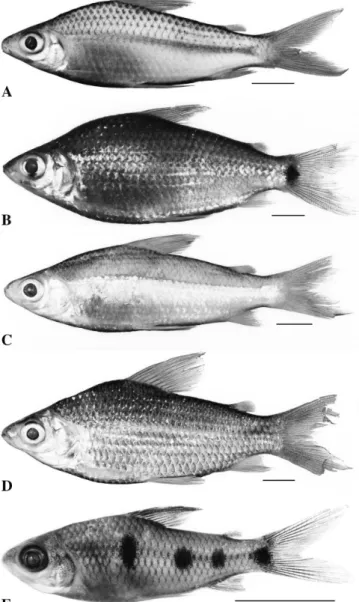
body, particularly along lateral-line scale row below dorsal fin, except in very large individuals of Leporinus agassizi (~250 mm SL), which lack dark pigmentation on body and caudal peduncle . . . .(29) Figure 3. - anostomidae. A: Leporellus vittatus (preserved), AUM 20003, 123.6 mm SL, Venezuela, Portuguesa, Río Portuguesa at high- way 5 bridge. b: Anostomoides laticeps (preserved), ANSP 182274, Venezuela, Amazonas, Rio Orinoco, 52.9 km SE of San Antonio.
c: Schizodon fasciatus (live, adult), Guyana, Rupununi River, 5.9 km WSW of village of Sand Creek, 02.967°N, 59.6592°W. d: Schizo- don vittatus (preserved), AUM 35557, 97.1 mm SL, Guyana, Tukutu, Circle W Creek, tributary of Pirara River, 03.654°N, 59.529°W.
e: Laemolyta proxima (preserved), AUM 45035, 134.4 mm SL, Guyana, Tukutu, pond at Yukupari, 3.659°N, 59.360°W. F: Anostomus brevior (live), FMNH ex ANSP 189141, Suriname, Sipalawini, Lawa River (Marowini drainage), 03.325˚N, 54.063˚W. G: Anostomus anostomus (live), USNM 403517, 52.7 mm SL, Guyana, Cuyuni River, 06.97˚N 59.993˚W. h: Anostomus ternetzi (preserved), MHNG 2626.021, 56.1 mm SL, French Guiana, Maroni River, Saut Toulalapata. i: Pseudanos irinae (preserved), AUM 48740, Guyana, Tukutu, Rupununi River, Aruwa Falls, 03.502°N, 59.339°W. J: Synaptolaemus cingulatus (live), AUM 43269, Venezuela, Amazonas, Río Orinoco, 03.307˚N, 66.600˚W. K: Petulanos plicatus (preserved), ANSP 180173, Guyana, Rupununi, Essequibo River, Yukanopito Falls, 01.915°N, 58.521°W. Scale bars indicate one centimetre. Photos by S. Moyers (A), B. Sidlauskas (B, H, K), M. Sabaj Pérez (C, F, J), J. Armbruster (d, E, i), and W. Bronaugh (G),
29a: Specimens smaller than approximately 100 mm SL . . . . . . .(30) 29b: Specimens larger than approximately 100 mm SL . . . . . . . .(31) 30a: Primary dark pigmentation on body consisting of inter- mittent longitudinal stripe running along lateral-line scale row from position below dorsal-fin base to caudal pedun- cle. Stripe composed of two to five spots, with at least some spots horizontally elongate. intensity and completeness of stripe highly variable, with anteriormost region typically darkest. Pigmentation of stripe particularly faint in material from demerara River, eastern Guyana. Smaller individuals usually with supplementary series of three or four small, vertically elongate spots present ventral to first through ninth scales of lateral-line scale row. Supplementary spots less intense in individuals of approximately 80 mm SL and dis- appear entirely during course of ontogeny . . . . . . . Leporinus agassizi Steindachner, 1876 (Figs 4I, 7A) 30b: Primary dark pigmentation on body consisting of three distinct round spots along lateral-line scale row, one situ- ated below dorsal–fin base, one slightly anterior to vertical through adipose-fin origin, and one on caudal peduncle.
Juveniles with two or three smaller supplementary spots;
first adjacent to opercle and centred on scale row just ventral to lateral-line scale row, second ventral to seventh and eighth lateral-line scales and third (when present) ventral to 20th and 21st lateral-line scales. Supplementary spots less intense in individuals of approximately 70 mm SL and disappear entirely during course of ontogeny . . . . . . Leporinus friderici (Bloch, 1794) (Fig. 7B) 31a: all but largest specimens with single distinct dark spot along lateral-line scale row below dorsal–fin base and with additional dark pigmentation forming diffuse, irregular and interrupted band occasionally present along lateral-line scale row posterior to that point. intensity of dark pigmentation fades ontogenetically, with largest individuals (~250 mm SL) lacking dark pigmentation entirely, and slightly smaller individuals usually retaining only spot below dorsal-fin base.
Midsized specimens occasionally retain patch of darker pig- mentation along lateral-line scale row anterior of vertical through anterior of adipose fin reminiscent of second spot that characterizes adults of Leporinus friderici (see below) . . . . Leporinus agassizi Steindachner, 1876 (Figs 4J, 7A) 31b: Two or three dark spots present along lateral-line scale row in all but one examined individual; one spot situated below dorsal-fin base, second immediately anterior to ver- tical through adipose-fin origin, and third variably present on caudal peduncle. Larger specimens typically retain dark mid-lateral spots, but intensity of spots sometimes fades in large individuals, with spot beneath dorsal fin darkest and spot over caudal peduncle lightest in those specimens. One large specimen from the Corantijn River weakly pigmented
and displaying only anterior spot below dorsal–fin base . . . . . . . Leporinus friderici (Bloch, 1794) (Fig. 7B) Comments on Anostomidae in Guyana, Suriname and French Guiana
With at least thirty recognizable morphospecies, the anostomidae represent the most diverse group of anosto- moid fishes in the Guianas. identification of anostomids to genus is relatively unproblematic when it is possible to examine the dentition critically, but at a finer taxonomic scale the correspondence between many of the morphospecies and the available taxonomic names is unclear. We present below a brief genus-by-genus discussion of the taxonomic conun- drums that abound in this group, and pay particular attention to our reasons for matching certain names to taxa. That said, our effort should not be considered a full taxonomic revision of these genera or their representatives in the Guianas!
Abramites. - There is a single specimen of Abramites hypselonotus (MHNG 2195.100) from an ambiguous locality in the Rio Branco drainage of extreme southwestern Guyana, where the Essequibo and Branco ichthyofaunas interchange through the Rupununi savannahs during high water periods (Lowe-McConnell, 1964; Watkins et al., 2005; de Souza et al., 2012). Abramites hypselonotus is primarily distributed through the amazon and Orinoco basins in northern South America (Vari and Williams, 1987, Fig. 6) and is clearly not a major component of the Guianese ichthyofauna.
Anostomoides. - despite a type locality at Crab Falls in the Essequibo River drainage, Anostomoides laticeps is apparently a very rare member of the Guianese ichthyofauna.
in addition to the type series we encountered only one addi- tional from the Rupununi River (appendix Fig. 1). Within the Guianas it appears to be endemic to the Essequibo sys- tem, though it also occurs in drainage systems beyond the Guianas, including the Río Orinoco (Garavello and Britski, 2003; Santos and Zuanon, 2006).
Anostomus. - Three species of Anostomus occur in the Guianas (appendix Fig. 2), bearing in mind the recent erection of Petulanos to contain several species formerly assigned to Anostomus (Sidlauskas and Vari, 2008). Anos- tomus ternetzi (Fig. 3H) is easily distinguished on the basis of coloration (with a pale middorsal stripe from the tip of the supraoccipital spine to the dorsal-fin origin versus a dark median stripe in that region in congeners), but preserved specimens of A. anostomus and A. brevior are much more difficult to separate. Anostomus anostomus is the more slen- der of the two species throughout ontogeny (see morphome- tric diagnosis in key), though it does increase in relative body depth ontogenetically and large individuals of A. anos- tomus approach the range of ratios that diagnose A. brevior.
Identifications are much easier if live coloration is available, as A. brevior has hyaline fins (Fig. 3F), while A. anostomus has varying degrees of red pigmentation on the dorsal, cau-
dal, anal and pelvic fins and caudal peduncle (Fig. 3G). The relative extent of that red pigment varies considerably across the range of the species (compare Fig. 3G in this publication with plate 5B of Sabaj Pérez [2009]). Whether this difference indicates a morphocline, variable water chemistry or dietary composition, or the presence of multiple species within the present concept of A. anostomus is unknown. Within the Guianas, A. brevior has a more easterly distribution in the Litani-Marowijne and Oyapock systems of French Guiana and Suriname, while A. anostomus occurs in river systems further west. interestingly, A. ternetzi has a disjunct distribu- tion in the Essequibo-Rupununi system and in the Marowi- jne/Maroni system, without apparent occurrence in the inter- vening river basins of Guyana and Suriname. Whether these disjunct populations merit formal taxonomic recognition is an open question.
Hypomasticus. - Hypomasticus was recently elevated from a subgenus of Leporinus on the basis of several mor- phological synapomorphies (Sidlauskas and Vari, 2008).
Members of the genus can be recognized externally by their inferior mouths. Two species occur within the Guianas (Appendix Fig. 3), of which Hypomasticus despaxi (from the Maroni and Oyapock systems) is the simpler to recognize due to its highly distinctive striped colour pattern (Fig. 4H).
Hypomasticus megalepis (Fig. 4a) from the Essequibo, Corantijn, Coppename and Maroni river systems is more problematic, as it has a spotted colour pattern very similar to that of Leporinus nijsseni (Fig. 6C), L. ortomaculatus (Fig. 4E) and L. granti (Fig. 6B). aside from the important difference in mouth position (inferior in H. megalepis versus terminal or subterminal in the above species of Leporinus), H. megalepis also possesses a distinct dark spot anteriorly on the base of the anal fin that is a continuation of a similar spot on the ventrolateral portion of body. Such an anal-fin spot is absent in Leporinus nijsseni, L. ortomaculatus and L.
granti.
it is noteworthy that a large percentage of material of Hypomasticus megalepis in collections was incorrectly iden- tified as Leporinus maculatus, a name that applies correct- ly to a species of Leporinus with alternating thick and thin dark vertical bars (Fig. 4N). The history behind that nomen- clatural confusion was discussed extensively by Géry et al.
(1988).
Laemolyta. - Of the five species in Laemolyta, only L.
proxima (Fig. 3E) occurs in the Guianas (Mautari and Men- ezes, 2006), with its distribution restricted to the Essequibo, Rupununi and Takutu river systems (appendix Fig. 4). it can be identified easily by the single continuous dark lateral stripe running from the eye to the posterior of the hypural plate and by the continuous incisiform margin formed by its dentary teeth.
Leporellus. - The highly distinctive Leporellus vittatus (Fig. 3A), with dark stripes on the dorsal and caudal fins and
an extensively scaled caudal fin, cannot be easily confused with any other anostomoid fish from the Guianas. It is rare in the ichthyofauna in this study area, being represented by only four examined lots, all from the Takutu or Rupu- nuni rivers of southern Guyana (appendix Fig. 5). Outside the Guianas this nominal species has an exceedingly broad reputed range, including representation throughout the ama- zon and Orinoco systems as well as the trans-andean drain- ages of Colombia. Whether all populations from across that vast geographic swath truly belong to a single species is an unanswered question.
Leporinus, general comments. - Leporinus is a large group of approximately 90 nominally valid species (Gar- avello and Britski, 2003). The genus as currently defined is demonstrably paraphyletic (Sidlauskas and Vari, 2008), but in the absence of a comprehensive revision and associated phylogenetic analysis it is uncertain which components of the genus may in fact represent natural groups. Following Géry (1977), we divide our discussion of these fishes into four almost certainly artificial groupings based on colour pattern (barred, striped, spotted or largely unpigmented) to facilitate location of comments pertinent to the identification of fishes in each group.
Leporinus, barred forms. - Within the barred or ban- ded subgroup of Leporinus, three distinct morphospecies are present in the Guianas, which we have assigned to L.
fasciatus (Fig. 4C), L. desmotes (Fig. 4k) and L. maculatus (Fig. 4N). Of these, L. maculatus is easily identified by its very distinctive alternating thick and thin dark bars. Lepori- nus fasciatus and L. desmotes, that both possess dark bars of a more regular width are sometimes confused. These two can be separated by the number of dark vertical bars (gener- ally ten in L. fasciatus versus seven or eight in L. desmotes, including the bar over the posterior of the opercle), the form of the symphyseal dentary teeth (laterally compressed, for- ward jutting tusks in L. desmotes versus well developed but not tusk-like in L. fasciatus) and in the coloration of the anterior portion of the dorsal fin (darkly pigmented [Fig. 4K]
in L. desmotes versus unpigmented [Fig. 4C] in L. fasciatus).
Within the Guianas L. desmotes is limited to the southern portion of the Essequibo River system and the Takutu River (Rio Branco drainage), while L. fasciatus and L. maculatus are ubiquitous across the Guianas except for the Oyapock basin (appendix Figs 6, 7).
Though the three morphotypes of banded Leporinus are relatively easy to separate, some taxonomic uncertainty is associated with all three names. Leporinus desmotes was described from the Rupununi River of Guyana (Fowler, 1914) and is the least problematic, though the nominal spe- cies L. jatuncochi from Ecuador and Peru (Ovchynnyk, 1971) is extremely similar and may be a junior synonym of L. desmotes. Leporinus fasciatus (Bloch, 1794) was one of the first three anostomid species to be described and it pos-
sesses a large putative range spanning the major rivers of the Guianas as well the amazon and possibly the Orinoco sys- tems. Several nominal subspecies (Borodin, 1929) as well as multiple possible junior synonyms have been proposed (Gar- avello and Britski, 2003). Overall the L. fasciatus complex is in need of revision, but is it clear that the species present in the Guianas must be the true L. fasciatus, because the spe- cies has a type locality within Suriname and no older name is available.
The proper nomenclature of the species assigned herein to Leporinus maculatus is much less clear. Within the Guia- nas, at least four names have been applied to species in this complex: L. alternus, L. maculatus, L. paralternus and L.
pellegrinii, with L. maculatus being by far the oldest name.
Géry et al. (1988) argued convincingly that the other three names are synonyms of L. maculatus, with the proliferation of nominal species likely due to the incorrect application by ichthyologists of the name L. maculatus to the species rec- ognized herein as Hypomasticus megalepis. Géry et al. did, however, recognize two subspecies, L. maculatus maculatus (including L. paralternus) with a supplementary partial bar after the first major bar and a body depth 3.9 to 4.15 in SL,
and L. maculatus pellegrinii (including L. alternus?) lack- ing a supplementary partial bar and with a body depth 4.25 to 4.45 in SL. Those cited subspecific differences appear inconsistent among the individuals we examined. One speci- men (ANSP 180171), for example, lacks a supplementary bar but has a body depth of 4.18 in SL. The paratype of L.
alternus (uSNM 66219) has a very slight supplementary bar in the form of a dark dot on the dorsum, despite the fact that the presence versus absence of the supplementary bar was the primary diagnostic feature used to separate L. paralter- nus from L. alternus by Fowler (1914). Perhaps most tell- ingly, variation within a single lot of specimens sometimes includes individuals demonstrating both colour patterns.
a prime example is uSNM 225995, which has four speci- mens with the supplementary bar ranging from dark, long and intense to completely absent. Overall the presence ver- sus absence of the supplementary bar does not appear to be ontogenetic, and may represent sexual dimorphism or just natural intraspecific variation among individuals. It does not appear to diagnose reliably any taxon of any rank, and thus we assign all of the specimens of Leporinus with alternating thick and thin bars in the Guianas to L. maculatus.
Figure 4 (left). - anostomidae. A: Hypomasticus megalepis (live), AUM 37999, Guyana, Region 9, Essequibo River, Kassi-Attae rapids, 02.226°N, 58.393°W. b: Leporinus arcus (preserved), ANSP 179647, Guyana, Cuyuni-Mazaruni, Whitewater Creek, 6.8 km SSW of Bar- tica, 06.378°N, 58.674°W. c: Leporinus fasciatus (live), ANSP 189158, Suriname, Sipalawini, Lawa River, eight km SSW of Anapaike- Kawemhakan, 03.325°N, 54.063°W. d: Leporinus lebaili (live), FMNH ex ANSP 189043, Suriname, Sipalawini, Lawa River, eight km SSW of Anapaike-Kawemhakan, 03.325°N, 54.063°W. e: Leporinus ortomaculatus (live), AUM 43262, Venezuela, Amazonas, Río Orino- co, 147 km ESE of San Fernando de atabapo. F: Leporinus nigrotaeniatus (juvenile, live), USNM 403522, 32.2 mm SL, Guyana, Cuyuni River. G: Leporinus nigrotaeniatus (adult, preserved), USNM 377393, 106.2 mm SL, Guyana, Rupununi, Coco Creek. h: Hypomasticus despaxi (preserved), ANSP 189042, Suriname, Sipalawini, Lawa River, Gansoela, rapids eight km SSW of Anapaike, 03.311°N, 54.065°W.
i: Leporinus agassizi (live), uSNM 402629, 95.1 mm SL, Guyana, Cuyuni River about 15 km upstream from Waikuri mountains near mouth of Toroparun River, 06.69186°N, 59.57722°W. J: Leporinus agassizi (live), USNM 403835, Guyana, Cuyuni River about 1 km downstream from Kanaima Falls, 06.88377°N, 60.24786°W. K: Leporinus desmotes (holotype, preserved), ANSP 39324, Guyana, Rupu- nuni River. l: Leporinus gossei (preserved), MHNG 2700.051, 110.8 mm SL, French Guiana, Mana River Basin, Crique Aya, 04.603°N, 53.418°W. M: Leporinus melanostictus (preserved), MHNG 2621.094, 118.0 mm SL, French Guiana, Fleuve Approuague, 04.193°N, 52.319°W. n: Leporinus maculatus (live), FMNH ex ANSP 189041, Suriname, Sipalawini, Lawa River, eight km SSW of Anapaike- Kawemhakan, 03.325°N, 54.063°W. Scale bars indicate one centimetre. Photos by M. Sabaj Pérez (A, C, D, E, H, K, N), B. Sidlauskas (B, G, L, M) and W. Bronaugh (F, i, J).
Figure 5. - anostomidae. A: Pseudanos trimaculatus (preserved), uSNM 224797, 67.7 mm SL, Guyana, Rupu- nuni, Puara River, amazon drainage.
b: Petulanos spiloclistron (preserved), USNM 209432, 72.3 mm SL, Suri- name, Fallawatre River, at rapids five km SSW of Stondansie Falls, 05.150°N, 56.483°W. Photos by T. B. Griswold.
Scale bars indicate one centimetre.
Leporinus, striped forms. - Three striped species of Leporinus occur in the Guianas: L.
arcus (Fig. 4B), L. nigrotaeniatus (Fig. 4F,G) and L. agassizi (Fig. 7a). Leporinus arcus is easy to identify due to its deep body with a wide dark midlateral stripe along the midline and an overall striped colour pattern remi- niscent of members of Anostomus (Fig. 3F, G, H). Leporinus nigrotaeniatus is also very distinctive due to the combination of a very slender body (body depth at dorsal-fin origin approximately 18-21% of SL) with a partial dark midlateral stripe that runs from ventral to the dorsal-fin base to the posterior margin of the hypurals in adults (Fig. 4G). in small juveniles, the midlateral stripe is intermit- tent (Fig. 4F). at middle stages of ontogeny, L. agassizi (Fig. 7a, centre) demonstrates a partial midlateral stripe similar to that present in L. nigrotaeniatus (Fig. 4G) but the former species has a distinctly deeper body (body depth at dorsal-fin origin approximate- ly 28-32% of SL). The midlateral stripe in L. agassizi is, however, divided into a series of lateral spots at early stages of ontogeny (Fig. 7a, bottom), never completely forms in some individuals (Fig. 4i), and fades later in ontogeny (Fig. 7a, top) to disappear entire- ly in very large adults (Fig. 4J). Leporinus agassizi is discussed more extensively below in a comparison with L. friderici. Within the Figure 6. - anostomidae. A: Leporinus apollo, holotype, FMNH 116827, 111.1
mm SL Suriname, Saramacca, Coppename River, Sidonkrutu. b: Leporinus granti, uSNM 225402, 110.6 mm SL, Suriname, Nickerie district, stream into Lucie River, 03.600°N, 57.617°W. c: Leporinus nijsseni, USNM 225377, 40.2 mm SL, Suri- name, Nickerie District, stream at Machine Park, 03.833°N, 57.567°W. Scale bars indicate one centimetre. Photos by T. B. Griswold.
Figure 7. - A: Growth series of Leporinus agassizi: Top, USNM 377364, 114.7 mm SL, Guyana. Centre, USNM 377410, 87.2 mm SL, Guyana, Burst Mouth Pond. Bottom, USNM 93438, 62.4 mm SL, Guyana, Wismar, 06.00˚N, 58.55˚W. b: Growth series of Leporinus friderici. Top, USNM 225383, 95.2 mm SL, Suriname, Nickerie, stream near Camp Anjoemara, 04.833˚N, 57.433˚W. Centre and bottom, USNM 225409, 68.3 and 55.7 mm SL. Suriname, Nickerie, Kamp Kreek, 04.817˚N, 57.467˚W. Scale bars indicate one centimetre. Photos by T. B. Griswold.
Guianas, L. agassizi and L. nigrotaeniatus occur through- out the Essequibo River drainage but are unknown from the Corantijn River and drainages further to the east (appen- dix Figs 8, 9). Leporinus arcus also occurs in the Essequibo drainage, but appears to be restricted to the northern half of Guyana and is unknown from the rivers of the Rupununi savannah (appendix Fig. 5).
Leporinus, spotted forms. - any discussion of the spot- ted species of Leporinus must confront the taxonomic confu- sion that has surrounded the concept of L. friderici, which along with L. fasciatus and Anostomus anostomus was among the first three anostomid species to be recognized formally (Linnaeus, 1758; Bloch, 1794). In his description of Salmo friderici (now in Leporinus), which has an indefi- nite type locality in Suriname, Bloch illustrated a large, fully adult individual with three distinct dark spots centred along the lateral-line scale row, one situated ventral to the dorsal fin, one just anterior to the vertical through the origins of the adipose and anal fins, and one on the caudal peduncle at the base of the medial caudal-fin rays. Bloch’s drawing and description very well match some recently collected Leporinus from the river systems of Suriname and French Guiana (Fig. 7B), although specimens smaller than the full adult illustrated by Bloch demonstrate additional faint bar- ring dorsal to the lateral line and a mottled pattern ventral to the lateral line. There is little question that these individuals are the true L. friderici.
as is often the case with very early South american spe- cies descriptions, the specific epithet of Leporinus friderici has also been applied to individuals from across the con- tinent for more than 200 years since Bloch’s original work with the resultant species complex very much in need of revision. Though such a revision is beyond the scope of this work, it became clear during our survey that specimens from the Essequibo system of Guyana provisionally assigned to L. friderici (e.g., Figs 4i, 7a bottom panel) differ substan- tially from specimens from the Corantijn River and drainages further east (Fig. 7B). The available material from the deme- rara, Essequibo and Rupununi systems exhibits wide colour pattern variation, with most of the variability centred on the degree of completeness of a partial midlateral stripe remi- niscent of the colour pattern that typifies the more slender L.
nigrotaeniatus (Fig. 4F, 4G). individuals bearing a complete stripe between a point below the dorsal fin and the posterior margin of the hypurals resemble closely L. agassizi from the amazon drainage, while individuals in which the stripe is interrupted are very similar to the type series of L. punctatus Garavello, 2000, from the Río Orinoco of Venezuela. Very small individuals (~60 mm SL and smaller, Fig. 6a, bottom panel) have a highly interrupted stripe that often appears as a series of five spots, of which only the spot ventral to the adipose fin is at all horizontally elongate. Such specimens have typically been identified as L. friderici in museum col-
lections, but differ from juveniles of L. friderici from the Corantijn River and drainages further east which have three distinct round spots centred along the lateral-line scale row in the region from ventral of the dorsal fin to the posterior mar- gin of the hypurals, none of which is horizontally elongate.
Matters are complicated further by ontogenetic variation.
at approximately 90 mm SL, the colour pattern of speci- mens of this complex from Guyana begins to fade and the lateral stripe becomes indistinct and begins to subdivide.
indivi duals pass through a stage in which they possess hori- zontally elongate dark markings in positions analogous to the three round spots that characterize L. friderici of Suri- name and French Guiana (compare Fig. 4i with 7B). The posterior two spots then fade, leaving only a single dark spot ventral to the dorsal fin (Fig. 7A, top panel). Eventually that spot similarly fades with the largest known individuals from the Essequibo drainage completely lacking midlateral dark markings (Fig. 4J). This contrasts sharply with the condition in L. friderici from the Corantijn River and drainages fur- ther to the east (appendix Fig. 9), in which adults maintain at least the anterior two dark marks throughout onto geny. a full series of intermediates can be assembled to link all of the forms in the Essequibo, Rupununi and demerara systems, and it seems clear that all these represent a single, morpho- logically variable species. For the most part the varia tion among individuals of the same size does not appear to be geographically structured, though the available specimens (mostly juveniles) from the demerara River are particularly weakly pigmented.
Overall, it is very clear that the material from the deme- rara, Essequibo and Rupununi rivers is not conspecific with Leporinus friderici which occurs in river systems to the east (appendix Fig. 9). Those western populations are identi- fied herein as L. agassizi, which is the oldest available name that appears to match at least a portion of the ontogenetic pigmentation pattern of that nominal species (namely the striped phase). Problematically, L. agassizi has a type loca- lity in the amazon drainage rather than one of the drainages of the northern Guiana Shield. as discussed above, L. punc- tatus from the Río Orinoco basin is another possibly conspe- cific species, and indeed it is possible that L. agassizi and L. punctatus are synonymous. a third possibility is that the material from the demerara, Essequibo and Rupununi rivers represents a species new to science. Only a thorough com- parison of samples from these and adjoining drainage basins with the relevant type series can resolve this issue.
Variation within Leporinus friderici proper is problem- atic in that we were unable to examine enough specimens from French Guiana to evaluate the diagnosability of the two putative subspecies L. friderici friderici and L. friderici acutidens. according to Planquette et al. (1996) L. friderici acutidens has a concave anal fin margin while L. friderici friderici has a straight or convex margin. We would con-
sider the fin margins of the extensive series of material that we examined from Suriname to be straight, or very slightly concave (e.g., Fig. 7B, top panel). That said, there remains substantial co lour pattern variation within L. friderici. Mod- erately to large sized specimens from Suriname (e.g., FMNH 116829) have little in the way of supplementary markings above and below the lateral-line scale row and have fairly small, but discrete lateral-line spots. Some material from the Nickerie River of Suriname (e.g., uSNM 225772, a lot of specimens at about 97 mm SL) has the pigmentation of the second and third spots in some individuals less intense than that of the spot below the dorsal fin. Material from fur- ther east in Suriname and French Guiana (Lawa/Marowijne drainage, e.g., ANSP 189264) tends to have more pigmenta- tion, retains distinct spots below the lateral line until at least 80 mm SL and has overall larger spots. Determination of whether this variation indicates a morphocline, natural varia- tion among individuals or the presence of recogni zable east- ern and western taxa within the present concept of L. frideri- ci will require the examination of more extensive series of specimens, and will unfortunately be complicated by the fact that no types are known for L. acutidens, which has a type locality simply of “South america”.
Identification of the remaining spotted species of Lepori- nus in the Guianas is much more straightforward. The two species most similar to L. friderici and L. agassizi are L. gos- sei from the Marowijne and Oyapock drainages of French Guiana (appendix Fig. 5) and L. lebaili from the Marowijne (appendix Fig. 11). Leporinus gossei (Fig. 4L) posses ses a colour pattern very similar to that of L. friderici but has only four scales in the upper transverse series (versus five in L. friderici) and usually retains into adulthood a dark spot posterior to the opercular margin centred just ventral to the lateral-line scale row (versus the lack of such a dark spot in adulthood). Leporinus lebaili (Fig. 4d) is easily recognized by the dark black pigmentation on the body that outlines the posterior margin of the opercular series (versus a lack of such pigmentation in L. friderici).
Leporinus nijsseni (Fig. 6C) can be separated from other spotted species of Leporinus in the Guianas by the presence of 12 rather than 16 circumpeduncular scales. This species other wise looks very similar to L. granti at small sizes (under 65 mm SL), as both have a very heavily spotted colour pattern.
Interestingly, material fitting the current concept of L. nijsseni appears to have a disjoint distribution in the Corantijn, Nick- erie, Suriname and Coppename rivers of Suriname and in the Oyapock River of French Guiana, without apparent occur- rence in the intervening Litani/Marowijne, Mana, Sinnamary or approuague river systems (appendix Fig. 1). Leporinus nijsseni also bears a close similarity to the poorly known L.
steyermarki Inger, 1956, from the Río Abácapa, which drains a tepui in Venezuela at a height of approximately 400 m above sea level (inger, 1956). Leporinus steyermarki also has
a spotted colour pattern and 12 circumpeduncular scales, but can theoretically be separated from L. nijsseni by the posses- sion of 32 lateral-line scales (versus 33-36 in L. nijsseni). a revision is necessary to determine whether the two disjunct populations of L. nijsseni merit recognition as distinct species or subspecies, and whether either is in the synonymy of the older L. steyermarki.
Leporinus granti, another heavily spotted, deep bod- ied species of Leporinus is easily recognized at sizes over 65 mm SL by the presence in most specimens of a diffuse dusky stripe ventral to the lateral-line scale row (Fig. 6B).
at small sizes the pigmentation ventral to the lateral-line scale row instead consists of a series of disconnected dark spots and L. granti looks very similar to L. friderici, L. nijs- seni and Hypomasticus megalepis. Nevertheless, juveniles of Leporinus granti can be recognized by the presence of 16 circumpeduncular scales (versus 12 in L. nijsseni), a termi- nal mouth (versus inferior in Hypomasticus megalepis) and a dark oblique stripe under the eye (versus the absence of such a stripe in all three cited species). Leporinus friderici is also much less extensively spotted at all stages of ontogeny than is L. granti. Leporinus granti appears commonly through- out the Branco, Essequibo, Corantijn, and Marowijne up to approuage basins but is notably absent in the Nickerie, Cop- pename, Saramacca and Suriname drainages of central Suri- name and the Oyapock system of far eastern French Guiana (appendix Fig. 10). The very similar L. nijsseni occurs in drainages where L. granti does not (appendix Fig. 1) except for a possible area of contact in the Corantijn system, sug- gesting that these two taxa may be allopatrically-generated sister species. Furthermore, both of these species appear to have disjoint distributions, suggesting the possible presence of cryptic species within the present concept of both taxa.
The remaining two species of spotted Leporinus from the Guianas are much more slender-bodied than the spotted species discussed above, with body depth at the dorsal-fin origin in the range of 19%-25% of SL, versus 28%-38% of SL. Leporinus ortomaculatus (Fig. 4E) is widely distributed throughout the Orinoco system (Garavello, 2000) but also occurs in the Takutu and ireng drainages (Rio Branco basin) of southwestern Guyana (Appendix Fig. 8). It is a heavily spotted species with three pairs of spots positioned interme- diate to four spots centred along lateral-line scale row. Each pair of spots is positioned with one member above lateral- line scale row and one below, with the overall form of each pair reminiscent of a colon.
Finally, a new spotted species, Leporinus apollo Sid- lauskas et al. 2011 (Fig. 6a) was discovered recently from the Coppename, Corantijn and Suriname rivers of Suri- name (appendix Fig. 4). it is extremely slender (body depth 18-23% of standard length), has a colour pattern of four large lateral spots and additional dark markings ventral to the lat- eral line, and has six upper transverse scales versus the five