SKRIPSI
THE EFFECTIVENESS OF MNEMONIC TECHNIQUE TO IMPROVE STUDENTS ENGLISH VOCABUALRY AT THE EIGHT
GRADE OF SMP NEGERI 6 PAREPARE (Classroom Action Research)
By
FATIMA RISA S Reg. Num. 15.1300.131
ENGLISH EDUCATION PROGRAM TARBIYAH FACULTY
STATE ISLAMIC INSTITUTE (IAIN) PAREPARE
2020
ii SKRIPSI
THE EFFECTIVENESS OF MNEMONIC TECHNIQUE TO IMPROVE STUDENTS ENGLISH VOCABUALRY AT THE EIGHT
GRADE OF SMP NEGERI 6 PAREPARE (Classroom Action Research)
By
FATIMA RISA S Reg. Num. 15.1300.131
Submitted to the English Education Program of Tarbiyah Faculty of State Islamic Institute of Parepare in Partial of Fulfilment of the Requirements for
the Degree of Sarjana Pendidikan (S.Pd)
ENGLISH EDUCATION PROGRAM TARBIYAH FACULTY
STATE ISLAMIC INSTITUTE (IAIN) PAREPARE
2020
iii
THE EFFECTIVENESS OF MNEMONIC TECHNIQUE TO IMPROVE STUDENTS ENGLISH VOCABUALRY AT THE EIGHT
GRADE OF SMP NEGERI 6 PAREPARE (Classroom Action Research)
Skripsi
As Partial Fulfillment of the Requirements for the Degree of Sarjana Pendidikan (S.Pd)
English Education Program
Submitted by
FATIMA RISA S Reg. Num. 15.1300.131
to
ENGLISH EDUCATION PROGRAM TARBIYAH FACULTY
STATE ISLAMIC INSTITUTE (IAIN) PAREPARE
2020
iv
v
vi
vii
ACKNOWLEDGEMENTS
ِمْيِحَّرلا ِن ْحَّْرلا ِالله ِمْسِب
In the name of Allah, the Beneficent the Merciful
Alhamdulillah, first of all the researcher would like to say a lot of thanks to Allah SWT for guidance, love and blessing help so that the writer could finish this skripsi. Shalawat and salam to our beloved prophet Muhammad saw as the last messenger of Allah SWT.
The researcher realizes that this skripsi has never been possible to be finished without supported and helped by some people. Therefore, the researcher wishes to express a lot of thanks to:
1. The researcher’s beloved parents Syamsuddin and Sonia for their loves, support, and sincered prayer for their children especially for the researcher who always work hard for schooling their daughter, therefore she can finish her study until become an under graduated student. Her siblings Jerry Syamsuddin and his wife, Azmil Syamsuddin, Syuhada S who always giving an amazing motivation, support and guidance in the light of truth.
2. Dr. Ahmad Sultra Rustan, M.Si. The Rector of State Islamic Institute (IAIN) Parepare, all of lecturers of English program and staffs of IAIN Parepare for their motivation, support and help during his study.
3. Dr. H. Saepudin, S.Ag., M.Pd. as the Dean of Tarbiyah Faculty of State Islamic Institute (IAIN) Parepare who has given the researcher a guideline in finishing this skripsi.
viii
4. Mujahidah, M.Pd. as the chairman of English Education Program for the fabulous serving to the students besides that she is like a researcher’s parent who always giving motivation, support and helping.
5. Dra. Hj. Nanning, M.Pd. as the first consultant who has given much motivation, guidance, and suggestion that very helpful to complete this skripsi. Thanks for your good advice.
6. Drs. Amzah, M.Pd. as the second consultant who has guided the researcher and who has given his much suggestion in writing until finishing this skripsi. Thanks for helping and your good advice. May allah bless his life with a good health.
7. All teachers in the SMP Negeri 6 Parepare who has taught the researcher and always given support, help and always giving some advice and motivation.
8. All lecturers of English Program who have taught and educated the researcher during her study in IAIN Parepare.
9. The researcher’s best friends Andi Syafitri Syam, Astina (Cendol squad), Suri, Sri, Alika, Muh Firman, Iswanto Randa, who always give support and motivation for the research.
10. The researcher’s another best friends Fia, Khadija, Riska, Titian, Nurul Aulia Awal, Nana, fatimah, Edil, Ridwan, Putri, Ayu (Posko Timoreng Panua) who always given support and motivation for the research. .
11. Her friends in English Program of Tarbiyah Faculty 2015. Thanks for giving support and sharing their time and being good friends.
12. All people who have given their help in writing this Skripsi that the researcher could not mention their one by one.
ix
The words are not enough to appreciate for their contribution and help in writing this Skripsi. May Allah bless them all. Finally, the researcher realizes that this Skripsi still has any weakness and it is not perfect yet. Therefore, the researcher with pleasure accept critics and suggestion from everyone who reads this Skripsi.
Parepare, February, 13th 2020 The Writer,
Fatima Risa S
Reg. Num. 15.1300.131
x
DECLARATION OF THE RESEARCH AUTHENTICITY The writer who signed the declaration below:
Name : Fatima Risa S
Student Reg. Number : 15.1300.131
Place and Date of Birth : Bamba, 14 july 1997 Study Program : English Education
Faculty : Tarbiyah
Title of Skripsi : The Effectiveness of Mnemonic Technique to Improve Students English Vocabulary at the Eight Grade of SMP Negeri 6 Parepare
Stated that this skripsi is her own writing, and if it can be proved that it was copied, duplicated or complied by any other people, this skripsi and the degree that has been gotten would be postponed.
Parepare, February, 13th 2020 The Writer,
Fatima Risa S
Reg. Num. 15.1300.131
xi ABSTRACT
Fatimah Risa S. The effectiveness of Mnemonic Technique to Improve Students English Vocabulary at the Eight Grade of SMP Negeri 6 Parepare (Supervised by Hj. Nanning and Amzah)
Vocabulary is very important to be mastered to support English language skills;
listening, speaking, reading and writing. Speaking would be meaningless and perhaps impossible having only structure without vocabulary. Nobody could listen clearly without mastering vocabulary. Anyone cannot understand what they read without mastering vocabulary. Moreover, Writing could not be arranged without vocabulary mastery. The problems are most of the students has difficulties in mastering vocabulary and difficult to remember new words. Therefore, many approaches are created to improve vocabulary mastery well.
Mnemonic is one of technique to train good vocabulary. It is applied to help students memorize vocabulary well and to be more easy and fun to remember words.
This study is a classroom action research. There were four steps in conducting:
planning, action, observation, and reflection. The subject of this study is eighth grade students. This classroom action research was done in two cycles. Each cycle was conducted into tree meeting and mnemonics as the topic of discussion. The result of this study showed that students’ improvement in mastering vocabulary was statistically significant.
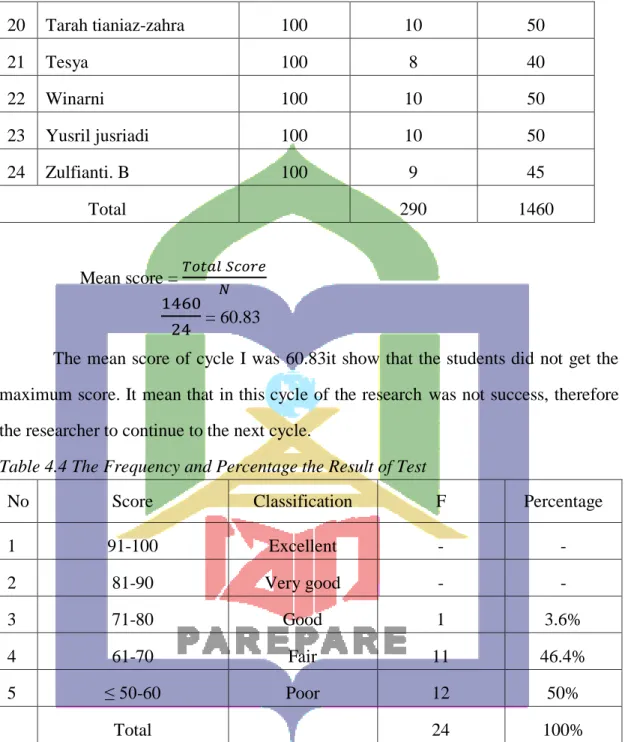
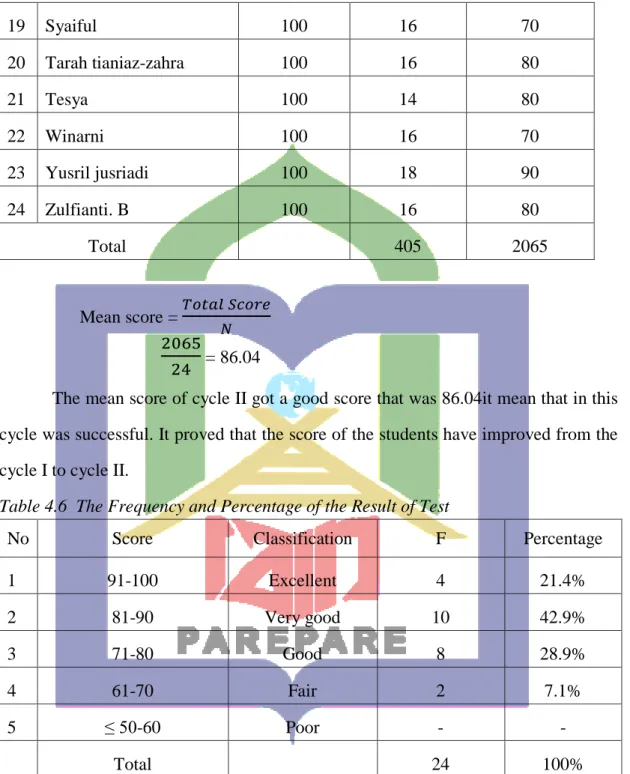
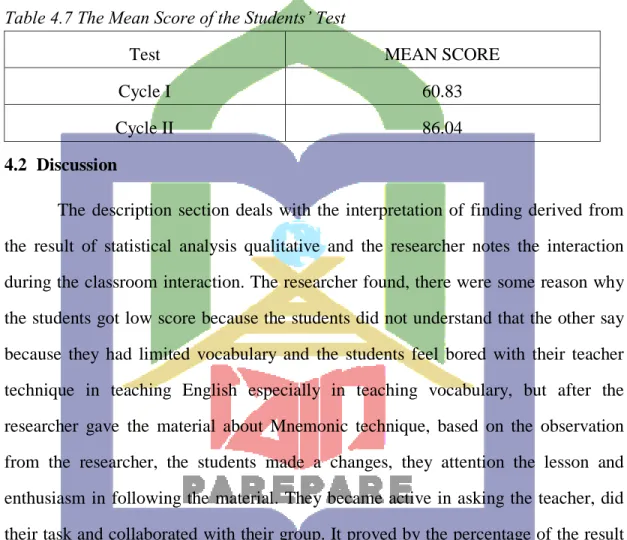
Based on the research conducted, the researcher found the significant improvement between cycle I and cycle II, it can be seen from the mean of cycle I which is 60,83, and the mean of cycle II which is 86.04. It can be concluded that the application of mnemonic technique can improve students’ vocabulary mastery.
Hopefully, this technique can help the students more easy to master vocabulary.
Keywords: Mnemonics Technique, Vocabulary Mastery, Classroom Action Research.
xii
LIST OF CONTENTS
COVER ... i
COVER OF TITLE ... ii
SUBMISSION PAGE ... iii
ENDORSMENT OF CONSULTANT COMMISSIONS ... iv
APPROVED OF CONSULTANT COMMISSIONS ... v
ENDORSMENT OF EXAMINER COMMISSIONS ... vi
ACKNOWLEDGEMENT ... vii
DECLARATION OF THE AUTHENTICITY OF THE SKRIPSI ... x
ABSTRACT ... xi
LIST OF CONTENTS ... xii
LIST OF TABLES ... xiv
LIST OF APPENDICES ... xv
CHAPTER I INTRODUCTION 1.1 Background ... 1
1.2 Problem Identification ... 2
1.3 Problem Solution Alternative Statement ... 3
1.2 Problem Statement ... 5
1.3 The Objective of the Research ... 5
1.4 Significance of the Research ... 5
CHAPTER II REVIEW OF RELATED LITERATURE 2.1 Some Pertinent Ideas ... 7
2.2 Previous Research Findings ... 18
2.3 Conceptual Framework ... 20
xiii
2.4 Hypothesis ... 21
2.5 Variable and Operational Definition of Variable ... 22
CHAPTER III METHODOLOGY OF THE RESEARCH 3.1 Research Design ... 23
3.2 Subject of the Research ... 27
3.3 Instrument of the Research... 27
3.4 Procedure of Collecting Data ... 27
3.5 Indicator Learning Achievement... 29
3.6 Technique of Data Analysis ... 30
CHAPTER IV FINDINGS AND DISCUSSION 4.1 Findings ... 32
4.2 Discussion ... 45
CHAPTER V CONCLUSION AND SUGGESTION 5.1 Conclusion... 51
5.2 Suggestion ... 51
BIBLIOGRAPHY. ... 52
APPENDICES... 54
xiv
LIST OF TABLES
Number The Title of Tables Pages
3.1 Classification the Score of Students 30
4.1 Average of the Student’s Observation Checklist in Cycle I 36 4.2 Average of the Student’s Observation Checklist in Cycle II 39
4.3 The Result of Test Cycle I 41
4.4 The Frequency and Percentage the Result of Test 42
4.5 The Result of Test in cycle II 43
4.6 The Frequency and Percentage of the Result of Test 44
4.7 The Mean Score of the student’s Test 45
xv
LIST OF APPENDICES
Number The Title of Appendices Pages
1 Instrument 54
2 Lesson plan 62
3 Worksheet 68
4 Research Allowance 70
5 Documentation 72
6 Curriculum Vitae 74
1 CHAPTER I INTRODUCTION 1.1 Background
In English language teaching, there are some terms must be paid attention for the success of the teaching process itself. Some of them are the teaching materials which must be relevant with the students’ level, skill full, qualified teacher who teach the materials, and many other aspects. In English language, there are some skills which must be mastered by the students. These are receptive and productive skill. The receptive skills include reading (understanding written language) and listening (understanding spoken language). Productive skills include speaking (producing spoken language) and writing (producing written language). In order to support those skills, it is essential to learn vocabulary.
Alderson states that vocabulary is a set of lexemes including single words, compound words and idioms. Extensive vocabulary will be unable to use the structures and functions we may have learned for comprehensive communication in contrast with the development of other aspect of second language, particularly pronunciation, vocabulary acquisition doesn’t seem to be solved by aged1.
Vocabulary is the most important factor in the language teaching and learning, especially in English because words are essential for communication. Someone who has limited vocabularies will difficult to communicate with other. Without have an extensive vocabulary the learners will difficult to understand English language or they will difficult to do a communication.
1Alderson, J. Charles and F. Bachman Lyle, Assesing Vocabulary (New York: Cambridge University Press, 2000), p. 45.
The basic of teaching learning English concerned with the students ‟habilities to use four language skills. In using language skills, they need many vocabularies because they have important role in language learning. Without having many vocabularies, it is impossible to build communication. They will difficult to understand what other people say to them.
According to Nation, “The importance of vocabulary has been neglected, when people began to realize that learning vocabulary is indeed not simple matter.’’2 It means that vocabulary is the important part of language, without vocabulary the language cannot be used to maintain all information in language. Vocabulary can be defined as sounds that express a meaning and for man independent unit in a language.
It can be said that vocabulary is smallest unit of speech that processes individual meaning to speak and can be used to interact one another and vocabulary can be said as a group of words on certain language as a part in teaching-learning in a foreign language.
1.2 Problem Identification
In fact, the students still have problem in learning English vocabulary.
Students have difficulties to memorize the vocabulary. They just memorize the word if in the classroom, but after that they sometimes forgot what they have learned before. It happened since most of the teachers did not give them an impressive lesson and no exposure to the language outside the classroom. Therefore, they forget their vocabulary easily and it makes teaching and learning vocabulary needs developing. In fact, the most common factor that becomes the obstacle in mastering vocabulary is
2Nation, I.S.P. Learning Vocabulary in Another Language (Cambridge: Cambridge University Press, 2001), p. 22.
3
limited number. These problems are indicating that (1) they had lack of vocabulary knowledge; (2) they often give up trying to understand the meaning of the 3 words;
(3) they cannot arrange the sentences correctly; (4) they were difficult to memorize the meaning of the words and remembering new vocabulary. Therefore, it is necessary for the teacher to apply certain technique to solve those problems and makes the students interested to learn English. Nunan presents a number of classroom techniques for vocabulary development3. One of the techniques is mnemonics. The other problem faced by students is the difficulty to understand the meaning of the word. The students are still use bahasa when they were asking and answering the question from the teacher.
Although English is not a new subject for students in the junior high school, it is undeniable that some of them only have a few vocabulary that they can remember in each particular situation, they will only remember the words they say most often, this will make it difficult for them to be in a new situation that requires them to have a conversation. As a stated by Wilkins in A. KaharuddinBahar. S.IP, M.Hum, is the opinion that: “people could describe few things without grammar, but they could express nothing without vocabulary.”4
1.3 Problem Solution Alternative
Based on those problems and condition above, the researcher intends to help the English teacher by introducing mnemonic technique at the eight grade students of SMP Negeri 6 Parepare, this technique will be effective and easy to apply.
3Nunan, D, Language Teaching methodology (London: Prentice-Hall, 1991),p. 134.
4A. Kaharuddin Bahar, The Communicate Competence Based English Language Teaching (Yogyakarta: ThursMedia, 2013), p. 49.
Mnemonics technique is a way to help students remember information more effectively and easily. This technique is best used in studying vocabulary in English.
Students can master the vocabulary easier and fun. These techniques used to aid the recall of new information. The implementation of mnemonic technique helps them remember more information they have learned and also can strengthen their vocabulary mastery. There are students who prefer to find meaning of the word from the dictionary and save it in their memory. Therefore, mnemonics technique can be used to memorize difficult words, while the words that easy to remember are not necessary to use this technique.
Mnemonic can motivate the students and the classroom will be more interesting. This technique is a way to help students remember information more effectively and easily. This technique is best used in studying vocabulary in English.
Students can master the vocabulary easier and fun. These techniques used to aid the recall of new information. The implementation of mnemonic technique helps them remember more information they have learned and also can strengthen their vocabulary mastery. Those are the reason why the researcher uses mnemonics technique. Djiwandono stated that the use of mnemonic techniques are depend on the student's learning style.5 There are students who prefer to find the meaning of words from the dictionary and save it in their memory. Therefore, mnemonics technique can be used to memorize difficult words, while the words that easy to remember are not necessary to use this technique.
5Djiwandono, P. I, Strategi Belajar Bahasa Inggris; Menyimak, Membaca, Menulis, dan Berbicara dengan Taksis (Jakarta: PT. Malta Pritindo, 2009), p. 16.
5
Based on the explanation above, the researcher is interested to conduct a research about “The Effectiveness of Mnemonic Technique to Improve Students English Vocabulary at the Eight Grade Students of SMP Negeri 6 Pare pare”
1.4 Problem Statement
Based on the research background, the writer formulates some problem statements as follows:
1.4.1 How is the use of Mnemonic Technique to improve students English vocabulary at the Eight Grade Students of SMP 6 Parepare?
1.4.2 How the implementation of Mnemonic Technique to improve the student’s English Vocabulary at the Eight Grade Students of SMP 6 Parepare?
1.5 Objectives of the Research
The objective of the research is to find out whether or not the use of mnemonic technique is effective to improve student English vocabulary at the Eight Grade Students of SMP Negeri 6 Parepare.
1.6 Significant of the Research
The researcher hopes that the results of this study can be used by the researcher, teacher, students, educational institution, and next researcher for the following purposes:
1.6.1 For the School
The results of the research are expected to give some theoretical contributions to the school to develop the quality of education.
1.6.2 For the Teachers
The results of the research are useful for English teachers as information to know his/her students’ reading ability and it can be used as a consideration to improve the student’s vocabulary mastery.
1.6.3 For the Students
The results of the research are useful for the students as information to know their vocabulary mastery, so they can improve it because of its importance to be mastered to support the improvement of their English vocabulary mastery.
1.6.4 For the Researchers
The result of this research are expected to become a reference for other researchers who want to conduct a further research on the similar problems, by using another design of research to develop the students’ vocabulary mastery.
7 CHAPTER II
REVIEW OF RELATED LITERATURE 2.1 Some Pertinent Ideas
2.1.1 The Concept of Vocabulary
The concept of vocabulary consist of definition of vocabulary, types of vocabulary, the important of vocabulary, classification of vocabulary, teaching vocabulary, and technique in teaching vocabulary.
2.1.1.1 Definition of Vocabulary
Jackson say Vocabulary is the stock of words in a language, or that is known or used by an individual, or that is associated with particular activity. Vocabulary can be defined as the words we teach in the foreign language.6It means vocabulary is the number of words that we have as by other people that will be used in communication with other, if some has more vocabularies they will easily communicate with other, so if someone has more vocabularies they will easily communicate with other people.
Vocabulary is one of the language aspect which should be learnt. Learning vocabulary is important because by learning it we are able to speak, write and listen.
It means that in vocabulary we have to know the meaning of it and also understand and can use it in sentence context. Harmer explains that the first to realize about vocabulary items is that they frequently have more than one meaning.7 Vocabulary is needed for expressing meaning used in the receptive language skill (listening and reading) and the productive language skills (speaking and writing).
6Jackson, Words, Meaning and Vocabulary (New York: Reference Services Review, 2002), p.
202.
7Harmer, Jeremy, The Practice of English Language Teaching (New York: Longman, 1991), p. 156.
Vocabulary contains of words which make up the language. It is clear that vocabulary is very important in foreign language acquisition. Hornby states that vocabulary is the total number of words that make up the language, or words known to a person, or used in a 10 particular book or subject, or list of words with their meaning, especially one which accompanies a textbook in a foreign language.8
Vocabulary is the most important material in foreign language teaching for learners. Therefore the teaching of English vocabulary has a very essential role in enabling Indonesian students to master English as their foreign language. English vocabulary mastery, in fact, has become a big problems or most Indonesian students.
If one does not have sufficient number of vocabulary, he will not be able to communicate with his surroundings.
The following are the classification of basic vocabulary as classified: The family term : grandfather, grandmother, father, mother, child, etc. Parts of body : head, eye, ear, nose, hand, foot, etc. Number : cardinal numbers (one, two, three, and etc); ordinal numbers (first, second, third, etc).Verb : go, sleep,read, write, drink, eat, walk, etc.Noun : car, shirt, table, pencil, pilot, etc. Adjective : handsome, beautiful, ugly, good, pretty, etc. Universal things : land, sky, moon, sun, water, etc.
2.1.1.2 The Importance of Vocabulary
Vocabulary is an important factor in the language teaching and learning, especially in English because words are essential for communication. Someone who has limited vocabularies will difficult to communicate with other. For the learners
8A.S Hornby, Oxford Advanced Learners of Current English (New York: Oxford University Press, 2000), p. 1506.
9
who learns English vocabulary helps them in learning for basic skills ( speaking, listening, writing and reading).
Vocabulary is an important component of language of proficiency and it influence how the learners speak, listen, read and write. Without have an extensive vocabulary the learners will difficult to understanding English language. Or they will difficult to do a communication. The basic of teaching learning English is concerned with the students‟ abilities to use four language skills. In using language skills, they need many vocabularies because they have important role in language learning.
Without having many vocabularies, it is impossible to build communication. They will difficult to understand what other people say to them.
2.1.1.3 Classification of Vocabulary
Jakcson states that vocabulary can be distinguished into active vocabulary and passive vocabulary. The active vocabulary is the words that used in your own speech and writing. The active vocabulary is the words that used in you recognize can make sense of in the speech and writing other people.9 Nation states that vocabulary in the text can be distinguished into four kinds, those are:
2.1.1.4 High-frequency words
There is the small group of high frequency which very important because these words cover a very large proportion of the running words in spoken and written texts and occur in all kinds of uses of the language.
9Jackson, Words , Meaning and Vocabulary: an Introduction to Modern Lexicology (New York: Oxford University Press, 2002), p. 28.
2.1.1.4.1 Academic words
The text is from academic textbook and contains many words that are common in different kinds of academic text: policy, phase, adjusted, sustained.
Typically these words make up about 9% of the running words in the text.
2.1.1.4.2 Technical words
The text contains some words that are very closely related to the topic and subject of the text. These words include indigenous, regeneration, pod carp, beech, rimy, and timber. These words are reasonably common in this topic area but no so common elsewhere. As soon as we see them we know that topic is being dealt with.
Technical words like this typically cover about 5% of the running words in the text.
2.1.1.4.3 Low frequency words
This group included words like zoned, pioneering and perpetuity, aired and pastoral. They make up over 5% of the words in an academic text. There are thousands of them in the language, by far the biggest group of words. They consist of the technical words for other subject areas, proper nouns, words that get almost got the high – frequency list and words that we rarely meet in our use in the language.10 2.1.1.5 Teaching Vocabulary in Intermediate Level
In general education there are some student levels. Brown states there are some student proficiency levels with the terms “beginning”, “intermediate”, or
“advanced”. Now we talk about students in intermediate level especially in teaching vocabulary11. Moreover, Allen states that at the intermediate level, we teach many of
10Nation, I. S. P, Learning Vocabulary in Another Language (Cambridge: Cambridge University Press, 2001), p. 11.
11Brown, H Douglas, Teaching by Principle and Interactive Approach to Language Pedagogy (New York: Longman Inc, 2001), p. 96.
11
the same kids of words that elementary students need.12Between beginner and intermediate we often class students as elementary. Like lesson for beginners, the intermediate vocabulary lessons include many words for things and persons in the learner daily lives. The age of our students is a major factor in our decisions about how and what to teach. People of different ages have different needs, competences and cognitive skills.13 So that, knowing the necessaries and the ability of the students can be trough their age is essential since people of different ages have different needs and cognitive skills.
Before teacher teach intermediate students, to manage their material or classroom atmosphere, Allen said that there are some characteristics of intermediate students such as: They need to extend their knowledge of vocabulary related to common areas of experience (food, clothing, transportation, health, human relations), they have already learned many of the basic words, so the teacher can (and should) use simple English explanations for introducing new vocabulary, some intermediate students have learned more English, that other member of the same class; therefore, different activities for individuals and small groups should frequently be arranged, intermediate students have reached a point in their language study where many become discouraged and lose interest
12Allen, Virginia French, Technique in Teaching Vocabulary (England: Oxford University Press, 1983),p. 145.
13Harmer, Jeremy, The Practice of English Language Teaching (Third edition: Longman Pearson Education limited, 2001), p. 37.
One reasons for the intermediate students possible discouragements the increasing difficulty of the vocabulary which must be learned-especially vocabulary related to the lives of people for whom English is the native language. 14
As the teacher, they can help students notice what certain words mean to speakers of English. One way to help students learn new vocabulary is using an effective technique or method. In this case the researcher uses a suitable method to teach the intermediate class, it is also a joyful method and memorable method to teach the students that still in Intermediate level, that method is mnemonic method.
2.1.1.6 The Techniques in Teaching Vocabulary
In teaching learning process especially English subject even though a lot of teacher apply traditional technique such as the teacher give a list of vocabulary to the students then ask them to memorize it. Thornbury states that traditionally, translation has been the most widely used means of presenting the meaning of a word in monolingual classes.15 Translation has the advantage of being the most direct route to a word’s meaning-assuming that there is a close match between the target word and its L1 equivalent. It is therefore very economical, and especially suitable for dealing with incidental vocabulary that may crop up in a lesson. However, as we have seen, an over reliance on translation may mean that learners fail to develop an independent L2 lexicon, with the effect that they always access L2 words by mean of their L1 equivalents, rather than directly. Also, because learners don’t have to work very hard to access the meaning, it may mean that the word is less memorable. A case of “no pain, no gain”.
14Allen, Virginia French, Technique in Teaching Vocabulary (England: Oxford University Press, 1983), p. 72.
15Scott, Thornbury, How to Teach Vocabulary (England: Slameto, 2002), p. 77.
13
Therefore, In this case, many scholars, researcher, and other educated people propose the new techniques in teaching learning process of English subject especially in rising vocabulary aquistion. Greenwood proposed build a word-rich environment technique to enrich student’s vocabulary. In this section, the most scholars proposed the technique of teaching vocabulary in which relevant with the value of real life in the learners environment. 16
In the teaching vocabulary, commonly the teacher concerns in the meaning.
There are many ways in presenting meaning the next set is choices relates to the means of presentation-whether to present the meaning through: translation, real thing, pictures, action/ gesture, definition and situation. Thornbury states there are many way in training good vocabulary as follows:
2.1.1.6.1 Using mnemonics
Techniques for remembering things are called mnemonics. These are tricks to help retrieve items or rules that are stored in memory and that are not yet automatically retrievable. We saw that the best mnemonics are those that: Have a visual element and self generated, not borrowed‟ from another learner or the teacher.
The best known mnemonics technique is called the keyword technique. This involves devising as image that typically connects the pronunciation of the second language word with the meaning of a first language word.
2.1.1.6.2 Word cards
The learners who have difficulty to find imaging, they can be trained to prepare and use sets of word cards. The word card technique involves these steps:
16Greenwood, The Greenwood Encyclopedia of Homes Through World James Steele (Citation: Liz Barnes, 2010), p. 19.
Learners write a word to be learned on one side of a small card (about the size of a business card) and its mother tongue translation on the other. Depending on the difficulty of the words a full set at any one time should consist of between 20 and 50 cards.
2.1.1.6.3 Guessing from context
Guessing from context is probably one of the most useful skills learners can acquire and apply both inside and outside the classroom. Recommended steps for guessing from context are there: Decide the part of speech of the unknown word- wether, for example, it is a noun, verb, adjective, etc. Look at the wider context, including the surrounding clauses and sentences- especially if there are signposting‟
words, such as but and, however, to, that might give a clue as to how the new word is connected to its context, etc.17
2.1.2 Concept of Mnemonic 2.1.2.1 Definition of Mnemonic
King, Weisz and Schopler state that the strange looking-word comes from greek word for ”memory” and refers to the specific memory improvement.18 This term is generally defined as a procedure for enhancing memory. The procedures here can be in the form of association of the image or sound used in developing better ways to take in information so that it will be much easier to remember.
Hornby defined vocabulary into three; a total number of words which makeup a language; body of words known to a person or used in particular book, subject; list of words with their meanings, especially one which accompanies a text book in
17 Scott, Thornbury, How to Teach Vocabulary (England: Slameto, 2002), p. 155.
18Morgan, C. t., King, R. A., Weisz, J R., & Schopler, J, Introduction to Psychology (New York: McGraw-Hill, 1986), p. 212.
15
foreign language19.It can help human beings easily memorize information by organizing them into elaborative code and vidualization therefore that they can integrate it and make connection between the new information and the previous familiar information they have already store in their memory.
As inference, mnemonic is memory enhancing strategy in which in its implication, these strategies are always accompanied by certain formula and pattern used to organize information into the familiar and meaningful associated information and connect it with the previous information have been stored in memory, so that the information can be memorized and recalled easily.
2.1.2.2 Types of mnemonic
Mnemonic technique or tick of memory is a special way which is made as a code for entering information items into mind system of student. There are many types of mnemonic device. However there are five types the most popular of mnemonic device. Among others are:
2.1.2.2.1 Peg word
Turkington says that this best method introduced by John Sambrook in England in 1879. Through peg word method unrelated items can be remembered easily by relating them to easily memorizable items which act as pegs or hooks. Peg word method has two stages. At first students are asked to remember number-rhyme pairs like one is bun, two is shoe, three is tree, four is door, five is hive, and so on. In the second stage the students are asked to visualize the word and try to link it to rhyming words.
19A.S Hornby, Oxford Learner’s Dictionary of Current English (Oxford: Oxford University Press, 1974), p. 123.
2.1.2.2.2 Acronyms
Another popular form of mnemonics is the use of acronyms. Acronyms are words that are developed from the first letter of words that are to be remembered20. The following examples demonstrate use of acronyms: To remember the Great Lakes the acronym HOMES could be used: Huron, Ontario, Michigan, Erie, and Superior.
Another example would be the use of the acronym ROY G BIV to remember the colors of a rainbow: Red, Orange, Yellow, Green, Blue, Indigo, and Violet.
It must be noted that students must first know the vocabulary for the strategy to be effective. The same can be said for the young-adult learner. If a student does not already know the names of the Great Lakes, the acronym will be of no help to them when recalling the information. Also, students need to be taught how to use the process. If they are not taught how to use the acronym to assist them in studying, they will not be able to recall the information. For example, it is very common for students to respond to the question, “What are the five Great Lakes?” with the answer HOMES. In this case, the student has not been instructed properly in linking the acronym to the information being recalled. The student recalls simply the acronym without understanding the content. The acronym cannot just be presented to the students or posted in the classroom.
2.1.2.2.3 Loci
Most studies indicate that the method of loci assists with memorization such as remembering a shopping list. The method of loci is also commonly called the mental walk. In basic terms, it is a method of memory enhancement which uses visualization to organize and recall information. Many memory contest champions
20Turkington, C,12 Steps to a Better Memory (Jakarta: PT Grasindo, 1996), p. 73.
17
claim to use this technique in order to recall faces, digits, and lists of words. “It has even proven its worth in on-the-spot tasks. In one study, a group of high-school students used the technique to accurately remember the contents of a complex lecture, by attaching keywords from the speaker's arguments to various locations in their mental map.”21
2.1.2.2.4 Keyword Method
The keyword method is a technique (form of mnemonics) commonly used to learn vocabulary words. It takes unfamiliar information and makes it more meaningful and concrete and thus, easier to remember. The word piggin means bucket. Develop keyword-Pig—it is familiar to students, acoustically similar to piggin and can be easily pictured. Develop a picture of a pig sitting in a bucket (or wearing a bucket) linking the keyword and the definition of the word. Teach the process : “When I say what does piggin, first think of the keyword pig (piggin-pig), then what was happening with the pig, the pig was sitting in a bucket (or the pig was wearing a bucket), then the answer-bucket.” It is very important to not forget to teach the students the process of how to remember and recall the needed information. Just developing and showing students mnemonic pictures will not improve their recall of vocabulary knowledge.
2.1.2.2.5 Musical
One way to successfully encode the information into student’s brain is to use music. A well-known example is the ‘’A-B-C-‘’ song, but there’s no end to what you can learn when it’s set to music. Students can learn the country, science cycles, memory verses, math equations, and more.
21Robson, Oxford Handbook of the History (Oxford, UK: Blackwell Publisher, 2011), p. 2.
If we search online, we’ll find that there are some songs already created specially to help teach certain information, and for others, students will have to make up their own. And don’t have to be able to carry a tune or write the music out correctly for this mnemonic method to work.
Music is also an effective tool for people with mild cognitive impairment and alzhemeir’s disease. Not only can the words songs be remembered from their childhood even when other language ability is almost gone, but they can also learn new information more effectively if it’s taught through music.
2.2 Previous Research Finding
Zeni Safirah, “Improving Vocabulary Mastery through Vocabulary Cards of Grade VII Students at SMP Institut Indonesia Yogyakarta in the 2015/2016 Academic Year” showed that the use of vocabulary cards to teach vocabulary could improve the students’ vocabulary mastery at SMP Institut Indonesia Yogyakarta. The results of the research show that there is improvement of the students’ vocabulary mastery through the use of vocabulary cards. By implementing vocabulary cards game the students became more confident to speak up and easier to memorize new words. It also made the students participate more in the learning activities and get more chance to communicate.22
Nia Lestari, “The Use of Mnemonics Technique to Increase Students’
Vocabulary Mastery (A Classroom Action Research at the Eighth Grade Students of SMPN 2 Banyubiru in the Academic Year of 2016/2017)” showed that using mnemonics technique can increase students’ vocabulary mastery. There were several
22Zeni Safirah, “Improving Vocabulary Mastery Through Vocabulary Cards Of Grade VII Students at SMP Institut Indonesia Yogyakarta in the 2015/ 2016 Academic Year”(Unpublished Skripsi UIN Jakarta. 2016), p. 109.
19
improvements reached by the students, not only on their academic score, but also on their behavior to the lesson. Dealing with the score that the students got, there was a significant improvement. The use of mnemonics technique can increase the students’
achievement in learning English especially in vocabulary mastery.23
Based on the findings of the researchers above, it shows that vocabulary is very important role to mastery all aspect of language, both for teachers and students. From the findings of the above researchers also explained that the mnemonic good technique for students and their learning vocabulary. However, there are several techniques that can also be uses to improve the vocabulary mastery, depending on how they try to learn well and seriously. So researchers assume that learning vocabulary can be done in any way including use mnemonic technique on improve students vocabulary mastery.
The recent value of this research is that previous researcher gather a type of type Mnemonic technique based on the triviality and there is application in everyday students life, so through this research the researchers will present the transformational Mnemonic stages of technology by uniting some of the more interlocking types of technique that students can easily meet in their daily and environmental situation, in other words they can apply this technique based on the situation they’re in.
23Nia Lestari, “The Use of Mnemonics Technique to Increase Students’ Vocabulary Mastery (A Classroom Action Research at the Eighth Grade Students of SMPN 2 Banyubiru in the Academic Year of 2016/2017)” (Unpublished Skripsi UI. 2017), p. 68 .
2.3 The Conceptual Framework
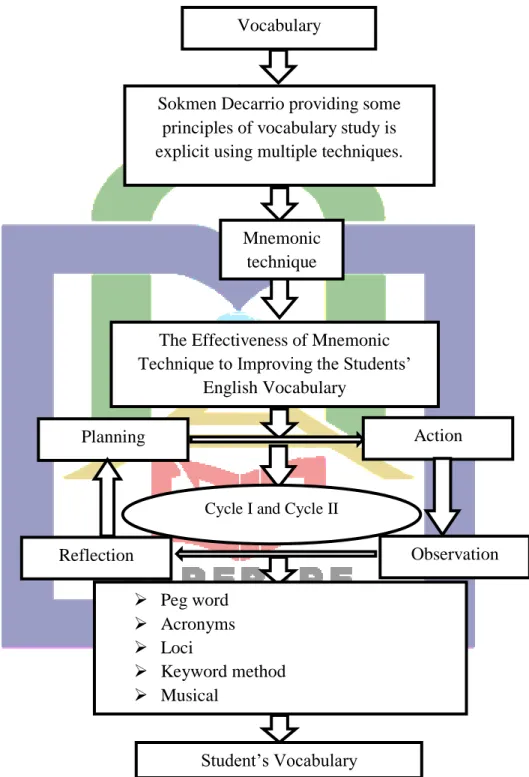
Figure 2.3 The Conceptual Framework of the Research Vocabulary
Sokmen Decarrio providing some principles of vocabulary study is explicit using multiple techniques.
Mnemonic technique
The Effectiveness of Mnemonic Technique to Improving the Students’
English Vocabulary (Classroom Action Research)
Planning Action
Cycle I and Cycle II
Observation Reflection
Peg word
Acronyms
Loci
Keyword method
Musical
Student’s Vocabulary
21
The researcher was design this study in the form of classroom action research.
This research will do in two cycles to overcome all students’ problem in vocabulary.
There were 3 meeting in each cycle. In each cycle divide into three activities. Each cycle consists of four steps, they are planning the action, acting, observing and reflecting the result of the observation. The teacher will apply the steps in the class base on lesson plan. The researcher use qualitative method in purpose of classroom action research. Related to the problem that faced by student, mnemonic as a technique to improve vocabulary that is appropriate in classroom action research design.
2.4 Hypothesis
The reasearch or scientific hyphothesis is a formal affirmative statement predicting a single research outcome, a tentative explanation of the relationship between two or more variables. For the hypothesis to be testable, the variables must be operationally defined. That is, the researcher specifies what operations are conducted, or test used, to measure each variable. Thus, the hypothesis focuses the investigation on a definite target and determines what observation or measure, are to be used.24
Based on the previous explanation and the conceptual framework the hypothesis in this class room action research is mnemonic technique can improve students’ vocabulary mastery in SMP Negeri 6 Parepare.
24John W. Best, Research in Education (United Stated of America: Prentice Hall Inc, 1981), p. 11.
2.5 Variable and Operational Definition of Research 2.5.1 Research Variable
Variables can be defined as any aspect of a theory that can vary or change as part of the interaction within the theory. In other words, variables are anything can affect or change the result of a study. Every study has variables as these are needed in order to understand differences. 25this research have two variables. They are
independent variable and dependent variable.
Independent variable (X) is a variable which effect to the dependent variable.
The independent variable of research is a mnemonic technique. Dependent variable (Y) is variable that is influenced by the independent variable. The dependent variable of this research is the students’ vocabulary at English .
2.5.2 Operational Definition 2.5.2.1 Vocabulary
Students vocabulary mastery is that knowing the meaning of English words and being able to use the words appropriately various context or the student’s knowledge about vocabulary which knows the meaning of the words and able to use it. It is indicated by the score achieved from the test given.
2.5.2.2 Mnemonic Technique
Mnemonic is a technique that can be easily practiced in student’s daily lives, while remembering certain words students can remember other words using this technique, because in this technique there are some fun ways to develop memorization words that are already known to students that refer to a new word that is not yet known by students based certain pattern, this will help students add their vocabulary.
25Cristhoper L. Heffner, Defining Variable ‘’allpsych.com/research methods/defining variables’’, accessed on 25 july 2019.
23
CHAPTER III
METHODOLOGY OF THE RESEARCH
3.1 Design of the Research
Research is process that is step combination that is done systematically and logically to get the solution of the problems or to the design of this study uses Classroom Action Research (CAR).
26
Figure 3.1 Cyclical action research model based on Kemmis and McTaggart in Burns
26Burns, A, Doing Action Research in English Language Teaching (New York: Routledge, 2010), p. 9.
The researcher designed this study in the form of classroom action research.
This research did in two cycles to overcome all students’ problem in vocabulary.
There were 3 meeting in each cycle. In each cycle divided into three activities.
Each cycle consists of four steps, they are planning the action, acting, observing and reflecting the result of the observation. The teacher applied the steps in the class based on lesson plan. The research design is as follow:
3.1.1 Planning
There are some preparations that prepare by the researcher related to the action as follows:
1. Preparing the materials.
2. Preparing lesson plan and designing the steps in doing the action.
3. Preparing list of students’ name and scoring.
4. Preparing sheets for classroom observation. It was prepared to know the situation of teaching-learning process when the technique applied.
5. Preparing teaching-aids.
6. Preparing test.
3.1.2 Action
The researcher implement the teaching learning activity of vocabulary using mnemonics technique based on the lesson plan.
3.1.3 Observing the action
Observation is one of the instruments used in collecting the data. The writer observed the students’ activities while teaching and learning process occur.
25
3.1.4 Reflection
The researcher was made an evaluation. The test is in the form of multiple choice tests. In this test, the students asked to answer the questions in the form of objective option.
The researcher used quantitative and qualitative method in purpose of classroom action research. Related to the problem that faced by student, mnemonic as a technique to improve vocabulary that is appropriate in classroom action research design. Nunan states that action research is a form of self-reflective inquiry carried out by practioner, aimed at solving problems, improving practice, or enhanching understanding27. Reflective enquiry undertaken by participants in social situation in order to improve the rationality and justice of their own practices, their understanding of this practices and the situations in which the practices are carried out. While, Mills states that the action research is any systematic inquiry conducted by teacher researchers, principals, school concelors, or other stage holders in teaching or learning environment, to gather information about the ways that their particular schools operate, how they teach, and how well their students learn28.
Burns mentions some characteristics of action research taken from expert definitions as follows:
1. Action research is contextual, small-scale and localized. It identifies and investigates problems within a specifics situation.
2. It is evaluating and reflective as it aims to bring about change and improvement in practice.
27Nunan, D, Research Method in Language Learning (Cambridge University Press, 1992), p.
229.
28Wright, C. Mills, The Power Elite (Oxford University Press, 2000), p.6.
3. It is participator as it provides for collaborative investigation by terms of colleagues, partitioners and researchers.
4. Changes in practice are based on the collection of information or data which provides the impetus for changes29. It can be concluded that action research is a form of self-reflective inquiry by teachers, researchers, principals, school counselors, or others take holders in teaching or learning environment to solve problems in order to get improvement.
The model of action research that used in this research was the model developed by Burns. According to the model, the implementation of the classroom action research includes four steps in the following:
a. Iden1tifying problems and planning the action.
b. Implementing the action c. Observing the action
d. Reflecting the result of the observation.30
In this pre-research, the researcher can use action research because the researchers will try to solve classroom problem in vocabulary mastery. The Classroom Action Research (CAR) aimed to improve the senior high school student’s vocabulary so that the result was higher than the previous. The researcher can use narrative text to tech vocabulary in communicative activity.
29Burn, Anne, Collaborative Action Research for English Language Teacher (Cambridge:
Cambridge University Press, 1999), p. 30.
30Burn, Anne, Collaborative Action Research for English Language Teachers, p. 32.
27
3.2 Subject of the Research
The researcher conducted research in SMP Negeri 6 Parepare. By focusing the eight grade students. The subject of this research is all of students in class VIII which consist of 28 students. The duration of the research was taken ± two months.
3.3 Instrument of the Research
The researcher used some instrument in this research, they were 3.3.1 Test
Test was used to find out the information about the result of the students English learning. The instrument that the researcher using in collect the student’s vocabulary through story, so they have to write vocabularies which they never find before and they memorized them.
3.3.2 Observation Checklist
The researcher used observational checklist to collect data about the students’
activity in teaching learning process to find out the data about Mnemonic technique in improving the students’ vocabulary mastery.
3.4 Procedure of Collecting Data
In collecting data accordance with the essence classroom action research Cycle II is an improvement of Cycle I, then each cycle consisting of planning, action, observation, and reflection. The procedure of collecting data was described as follows:
3.4.1 Cycle I
This cycle consist of planning, action, observation, reflection.
3.4.1.1 Planning
At this stage, there are some things that prepare and conduct by the researcher prior to portray herself as teacher in the classroom, this step is take so that the learning process can go well if it was done careful planning it, the things in stage is as follow: The researcher examined the students of SMP Negeri 6 Parepare, the researcher analyzed the subject matter, the researcher analyzed to the school’s curriculum, the researcher created lesson plans (learning implementation plan), the researcher prepared supporting materials, such as creating sheet of observation and assessment tools.
3.4.1.2 Acting
This stage is the implementation or follow-up the planning of stage, as for who do as follows: The researcher explained the material about Peg word and applied it to his class through assignments or games, the researcher explained the material Acronyms word and applied it to his class through assignments or games, the researcher explained the material Loci word and applied it to his class through assignments or games.
3.4.1.3 Observing
The researcher observed the situation on the classroom the students being activity, student’s interaction in the classroom action during the teaching learning process and vocabulary ability.
29
3.4.1.4 Reflection
At this stage the result obtained at this stage was collected and analyzed observation made further improvements to the improvement action plan in the next cycle.
3.4.2 Cycle II 3.4.2.1 Planning
The planning in this stage was generally the some as planning in the first cycle. Making lesson planned for learning process. However all wrong thing in the first cycle would be revised.
3.4.2.2 Action
The researcher explained the material about Keyword and applied it to his class through assignments or games. Then, the researcher explained the material about Musical and applied it to his class through assignments or games.
3.4.2.3 Observation
The researcher observed and making note all activity during learning and teaching process, make a note all activity of the students based on the revision and evaluation in the first cycle.
3.4.2.4 Reflection
The activities in reflection stage same with reflection, action in the first cycle.
The researcher analysis and consider result of the second cycle, and compare.
3.5 Indicator of Leaning Achievement
The indicator of this research in measuring the effectiveness and the success of this learning as follows:
1. The main score of students’ outcomes in vocabulary improved ≤ 50% from the cycle I to the cycle II.
2. The student is more effective to do their assignment, the researcher can see from the observation sheets.
3. The learning have complete if 60% students were predicated as good in vocabulary.
3.6 Technique of Data Analysis
The data that from cycle I and cycle II were analyzed through the following steps, as follows:
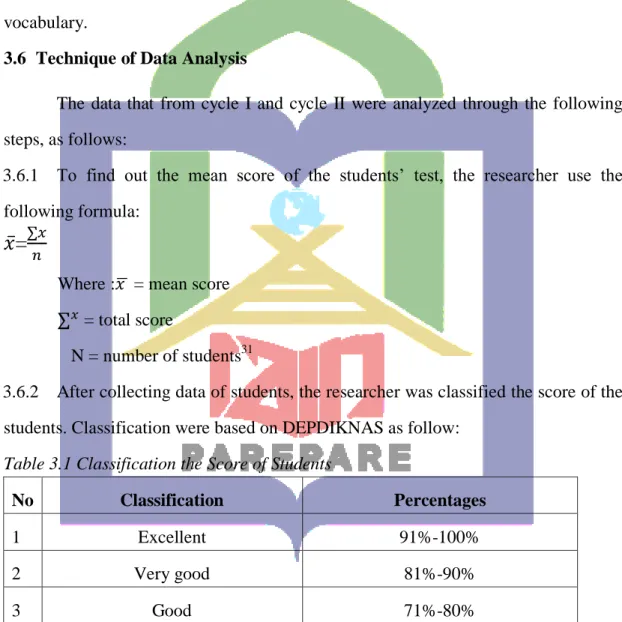
3.6.1 To find out the mean score of the students’ test, the researcher use the following formula:
𝑥̅=
∑𝑥𝑛
Where :𝑥 ̅ = mean score
∑𝑥 = total score
N = number of students31
3.6.2 After collecting data of students, the researcher was classified the score of the students. Classification were based on DEPDIKNAS as follow:
Table 3.1 Classification the Score of Students
No Classification Percentages
1 Excellent 91%-100%
2 Very good 81%-90%
3 Good 71%-80%
31Ariftiro, Muhammad, Dasar-Dasar Statistika (Ujung Pandang: Universitas Negeri Makassar, 1999), p. 177.
31
4 Fairly 61%-70%
5 Poor 51%-60%32
3.6.3 To conclude the percentage of the students’ score, the researcher uses formula as follow:
P=𝐹
𝑁 x 100
Where: P =Percentages F = Number of correct N = Number of sample
32Departemen Pendidikan Nasional, Pedoman Pengembangan Silabus (Jakarta: Depdiknas Republik Indonesia, 2002), p. 67.
32 CHAPTER IV
FINDINGS AND DISCUSSION 4.1 Research Findings
4.1.1 Description of activity
On Tuesday 8th October 2019 the first time for the researcher came in the schoolof SMP Negeri 6 Parepare made observation. The researcher met the headmaster to converse about research plan, the headmaster asked to meet with English teacher, when met the English teacher the researcher asked him for permission to research to him class, theEnglish teacher gave permit and asked the researcher about condition and skill of students. The English teacher said that ‘’she just the students basic material because the students’ ability to mastery of vocabulary still low’’.
After got information about the student’s condition in the class, the researcher used Mnemonic as an alternative technique that can help students for improving their vocabulary. The researcher asked the teacher to give the data and lesson schedule of the students of SMP Negeri 6 Parepare. The teacher asked researcher to choose which one class that would be researched and the researcher just focus in VIII class.
Saturday 9th October 2019, the researcher came to class VIII to see the condition of class, when the researcher came in class the students welcomed and gave greeting for the researcher as usually they did, then the student said pray together, after that the researched introduced herself to students and it was the first meeting to them, after the researcher introduce herself, the researcher asked the students to introduce their self one by one. Before the students introduce their self the researcher asked them, did you ever learn about the introduction? ‘’yes’’ the students said, then
33
the researcher asked them to introduce their self in English. Four of them could introduce their self correctly and some of them could not introduce their self because they forgot the lesson and did not memorize again. Then the researcher asked them to open their book to introduce their self.
4.1.2 Presentation Data Process of Cycle 1 Action Research
Discussion of cycle consist of four phrase, those are planning, action, observing, and reflecting
4.1.2.1 Planning
After the researcher decided to use Mnemonic technique in teaching vocabulary the next activity the researcher prepared anything that needed for learning process. Based on the data from first information did as follows: The researcher helped the students to memorize words easily through Mnemonic technique, set the standard of competence, made lesson plan, made the observation sheet for the student’s achievement,
4.1.2.2 Action
4.1.2.2.1 The first meeting
Thursday 10th November 2019 was the first meeting to give the students material, before started the first lessons the researcher explained the meaning and the important of vocabulary to master of English and the important vocabulary in their life to make the students motivated in learning English. The students gave greeting and also prayed before studied, then the researcher started to explain the first material from Mnemonic technic, the researcher explained about the material and also gave the example how to use this technique. First students asked by the researcher to mentioned some vocabulary about their class. Students were gave an example of a
vocabulary regarding the home environment in descriptive text. Students identified the vocabulary mentioned from the text. After that the students were told to find vocabulary who had different writing but who bears a resemblance to names, compatible with the material and discussed together. Students are asked to made list of vocabulary at least 10 to be memorized at the next meeting.
4.1.2.2.2 The second meeting
In the second meeting, Friday 11th November 2019, the researcher presented the material about mnemonic technique, the research prepared some of methods which was suitable with mnemonic technique to make students active, creative and fun in learning process. Before started the lesson the students gave greeting for the researcher as usually they did, then the students prayed together before studied. After that the researcher explained how to use the Mnemonic technique. The researcher got students to make groups. After that the students were given an example of how to memorize vocabulary using mnemonic technic, then students gave a blank card that they would fill later with a new vocabulary and found the meaning of the words.
They were asked to made a phrase of the few words they often found compatible with the concept of mnemonic technique, then students wrote down a vocabulary list they had obtained then exchanged the card with their group friends and read it, the last, before the researcher ended the meeting for today students were given the task of making 10 new vocabulary list and found the meaning of the word to memorize in the next meeting.
4.1.2.2.3 The third meeting
The third meeting Tuesday 17th November 2019, in this meeting there 24 students attended the day. Before starting the lesson, the class was opening and
35
praying by students and the researcher, checked the attendance of students, and gave stimulation, motivation, indicator should be purposed to students before entering the lesson. Before the researcher entering the lesson the researcher did not forget to examine the students’ memorizing.
After that the researcher gave a new material about mnemonic technic to help students to learned vocabulary easily. The students gave an example of how to memorize anew vocabularies using the mnemonic technique. Students made good use their environment to expanded a new vocabulary, they do that in their class and in their houses, then the students were asked to made a list of vocabularies coil they had found and read it at once memorize it. Day after day the students enjoy with this technique because the technic made them happy and got many vocabularies.
Before closed this meeting the researcher gave the students10 list of vocabulary, then memorized in their houses and were presented in the next meeting.
After that the researcher gave the students motivation and the conclusion of the students’ activity in this meeting as follows: One student was not present in this meeting, all of students were active in learning process, the students’ knowledge about the material was still poor, sometimes the students could not answer the researcher questions, the researcher could see the students’ improvement in learning English,
4.1.2.3 Observation
During the class, the researcher and teacher made collaboration. The teacher opened the class and gave some advised, and then the researcher continued to give the explanation about the material and the teacher as the observer continued to take
observation checklist from the students during the learning process based on the planning above. The factors observed by the observer during the class as follow:
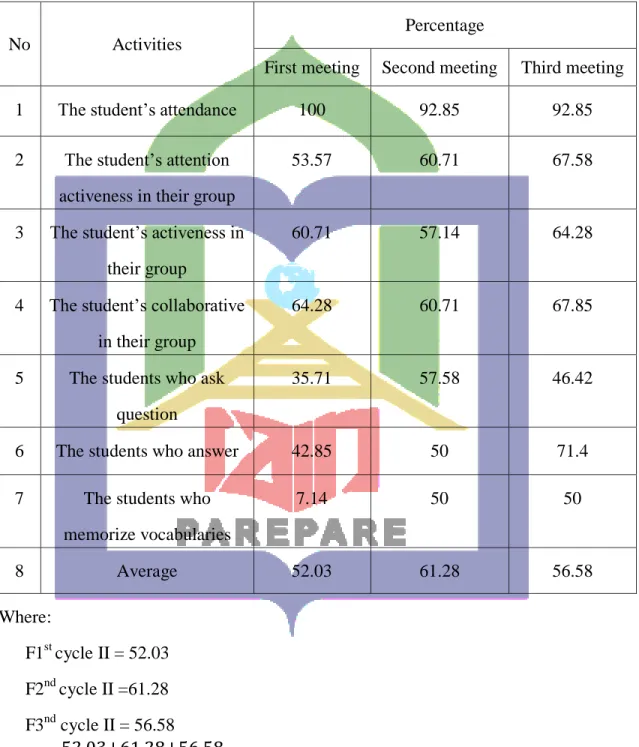
Table 4.1: Average of the Student’s Observation Checklist in Cycle I
No Activities
Percentage
First meeting Second meeting Third meeting
1 The student’s attendance 100 92.85 92.85
2 The student’s attention activeness in their group
53.57 60.71 67.58
3 The student’s activeness in their group
60.71 57.14 64.28
4 The student’s collaborative in their group
64.28 60.71 67.85
5 The students who ask question
35.71 57.58 46.42
6 The students who answer 42.85 50 71.4
7 The students who memorize vocabularies
7.14 50 50
8 Average 52.03 61.28 56.58
Where:
F1st cycle II = 52.03 F2nd cycle II =61.28 F3nd cycle II = 56.58 F
=
52.03+61.28+56.583