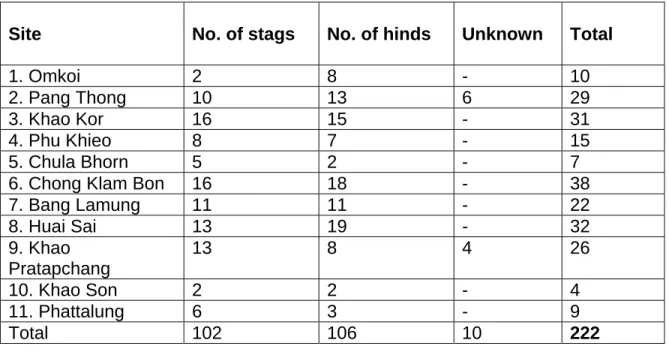
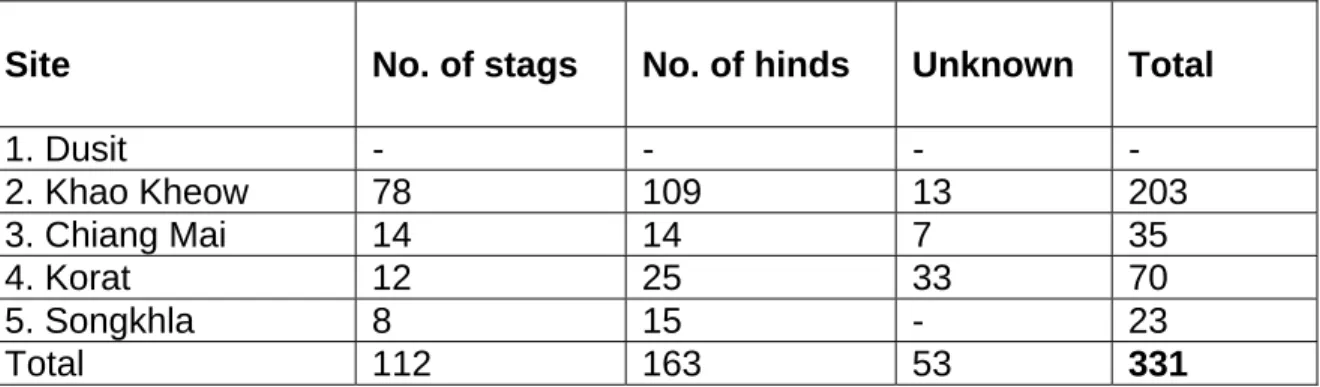
The status and distribution of Eld's deer Cervus eldi siamensis in Preah Vihear Province, Cambodia. It was very encouraging to see the progress made in various aspects of Eld's deer conservation. Surveys were conducted on foot, with camera traps used at key locations to confirm the presence of Eld's Deer.
To estimate the status and distribution of Eld's Deer and other key species in Preah Vihear Province. In the dry season, hunting is mostly concentrated around water sources (ponds) where Eld's Deer would drink or graze. At this time wildlife, including Eld's Deer, will migrate to the restricted areas of upland Dry Dipterocarp Forest.
During the last investigation a dead Eld's Deer was found and our guides insisted that it had been abandoned by Dhole. Camera trap data shows that in areas where domestic livestock are present, there is very little evidence of Eld's Deer. Populations and locations of Eld's Deer and other important species should be monitored annually.
Monitoring of Eld's Deer should be considered during breeding time and when they come to water sources.
Short history of the project and site
Threats to Eld’s Deer and Habitat
Current Collaborative Activities
The forest area where the Eldo deer population lives was officially designated as an Eldo deer sanctuary by the provincial governor in April 2004. Provincial Office for Agriculture and Forestry (PAFO). PAFO has been given computer and office equipment and the salary of one PAFO staff has been supplemented by WCS so that he can act as the government's Elda deer conservation coordinator.
In 2003, WCS implemented an incentive program to encourage village support of Eld's deer conservation activities. In 2004, two research projects were undertaken in the Eld's Deer Sanctuary, through collaboration between WCS and the Department of Biology of the National University of Laos (NUoL). Students used the research results in their final year theses, and WCS included the results in a Technical Report on Eld's deer habitat.
From this research and previous research from WCS-Lao and research from Myanmar, 15 plant species that provide food for Eld's deer were identified as occurring in the sanctuary, mainly grasses, grass-like species and fruit-bearing trees. To a lesser extent, headwater, agricultural, and grassland habitats hosted plant species foraged by Eld's deer.
Future Plans for Activities and Research
The one village located within the Sanctuary owned 50% of the rice fields, and the two villages bordering the Sanctuary owned most of the rest. The second student project aimed to estimate the proportion of each habitat type in the same 100 km2 area of the reserve by identifying the habitat type along eight 1 km transects. In addition, they provided a floristic analysis of each habitat type, based on surveys of 10 vegetation plots per habitat type.
Open Dipterocarp Forest was found to be the most common vegetation type, accounting for 80% of transects on average (Figure 11 from the report). More than 260 plant species were identified across the six habitat types, including four IUCN Red List tree species (yet to be confirmed). Although evergreen and semi-evergreen forests did not provide as much foraging potential for the deer, these two habitats were the most diverse in plant species.
Conclusion
However, Eldo's deer habitat has been exterminated or degraded by the agriculture of three local villages. In all aspects of the Eld's deer project, cooperation and especially the involvement of villagers was emphasized. The male Eldo deer originated from Pursat province and arrived in Kampot in September 2001.
Elda the male deer is currently housed alone and appears to be in good health. It allowed government officials to realize their contributions to the conservation of Eldo deer in Hainan. The forest around the research station is in excellent condition, but not suitable for deer.
The forest currently contains bantang, which is a good indication that it would be suitable for field deer. The year 2004 marked the important milestone for the conservation of the Eld Deer (Cervus eldi) in Thailand. Retrospective study of the historical distribution of the Eld deer, researched from both published data and fossils.
Establishment of genome resource bank (GRB) for Siamese Eld's deer and training for Thai ZPO staff. This step is critical to the future activities as a master plan and detailed road map for Eld's deer conservation and restoration. Collective management and guidance by a coordinated Thailand Eld's Deer Conservation Committee (TEDCC) consisting of the highest authorities in the Zoo.
There is a significant number of 'surplus' Eld's deer in the current population of unknown genetic origin. A major challenge is to identify suitable habitat for experimental as well as authentic Eld deer reintroduction activities. Conduct a fire ecology and management study to create suitable habitat for Eld deer recovery.
Recently, the government also passed the Forest Act to preserve deer and their biodiversity.
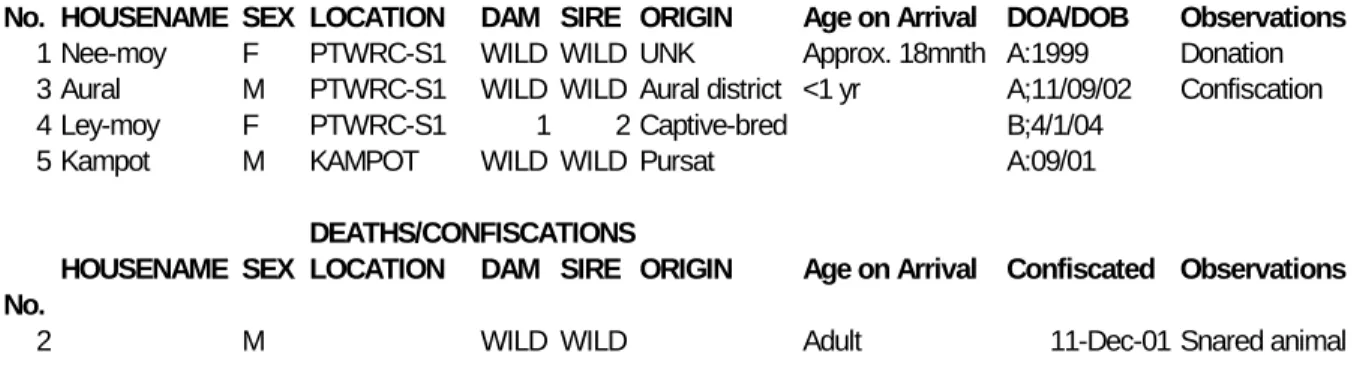
Conduct a regional survey for presence/absence of Eld’s deer in Lao, Cambodia, and Thailand tri-border area
There is a need to know how these deer react to water, fire, China and Cambodia. There is a need to know how these deer respond to water, fire and grasslands embedded in a forest matrix. Identify projects in range countries that will address the role of ecological factors in the ability of protected areas to support El's deer.
Chatthin Wildlife Sanctuary needs financial support Action step
Establish a third population of Siamensis in Hainan Island Action step
Consolidate captive animals in Cambodia into one herd (plus use of confiscated animals from illegal trade)
Assess the potential of animals to migrate from Cambodia and Laos to Thailand, independent of attempts at captivity.
Viable populations of wild deer within the Western Forest Complex. Several populations needed
Develop a poster (prototype) for the Eld's deer for inclusion in regional Eld's deer awareness programs. Objective: To develop a specific module for Eld's deer for inclusion in a training course for field assessment/survey techniques/habitat assessment at the regional level (develop a series of Eld's deer specific modules to teach people how to survey in low-density situations and the general condition of conservation, threats and biology; also include habitat assessment maps). Establish a viable population for both subspecies (Thamin and Siamensis) for reintroduction Action Step 1a: Develop a proposal and submit it to the Ministry of Natural Resources.
Action Step 1b: Conduct genetic analysis of ZPO's Eld's deer population to establish subspecies or resolve potential hybrid issues. Should consider tagging individuals so that once subspecies is confirmed, individuals from this sub-population can be included in the genetic management population. Boripat Siriaroonrat (safe samples from USA); Sumate Komalnarnath (secured at least 25 individual specimens from ZPO, DNP and private collections each); Naris Bhumpakphan.
Action Step 1c: Establish the Captive Management Subcommittee, recommended in the Strategic Plan, to establish a plan for the genetic management of both subspecies. We should consider training staff in genetic management, establishing a studbook for both subspecies, and developing a plan to move the stock animals to the DNP facility. Objective: To develop a cooperative genetic management plan for the siamensis subspecies. Action Step 1a: Implement a marking and identification system for all animals (siamensis) in captivity and set up a studbook.
Action Step 1b: Thai and Cambodian counterparts will develop a proposal for the development of a joint prison management program. This proposal should consider strategies to upgrade facilities at Phnom Tamao Rescue Center and provide animals for the Cambodian genetic management program. Action Step 1c: Once project proposal is approved, proceed to develop a memorandum of understanding between Thai and Cambodian authorities.