ISBN 92-64-18589-5 96 2001 01 1 P
The Well-being of Nations
THE ROLE OF HUMAN AND SOCIAL CAPITAL EDUCATION AND SKILLS
The Well-being of Nations
The Well-being of Nations
THE ROLE OF HUMAN AND SOCIAL CAPITAL
«
In a rapidly changing world, the success of nations, communities and individuals may be linked more than ever before, to how they adapt to change, learn and share knowledge.
This report helps clarify the concepts of human and social capital and evaluates their impact on economic growth and well-being. Although the evidence on social capital is less developed, reflecting the novelty of the concept in economic and social science, the report draws on a number of empirical studies which suggest potentially important linkages between human and social capital.
The evidence suggests that human and social capital can be of key importance in contributing to a wide range of positive outcomes, including higher income, life satisfaction and social cohesion.
Although there is no evidence for systematic "under-investment" in either human or social capital, concerns are expressed about the distribution and quality of each form of capital and how this might impact on future well-being. There is limited scope for public policy to change the quality, stock and distribution of human and social capital in the short-term. However, a number of areas are discussed in which public, private and voluntary actors may leverage long-term improvements in both human and social capital.
EDUCATION AND SKILLS
w w w. o e c d . o rg
-:HSTCQE=V]Z]^U:
The Well-being of Nations
THE ROLE OF HUMAN AND SOCIAL CAPITAL
ORGANISATION FOR ECONOMIC CO-OPERATION AND DEVELOPMENT
AND DEVELOPMENT
Pursuant to Article 1 of the Convention signed in Paris on 14th December 1960, and which came into force on 30th September 1961, the Organisation for Economic Co-operation and Development (OECD) shall promote policies designed:
– to achieve the highest sustainable economic growth and employment and a rising standard of living in Member countries, while maintaining financial stability, and thus to contribute to the development of the world economy;
– to contribute to sound economic expansion in Member as well as non-member countries in the process of economic development; and
– to contribute to the expansion of world trade on a multilateral, non-discriminatory basis in accordance with international obligations.
The original Member countries of the OECD are Austria, Belgium, Canada, Denmark, France, Germany, Greece, Iceland, Ireland, Italy, Luxembourg, the Netherlands, Norway, Portugal, Spain, Sweden, Switzerland, Turkey, the United Kingdom and the United States. The following countries became Members subsequently through accession at the dates indicated hereafter: Japan (28th April 1964), Finland (28th January 1969), Australia (7th June 1971), New Zealand (29th May 1973), Mexico (18th May 1994), the Czech Republic (21st December 1995), Hungary (7th May 1996), Poland (22nd November 1996), Korea (12th December 1996) and Slovak Republic (14th December 2000). The Commission of the European Communities takes part in the work of the OECD (Article 13 of the OECD Convention).
The Centre for Educational Research and Innovation was created in June 1968 by the Council of the Organisation for Economic Co-operation and Development and all Member countries of the OECD are participants.
The main objectives of the Centre are as follows:
– analyse and develop research, innovation and key indicators in current and emerging education and learning issues, and their links to other sectors of policy;
– explore forward-looking coherent approaches to education and learning in the context of national and international cultural, social and economic change; and
– facilitate practical co-operation among Member countries and, where relevant, with non-member countries, in order to seek solutions and exchange views of educational problems of common interest.
The Centre functions within the Organisation for Economic Co-operation and Development in accordance with the decisions of the Council of the Organisation, under the authority of the Secretary-General. It is supervised by a Governing Board composed of one national expert in its field of competence from each of the countries participating in its programme of work.
Publié en français sous le titre : DU BIEN-ÊTRE DES NATIONS : Le rôle du capital humain et social
© OECD 2001
Permission to reproduce a portion of this work for non-commercial purposes or classroom use should be obtained through the Centre français d’exploitation du droit de copie (CFC), 20, rue des Grands-Augustins, 75006 Paris, France, tel. (33-1) 44 07 47 70, fax (33-1) 46 34 67 19, for every country except the United States. In the United States permission should be obtained through the Copyright Clearance Center, Customer Service, (508)750-8400, 222 Rosewood Drive, Danvers, MA 01923 USA, or CCC Online: www.copyright.com. All other applications for permission to reproduce or translate all or part of this book should be made to OECD Publications, 2, rue André-Pascal, 75775 Paris Cedex 16, France.
3
This report is a publication of the Centre for Educational Research and Innovation at the OECD. It was co-authored by Tom Healy and Sylvain Côté, with significant input from John F. Helliwell (University of British Columbia, Canada), Simon Field and many other colleagues within the OECD Secretariat.
This report profited greatly from the advice of a wide range of both academic experts and official country representatives at meetings of OECD committees and boards which guided the development of the work. Two outside events were also particularly significant: first, an international symposium organ- ised and co-sponsored by Human Resources Development Canada (HRDC) and the OECD on The Contri- bution of Human and Social Capital to Sustained Economic Growth and Well-being held in March 2000 in Québec City, Canada; second, a meeting of a group of experts on human and social capital who met at the OECD in July 2000 to review the first draft of this report.
The volume is published on the responsibility of the Secretary-General of the OECD.
4
Acknowledgements
Among the international group of experts who contributed to the report, particular thanks are due to:
Gunnar Eliasson (Royal Institute of Technology in Stockholm), Dominique Foray (Université Dauphine, Paris), David Halpern (University of Cambridge, UK), Tom Kellaghan (Education Research Centre, Ireland), Bengt-Aake Lundvall (Aalborg University, Denmark), Peter MacDonagh (advisor to the Irish Prime Minister), Lars Osberg (University of Dalhousie, Canada), Robert D. Putnam (Harvard University, US), Jo Ritzen (Vice-President, World Bank), Tom Schuller (Birkbeck College, UK), Simon Szreter (University of Cambridge, UK), Jonathan Temple (Oxford College, UK), Doug Willms (University of New Brunswick, Canada), Michael Woolcock (World Bank), Jean-Pierre Worms (Centre de Sociologie des Organisations, Paris).
Special thanks are due to Human Resources Development Canada (HRDC), particularly to Jean-Pierre Voyer and Richard Roy, for supporting the project at various stages, for funding the secondment of Sylvain Côté to the OECD secretariat, and for co-sponsoring the symposium in Quebec City in March 2000.
5
Introduction ... 7
Chapter 1. Emerging Social and Economic Concerns... 9
1.1. What are today’s governments and societies concerned about? ... 9
1.2. What is happening in some of these key areas of concern?... 10
1.3. The inter-relationship between well-being and human and social capital ... 12
1.4. Is well-being sustainable over time?... 14
Notes ... 15
Chapter 2. The Evidence on Human Capital... 17
2.1. Introduction ... 17
2.2. What do we mean by human capital? ... 17
2.3. How do we measure human capital?... 20
2.4. How is human capital developed? ... 20
2.5. How is human capital distributed?... 24
2.6. Changing demand for human capital... 26
2.7. What is the impact of human capital on economic well-being? ... 28
2.8. What is the impact of human capital on all aspects of human well-being? ... 32
2.9. Summing up... 35
Notes ... 37
Chapter 3. The Evidence on Social Capital... 39
3.1. Introduction ... 39
3.2. Different concepts of social capital ... 39
3.3. How do we measure social capital?... 43
3.4. The sources of social capital... 45
3.5. Are trust and civic participation changing over time?... 48
3.6. What lies behind changes in levels of trust and civic participation? ... 49
3.7. What is the impact of social capital on well-being? ... 52
3.8. The relationship between social capital and social inequality... 55
3.9. Impact of social capital on economic well-being ... 57
3.10. Conclusion... 61
Notes ... 62
Chapter 4. Policy Implications and Further Research Needs... 65
4.1. Introduction ... 65
4.2. Policies for human capital ... 66
4.3. Policies for social capital ... 67
4.4. Knowledge gaps and future areas of research ... 69
4.5. Conclusion... 70
Notes ... 72
6
Appendix A. Some Measures of Well-being... 73
Appendix B. Some Trends in the Social and Economic Environments... 80
Appendix C. Determinants of School Attainment: the Research Evidence... 90
Appendix D. The Impact of Human Capital on Economic Growth: Some Major Studies... 95
Appendix E. Are Trust and Civic Engagement Declining in OECD Countries?... 99
References ... 105
List of Tables 3.1. A measure of trust (World Values Study), 1995-96 ... 44
D.1. The impact of education in cross-country regression analysis: some major studies ... 96
List of Figures 1.1. Relationship between human well-being, economic well-being and GDP... 10
1.2. Key inputs to human well-being and their inter-relationships ... 12
2.1. Comparative distribution of literacy levels ... 21
A.1. Illustration of the Osberg Index ... 75
A.2. International comparisons of trends in economic well-being... 76
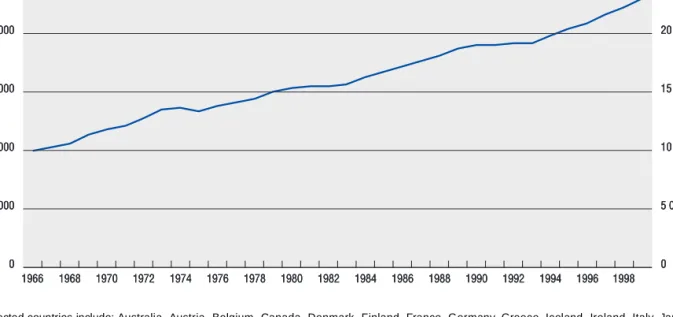
B.1. Real gross domestic product per capita, in constant prices, average based on selected OECD countries, 1966-99 ... 80
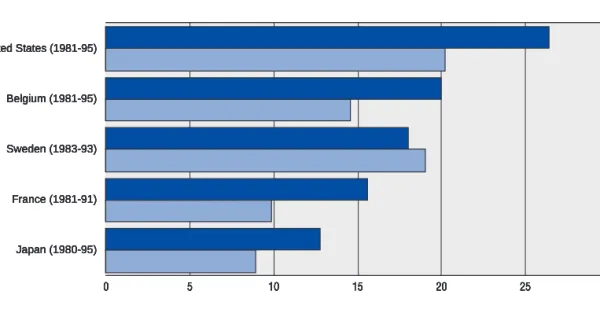
B.2. Trends in income inequality for the entire population, selected OECD countries, mid-1980s and mid-1990s ... 81
B.3. Percentage of children living in relative poverty, selected OECD countries, 1990s ... 82
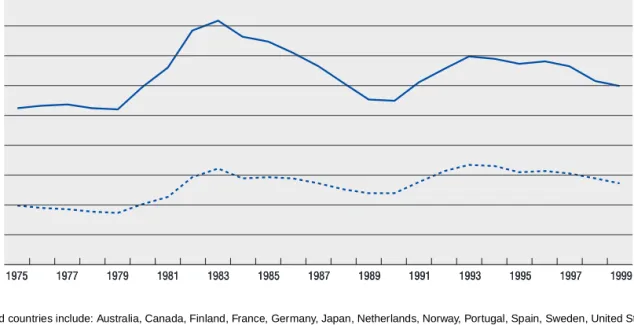
B.4. Unemployment rates, 25-54 year-olds and 15-24 year-olds, selected OECD countries, 1975-99 ... 83
B.5. Age/dependency ratios, OECD countries, 1950-2050... 83
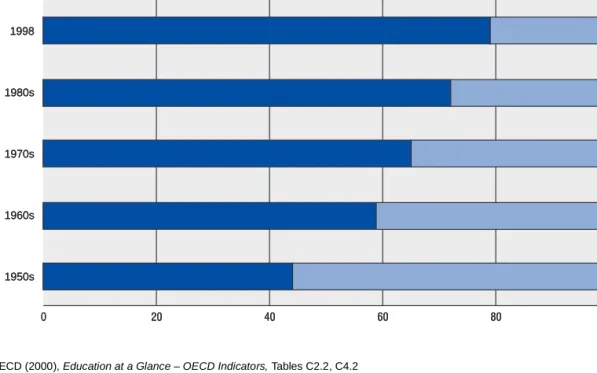
B.6. Percentage of the population 25-64 years of age in OECD countries with completed upper secondary education or higher, 1950-98 ... 84
B.7. Incidence of lone-parenting, selected OECD countries, comparison between the 1980s and 1990s ... 84
B.8. Differences in earnings between men and women, 25-64 year-olds (for full-time workers), 1980s to 1990s... 85
B.9. Average labour force participation rates for men and women aged 15-64, selected OECD countries, 1960-99 ... 85
B.10. Arrivals of foreigners into OECD countries, 1999 ... 86
B.11. Number of acute drug-related deaths recorded in the European Union per million people, 1986-97... 86
B.12. Criminal victimisation rates, 1980s and 1990s... 87
B.13. Average life expectancy at birth, selected OECD countries, 1960-98 ... 87
B.14. Recent trend in life-satisfaction in the European Union, 12 selected countries, 1973, 1983 and 1997 ... 88
B.15. Proportion of people giving different happiness answers in the United States, 1972-98 ... 88
B.16. Suicide rate in selected OECD countries, 1950-97 ... 89
B.17. GHG emissions in OECD countries under alternative scenarios, 1990-2010 ... 89
E.1. Club meeting attendance dwindles in the United States, 1975-1999 ... 99
E.2. Demand for legal and security has increased in the United States, 1900-1997... 100
7
The role of human capital in supporting economic and social development is a long-standing theme, although there continues to be dispute over its exact significance. Recent years have also wit- nessed increasing attention to the role of social capital – exploring the idea that social relationships, as well as individual attributes, play a critical role in economic activity and human well-being.
The purpose of this report is threefold: i), to describe the latest evidence covering investment in human capital and its impact on growth and well-being; ii) to describe and clarify the more novel con- cept of social capital; and iii) to identify the roles of human and social capital in realising sustainable economic and social development. This report is an input to the OECD projects on economic growth and sustainable development. It also builds on the 1998 OECD report, Human Capital Investment – An International Comparison.
Chapter 1 outlines the key concerns, trends, concepts and relationships discussed in the report as well as the main questions to be addressed. Chapter 2 considers the definition and measurement of human capital, covering all types of skills and attributes embodied in individuals relevant to well- being. The sources of human capital in families, schools, communities and workplaces are discussed, especially in relation to the distribution of learning opportunities and outcomes across different groups.
The chapter also assesses the empirical evidence for the impact of human capital on the economy and society. Chapter 3 addresses the conceptual and measurement framework for social capital, examining its sources and impacts on a broad range of possible outcomes. The potential for complementarity between human and social capital, both from a conceptual and an empirical standpoint, is discussed.
Chapter 4 addresses some basic questions about the implications for public policy of the preceding analyses of human and social capital and identifies further research and data needs at the international level. A key consideration is that many actors are involved in promoting and harnessing high-quality investments in organisations, communities and people.
9
EMERGING SOCIAL AND ECONOMIC CONCERNS
“Distinctions must be kept in mind between quantity and quality of growth, between its costs and return, and between the short and the long run… “Goals for ‘more’ growth should specify more growth of what, and for what”. Simon Kuznets in The New Republic (1962).
This report is concerned with human and social capital, not as ends in themselves, but as resources which can be used to support economic and social development. The purpose of this chapter is to set the discussion of human and social capital in the context of these broader social objectives.
1.1. What are today’s governments and societies concerned about?
Inclusion and quality of life are major concerns for government and society…
Governments and societies seek economic growth but are also increas- ingly concerned about its impact on the natural and social environments.
They are concerned about inequality, about the possibility of new forms of exclusion and poverty as the use of technology expands and, more generally, about the quality of life and health of children, the elderly and individuals and groups confronting economic and social disadvantage. Dealing with these concerns is made all the more complex by changing patterns of work, family life and community engagement.
… and important shifts in values and attitudes are taking place.
Underlying these emerging concerns are fundamental shifts in values and patterns of social engagement which are occurring in many OECD countries, shifts which may call for a re-appraisal of policy objectives. Many of these shifts point towards greater diversity and more emphasis on self-expression, individual autonomy and responsibility, subjective well-being and quality of life. The World Values Study suggests that beyond a certain threshold of income per capita, increases in subjective well-being diminish for higher income (Inglehart, 1997).
Economic and social progress need not be contradictory…
Many observers have examined the interface between economic progress and social dysfunction – for example, the implications for workers of rapidly changing technology, skills obsolescence, job insecurity and longer hours of work. This report finds no evidence to show that increased economic prosperity has necessarily depleted social capital reserves, but it does suggest a link between some aspects of economic progress and increased stress or loosening of social ties. However new conditions of production and work also give rise to new opportunities which, when seized, may contribute to significant advances in well-being.
10
… but we need to be concerned about long- run changes in human well-being, as well as short-run increases in economic output.
Social objectives are broader than immediate increases in economic out- put because: i) the evolution of total, and not just economic, well-being is of importance; and ii) the long-term impact of economic, environmental and social trends needs to be factored into any analysis of current policy options.
The time dimension is crucial in considering current investment and produc- tion patterns and anticipated future downstream impacts, since uncertainty and long gestation periods characterise many public and private policy choices. To bring about higher and sustainable levels of well-being, it is important to understand the impacts of developments in the human and social environments as well as physical and natural ones.
1.2. What is happening in some of these key areas of concern?
Rapid economic growth has reduced absolute poverty…
Recent decades have witnessed large increases in economic output across OECD countries with increases in standards of living and working con- ditions as well as in health and educational attainment. Although the rising tide of material wealth may not have raised all boats to the same extent everywhere, levels of absolute poverty and deprivation have declined in OECD countries since the 1950s. While economic growth is not the only policy objective, it does provide the resources for tackling social exclusion, poverty and poor levels of health. Following unprecedented increases in economic output, concern is now turning more to the “quality” of economic growth and how to achieve further increases in well-being.1
… but well-being is broader than economic well-being…
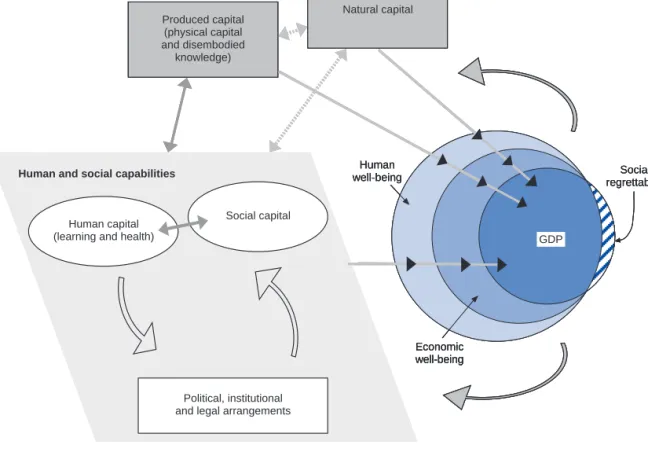
Figure 1.1 depicts three layers of well-being.2 Well-being includes economic well-being but also extends to the enjoyment of civil liberties, relative freedom from crime, enjoyment of a clean environment and individual states of mental and physical health. In this vein, Sen (1987) emphasises opportunities or the
“social capabilities” of individuals to choose and achieve the life goals that best suit them. On this approach, growth in economic output enlarges the range of
Figure 1.1. Relationship between human well-being, economic well-being and GDP
Source: OECD.
Social regrettables GDP
Human well- being
Economic well- being
Social regrettables GDP
Human well- being
Economic well- being
Social regrettables GDP
Human well- being
Economic well- being
11
human choice (e.g.work, leisure or political and cultural activities) rather than serving as a goal in itself. Outcomes (“functionings” according to Sen) are less significant than “opportunities” enabling people to achieve the life that suits them and which they have chosen. The realisation of human capa- bilities is therefore vital for a broader notion and measure of human and social development. Human well-being is more than the sum of individual levels of well-being since it relates to individual and societal preferences regarding equality of opportunities, civil liberties, distribution of resources and opportunities for further learning.
… and economic well-being is broader than measures such as GDP.
Economic well-being – flowing from economic output – is an important component of well-being. However gross domestic product (GDP)3 has signifi- cant limitations as a measure of economic output. GDP captures current pro- duction of those consumption and investment goods and services accounted for in the National Accounts but excludes non-market household activity4 (such as parenting) and activities such as conservation of natural resources that contrib- ute to future well-being through net additions to the capital stock of society.5 Aggregate measures of output and income, such as GDP, also fail to reflect social preferences concerning equity goals.
GDP includes activities which do not contribute directly to well-being.
GDP includes goods and services which do not contribute directly to well-being. These items are exemplified by so-called “regrettables” arising from outcomes such as pollution, crime and divorce. Figure 1.1 depicts “social regrettables” within GDP but outside well-being (including economic well- being). “Social regrettables” are represented by outlays and expenditures which do not directly contribute to well-being but are nevertheless deemed to be necessary, for example national security (refer to Appendix A).
We cannot expect a clear consensus on what is meant by well-being…
Our understanding of well-being or human welfare is pervaded by values that will vary between individuals and social groups. There are also technical difficulties in measuring the dimensions of well-being. Subjective aspects of well-being, such as reported levels of life satisfaction and personal well- being, are difficult to measure or relate to underlying explanatory factors.6 In defining social needs, some judgement is necessary as to how to value the needs of different groups in civil society. For example, a certain degree of income inequality may be desirable for ensuring incentives for work and may also reflect the preferences of individuals for a particular lifestyle, place of liv- ing, occupation and balance between leisure and work or between voluntary caring and paid employment. To highlight key social trends, it is possible to choose different indicators and implicitly attach different weights or levels of importance to each (see Appendix A).
… but this has not prevented attempts to develop summary measures.
Despite these difficulties, several attempts have been made to arrive at a summary measure of well-being. One approach (Osberg, 2001) relates to eco- nomic well-being only, and brings together four main types of indicators: i) cur- rent per capita consumption flows; ii) changes in capital stocks (including natural and human); iii) changes in income distribution; and iv) changes in economic risks.
These measures suggest that well-being has lagged behind GDP.
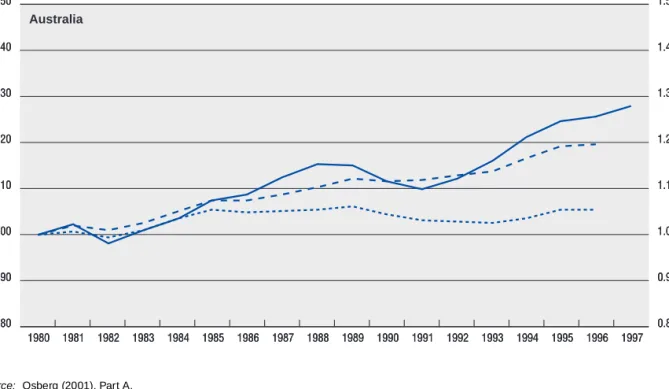
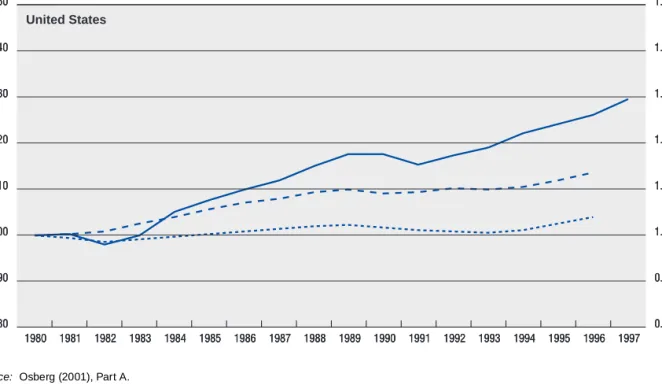
Trends in measures of well-being in some OECD countries appear to have lagged behind rising GDP per capita (see Appendix A). Measures by Osberg (2001) suggest that, up to the 1980s, trends in per capita GDP for many OECD countries closely tracked trends in economic well-being, only to diverge since then. The results for 5 countries are shown in Figure A.2. Similarly,
12
other measures based on a wider range of social indicators (e.g.the Index of Sustainable Economic Welfare and the Fordham Index of Social Health) have indicated the same trend since the early to mid-1980s. The main reasons for this divergence were environmental degradation, increased relative poverty and income inequality in some OECD countries.
Economic and social trends are linked, but only partially. Figure A.1 shows trends across a range of social concerns for some or all OECD countries since the mid-1970s or later. These concerns relate to indicators of changes in income, poverty, and labour market participation as well as changing patterns of family formation and health, demography and environmental concerns.
1.3. The inter-relationship between well-being and human and social capital The role of various factors which impact on well-being as well as their complex inter-relationship is illustrated in Figure 1.2.
Human and social capabilities impact on well-being…
On the “input” side of Figure 1.2 are natural and physical capital as well as “human and social capabilities”. Human capital represents the knowledge, skills and health embodied in individuals (see definition in Chapter 2) and social capital refers to the norms and networks facilitating co-operation either within or between groups (see definition in Chapter 3). Political, institutional
Figure 1.2. Key inputs to human well-being and their inter-relationships
Source: OECD.
Social regrettables
Economic well-being
Political, institutional and legal arrangements Human capital
(learning and health)
Social capital
GDP Human
well-being Produced capital
(physical capital and disembodied
knowledge)
Natural capital
Human and social capabilities Social
regrettables
Economic well-being
Political, institutional and legal arrangements Human capital
(learning and health)
Social capital
GDP Human
well-being Produced capital
(physical capital and disembodied
knowledge)
Natural capital
Human and social capabilities Social
regrettables
Economic well-being
Political, institutional and legal arrangements Human capital
(learning and health)
Social capital
GDP Human
well-being Produced capital
(physical capital and disembodied
knowledge)
Natural capital
Human and social capabilities
13
and legal (PIL) arrangements interact with human and social capital to influ- ence well-being. Additionally (although to avoid excessive complexity it is not shown in the chart), human and social capital and PIL also have their worn direct links with natural and produced capital.
… and political, institutional and legal arrangements are extremely important complements to human and social capital.
There is, potentially, a strong complementarity between human capital, social capital and PIL.7 Coleman (1988), in his work on social capital in the 1980s, stressed the role of strong communities and ties among parents, educators and pupils in fostering learning. On the other hand, education and learning can sup- port habits, skills and values conducive to social co-operation and participation.
Good quality institutions, a highly-skilled labour force and the prevalence of norms and networks facilitating social co-operation underpin higher levels of investment in physical capital and can potentially enhance strategies to renew the natural environment. Health is also an important input to well-being and economic performance as well as being linked to age, lifestyle, social status, learning and the extent of social ties and inter-personal support. Indeed, some economists view health as being part of human capital.8
A range of formal and informal civic, political and legal institutions under- pin market activities and civic life. Institutions set the “rules of the game”.
Rodrik (2000) describes five types of institutions which:
•Protect private property and contract enforcement.
•Moderate some business activities.
•Support macro-economic stability.
•Provide social insurance or protection.
•Manage social conflict.
Such institutions, when working effectively, can allow countries at different levels of development to handle change and to achieve sustained economic growth.9
Closely allied to the concept of social capital is that of social cohesion.
Jenson (1998) has defined social cohesion as “the shared values and commit- ment to a community” and has identified five important dimensions: belonging;
inclusion; participation; recognition; and legitimacy. More cohesive societies are effective in realising collective goals because they are better at protecting and including individuals and groups at risk of exclusion. Ritzen (2001) states:
“The objective of social cohesion implies a reconciliation of a system of organi- sation based on market forces, freedom of opportunity and enterprise, with a commitment to the values of solidarity and mutual support which ensures open access to benefit and protection for all members of society.” These understand- ings of social cohesion describe outcomes or states of social harmony, which are the result of various factors, including human and social capital. Hence, social cohesion is a broader concept than that of social capital.
Clear distinctions need to be drawn between human capital, social capital and the political, institutional and legal
arrangements.
Human and social capital are closely related to the way in which institutions and political and social arrangements impact on society. However, the various elements need to be carefully distinguished, since:
•Human capital resides in individuals.
•Social capital resides in social relations.
•Political, institutional and legal arrangements describe the rules and institutions in which human and social capital work.
14
1.4. Is well-being sustainable over time?
Sustaining well-being requires adequate investments in human and social capital…
Some of the effects of human and social capital on well-being take a long time to appear, most obviously the long-term benefits of social investment in children. Inadequate investment might undermine the opportunities of future generations. Consideration of future “social needs” presents a challenge and points to the need for co-ordination across different policy domains. The policy community has increasingly focussed on the importance of sustainable devel- opment, reflecting a growing consideration of how environmental policies relate to future needs.
A closer integration of economic, social and natural environment con- cerns is warranted because of the need to relate long run trends, costs and benefits to present investment choices as well as focus on the interdepen- dence between different processes in any policy consideration. The interim report on the OECD three-year project on sustainable development (OECD, 1999b) stated that “It [sustainable development] has now acquired a broader meaning, implying that the objectives of increasing economic effi- ciency and material wealth must take into account social and environmental concerns within an overall policy framework”.
… since change in both the social and natural environments operate on long-term time scales.
Any degradation of the social environment is likely to occur gradually and affect some groups more than others. This degradation might take the form of increased insecurity, higher incidence of anti-social behaviour including crime, more time spent commuting and lower levels of personal well-being.10 Some of this erosion, such as declining levels of civic engagement, may not even be initially apparent.
Consequently, social partnership and consensus are important for sustained development.
Social cohesion can mobilise the energy of the population to get things done. According to Rodrik (1998), social polarisation can impair an economy’s ability to react to negative economic shocks. An increasing divide between the highly-skilled and the unskilled can undermine social cohesion. Human and social capital can play an important role in facilitating the effective use of skills, the sharing of information and the mediation of conflicts. Dobell (2001, p. 37) notes: “With the resurgence of power exercised through civil society and demo- cratic institutions, economic decisions which have significant distributional con- sequences cannot be referred to strictly economic calculation nor be determined simply on aggregate cost-benefit analysis or other consequential criteria. Accept- ability (legitimacy) in the eyes of an empowered civil society will be essential to social approval for economic action and the pursuit of economic growth.”
15
Notes
1. These concerns are not new. They were evident in the 1970s following unprecedented economic growth in the immediate post-war period. The OECD launched a Social Indicator Programme in the 1970s following a ministe- rial declaration in 1970 which stressed that “growth is not an end in itself, but rather an instrument for creating better conditions of life” and that “… increased attention must be given to the qualitative aspects of growth, and to the formulation of policies with respect to the broad economic and social choices involved in the alloca- tion of growing resources” (quoted in OECD, 1976, p. 7).
2. Economic well-being is included entirely within “well-being”. For the remainder of this report, the term “well- being” denotes human well-being unless the concept is restricted to economic aspects in which case the term
“economic well-being” is used.
3. The limitations of existing measures based on GDP were acknowledged by those who contributed to the devel- opment of national accounting standards in the mid-20th Century.
4. “The value of women’s labor in the home has not been accounted for because it’s not part of a market, a mis- take worth roughly $8 trillion” (Picciotto, 1998).
5. GDP does include gross investment in physical capital as well as current consumption. However, the contribu- tion of current production to changes in other types of capital stock is generally not accounted for.
6. However, Chapters 2 and 3 will report recent evidence on analysis of reported levels of subjective well-being or life satisfaction which suggest that some of the factors underlying levels of subjective well-being can be identified empirically.
7. In some cases, human capital, social capital and PIL are substitutable as when, for example, formal institutions and rules may substitute for informal social networks.
8. Gary Becker, who was among the first to use the term “human capital”, viewed education, on-the-job training and health as components of human capital with consequences for earnings and economic productivity (pp. 54-55 in Becker, 1993).
9. However, as Rodrik stresses, the prescription will vary from country to country as there is no magic blueprint for each and every situation or country.
10. Whether people are less healthy is a separate issue. It may be sufficient for many people to feel that their well- being has declined to signal an issue of concern.
17
THE EVIDENCE ON HUMAN CAPITAL
“For growth and prosperity to be sustainable, social cohesion is required; here too, the role of human capital is vital.
These tenets are now increasingly accepted” (OECD, 1998, p. 91).
“Education does not have to be justified solely on the basis of its effect on labour productivity. ... Students are not taught civics, or art, or music solely in order to improve their labour productivity, but rather to enrich their lives and make them better citizens” (Weiss, 1995).
2.1. Introduction
The economic importance of knowledge and skills is growing…
Changing economic and social conditions have given knowledge and skills – human capital – an increasingly central role in the economic success of nations and individuals. Information and communications technology, globali- sation of economic activity and the trend towards greater personal responsi- bility and autonomy have all changed the demand for learning. The key role of competence and knowledge in stimulating economic growth has been widely recognised by economists and others.
… while the social impact of learning is just as significant as the economic one.
The non-economic returns to learning, in the form of enhanced personal well-being and greater social cohesion, are viewed by many as being as important as the impact on labour market earnings and economic growth.
These personal and social goals of learning are not necessarily inconsistent with the goal of promoting economic performance, not least as well-rounded, flexible and adaptable individuals ready to continue learning throughout life are necessary for realising the economic goals of education.
This chapter seeks to define and illustrate human capital, and to explore its relevance to some key policy issues, including:
•“What works” in promoting effective learning outcomes (section 2.4).
•The impact of different types of learning (level, skill domain or type) on growth in GDP (sections 2.7 and 2.8).
•The question of whether there is under-investment in human capital because some of the social benefits are not captured by individuals undertaking investment.
•The impacts of learning and education on well-being (sections 2.7 and 2.8).
2.2. What do we mean by human capital?
Human capital is defined by individually possessed knowledge and skills…
Economists have traditionally identified three factors of production:
land, labour and physical capital. Beginning in the early 1960s, increasing attention was paid to the quality of labour, particularly the level of education and training in the workforce. This gave rise to the concept of human capital
18
embodying skills and other attributes of individuals, which confer a range of personal, economic and social benefits. Skills and competencies are largely acquired through learning and experience but may also reflect innate capaci- ties. Some aspects of motivation and behaviour, as well as attributes such as the physical, emotional and mental health of individuals are also regarded as human capital. The definition of human capital used in this report is:
The knowledge, skills, competencies and attributes embodied in individuals that facilitate the creation of personal, social and economic well-being.
… and attributes. While “human capital” has often been defined and measured with refer- ence to acquired cognitive skills and explicit knowledge, a broader notion of human capital, including attributes, more adequately reflects how various non-cognitive skills and other attributes contribute to well-being and can be influenced and changed by the external environment including learning.
Human capital is developed in specific cultural settings.1
Learning is lifelong and lifewide…
Learning and acquisition of skills and knowledge takes place from birth to death. The concept of lifelong learning emphasises not just the importance of adult learning and training, but also learning at all stages of life including
“learning to learn” in the context of schools and other institutions of formal education: both the lifelong and “lifewide”. Human capital is developed in the contexts of:
• Learning, within family and early childcare settings.
• Formal education and training including early childhood, school-based compulsory education, post-compulsory vocational or general education, tertiary education, public labour market training, adult education, etc.
• Workplace training as well as informed learning at work through specific activities such as research and innovation or participation in various professional networks.
• Informal learning “on-the-job” and in daily living and civic participation.
This inclusive approach to human capital helps to rebut the criticism that the notion of human capital dehumanises by likening people to physical mechanisms. By contrast, the 1998 OECD report on human capital argued that the concept of human capital “powerfully emphasises how important people have become, in knowledge- and competence-based economies”.
… and human capital is multi-faceted…
Human capital is multi-faceted in its nature. Skills and competencies may be general (like the capacity to read, write and speak), or highly specific and more or less appropriate in different contexts. Firm-specific skills and knowledge are acquired through learning on the job and firm-based training.
Much knowledge and skill is tacit rather than codified and documented – either because it defies codification, or the task of codification has simply not been carried out. The more knowledge is tacit rather than explicit, the more difficult it is to share and communicate. Lundvall and Johnson (1994) classify knowledge into four categories:
1. Know-what: refers to knowledge about “facts”.
2. Know-why: refers to knowledge about principles and laws in nature, human mind and society.
3. Know-how: refers to skills (i.e.ability to do something).
19
4. Know-who: involves the social ability to co-operate and communicate with different kinds of people and experts.
… including qualities ranging from literacy to perseverance.
Unlike physical capital, human capital is embodied in individuals.2 Human capital grows through use and experience, both inside and outside employment, as well as through informal and formal learning, but human capital also tends to depreciate through lack of use. Some skills will decline with age and this process partly explains the observed decline in measured human capital (or at least additional earnings associated with any given level of education) beyond a certain age (Mincer, 1974). Hence, human capital cannot be conceptualised as homogeneous and static bun- dles of skills or competence acquired once and for all by individuals.
Some key skills and personal attributes relevant to human capital may be categorised as follows:
1. Communication (including foreign language competence in each of the items directly below)
– Listening – Speaking – Reading – Writing 2. Numeracy
3. Intra-personal skills – Motivation/perseverance
– “Learning to learn” and self-discipline (including self-directed learning strategies)
– Capacity to make judgements based on a relevant set of ethical values and goals in life
4. Inter-personal skills – Teamwork – Leadership
5. Other skills and attributes (relevant to many areas above) – Facility in using information and communications technology – Tacit knowledge
– Problem-solving (also embedded in other types of skills) – Physical attributes and dexterity
In practice most human activities require teamwork.
Fukuyama (1995) notes that “virtually all economic activity… is carried out not by individuals but by organisations that require a high degree of social co-operation”. “Organisational capital” reflects the shared knowledge, teamwork and norms of behaviour and interaction within organisations; it is an organisation-level version of the social capital discussed in the following chapter. Leana and Van Buren (1999) define organisational capital as “a resource reflecting the character of social relations within the firm”. It is devel- oped through “members’ levels of collective goal orientation and shared trust, which create value by facilitating successful collective action”. Co-operative effort is encouraged when organisational factors attenuate opportunism, foster trust, encourage open communication, and promote common purposes and values (e.g.Axelrod, 1984).
20
Knowledge and networks have assumed an increasingly important role.
There is growing recognition that the management and sharing of knowl- edge may be central to what has been termed a “new economy” based on fundamentally new organisational and technological conditions (Lesser, 2000). The roles of knowledge, flexibility, trust and networking take on added importance in the search for new ideas and practices in a rapidly changing economic environment. Many observers have linked the concept of the “new economy” to that of a “learning economy”, where the capacity of networks, firms and individuals to learn, change and communicate and apply knowledge is qualitatively more important than before (OECD, 2000a).
2.3. How do we measure human capital?
Qualification measures are a simple but weak proxy for human capital.
Educational credentials are a simple and readily measured proxy for skills and competence. Their drawback is that they do not reflect human capital obtained through informal training or through experience, and differ- ent educational credentials (for example from different countries) can be difficult to compare. The alternative approach is to use questionnaire tests of student achievement or adult skills, such as the Programme for International Student Assessment (PISA) and the International Adult Literacy Survey (IALS) (see Figure 2.1). They measure only some aspects of skill and competence and are subject to survey and test limitations (for example, with respect to the size of sample, range of inter-related variables covered and coverage of countries).
Adding up individual embodiments of human capital is difficult…
Attempts have been made to aggregate data on projected labour mar- ket earnings of individuals by level of initial education over a lifetime3 to arrive at an estimate of the value of human capital. Such an approach will omit the importance of “collective knowledge or skill” residing in organisa- tions and other collective entities.4 (In principle, individuals are unlikely to be able to extract a full rental from their organisation-specific skills in their wages, since their employer is the sole potential purchaser of those skills.) Aggregation is also likely to omit the impact of interactions and spillovers5 arising from enhanced human capital in some members. Finally, the highly specific, culturally bound, non-communicative, tacit and heterogeneous dimensions of human capital are not easy to encapsulate in such aggregate measures of human capital.
… and the measurement of human capital needs to recognise the limitations of many proxies.
These caveats point to the need for considerable caution in estimations of stocks or flows of investment in human capital, especially at the interna- tional comparative level. Single-index measures of human capital need to be complemented with more specific measures based on direct measurement of knowledge and skills in organisations.
2.4. How is human capital developed?
Investment in skills takes place in many different settings and stages of the lifecycle…
Human capital formation takes place not only in formal education or training programmes, but also in informal interaction with others as well as through self-reflection and self-directed learning. The role of social networks and norms in fostering a culture of learning is important throughout the entire lifecycle. This section reviews empirical evidence on the impact of various factors on learning outcomes – evidence mainly available at primary and sec- ondary levels of education – and draws on a very large literature covering various disciplines. Further details are provided in Appendices C and D.
21 Figure 2.1. Comparative distribution of literacy levels
Note: Countries are ranked by the proportion in levels 3 and 4/5.
Source: OECD (2000), Literacy in the Information Age, Paris.
100 80 60 40 20 0
100 80 60 40 20 0
100 80 60 40 20 0
100 80 60 40 20 0 100
% %
% %
% %
80 60 40 20 0
100 80 60 40 20 0 20
40 60 80 100
20 40 60 80 100
20 40 60 80 100
20 40 60 80 100
20 40 60 80 100
20 40 60 80 100 A. Percentage of adult population aged 16-65 at each prose literacy level, 1994-98
Sweden
Finland
Germany
B. Percentage of adult population aged 16-65 at each document literacy level, 1994-98
C. Percentage of adult population aged 16-65 at each quantitative literacy level,1994-98
Level 4/5 Level 3
Level 2 Level 1
Norway Finland Netherlands
CanadaAustralia New Zealand
Denmark United States
Belgium (Flanders) Germany
Switzerland (French)
Hungary United Kingdom
Ireland Czech Republic
Switzerland (Italian) Switzerland (German)
SloveniaPortugalPoland Chile
Sweden NorwayDenmark Netherlands
Chile
Belgium (Flanders) Germany
Czech Republic
CanadaAustralia
Switzerland (French)Switzerland (German)Switzerland (Italian) United States
United KingdomNew Zealand Ireland
HungarySloveniaPolandPortugal
SwedenDenmark Norway Czech Republic
Chile SloveniaPolandPortugal Netherlands
Switzerland (French) Finland
Belgium (Flanders) Switzerland (German)
CanadaAustralia
Switzerland (Italian)
United StatesNew Zealand United Kingdom
HungaryIreland 100
80 60 40 20 0
100 80 60 40 20 0
100 80 60 40 20 0
100 80 60 40 20 0 100
% %
% %
% %
80 60 40 20 0
100 80 60 40 20 0 20
40 60 80 100
20 40 60 80 100
20 40 60 80 100
20 40 60 80 100
20 40 60 80 100
20 40 60 80 100 A. Percentage of adult population aged 16-65 at each prose literacy level, 1994-98
Sweden
Finland
Germany
B. Percentage of adult population aged 16-65 at each document literacy level, 1994-98
C. Percentage of adult population aged 16-65 at each quantitative literacy level,1994-98
Level 4/5 Level 3
Level 2 Level 1
Norway Finland Netherlands
CanadaAustralia New Zealand
Denmark United States
Belgium (Flanders) Germany
Switzerland (French)
Hungary United Kingdom
Ireland Czech Republic
Switzerland (Italian) Switzerland (German)
SloveniaPortugalPoland Chile
Sweden NorwayDenmark Netherlands
Chile
Belgium (Flanders) Germany
Czech Republic
CanadaAustralia
Switzerland (French)Switzerland (German)Switzerland (Italian) United States
United KingdomNew Zealand Ireland
HungarySloveniaPolandPortugal
SwedenDenmark Norway Czech Republic
Chile SloveniaPolandPortugal Netherlands
Switzerland (French) Finland
Belgium (Flanders) Switzerland (German)
CanadaAustralia
Switzerland (Italian)
United StatesNew Zealand United Kingdom
HungaryIreland 100
80 60 40 20 0
100 80 60 40 20 0
100 80 60 40 20 0
100 80 60 40 20 0 100
% %
% %
% %
80 60 40 20 0
100 80 60 40 20 0 20
40 60 80 100
20 40 60 80 100
20 40 60 80 100
20 40 60 80 100
20 40 60 80 100
20 40 60 80 100 A. Percentage of adult population aged 16-65 at each prose literacy level, 1994-98
Sweden
Finland
Germany
B. Percentage of adult population aged 16-65 at each document literacy level, 1994-98
C. Percentage of adult population aged 16-65 at each quantitative literacy level,1994-98
Level 4/5 Level 3
Level 2 Level 1
Norway Finland Netherlands
CanadaAustralia New Zealand
Denmark United States
Belgium (Flanders) Germany
Switzerland (French)
Hungary United Kingdom
Ireland Czech Republic
Switzerland (Italian) Switzerland (German)
SloveniaPortugalPoland Chile
Sweden NorwayDenmark Netherlands
Chile
Belgium (Flanders) Germany
Czech Republic
CanadaAustralia
Switzerland (French)Switzerland (German)Switzerland (Italian) United States
United KingdomNew Zealand Ireland
HungarySloveniaPolandPortugal
SwedenDenmark Norway Czech Republic
Chile SloveniaPolandPortugal Netherlands
Switzerland (French) Finland
Belgium (Flanders) Switzerland (German)
CanadaAustralia
Switzerland (Italian)
United StatesNew Zealand United Kingdom
HungaryIreland
22
… and cultural context affects learning.
The importance of the cultural context in which learning and instruction take place has been emphasised by many. For example, Fuller and Clarke (1994) review a number of different approaches including what they describe as “policy mechanics”6 and “classroom culturalist”7 approaches to evaluating school pro- ductivity. As well as carrying particular norms and attitudes from their homes and social backgrounds, students learn particular norms, habits and values in the cul- tural setting of the school and classroom. These norms reinforce or modify per- ceptions of merit, status and norms of behaviour and participation as well as attitudes towards learning. Hence, the culturally constructed meanings attached to learning and instructional practices and tools may matter as much as the mate- rial content of school inputs or volume of resources expended. Fuller and Clarke claim that the culturalist approach, while it represents a valid perspective, has not been successful in producing empirical evidence on cross-cultural variability in meanings assigned to teaching tools and practices as well as identifying policy levers that can boost learning in different cultural settings.
Increased expenditure on education needs to be complemented by other strategies to enhance performance.
Public spending on education at all levels has been increasing in OECD countries over recent years, reflecting both increased participation (espe- cially at the post-compulsory stages) as well as increased spending per stu- dent in real terms – often linked to reductions in school class sizes. The evidence suggests that spending does matter to learning outcomes but to a limited degree, and the efficacy of spending is very much tied to how teach- ing practices, school organisation and parental support combine with increased funding for education (Hanushek and Kim, 1995, Hanushek and Kimko, 2000 and Gundlach, Wossmann and Gmelin, 20008).
There may be diminishing returns to spending on education for higher levels of economic development.
Some evidence suggests that there may be diminishing returns to spend- ing on form al educ ation in more econom ic ally develop ed countries (Hanushek and Kim, 1995). In developing countries, Fuller and Heyneman (1989) showed that school effects on achievement are greater than family background influences within impoverished settings, thus giving weight to public policy leverage in influencing student learning outcomes among the most disadvantaged. An important conclusion from much of the empirical work is that, in general, increased spending through expansion in educational participation (especially in achieving lower early school drop-out) may pro- vide better returns (increased earnings in the labour market) than increased spending per student grade-year. This seems to hold for the United States (Betts and Roemer, 1998) as well as for developing countries (Psacharopolous, 1994).
Lower class sizes do appear to yield higher attainment, but the effect sizes are modest.
Much of the increased spending on education in recent decades has been devoted to reductions in class size. The question arises of whether future reductions in class size will be cost-effective. The effects depend on the age or needs group concerned – for example, smaller classes for young children (nursery schools or first grade year of elementary school) may have a positive impact. Research in the US and other OECD countries suggests that smaller classes do yield somewhat better attainment, according to student test data. However, whatever gains might be achieved as a result of smaller classes need to be weighed against the costs and the returns to alternative strategies such as attention to teacher training and quality. A large reduction in class size, say from 25 to 15 is likely to yield some improvement in results but the cost would be huge. It is likely that for specific subject areas, for specific groups of students and in combination with particular adaptations in teaching methods, smaller classes could yield improved results. Further research is
23
needed on this possibility, linked to the policy option of using small class sizes for some purposes, and larger sizes for other purposes.
The respective impact of families and schools is debated.
There is considerable agreement that family, social and home back- grounds bear on school effectiveness. Many studies point to the importance of factors such as the support, aspirations and work habits which parents pro- vide their children. For example, Wossmann (2000), using data from a large number of countries participating in the Third International Mathematics and Sci- ence Survey (TIMSS), identifies parental influence over, and interest in, teach- ing of their children as well as curricular decisions as important influences over learning outcomes. Bourdieu (1979) uses the term “cultural capital” to describe the habits or cultural practices based on knowledge and demeanours learned through exposure to role models in the family and other environ- ments. It also represents the collection of family-based resources such as parental education levels, social class, and family habits, norms and practices which influence academic success. Five major categories have been identi- fied (Kellaghan et al., 1993): work habits of the family, academic support and guidance, stimulation to explore and discuss ideas and events, language environment (opportunities for thinking and imagination) and academic aspi- rations and expectations.9 Parents or siblings can help children with home- work as well as in promoting values of learning and discipline. The higher the expectations of parents (particularly those of the mother), the lower is the probability of dropout. These can be effective buffers against the negative impact of low socio-economic status and low parental education attainment on children’s academic outcomes (White and Kaufman, 1997).
Social networks are important for learning.
Coleman, who was primarily responsible for introducing the concept of social capital to educational research, emphasised the importance of a sur- rounding community of adults for young persons who are “embedded” in the enclaves of adults closest to them (Coleman, 1988). Social capital refers to the resources gained through social ties, memberships of networks and sharing of norms. By contrast, cultural capital – which is one dimension of social capital – refers to the resources residing in families whereby individuals attain a particular social status (Bourdieu, 1979; Bourdieu and Passeron, 1970). Families and stu- dents have access to varying amounts of financial, human, cultural and social capital, but such capital alone does not guarantee positive educational out- comes. Coleman argues learning can be supported by social capital through the existence of many types of supportive relations among adults who are parents of the children in the same school. The types of support relate to homework, out-of-school activities, and direct parental involvement in school activities and support for families and children in difficulty. Empirical evidence at US state level for the impact of social capital on student learning outcomes is shown by Putnam (2000a) (see Appendix C for details).
Partnerships, funding and effective regulatory arrangements matter.
Caution is needed in identifying the most significant determinants of stu- dent achievement. The mere presence of physical resources or highly trained teachers is not enough. Much depends on how the various actors including students, parents, teachers and those in the wider school community interact and make use of resources. The difficulty in identifying key factors is com- pounded by the susceptibility of results to what is being measured on the out- come side (impacts vary by subject area or skill domain) and to the population under examination (targeted support for particular groups may be more effective than for other groups). In general, stronger partnerships between students,