R E V I E W
The essential oil of patchouli, Pogostemon cablin: A review*
Teris A. van Beek
1 |Daniel Joulain
21Laboratory of Organic Chemistry, Wageningen University, Stippeneng 4, 6708 WE Wageningen, The Netherlands
2SCBZ Conseil, Les Micocouliers‐F3, 99 avenue Sidi Brahim, 06130 Grasse, France Correspondence
Teris A. van Beek, Laboratory of Organic Chemistry, Wageningen University, Stippeneng 4, 6708 WE Wageningen, The Netherlands. Tel. + 31 317 482376;
Fax + 31 317 484914;
Email: [email protected]
Abstract
The leaves of Pogostemon cablin (Blanco) Benth. (Lamiaceae) are the source of patchouli essential oil, which is – with an annual production of about 1300 tonnes –an important and unique commodity in the fragrance industry. All the literature pertaining to patchouli was critically reviewed with an emphasis on the qualitative and quantitative chemical analysis of the oil but also harvesting, fermentation, drying, distillation, used analytical techniques, sensory aspects including molecules responsible for the odour, adulteration and toxicological aspects, i.e., skin sensitisation, are discussed. In total 72 constituents have been convincingly identified in the oil and another 58 tentatively. The main constituent is the sesquiterpene patchoulol. For this review over 600 papers were consulted and in the supplementary information all patchouli‐related references not relevant enough to be cited in the paper itself are listed.
K E Y W O R D S
adulteration, composition, odour, patchoulol, steam distillation, toxicology
1
|I N T R O D U C T I O N
Patchouli essential oil (PEO) is obtained by steam distillation or hydrodistillation of the dried leaves of Pogostemon cablin (Blanco) Benth. (Lamiaceae). It has a unique woody odour and is an indispensable and difficult to replace constituent of many women's and men's fragrances as well as cosmetics in general.6It has been stated that“this oil is one of the most important materials available to the perfumer.”7 Approximately 90% of today's global production of 1200‐1300 metric tonnes per annum is realised in Indonesia.8-11Swamy et al. mention a higher figure of about 2000 tonnes.12In terms of bulk, it is approxi- mately the tenth most important essential oil.8The current price level is US $ 61‐63 per kg for good quality oil11but has been as high as $ 150/kg.13In terms of turnover PEO belongs to the 15 most important essential oils,14and we estimate the current annual sales at approxi- mately $ 75 million. Patchouli leaves entered the European market in the first half of the 19thcentury and the odour soon became popular.
The essential oil is already mentioned in the first book on plant
constituents,15 and a short monograph containing information on constituents and odour was published as early as 1875.16More exten- sive monographs were published near the end of the 19th century17,18 and PEO constituents like patchoulol and patchoulene already occur in Beilstein's Handbook of Organic Chemistry.19
With regard to the Chemical Abstracts Service (CAS) Registry Number (RN) assigned to the essential oil, the situation is somewhat confusing. In our view the CAS RN, which corresponds best to the essential oil is [8014‐09‐3] (Oils, patchouli), the definition of which is:
“Extractives and their physically modified derivatives. Pogostemon cablin (Pogostemon patchouli), Labiatae” with as other names: Oil of Patchouli, Patchouli oil. In addition to this RN, there is also [84238‐ 39‐1] (Patchouli, extract) with as definition: “Extractives and their physically modified derivatives such as tinctures, concretes, absolutes, essential oils, oleoresins, terpenes, terpene‐free fractions, distillates, residues, etc., obtained fromPogostemon cablin(Pogostemon patchouli), Labiatae”. This is clearly a much wider definition also encompassing solvent extracts and supercritical fluid extracts. However, it does not exclude the essential oil. Still other CAS RNs, like [1442462‐94‐3], [918959‐91‐8], [94334‐20‐0], [91770‐50‐2], [91770‐49‐9], [91079‐ 37‐7], [73049‐67‐9], [68917‐23‐7], and [73049‐85‐1] refer to specific
- - - - This is an open access article under the terms of the Creative Commons Attribution License, which permits use, distribution and reproduction in any medium, provided the original work is properly cited.
© 2017 The Authors. Flavour and Fragrance Journal Published by John Wiley & Sons, Ltd.
*Part 6 of 7 in a series on woody fragrance raw materials. For parts 1‐5 see references 1–5.1–5
DOI: 10.1002/ffj.3418
Flavour Fragr J. 2017;1–46. wileyonlinelibrary.com/journal/ffj 1
modified extracts, e.g., acetylated or oxidised extracts, and are of little importance for this review. [1450625‐49‐6] refers to a biotechnologi- cally produced extract, which is reminiscent of patchouli but is not derived fromP. cablin. In the USA, PEO has been approved by the Food and Drug Administration under paragraph 21 CFR 172.510,20and has the GRAS (“generally recognized as safe”) status under nr 2838.21It occurs in the list of the European Chemical Agency (ECHA) under EC list nr 616‐944‐7,22and in the Chinese positive list of ingredients used in cosmetics under nr 02634.23
Over the years many reviews have appeared onPogostemon cablin, its constituents and their uses. They are summarised in Table 1. In spite of the large number of reviews, a comprehensive and critical review of the chemical composition of PEO and its quality control, adulteration, odour and possible skin sensitisation is still lacking, i.e., a review for the fragrance industry similar to the ones, which appeared earlier in this journal on plants containing woody fragrances.1-5This review aims at filling this gap.
References were obtained from the authors' existing personal literature databases on patchouli as well as a search in SciFinder Scholar from 1900 till October 20, 2017 with the key words:
“Pogostemon cablin”, “patchouli”, “patchouly” and “patchoulol” but restricted to English, French and German publications in journals. Addi- tionally, Miltitz Berichte and Fritzsche, Dodge and Olcott monthly bul- letins were scanned. More references in more languages were found after reading all the initially obtained papers and these were subse- quently downloaded and read. Several relevant patents were included
too. All papers were obtained in complete form and are not cited from abstracts only. In some cases, external experts or authors of published patchouli papers were consulted for advice. Reliable references relevant to the fertilisation, harvesting, drying, fermentation and distillation of patchouli leaves, identification and chemical analysis of volatile constituents of patchouli, and the odour, adulteration and toxicology of the oil finally made it into this review. Some analytical papers were deemed less reliable and were excluded. This review excludes a discussion of the history, botany, ecology, breeding, cultiva- tion, biotechnology, pharmacology, medical and food uses, economy and biosynthesis of constituents or the oil itself. For these topics, the reader is referred to one of the many reviews cited in Table 1. All encountered patchouli references, which are not cited in this review, are listed in the Supplementary Information (SI).
2
|I N F L U E N C E O F F E R T I L I S A T I O N , H A R V E S T I N G T I M E , D R Y I N G ,
F E R M E N T A T I O N A N D D I S T I L L A T I O N T E C H N I Q U E O N E S S E N T I A L O I L C O N T E N T A N D C O M P O S I T I O N
2.1
|Average Essential Oil Content
The average oil percentage in “dried” P. cablin leaves as reported in 72 references was calculated as 2.6% (ranges: 0.54 – 5.2%).12,26-28,55,58-121However in view of the discussion below, this figure is not precise as it is dependent on the exact plant material used (cultivar, age, soil and growth conditions), percentage of stems as well as foreign materials (soil, other plant species like weeds122), drying and/or fermentation, storage, final percentage of water and the distillation technique, conditions and duration. There is no standardisation so it is well possible that the percentage PEO of two batches of identical plant material could differ more than a factor of two. A few studies reported the oil percentage in fresh leaves on a fresh weight basis, a realistic value being ~0.3%.123 Mahanta reported a seemingly high value of 0.7%.122Twigs or stems contain less oil than leaves.65,75Husain stated that an oil content of 2.5% is satisfactory for commercial purposes.30 Weiss cites Indonesian sources, who claim 5.8%, or even 6‐8% oil content, but this seems optimistic in view of all the reports above.47
2.2
|Effects on Oil Composition
In view of the difficulties associated with the chemical analysis of PEO (see § 3.2), the natural variation of patchouli leaves and the lack of standardisation of various procedures such as fertilisation, harvesting, drying, fermentation or distillation, in our view there are currently no reliable studies on the effect of said parameters on the percentage of individual constituents in PEO. Thus, this aspect is not further discussed.
2.3
|Fertilisation and Cultivation Conditions
Bhaskar and Saha et al. compared different nitrogen treatments. The oil yield in kg/ha increased with more nitrogen but an effect on the oil content (in %) was less clear, with only the lowest N dose giving TABLE 1 Overview of earlier reviews onP. cablin, its constituents or
its uses
Main topics of review
Year of
publication References broad, i.e., history, botany,
cultivation, distillation, annual production and prices
1911, 1921, 1931, 1949
24-27
cultivation of patchouli 1968, 1986, 1988, 1994, 2006
28-32
trade of PEO 1982 33,34
chemistry 1984, 1995 35,36
mini reviews on chemistry 1976‐2014 37-43
agrotechnology 1995 44
uses in foods 1996, 2016 45,46
all aspects except for chemical constituents
1997 47
botanical and biological aspects 1999 48
general review 2005, 2015 13,49
role ofP. cablinas herbal medicine in China
2007 50
origin of the name“patchouli” 2010 51
odour 2012 52
phytochemistry and pharmacology 2013, 2015 53,54
production and application 2013 55
cultural practices, harvesting, distillation and diseases
2016 56
botany, agrotechnology and biotechnology
2016 57
significantly less oil.73,95,96Also in similar later studies, no or a very lim- ited influence of fertiliser levels on oil content was found but the yield in kg/ha invariably increased.76,87,88,99-102,124,125 Additionally Singh found no effect of the irrigation level on oil content or oil composi- tion.102 No effect of potassium on the oil content was found.92 Bhaskar et al. investigated the effect of two growth regulators (triiodobenzoic acid and kinetin) on oil content and oil yield. At the maximum dose of both, the oil yield (in kg/ha) more than doubled but the oil content increased only by 25%.73,103In contrast, in another study a 50μM application of kinetin gave a 58% increase in % oil con- tent on a shade dry weight basis.126Application of benzyl adenine (BA) gave a 50% increase in oil yield but did not influence oil content.94 Misra obtained the same result for foliar application of gibberellin.85 When patchouli plants were grown under sun and shade conditions, there was no significant difference in oil content in one study,84while in two other studies unshaded plants contained more oil.28,47When 11 different arbuscular mycorrhizal fungi were tested, one was found to increase significantly both biomass and oil content.104
2.4
|Harvesting Time
The first harvesting usually takes place six months after planting in the field, and then again, every three to six months for a total of two to three years. Harvesting is best done after sunrise or before sun- set.27,30,47,48Tripathi and Hazarika investigated the influence of the harvest year and the harvest within each year on the oil content. The oil content declined from 4.1% in year 1 via 3.5% in year 2 to 2.7%
in year 3. There were no significant differences between the three har- vests within each year.59The same authors studied the influence of the maturity stage. The oil content of semi‐mature leaves (4.5%) was higher than those of vegetative (4.0%) and fully mature leaves (3.8%).59Blank et al. harvested four times within the first year after planting and found average percentages of 1.73, 1.70, 2.14 and 1.79% for 7 different plants.61Manjunatha et al. reported approxi- mately the same oil percentage for harvests 6, 9 and 12 months after planting. The oil yield per ha decreased sharply for these same har- vests, especially from the first to the second harvest.87Similar results have been reported by Singh et al.110In contrast, in another study both the oil content and the oil yield per ha were much higher for the sec- ond harvest after 11 months than for the first harvest after 8 months.97Sarma compared the oil yield in kg/ha of harvests after 5, 8 and 11 months in two subsequent years. In both year 1 and 2, the highest yields were noticed after 11 months and on average yields were 40–50% higher in year 2 than in year 1. The influence of the har- vesting time during the day (morning, mid‐day, evening) was much less pronounced.124In yet another study, leaves were harvested after 3, 6 or 9 months. Oil yields were 3.45, 3.36 and 2.38%.68Unusually Thai et al. harvested every month from the 4th month after planting onwards.120 The oil yield increased from an initial ~2.2% to ~3.1%
for the last three harvests. As the amount of leaves in kg/ha decreased sharply during the last two harvests, the optimum oil yield in kg/ha peaked at the 3rdand 4thharvest (~14 kg/ha).120Overall the different studies do not yield one conclusive picture and most likely local influ- ences like plantlet type, soil, rain, temperature, weeding, manure, amount of leaves, distillation parameters, etc. play an important role.
Kongkathip et al. investigated the patchoulol content of PEOs obtained from leaves harvested after 3, 6 or 9 months and noted a gradual decrease as a function of leaf age.68
2.5
|Drying and Fermentation
As about 50% of the available PEO is stored in cells buried within the leaves (see next section on distillation for more information), the distil- lation of fresh leaves gives a low yield, also when expressed on a dry weight basis. The best way to free the interior oil is drying and possibly also a mild fermentation of the leaves. These processes make the cell walls of the oil glands more permeable, making it in turn easier for PEO to diffuse out of the leaves and be steam distilled. This was already more than a century ago well documented by de Jong.127He determined the oil content of fresh leaves, leaves fermented during several days at 52 °C and leaves dried immediately after harvesting and found that the dried and fermented leaves gave exactly the same yield, which was 2.5 times higher than that of distilled fresh leaves.127 Later studies confirmed this finding.65,83 During the fermentation, there was no enzymatic action on stored non‐volatile precursors to increase the amount of PEO127thus disproving an earlier hypothesis.18 Similarly, Guenther stressed that proper drying is important as it makes the membranes more permeable. However fermentation should be avoided as it can lead to a mouldy odour.27 On the other hand changes as a result of curing could occur during storage or shipment of baled leaves from Asia to Europe or USA leading to higher quality PEOs.27,48The investigation by Gogröf produced results, which are somewhat contradictory to those above.128He found a 50% higher oil content in leaves dried during 30 days relative to fresh leaves.
Possibly this is due to a“storage”effect (vide infra). Also deliberate fermentation gave a slightly increased oil yield. Based on TLC, he noted no qualitative changes as a result of drying or fermentation.128 The fact that changes are still occurring during storage was shown in a study where leaves were stored for 210 days and analysed every 30 days for PEO content. Oil yield initially increased and reached a maximum of 4.2% after 150 days of storage. Afterwards it declined to 3.15% at 210 days, almost the same content as after 30 days of dry- ing (3.05%).83,124Fermentation was avoided. An explanation was not given but slow evaporation could be the cause of the long‐term decrease. In the same study shade drying and sun drying were com- pared. The oil content was ~15% lower after sun drying. The effect of storage on the oil content did not depend on the method of dry- ing.83,124According to Doraswamy sun drying is initially possible but after a slight withering of the leaves, drying should be continued in the shade.116 A storage of 150 days being optimal for the oil yield was confirmed in an independent study.59 These authors suggested that the increase up to 150 days is due to modest fermentation, which weakens the cell walls and thereby facilitates oil recovery.59
Drying usually takes place by spreading the leaves out on a floor or placing them in racks with proper ventilation and frequent turning to avoid the growth of fungi.27,48,116 Doraswamy stated that leaves should be dried to one fifth of their original weight to get a high yield and superior quality.116 When comparing three different drying methods, namely spread drying (8‐10 days), heap drying (10 days), and spread (3‐4 days) followed by heap drying (2 days), the oil yields
were respectively 3.70, 3.35 and 3.87%.59Ramya et al. reviewed sev- eral drying studies and mentioned that oven drying at 30–50 °C during half a day gives a similar oil yield as shade drying during 54 hr.55This was confirmed in another study where percentages of 2.46, 2.60 and 2.40% were reported for mechanical drying at 40 and 45 °C and shade drying during 45 hrs respectively.78Oyen cited a source stating that drying at temperatures over 40 °C resulted in 80% loss of oil.48In another well‐documented study just the opposite result was found:
drying during 5 hr at 45 °C and 96 hr at 17–25 °C gave yields of 3.25 and 2.25% respectively.116In both cases the final water content was 17%. Masetto et al. compared drying periods of 0, 10, 14, 21 and 28 days and found the highest yield after 10 days of drying.112
Kongkathip compared oven‐dried leaves with leaves fermented during 11, 34, 44 or 77 days.68The percentages given for the oven‐ dried leaves (0.30%) and 34 days fermented leaves (1.04%) seem erro- neous. The authors concluded that fermentation during 77 days gave the highest oil yield (2.48%).68Rulianah et al. have tried to degrade cellulose and lignin in patchouli leaves by treatment with a white rot fungus,Phanerochaete chrysosporium, in a liquid medium to increase the oil yield.79After a 7‐day treatment the oil content was 2.8% and after 15 days 4.5%. The resinoid oil was isolated from the medium by liquid‐liquid extraction (LLE) with hexane. A reference value obtained by steam distillation of dried leaves was not given. Although the yield is high, the procedure does not seem to be economically feasible on a large scale. Another problem may reside in the olfactory properties of the fermented oil. Yu et al. carried out a pretreatment of the leaves with hemicellulase during 1 hr at 45 °C followed by steam distillation. It gave a 41% higher oil yield than non‐treated leaves.129
Summarising, it is clear that proper drying prior to distillation is absolutely necessary to obtain a good yield. However, what exactly happens during the drying and possible fermentation and long‐ term storage in chemical terms and how this affects the odour quality of the resulting PEO is still unclear after more than a century of research.
2.6
|Distillation Technique
Through a truly excellent microanalysis study, Henderson et al. showed that inP. cablinvolatile constituents are located in two different types of cells.130On the leaf epidermis one can find glandular trichomes.
Independent of its size, one leaf contains 60,000 trichomes and each trichome contains 2 ng of essential oil. In the spongy mesophyll of leaves one can find internal cells containing essential oil. There are approximately 3 times more internal cells than external ones but as the internal ones contain 3 times less essential oil, the amount of PEO stored in both cell types is about the same. Qualitatively there was no difference in composition. Stems and roots contained much less essential oil than leaves.130Another anatomic study postulated that the internal mesophyll cells contain more sesquiterpenes although no chemical analytical evidence was provided.131These findings con- firm much earlier observations127,132,133as well as a recent micro- scopic study.134 In 2013, two detailed electron microscopy studies were performed in which up to six different types of glandular tri- chomes, two forms of non‐glandular trichomes, and two types of inter- nal glands were distinguished.135
As the oil in the internal structures is deeply buried and can hardly pass the intact oil gland membranes, it is adamant that a drying step precedes the hydro or steam distillation. More than a century ago de Jong already remarked that otherwise only the oil in the outside glan- dular hairs could be obtained.127Quite remarkably, Gogröf reported that fresh leaves yielded their oilfasterthan dried leaves. He came to this conclusion by hydrodistillation experiments and microscopic stud- ies of the leaves after distillation. Perhaps this contradictory result is due to working withP. heyneanusinstead ofP. cablin. The exact identity of the species used in his study is unclear.128Recently the results of de Jong were confirmed by hydrodistilling fresh, semi‐dry and dry leaves.
The distillation of fresh leaves was essentially over after 3 hours but yielded only 1.82% of oil. For semi‐dry and dry leaves these figures were 10 hours & 3.62% and 15 hours & 4.18% respectively.83,124 Bruns reported an almost 10% higher oil yield if the distillation time was increased from 5.5 to 7.5 hours.75But even after drying and grind- ing, the high boiling constituents in PEO are difficult to distil, with steam distillation being more effective than hydrodistillation.77 Von Rechenberg reported a 10% higher yield with steam distillation starting from the same leaves and also a different oil composition.77Similarly Doraswamy reported higher yields when steam distillation was used versus hydrodistillation.116
The bottom line is that patchouli leaves require long distillation times, a common feature for all sesquiterpene‐rich essential oils. De Jong reported that it took several days before no more oil was distilled and Gildemeister and Hoffmann mention 36 hr.26,127 Benveniste mentions a relatively short 6 hr for a steam distillation to complete90but Guenther cites steam distillation times of commer- cial distilleries of 12–24 hr.27 He also remarked that higher steam pressures reduce the distillation time and often but not always increase the yield. A too high steam pressure or too long distillation may affect the quality negatively. The steam pressure is best varied during the distillation.27,55By cohobation of the distillation waters, the oil yield can be increased by 15%.27Kumar showed that soaking of dried leaves prior to hydrodistillation led to a 5% (after 12 hr of soaking) to 10% (after 24 hr of soaking) higher yield of PEO.66 Recently Costa et al. reported that an 8 hr hydrodistillation of dried leaves in a Clevenger apparatus statistically did not yield more oil than a 1 hr distillation even though at first glance the percentages of 4.8 (8 hr) and 3.3 (1 hr) suggest otherwise.108As their conclusion differs significantly from all others over the past century, it should be treated with some reservation. Ramya et al. studied the effect of bed packing densities of 8, 10 and 12 kg/m3of the distillation still on the oil content after 4‐6 hr of distillation time. The highest content of 2.78% was not surprisingly found for the lowest loading in combina- tion with the longest distillation time although overall the differences were small.55
2.7
|The presence of iron in patchouli essential oil
Iron ions can occur in PEO, as a result of the distillation process being carried out in non‐stainless steel equipment or due to storage in iron containers.27,136,137The presence of iron ions causes the PEO to be darker in colour,138,139and can furthermore reduce the stability of the oil.137,140The presence of phenolic or enolic constituents or a high
acidity increases the iron content27,138so we hypothesise that the iron content in a PEO might be partially related to its pogostone content.
Harunsyah reported on a PEO having an iron content of 384 ppm,137,140while 25 ppm is the specified maximum.141Some compa- nies offer PEOs containing iron and iron‐free qualities.142 Iron ions can be removed by treatment with citric acid, tartaric acid or EDTA,91 oxalate,143by molecular distillation,27,142,144or by filtration over ben- tonite.145 Holdsworth‐Haines described the use of tartaric acid to remove either copper or iron from PEO.138Copper‐containing PEOs are greenish in colour.138
3
|A N A L Y T I C A L I N V E S T I G A T I O N S O F P A T C H O U L I E S S E N T I A L O I L
3.1
|History of patchouli oil analysis and used analytical techniques
Several periods regarding patchouli oil analysis can be distinguished.
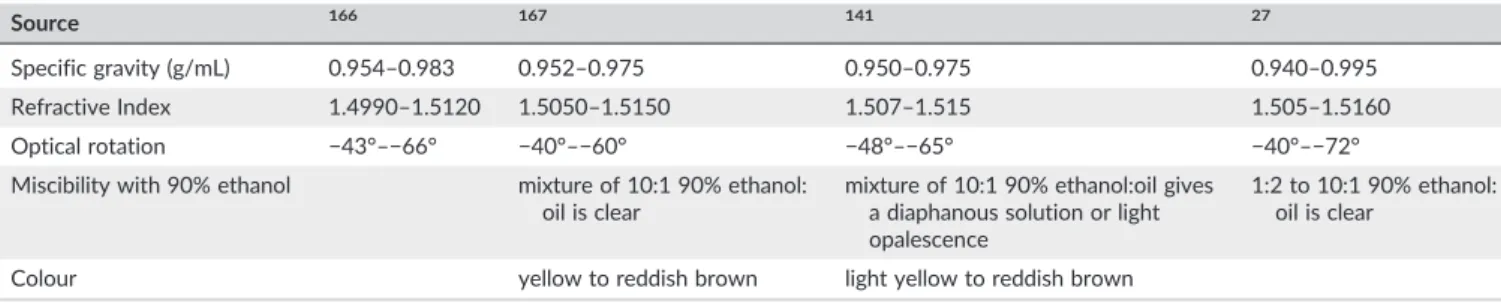
The first period runs from 1840–1960 during which analyses were mostly focused on characterisation of the oil by parameters like spe- cific gravity, refractive index,146,147 optical rotation, colour, odour and solubility (Table 2). Separation of compounds proceeded by vac- uum distillation and crystallisation, and structure elucidation took place by highly elegant but nonetheless tedious and time‐consuming chemi- cal degradation and derivatisation studies. The purity of products was most often assessed by boiling points, elemental analysis and mixed melting points (m.p.) with reference substances. Although patchoulol had already been isolated in the 19thcentury, not a single structure of the major sesquiterpenic constituents was known prior to 1960.26,27However systematic investigations were on‐going.148-150 and in the period 1950–1960 column chromatography as well as UV
and IR spectroscopy were used for the first time.149Gogröf was the first to apply a chromatographic method in an analytical fashion to PEO (ascending thick layer chromatography with silica gel
"chromatostrips", an early version of TLC).128
The period from 1960–1970 saw the identification of several major constituents like patchoulol, α‐guaiene,α andβ‐patchoulene, seychellene, andα‐bulnesene. Synthesis played an important role in these investigations and an X‐ray study finally solved the structure of patchoulol.151Newly introduced techniques included both analytical and preparative packed column gas chromatography, and
1H‐NMR.152,153Already in 1967 Tsubaki applied capillary GC to better separate PEO hydrocarbons.154
Over the next 15 years several fragrance companies, like IFF,155 Roure Bertrand Dupont,156and Henkel KGaA,75carried out in‐depth analyses of patchouli oil. Most of our current knowledge on its constit- uents still stems from these investigations. The main motivation was to find out which molecules are responsible for the unique patchouli odour (see also § 5.1 on odour) and GC‐olfactometry (“sniffing port” analyses) was applied several times to PEO. In this period GC com- bined with mass spectrometry became commercially available and pro- vided hitherto unknown analytical capabilities in the essential oil field.
13C‐NMR was introduced during this period as a new and very useful spectroscopic technique.
The fourth and last period runs from approximately 1985 till our present time. GC‐MS is now widely available and mass spectral data- bases (Wiley, NIST) come with the purchase of the instrument. This resulted in quantitatively many analyses, of which many are qualita- tively of lower quality than before. High‐speed GC on 10 m × 0.1 mm
× 0.2μm columns has been applied on PEO.157,158In spite of run times shorter than 5 min with fair resolution, in practice this approach never became popular. Occasionally new compounds in patchouli oil are reported159,161or the structure of a known compound corrected.162 Vibrational circular dichroism (VCD), which allows the distinction of enantiomers even when they lack a UV chromophore, was applied in the latter study. As the VCD spectrum can be theoretically calculated, it allows the determination of the absolute configuration. Nowadays structural proof is provided by 2‐dimensional NMR rather than by total synthesis. Chromatographic resolution has potentially dramatically increased by the commercial availability of GC×GC‐TOFMS (compre- hensive two‐dimensional gas chromatography with time‐of‐flight mass spectrometry for detection). Fragrance companies continue to be inter- ested in patchouli oil and patchouli odour.162-165
According to Guenther higher quality oils exhibit higher absolute specific gravity, refractive index and optical rotation values and good solubility.27A high specific gravity and optical rotation together indi- cate a high patchoulol content and consequently a lower hydrocarbon content, which will provide a more pleasant aroma. In the 1930s, so called“Singapore oils”were in high demand and showed a higher spe- cific gravity and better miscibility than “Java patchouli oil”.168 In another case, a PEO from the Seychelles was rejected on the basis of wrong figures for specific gravity, refractive index and optical rotation in spite of a fair odour and good solubility.169
TABLE 2 Physicochemical properties of patchouli essential oil
Source 166 167 141 27
Specific gravity (g/mL) 0.954–0.983 0.952–0.975 0.950–0.975 0.940–0.995
Refractive Index 1.4990–1.5120 1.5050–1.5150 1.507–1.515 1.505–1.5160
Optical rotation −43°–−66° −40°–−60° −48°–−65° −40°–−72°
Miscibility with 90% ethanol mixture of 10:1 90% ethanol:
oil is clear
mixture of 10:1 90% ethanol:oil gives a diaphanous solution or light opalescence
1:2 to 10:1 90% ethanol:
oil is clear
Colour yellow to reddish brown light yellow to reddish brown
Nowadays PEO as well as the leaves ofP. cablinoccur as mono- graphs in the Chinese Pharmacopoeia.170,171Patchouli leaves are iden- tified by microscopy and TLC of the contained essential oil with patchoulol as reference substance. For patchoulol a minimum content of 0.10% based on dry leaves is specified.171PEO is identified by its colour, smell, specific gravity (0.950 ‐ 0.980) specific rotation (−43°–−66°), refractive index (1.503‐1.513), TLC on silica with patchoulol and pogostone as reference substances and the absence of materials insoluble in 90% ethanol (1:10 ratio). A minimum content of 26% is specified for patchoulol.170
3.2
|Considerations for the evaluation of published patchouli oil analyses
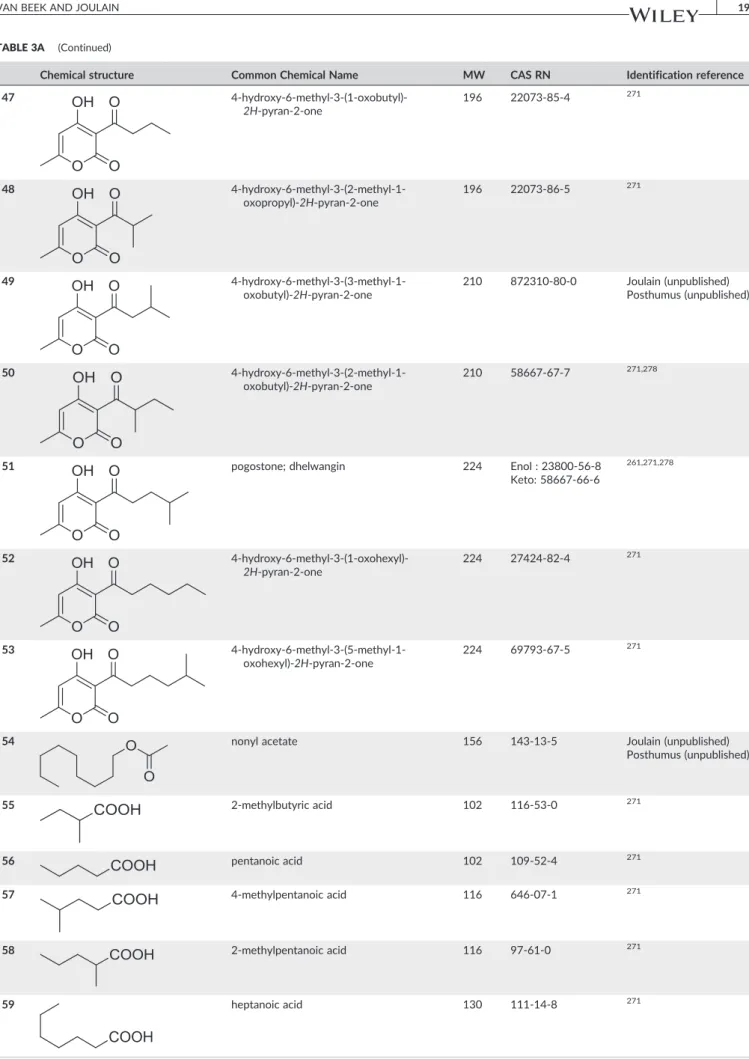
All papers describing the structure elucidation of individual compounds or chemical analyses of the total essential oil of Pogostemon cablin (patchouli oil) were carefully checked with two aims in mind. Aim 1 was to arrive at a listing of all compounds, which–with a greater (Table 3A) or lesser degree (Table 3B) of confidence–occur in PEO.
Aim 2 was to determine the qualitative and quantitative variation of the major constituents (Table 4). Papers devoted to solvent or super- critical extracts were excluded as they do not deal with essential oils and cannot be compared quantitatively with essential oils by GC, since extracted non‐volatile compounds do not elute. By definition essential oils are obtained via steam distillation (mostly industrial scale) or hydrodistillation (lab scale, e.g., Clevenger apparatus).172 A second consideration was that there is currently no significant market for odorant‐rich patchouli extracts. Finally, the benzene extract, which was mostly used in the past, is now obsolete.173,174
Although essential oil analysis appears simple and straightforward as it only involves the injection of a diluted solution of the essential oil into a GC‐MS, in our opinion it is not. This is especially true for oils consisting mostly of sesquiterpene hydrocarbons and oxygenated ses- quiterpenes, like for instance PEO. First of all, the chromatography can be poor, e.g., due to severe overloading of the column or too short retention times (low k' values), and several examples of such shortcom- ings in the patchouli literature were encountered. This will automati- cally result in more co‐elution and additionally the mass spectrum can be affected. Less credit was given to such analyses. The paper by Frister is an example of too short retention times.175Additionally there are wrong mass spectral assignments and errors in the legend.175The real pitfall in essential oil analysis however, lies in the data processing.
Commercial mass spectral databases, such as NIST and Wiley, are not dedicated to essential oils, which means that many sesquiterpene spectra do not occur in these databases but spectra of many more non‐volatile constituents do occur. As the library search algorithm will always generate some fit, albeit at 30% similarity, this can lead to the supposed identification of rather odd compounds in patchouli oil such as farnesyl pyrophosphate (ionic, non‐volatile), thyroxine (a non‐ volatile human hormone), 5‐azulenemethanol (a blue compound;
patchouli oil is never blue), tetrahydrosmilagenin (a non‐volatile steroid‐triol), squalene (non‐steam distillable, human skin constituent), 1,4,7,10,13,16‐hexaoxacyclooctadecane (a crown ether), 3‐hexadecyne (so far not known as a natural product), dibutyl phthal- ate (plasticizer), anthracene (polyaromatic hydrocarbon), 4,5‐
dimethoxy‐2‐methylphenol (not less than 34.6% of the oil), trilaurin (39 carbons, non‐steam distillable), glycyl‐L‐proline, 2‐hydroxy‐5,6‐ epoxy‐15‐methyl‐pregnan‐20‐one or butylated hydroxytoluene (synthetic antioxidant) to name a few. Papers reporting such com- pounds were given less credit with regard to other identifications.
As mass spectra of structurally different sesquiterpenes can be near identical, the opposite is also true: even a fit of 99% does not always guarantee that a compound has been correctly identified. We came across many examples of misidentifications of this kind. Although in retrospect one can of course never prove that a certain constituent did not occur in a particular oil, based on the over 100 patchouli analyses studied, we have excluded isolated reports of–sometimes major–compounds not mentioned by other investigators. An example is germacrene A reported at a concentration of 11.73% while for the almost co‐eluting α‐bulnesene a concentration of only 0.86% was given in the same paper.α‐Bulnesene is one of the four major constit- uents of PEO. Superficially the two mass spectra are similar. In 2017, an“improved”patchouli plant containing 40.41%β‐selinene as major constituent was reported. Based on the depicted chromatograms, most likely an identification error was made.
An additional problem of complex oils, like patchouli, is that inev- itably some compounds (partially) co‐elute, which changes the mass spectrum of the major contributor and obscures the spectrum of the minor one, resulting in turn in a wrong assignment. By careful deconvolution this can be corrected to some extent but this requires mass spectral expertise, which sometimes appears to be absent. Also, long listings of identified trace constituents were considered as some- what suspicious for the reasons given above. In our view, still more is notknown about the trace constituents (concentration from 0.01‐ 0.5%) of PEO than what is known. Occasionally authors have reported on the occurrence of a specific enantiomer, e.g., in 2016 both (−)‐ caryophyllene oxide and caryophyllene oxide (later eluting) were reported in one and the same analysis of patchouli oil. However, in all such cases a non‐chiral column was used making such assignments impossible and thus the report less credible. The same holds true for the same compounds reported twice, or even thrice, in a single analysis and the inclusion of vague compound names such as“trans‐tricyclo”or
“isobutyrate”or“apha‐guanine”.
Similarly, incidental reports of sesquiterpenes belonging to biosyn- thetically very different classes from those occurring in PEO were disregarded until more convincing evidence than just a mass spectrum is provided. The major sesquiterpenes occurring in patchouli oil belong to the guaiane, α/γ‐patchoulane, β/δ‐
patchoulane, deoxypatchoulol, seychellane, and caryophyllane classes.
Minor constituents belong to the elemane, eudesmane, germacrane, humulane, farnesane, cycloseychellane, nortetracyclopatchoulol and copaane classes. Although we cannot exclude the occurrence of other classes, until further proof is provided we treat the identifications of, for example, (−)‐eromophilene,cis‐thujopsene,trans‐longipinocarveol, longifolenaldehyde, (+)‐α‐longipinene, aristolone, 4,5‐diepiari- stolochene, β‐ylangene, valencene, nootkatene, dihydrokaranone,γ‐
muurolene, γ and δ‐cadinene, 4‐oxo‐14‐norvitrane, β‐chamigrene, andα‐bergamotene on biosynthetic grounds as doubtful.
Retention indices (RIs or LRIs = linear retention indices) are neces- sary to identify sesquiterpenes with a much greater degree of
confidence than by mass spectra alone. Tables with RIs of sesquiter- penes are available.176-178However we noted several papers where RIs seem to have not been experimentally determined but rather sim- ply copy/pasted from the aforementioned databases. Such papers have been treated cautiously. Also, papers reporting impossible RIs such as RI = 932 for patchoulol or RI = 1939 for l‐(+)‐ascorbic acid 2,6‐dihexadecanoate (anyhow not a steam distillable compound) hav- ing 37 carbons were considered to be less reliable. Papers reporting oxygenated sesquiterpenes eluting before sesquiterpene hydrocar- bons, or tridecane eluting 7 min after tetradecane (in a 2016 paper) have been treated with some reservation. RIs can somewhat vary even if recorded on the same stationary phase depending on carrier gas, inlet pressure, column length and diameter, film thickness, analyte con- centration, detector (FID versus MS) and especially the temperature gradient.179Peak reversals are possible due to using different temper- ature gradients or by going from gradient to isothermal elution. Polar phases (such as PEG 20M), which are often preferred when analysing essential oils, are prone to produce more variable and thus less reliable RIs upon ageing and depending on manufacturers. Thus, like mass spectra, RIs should be used wisely.
Errors in identifications, reported mass spectra and RIs do occur in the literature and through error multiplication ("domino effect") can further complicate essential oil analyses. The most notorious error of this kind relates to the identification of seychellene asγ‐patchoulene by Wenninger et al. in 1966.153Presumably based on this persisting error, Hussa et al. still misidentified in 2011, so 45 years (!) later, seychellene asγ‐patchoulene. This particular confusion in the litera- ture is further aggravated by an unknown component, having the same mass spectrum as γ‐patchoulene, almost co‐eluting with δ‐
patchoulene (see also § 3.3 on identification). In spite of claims by some authors, reference standards are regrettably not available for most sesquiterpenes occurring in PEO.
Still another type of error that can occur in patchouli analysis is either a wrong botanical identification or a mix‐up of samples in the lab. For instance, in a 2016 paper, carvacrol (47.5%) and p‐cymene (15.2%) were reported as the main constituents of patchouli oil. Not surprisingly, neither patchoulol nor any of the other constituents typi- cal of patchouli oil were reported. This shows a total lack of any liter- ature research by the authors and this paper has not been cited in this review but does occur in the SI. Possibly a botanical misidentifica- tion also played a role in the atypical oils reported on by Sugimura et al.
in the 90s.74,180Since then no one else has reported near 20% of germacrene B and longifolene in PEO.
A further problem is the occurrence of extraneous constituents in patchouli oil, by inadvertent contamination of leaves ofP. cablinwith other materials like weeds prior to steam distillation, by a lack of cleaning of the distillation equipment between charges or by wilful adulteration before or after distillation. An example of the latter is the addition of gurjun balsam, which contains compounds belonging to the aromadendrane class (see § 4 on adulteration). Several authors have reported the occurrence of acetophenone in patchouli oil.
Acetophenone is the main constituent (51%)181 ofP. heyneanusand this species is used to adulterateP. cablin.48Only small amounts ofP.
heyneanuswill be needed to be able to detect acetophenone as a minor constituent in genuine PEO. Murugan et al. in their comparative study
of both Pogostemon species were unable to detect acetophenone inP.
cablin oil.181 Probably several unlikely compounds detected in PEO have been correctly identified and originated from a contamination.
This however was in most cases impossible to prove.
Finally we encountered one odd case where analytical data of one set of authors182were copied five years later by a pair of unrelated authors without providing any remark in the experimental or a citation.
Furthermore, the same pair of authors (Kusuma and Mahfud) subse- quently republished these data in 2017 with unexplained changes and without citing their own paper from 2016. Together these facts made us entirely disregard the six very similar papers by these two authors, however these references like all others rejected can be found in the SI.
3.3
|Constituents of Patchouli Essential Oil
Based on all criterions mentioned above, we weighed the quality of each report and gave more value to–in our opinion–high quality reports and completely disregarded (and neither used nor cited) lower quality analyses. However, all references relating to non‐used patch- ouli analyses can be found in the supplementary information. In retro- spect, it was possible to correct several clearly wrong assignments, especially when a chromatogram was available. In such cases, corrected data have been used. We have also compared the combined results qualitatively with independent GC‐MS analyses of genuine PEOs carried out in the laboratories (Robertet and Wageningen Uni- versity) of both authors using dedicated essential oil mass spectral databases.
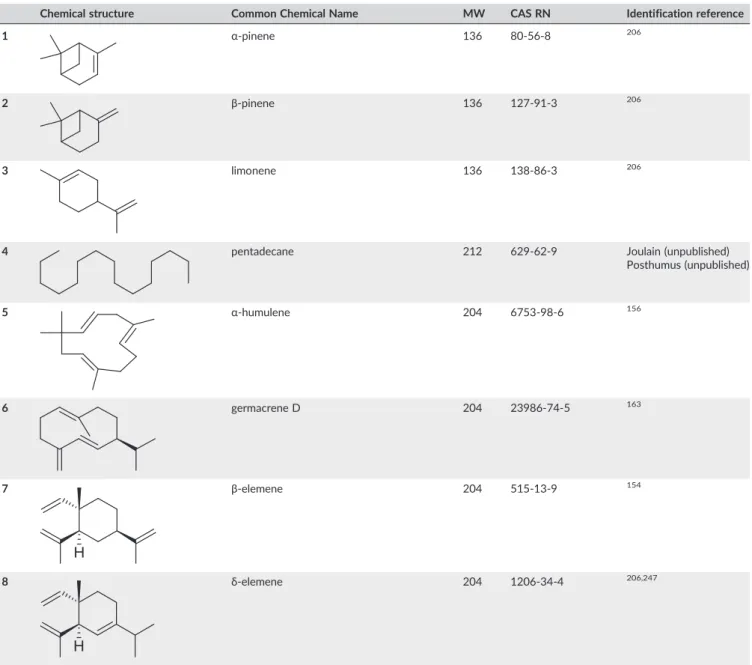
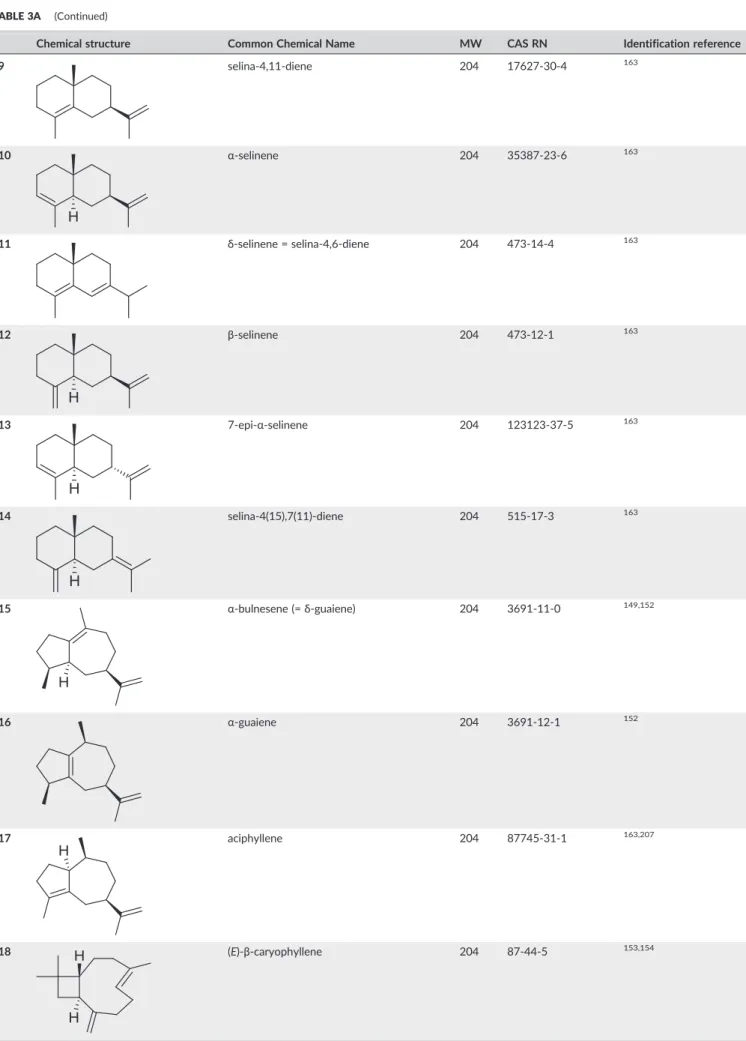
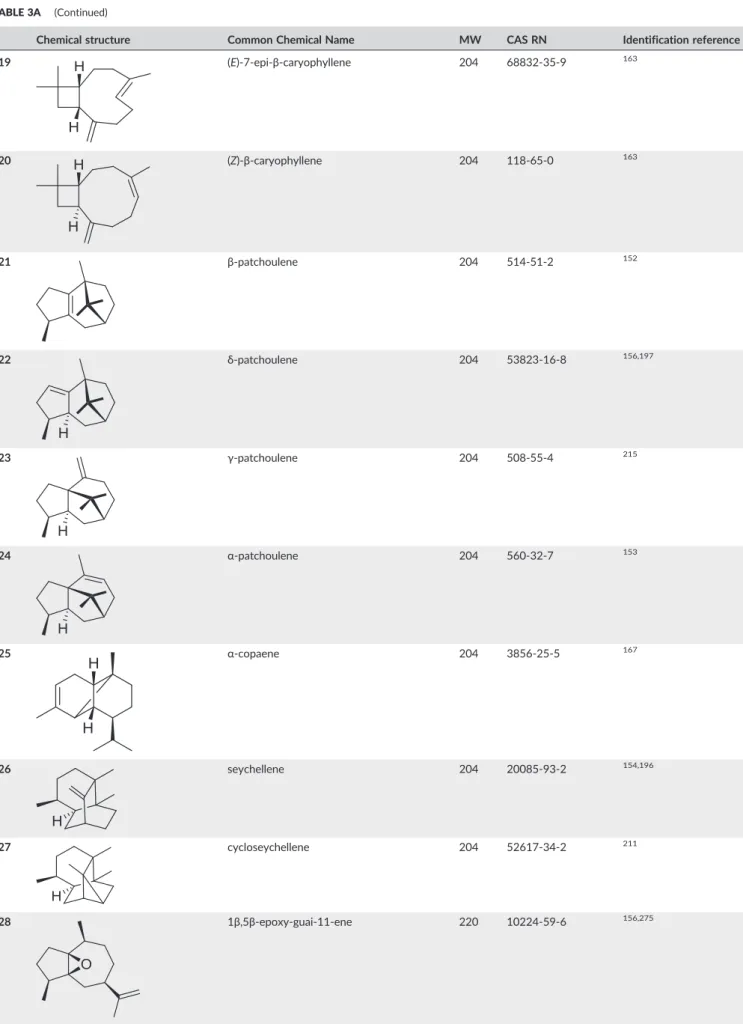
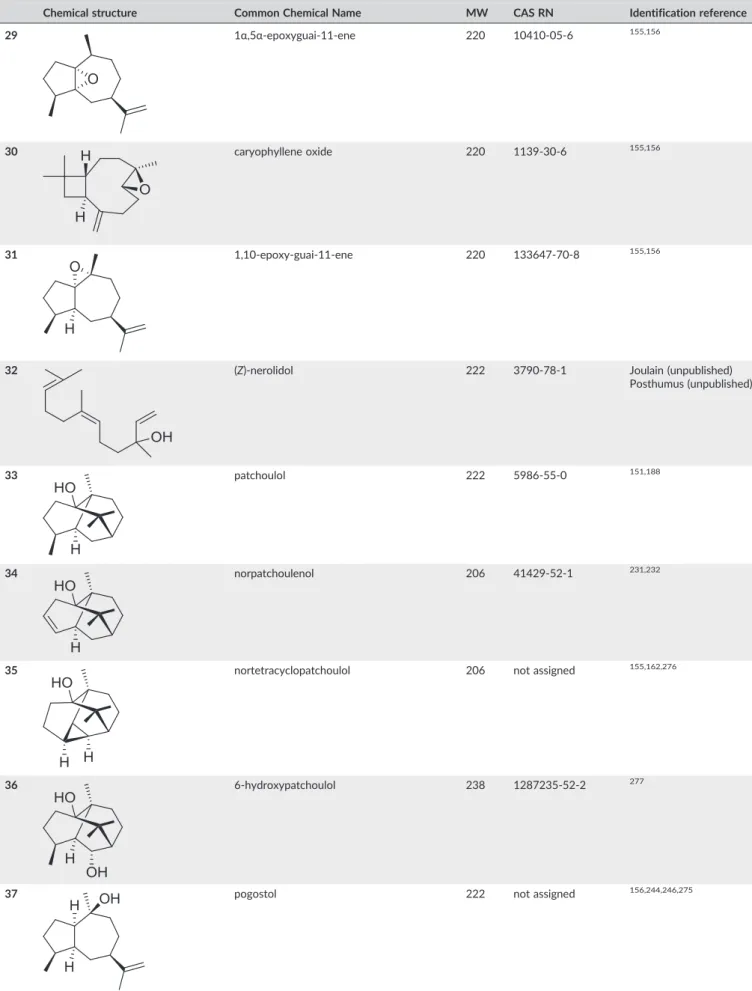
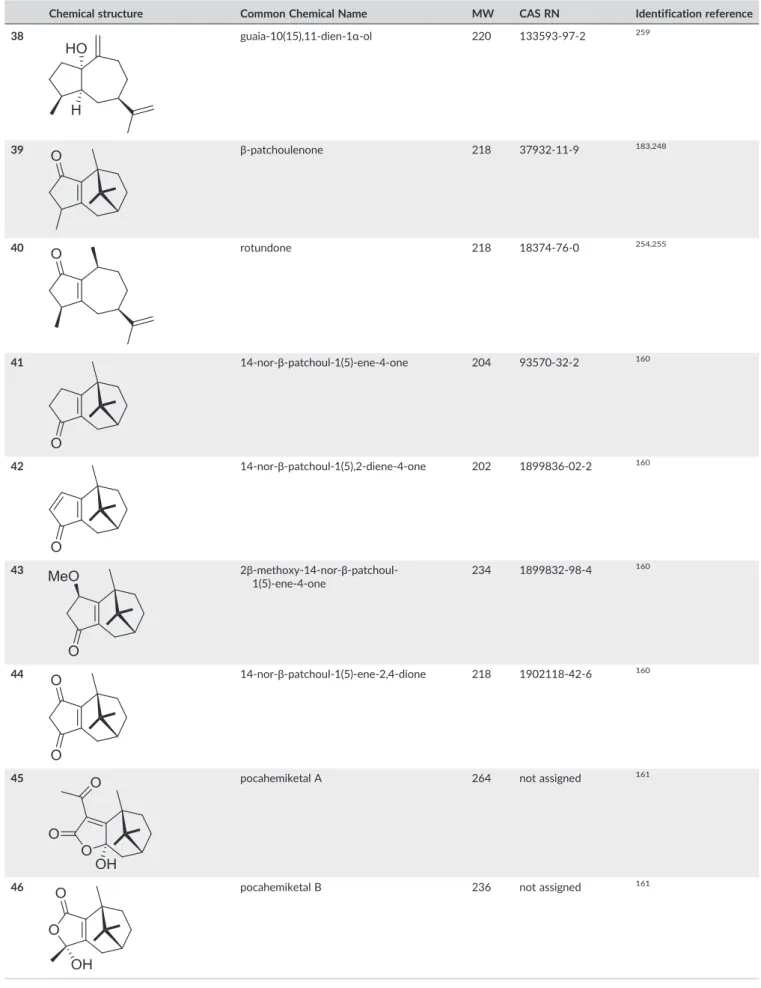
The outcome of the excellent, good and fair reports has been used to compile a listing of compounds, which occur in PEO with a high degree of certainty (Table 3A) or with a reasonable degree of certainty (Table 3B). This information is qualitative, i.e., whether a constituent occurred at a high or low concentration did not play a role. So actually, Tables 3A and 3B contain several compounds, which cannot be detected in total PEO, not even by an expert with a modern GC‐MS.
This is especially true for carboxylic acids, phenols and amines (alkaloids), which can be easily separated and significantly enriched by LLE. In the literature, hundreds of compounds have been reported to occur in patchouli oil. If a constituent has been reported in an–in our view–dubious paper or has been reported only once or twice, the con- stituent did not make into Table 3B. First, additional independent proof should be provided. Some compounds or groups of compounds merit more attention from an identification point of view, i.e., because the identification is troublesome or because of a structural revision. These are discussed in the following paragraphs after which Table 3A and 3B with 72 positively and 58 tentatively identified patchouli constituents respectively follow. Identifications reported by scientists from the fragrance industry deserve special attention,155,165,183-185since they have not been published in peer‐reviewed journals on the basis of detailed spectroscopic data recorded from isolated pure substances.
As this missing information may exist as proprietary information of these companies, many of these identifications could be correct.
However, as they do not satisfy the requirements of this journal, we have therefore included them in Table 3B.
3.3.1 | SQHCs in general
Sesquiterpene hydrocarbons (SQHCs) constitute a large fraction of PEO. Hefendehl and Welch et al. both mention 62%,186,187 while Ohloff et al. report 40‐60%.52Our in‐house analyses of more than 20 commercial samples show a wide range of variation (49‐73%, mean 59%).163The literature data in Table 4 based on 100+ PEO analyses yield an average of 47% excludingγandδ‐patchoulene and unidentified SQHCs so approximately half of the oil. In extreme cases the SQHC con- tent can be > 80% or < 25%. As discussed in § 3.2, the identification of sesquiterpenes, including SQHCs, is wrought with difficulties leading to many misidentifications in PEO. Ideally identification should be based on an identical EI‐MS according to both the computer algorithm and a skilled human observer and identical retention times to an authentic ref- erence substance on two different GC phases. Thus, as only few SQHCs are commercially available, identifications are rarely ideal.
In the very first chemical study of PEO in 1869, it was reported that patchoulol33could be easily converted to a SQHC, which must have been a mixture of patchoulenes.188The name“patchouline”was coined for this product in 1877,189which was later changed to“patchoulene”. The first attempt to isolated pure SQHCs by repeated fractional distil- lation from PEO took place in 1904.190Based on the reported boiling points, fractions 1 and 2 might have been (partially pure)α‐patchoulene 24andα‐bulnesene15respectively. After partially successful studies on probably againα‐patchoulene andα‐bulnesene in 1950 byŠorm et al.,149the identification of the main SQHCs in PEO started in earnest in 1962.152,191The identification ofα‐bulnesene15,α‐guaiene16and β‐patchoulene21was based on a comparison by GC, UV, IR and NMR with isolated dehydration products of guaiol and bulnesol. The contemporary study by Büchi et al. on the formation of the various patchoulenes from patchoulol 33must have been helpful.192A few years later, Tsubaki et al. used a combination of the new capillary GC technique, column chromatography (including AgNO3complexation), preparative GC, NMR and IR to confirm the presence ofα‐bulnesene 15, α‐guaiene 16 and β‐patchoulene 21, and establish that of α‐patchoulene 24.154 They also identified β‐elemene 7 and β‐
caryophyllene18, the latter being a genuine PEO constituent as con- firmed by others.153,193,194 Additionally Tsubaki et al. detected but not identified a tricyclic sesquiterpene“hydrocarbon G”having a termi- nal methylene according to its IR and NMR spectra. The mass spectrum showed the base peak atm/z122.154It was proven to be identical to seychellene 26, which was simultaneously isolated and structurally identified by Wolff et al.195,196 In his study of a PEO produced in Brazil, Peyron reported in addition to most of the SQHCs mentioned above, α‐elemene andλ‐patchoulene. In retrospect, the latter two compounds were most likelyβ‐elemene7and a mixture of seychellene 26 and δ‐patchoulene 22, respectively.194 Teisseire reported in 1973 the isolation of 13 sesquiterpene hydrocarbons, of which 8 were identified. Of those, onlyα‐humulene5had not been reported before in PEO.156,193His unidentified“hydrocarbon B”was later shown to beδ‐patchoulene22.197A few minor SQHCs in PEO merit special attention and are discussed individually at the end of this section.
Faraldos et al. have commented on the confusing nomenclature of the patchoulane sesquiterpenes.198 As the skeletons of α/γ‐patchoulane (tricyclo[5.3.1.01,5]undecane), β/δ‐patchoulane
(tricyclo[6.2.1.02,6]undecane) and patchoulol (tricyclo[5.3.1.05,10] undecane) all share the same cyclodecane ring (C1 to C10) and differ only in the bridging positions of the isopropyl group, i.e., C11 with its two geminal methyl groups, and the zero carbon connections (second- ary bridge), they proposed shorthand names to name the three patchoulane skeletons unambiguously.198 Based on the location of the C11 bridge and the second ring fusion, they distinguish [1,7:5,10]‐, [1,7:1,5] and [7,10:1,5]patchoulanes. Patchoulol33would thus be named [1,7:5,10]patchoulan‐1‐ol.198
The chemical structures of most of the major SQHCs have been unambiguously confirmed by either total synthesis, like for seychellene and cycloseychellene,187,199or hemi‐synthesis, e.g.,α‐guaiene16and aciphyllene17from guaiol.200Nowadays, NMR is often replacing full or hemi‐synthesis for proof of structure but errors are possible and pogostol 37 is a telling example (vide infra). High resolution NMR and MS data have been published for many isolated SQHCs, e.g., for α‐guaiene, α‐bulnesene, seychellene and α‐patchoulene, albeit in a rather confusing article requiring errata.201,202
Some of the PEO SQHCs, e.g., β‐patchoulene 21 and α‐
patchoulene24are suspected to be artifacts formed by dehydration of patchoulol33and subsequent Wagner‐Meerwein rearrangements during steam distillation.52Invariably when patchoulol is dehydrated, depending on the conditions various mixtures of patchoulenes and other rearranged hydrocarbons result. For instance, when treated with POCl3in pyridine, a mixture ofγ‐patchoulene23andα‐patchoulene24 resulted in 91% yield. When the mixture of23&24or patchoulol33 was treated with concentrated sulphuric acid in ether,β‐patchoulene 21 was formed.192 And when heated in refluxing hexane in the presence of acidic Amberlite‐IR‐120H, patchoulol is transformed in 77% yield into a mixture containing 55%β‐patchoulene 21and 5% δ‐patchoulene 22, among other unidentified hydrocarbons.203 Interestingly, small amounts of seychellene26are also formed under these conditions, together withε‐patchoulene76.163The latter has been tentatively identified as a very minor constituent in PEO and might well be an artifact formed by isomerisation ofβ‐patchoulene and/or δ‐patchoulene during distillation.163 Although the above conditions differ from those during steam distillation, almost certainly, depending on pH and temperature, dehydration of patchoulol followed by carbocation rearrangements take place during steam distillation.
However, what happens exactly during the fabrication of PEO and the influence of steam distillation on its qualitative and quantitative compo- sition has never been investigated in detail with modern techniques.
Aromadendrene and cadinane SQHCs have been frequently reported in PEO but we consider these reports erroneous (see also
§ 3.2). An example is the report by Ishihara et al. (PEO SQHC fraction containing 4% gurjunene and 1% δ‐cadinene).204 The presence of the former class is the result of adulteration.205,206The mentioning ofδ‐cadinene in concentrations of 2‐3%40in four PEOs is probably due to a misidentification of aciphyllene 17 (Lawrence, personal communication).
3.3.2 | Aciphyllene
Aciphyllene (guai‐4,11‐diene)17is always present in a few percent in patchouli oils. It elutes just before the major constituentα‐bulnesene
15on non‐polar columns. It was independently identified by Saritas and by Joulain,163,207and later confirmed by others.208In the structure given by the former two authors the 2‐propylidene side chain at C‐7 has theα‐configuration, in contrast to almost all other sesquiterpenes in PEO. When aciphyllene was first synthesized by Blay et al., its spec- tral data did not match those of the natural product.209Subsequently its structure was revised to17(Table 3A), i.e., with the C‐7 substituent in theβ‐position. The structural revision was confirmed by Srikrishna and Pardeshi,210and later by synthesis.200
3.3.3 | α‐Copaene
This hydrocarbon has been cited as a possible marker for contamination or adulteration. Indeed, the earlier mentioned ISO norm states that the content of this hydrocarbon should not exceed 1%, which suggests that higher levels would indicate some adulteration, possibly with copaiba balsam (Copaifera spp.). While authentic PEOs have been found to contain 0.1% α‐copaene 25,123 the authors have recorded lower percentages or even undetectable levels of this SQHC in many oils distilled and analysed by us and PEOs withα‐copaene levels >0.5%
should indeed be treated as suspicious in terms of possible adulteration.
3.3.4 | Cycloseychellene
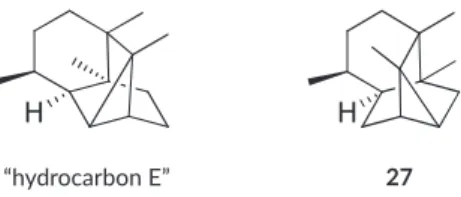
The rare tetracyclic cycloseychellene27was first reported in 1973.211 One year later Dhekne and Paknikar showed that Tsubaki's“hydrocar- bon E”154(Figure 1) was actually cycloseychellene.212Its structure was revised in 1981 on the basis of high field NMR studies,213and total synthesis.199
3.3.5 | γ‐Patchoulene
The IR spectrum initially assigned toγ‐patchoulene23isolated from PEO actually corresponded to seychellene26.214,215The IR spectrum of authenticγ‐patchoulene obtained by dehydrating patchoulol with POCl3and preparative GC (pGC), was reported later.215This spectrum is identical to that ofγ‐patchoulene isolated from PEO in July 2000 by one of the authors.163Indeed the IR spectra ofγ‐patchoulene23and seychellene26show striking similarities, whereas these hydrocarbons are easily distinguished by their mass spectra and linear retention indices (LRIs). Although frequently reported as a constituent of PEO, whether γ‐patchoulene genuinely occurs in patchouli leaves or is merely an artifact, remains to be determined. Tsubaki et al. could not detect itin PEO but they could detect it in distillation fractions of PEO. According to them it elutes just after α‐bulnesene on a HB‐ 2000 stationary phase.154 Teisseire confirmed that γ‐patchoulene does not occur in PEO and that its retention time in GC is totally differ- ent from seychellene.193On a dimethylpolysiloxane phase (syn. DB1,
SE30 or CP Sil5) an LRI of 1497 is reported, i.e., close to aciphyllene (LRI=1495) and α‐bulnesene (LRI=1503).177 Unfortunately often
“γ‐patchoulene” is reported to elute close to α‐patchoulene and δ‐patchoulene, probably due to the elution there of a still unknown SQHC having almost the same mass spectrum as23.
3.3.6 | η‐Selinene
η‐Selinene 75 (ent‐isomer of cascarilladiene) has been tentatively identified as a very minor SQHC in PEO (Joulain, unpublished). It is easily overlooked as it coelutes with cycloseychellene and/or β‐caryophyllene on non‐polar phases. However, on a polar Wax phase, it can be observed close to cycloseychellene andα‐guaiene.
3.3.7 | Oxygenated sesquiterpenes in patchouli essential oil
Patchoulol
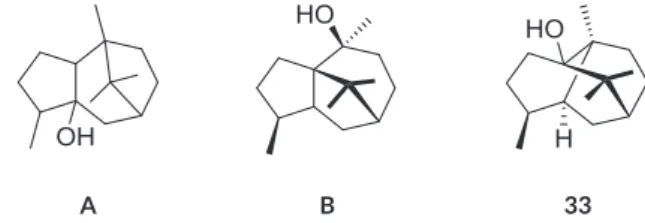
Patchoulol (syn. patchouli alcohol) was first isolated in crystalline form by Gal in 1869 as the major component of PEO.188The first correct elemental composition (C15H26O; adjusted from the C30H26O2given in the paper) of what was then named "patchouli camphor" was derived 8 years later.189 In retrospect amazingly correct, the com- pound was suspected to be the hydrated hydrocarbon (C5H8)3, i.e., C15H24+ H2O. Wallach and Tuttle confirmed these data in 1894.216 They also suggested that patchoulol is a tertiary alcohol, a proposal which found support 10 years later.217Next Semmler and Mayer con- cluded that patchoulol is a tricyclic alcohol on the basis of its molecular refractivity.218 The first – incorrect – structure A (Figure 2) for patchoulol was published by Treibs.148Unaware of carbocation rear- rangements, he concluded from the fact that dehydration produced some (blue) guiazulene that patchoulol must possess a bridged 5‐7 ring system. This work was continued by Büchi et al. with a series of chemical degradations of β‐patchoulene 21, γ‐patchoulene 23and α‐patchoulene24.192The isolation and the structural determination of21,23and24obtained by pyrolysis of the acetate and the forma- tion of β‐patchoulene 21 by dehydration of patchouli alcohol with H2SO4, I2, or H3BO3, led to the–incorrect –conclusion that patchoulol possessed the tricyclic structureB(Figure 2). With struc- tureBin mind, an elegant partial synthesis of patchoulol was designed from (+)‐camphor, via an epoxide of24, which was expected to lead to optically active "patchouli alcohol"B but in reality led to the true natural product33!219However shortly thereafter, structure33was finally and unambiguously assigned to patchoulol on the basis of an X‐ray crystal analysis151of the known bright red chromic acid ester.220 The apparently contradictory results of both the chemical elucidation of the structure of patchoulol and of its partial synthesis from (+)‐ camphor were explained in a subsequent article.221The unexpected reverse skeletal rearrangement of an epoxide, which was overlooked by the authors, caused faith to be placed in the wrong structure B instead of33. This historical case has been attractively reviewed by renowned organic chemists.222,223 Faraldos et al. studied the biosynthesis of patchoulol in considerable detail through the use of deuterium labelled farnesyl diphosphate.198As part of these studies, they published the most extensive NMR study of33.198
FIGURE 1 Left: initial (wrong) structure of cycloseychellene.211 Right: Revised and correct structure of cycloseychellene27213
While patchoulol is not specific for Pogostemon species, its occur- rence in high concentrations is nevertheless scarce in other essential oils, and mostly restricted to certain Valeriana species,224for example 26.2% inValeriana celticaleaf oil,225 up to 50% inValeriana wallichii rhizome oil,226inValeriana panciciiroot and rhizome oil,277and up to 66.7% inValeriana jatamansirhizome oil.228Adulteration ofV. celtica andV. jatamansiwith PEO supposedly occurs, however as in the above cited studies genuine plant material was used, there is no doubt that patchoulol is a true constituent of several Valeriana essential oils.
Nowadays, purified patchoulol obtained by fractional distillation of PEO and subsequent crystallisation is commercially available in multi‐ kg quantities for fragrance applications under the trade name Healingwood.229
3.3.8 | Norpatchoulenol
Norpatchoulenol34was first reported in PEO by Teisseire's group in 1971.230,231Its structure and absolute configuration were determined by a correlation with cyperene232(Scheme 1) and an X‐ray analysis of a crystalline bromo‐ketone derivative.233Later Mookherjee claimed that norpatchoulenol had already been known to his employer since 1966.155The concentration of34in PEO is on average 1% but the actual percentages vary from 0.11 to 4% (see Table 4).
A biogenesis of34from patchoulol33(Scheme 1) has been pro- posed by Ourisson, based on forcible gastric feeding of33to rabbits and dogs, generating diolCand hydroxy‐acidDas hydrolysable glucu- ronides present in the urine of the animals.234DiolCwas also pro- duced by microbial hydroxylation (bacteria or fungi).235Catalytic or chemical oxidation of diolCfurnished hydroxy‐acidDand the latter was converted to34by lead tetraacetate in pyridine in the presence of cupric acetate. However, neitherCnorDhas been identified so far as putative precursors of patchoulol in PEO or any patchouli extract. Also, our analyses of many PEOs, do not point in the direction
of a relation between patchoulol and norpatchoulenol concentrations.
On the other hand, the concentrations of norpatchoulenol and nortetracyclopatchoulol35do seem to be related suggesting a com- mon C14 precursor. Thus, the biosynthesis of norpatchoulenol 34 (as well as35) in patchouli leaves remains unknown to date.
3.3.9 | Nortetracyclopatchoulol
The structure of nortetracyclopatchoulol was originally published as a trace constituent (0.001%) with a typical patchouli odour, which was even slightly stronger than that of patchoulol and norpatchoulenol.155 As an X‐ray study failed, in addition to the obtained GC, IR, MS and NMR data, the authors performed a correlation with norpatchoulenol.
Treatment with a strongly acidic ion exchanger gave indeed the expected norpatchoulenol after which the authors concluded thatE (Figure 3) represented the trace constituent. The configuration of the cyclopropane ring was left undecided. For the next 33 years this was assumed to be the correct structure. However, in 2014, Zaizen et al.
published structure 35, also a nortetracyclopatchoulol, as a novel odour‐active compound in patchouli oil. They performed a rigorous NMR study including INADEQUATE13C‐13C measurements, which technique was not available in the early 80s.162Sniffing port gas chro- matography was used to pinpoint this minor constituent. However, as no nortetracyclopatchoulol was detected in their study and the mass spectrum for35was identical to that of nortetracyclopatchoulol, we reason that Zaizen et al. in fact reisolated nortetracyclopatchoulol.
Additional proof for this hypothesis can be found in the fact that in our own PEO analyses, only one peak with the same mass spectrum as 35can be observed and on a WAX phase this compound elutes just after patchoulol and well before pogostol (Joulain, unpublished), i.e., at the same position as in the Wax chromatogram of Zaizen et al. This would imply that structureEis wrong. This is certainly possible as it would be very difficult to distinguish betweenEand35with low res-
olution NMR without having both compounds available. It is further likely that35would be converted to norpatchoulenol upon treatment with acid. Thus, the important odour‐active nortetracyclopatchoulol has structure 35 and occurs as such in Table 3A. The absolute configuration was proven by vibrational circular dichroism (VCD).162 As can be seen in the chromatogram of PEO B (Figure 7b), nortetracyclopatchoulol (peak marked ntP at 44.5 min) is not necessar- ily a 0.001% trace constituent but can occur at concentrations of 0.5%
or higher. Therefore, in some oils it might contribute significantly to the overall patchouli odour.
SCHEME 1 Possible biosynthetic route to norpatchoulenol34starting from patchoulol33via intermediatesCandDaccording to Ourisson.234 Far right: structure of cyperene
FIGURE 2 Left: first (wrong) structureAof patchoulol.148 Middle: second (wrong) structureBof patchoulol.192,219 Right: correct structure33of patchoulol151
3.3.10 | Pogostol
Although pogostol has been reported to occur in more than 30 essen- tial oils including PEO, its identification has been rarely supported by more evidence than mere GC‐MS data. However, PEO is the exception to the rule as several authors have reported also NMR data and its occurrence in PEO is beyond doubt. Pogostol was first isolated by Pfau and Plattner in 1936.236They converted it to the blue guiazulene by the dehydration/dehydrogenation method, which they had just invented. In 1968 Hikino et al. proposed structure F(Figure 4), i.e., without any stereochemistry.237The stereochemistry at C4, C5 and C7 was partially clarified (structureG, Figure 4) by Teisseire et al. on the basis of convincing chemical correlations with both bulnesol and α‐bulnesene whose absolute stereochemistries were already known at that time.156,193 Unfortunately he did not provide any specific optical rotations in his Experimental. Ten years later Itokawa et al.
isolated a sesquiterpene alcohol from Alpinia japonicarhizomes and identified it as pogostol on the basis of having identical IR and low field
1H NMR data as an authentic reference.238Although they overlooked Teisseire's findings and did not show any stereochemistry, they did report13C NMR data, which proved to be very useful in subsequent investigations by other authors. In 1987 without further explanation, Teisseire reported structure H (Figure 4) for pogostol.239 In 1997, Fleischer et al. reported pogostol O‐methyl ether from Artabotrys stenopetaluswith the same stereochemistry as inH.240They elucidated the structure on the basis of extensive NMR studies including HMBC and NOESY spectra. In 2000, during the course of an in‐depth analysis of vetiver essential oil, Weyerstahl et al. isolated and identified pogostol by comparing their13C‐NMR data with those of
Hitokawa.241 By NOED NMR experiments (not described in the Experimental) they arrived at the same structure Hfor pogostol as published earlier by Teisseire. The same conclusion was reached by Stierle et al.242
In the same year the structures for pogostol and its methyl ether were challenged by Booker‐Milburn et al. after their total synthe- sis.243 On the basis of 13C‐NMR data, they proved that natural pogostol was neither identical to Hnor to its 7‐epimer. However, they did not propose any alternative structure. The structure of pogostol was then corrected toI (Figure 4) by Amand et al. on the basis of renewed NOE observations in two different solvents.244 In CDCl3 H4 and H5 are separated by only 0.01 ppm complicating NOE conclusions, which probably led to four groups publishing the same but wrong structureH. In pyridine, these two atoms are much better separated. In 2014, pogostol was isolated from a fungus andH was given as the structure.245In the 90s we have isolated pogostol from PEO and carried out detailed NMR studies. The13C‐NMR data are identical to those published by Itokawa, Weyerstahl, Stierle, Amand and Barra. One of the authors (TvB) arrived at the same con- clusion as Amand et al. concerning the relative stereochemistry.246 However structureIis not in agreement with the evidence provided by Teisseire. As pogostol can be converted to α‐bulnesene and bulnesol, 37represents the correct structure for pogostol, i.e., the enantiomer ofI. Although not being hard evidence, the fact that all compounds in PEO without double bonds at C4, C5 and C7, likeα‐
patchoulene24,γ‐patchoulene 23,α‐bulnesene15, seychellene26 and patchoulol 33, have the same stereochemistry at C4, C5 and C7 as37, supports the suggested absolute stereochemistry. Conse- quently, the structure assigned in the CAS Registry to (−)‐pogostol with the chemical name (1R,3aS,4R,7S,8aR)‐decahydro‐1,4‐dimethyl‐ 7‐(1‐methylethenyl)‐4‐azulenol with CAS RN [21698‐41‐9] is wrong, as it corresponds to (+)‐ent‐pogostol. The – in our view – correct structure of pogostol present in PEO is shown in Table 3A, with the (1S,3aR,4S,7R,8aS)‐configuration, and is therefore pending a new CAS RN.
3.3.11 | Selinane SQHCs
In considering the fairly large number of selinane (syn. eudesmane) hydrocarbons identified in PEO, albeit in relatively minor proportions,
FIGURE 4 Various postulated, partially inaccurate, structures of pogostol37 FIGURE 3 Left: initial (wrong) structureEof nortetracyclopatchoulol.155 Right: Revised correct structure of nortetracyclopatchoulol35162