RISK VULNERABILITYAND TAKAFULACCEPTANCE:
EVIDENCE FROM A FRONTIER MARKET Abdulsalam Mas’ud
Department of Accountancy, Hussaini Adamu Federal Polytechnic, Kazaure, Jigawa State, Nigeria.
(Email: [email protected])
ABSTRACT
Recently, acceptance of takaful as an Islamic financial product has been declining in African Muslim-dominated countries such as Kenya, Tunisia, and Nigeria. In understanding the causes of this trend and to proffer a possible solution, this study examines the effects of individuals’ attitude toward takaful, perceived behavioral control, individual’s risk vulnerability on takaful acceptance intention in the Nigerian Frontier Market. It also examined the moderating effect of individual’s risk vulnerability on the relationship between attitudes toward takaful, perceived behavioral control, and takaful acceptance intention. Through a quantitative methodology employed for the purpose, the results revealed that attitude toward takaful, perceived behavioral control and individual’s risk vulnerability are significantly related to acceptance intention. Moreover, individual’s risk vulnerability moderates the relationship between attitude toward takaful, perceived behavioral control, and takaful acceptance intention. In line with these findings, theoretical and practical implications, as well as the direction of future research, were highlighted.
JEL Classification: L1, D4
Key words: Attitude, Acceptance intention, Perceived behavioral control, Risks vulnerability, Takaful
1. INTRODUCTION
The emergence of traditional Islamic banking was said to have emanated from a rural area in Pakistan in the 1950s while the modern Islamic banking commenced through a pioneering experiment via the Mit-Ghamr Islamic Savings Bank (MGISB) in Egypt in 1963 (Chachi, 2005). One of the Islamic financial products is takaful (Islamic
insurance), which originated from Sudan in 1979 (Husin and Rahman, 2013). Despite its emergence from Africa, the penetration of takaful is deteriorating in some Muslim dominated African countries such as Kenya, Nigeria, and Tunisia. Its penetration growth rates declined from 3.4% in 2009 to 3.1% in 2010 and later 2.7% in 2011 (Deloitte, 2014). Specifically, in the Nigerian Frontier Market which is the main focus here, the insurance market penetration including takaful is just 0.6% (Deloitte, 2014), notwithstanding the fact that over half of its population are Muslims (Yusuf, 2012). Though available empirical evidence from the Nigerian Frontier Market revealed a right attitude toward takaful acceptance intention among Muslims (Maiyaki and Ayuba, 2015; Yusuf, 2012), the actual participation in takaful schemes is still low as shown by the penetration and growth rate statistics (Deloitte, 2014). Even though the concept of takaful in Nigeria was first introduced in 2008 with registration of three insurers, followed by issuance of the Takaful Regulation Policy in 2013 (Nwachukwu, 2015), the evidence does not show any increase in insurance penetration growth in the country after nine years of emergence.
Then, the question is: why in reality is there a decline in takaful penetration growth in Muslim-dominated African countries including Nigeria despite acceptance intention? Answering this question requires an understanding of the construct with which attitudes and behavioral control interact to predict intention to takaful acceptance. It is unarguable that the main idea behind insurance is to cover the risk. Insurance is considered as a good risk management mechanism (Harrington and Niehaus, 2003). Similarly, takaful has been described as a good risk management product devised to indemnify individuals against particular unforeseen occurrences (Husin and Rahman, 2013). In understanding the dynamics of role of
“risk” in the idea of insurance (takaful inclusive), this study considers the integration of “individual’s risk vulnerability” into the takaful acceptance model of Md Husin and Ab Rahman (2013), in conjunction with other predictors such as attitude toward takaful and perceived behavioral control.
The objectives of the paper are twofold. First, to examine the direct effect of attitude, perceived behavioral control and individual’s risk vulnerability on takaful acceptance in the Nigerian Frontier Market. Second, to explore the moderation effect of individual’s risk vulnerability in the relationship between attitudes towards takaful;
perceived behavioral control; and takaful acceptance intention in the Nigerian Frontier Market. Attaining the abovementioned objectives would have theoretical and practical marketing implications.
Integration of individual’s risk vulnerability as a direct and moderating variable would contribute to behavioral Theories of Reasoned Action (TRA) (Fishbein and Ajzen, 1975) and Planned Behavior (TPB) (Ajzen, 1991). To the best of the researcher’s knowledge, despite the relevance of “risk” in insurance, its effect directly or indirectly has not been empirically explored in alignment with takaful acceptance intention.
The paper is divided into five parts, with this as an introduction. The next part is a literature review, followed by the methodology in the third section. The fourth part covers the results and discussions. Lastly, the paper ends with a conclusion, implications, and suggestions for future research.
2. LITERATURE REVIEW 2.1 TAKAFUL AND ITS ACCEPTANCE In Islam, a ḥadīth reported that:
“Actions are according to intentions, and everyone will get what was intended. Whoever migrates with an intention for Allah and His messenger, the migration will be for the sake of Allah and his Messenger. And whoever migrates for worldly gain or to marry a woman, then his migration will be for the sake of whatever he migrated for.” (Al-Bukhā rī).
Intention toward acceptance of takaful predicts the actual participation in the scheme. This intention can be built from individual’s attitude; the surrounding social influence and the extent to which people have control over their real action. Behavioral theories such as TRA (Fishbein and Ajzen, 1975) and TPB (Ajzen, 1991) proposed how intention predicts behavior, and how intention itself is predicted by attitude, subjective norms and perceived behavior control. Specifically, TRA postulated that intentions are predicted by an individual’s attitude toward the behavior and subjective norms surrounding a person who exercises the behavior (Fishbein and Ajzen, 1975). The extension of TRA brought about TPB through the integration of perceived behavior control (Ajzen, 1991). While attitude, subjective norms, and perceived behavioral control all predict intention, the subjective norm has a weaker effect on intention (Armitage and Conner, 2001; Godin and Kok, 1996). In line with this
insight from literature, the subjective norm is purposely removed from the model proposed in this study. In addition to the known predictors, and in alignment with the relevance of “risk” to the concept of insurance (takaful inclusive), this study proposed individual’s risk vulnerability as a predictor of intention toward takaful acceptance directly, and indirectly as a moderator. The next subsections review the literature and develop hypotheses for examination of direct and indirect effects of attitude, perceive behavioral control and individual’s risk vulnerability on takaful acceptance intention.
2.2 ATTITUDE TOWARD TAKAFUL ACCEPTANCE
The individuals’ positive or negative feelings regarding execution of certain actions are what define their attitude toward performing a behavior (Fishbein and Ajzen, 1975). Individuals’ attitude toward a behavior is evaluated based on their beliefs regarding the implication of consequences to performing the behavior. Not only this, it encompasses the evaluation of desirability or otherwise of consequences following executing of a particular action. The extent to which attitude predicts behavioral intention has been clearly addressed in TRA and TPB (French et al., 2005). Several meta-analytical reviews revealed strong influence of attitude on actual behavior (Godin and Kok, 1996; Armitage and Conner, 2001).
Specifically, in relation to takaful, attitude was found to have an influence on its acceptance intention. In Malaysia, studies show that attitude predicts takaful acceptance intention (Amin, 2012; Rahim and Amin, 2011). Other scholars in Malaysia also examined two components of attitude, namely perception of takaful and perception of takaful service quality among others (Razak et al., 2013). The findings revealed that both are significant predictors of takaful acceptance intention. A comprehensive model constructed in Malaysia in line with previous studies indicated that attitude is a strong predictor of takaful acceptance intention (Husin and Rahman, 2013). Likewise, the influence of attitude on takaful acceptance was also found in the Tunisian context (Souiden, Jabeur, and Estelami, 2015).
In the Nigerian Frontier Market, there is little empirical evidence on the influence of attitude on behavioral intention in relation to takaful acceptance. For instance, one of the earlier studies in Nigeria was Yusuf (2012) which was purely conceptual. Only in recent times did Maiyaki and Ayuba (2015) attempt the examination of three antecedents of attitude: awareness, trust and perception which were found to have a strong effect on attitude towards takaful acceptance.
However, the limitation of their study is a concentration on one city, restricted to the only attitude and failed to incorporate takaful acceptance intention and its predictors. In line with available empirical evidence on the influence of attitude on takaful acceptance intention coupled with the paucity of proof in Nigeria, the following hypothesis is developed.
H1: Attitude towards takaful acceptance positively relates to takaful acceptance intention in Nigeria.
2.3 PERCEIVED BEHAVIORAL CONTROL ON TAKAFUL ACCEPTANCE
Perceived behavioral control refers to the individual’s ability to execute a particular behavior (Ajzen, 1991). It has two components:
that is the extent to which people have control over their behavior on one hand, and the level of confidence they possess in performing such behavior on the other. It builds on both the power of internal confidence and situation confidence which individuals possess while performing an action. Studies documented that perceived behavioral control is a significant predictor of intention (Armitage and Conner, 2001; Godin and Kok, 1996; Kidwell and Jewell, 2003).
Exclusively, empirical evidence was revealed in relation to the influence of perceived behavioral control on takaful acceptance intention. A study which operationalized perceived behavioral control as access to information in relation to takaful found that it has significant positive influence on takaful acceptance intention (Rahim and Amin, 2011). This operationalization of perceived behavioral control as access to information is to address one dimension of perceived behavioral control that is resource availability that gives the individual a situational confidence to exact a behavior. Another study which operationalized perceived behavioral control into two dimensions in alignment to takaful; i.e. as self-regulatory efficacy and facilitating conditions, proposed that the two dimensions are likely predictors of takaful acceptance intention (Husin and Rahman, 2013).
Moreover, another study which also operationalized perceived behavioral control as the amount of information available to individuals to enable them to exact a behavior found its significant influence on takaful acceptance intention (Amin, 2012). A review of the possible predictors of takaful participation intention showed that perceived behavioral control is an important predictor of such intention (Md Husin and Ab Rahman, 2013).
Despite empirical evidence of the influence of perceived behavioral control on takaful acceptance intention, in Nigeria both conceptual and empirical literature is lacking on the aforementioned relationship. Thus, the following hypothesis is developed.
H2: Perceived behavioral control positively relates to takaful acceptance intention in Nigeria.
2.4 INDIVIDUAL’S RISKS VULNERABILITY
In insurance, risk has been defined as the probability that an insured event, such as loss, injury or death, will happen (Financial Consumer Agency of Canada, 2011); thus, people who face high probability of such occurrences will be more likely to participate in takaful schemes in anticipation of salvation. In this study, individual’s risk vulnerability is defined as one’s exposure to health, financial, career, safety and social risks which may put one’s life in danger thereby increasing the need of being protected from the consequences of those vulnerabilities. The definition is composed of both financial and non- financial risk vulnerability. It was offered based on Vaughan and Vaughan (2007) who described risks as the circumstances in which exposure to loss exists. Studies link potential loss with risk-taking behavior (Arkes, Herren and Isen, 1988; Jessor, 1991); this potential loss is what the current study considered as vulnerability toward health, financial, career, safety and social risks. In some studies, individual’s risk vulnerability construct was operationalized as individual’s risks preference (Alabede, Ariffin and Idris, 2012a;
2012b), which was examined to have an indirect effect on behavioral intention but in a relationship with tax compliance. To the best of the researcher’s knowledge evidence is unavailable both globally and in Nigeria regarding the influence of individual’s risk vulnerability on takaful acceptance intention. To the researcher’s surprise despite the relevance of risk in the concept of insurance, its influence on takaful acceptance intention has not been explored; thus, the following hypothesis is formulated.
H3: Individual’s risk vulnerability positively relates to takaful acceptance intention in Nigeria.
Considering the relevance of “risk” in the context of insurance, and more specifically takaful, this study will explore the moderating effect of individual’s risk vulnerability in the relationship
between attitude, perceived behavioral control and takaful acceptance intention in Nigeria. The reality is that individual’s risk preference (individual’s risk vulnerability in this study) was used as a moderator variable in other studies; attitudes and tax compliance behavior (Alabede, Ariffin and Idris, 2011a), tax service quality and tax compliance behavior (Alabede, Ariffin and Idris, 2011b), public governance quality and tax compliance behavior (Alabede, Ariffin and Idris, 2012b), as well as noncompliance opportunity and tax compliance behavior (Alabede, Ariffin and Idris, 2012a). Logically, the construct can serve as moderator since individuals have different risk vulnerabilities; with some having high while others low. Thus, while the construct has been utilized as a moderator in relation to behavior, its moderating effect on the relationship between attitudes towards takaful; perceived behavioral control; and takaful acceptance intention has not been examined in the extant literature. In addressing this research gap, the following hypotheses are formulated.
H4: Individual’s risk vulnerability moderates the relationship between attitude toward takaful and takaful acceptance intention in Nigeria.
Specifically, individuals with high risk vulnerability would have more favorable attitudes toward takaful acceptance than those with low-risk vulnerability.
H5: Individual’s risk vulnerability moderates the relationship between perceived behavioral control and takaful acceptance intention in Nigeria. Specifically, individuals with high-risk vulnerability would have less behavioral control toward takaful acceptance than those with low-risk vulnerability.
2.5 THEORETICAL MODEL
A theoretical model or framework is formulated in line with practical problems, prior empirical evidence and theories in the area the researcher wants to investigate (Eisenhart, 1991). In a research, a theoretical model aids in clarifying the relationship existing among variables under consideration (McGaghie, Bordage, and Shea, 2001).
Therefore, this theoretical model has been developed based on the practical problem relating to declining growth rate of takaful penetration in the Nigerian Frontier Market, the existing empirical evidence as well as the underpinning theories namely TRA (Fishbein and Ajzen, 1975) and TPB (Ajzen, 1991). Validation of this theoretical model would lead to a suggestion to takaful operators
particularly in Africa on how to improve the takaful acceptance in Muslims dominated countries. The theoretical model is presented in Figure1.
FIGURE 1
Takaful Acceptance Model: Integrating the Moderating Effect of Individual’s Risk Vulnerability
The name of the above model was derived based on Husin and Rahman (2013), but was extended by integrating the moderating effect of risk vulnerability which was not considered in the previous studies.
3. METHODOLOGY
3.1 SAMPLE DESCRIPTIVE STATISTICS
The population of this study consisted of the Muslim population in Nigeria. However, since the intention is in the heart which is hard to determine, when the exact number of population is difficult to determine, the valuable statistical tool used in determining a sample size prior to undertaking the research (priori analysis) is G*power (Mayr et al., 2007). Using priori power of analysis, a sample size N is determined as a function of requisite power level, thus, it is an efficient method of finding a power of sample before carrying out the actual study (Faul et al., 2007). The results from G*power for this study’s priori sample size as contained in Table 1 reveals that at 5%
H3
H5 H4
H2 H1 Attitude
Towards Takaful
Perceived Behavior Control
Takaful Acceptance Risk
Vulnerability
probability level and 95% confidence interval with three predictors (attitude towards takaful, perceived behavioral control, and individual’s risks vulnerability) the minimum sample required is 119 respondents.
In terms of sampling techniques, the existing model which is an extension of the earlier takaful acceptance models e.g. Malaysia (Rahim and Amin, 2011) and Tunisia (Souiden, Jabeur, and Estelami, 2015), convenience sampling technique was employed here through an online survey. Use of online survey can be justified by the fact that Nigeria has high internet penetration, with about 51.1% of its population online as at June 2015 (Internet World Stats, 2015). The data collection was concluded within two weeks, resulting in 129 responses, above the required minimum sample size of 119. The breakdown of the samples is 1.6% are 18-20 years, 33.3% are 21-30 years, 48.1% are 31-40 years, 16.3% are 41-50 years, and lastly 0.8%
is 51-60 years. The sample comprised of 90.3% males and 9.7%
females. This could be possible considering the method of data collection which was based on online survey. Normally in the Nigerian context male has high rate of usage of internet compared to females. The marital statuses of the samples are 23.3% single and 76.7% married.
TABLE 1
G*Power Priori Sample Size Estimation
Input: Effect size f² = 0.15
α err probability = 0.05 Power (1-β err probability) = 0.95 Number of tested predictors = 3 Total number of predictors = 3 Output: Non-centrality parameter λ = 17.85
Critical F = 2.68
Numerator df = 3
Denominator df = 115
Total sample size = 119
Actual power = 0.95
Note: F-test for linear multiple regression: fixed model, increase of R2. A priori: compute required sample size.
3.2 INSTRUMENTATION
The research instrument was designed using items adapted from previous scholars. Takaful acceptance intention was measured using
five items adapted from Amin et al. (2011), attitude toward takaful was measured using six items (Amin et al., 2011), perceived behavioral control using four items (Ziadat, 2015), and individual’s risk vulnerability using five items (Alabede, Ariffin and Idris, 2012a;
2012b; Ziadat, 2015). In all these cases, a 5-point Likert scale was used. For takaful acceptance intention, attitude towards takaful and perceived behavioral control it ranges from 1 (strongly disagree) to 5 (strongly agree). Differently, for individual’s risk vulnerability, it ranges from 1 (never) to 5 (almost always). What informed this selection was the nature of the questions. For example, in relation to health risks, individuals were asked, “How often did you engage in these behaviors? Example, smoking, high alcohol consumption, etc.”
In addition to latent constructs, the instrument also contained questions relating to age, gender, and marital status.
3.3 ANALYTICAL PROCEDURES
Data analysis was performed through Partial Least Squares (PLS) path modeling using Smart-PLS Version 3.0. The rationale for using this approach is the complexity of the model (Hair, Ringle and Sarstedt, 2011; Hair et al., 2012; Hair et al., 2013), as it contains direct effects and moderating effects. PLS path modeling has two basic models:
measurement model and structural model (Hair, Ringle and Sarstedt, 2011). The measurement model was used to ensure that the data are valid and reliable for statistical estimations while the structural model was used for estimating the significance of path coefficients for hypotheses testing as well as evaluating the robustness of the estimations.
4. RESULTS AND DISCUSSIONS
PLS path model was assessed using a two-step process: the measurement model and structural model, which is in line with Henseler, Ringle and Sinkovics (2009). It is important to note that fulfilling the requirements for measurement model is a precondition for the structural model evaluation, because failure to satisfy such requirements can affect the statistical accuracy of the structural model results (Hair et al., 2013). The results are presented in 4.1 and 4.2.
4.1 MEASUREMENT MODEL RESULTS
Measurement model was evaluated using four criteria; indicator reliability, internal consistency reliability using composite reliability and convergent validity based on Average Variance Extracted (AVE) of ≥0.50, and discriminant validity (Hair, Ringle and Sarstedt, 2011;
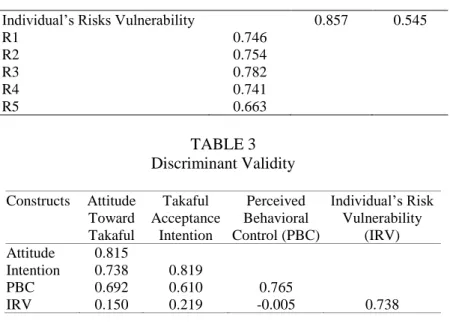
Hair et al., 2012; Hair et al., 2013; Fornell and Larcker, 1981). The results of the measurement model are good; the indicators’ loadings of all latent constructs are higher than the required minimum value of
≥0.40 except PBC1 of perceived behavioral control which was subsequently deleted. All the four constructs achieved internal consistency reliability as the composite reliability of each is higher than the required threshold of ≥0.70; it ranges from 0.802 to 0.922.
Likewise, the convergent validity of all the latent constructs as evaluated using AVE is higher than the minimum cutoff value of
≥0.50; it ranges from 0.545 to 0.670. Finally, the squareroot of AVE of each of the latent constructs is greater than its squared inter- correlation with any other constructs in the model, depicting good discriminant validity. Having satisfied the four measurement model criteria as contained in Tables 2 and 3, it can be ascertained that all the latent constructs are valid and reliable for structural model evaluation.
TABLE 2
Indicator Loadings, Consistency Reliability and Convergent Validity Indicators and Constructs Indicators’
Loadings
Composite Reliability
AVE
Attitude Toward Takaful 0.922 0. 664
A1 0.875
A2 0.834
A3 0.855
A4 0.775
A5 0.706
A6 0.831
Takaful Acceptance Intention 0.910 0.670
I1 0.829
I2 0.784
I3 0.783
I4 0.872
I5 0.823
Perceived Behavioral Control 0.806 0.585
PBC1 0.605
PBC2 0.868
PBC3 0.798
Individual’s Risks Vulnerability 0.857 0.545
R1 0.746
R2 0.754
R3 0.782
R4 0.741
R5 0.663
TABLE 3 Discriminant Validity Constructs Attitude
Toward Takaful
Takaful Acceptance
Intention
Perceived Behavioral Control (PBC)
Individual’s Risk Vulnerability
(IRV) Attitude 0.815
Intention 0.738 0.819
PBC 0.692 0.610 0.765
IRV 0.150 0.219 -0.005 0.738
4.2 STRUCTURAL MODEL EVALUATION
Hair et al. (2013) posited that there are five key criteria for assessing the structural model in PLS-SEM. These include assessments of: (1) multicollinearity using Variance Inflation Factor (VIF), (2) significance of the path coefficients (direct, and moderated), (3) coefficient determination (R²), (4) the effect size (f²), and lastly (5) predictive relevance (Q²). The results are presented in Tables 4 and 5.
TABLE 4
Multicollinearity Diagnostics
Constructs VIF
Attitude towards Takaful 2.010
Perceived Behavioral Control 1.965
Individual’s Risk Vulnerability 1.047
The findings from Table 5 indicate that attitude toward takaful has significant positive impact on takaful acceptance intention in the Nigerian Frontier Market (ß = 0.568; t = 7.150; p = 0.000), which supported H1, and is consistent with previous studies relating to takaful acceptance intention (Amin, 2012; Souiden et al., 2015, Rahim and Amin, 2011, Maiyaki and Ayuba, 2015). Consistent with Husin and Rahman (2013) and Rahim and Amin (2011), the result revealed that perceived behavioral control has a significant influence on takaful acceptance intention in the Nigerian Frontier Market (ß = 0.217; t =
2.288; p = 0.011), thereby supporting H2. More interesting, the findings revealed that individual’s risk vulnerability strongly predicts takaful acceptance intention (ß = 0.135; t = 2.905; p = 0.002), hence H3 is supported. This result is pioneering from the current study; the extant literature did not reveal empirical evidence on the influence of individual’s risk vulnerability on takaful acceptance intention. Hence this study has made a breakthrough by providing empirical evidence for the aforementioned relationship.
TABLE 5
Path Coefficients for Hypotheses Testing
Hypotheses Beta S.E. Decision
Direct Effects
Attitude → Takaful Acceptance Intention
0.568*** 0.079 Supported Perceived Behavioral Control →
Takaful Acceptance Intention
0.217** 0.095 Supported Risks Vulnerability → Takaful
Acceptance Intention
0.135*** 0.047 Supported Moderation Effects
Attitude*Risks Vulnerability → Takaful Acceptance Intention
0.106* 0.074 Supported PBC * Risks Vulnerability→ Takaful
Acceptance Intention
-0.203** 0.121 Supported Note. ***, **, and * denote 1%, 5%, and 10% significance levels respectively.
Apart from direct effect, additional pioneering evidence provided is the result of the moderating effect of individual’s risk vulnerability in the relationship between attitude toward takaful, perceived behavioral control, and takaful acceptance intention is pioneering this research; extant literature did not reveal empirical evidence on such moderation effect. The results indicated that individual’s risks vulnerability significantly moderates the relationship between attitude towards takaful and takaful acceptance intention (ß = 0.106). Hence, H4 is supported. Consistent with the postulation of this study, the results showed that individuals with high- risk vulnerability would have more favorable attitudes towards takaful acceptance than those with low-risk vulnerability. Moreover, it also indicated that individual’s risk vulnerability significantly moderates the relationship between perceived behavioral control and takaful acceptance intention (ß = -0.203), thereby supporting H5. The finding is congruent with this study’s postulation that individuals with high-
risk vulnerability would have less behavioral control toward takaful acceptance than those with low-risk vulnerability. Individuals with high-risk vulnerability would likely lose behavioral control and just be more willing to accept takaful so as to be salvaged by its benefit.
Figures 2 and 3 present the interaction effects.
FIGURE 2 FIGURE 3
Interaction Effect: Attitude Interaction Effect: PBC
In addition to multicollinearity and path coefficients (direct and moderation) evaluation, other statistics indicate strong support for the structural model. The coefficient of determination (R²) of the model is 0.581, and the adjusted is 0.571, implying that attitude toward takaful, perceived behavioral control, and individual risk vulnerability collectively explained 57.1% of the variations in takaful acceptance intention in Nigeria. Chin (1998) classified R² of 0.19, 0.33 and 0.67 as weak, moderate and substantial respectively, while Hair et al.
(2011) classified R² of 0.25, 0.50, and 0.75 as weak, moderate and substantial respectively. In each case, the R²of the current study can be categorized as medium.
Effect-size (f²) is another criterion for evaluating the structural model, which examine the unique effect of each independent variable to the dependent variable. It is assessed using the following formulae:
(1) 𝑓2=𝑅2 𝐼𝑛𝑐𝑙𝑢𝑑𝑒𝑑 − 𝑅2 𝐸𝑥𝑐𝑙𝑢𝑑𝑒𝑑 1 − 𝑅2 𝐼𝑛𝑐𝑙𝑢𝑑𝑒𝑑
Note: Individual’s Risk Vulnerability strengthens the positive relationship between Attitudes Towards Takaful and Takaful Acceptance Intention.
Note: Individual’s Risk Vulnerability dampens the positive relationship between Perceived Behavioral Control and Takaful Acceptance Intention.
According to Cohen (1988), f² of 0.02, 0.15 and 0.35 are classified as small, medium, large respectively. Therefore, the effect sizes (f²) of attitude towards takaful, perceived behavioral control, and individual’s risk vulnerability are 0.383, 0.057, and 0.042, those classified as large, medium, and small respectively.
Predictive relevance (Q²) is the last criterion for evaluating the structural model. It evaluates the power of the model in the absence of other unobserved data, and it is assessed using construct-cross validated redundancy (Hair et al., 2011). Thus, any structural model with (Q²) above zero can be said to have predictive relevance (Stone 1974; Geisser 1974). Therefore, with (Q²) of 0.359, which is greater than zero, the current research model is said to have predictive relevance.
4.3 MODEL FIT
Hair et al. (2013) argued that PLS path modeling does not require global goodness-of-fit (GoF) criterion assessment. However, in a more recent publication it was posited that the standardized root means square (SRMR) residual can be used for assessing GoF of the PLS model (Henseler et al., 2014). This measure is available in the Smart- PLS 3.0 utilized in this study. SRMR is defined as the residual differences between the sample’s correlated data and the predicted correlated model (Hooper, Coughlan and Mullen, 2008). SRMR values range from zero to 1.0, with values closer to zero indicating perfect model fit. A well-fitting model should have an SRMR value less than or equal to 0.05; however, a value close to 0.08 is deemed acceptable (Hooper, Coughlan and Mullen, 2008; Hu and Bentler, 1999). For the current research model, the value of SRMR residual obtained from Smart-PLS 3.0 was 0.08 which can be considered acceptable (Hu and Bentler, 1999). Moreover, Hooper, Coughlan and Mullen (2008) asserted that the larger the sample size, the lower the SRMR residual, the SRMR value of 0.08 obtained in this work can be said to be sufficient owing to the low sample size of only 129 respondents. Therefore, based on the SRMR residual used to assess the fitness of the PLS model (Henseler et al., 2014), it is concluded that the hypothesized model fits the data in the current study.
5. CONCLUSION, IMPLICATIONS, AND FUTURE RESEARCH In recapping its objectives, the study examined the direct effect of attitude toward takaful, perceived behavioral control, individual’s risk
vulnerability on takaful acceptance intention in Nigeria. It also examined the moderating effect of individual’s risks vulnerability on the relationship between attitudes toward takaful, perceived behavioral control, and takaful acceptance intention. Consequently, attitude toward takaful, perceived behavioral control and individual’s risk vulnerability were found to have a significant direct relationship with takaful acceptance intention. Individual’s risk vulnerability moderates the relationship between attitude toward takaful, perceived behavioral control, and takaful acceptance intention.
5.1 LITERATURE AND THEORETICAL IMPLICATIONS Contribution has been made to the existing literature on additional evidence from the Nigerian Frontier Market on the influence of attitude toward takaful, perceived behavioral control, and individual’s risk vulnerability on takaful acceptance. Theoretically, the inclusion of individual’s risk vulnerability as direct predictor and moderator into the takaful acceptance model has not in small value contributed to TRA and TPB. This contribution is an answer to a call made by Fishbein and Ajzen (1975) and Ajzen (1991) for the inclusion of additional variables into TRA and TPB that can add more explanation to human behavior directly or indirectly.
5.2 TAKAFUL MARKETING IMPLICATION
For the direct effect, incongruence with previous studies, the result suggests that individuals have the intention to accept takaful as an Islamic financial product in a Muslim dominated country such as Nigeria as shown by the predictors of intention. However, the question of interest is: Why in reality there is a decline in takaful penetration growth in Muslims dominated African countries including Nigeria despite acceptance intention?
The results of indirect effects (moderation) provide an answer to the aforementioned practical question. The answer is that individual’s risk vulnerability is the significant market penetration mechanism to be used by takaful operators in Frontier Markets especially Muslim dominated African countries to transform rapidly intention into action. It enhances one’s attitude towards takaful acceptance which in essence will enhance intention that can easily be transformed into actual acceptance (moderation). It also weakens individual’s behavioral control on whether or not to participate in takaful (moderation), in that individuals with higher risk vulnerability
would likely losebehavioral control thereby being more eager to take part intakaful in anticipation of been rescued by takaful funds in the event of risks associated with their vulnerabilities.
Though the Islamic idea behind takaful is “mutual assistance”
(i.e. ta‘āwun), individuals are highly rational; they think of their benefit first before others. Hence, applying this marketing strategy in conjunction with the Islamic idea of takaful would likely boost takaful penetration growth in African Frontier Markets.
5.3 LIMITATIONS AND FUTURE RESEARCH DIRECTION This study is associated with a number of limitations. First, the samples used are mainly concentrated in the Muslim dominated northern part of Nigeria where the researcher has a high level social network affiliation facilitating data collection. It will be of interest for future studies to use samples from non-Muslim parts of Nigeria. It should also be of interest to develop two takaful acceptance models simultaneously to compare the predictors of takaful acceptance between Muslim dominated and non-Muslim dominated regions.
Second, though the samples are sufficient for the purpose of this research considering the number of predictors analyzed, future studies should also consider expanding samples relative to the number of predictors to be used. Lastly, the coefficient of determination (R²) which is considered moderate in line with Chin (1998) and Hair et al.
(2011) implied that attitude towards takaful, perceived behavioral control, and individual risk vulnerability collectively explained 57.1%
of the variations in takaful acceptance intention in Nigeria. However, it can be enhanced through the integration of additional variables not included in the current theoretical model.
REFERENCES
Ajzen, I. “The Theory of Planned Behavior.” Organizational Behavior and Human Decision Processes 50, no. 2 (1991): 179-211.
Al-Bukhā rī, Muhammad ibn Ismā‘īl. Ṣaḥīḥ Al-Bukhārī, Hadith 1, https://sunnah.com/bukhari/1/1.
Alabede, J.O., Z.Z. Ariffin, and K.M. Idris. “Individual Taxpayers’
Attitude and Compliance Behaviour in Nigeria: The Moderating Role of Financial Condition and Risk Preference.” Journal of Accounting and Taxation 3, no. 3 (2011a): 91-104.
———. “Tax Service Quality and Compliance Behaviour in Nigeria:
Do Taxpayer’s Financial Condition and Risk Preference Play Any Moderating Role?” European Journal of Economics, Finance and Administrative Sciences 35 (2011b): 90-108.
———. “Noncompliance Opportunities and Tax Compliance Behavior in Nigeria: The Moderating Effect of Taxpayers’
Financial Condition and Risk Preference.” Journal of Modern Accounting and Auditing 8, no. 4 (2012a): 445-60.
———. “Public Governance Quality and Tax Compliance Behavior in Nigeria: The Moderating Role of Financial Condition and Risk Preference.” Issues in Social and Environmental Accounting 5, no. 1 (2012b): 3-24.
Amin, H. “An Analysis on Islamic Insurance Participation.”Jurnal Pengurusan 34 (2012):11-20.
———., A.R.A. Rahim, L.S. Sondoh Jr., and M.A. Chooi Hwa.
“Determinants of Customers’ Intention to Use Islamic Personal Financing: The Case of Malaysian Islamic Banks.”
Journal of Islamic Accounting and Business Research 2, no.
1 (2011): 22-42.
Arkes, H.R., L.T. Herren, and A.M. Isen.“The Role of Potential Loss in the Influence of Affect on Risk-Taking Behavior.”
Organizational Behavior and Human Decision Processes 42, no. 2 (1988): 181-93.
Armitage, C.J., and M. Conner. “Efficacy of The Theory of Planned Behaviour: A Meta‐Analytic Review.” British Journal of Social Psychology 40, no. 4 (2001): 471-99.
Chachi, A. “Origin and Development of Commercial and Islamic Banking Operations.” Journal of King Abdulaziz University:
Islamic Economics 18, no. 2 (2005): 3-25.
Chin, W.W. “Issues and Opinion on Structural Equation Modeling.”
Management Information Systems Quarterly 22, no. 1 (1998):
7-15.
Cohen, J. Statistical Power Analysis for the Behavioral Sciences.
Hillsdale, New Jersey: Lawrence Erlbaum Associates, 1988.
Deloitte. The Way Forward for Takaful - Spotlight on Growth, Investment and Regulation in Key Markets. Manama, Bahrain: Deloitte & Touche, 2014.
Eisenhart, M. “Conceptual Frameworks for Research Circa 1991:
Ideas from a Cultural Anthropologist; Implications for Mathematics Education Researchers (Plenary Address).” In Proceedings of the Thirteenth Annual Meeting of PMENA, Blacksburg, Virginia, 1991.
Faul, F., E. Erdfelder, A.-G. Lang, and A. Buchner. “G*Power 3: A Flexible Statistical Power Analysis Program for the Social, Behavioral, and Biomedical Sciences.” Behavior Research Methods 39, no. 2 (2007): 175-91.
Financial Consumer Agency Of Canada. Understanding Insurance Basics. Ottawa, Canada: Financial Consumer Agency of Canada, 2011.
Fishbein, M., and I. Ajzen. Belief, Attitude, Intention and Behaviour:
An Introduction to Theory and Research. Reading: Addison- Wesley, 1975.
Fornell, C., and D.F. Larcker. “Evaluating Structural Equation Models with Unobservable Variables and Measurement Error.”
Journal of Marketing Research 1, no. 18 (1981): 39-50.
French, D. P., S. Sutton, S.J. Hennings, J. Mitchell, N.J. Wareham, S.
Griffin, W. Hardeman, and A.L. Kinmonth. “The Importance of Affective Beliefs and Attitudes in The Theory of Planned Behavior: Predicting Intention to Increase Physical Activity.”
Journal of Applied Social Psychology 35, no. 9 (2005): 1824- 48.
Geisser, S. “A Predictive Approach to the Random Effect Model.”
Biometrika 61 (1974): 101-7.
Godin, G., and G. Kok. “The Theory of Planned Behavior: A Review of Its Applications to Health-Related Behaviors.” American Journal of Health Promotion 11 (1996): 87-98.
Hair, J.F., G.T.M. Hult, C.M. Ringle, and M. Sarstedt. A Primer on Partial Least Squares Structural Equation Modeling (PLS- SEM). Los Angeles: SAGE Publications, 2013.
Hair, J.F., C.M. Ringle, and M. Sarstedt. “PLS-SEM: Indeed a Silver Bullet.” The Journal of Marketing Theory and Practice 19 (2011): 139-52.
Hair, J.F., M. Sarstedt, C.M. Ringle, and J.A. Mena. “An Assessment of the Use of Partial Least Squares Structural Equation Modeling in Marketing Research.” Journal of the Academy of Marketing Science 40 (2012): 414-33.
Harrington, Scott E., and Gregory Niehaus. Risk Management and Insurance. New York: McGraw-Hill/Irwin,2003.
Henseler, J., T.K. Dijkstra, M. Sarstedt, C.M. Ringle, A.
Diamantopoulos, D.W. Straub, D.J. Ketchen, J.F. Hair, G.T.M Hult, and R.J. Calantone. “Common Beliefs and Reality About PLS Comments on Rönkkö and Evermann.”
Organizational Research Methods 17, no. 2 (2014): 182-209.
Henseler, J., C.M. Ringle, and R.R. Sinkovics. “The Use of Partial Least Squares Path Modeling In International Marketing.”
Advances In International Marketing 20 (2009): 277-319.
Hooper, D., J. Coughlan, and M. Mullen. “Structural Equation Modelling: Guidelines for Determining Model Fit.”
Electronic Journal of Business Research Methods 6 (2008):
53-60.
Hu, L.T., and P.M. Bentler. “Cutoff Criteria for Fit Indexes in Covariance Structure Analysis: Conventional Criteria Versus New Alternatives.” Structural Equation Modeling: A Multidisciplinary Journal 6, no. 1 (1999): 1-55.
Husin, M.M., and A.A. Rahman. “A Review of Intention-Behaviour Theories: How Useful are these for Measuring Consumer Intention to Participate in Family Takaful.” Insurance and Takaful Journal 4 (2013): 37-49.
Internet World Stats. “Usage and Population Statistics.”Internet World Stats.http://www.internetworldstats.com/stats1.htm Jessor, R. “Risk Behavior in Adolescence: A Psychosocial Framework
for Understanding and Action.” Journal of Adolescent Health 12 (1991): 597-605.
Kidwell, B., and R.D. Jewell. “An Examination of Perceived Behavioral Control: Internal and External Influences on Intention.” Psychology and Marketing 20, no. 7 (2003): 625- 42.
Maiyaki, A., and H. Ayuba. “Consumers’ Attitude toward Islamic Insurance Services (Takaful) Patronage in Kano Metropolis, Nigeria.” International Journal of Marketing Studies 7, no. 2 (2015): 27-34.
Mayr, S., E. Erdfelder, A. Buchner, and F. Faul. “A Short Tutorial of Gpower.” Tutorials in Quantitative Methods for Psychology 3 (2007): 51-59.
McGaghie, W.C., G. Bordage, and J.A. Shea. “Problem Statement, Conceptual Framework, and Research Question.” Academic Medicine 76 (2001): 923-24.
Md Husin, M., and A. Ab Rahman. “What Drives Consumers to Participate into Family Takaful Schemes? A Literature Review.” Journal of Islamic Marketing 4, no. 3 (2013): 264- 80.
Nwachukwu, Lucy. “Boosting Inclusive Insurance in Nigeria via Takaful Insurance.” News Agency of Nigeria (NAN) vol. 9 no.
133, June 5, 2015, Features Section.
Rahim, F.A. and H. Amin. “Determinants Of Islamic Insurance Acceptance: An Empirical Analysis.”International Journal of Business and Society 12, no. 2(2011): 37-54.
Razak, M., R. Idris, M.M. Yusof, W.E. Jaapar, and M.N. Ali.
“Acceptance Determinants Towards Takaful Products In Malaysia.” International Journal of Humanities and Social Science 3, no. 17 (2013): 243-52.
Souiden, N., Y. Jabeur, and H. Estelami. “The Impact of Islamic Beliefs on Consumers’ Attitudes and Purchase Intentions of Life Insurance.” International Journal of Bank Marketing 33, no. 4 (2015): 423-41.
Stone, M. “Cross-Validatory Choice and Assessment of Statistical Predictions.” Journal of the Royal Statistical Society Series B (Methodological) 36, no. 2 (1974): 111-47.
Vaughan, E.J., and T.M. Vaughan. Fundamentals of Risk and Insurance. Hoboken, New Jersey: John Wiley & Sons, 2007.
Yusuf, T.O. “Prospects of Takaful’s (Islamic Insurance) Contributions to the Nigerian Economy.” Journal of Finance and Investment Analysis 1, no. 3 (2012): 217-30.
Ziadat, M.T.A. “Applications of Planned Behavior Theory (TPB) in Jordanian Tourism.” International Journal of Marketing Studies 7, no. 3 (2015): 95-106.