
Guillaumont and Kpodar (2005) define this phenomenon as "the hysteresis effect" whereby the unemployed are the last to be hired. A family is considered poor if the income earned by the household is below the poverty line income (PLI). In addition, they found that 12 percent of the poverty line cash transfer was needed to lift the poor out of poverty based on income.
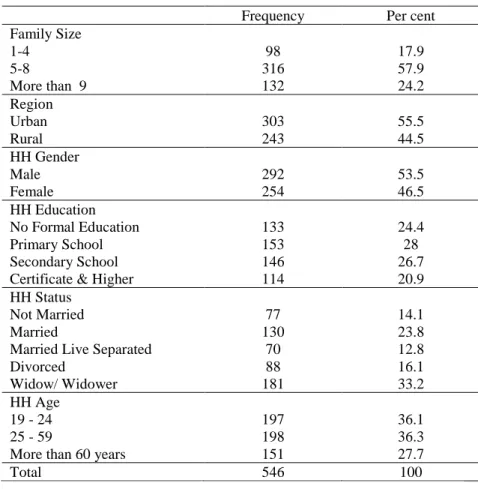
This study investigates the measurement of poverty based on income and expenditure of the poor in Kelantan, Malaysia. The existence of economies of size in household consumption cautions us against concluding that larger families tend to be poorer (Mok, Gan, & Sanyal, 2007). The family size classification in this study is based on household expenditure in Malaysia, which are: 1) family size 1 to 4; 2) a family with 5 to 8 members and; 3) family size 9 and up. The poverty rate is measured on the basis of the Population Index (HC); this can show the proportion of poor households among total households.
The poverty gap index (P) measures the extent to which individuals fall below the poverty line, as a percentage of the poverty line. The measure is based on the ratio of the number of HC inhabitants multiplied by the poverty gap index (P) plus the Gini coefficient (GP) of the distribution of income among the poor weighted by [(1-P)], i.e. The poverty gap Index shows the percentage of the average income of the poor that is short of the poverty line (Ibrahim, P. H, 2006).
It is more sensitive to changes in the income of the poorest and less sensitive to changes in the income of those living near the poverty line (Islam, and Shimeles, 2007).
RESULTS
Index is suitable because it also includes all the information about the number of poor, the extent of poverty deficits per person and the distribution of income among the poor. However, the Sen index is set to increase, indicating that poverty among the poorest has become worse. From this we can understand that the income method requires more information and resource than the expenditure method to understand their poverty situation.
This shows that a higher dimension of poverty is identified based on the expenditure approach; we can see that the amount for the second approach (at least the expenditure or income approach) was doubled than the first approach (the expenditure and income approach). It shows that 91 percent of the households are poor based on the expenditure method and 80 percent of the sampled households are poor based on the income method. The result shows that, out of 546 families sampled in the study area, 497 families were categorized as poor according to the expenditure method and 437 families were considered poor according to the income method.
The expenditure method estimated a higher number of poor people than the income method, which is 1.14 times higher. In addition, the expenditure method estimated that higher family size, urban region, female, gender of the household head, no formal education, married, and aged 19 to 24 years had the worst headcount index, while for the income method, a family size of 5 to 8, rural area, female household gender head, high school, widow/widower and over 60 years old has the worst income index. The result shows that most of the poor in Kelantan have income above the poverty line and consumption below it.
The poverty severity index is more difficult to interpret compared to the two previous indices. But, compared to expenditure approach, the income method (0.02) shows a serious income inequality in Kelantan. Based on variables, almost all variables have a higher poverty severity compared to the total expenditure poverty severity in Kelantan.
The head of the household with no formal education has the highest poverty rate (0.86) while married but living separately. 0.40) has the second highest poverty rate in Kelantan. Meanwhile, the income method shows that households that are married but living apart (0.51) have the highest poverty rate and 3 variables (family size 5 – 8, female gender and no formal education) have more than 0.10 of the poverty rate in Kelantan. This result indicates that the income method underestimates inequality among the poor in the study area than the expenditure method.
DISCUSSION
This suggests that those with higher incidence of expenditure poverty have greater household dependency (children) in the family (9 and above in family size, aged 19 to 24), higher cost of living (urban) and less savings (no formal education and married ). While the prevalence of higher income poverty is reflected from low-wage economic activity (unpaid activity) (rural), low economic contribution among family members (high school, widow/widower), and they received higher social welfare programs such as food stamps, medical assistance, subsidies, work support and cash transfer services (60 years and above). This suggests that large parts of the poor are not income poor, but consumption poor.
Knight and Li (2006) found that the incidence of poverty for individuals who are income poor but not consumption poor is lower than those who are consumption poor but not income poor in urban China. If the poor in Malaysia have strong prior savings that face the risk of unemployment, this indicates the need for greater public support of the unemployed. Third, the result of this study shows that household heads who have no formal education and are married but live apart have the worst poverty gap and poverty severity in both poverty lines.
Education and training is one of the most important social investments because it will bring long-term benefits to a country (De la Porte et al., 2012). From the results we see that the head of households who are married but living separately have the largest poverty gap and poverty severity in both poverty measurement approaches. Being a single mother has more disadvantages when the lack of income breadwinner in the family with lack of primary workers (husband) in the family had reduced the family income thereby limiting expenditure.
This may be caused by the lack of income that the breadwinner among the family with a lack of primary workers (husband) in the family had reduced the income of the family that limits their expenses. Further, most married heads of households had a number of children in their household, which may contribute to higher consumption by the head of household. Thus, the results show that the decline of living apart will reduce poverty in Kelantan as the high poverty gap and severity between married but living apart marital status.
For example, results from family size 9 and above show that their incidence of poverty is the highest among other families. But their poverty gap shows that this type of family suffers from the lowest poverty gap. This situation implies that although their poverty incidence (quantity) is the worst (compared to other family sizes), their difference (quality) is the lowest.
CONCLUSION
Measuring poverty from the expenditure overview: an analysis of zakat recipients among the poor and needy in Kelantan, Malaysia. Journal of Business and Social Development 5, no. Poverty and Inequality in Indonesia: Estimates, Decomposition, and Key Issues.” Journal of the Asia-Pacific Economics 5, no. Towards achieving quality of life through the management of zakat distribution to its rightful recipients (the poor and needy). International Journal of Business and Social Sciences 2, no.
34;Economic Poverty Reexamined: Material Hardship and Income Poverty in the United States." Doctoral Dissertation, University of Washington, 1999. 34;Poverty and Psychiatric Status: Longitudinal Evidence from the New Haven Epidemiologic Catchment Area Study." Archives of General Psychiatry 48, no. 34;Waging the War on Poverty: Poverty Trends Using a Historical Supplemental Poverty Measure.” Journal of Policy Analysis and Management 34, no.
Negative net income and the measurement of poverty: a note. Journal of Management, Finance and Economics 3, no. 34;The Role of Zakat Distribution among Muallaf (New Converts) in Reducing Poverty in Selangor, Malaysia." Journal of Economic Policy Researches 2, no. 34;Financial Development, Financial Instability and Poverty." Center for the Study of African Economies, University of Oxford.
34;Determinants and Policy Implications of Off-Balance Sheet Activities of MENA Countries' Commercial Banks." In Economic Research Forum. 34;Interconnections Between Income and Expenditure Approach to Measure Poverty in Northern Rajasthan." International Journal of Advanced Research in Management and Social Sciences 5, No. 34; Recent Trends in Economic Inequality in the United States: Income versus Expenditure versus Material Well-Being.” In Poverty and Prosperity in the United States in the Late Twentieth Century, 121-207.
34; Measures against material deprivation: final report. Washington, DC: US Department of Health and Human Services, Office of the Assistant Secretary for Planning and Evaluation (2004). 34; Poverty in African Households: The Limits of Surveys and Censuses." Journal of Development Studies 51, no. 34; Assessing the Quality of the March Current Population Survey and the Survey of Income and Program Participation Income Estimates." Unpublished article, US Census Bureau.
34;Negative Net Income and the Measurement of Poverty: A Note." Journal of Management, Finance and Economics 3, no. 34; Zakat Expenditure, School Enrollment and Economic Growth in Malaysia." International Journal of Business and Social Science 2, no.
