i A THESIS
Submitted to the faculty of teachers and education Muhammadiyah University of Makassar in partial fulfillment of the reqruitment for the degree of sarjana
Pendidikan
ILHAM IDRUS 10535589714
ENGLISH DEPARTMENT
FACULTY OF TEACHER TRAINING AND EDUCATION MUHAMMADIYAH UNIVERSITY OF MAKASSAR
2019
iv
SURAT PERJANJIAN
Saya yang bertanda tangan di bawah ini:
Nama : ILHAM IDRUS
NIM : 10 535 589714
Jurusan : Pendidikan Bahasa Inggris
Judul Skripsi : The Use of Simulation Method to Improve The Students Speaking Skill (An-Experimental Research of the Eighth Grade Students’ at SMP PGRI 1 Tamalate)
Dengan ini menyatakan perjanjian sebagai berikut:
1. Mulai dari penyusunan proposal sampai dengan selesainya skripsi saya, saya akan menyusun sendiri skripsi saya, tidak dibuatkan oleh siapapun.
2. Dalam menyusun skripsi, saya akan selalu melakukan konsultasi dengan pembimbing.
3. Saya tidak akan melakukan penjiplakan (plagiat) dalam menyusun skripsi ini.
4. Apabila saya melanggar perjanjian saya seperti yang tertera pada butir 1,2 dan 3 maka saya bersedia menerima sanksi sesuai dengan aturan yang berlaku.
Demikian perjanjian ini saya buat dengan penuh kesadaran.
Makassar, Oktober 2019 Yang membuat pernyataan:
ILHAM IDRUS 10535 5897 14
v
SURAT PERNYATAAN
Saya yang bertanda tangan di bawah ini:
Nama : ILHAM IDRUS
NIM : 10 535 5897 14
Jurusan : Pendidikan Bahasa Inggris
Judul Skripsi : The Use of Simulation Method to Improve The Students Speaking Skill (An-Experimental Research of the Eighth Grade Students’ at SMP PGRI 1 Tamalate)
Dengan ini menyatakan:
Skripsi yang saya ajukan di depan tim penguji adalah hasil karya saya sendiri bukan hasil ciplakan dan tidak dibuatkan oleh siapapun.
Demikian pernyataan ini saya buat dengan sebenar-benarnya dan bersedia menerima sanksi apabila pernyataan saya tidak benar.
Makassar, Oktober 2019 Yang membuat pernyataan:
ILHAM IDRUS 10535 5897 14
vi MOTTO
- Intelligence is not the measurement, but intelligence support all!
- Work hard, Play hard. Failure occurs only when we give up.
vii ABSTRACT
ILHAM IDRUS, 2016. “The Use of Simulation Method to Improve the Students Speaking Skill (An-Experimental Research of the Eighth Grade Students’ at SMP PGRI 1 Tamalate)”., under the thesis of English Education Department, the faculty of Teachers Training and Education, Makassar Muhammadiyah University, supervised by Eni Syatriana and Ilmiah.
This research was aimed at finding out check speaking or not the use of simulation method can improve the students speaking skill in terms of accuracy (pronunciation) and vocabulary. The design used was experimental with one class of the eight grade at SMP PGRI 1 Tamalate. The data obtained through the oral test. It was analyzed quantitatively.
The statistical computation showed that the value of t 8.10> value of t table 2.110 with the mean score of the pronunciation was 2.55 and vocabulary was 2.94 and the result of the students improvement in post-test is 68.19%. It indicates that Simulation Method was effective in increasing the students‟
speaking skill.
This study has proven that use of Simulation Method was effective in terms of increasing students‟ achievement and improving their speaking ability the value of the research is bigger than the ratio on the table.
Key word : Simulation Method, Speaking skill, Accuracy in Speaking
viii
ACKNOWLEDGEMENT
In the name of Allah, Most Gracious, Most Merciful
Alhamdullilahi Robbil „Alamin, first of all I would like to express my deepest praise and gratitude to Allah SWT who has given me His blessing and merciful to complete this thesis. Shalawat and salam are addressed to the final chosen religious messenger, the Prophet Muhammad SAW.
I realized that many people had given their helps and useful suggestion for the finishing of this thesis. Without the assistance of them, this thesis would never have existed. Therefore, the writer would like to express his appreciation and sincere thanks to:
1. Prof. Dr. H. Abd. Rahman Rahim, S.E., M.M., the Rector of University of Muhammadiyah Makassar.
2. Erwin Akib, M.Pd., Ph.D. the Dean of Teacher Training and Education Faculty.
3. Ummi Khaerati Syam, S.Pd., M.Pd., the Head of English Education Department of Teacher Training and Education Faculty, Muhammadiyah University of Makassar.
4. My high appreciation and great thankful are due to my first consultant Dr. Eni Syatriana, M.Pd., and Hj. Ilmiah, S.Pd., M.Pd. as the second consultant who have given their valuable time and guidance to finish this thesis.
ix
5. My heartful thank to all lectures of the Teacher Training and Education Faculty. UNISMUH especially to the lectures of English Department for their guidance during my study.
6. Thanks to my family especially for my parent who never stop pray for my success and who support me in finances and pray during my study in college.
7. Thanks Fitrianti Nur, Ina Jinoddin, Abdul Rauf, Brother Al-ikhwan Manurung, Brother Ayyub Baharuddin, Firman Rk, Iin Safei, Mulheriadi, Muh.Agung Sulfikar, Muh.Agung Teguh Anugrah, Aan Ghyfari and all of my best friends who have given their time, guidelines, and patient, especially during the writer arranging this thesis.
8. Unforgettable thanks to all my friends in D (Diamond) class of English Department “2014”, the big family of EDSA and TALAS Unismuh Makassar.
Finally, I dedicated this thesis for my beloved parents M.Idrus and Sanaria Who always love, care, pray and support in my study, there is no appropriate symbol which suitable to state my thanks to them. And also for the person who I could not write on this paper anymore.
May almighty, Allah SWT bless us all now and forever, Aamiin.
Makassar, Agustus 2019
ILHAM IDRUS
x
LIST OF CONTENTS
TITLE PAGE ... i
APPROVAL SHEET ... ii
CONSELLING SHEET ... iii
SURAT PERJANJIAN ... iv
SURAT PERNYATAAN ... v
MOTTO... vi
ABSTRACT ... vii
AKNOWLEDGEMENTS ... viii
LIST OF CONTENTS ... ix
LIST OF TABLE S ... xii
LIST OF APPENDIXES ... xiii
CHAPTER I INTRODUCTION A. Background ... 1
B. Problem Statements ... 4
C. Objectives of the Research ... 4
D. Significance of the Research ... 4
E. Scope of the Research ... 4
CHAPTER II REVIEW OF RELATED LITERATURE A. Previous Related Research Finding ... 5
B. Some Pertinent Ideas ... 7
C. Conceptual Framework ... 25
D. Hypothesis ... 26
CHAPTER III RESEARCH METHODOLOGY A. Research Design ... 27
B. Research Variables and Indicators ... 27
C. Population and Samples ... 28
xi
D. Research Instrument ... 29 E. Techniques of Data Analysis ... 31 CHAPTER IV FINDING AND DISCUSSION
A. Findings ... 35 B. Discussion ... 43 CHAPTER V CONCLUSION AND SUGGESTIONS
A. Conclusions ... 47 B. Suggestions ... 47 BIBLIOGRAPHY
APPENDIX
CURRICULUM VITAE
1 CHAPTER I INTRODUCTION A. Background
Language is a means of communication that is used to transfer information, ideas, and feelings from one person to another. It uses to communicate both in written and spoken form. Considering the importance of the language, our government have to draw up English as a foreign language that should be studied by the students. Language is a key in every communication in social life. It has an important role to put people in contact with other to communicate meaning and message they inform. For students in Indonesia speaking is quite difficult to produce well and correctly. The facts show that most of student in Indonesia find it very hard to express their ideas in English orally.
Brown and Yulein Asmi (2013:1) states that one of the aims of teaching English as a second or foreign language is to make the learners able to communication information effectively in spoken English. English have the most important language in International communication. The people all over the world speak the language when they meet one another in every international meeting, workshop, or conference. All countries in the world have set the language as one of the compulsory subject studies at school.
English have many functions, one of them as states that English is means for the students to develop science, technology, culture and art.
Speaking is a means of oral communication in giving ideas or information to others. It is the most essential way in which the speaker can express himself through the language. Speaking one of the skills in language in the importan one to be learned. Speaking is important because it is use as a means to express opinios. Students or learners used the language in conversation activies. Widdowson, (1985:58) states that an act of communication through speaking is commonly perform in face to face interaction and occur as part of dialogue or rather form or verbal exchange.
Generally speaking, there are two factors to affect student‟s speaking in English in class. One is they fail to find suitable words to express themselves and the other is they are afraid of making mistakes. Sometimes they make mistake when they are speaking because they are not confidence and indiscipline. So, good environment helps the student to speak actively and correctly. In the class, the student interact with their teacher and of course with their friends. That is why the English teachers should provide atmosphere and conditions that enhance student‟s reaction. Sometimes on communication each other ; they can more actively, confidence, discipline and critical with Simulation method, hopes that they can more actively, confidence, discipline and critical.
Simulation method is a method that useful for the students to improve their speaking ability because they can speak well without hesitation, they can express whatever ideas in their mind to express their opinion or argument about something. While the students are speaking, they also more actively,
confidence, discipline and critical in expressing something. The students not only practice speaking in teaching English process but they also can improve their speaking ability in their everyday life to speak with teachers, classmates, friends and other speakers.
Furthermore, if they are actively involved in the classroom, they will be motivated to learn it and automatically the students‟ speaking will improve. The researcher finds similar case the eighth year in SMP PGRI 1 Tamalate. The Researcher chose this school because the researcher was almost 2 month doing internship 3. There are many problems by the students in learning English. One of the crucial problems is their ability and participation in speaking. After the teacher give the materials, the students are looked bored to practice. They still confuse what they have to say and how to say. It is caused their pronunciation are still not good lack of vocabularies.
They also still confuse to express the ideas on their mind even not active enough on their speaking class. In speaking class, the students hope to express ideas, information and feeling others
Based on explanation above, the important for the teachers to encourage and motivate the students to speak English, especially in the class.
Therefore , the researcher conducts a research under the title, “The Use of Simulation Method to Improve the Students Speaking Skill”.
B. Problem Statements
Based on the background describe earlier, the researcher formulate research questions as follows:
Does the use of simulation method improve the students speaking skill?
C. Objective of the Research
In relating to the problem statement above, the objectives of the research is to find out whether the use of simulation method can improve the students speaking skill or not
D. Significance of the Research
The results of the research expects to be meaningful information and approach for students in learning and improving their speaking ability and also the result of this research is able to give a contribution for English teacher to develop the students‟ speaking ability through Simulation as a useful method.
To find out the ability of the students‟, the researcher will give a pretest, treatment and posttest and also motivates all of the students‟ to learning English.
E. Scope of the Research
The scope of this research is restricted to speaking ability in relation to the use of Simulation Method at the Eight Grade Students of SMP PGRI 1 Tamalate. The researcher will use Simulation Method to improve the students speaking ability with the focus on the students pronunciation and vocabulary.
5 CHAPTER II
REVIEW OF RELATED LITERATURE
A. Previous Related Research Findings
Wahyudi (2014) in his written, Improving Students’ Speaking Ability Use of Whole Brain Technique is Effective in Terms of Increasing Students’
Achievement and Improving their Speaking Skill (the value of the research is bigger than the ratio on the table). It also can be seen on the means‟ scores on both of pronunciation and vocabulary in posttest gained higher means scores is 7.73in pronunciation and 7,73 in vocabulary than the pretest.
Ammetyas (2017) in his thesis “The Use of Simulation In Teaching Speaking Skill: A Case Study At SMA Al-Islam 1 Surakarta In The Academic Year Of 2015/2016”.The results showed that: (1) There are three important stages in the implementation of simulation, they are preparation stage, implementation stage, and evaluation stage. The type of simulation that teacher used is game-based simulation. The aspects of simulation used in English class are content, instruction, language focus, and students‟ contribution.
Moreover, the teacher‟s way of adjusting the material with simulation is by considering the assumption that the simulation is suitable for delivering the material and the combining of the material and simulation can create interesting learning activity so it can reach the students‟ learning objectives. (2)The problems faced during the implementation of simulation are students‟ anxiety, students‟ uneven
participation, students‟ use of mother tongue and the limited time allocation.
Therefore, the students‟ learning factors that cover the students‟ condition and teachers‟ treatment may be referred to the solutions, they are about how the teacher deal with the students anxiety, intensify students‟
participation, encourage students‟ self-discipline to use English as language learned instead of mother tongue and use time allocation effectively.
Hafidhah.2017.”The Implementation Of Simulation Method To Improve Students‟ Speaking Skill At The Second Grade Students Of Mtsn Pulosari”. The result of this research, the implementation of Simulation Method improve students‟ speaking skill at MTsN Pulosari. The result of observation checklist showed that the students became active during teaching learning process. It was seen from the result of observation checklist cycle 1 was 58%, in cycle 2 was 92%. The result of questionnaire showed that the students more get motivation with this method. It was seen from the result in cycle 1 was 54% and the cycle 2 was 84%. The test in cycle 1 showed that there was54%who got low score under basic minimum standard was 75. Then in cycle 2,who reached the minimum score based from KKM was 100%. The researcher concluded that the result from observation, questionnaire, and test in cycle 2 is better than cycle 1. It meant that the study had been successful by using Simulation method.
From the related research finding above, the similarities of this research is similar in away that it improves the students‟speaking ability in the term of pronunciation and vocabulary. The difference is how to applying a method in the
class and how face the students‟ because every students‟ has a different problem to understand a material. Actually, it seems that the way of teaching speaking have to catch the students attention and involves them learning process actively by creating a good atmosphere, particularly in improving speaking ability. Compare with Simulation Technique the students will be more interested and active in learning process because the students will get the experience as like as in the real situations in speaking.
B. Some Pertinent Ideas
1. Some Concepts of Speaking
Speaking as one of the skills in language learning is the important one to be learned. Speaking is the important one because it is used as the tool to express the opinion of the students directly from their mouth. And the students or language user use the language in conversation activities. It is reality of speaking. Speaking as the productive skill is the common way to express the people statement. Widdowson, (1985) states that speaking is a means of oral communication that gives information involves two elements, namely the speaker who gives the massage and the listener who the receptive the massage in other word, the communication involves the productive skill of listening.
Speaking is tools of communication to other or speaking is way to bring a message from one person to other interact with them. Communication will be not running well without speaking and it is essential way which the speaker can express themselves through the language, communication is
collaborated venture in which the interlocutors negotiate meaning in order to achieve their communication ends.
Speaking is to express the needs–request, information, service. The speakers say words to the listener not only to express what in her mind but also to express what he needs whether information service. Most people might spend of their everyday life in communicating with other. Define communication as follow: communication, of ideas, of opinions, of feeling.
Therefore, communication involves at least two people where both sender and receiver need to communicate to exchange information, ideas, opinions, views, or feelings.
Meanwhile, Jones (1989: 14) stated, “Speaking is a form of communication. We can say that a speaker must consider the person they are talking to as listeners. The activity that the person does primary based on particular goal. So, it is important that everything we wants to say is conveyed in an effective way, because speaking is not only producing sounds but also a process of achieving goals that involves transferring messages across. Jones said (1989: 14) how you say something can be important as what you say in getting your meaning across. Therefore, speaking process should pay attention to want and how to say as well as to whom appropriately.
Valdman in Kothari (2004) said, the ability to speak a foreign language is without doubt the most highly prized language skills, and rightly.
So, because he was can speak the language well can also understand it and
can learn to read it with relative case an also the ability to speak a language will greatly expedite and facilitate learning to write it.
We have known that speaking play the important role in the language, in order to express the idea, opinion, and feeling of the people. As the oral skill speaking is the general way of presenting idea directly.
Lubis in Kuntjojo, (2009) says Question and answer, major elements in natural conversation sessions. Beside on that statement we conclude that one of important aspects in speaking is there is a communication or interacting between the speaker and listener. So it will make the good attraction / understanding about the object of topic.
2. The Purpose of Speaking
Speaking is the tool of communication that makes the people easier to interaction. According to Kingen in Uonis (2017), the purpose of speaking both the transactional and interpersonal into an extensive list of twelve categories as follows:
a. Personal-expressing personal feelings, opinion, beliefs and ideas.
b. Descriptive-describing someone or something real or imagined.
c. Narrative-creating and telling stories or chronologically sequence events.
d. Instructive-giving instruction or providing directions designed to produce an outcome.
e. Questioning-asking question to obtain information.
f. Comparative-comparing two or more objects, people, ideas, or opinions to make judgments about them.
g. Imaginative-expressing mental of people, place, events, and objects.
h. Predictive-predicting possible future events.
i. Interpretative-exploring meanings, creating hypothetical deduction, and considering inferences.
j. Persuasive-changing others opinions, attitudes, or point of view, or influencing the behavior of others in some way.
k. Explanatory-explaining, clarifying, and supporting ideas and opinions.
l. Informative-sharing, information with others.
3. Components of Speaking
Harris (1994) asserts that are five components in speaking ability(Accuracy,grammar,vocabulary,fluency and comprehension). For this reason,the researcher would explain each of items one by one.
1. Accuracy
There are definitions of accuracy by experts :
a. Bartram and Walton (2002), accuracy in spoken English refers to
“utterances as near as to a native speaker‟s as possible” in terms of grammar, vocabulary and pronunciation.
b. Willerman (2011), oriented approach which accepts that grammatical or pronounciation errors are insignificant, especially in the eral stages.
Correction can hinder learner‟s development in speaking.Based on expalanation above can conclude that accuracy is refers to grammar, pronunciation and vocabulary. In other words accuracy as the production of grammatical utterances.
2. Grammar
A conversation will be good-look when the speaker using grammar in those situation. Harmer (2001) points out that grammar of a language is the description of the way in which words can change their forms and can be combined into sentence in that language. From the statement above,it can be conclude that having good grammar, the speaker can convey/produce the words or sharing information correctly.
3. Vocabulary
Vocabulary is the knowledge of words and word meanings. A language learner cannot communicate or express his or her ideas either in spoken or writetten form if he or she does not have sufficient vocabulary. Having limited vocabulary is also a barrier that precludes learners from learning a language. In other side,having a large vocabulary to call upon will help our verbal communication flow and allow us to start eliminating noises such as,,,umm‟‟ and uhh‟‟.
Furthermore,vocabulary is a group pf words to make sentence structure in conveying idea or message to the listener. What word means is often defined by its relationship to other words. For example,we explain the meaning of fully by saying that it is the opposite of empty, we
understand that cheap is the opposite of expensive (Harmer,2001).
Finally, vocabulary is a group of words to make use to describe concepts/ideas to purpose convey our ideas either in spoken or written form.
4. Fluency
There are definition of fluency by expert : a. According to Fillmore (1979) fluency are :
1). The ability to talk in coherent, reasoned and semantically dense sentences, showing a mastery of the semantic (meaning in language) and syntactic resources of the language.
2). The ability to have appropriate things to say in a wide range of contexts, so that you do not become tongue tied or lost for word In other words, fluency is about coherence and context sensitivity in utterances. In this study, the fluency of spoken English in the simulated role play situations which involve social interactions between two interlocutors is measured. The fluency level is measured using hesitation. This is because hesitation is one of the criteria considered in determining fluency in major standardized test such as Test of English as a Foreign Language (TOEFL), International English Language Testing System (IELTS), and Malaysian University English Test (MUET). Besides that, the formulaic phrases used in learner‟s spoken English are identified as an indicator of fluency.
b. According to Brumfit (1984), fluency is "to be regarded as natural
language use." He also summarizes Fillmore's four kinds of fluency saying that they are related to four characteristics: speed and continuity, coherence, contextsensitivity, and creativity. These characteristics, he argues, are related to four "basic sets of abilities" as follows: psycho-motor, cognitive, affective and aesthetic.
Based on the expalanation abovecan conclude that fluency is the ability to talk/speak coherent and context sensitivity in utterances. Fluency which consists of smoothness, and the speaker should be able to speak fluent and quickly.
5. Comprehension
Comprehension is the ability to understand completely and be familiar with a situation or facts. Meanwhile, Horny (1995) claims that Comprehension is the power of understanding and an exercise aimed at improving or testing one‟s understanding of language (written or spoken).
Morever,comprehension can also mean the capacity of the main to perceive and understand; power to grasp the ideas; ability to know. In short, comprehension is important to avoid misunderstanding between a speaker and a listener.
4. The Principles of Teaching Speaking
According to Balley inPurwanto (2016) mentions some principles of teaching speaking to students. The principles are as the following.
a. Be aware of the differences of the second language and foreign language learning context. Language as a foreign language is in which the language is not used by the people in the country. It is as a foreign language. This situation, the students are challenged to use and study the target language.
b. Give students practice with both fluency and accuracy. Accuracy is as much as the learner uses the target language when they use the language. While fluency is how far the speaker uses the language quickly and has self confidence to utter the language.
c. Provide opportunities for students to talk by using group work or pair work, and limiting teacher talk. Experience is the best way to improve students‟ competence in speaking.
d. Plan speaking tasks that involve negotiation for meaning. Speaking tasks that involve negotiation for meaning will help students to interact with others.
e. Design classroom activities that involve guidance and practice in both transactional and interactional speaking. Transactional and interactional speaking can be reached through activities which is fun, enjoying, and motivating.
5. The Roles of The Teacher in Teaching Speaking
The role of the teacher is important in learning process. The successes of the learning process is depend on the teachers understanding about their role in teaching and learning process, especially in teaching speaking.
According to Harmer inAwaliyah(2017)classify roles of teacher in teaching speaking, as follows:
a. Prompter: The teachers provide the students with discrete suggestions, leave them to struggle by themselves, and give them chunks not words, without disrupting the discussion.
b. Participant: The teachers participate in the discussion by introducing new information and by ensuring the continuation of students‟ engagement. The main point is the teacher should not monopolize the conversation.
c. Feedback provider: The teachers can give some feedbacks by giving helpful and gentle correction and by telling the students about their performance. Besides that, they should avoid over- correction, since it might lead to students‟ reluctance to continue the dialogue.
d. Assessor: The teachers can write down some written samples of languages produced by students, or memorize some of it, then tell it to their students.
e. Observer: The teachers should observe the class speaking activity and find out what makes the activity breakdown.
f. Resource: The teachers have to provide some tools to improve their students‟ oral competence.
g. Organizer: The teachers manage the classroom to set the activities and get the students engaged.
6. Problems in Teaching and Learning Speaking
Learners sometimes have some obstacles when they want to talk in the class. According to Mai In Leong (2017) state that there are some problems for speaking skill that teachers can come across in helping students to speak in the classroom. These are inhibition, lack of topical knowledge, low participation, and mother-tongue use :
a. Inhibition.Learnersare often inhibited about trying things in foreign language classroom, afraid to make mistakes or to be criticized, and shy to utter words.
b. Lack of topical knowledge. Learners sometimes find fault that they do not have something to say. In other words, they cannot express themselves.
c. Low participation. Only one participant talks because some learners dominate, while other speaks a little or not at all.
d. Mother tongue use. In the class, all learners share the same mother tongue, so they feel unnatural to speak in the foreign language.
From the theories above, those problems in speaking are possible to obstruct student language development in the teaching-learning process. In teaching speaking, teachers should always encourage the students, not allowing students to become discouraged when they make mistakes. They have to understand that making mistakes is part of the learning process. Then, the teachers should provide some classroom speaking activities in which the students can engage actively.
7. Principle in Designing Speaking Technique
There are a number of practical principles for designing techniques that include speaking. Brown in Ginusti (2014) proposes seven principles in designing teaching speaking to help teachers to conduct the speaking class.
a. Use techniques that cover the range of learner needs, from language- based focus on accuracy to message-based focus on interaction, meaning and fluency. Teacher is expected to design tasks and to use techniques that help students to gain and apply all materials which should be learnt. At the same time, teachers should make any drilling as meaningful as possible without making students boring.
b. Provide intrinsically motivating techniques. Teacher should try to appeal to students‟ ultimate goals and interests in their need for knowledge, for status, for achieving competence and autonomy,
and for being all that they can be. Helping the students to see how the activity will give them benefit encourages them to get involved.
c. Encourage the use of authentic language in meaningful contexts. It deals with the design authentic contexts and meaningful interaction that supported by teacher‟s creativity in designing the materials.
d. Provide appropriate feedback and correction. The feedback is mostly from the teacher, but it can be found outside of the classroom. However, it is important for teachers to give the kinds of corrective feedback that are appropriate for the moment.
e. Capitalize on the natural link between speaking and listening.
Because speaking and listening are categorized as interrelated skills can reinforce each other. It means that in teaching speaking, the teachers should include listening skill aspect.
f. Give students opportunities to make an oral communication.
Teachers can stimulate the students‟ communicative competence by asking them to initiate conversations, to nomine topics, to ask questions, to control conversation and to change the subject. So, teachers should design speaking techniques allowing students to communicate by using the language.
g. Encourage the development of speaking strategies. Teachers should develop strategies to help the students accomplish oral communicative purposes. The strategies include asking for clarification (e.g. What?), asking someone to repeat something (e.g.
Excuse me?), using fillers (e.g. uh, I mean, Well), using conversation maintenance cues (e.g. Huh, Right, Yeah), getting someone‟s attention (e.g. Hey, So) and so forth.
8. Assessing Speaking
Brown in Purwanto (2017) proposed five categories of speaking assessment tasks :
a. Imitative. This is types of speaking performance tasks that deal with the ability to imitate a word or phrase or possibly a sentence.
The example of these kinds of tasks is repetition.
b. Intensive. This category of speaking assessment tasks related to the linguistic difficulties either phonological or grammatical aspect of language. Kinds of intensive speaking tasks are direct response, read-aloud, dialogue completion tasks and oral questionnaires, picture-cued tasks, and translation.
c. Responsive. This kinds of tasks include interaction and test comprehension but at somewhat length of utterance. Question and answer, giving instruction and directions and paraphrasing are categorized as responsive speaking tasks.
d. Interactive. Interactive speaking tasks can be described as tasks which produce interaction either transactional language or interpersonal exchange. Interview, role play, discussions and conversations, and games can be set as interactive tasks.
e. Extensive. These oral production tasks which are termed as monologue tasks include speeches, oral presentation, and story- telling.
9. Some Concepts of Simulation Method
Simulation is a situation in which a particular set of conditions is created artificially in order to study or experience something that could exist in a reality. The most common view of simulations is that they provide a way of creating a rich communicative environment (a present of reality) where the students actively become a part of some real-world system and function according to predetermined roles as members of that group. More important, however, is the notion that a simulation becomes reality and the “feeling of representative fades” (Crook in Javid, 2006), so much so that the world outside the simulation becomes, paradoxically, imaginary for a more detailed explanation of the mechanics of simulations.
Kaplan, (1997) stated Simulation is acting out or mimicking an actual or probable real life condition.
Joice, (1992) stated that Simulation is the act of imitating the behavior of some situation or some process by means of something suitably analogous (especially for the purpose of study).
Simulation is an extremely valuable for Eleventh learning. It encourages thinking and creativity, lets students develop and practice new language and behavioral skills in a relatively nonthreatening setting, and can create the motivation and involvement necessary for learning to occur.
13
This paper will examine this technique in detail. Simulations simulate real life situations, while in role playing the participant is representing and experiencing some character type known in everyday life. Simulations always include an element of role play.
Simulation clearly promotes effective interpersonal relations and social transactions among participants. In order for a simulation to occur the participants must accept the duties and responsibilities of their roles and functions, and do the best they can in the situation in which they find themselves. To fulfill their role responsibilities, students must relate to the others in the simulation, utilizing effective social skills, Kaplan (1997).
Simulations are complex, structured role-playing situations that stimulate the real experiences.
a. The Benefits of Simulation 1) It motivates learners
Simulation activities give learners a chance to be involved in language use. The learners need not to feel uncomfortable as some would in the case of drama where the learners may have to act in front of the class. Some learners are shy and are not able to perform well whereas simulation only requires them to work within their teams or groups and make collective decisions. It allows everyone to participate and even when mistakes are made, the teacher does not interfere.
2) It gave opportunity for meaningful practice of language learnt.
Simulation and language are interrelated because most simulations involve interaction, either verbal or non-verbal, in spoken or written form.
However, simulations are especially useful for oral courses, where learners learn to voice their opinions and listen to one another. It injects a feeling of realism and relevance into the classroom.
3) It can be used as an assessment method
Oral examinations can make use of simulations where students are gave different roles to play in groups of four or five and left to interact on their own. The accuser observes and scores the students based on a marking scheme.
4) It encourage creativity
Although simulation tasks begin with information given to learners, it also takes a certain amount of the learners‟ ingenuity to generate their ideas to complete the simulation. The better the learners are, the faster they may arrive at a solution to the problem presented. This provides ample opportunities for creativity on the learners‟ part.
Kaplan (1997) mentioned some limitations that can limitation the simulation in the class:
b. Some Limitations of Simulation 1) Time constraints
To carry out a simulation in class requires time and in most language syllabuses, time is a constraining factor. If teachers plan ahead they may be able to „squeeze in‟ one or two simulations in a month or a term,
depending on the intensity of the language course should be taken into account.
2) Selection of suitable simulations
Some of criteria will have to be set before selecting the appropriate simulation. Factors to be considered include the language level of the learners. The costs of purchasing or making simulation sets, its relevance to the students and so on.
3) Operational problems
A number of things have to be done before a simulation is used in the lesson. The learners have to be clearly instructed and suitable roles have to be designated to individual learners. The teacher has to act as the controller and once the simulation begins, the controller should not interfere. Therefore, it is important that instructions are understood or the simulation may fail. There is also a need to „de-brief‟ the learners after the simulation is completed. This stage is similar to that evaluation where the teacher has to comment on the learners‟ performance in the simulation.
This may be the difficult task if there are more than two groups in the class.
c. Procedure of Using Simulation Method in Teaching Speaking Procedure involves a step-by-step guide to the students‟ activity.
Richards in Kothari (2004) For example, recommends a six step procedure for role playing/simulation: preliminary activity, a model dialogue, learning to perform the role play with the help of role cards, listening to 16
the recording of native speakers performing the role play with role cards, follow-up, and repeating the sequence. However, many simulation/role playing procedures do not follow these steps.
Beside that there is another procedure that can be followed in the simulation class:
1) Teacher gave instruction, explain roles, choosing actor/player, explain procedure and allot material.
2) Teacher can use some tools in simulation like card colored which used for write instruction or situations.
3) Action of simulation.
4) Teacher leads discussion.
On the regard with the material of speaking (Expressing of asking opinion, giving opinion, expressing of satisfaction, and expression of dissatisfaction) by using Simulation Technique point speaking exercises as like Heaton, (1975:90) stated that the tested are given a series of situations and are required to construct sentences on the lines of a certain pattern or group of patterns. Again, it is essential that two or three models be gave to the testes so that they know exactly what is required. (The tested read or hear the situation and then make the appropriate responses, shown in the brackets.)
Examples:
1) Mrs. Green lives in a flat. She doesn‟t like living in a flat and would like to live in a small house with a garden. (She wishes she lived in a small house with a garden.)
2) It‟s raining heavily. Tom and Anna are waiting impatiently at home to set off on their picnic. (They wish it would stop raining.)
(Heaton, 1975:90) C. Conceptual Framework
INPUT : There are two factors should be focuses to improve the students speaking ability, they are accuracy (pronunciation) and vocabulary.
Teaching and Learning process by using Simulation Method
Teaching Speaking Ability
Students‟ Speaking Ability
Accuracy (Pronunciation)
Vocabulary Pre-test
Post- Test Process
Input
Output
PROCESS : To improve all of them, there is a strategy of teaching speaking accuracy (pronunciation) and vocabulary was apply in this research. The students was be teaching by using Simulation Technique.
OUTPUT : Refers to the improving of students speaking accuracy (Pronunciation) and vocabulary, so students can speak English well and accurately.
D. Hypothesis
1. The Null Hypothesis (Ho)
There is no significant difference between students‟ ability of speaking before and after being taught by Simulation Technique.
2. The Alternative Hypothesis (H1)
There is a significant difference between the students‟ ability in speaking before and after being taught by using Simulation Technique..
27 CHAPTER III RESEARCH METHOD
A. Research Design
This research design was a pre-experimental research that applied the one group pretest-posttest design. This design was present as follow:
O1 X O2
Note:
O1: Pre-test O2: Post-test X: Treatment
(Gay, 2006:251) This design involved one group and consisted of pretest and posttest, where the pretest before giving treatment and posttest was done after giving some treatment. The group received treatment by using Simulation method. The group selected from the population by using purposive sampling.
B. Research Variables and Indicators
This research consists of two variables; those were dependent variable and independent variable. Those variables were defined as follows:
a) The independent variables of this research were Simulation as the teaching techniques use to facilitate the students to speak English in the classroom.
b) The dependent variable of this research was the students speaking ability.
The indicators of this research are pronunciation and vocabulary.
c) Pronunciation is the act of pronouncing words with reference to the pronunciation of sound, the placing of stress and intonation. Vocabulary is the number or variety of word that the students use and shows the expression based on words.
C. Population and Samples 1. Population
The population of this research was the Eight Grade Students of SMP PGRI 1 Tamalate, Makassar regency in the academic year of 2019/2020. There were 2 classes namely VIII.A class and VIII.B class.
The number of population is 38 students.
2. Sample
The researcher used purposive sampling technique, where the researcher took one the two classes as a sample. The sample in this research was VIII.A class that consists of 18 students.
D. Research Instrument 1. Pre Test
Before giving treatment, the researcher gave pre-test for experimental class. The test consisted of speaking material based on curriculum of SMP PGRI 1 Tamalate the Eight grade. It was intended to see the students‟ prior knowledge of speaking class.
2. Treatment
In the treatment, the activity started by giving information about the program and the procedure of activities. The students gave treatment where the Simulation method in teaching speaking. It involved the students in the teaching process which stands for:
a. Asking
The researcher designed some questions to stimulate the students‟
thinking and curiously.
b. Investigating
The students examined and observed the object based on the topic they are going to learn.
c. Creating
The students asked to make a note and rough draft the obtain information or data.
d. Reflecting
The students reflected back to the material.
The teaching process held four meeting. It took 45 minutes, namely:
1. Opening
The researcher gave informal greeting and self introduction for the first meeting only. Then talked to the students what they are going to learn and also why it is important. After that, the researcher also explained the
method which they took a part in the learning process. This step was expected to arise the students‟ curiously to learn.
2. Main activity
- Before presenting the material, the researcher gave some steps of the technique.
- The researcher explained the topic that was given to the students - The researcher hold the class activity based on the Simulation
method as it had been explained before.
3. Closing
- The researcher gave oral test to the learners about the topic
- The researcher gave some review about the materials which had been presented.
3. Post Test
The post-test gave after the treatment. The researcher gave the post-test to find out the value of the treatment whether or not the result of the post test was better than the result of the pretest. It was done to know the students‟
achievement before and after giving treatment by using experimental Method to improve the students speaking skill. The content of the posttest was the same as the content of the pretest.
E. Techniques of Data Analysis
In collecting data, there were some steps apply by the researcher as follows:
1. Before the treatment, the researcher gave pre-test to the students in the form of making an opinion based on topics.
2. The researcher recorded the students when speaking in front of the class.
3. After giving the pre-test, the researcher gave treatment. It is in the form of teaching and learning process by using Simulation Technique.
4. After the treatment, the researcher gave post-test to the students in the same form with pre-test to know their improvement after apply Simulation Technique in teaching and learning process.
5. The researcher recorded the students speaking in front of the class.
In scoring the result of the students‟ test evaluated based on two aspects of speaking below:
Table 1: Accuracy in Pronunciation Rubric
Classification Point Score Criteria
Very Good
5 96-
100
Pronunciation and intonation are almost always very clear/accurate
Good
4
86-
95 Pronunciation and intonation are usually clear/accurate with a few problem areas
Average
3 76-
85
Pronunciation and intonation errors sometimes make it difficult to understand the student Poor
2 66-
75
Frequent problems with pronunciation and intonation
Very Poor 1 56-
65
The students speak very hasty, and more sentences are not appropriate in pronunciation and little or no communication
(Longman, 2005: 136)
Table 2: Vocabulary Rubric
Classification Point Score Criteria
Very Good
5 96-
100
Uses a variety of vocabulary and expressions
Good
4
86-95 Uses a variety of vocabulary and expressions, but makes some errors in word choice
Average
3 76-85
Uses limited vocabulary and expressions Poor
2 66-75 Uses only basic vocabulary and expressions
Very Poor 1 56-65 The students‟ speak very hasty and more sentences are not appropriate using vocabulary and little or no communication
(Longman, 2005: 136)
1. The rate scale scoring system
After collecting the data of the students, the researcher classified the score of the students. To classify the students‟ score, there were seven classification as follows:
a. 9.6 to 10 is classified as excellent b. 8.6 to 9.5 is classified as very good c. 7.6 to 8.5 is classified as good d. 6.6 to 7.5 is classified as fairly good e. 5.6 to 6.5 is classified as fairy f. 3.6 to 5.5 is classified as poor g. 0.0 to 3.5 is classified as very poor
(DirektoratPendidikan,1999 :58 )
3. Computing the frequency and the data percentage of the students score by used the following formula:
Score = Student‟s correct answer x10 Maximum score
4. Calculating the mean score of the students speaking accuracy by used formula:
̅ ∑
Where:
X :Mean Score
∑ :Total Score N : Total Respondent
1. Calculating the result of the test
Finding out the significant difference between students pre-test and post- test by used formula:
t =√∑ (∑ )
( ) Where:
t : the test of significance
D : the different between matches‟ pair
D : mean score from the different score of pre-test and post-test
∑ : The sum of square N : the number of sample I : constant number
(Gay, 1981: 357)
34
CHAPTER IV
RESEARCH FINDING AND DISCUSSION
In this chapter, the researcher presents findings of the research and discussions. Finding consists of the ability to identify the pronunciation and vocabulary through Simulation Method. The discussion of the research covers further explanation of the findings.
A. Findings
In findings section, there were several sections that would be explored. They are pretest results and post test results. Each section is presented in detail as follows.
1. Students Speaking Ability
The finding of the research deals with the scoring classification of the students‟ pretest and posttest, hypotheses testing of paired sample containing mean score, and t-test of significance these findings described as follows:
a) Accuracy in pronunciation (Pre-Test)
Table 4.1:Rate Percentage and Frequency in Pretest of the Speaking Accuracy in Pronunciation Form
Pre test
No Classification Ranges Point Score Frequency Percentage
1 Very good 9.1 to 10 5 96-100 0 0%
2 Good 7.6 to 9.0 4 86-95 0 0%
3 Average 6.1 to 7.5 3 76-85 0 0%
4 Poor 5.1 to 6.0 2 66-75 7 38.89 %
5 Very poor 0.0 to 5.0 1 56-65 11 61.11 %
Total 18 100%
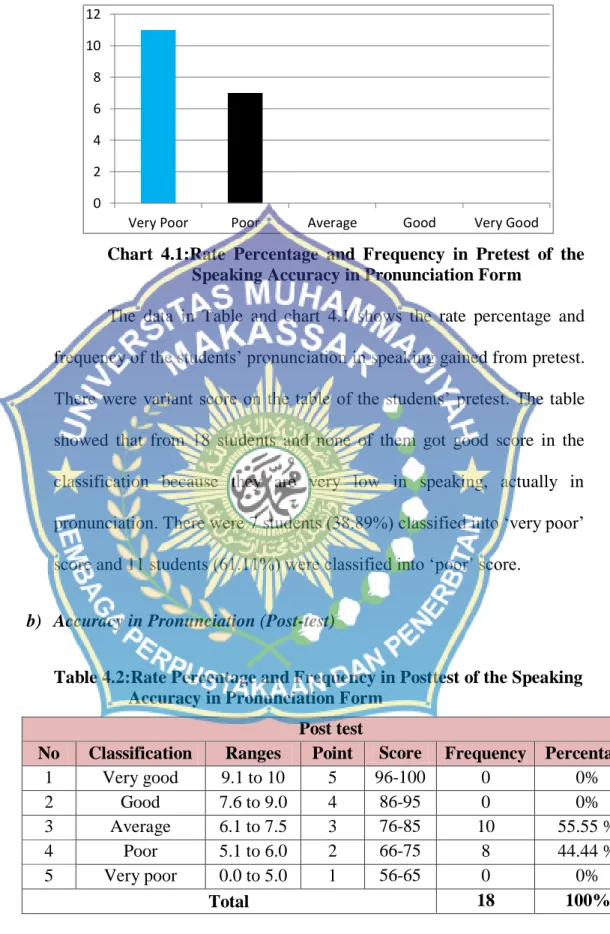
Chart 4.1:Rate Percentage and Frequency in Pretest of the Speaking Accuracy in Pronunciation Form
The data in Table and chart 4.1 shows the rate percentage and frequency of the students‟ pronunciation in speaking gained from pretest.
There were variant score on the table of the students‟ pretest. The table showed that from 18 students and none of them got good score in the classification because they are very low in speaking, actually in pronunciation. There were 7 students (38.89%) classified into „very poor‟
score and 11 students (61.11%) were classified into „poor‟ score.
b) Accuracy in Pronunciation (Post-test)
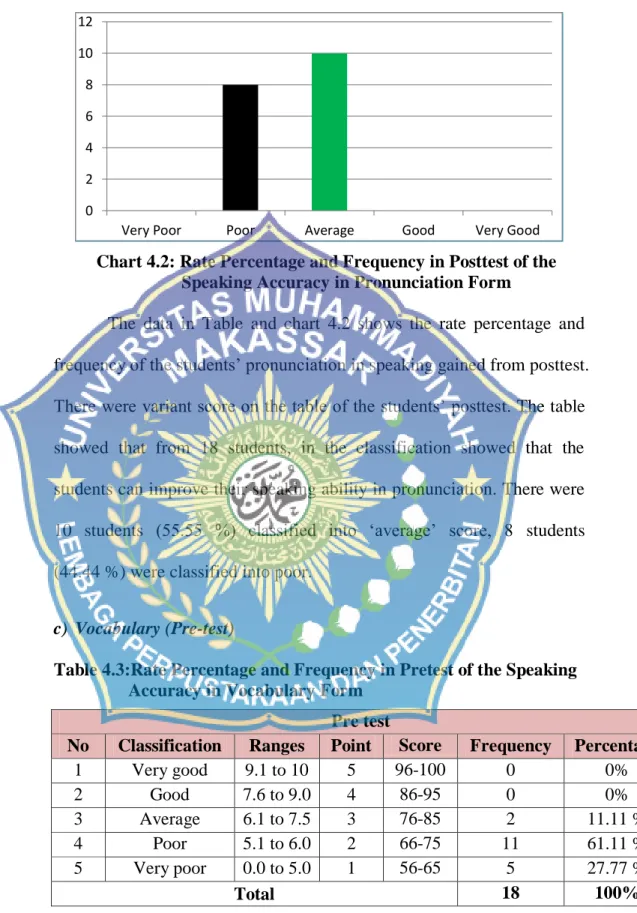
Table 4.2:Rate Percentage and Frequency in Posttest of the Speaking Accuracy in Pronunciation Form
Post test
No Classification Ranges Point Score Frequency Percentage
1 Very good 9.1 to 10 5 96-100 0 0%
2 Good 7.6 to 9.0 4 86-95 0 0%
3 Average 6.1 to 7.5 3 76-85 10 55.55 %
4 Poor 5.1 to 6.0 2 66-75 8 44.44 %
5 Very poor 0.0 to 5.0 1 56-65 0 0%
Total 18 100%
0 2 4 6 8 10 12
Very Poor Poor Average Good Very Good
Chart 4.2: Rate Percentage and Frequency in Posttest of the Speaking Accuracy in Pronunciation Form
The data in Table and chart 4.2 shows the rate percentage and frequency of the students‟ pronunciation in speaking gained from posttest.
There were variant score on the table of the students‟ posttest. The table showed that from 18 students, in the classification showed that the students can improve their speaking ability in pronunciation. There were 10 students (55.55 %) classified into „average‟ score, 8 students (44.44 %) were classified into poor.
c) Vocabulary (Pre-test)
Table 4.3:Rate Percentage and Frequency in Pretest of the Speaking Accuracy in Vocabulary Form
Pre test
No Classification Ranges Point Score Frequency Percentage
1 Very good 9.1 to 10 5 96-100 0 0%
2 Good 7.6 to 9.0 4 86-95 0 0%
3 Average 6.1 to 7.5 3 76-85 2 11.11 %
4 Poor 5.1 to 6.0 2 66-75 11 61.11 %
5 Very poor 0.0 to 5.0 1 56-65 5 27.77 %
Total 18 100%
0 2 4 6 8 10 12
Very Poor Poor Average Good Very Good
Chart 4.3:Rate Percentage and Frequency in Pretest of the Speaking Accuracy in Vocabulary Form
The data in Table 4.3 shows the rate percentage and frequency of the students‟ vocabulary in speaking gained from pretest. There were variant score on the table of the students‟ pretest. The table showed that from 18 students and none of them got good score in the classification because they are very law in speaking, actually in vocabulary. There were 4 students (22.22%) classified into „very poor‟ score, 12 students (66.67%) were classified into „poor‟ score and 2 students (11.11%) were classified into „average‟ score.
d) Vocabulary (Post-test)
Table 4.4 :Rate Percentage and Frequency in Posttest of the Speaking Accuracy in Vocabulary Form
Post test
No Classification Ranges Point Score Frequency Percentage
1 Very good 9.1 to 10 5 96-100 0 0%
2 Good 7.6 to 9.0 4 86-95 2 11.11 %
3 Average 6.1 to 7.5 3 76-85 13 72.22 %
4 Poor 5.1 to 6.0 2 66-75 3 16.66 %
5 Very poor 0.0 to 5.0 1 56-65 0 0%
Total 18 100%
0 2 4 6 8 10 12 14
Very Poor Poor Average Good Very Good
Chart 4.4: Rate Percentage and Frequency in Posttest of the Speaking Accuracy in Vocabulary Form
The data in Table and chart 4.4 shows the rate percentage and frequency of the students‟ vocabulary in speaking gained from posttest.
There were variant score on the table of the students‟ posttest. The table showed that from 18 students, in the classification showed that the students can improve their speaking ability in vocabulary. There were 2 students (11.11 %) classified into „good‟ score, 13 students (72.22 %) classified into „average‟ score and 3 students (16.66 %) were classified into poor.
2. The Improvement of Students’ Accuracy in Speaking Ability
The improvement of students‟ pronunciation and vocabulary through the Simulation Method in eight grade students‟ of SMP PGRI 1 Tamalate can be seen clearly based on the following table:
0 2 4 6 8 10 12 14
Very Poor Poor Average Good Very Good
Table 4.5
The Improvement of Students’ Accuracy in Speaking Ability
Indicators Mean Score Improvement
(%) Pre-Test Post-Test
1 Pronunciation 1.38 2.55 84.7 %
2 Vocabulary 1.88 2.94 56.38%
Total score 3.27 5.5 68.19 %
Chart 4.5: The Improvement of Students’ Accuracy in Speaking Ability
The improvement of pronunciation between pre-test and post-test is 84.7 %, it showed that the Simulation Method can improve the students speaking ability in pronunciation. In vocabulary, it showed that the improvement between pre-test and post-test is 56.38 %. Total score improvement of the students‟ accuracy in speaking ability is 68.19 %.
3. T-test of Value
To know the level of significance value of the pre-test and post- test, the researcher used t-test analysis on the level of significance (p) = 0.05 with the degree of freedom (df) = N-1, where N= Number of subject (18 students) then the value of t-table is 2.110. The t-test statistical,
0 20 40 60 80 100
Pronuncition Vocabulary
analysis for independent sample was applied. The following table shows the result of t-test calculation:
Table 4.6
The T-test of Students’ Improvement
Components t-test value t-table
value
Speaking 8.10 2.110
Chart 4.6: The T-test of Students’ Improvement
The Table 4.6 above shows that t-test value for speaking ability was higher than t-table 8.0>2.110. It means that there is significant difference between the students‟ speaking in the class before and after using Simulation Method in speaking process of the eight grade students of SMP PGRI 1 Tamalate.
The Hypothesis was needed to find out whether the hypothesis was accepted or rejected. If the result of t-test was lower than t-table‟
value, the null hypothesis (H0) will be rejected, and if the result of t-test was higher than the t-table‟ value, the alternative hypothesis (H1) will be accepted.
0 2 4 6 8 10
T-test Value
T-table Value
In order to find out the degree of freedom (df), the researcher used the following formula:
df = n-1 df = 18-1 df = 17
For the level of significance (p) = 0.05 and df = 17, the value of the t- table = 2.110 The result t-test value of the speaking 8.10>2.110.
The results of the t-test value of accuracy in pronunciation and vocabulary form in speaking are used to determine the hypothesis that occurs in this research.
The Null Hypothesis (H0) is rejected and the Alternative Hypothesis is accepted (H1) where the t-test value of Speaking Ability 8.10 were higher than t-table 2.110. Therefore, there was a significant difference between the result of the students‟ pretest and posttest in speaking ability through the use of Simulation Method.
B. Discussion
1. Students Speaking Ability
Speaking is the important one because it is used as the tool to express the opinion of the students directly from their mouth and to conversation activities. The researcher was gave the students some tests in pre-test to find out the students speaking ability, the kind of test was interview. After pre-test, the researcher was gave treatment by using
Simulation Method. The last meeting, the students‟ was given a post-test, it is like the students dialogue in front of class with their classmate.
According to Widdowson, (1985) speaking is a means of oral communication that gives information involves two elements, namely the speaker who gives the massage and the listener who the receptive the massage in other word, the communication involves the productive skill of listening. This research showed that the use of Simulation Method can make the students improved their speaking ability especially in accuracy (pronunciation) and vocabulary.
a) Accuracy in Pronunciation
Certainly we all realize that pronunciation is one of speaking elements that have strong relation with vowel and consonant, stress and intonation. Pronunciation, intonation and stressed are learn by way imitating and repeating. Therefore, teacher of English should have good standard of pronunciation in other that the learner can imitate their teacher in teaching and learning process.
It is the manner of pronunciation something articulate utterance, Webster in Tompkins (1998). Which one the problem of students is they are have not differentiate in produce every word in English language, so actually the researcher was gave some technique to find the different of word. In pre-test, the students very law in speaking. From 18 students, none of them got good score, there were 7 students only got „poor‟ score and 11 students got „very poor‟ score.
After treatment, the students can improve their speaking ability in the term of pronunciation. From 18 students, there were 10 students got
„average‟ score and only 8 students got „poor‟ score. Which one the students got from „very poor‟ score to average score is HDR initial, the score is 1 (very poor) in pre-test and 3 (average) in post-test.
The example of students produced in pronunciation as follows:
NO Poor Score Good Score
1.
Beautipul (Beautiful), students should say
(/'bju:təfʊl/)
(Strong) Students’say(/'strɒŋ/) 2.
Agrii (Agree), students should say
(/ə'gri:/)
(Mean) Studentssay (/’mi:n/)
3.
Cull (Could), students should say
(/'kʊd/)
(Great)
Students’say (/'greɪt/)
b) Vocabulary
Students not confidence say something because there were afraid to make mistake, in pre-test showed that which 18 students none of them got good score. Based on the problem, the researcher was give some treatment and give motivation until the students confidence to improve they speaking ability in vocabulary, the score in pre-test which 18 students was got „poor‟ and „very poor score‟ it is different in the post- test which 18 students, 2 students was got „good‟ score, 13 students was got „average‟ score and 3 students was got „poor‟.
Which one example of the students got from „very poor‟ score to average score is IRF, the score is 1 (very poor) in pre-test and 3 (average) in post-test. It is relevant with (Harmer, 2005), states that someone can be considered of having good vocabulary use, when the vocabulary produced is wide (lack of repetition) or appropriate with certain situation of dialogue or speech.
The example of students’ vocabulary mastery as follows:
Good Score
1. Decision (The students’ was produced this word when interview)
2. Enterprise (The students’ was produced this word when interview)
3. Evening (The students’ was defined this word in treatment
This research showed that the use of Simulation Methodcan make the students improved their speaking ability especially in pronunciation and vocabulary. They have a new experience after thaught the technique than before. It proved that there was an improvement of the students‟
speaking ability after the treatment. There was improvement self confidence of the students because the technique make the students being actived in the classroom and always did the excercise well. So the researcher found that there was a significance difference between the
result of the students‟ pretest and posttest in speaking by using Simulation Method.