A History of Botanical Exploration in Amazonian Ecuador, 1739-1988
S.S. Renner
SMITHSONIAN INSTITUTION PRESS Washington, D.C.
1993
A B S T R A C T
Renner, S.S. A History of Botanical Exploration in Amazonian Ecuador, 1739-1988. Smith- sonian Contributions to Botany, number 82,39 pages, 1 map, 1993.-Information is provided on all individuals known to have collected botanical specimens in the eastern Ecuadorean lowlands below 600 m altitude from 1739 until 30 May 1988. This area belongs to the provinces Sucumbios, Napo, Pastaza, Morona-Santiago, and Zamora-Chinchipe and covers about 7 1 ,000 km2. Besides biographical data, are included collecting dates and localities, herbaria containing the specimens, and pertinent references to publications by the collector, or about the collector or the expedition. The data are arranged alphabetically by collector, including cross references between main and secondary collectors. Altogether 205 collectors are treated. The total number of specimens gathered in the eastern Ecuadorean lowlands (excluding duplicates, including bryophytes and fungi) is around 61,000, i.e., about 86 per 100 km2, representing an estimated 4000 species of vascular plants. An index to localities and a map provide general information on the main collecting regions.
OFFICIAL PUBLICATION DATE is handstamped in a limited number of initial copies and is recorded in the Institution's annual report, Smithsonian Year. SERIES COVER DESIGN: Leaf clearing from the katsura tree Cercidiphyllum japonicum Siebold and Zuccarini.
Library of Congress Cataloging in Publication Data Renner, Susanne. 1954-
A history of botanical exploration in Amazonian Ecuador, 1739-1988 S.S. Renner.
p. cm.-(Smithsonian contributions to botany ; no. 82) Includes bibliographical references and index.
Supt. of Docs. no. SI 1.29:
1. Botany-Ecuador-History. 2. Botany-Amazon River Region-History. 3. Plant collecting-Ecuador- History. 4. Plant collecting-Amazon River Region-History. 5 . Plant collectors-Ecuador- History. 6. Plant collectors-Amazon River Region-History. 7. Scientific expeditions-Ecuador- History. 8. Scientific expeditions-Amazon River Region-History. 1. Title. 11. Series.
QK2 1.E23R46 I992 92-5840 581.9866'4-dc20 92-5840
@
The paper used in this publication meets the minimum requirements of the American National Standard for Permanence of Paper for Printed Library Materials 239.48-1984.Page
Introduction
. . .
1Acknowledgments
. . .
3Chronology of Botanical Exploration
. . .
3The Cryptogamic Flora
. . .
6Ethnobotanical Collecting in Amazonian Ecuador
. . .
6Annotated List of Collectors
. . .
7Index to Localities
. . .
32Literature Cited
. . .
35The Status of the Botanical Inventory of Amazonian Ecuador
. . .
7...
111A History of Botanical Exploration in Amazonian Ecuador, 1739-1988
S . S . Renner
Introduction
In proportion to its area Ecuador is the floristically richest country in South America. This botanical wealth is undoubt- edly due to the diverse ecological conditions created by the Andes, rising in Ecuador from sea level to nearly 6300 m altitude. The country accordingly has attracted the interest of numerous naturalists, many of whom crossed Ecuador on their way from Bogota to Lima or visited various ports of South America, including Guayaquil. Among the earliest were La Condamine and Joseph de Jussieu (174Os), Nee (a naturalist on the Malaspina expedition, visiting Guayaquil in October 1790 (Madulid, 1989)). Tafalla (collecting near Guayaquil around 1800), Humboldt and Bonpland (1 802), Barclay and Hinds (resident botanists on H.M.S. Sulphur collecting in Ecuador in 1836 and 1838), Hartweg (itinerary: Bentham, 1839), Leh- mann, Lobb (biography: Ewan, 1973), and Andre (itinerary:
Smith, 1965), to name but a few. Darwin during his visit to the Galapagos Archipelago in 1835 collected numerous animals and also 209 plants (Wiggins and Porter, 1971). However, except for La Condamine and possibly Jussieu, all early exploration was confined to the coastal area and the western Andes.
The botanical exploration of the much less visited eastern lowlands from the time of Condamine and Jussieu until May 1988 forms the subject of the present work. Until a future publication on the collecting history of the entire country, this compilation may be useful in itself; at the same time it may serve as a basis for further investigations. To make this paper more generally useful I have prepared an index to the localities where plants have been collected and have cited relevant ethnobotanical and phytochemical literature or, occasionally, semi-popular travel accounts in addition to technical papers describing new species based on an author’s collections. The work of foresters, phytochemists, entomologists, ornitholo- S.S. Renner, Botanical Institute, University of Aarhus, Nordlandsvej 68, DK-8240 Risskov, Denmark
gists, or anthropologists sometimes involves making herbarium collections and their material, though usually not widely distributed, is often interesting for its associated data and for otherwise unvisited localities. An effort has therefore been made to include all such work. In a few cases some information is also given on a collector’s activities immediately outside the eastern Ecuadorean lowlands, particularly when itineraries were contained in letters to me or were extracted from diverse published sources. The editors of the Flora of Ecuador, G.
Harling and B. Sparre (volumes 1-24, until 1986) and G.
Harling and L. Anderson (from volume 25 onward), from the start have encouraged the complete citation of a relatively large number of spec.imens, and an impression of who collected where and when in Ecuador may therefore be gained simply by going through the published volumes (1-39); I have recon- structed from cited specimens the itineraries of some important collectors like Spruce, Jameson, Isern, Rimbach, and Benoist.
The eastern lowlands of Ecuador are herein defined as the area east of the Andes that lies below 600 m altitude (Map l), comprising a surface of about 71,000 km2. Politically these lowlands belong to the provinces Napo, Pastaza, Morona- Santiago, and Zamora-Chinchipe. (In January 1989 the Province of Nap0 was subdivided, with the southern portion retaining the name Napo. The northern part, comprising the cantones Gonzalo Pizmo, Lago Agrio, Shushufindi, Putu- mayo, and Sucumbios, now forms the Province Sucumbios, with Lago Agrio as its capital. Most of this history was prepared before that change, and all references to Nap0 refer to the province in its former boundaries.) In Ecuador the area east of the Andes is commonly referred to as “Oriente,” which, however, officially is thought of as including all land up to 2000 m altitude and as comprising a surface of 134,760 km2.
Administrators also sometimes define the lowlands as the area lying below 300 m altitude because fluvial transport stops at about that altitude. The 600 m contour line used herein to delimit Oriente has the advantage of appearing as a reasonable floristic delimitation since many species reach distributional limits at this elevation. Oriente has a population density of
1
2 S M ITHSONIAN CONTRIBUTIONS TO BOTANY
FIGURE 1 .-Map of eastern Ecuador, including regions of particular botanical collecting.
between 2 and 3 inhabitants per km2, including several relatively (!) large indigenous groups (see below, “Ethnobo- tanical Collecting”).
Ecuador, Colombia, and Peru have changed; some stretches are still in contention. Until the 1820s the Presidency of Quito (La
Provincia, or Real Audiencia, de Quito) was officially part of the Viceroyalties of New Granada and Peru. From 1821-1830 Ecuador belonged to Gran Colombia, forming three Depart- Since La Condamine’s times the boundaries between ments, the Dpto. de Guayaquil, the Dpto. del Ecuador, and the Dpto. de Azuay, the last comprising the entire area east of the Andes to the Maranon. After the separation from Colombia and
until the war with Peru in 1941, the Maranon (to its confluence with the Pastaza) remained the official southeastern Ecua- dorean border. The origin of early collections from “Peruvia,”
“Loxam Novogranatensium,” “Peruvia pastoensis,” “collibus siccis Peruviae,” or “Loja peruvianorum” obviously has to be determined in the context of the maps the respective collector is likely to have used. (Several useful reproductions of old maps may be found in the seven volume Historia del Ecuador, edited by J.S. Lara, 1981-1982).
By far the most convenient fluvial route to the southeastern province of Maynas was (is) the Rio Bobonaza. From Banos one traveled to Canelos where a Dominican mission had been established in 1581 and from there one continued down the Bobonaza (220 km) to the Pastaza on which one reached the Maranon, having passed Andoas. A more southern route down the Rio Chinchipe to the Maranon was taken by La Condamine.
To reach the northern parts of the Amazonian lowlands the route Ambato-Banos-Mera-Puyo to Puerto Nap0 could be used, from where one traveled down the Rio Nap0 to Coca (Puerto Francisco de Orellana), passing Ahuano and Santa Rosa. Until the advent of petroleum exploration there were hardly 300 km of gravel roads reaching more or less far into the eastern lowlands and they were usually passable only in the dry season: the road from Quito ending at Baeza (99 km); the Ambato-Puerto Misahualli road (1 75 km); the Cuenca-Limon road (91 km); and the road across the Loja-Zamora pass (60 km) leading down to lo00 m altitude and the headwaters of the Rio Zamora. Wallace, in a footnote to Spruce’s (1908:209) account of his travels in Ecuador during the years 1857-1 863, still asserted, “There is, in fact, not a single road in Ecuador.”
ACKNOWLEDGMENTS.-This paper originated as a by- product of taxonomic work for the Flora of Ecuador and a checklist of eastern Ecuadorean flowering plants. I thank the curators of F, GB, MO, NY, QCA, S , SEL, and US for permission to consult specimens and also the numerous individuals who answered letters asking for information on their collecting. Special thanks are due to L. Anderson, L.
Besse, S . Churchill, L. Dorr, G . Harling, E. Heinrichs, E.L.
Little, Jr., D. Neill, B. Stahl, H. Balslev, J. Ewan, and J.
Wurdack. Financial support to visit herbaria in Sweden, Ecuador, and the United States came from the Danish Natural Sciences Research Council and the Marie Selby Botanical Gardens (through a Visiting Scientist position). Letters received in connection with the current project are in my personal file and might be made available. I am grateful for all corrections and additions to the “List of Collectors.”
Chronology of Botanical Exploration
In this section I give a brief resume of the main phases of botanical exploration in eastern Ecuador. Apart from general works covering the zoological and botanical exploration of South America (e.g., Horn and Kahle, 1936; Pennell, 1945;
Maguire, 1958; Papavero, 1971, 1973), there are two published
sources for the history of collecting in Ecuador: Diels’ (1937) very useful list of collectors up to 1936 and a booklet by Acosta-Solis (1968). Wurdack (1964) discussed the botanical exploration of the Pongo de Manseriche region of the upper Maranon, and there are published biographical notes on a few of the early collectors like Spruce, Mexia, and Camp.
The first naturalists to visit the eastem lowlands were the French botanist Joseph de Jussieu (1704-1779) and the geographer and naturalist Charles Marie de la Condamine (1701- 1774). La Condamine, descending the Rio Chinchipe, reached Jaen de Bracamoros in June 1743. From there he continued after a four-day walk to the port of Chuchunga (near the present-day town of Nazaret) on the Marnon to Borja, the capital of Maynas, and thence to the mouth of the Amazon, which he reached on the 27th of September (Wurdack, 1964;
Latorre, 1988, reproduces Condamine’s map and discusses its cartographic significance). Whereas la Condamine made no botanical collections, his compatriot Jussieu, like so many others in Ecuador on the quest for quinine, already in 1739 visited Loja to gather specimens that eventually found their way to Paris, where Alexander von Humboldt compared them with his own plants from the same locality (Steele, 1964). Most of Jussieu’s plants are from higher elevations but at least some seem to stem from lower slopes of the Rio Zamora valley.
Almost 60 years later, in August 1802, Humboldt and Bonpland, coming across the Andes from Chontali, also reached the Rio Chinchipe near its junction with the Maranon.
During 17 days Bonpland collected plants near Rentema before they continued to JaCn (Wurdack, 1964; Sandwith, 1968).
The next to reach Ecuadorean Amazonia were Gaetano Osculati, William Jameson, and Richard Spruce. Osculati, an Italian naturalist traveling the world to collect insects, in 1847 decided to follow the Rio Nap0 from its sources to its junction with the Amazon and thence on to BelCm. He arrived in Belem in March 1848. (Dates for his stays in Puerto Napo, Ahuano, Santa Rosa, and Coca are given by Papavero, 1973:343-347.) According to Steere (1 948b) Osculati collected a few mosses near Puerto Napo, where he had stayed at the house of Manuel Villavicencio, another avid insect and bird collector. Jameson, a Scot, was Professor of Chemistry and Botany at the Universidad Central in Quito from 1826 until 1873. From January to May 1857 he traveled to Tena, Archidona, Puerto Napo, Ahuano, Santa Rosa and back again (Jameson, 1858) but relatively few collections were made during that trip. In the same year Richard Spruce, coming up the Rio Bobonaza from Peru, reached Canelos, from where he continued over land to BaAos. Spruce collected a large number of mosses and hepatics near Pucayacu, just south of Canelos (Spruce, 1908: 102-163), and he considered the Montana de Canelos from the middle of the course of the. Bobonaza to the upper Pastaza valley at about 1800 m altitude “the richest cryptogamic locality on the surface of the globe” (1908: 164-1 66). However, “the circumstances under which I traveled prevented me paying any attention to the phanerogamous plants nor did I throughout the journey see any large tree in flower, save two or three times a species of
4 SMITHSONIAN CONTRIBUTIONS TO BOTANY Laurel.” Just behind Canelos Spruce was forced to throw away
the trunk with drying paper brought from Tarapoto, and on the way from Canelos to Banos he “could bring no plants along save a few mosses” (1 908:205). A single specimen from the Rio Bobonaza “s.n.” at Kew is cited in the Flora of Ecuador (13:375).
Eight years later, from May to July 1865, the Spaniard Juan Isern y Battlo, a member of the Comision Cientifica del Pacifico (cf. Miller, 1968, which includes a map showing the South American phase of this extraordinary expedition), visited Archidona, Puerto Napo, and the slopes of the Volcan Sumaco, then continued down the Rio Nap0 to Coca. Isern’s plants were first studied by Jose Cuatrecasas (1935) who also researched Isern’s itinerary. At least 500 numbers were collected in the lowlands.
Luigi or, in the Spanish form, Luis Sodiro (1836-1909), an Italian Jesuit and like Jameson Professor of Botany at the Universidad Central, is best known for his publications on the vegetation of Ecuador and on pteridophytes, Anthurium, and Piper. Though he collected extensively he apparently never reached the eastern lowlands (Stafleu and Cowan, 1976-1988;
Nicolson, 1983; Croat, 1988).
Several professional plant hunters, among them R. Pearce and G. Wallis working for the Veitch Tropical Nurseries of Exeter, came to Ecuador to find plants suited for horticulture.
Richard Pearce collected in the Cuenca vicinity in 1862, Gustav Wallis along the banks of the Rio Zamora in 1876 or 1877.
Wallis took mainly orchids and a few other beautiful plants like the melastome Monolena primulaejlora, described from a cultivated specimen he provided. Another professional plant collector, Hugo Poortman, working for E.F. Andre, seems to have collected in the same area in 1882. It is unclear how far into the eastern lowlands any of these men came.
In 1894 the German expatriate August Rimbach, professor at the university in Cuenca, and his brother Karl descended the Rio Bobonaza to the Pastaza (Rimbach, 1897; Diels, 1937).
They thus made the exact return journey of Spruce, but seem to have had better weather (cf. Wallace’s comment in Spruce, 1908:135). Though Rimbach made at least 800 collections in Ecuador (distributed to many herbaria), only one specimen from the Rio Pastaza is cited in the Flora of Ecuador so far.
In the twenties and thirties the botanical exploration of eastern Ecuador became slightly more intensive. Carlo Crespi, an Italian Salesian missionary, in 1924 collected ferns in the vicinity of Indanza down to elevations around 600 meters, and the French botanist Raymond Benoist, like several of the other early botanical explorers Professor at the Universidad Central, collected at least 650 numbers near Puerto Nap0 in 1931. In March and April 1935, the then 64-year-old American Ynes Mexia visited Canelos on the Rio Bobonaza and Puerto Napo, Tena, and Archidona in the Nap0 valley. From her Ecuadorean travels she brought back almost 2000 numbers, some 400 of them from the eastern lowlands. Simultaneously with Mexia, another woman, the 25-year-old gardener Erica Heinrichs
collected for the Botanic Garden of Berlin-Dahlem near Archidona, Tena, and Nuevo Rocafuerte on the lower Nap0 river, near Canelos and Sarayacu on the Bobonaza, and in the vicinity of MCndez and Macas in Morona-Santiago. Heinrichs stayed in Ecuador from 1932 to 1935, collecting lo00 numbers, usually with 12 duplicates; 245 of her collections were made in lowland Oriente. Also active during the 1930s were Arnold and Hertha Schultze-Rhonhof, an independent couple who during five years collected insects and plants in various parts of Ecuador, including the environs of Mera, Puyo, and Canelos.
(They also visited the coastal plain and the northern Ecua- dorean Andes near the Colombian border, but probably no specimens survive.) The Botanic Garden of Berlin-Dahlem received a total of 1497 numbers collected by the Schultze- Rhonhofs, and at least some of this material has been saved;
however, of the six sheets cited in the Flora of Ecuador (volumes 1-39) only two are extant (and housed in Berlin).
Towards the end of the Second World War the U.S.
Government organized surveys for high-quality sources of quinine, rubber, and timber in Colombia, Ecuador, and Peru (Pennell, 1945; Steere, 1945a-c; Hodge 1948; Acosta-Solis, 1951). To Ecuador came the botanists W.H. Camp, W.C.
Steere, L.R. Holdridge, E.L. Little, F.M. Ownbey, G.W.
Prescott, W.B. Drew, I.L. Wiggins, and J.A. Steyermark, and the ornithologist A. Skutch, among others. An Ecuadorean collaborator of the Cinchona mission was M. Acosta-Solis.
Working until September 1945 (Balslev and Joyal, 1980) Wendell Holmes Camp and his assistants also made important collections in the lowlands, but because of Camp’s special interest in the Ericaceae, the vast majority of their material was gathered at higher altitudes. Among the most interesting plants of Camp’s team are those collected on the lower ridges of the Cutucu mountain range. The Cutucu area was later (in 1975) also visited by Elbert Little and his Ecuadorean collaborators Alberto Ortega, Alfred0 Samaniego, and Francisco Vivar, who concentrated on the trees of the area. Another botanist from the New York Botanical Garden, William C. Steere (1907-1989).
during his first visit developed a life-long special interest in Ecuadorean mosses (Steere, 1948b). A comprehensive anno- tated catalog, including his personal collections from Ecuador, is in press.
The foundation for the important contributions made by Scandinavian botanists to the exploration of Ecuador was laid by Nils Johan Anderson (collecting mostly in western Ecuador in 1852), Gustav Lagerheim (professor at the Universidad Central from 1889- 1892, collections mostly near Quito), and I.
Holmgren and 0. Heilborn ( 1 9 19- 1921, mostly in the Andes).
The farthest east Holmgren and Heilborn collected was along the Rio Verde near Banos. In the fall of 1939 another Swede, Erik Asplund, worked in the vicinity of Tena and Archidona and though relatively few of his collections were made below 600 m altitude, his material is important in the context of floristic knowledge of the Oriente because of its outstanding quality. As his assistant, Asplund employed a citizen of Mera,
Manuel Lugo, who had already been working for the Schulze-Rhonhofs. Subsequently, Manuel Lug0 also worked for Gunnar Harling, and he and his son Holguer collected a total of over 6000 numbers, mainly trees from the Oriente.
Gunnar Harling, then at the University of Stockholm, came to Ecuador towards the end of 1946 as member of a Finnish-Swedish Ethnographical expedition. This was headed by Rafael Karsten who, however, soon left, leaving Harling in charge. Harling returned to the Oriente in 1958-1959 and was one of the first botanists to collect along the Rio Nap0 down to Coca almost 100 years after Isem. After having moved to the University of Goteborg in 1963, he and B. Sparre from Stockholm began to make plans for a Flora of Ecuador. During a preparatory phase from 1968 on collaborators were found and an international editorial board established; the first volume appeared in 1973 (Harling, 1973). In Ecuador, Harling employed the Lugos as resident collectors and in Sweden he was instrumental in involving collaborators and students in the Flora of Ecuador project. Another early Swedish expedition was that of Folke Fagerlind and his student Per-Goran Wibom from the University of Stockholm, who collected near Puyo and Mera and on the lower Rio Nap0 between Tiputini and Lagartococha in 1952- 1953.
Oil exploration in eastern Ecuador started in the 1940s and led to the gradual establishment of airstrips, roads, and other installations during the 1950s and early 1960s. When oil was finally discovered in Lago Agrio some 38 km from the Colombian border on 3 March 1967, large-scale exploration began and botanical exploration boomed; of the 118 main collectors almost 100 came after 1960. In 1968, L. Holm- Nielsen and S . Jeppesen, from the Botanical Institute of Aarhus University, conducted the first expedition to Ecuador by Danish botanists, collecting extensively also in eastern Ecuador (Holm-Nielsen and Jeppesen, 1968). Holm-Nielsen returned to Ecuador in 1973 (with S . Jeppesen, B. Lojtnant, and B.
Ollgaard) and was professor at the Pontificia Universidad Catblica in Quito from 1979-1981, during which period he organized several expeditions to the Oriente with his students J.
Jaramillo, F. Coello, R. Alarcon, R. Andrade, E. Azanza, and J.
Brandbyge. The collaboration between the Botanical Institute in Aarhus and the P. Universidad Catolica continued. Holm- Nielsen was followed by H. Balslev (1981-1984), S . Laegaard (1984-1986), B.B. Larsen (1985-1986), P.M. Jorgensen (1986-1989), H. Borgtoft Pedersen (1989-1990), and B.
Ollgaard (1990- ) as professors of botany at the Universidad Catolica, and numerous Ecuadorean and Danish students became involved in floristic and vegetation-analytical work, with eastern Ecuador being the main focus of attention.
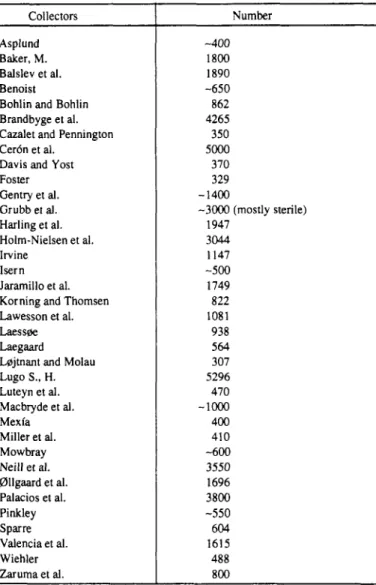
Particularly J. Brandbyge and E. Azanza brought back interesting collections from remote areas (see Table 1; at this writing A AU holds 92,000 specimens from the entire country).
From 1970 to 1972 Bruce MacBryde was resident collector for the Missouri Botanical Garden in Ecuador and the -1500 collections deposited by him and and his Ecuadorean wife
TABLE I.--Collections of more than 300 numbers in lowland eastern Ecuador.
Note that Spruce’s cryptogams from the Rio Bobonaza are not included here.
Collectors
~~~ ~
Asplund Baker, M.
Balslev et al.
Benoist
Bohlin and Bohlin Brandbyge et al.
Cazalet and Pennington Ceron et al.
Davis and Yost Foster Gentry et al.
Grubb et al.
Harling et al.
Holm-Nielsen et al.
Irvine lsern Jaramillo et al.
Korning and Thomsen Lawesson et al.
Laessoe Laegaxd Lojtnant and Molau Lug0 S., H.
Luteyn et al.
Macbryde et al.
Mexia Miller et al.
Mowbray Neil1 et al.
Ollgaard et al.
Palacios et al.
Pinkley Sparre Valencia et al.
Wiehler Zaruma et al.
Number -400
1800 1890 862 4265 350 5000 370 329 -650
-1403
-3000 (mostly sterile) 1947
3044 1147 -500
1749 822 1081 938 5 6 4 307 5296 470 -1000 400 410 -600 3550
1696 3800 604 1615 488 800 -550
Olga, professor of botany at the Universidad Catblica, became the foundation of the Catholic University’s modem herbarium.
Important collectors associated with this herbarium are Jaime Jaramillo and Flavio Coello (cf. Table 1). MacBryde himself collected widely in the Oriente, but especially near Santa Cecilia (Napo) and in Morona-Santiago and Zamora- Chinchipe, areas to which he went repeatedly also with amateur orchid collectors.
A new type of floristic research work began in the 1960s.
namely quantitative ecological inventories, involving the enumeration of every tree (usually) of a limited area regardless of its phenological stage, the measurement of several parame- ters of these trees, and the analysis of species abundance and distribution. In the Oriente this method was first used by Grubb, Lloyd, Pennington, and Whitmore during an expedition of the Oxford University Exploration Club in 1960 (Emerson, 1960) on which they collected about 3000 plants, most of them sterile. They used a multidisciplinary approach, supplying
6 SMITHSONIAN CONTRIBUTIONS TO BOTANY
forest transects of the kind commonly done by foresters with microclimatological measurements and soil analyses (Grubb et al., 1963; Grubb and Whitmore, 1966, 1967). An example of
“classic inventory work” by foresters is the 1975 survey of the timber resources of southeastern Oriente carried out by Little and collaborators. A biological inventory combined with autecological studies was also carried out by a University of Kansas team that in 1972 set up a quadrat near Santa Cecilia (botanical and herpetological studies by MacBryde, Dwyer, and Simmons; cf. Duellman, 1978). From 1982 to 1984 the New York Botanical Garden, the Pontificia Universidad Catdlica, and the Botanical Institute of Aarhus University jointly carried out an inventory project at Anangu in the northwestern comer of the Yasuni National Park (Balslev et al., 1987; see also the entry “SEF project” in the list of collectors), and in 1988 the Universidad Catolica and the Aarhus Botanical Institute began a new project, again using the inventory approach, which includes the floristic and physiognomic analysis of the entire vascular flora of a hectare near the University’s Cuyabeno station.
Since 1985 David Neill of the Missouri Botanical Garden, St. Louis, under contract with the U.S. Agency for International Development, and the Direccion Nacional Forestal and his Ecuadorean collaborators, C. C e o h , W. Palacios, J. Zaruma, and recently F. Hurtado, among others, are collecting exten- sively in the Oriente, concentrating on trees (Neill and Palacios, 1989; cf, Table 1). Neill and G.A. Suarez also founded the biological reserve “Jatun Sacha” near Misahualli. After the cut-off date for the present compilation, visits to the Napo- Pastaza border (Rio Tigiiino) by D. Neill and F. Hurtado, to the Cutucu mountains by L. Dorr (New York Botanical Garden), and to the area just south of Cutucli by H. van der Werff (Missouri Botanical Garden) are highlights of the most recent phase of exploration in Oriente.
The Cryptogamic Flora
The cryptogamic flora of lowland eastern Ecuador is expected to be rather uniform and relatively poor with the exception of groups like ferns, hepatics, epiphyllous lichens, and rust fungi (Buck and Thiers, 1989; Nishida, 1989).
However, there clearly is a lack of critical collecting. Spruce’s (1884-1885) monumental treatment of the hepatics of the Amazon basin and the Andes is mostly based on his own collections, but as discussed above, in Ecuador these were gathered for the most part on the slopes above 600 meters.
Probably the first moss collections in the eastern lowlands were made near Puerto Nap0 by G. Osculati and M. Villavicencio in 1847 and 1869, respectively (Bartram, 1933; Steere, 1948b;
Papavero, 1973), and Steere also mentions collections made in 1909-1910 by the Abbe Michel Allioni, but it is unclear at which altitude. The following modem workers have concen- trated on mosses: W.C. Steere (1948b), G. Harling (Crum, 1957), L.B. Holm-Nielsen and students (Robinson et al., 1971,
1977), and S . Churchill and I. Sastre (Churchill et al., in press), Gunnar Harling has collected several hundred leaves with epiphyllous cryptogams, mainly lichens and hepatics (partly reported on by Herzog, 1957), and many of them come from the eastern lowlands. Freire C. Crespi, S . Roth, and B. Ollgaard have concentrated on ferns and lycopods (Ollgaard. 1979), and L. Arvidsson, D. Nilsson, and M. Lindstrom have focussed on lichens (Arvidsson, 1986; mainly through the efforts of Arvidsson and his students, GB houses about 10,OOO numbers of Ecuadorean lichens). Prescott seems to be the only professional phycologist to have made collections in lowland Oriente.
The first mycological collections were made by Richard Spruce. Since then fungi have been collected by
T
Laessae (Laesscde et al., 1989), C. Blaney, and E. Bravo-Velasquez (Bravo-Velasquez and Hedger, 1988), and myxomycetes by G.Harling (Herzog, 1952; Arnell, 1962; Harling, 1967), U.
Eliasson (Farr et al., 1979), and F. Schinner (Schinner, 1981).
General collections often include at least some lower plants;
for example, P. Grubb and his collaborators during the Oxford University Expedition collected 170 numbers of bryophytes, and L. Anderson has collected at least 95 lichens, mosses, and fungi in the Oriente below 600 m (and many more above that altitude).
Ethnobotanical Collecting in Amazonian Ecuador This section draws attention to studies conducted by anthrophologists or ethnobotanists that involved the collections of voucher specimens. These researchers tend to work long periods at remote places and to collect plant parts or life stages not usually collected (roots, bark, saplings, etc.). Labels of their specimens also may carry unusual information, and many ecologically relevant data are contained in doctoral disserta- tions by ethnographers or ethnobotanists. However, this material is often not widely distributed, and it may therefore be necessary to request it from the researcher’s home institution (see “List of Collectors”).
Of the native groups living in Amazonian Ecuador, the largest are the lowland Quichua or Yumbos (-25,000) whose use of plants has been studied by Alarcon (1988). Holm- Nielsen, Balslev, and students (Kvist and Holm-Nielsen, 1987, and unpublished), Irvine (1987), van Asdall(1983), Marles and Neill (Marles et al., 1988), and Shemluck (unpublished). The botany of the Ecuadorean Jivaroan tribes or dialect groups, i.e., the Jivaro, often referred to as Jibaro or Shuar, and Achuar, some 10,OOO and 5,000 people, respectively, has been studied by Karsten (1935, but see Hamer, 1972), Crespi, Cazalet, and Pennington (Pennington et al., 1962), Baker and Lowell, and Villegas (unpublished). The Cofan, who belong to the Chibcha language group and comprise about 500 members, have been studied ethnobotanically by Schultes (numerous publications), Pinkley (1969a, 1973), and Ceron (1987), and the use of plants by the Siona-Secoya who speak a western Tukano language
and number about 700 people has been studied by Vickers and Plowman (1984), Vickers (1976, 1989), Brandbyge and Azanza (1982), and Lescure, Balslev, and Alarco (Lescure et al., 1987). Finally, the ethnobotany of the Waorani (Huaorani, Auca) who comprise 700 individuals speaking a language related to Zaparo, has been studied by Davis and Yost (1983a,b).
The Status of the Botanical Inventory of Amazonian Ecuador
At least 196 persons have made collections in the eastern lowlands of Ecuador below 600 m altitude, 125 of them under their own number series. Based on the information obtained (and presented in the “List of Collectors”), I calculated that at least 60,OOO numbers have been collected in lowland eastern Ecuador. (Table 1 lists the major collections in terms of numbers of specimens.) The only important collections for which no data on their size have been obtained are those of Acosta-Solis and Spruce (the latter’s collection of cryptogams that is; Spruce collected almost no phanerogams along the Rio Bobonaza below 600 m altitude). In the lowlands these workers may have made another 1000 collections, which would yield a total of around 61,000 collections of vascular plants, i.e., 86 specimens/100 km2. A checklist of the flowering plants of the area lists over 3000 species (Renner et al., 1991) and it is estimated that the eastern lowlands of Ecuador harbor at least 4000 species of vascular plants (Balslev and Renner, 1989).
In a recent source book on the status of the floristic inventory of the tropics (Campbell and Hammond, 1989), Campbell (1989) gave a number of 21 specimens/100 km2 for Ecuador as a whole based on calculations for which he used the Index Herbariorum (Holmgren et al., 1981) figures of herbaria holdings within the borders of tropical-forested countries.
These figures are obviously much out-of-date. Campbell (1989), like others, considers that a minimal botanical inventory requires about 100 herbarium specimens/100 km2 and he regards the number of 50 collections/l00 km2 as the threshold between a well-collected and a poorly collected tropical country. By these standards, Amazonian Ecuador had thus already in 1988 reached the status of a well-collected area.
However, modem collecting tends to be centered around a few places like, for example, the biological reserves Cuyabeno, Yasuni, or Jatun Sacha. Yet, recent inventories of these relatively accessible places have resulted in new species and new generic records. Sites known to be rich in endemics, such as the Cutucu mountain range (visited by seven expeditions), continue to yield numerous new taxa and it is abundantly clear that there are immense patches of entirely unknown country between the rivers and roads.
Annotated List of Collectors
The following annotated list of plant collectors is arranged
alphabetically (with the Danish o at the beginning of a name treated in the conventional transliteration, Oe) and includes all persons cited on the labels of plants collected in Napo, Pastaza, Morona-Santiago, and Zamora-Chinchipe below 600 m alti- tude during the period from 1739 to 31 May 1988. The data cited in the list were gathered in two ways: an initial list was assembled from herbarium labels in AAU, GB, QCA, and S . This was supplemented by searching the 39 published volumes of the Flora of Ecuador (G. Harling and B. Sparre, editors, 1973-1986, and G. Harling and L. Andersson, editors, 1986-) and further pertinent literature. Letters were then sent to almost all living collectors asking for information on their collecting in Oriente. An attempt was also made to reconstruct itineraries and activities from the labels of collections deposited at AAU, F, GB, MO, NY, QCA, S , and US, as well as from literature.
A distinction has been made between main and secondary (co-)collectors: those names cited in the first place on the label and whose numbering systems were employed on a particular expedition are printed in capitals (main collectors); the names of others cited on the label (secondary or co-collectors) are printed in caps and lower case. In the entries for secondary collectors, the reader is referred to the main collector, whose name is given in capitals, for further information. Some project acronyms and acronyms of Ecuadorean government agencies have been included in the alphabetical listing. Generally, I have closely followed the format of 0. Huber and J.J. Wurdack’s History of Botanical Exploration in Territorio Federal Amazo- nas, Venezuela (1984). Herbarium acronyms are from Holm- gren et al. (1981).
The data provided for each main collector are the following:
Last name, given names.
Year of birth and death; citizenship at actual time of visit to eastem Ecuador; profession (institution with which the collector was associated).
Period of collecting activity in Oriente: itinerary (names of co-collectors).
Numbers of plants collected during specified period; main herbaria where the collections from this period are deposited, with the herbarium housing the collector’s own set listed first; if this is not known, herbaria are listed alphabetically.
Notes.
Publications related to the collector’s collections from, or activities in eastern Ecuador.
Abalo, Jose E.
19??- ; Venezuelan; Agronomist, producer of chicken feed, living in Maracay, Venezuela.
Jul 1982:
Notes: Amateur collector of Heliconia.
Publication: Abalo and Morales, 1983.
1910- ; Ecuadorean; Botanist (Director del Instituto Ecua- Nap0 (with G.L. MORALES).
ACOSTA-SOLIS, MISAEL
toriano de Ciencia Naturales, Quito).
8 SMITHSONIAN CONTRIBUTIONS TO BOTANY Notes: In 194 1- 1942, Acosta-Solis collected more than
lo00 numbers to the east of Riobamba, along the Rio Pastaza, and near Puyo almost all above 900 m alt., however, there are at least a few collections from Arajuno; there is a set of this material at F. His more recent collections from Nap0 (Shushufindi, Coca) and Pastaza (Sarayacu) await distribution (May 1989, in litt.).
Publications: Acosta-Solis, 195 1, 1968.
1953- ; Dutch; Botany student (Univ. of Utrecht).
Feb 1980: Napo, Rio Aguarico, Cuyabeno (with C.C.
Feb-Mar 1980: Napo, Coca (with J. BRANDBYGE and Publications: Akkermans and Berg, 1982; Berg and Akkermans, Reinier A.W.P.
BERG and L. Holm-Nielsen).
E. Azanza).
Akkermans, 1985.
A L A R C O N G A L L E G O S , R O C I O
196?- ; Ecuadorean; Botany student (Pontificia Univ.
Aug 1979: Napo, Coca (with L. HOLM-NIELSEN).
Aug 1979: Napo, Misahualli (with L. HOLM-NIELSEN 1979-1982: Napo, Misahualli and Nuevo Rocafuerte.
1982: Napo, near mouth of Rio Yasuni (with H. BALS- Notes: Research on the ethnobotany of the Quichua Publications: Alarcon, 1988.
19??- ; Ecuadorean.
Aug 1985:
Taisha.
Catblica, Quito, presently FundaciOn Natura).
and R. Andrade).
2 12 numbers; QCA.
LEV).
Indians.
ANANANCH, LUIS
Morona-Santiago, Centro Tuntin Entsa, near Few numbers; NY.
Notes: Collecting under a project with the accronym RBAE.
Anderson, Joe J.
19??- ; U.S.; Entomology student, presently working for 21 Jun-10 Jul 1986: Napo, vicinity of Jatun Sacha, near
the World Bank in Washington.
Misahualli (with J.S. MILLER).
Andersson, Lennart 1948- ; Feb-Apr 1974:
Itinerary given under HARLING.
Jan 1977:
Itinerary given under HARLING.
Feb-Mar 1980:
Itinerary given under HARLING.
Apr 1985: Zamora-Chinchipe, Zumbi-Paquisha, western slopes of Cordillera del Cbndor (with G. HARLING Swedish; Botanist (Dept. of Systematic Botany, Napo; Morona-Santiago (with G. HAR- Univ. of Goteborg).
LING).
Nap0 (with G. HARLING and U. Eliasson).
Napo; Pastaza (with G. HARLING).
and M. Hagberg).
Notes: Specialist on neotropical Marantaceae and Mu- saceae; co-editor of Flora of Ecuador since 1986 (vol.
25 onwards).
Publications: Andersson, 1985; Kennedy, Andersson, and Hagberg, 1988.
ANDRADE, RAMON
195 1- ; Ecuadorean; Botany student (Pontificia Univ.
Aug 1979: Napo, Misahualli (with L. HOLM-NIELSEN Aug 1980: Napo, Rio Putumayo.
Few collections; QCA, AAU.
Catblica, Quito).
and R. Alarcon).
Andreasen, Niels Henrik of Aarhus).
Larsen, and A.R. Jensen).
1954- ; Danish; Botany student (Botanical Institute, Univ.
Jun-Jul 1982: Napo, Anangu (with B. PlLLGAARD, B.B.
AREVALO, ANIBAL
19??- ; Ecuadorean; Forester? (Ministerio de Agricultura y Ganaderia).
1975-1976: Napo, Territorio de 10s Aucas, Lago Agrio (with R.A.A. OLDEMAN, H.G. Oldeman, G.L. Mo- rales, and Lara; in various combinations).
Nov 1976: Napo, Puerto Quito (with Lara).
Publications: Arevalo et a]., 1976.
1961 - ; Ecuadorean; Biology student (Pontificia Univ.
1985: Napo, Anangu, Rio Payamino.
1986: Morona-Santiago, Bomboiza.
Notes: Concentrated on Cyclanthaceae and Arecaceae.
1949- ;
Few collections; QCA.
ARGUELLO, ANA Catblica, Quito).
Few collections; QCA, AAU.
ARVIDSSON, LARS
Swedish; Botanist (Dept. of Systematic Botany, Univ. of Goteborg, presently at the Natural History Museum in Goteborg).
1972: Napo, Coca region, Santa Rosa (with D. Nilsson).
Notes: Concentrated on lichens.
Publications: Arvidsson, 1986.
1888-1 974; Swedish; Botanist (Museum of Natural History, Stockholm).
27 Sep 1939 until at least 6 Jan 1940: Napo, vicinity of Tena and Archidona, occasionally also Puerto Nap0 (between his nos. 8800-10268, with most from above 600 m alt.); S , some with specialists.
Nov-Dec 1955, Feb-Mar 1956: Pastaza, Mera and vicinity, Veracruz; from March on in Morona-Santiago near Macas (all above 600 m alt.).
Asplund’s fieldbooks and notes about his collec- tions, which total 9965 from Ecuador, are archived at S ; NOS. 579-616; GB, QCA.
ASPLUND, ERIK
Notes:
they consist entirely of numbers and abbreviations.
There are also numerous still undistributed duplicates (nos, 4960- 14925; Lundin, in litt., July 1989; Harling, pers. comm., August 1989). The collection localities of Asplund in Ecuador are shown on map 18 in Holm- Nielsen et al., 1984.
AZANZA, EDUARDO
1951- ; Ecuadorean; Biology student (Pontificia Univ.
Catolica, Quito).
Feb-Aug 1980: Napo; Pastaza; Morona-Santiago (mostly with J. BRANDBYGE, partly also with B. OLL- GAARD, S . Roth, and C. Sperling).
Itinerary given under BRANDBYGE.
2-29 Aug 1981:
Itinerary given under BRANDBYGE.
Nov 1982: Napo, Cuyabeno (with A. Barfod).
Jul 1983: Napo, Cuyabeno (with H. BALSLEV and L.
Publications: Brandbyge and Azanza, 1982.
1920- ;
1965: Napo, Zarzayacu, 700 m alt.
Nos. 4232-4235; MY (1st set), B, BH, BM, COL, F, G, LOJA, NY, P, RB, SI, U, UC, VEN.
In Napo, Badillo collected Jacaratia digitata and Carica microcarpa; in the rest of the country he collected another 62 numbers of Caricaceae.
Publications: Badillo, 1983.
Nap0 (with J. BRANDBYGE, L. Wer- ling, and S . Leth Nissen).
Few numbers; QCA, AAU.
Cox).
BADILLO, VICTOR M.
Venezuelan; Botanist (Herbarium of the Fac. of Agronomy, Universidad Central, Maracay).
Notes:
BAKER, MARC A.
1953- ; US.; Botanist (at the time, New York Botanical Garden, New York).
1985-1986: Morona-Santiago, Bomboiza (with K. Low- ell).
1985-1986: Napo, vicinity of Coca and Misahualli;
Pastaza; Morona-Santiago, Taisha (alone or with D.
Neill; with W. Palacios; with Trushell; with J. Zaruma).
Nos. 5600-7400; NY, MO, QAME, QCA, and duplicate sets.
Ethnobotanical research mostly with the Ashuar Indians through the auspices of the Salesian Mission;
M.A. Baker made many economic plant vouchers. He participated in the joint project of the DirecciQ Nacional Forestal, the Missouri Botanical Garden, and the New York Botanical Garden in lowland eastern Ecuador (see entry D. NEILL).
Notes:
Baker, Raymond F.
1945- ;
29 Jun-20 Jul 1982:
U S ; Horticulturist (Harold L. Lyon Arboretum, Univ. of Hawaii, Honolulu).
Napo, 50 km W of Lago Agrio; road Lago Agrio to Rio San Miguel; vicinity of Santa Cecilia; road Lago Agrio to Coca; vicinity of Coca and
road to Auca oil fields; road Coca to Armenia Vieja;
Afiangu; vicinity of Lago Agrio; Tena-Pano road and vicinity of Tena; along Tena-Puyo road (with H.
KENNEDY and L. BESSE, who both kept fieldbooks;
most of Baker’s vouchers are BESSE numbers).
Baker made only live collections, mainly of palms, aroids, and orchids, for which L. Besse and H. Kennedy made the voucher specimens. Accession numbers of the live collections are L-82.1097-L-82.15 18.
Notes:
BALSLEV, HENRIK
195 1 - ; Danish; Botanist (Botanical Institute, Univ. of Aarhus).
Nov 1976: Napo, Coca (with E. Madsen). The expedition is reported on in Ollgaard and Balslev, 1979, and the collection localities are also shown on map 2 in Holm-Nielsen et al., 1984.
Jan 1981: Napo, Misahualli, Tena.
Apr 1982: Napo, Coca, Rio Aguarico, Rio Eno, Shushu- NOS. 10578-10656; AAU, QCA.
NOS. 1589-1602; NY, QCA.
findi, Anangu.
NOS. 2280-2356; 2383-2425; AAU, QCA.
Jun 1982: Napo, Anangu (with J. LUTEYN, B. Ollgaard, Jul 1982: Napo, Afiangu (with J. LUTEYN, S . Clemants, Aug 1982: Napo, mouth of Rio Yasuni (with R. Alarc6n).
Aug 1982: Napo, Pompeya and along the Rio Napo, near B.B. Larsen, S . Clemants, and J. Boeke).
and J. Boeke).
NOS. 2906-3075; AAU, QCA.
Itaya (with Santos Dea).
NOS. 2796-2905; QCA.
Feb 1983: Napo, Anangu (with J. LUTEYN and J. Pipoly).
Mar 1983: Napo, Anangu; Pastaza, Puyo.
May 1983: Napo, Cuyabeno.
Jun 1983: Napo, Coca.
Jul 1983: Napo, Cuyabeno (with L. Cox and E. Azanza).
Aug 1983: Napo, Lago Agrio (with B. Boom).
Dec 1983: Napo, San Jose de Payamino (with D. Irvine).
Jan 1984: Napo, Cuyabeno (with H. HOPKINS).
Jan 1984: Napo, Cuyabeno.
Feb 1984: Napo, Rio Aguarico.
Jun-Jul 1985: Napo, Anangu (with A. Barfod and F.
NOS. 4262-4270; 4274-4285; NY, QCA.
NOS. 4300-4313; NY, QCA.
NOS. 43 14-432 1; NY, QCA.
NOS. 4322-4376; AAU, QCA.
NOS. 4379-4399; AAU, NY, QCA.
NOS. 4542-4639; QCA.
NOS. 4775-4817; NY, QCA.
NOS. 4825-4908; NY, QCA.
Skov).
NOS. 60500-60638; QCA, AAU.
Jul 1985: Morona-Santiago, Rio Upano.
NOS. 60649-60650; QCA, AAU.
10 SMITHSONIAN CONTRIBUTIONS TO BOTANY Jul-Aug 1985: Napo, Anangu (with A. Barfod and F.
Skov).
NOS. 60679-60755; QCA, AAU.
Apr 1986: Napo, Anangu, Cuyabeno (with A. Henderson and F. Borchsenius K.).
NOS. 6203 1-62050; 6205 1-62076; QCA, A AU.
May 1986:
A AU.
Pastaza, Puyo; Morona-Santiago, Taisha.
Nos. 62080; 62200-62218, and 62401-62417; QCA, Apr 1986: Napo, Anangu.
Apr 1987: Rio Napo.
May 1987: Napo, Misahualli.
1 Apr 1988: Napo, Cuyabeno.
Apr 1988:
Mar-Apr 1989: Napo, Cuyabeno.
Notes:
NOS. 622 19-62400; QCA, A AU.
NOS. 62465-62484; QCA, A AU.
NOS. 62498-62505.
NOS. 69000-69054; QCA, AAU.
Napo, Cuyabeno (with R. VALENCIA and K.
Bloc h).
NOS. 84400-84909; QCA, AAU.
Specialist on New World Juncaceae and palms.
Resident botanist and professor at Pontificia Univ.
Cat6lica, Quito 1981-1984.
Publications: Balslev, 1979; Balslev and Joyal, 1980;
Balslev and Barfod, 1987; Balslev et al. 1987; Balslev, 1988; Balslev and Renner, 1989.
Barfod, Anders Aarhus).
1952- ;
Nov 1982: Napo, Cuyabeno (with E. AZANZA).
Jul-Aug 1985:
Notes:
Publications: Barfod, 1987; Balslev and Barfod, 1987.
1959- ; U.S.; Botanist (New York Botanical Garden, New Oct 1988: Morona-Santiago, Cutucu, 600-1000 m alt.
Notes: Specialist in Sterculiaceae.
188 I - 1970; French; Botanist (Laboratoire de Phanerog- amie, Museum National d’Histoire Naturelle, Paris).
Apr 1931 until at least Sep 1931: Napo, Puerto Napo, Rio Napo.
Around nos. 4150-4798; P, Q, few duplicates in AAU, S ,
uc.
Taught at the Universidad Central in Quito from 1930 to 1932 and travelled mainly in western Ecuador.
Benoist, 1932; Theriot (1936) reported on Benoist’s mosses.
Danish; Botanist (Botanical Institute, Univ. of
Napo, Anangu (with H. BALSLEV and F.
Skov).
Concentrating on Anacardiaceae and palms.
Bamett, Lisa Ceryle York).
(with L. J. DORR).
BENOIST, M. RAYMOND
Notes:
Publications:
BERG, CORNELIS CHRISTIA AN
1934- ; Dutch; Botanist (Univ. of Utrecht, presently Univ.
of Bergen).
Sep 1977: Napo, near Cosanga and near Baeza, above 600 m alt.
Feb 1980: Napo, Rio Aguarico, Cuyabeno (with R.A.W.P.
Akkermans and L. Holm-Nielsen).
NOS. 1007-1 133; A AU, QCA, U.
Jan 198 1 : Pastaza, near Puyo, above 600 m alt.; Napo, near Misahualli; Morona-Santiago, Macas to Indanza.
NOS. 1200-1236; QCA, U.
Notes: Specialist on neotropical and African Moraceae, Publications: Berg, 1972, 1981; Berg and Akkermans,
and Cecropiaceae.
1985.
BERGMANN, BIRGITTE Aarhus University).
cha (with H. Borgtoft Pedersen).
1960- ; Danish; Biology student (Botanical Institute, Feb-Apr 1987: Napo, Nuevo Rocafuerte, Laguna Jatunco-
Nos.: 62120-62127; QCA, AAU, and specialist sets.
Feb-Apr 1987:
ersen).
Napo, Paiiacocha (with H. Borgtoft Ped- Nos. 62 128-62 140; QCA, A AU, and specialist sets.
Feb-Apr 1987: Napo, INIAP station at San Carlos (with H.
Borgtoft Pedersen).
Nos. 62163-62166; QCA, AAU, and specialist sets.
May-Jun 1988: Napo, airstrip of the Conoco oil company, on Rio Tivacuno in the Yasuni National Park and near Misahualli (with S. Laegaard and partly with
S.S.
Renner).
Nos. 62592-62599 and 67203-67235; QCA, A AU.
Notes: Concentrating on palms, especially the genus Chamaedorea.
BESSE, LIBBY (Elizabeth L.)
1928- ; US.; Keeper of the Herbarium (Marie Selby Botanical Gardens, Sarasota, Florida).
16-19 Jun 1978: Napo, Limoncocha (with M. MADISON and T. Plowman).
Jan 1979: Napo, Coca, Auca oil field, Rio Nap0 below Puerto Misahualli (with K. Tan and J.S. Halton).
Nos. 005-098 at SEL and QCA; 1014-1107 and 1 178- 1209 at SEL only; specialist sets; the duplicates were renumbered in Quito (series starting with 0) 5-6 Oct 1981 : Morona-Santiago, Sucua-Macas rd. (with H.E. LUTHER and J.S. Halton).
29 Jun-20 Jul 1982: Napo, 50 km W of Lago Agrio, road Lago Agrio to Rio San Miguel, vicinity of Santa Cecilia, road Lago Agrio to Coca, vicinity of Coca and road to Auca oil fields, road Coca to Armenia Vieja, Aiiangu, vicinity of Lago Agrio, Tena-Pano road, and vicinity of Tena, along Tena-Puyo road (with H.
KENNEDY, who kept her own fieldbook, and R.
Baker).
Nos. 1529-1632; SEL, MO, QCA, and specialist sets.
Nov 1983: Napo, Lago Agrio, Coca, Auca oil fields, Rio
Nap0 at Laguna Taracoa, Rio Coca (with J.S. Halton and A. Besse (L. Besse’s son)).
Nos. 1915-1969; SEL, MO, QCA, and specialist sets.
Note: Besse has concentrated on epiphytic families.
Blaney, Carol
1960- ; U.S.; Student (Univ. of Indiana, Bloomington).
Dec 1988:
Notes: Concentrated on fungi.
1961- ; Danish; Biology student (Botanical Institute, Aarhus University).
3-12 Nov 1987: Napo, Anangu, Rio Yasuni, Rio Payam- ino (with F. SKOV and F. Borchsenius K.).
Nov-Dec 1987: Napo, Cuyabeno, 30 km N of Coca, Coca-Lago Agrio road (with B.B. Klitgaard, who also collected under her own number series); Morona- Santiago, Rio Upano.
62618-62627; AAU, QCA, and specialist sets.
Napo, Huamani, Dureno (with A. GENTRY and C. Ceron).
BLICHER-MATHIESEN, ULLA
NOS.: 62600-62607; 62608-626 10; 626 1 1-626 12;
Notes: Concentrating on palms.
Publications: Blicher-Mathiesen and Balslev, 1990.
1963- ; Danish; Biology student (Botanical Institute, Apr-Jun; Sep-Nov 1988: Napo, Cuyabeno (with R.
Notes: Bloch, Valencia, and Balslev inventoried the trees Bloch, Klaus
Univ. of Aarhus).
VALENCIA and H. Balslev).
larger than 5 cm DBH on a hectare.
BOEKE, JEF D.
1954- ; U.S.; Molecular Biologist, on a Thomas J. Watson Foundation fellowship; informally associated with the New York Botanical Garden, presently John Hopkins Univ.
Dec 1976: Napo, Cosanga area, mostly above 600 m alt.
(with J.B. McElroy).
Nos. 342-449; NY, QCA, GH, a good set in AAU.
Jun 1982:
Jul 1982:
Notes:
Napo, Anangu (with J. LUTEYN, B. Ollgaard, B.B. Larsen, H. Balslev, and S. Clemants).
Napo, Anangu (with J. LUTEYN, H. Balslev, and S. Clemants).
Boeke travelled and collected in Colombia, Ecua- dor, Peru, and Bolivia from September 1976 to August 1977.
BOHLIN, JAN-ERIC
1948- ; Swedish; Botanist (Dept. of Systematic Botany, Univ. of Goteborg, presently a system engineer for the Volvo company).
Napo, vicinity of Coca (with G. HARLING, M.
Lindstrom, and S. Roth).
Napo, Coca, San Jose de Payamino, Lago Agrio, Anangu (with M. Bohlin). The collection localities of this expedition are shown on map 14 in Holm-Nielsen et al., 1984.
Jan 1982:
May-Aug 1983:
NOS. 201-1063; GB.
Notes: Specialist on neotropical Nyctaginaceae.
Publications: Bohlin, 1988.
Bohlin, Maria 1956-
:
May-Aug 1983: Napo, Coca, San Jose de Payamino, Lago Swedish; J.-E. Bohlin’s wife (Biology teacher).
Agrio, Anangu (with J.-E. BOHLIN).
Boom, Brian 1954- ;
29 May-20 Jun 1982:
Aug 1983: Napo, Lago Agrio (with H. BALSLEV).
Notes: Specialist on neotropical Rubiaceae and Theaceae.
1959- ; Danish; Biology student (Botanical Institute, Univ. of Aarhus).
Apr 1986: Napo, Anangu (with H. BALSLEV and A.
Henderson).
3-12 Nov 1987: Napo, Anangu, Rio Yasuni, Rio Payam- ino (with F. SKOV and U. Blicher-Mathiesen).
Notes: Concentrated on palms.
Publications:
U.S.; Botanist (New York Botanical Garden, New Napo, Anangu (with J. LUTEYN, S.
York).
Mori, B.B. Larsen, and B. Ollgaard).
Borchsenius Kristensen, Finn
Borchsenius and Balslev, 1989; Borchsenius and Olesen, 1990.
Borgtoft Pedersen, Henrik
1959- ; Danish; Botany student (Botanical Institute, Univ.
of Aarhus).
Feb-Apr 1987: Napo, Nueva Rocafuerte, Laguna Jatunco- cha Rio Napo, Panacocha, INIAP station at San Carlos (with B. BERGMANN).
Resident botanist and professor at Pontificia Univ.
Catolica, Quito, 1989- 1990.
Borgtoft Pedersen and Balslev, 1990.
Notes:
Publications:
1953- ; Danish: Biology student (Botanical Institute, Aarhus University).
Feb 1980: Napo, Rio Aguarico, San Pablo de 10s Secoyas, Rio Aguas Negras, Puerto Montufar, Rio Cuyabeno, Rio Aguarico, Dureno (with L. HOLM-NIELSEN and J. Jaramil lo).
Feb-Mar 1980: Napo, Coca, Auca oil fields, Rio Payam- ino, Coca-Lago Agrio rd., San Carlos, Rio Napo, Yuca rd., Yuca oil field, Guayusa, Rio Coca, between San Carlos and Guamayacu, upstream Rio Nap0 (with E.
Azanza and, in the beginning, with R.A.W.P. Akker- mans).
BRANDBYGE, JOHN
NOS. 3oooO-31370; AAU, QCA, MO, GB.
31 Mar-8 Apr 1980: Napo, Lago Agrio, along rd. to San Miguel, along rd. Lago Agrio-Coca, Punto Aguarico (with E. Azanza)
NOS. 3037 1-305 1 1 ; A AU, QCA, MO, GB.
12-14 Apr 1980: Napo, Lagunas de Cuyabeno, Puerto Bolivar (with E. Azanza).
12 SM ITHSONIAN CONTRIBUTIONS TO BOTANY NOS. 30512-30553; AAU, QCA, MO, GB.
16 Apr 1980: Napo, San Pablo de 10s Secoyas (with E.
Azanza).
NOS. 30554-30570; AAU, QCA, MO, GB.
7-9 May 1980: Napo, Rio Guepi, path to Puerto Ro- driguez at Rio Putumayo (with E. Azanza).
NOS. 3057 1-30622).
18 May-7 Jun 1980: Pastaza, Lorocachi, Rio Curaray, Ceilan, Rio Cononaco (J. Jaramillo, F. Coello, and A.
Freire (a snake expert from Guayaquil)).
NOS. 30623-3 1807; A AU, QCA, MO, GB.
13-29 Jun 1980: Morona-Santiago, Taisha, Rio Guam- bime, Rio Pangui, Rio Panguientza, Huasaga, Tukupi, Rio Pumpuentza at Achuar village (with E. Azanza).
NOS. 3 1808-32433; AAU, QCA, MO, GB.
Jul 1980: Morona-Santiago; Pastaza; Nap0 (with B. OLL- GAARD, E. Azanza, S . Roth, and C. Sperling).
5-16 Aug 1980: Napo, San Pablo de 10s Secoyas, Shushufindi, Rio Wai si aya, a northern tributary of Rio Aguarico (with E. Azanza).
NOS. 32434-32809; AAU, QCA, MO, GB.
2-29 Aug 198 1 : Napo, San Pablo de 10s Secoyas, Rio Wai si ay8, Rio Cuyabeno, Puerto Bolivar, Rio Tarapuia, Lagunas de Cuyabeno, Rio Wai si aya, San Pablo de 10s Secoyas (with E. Azanza, L. Werling, and S . Leth- Nissen).
NOS. 32947-36242; AAU, QCA, MO, GB.
Apr 1983: Napo, Cuyabeno.
Notes:
NOS. 42658-42683; AAU, QCA, MO, GB.
Specialist on neotropical Polygonaceae. Resident botanist and professor at Pontificia Univ. Catolica, Quito, 1979-198 1, thereafter resident scientist at CESA 1984-1986. Map 5 in Holm-Nielsen et al., 1984, shows Brandbyge’s 1980 and 198 I collecting stations.
Both expeditions are also reported on in great detail in Brandbyge and Azanza, 1982, which contains maps, locality descriptions, numbers of plants collected at each locality, and an index to all localities visited.
Brandbyge and Azanza, 1982; Brandbyge, 1986, 1989a-c, 1990.
Publications:
BRAVO-VELASQUEZ, ELIZABETH
1956- ; Ecuadorean; Mycologist (Pontificia Univ. Cato- Sep 1981: Napo, Rio Aguarico, Cuyabeno (with P.
lica).
Gbmez).
NOS. 75-327; QCA.
Notes:
with wood samples as well as some fungi.
Publications: Bravo-Velasquez and Hedger, 1988.
1904- 1963; U.S.; Biosystematist (New York Botanical Garden, New York).
Nov-Dec 1944: Morona-Santiago, valleys of Rio Upano and Rio Paute, vicinity of Mendez, cordillera NE of
Collected mainly ethnobotanical vouchers and trees
CAMP, WENDELL HOLMES
MCndez, base of Cutucu.
Numbers collected around 600 m: 848-914; 933; 947- 948; 1024-1069, 1418-1509, all in the E series; NY (1st set), BM, F, G, GH, K, LA, MO, P, PH, S , U, US, VEN.
Notes: The itinerary of Camp and his helpers F. Prieto, M.
Giler, and H. Jorgensen has been reconstructed (Balslev and Joyal, 1980; Joyal, 1987).
Several papers are cited in Balslev and Joyal (1980); particularly useful is Camp, 1952, which includes a map of collecting sites.
Publications:
Campuzano, Gonzalo 19??- ;
1-7 Aug 1975:
Ecuadorean; Forester (Ministerio de Agricultura y Napo, Lago Agrio, Rio Aguarico, Shushu- Ganaderia, Quito).
findi, Tarapoa (with E.L. LITTLE).
CAZALET, PETER C.D.
1940- ;
Oct 1961-Feb 1962: Morona-Santiago, Taisha (with TD.
Pennington).
Around nos. 75 15-7765 (350 numbers in total); B,
FHO,
K, NY, UC, US.The 1961-1962 expedition of Cazalet and Penning- ton was designed to follow up the botanical work of the 1960 Oxford University Expedition, by collecting plants from similar vegetation zones, but different localities. A photographer accompanied the expedition to film aspects of the life of the Jivaro Indians at Taisha.
English; Soil chemist, geographer.
Notes:
Publications: Pennington et al., 1962.
1957- ;
1985-1986: Napo, vicinity of Dureno.
Sep-Nov 1985: Napo, upper Rio Nap0 area (with R.J.
MARLES, W. Palacios, D. Neill, P. Gomez, and C.
Cerbn).
Morona-Santiago (with D. Neill, M.A. Baker, W. Palacios, and J. Zaruma).
CERON, CARLOS E.
Quito).
Ecuadorean; Botanist (Univ. Central del Ecuador,
NOS. 116-407; Q.
Nov 1986:
NOS. 417-488; QCNE, QAME.
1987-: Napo, intensive collections at Jatun Sacha and environs (Misahualli), INIAP station near Coca, the Yasuni National Park, and other localities.
and further sets.
Napo, Huamani, Dureno (with A. GENTRY and C. Blaney).
C. Ceron studied the ethnobotany of the C o a h Indians for a doctoral dissertation (Univ. Central, Quito.
Thereafter he collected under contract for the Missouri Botanical Garden for a floristic inventory of Jatun Sacha. He also collected under the number series of D.
Neill with, among others, W. Palacios, P. Gomez, and R. Marles.
NOS. 516-5ooOe; QAME, MO, NY, AAU, QCNE, QCA, Dec 1988:
Notes:
Publications: Ceron, 1987.
19??- ;
Apr 1982: Napo, Coca.
Notes:
CHAGUARO, MONICA
Ecuadorean; Forestry student (?) Few numbers; QCA, QAME.
M. Chaguaro assisted A. Flores in a government- sponsored tree inventory of lowland Napo.
CHURCHILL, STEVEN P.
1948- ; US.; Botanist (New York Botanical Garden, New York).
Jul-Aug 1985: Napo, -7 km S of Tena on road to Puyo, -20 km S of Tena on road to Puyo, Anangu (with I.
Sastre-De Jesus).
representative collections at QCA and AAU.
Churchill et al., in press.
NOS. 13653-13662; 13663-13670; 13742-13881; NY, Notes: Specialist on neotropical mosses.
Publications:
1954- ; U.S.; Botany student (New York Botanical Jun 1982: Napo, Anangu (with J. LUTEYN, B. Ollgaard, Jul 1982: Napo, Anangu (with J. LUTEYN, H. Balslev, Notes: Doctoral dissertation on Befaria.
195 1 - ; Ecuadorean; Biologist (Pontificia Univ. Catolica, Quito, presently Metropolitan Touring, Quito).
Aug 1979: Napo, Coca, Auca oil fields, Rio Napo, Rio Tiputini, Nuevo Rocafuerte, Rio Yasuni, Lagartococha, Rio Aguarico (with L.B. HOLM-NIELSEN and J.
Jaramil lo).
Mar 1980: Pastaza, Curaray (Jesus Pitishka), Rio Villano (with L.B. HOLM-NIELSEN and J. Jaramillo).
18 May-7 Jun 1980: Pastaza, Lorocachi, Rio Curaray, Ceilan, Rio Cononaco (J. BRANDBYGE, E. Azanza, and A. Freire (a snake expert from Guayaquil)).
Jun-Jul 1980: Napo, Lago Agrio, Rio Aguarico, San Pablo de 10s Secoyas, Cuyabeno (with J.
JARAMILLO).
Aug 1980: Pastaza, Tiwaeno, Tonampari, Rio Curaray, Tzapino; Napo, Campana Cocha, Misahualli (with J.
JARAM ILLO).
Feb 1981: Napo, Nuevo Rocafuerte (with J. JAR- AMILLO).
Notes: Former head of the National Parks Organization in eastern Ecuador.
Publications: Jaramillo and Coello (1982) gives the itiner- aries of both collectors.
Clemants, Steven E.
Garden, New York).
B.B. Larsen, H. Balslev, and J. Boeke).
and J. Boeke).
Coello H., Flavio
CONDAMINE, CHARLES MARIE DE LA 1701 -1774; French; Geographer, naturalist.
Notes: Starting from Tarqui near Cuenca in May 1743 and passing Zaruma (60 km NW of Loja), La Condamine descended the Rio Chinchipe, passed Rentema and
JaCn, and reached Borja on the Maranon on the 12 of June; there are no botanical collections.
La Condamine’s map is reproduced and discussed in detail by Latorre (1988); Wurdack (1964, with two maps) gives an account of La Condamine’s descent to Peru.
Notes:
cox, L.
19??- ; Jul 1983:
US.; Phytochemist (Latinreco S.A., a Nestle research lab in Quito, presently with Nestle in Geneva).
Napo, Cuyabeno (with H. BALSLEV and E.
Azanza).
CRESPI, CARL0
1891 - 1982; Italian; Salesian missionary who lived most of his life in Cuenca, which is also where he died.
1924: Morona-Santiago, vicinity of Indanza (Yunganza, Vhsquez, Milagro, Sapote), mostly above 600 m;
TOGRES, US.
C. Crespi worked with the Jivaroan Indians. In 1924, he collected over 600 ferns, which were sent to the herbarium “Togres” in Turin (rec. in 1926) and worked on by R. Bosco (1938) (Giuseppe Brocardo, Director of the herbarium, in litt., April 1991).
Notes:
Publications: Crespi, 1924a,b.
1938- ; Dec 1979:
CROAT, THOMAS B.
Louis).
Puyo, 500 m ah.; and 61.5 km N of Puyo, 500 m alt.
duplicate sets widely distributed.
El Auca, Lago Agrio-Baeza rd., km 43, 560 m alt.
QPNRA, and duplicate sets.
U.S.; Botanist (Missouri Botanical Garden, St.
Napo, Tena-Puyo rd.; Pastaza, 58.1 km N of NOS. 49627-49634; 49639-49668; MO, QPNRA, and Oct 1980: Napo, rd. Lago Agrio to Rio San Miguel, Coca, NOS. 50299-50374; 50375-50430; 5043 1-50441; MO, Notes: Specialist on neotropical Araceae.
1951- ;
D’ Alessandro, Dennis
U.S., resident of Ecuador, living in Vilcabamba;
Horticulturist and professional plant collector, espe- cially orchids.
May 1985: Zamora-Chinchipe, vicinity of Gualaquiza (with B. STEIN).
D’ARCY, WILLIAM G.
St. Louis).
1931- ; 19??:
Notes:
U.S.; Botanist (The Missouri Botanical Garden, Napo, Rio Nap0 near Misahualli.
Nos.? (at least no. 14034), MO.
Specialist on neotropical Solanaceae and floristics of Panama.
DAVIS, E. WADE
1953- ; Canadian; Ethnobotanist (field work for his Ph.D.
while at Harvard Univ., Cambridge, Massachusetts, presently working in Vancouver, British Columbia).
Napo, 26 mi (40 km) W of, and vicinity of, Lago Agrio and Dureno (with T. PLOW- 30 Jul-5 Aug 1974: