IMPLEMENTING SONG MNEMONIC
TO IMPROVE STUDENTS’ VOCABULARY MASTERY
AT TENTH GRADE STUDENTS OF ASY-SYAFAAH VOCATIONAL HIGH SCHOOL SUMBERSARI JEMBER IN ACADEMIC YEAR 2022-2023
UNDERGRADUATE THESIS
Written by:
ACHMAD FAWAS SRN: T20196155
KIAI HAJI ACHMAD SIDDIQ JEMBER STATE ISLAMIC UNIVERSITY EDUCATION AND TEACHER TRAINING FACULTY
ISLAMIC STUDIES AND LANGUAGE EDUCATION DEPARTMENT ENGLISH EDUCATION STUDY PROGRAM
JUNE 2023
ii
IMPLEMENTING SONG MNEMONIC
TO IMPROVE STUDENTS’ VOCABULARY MASTERY
AT TENTH GRADE STUDENTS OF ASY-SYAFAAH VOCATIONAL HIGH SCHOOL SUMBERSARI JEMBER IN ACADEMIC YEAR 2022-2023
UNDERGRADUATE THESIS
Submitted to State Islamic University of Kiai Haji Achmad Siddiq Jember to fulfilment of requirement for the degree of Sarjana Pendidikan (S. Pd)
Faculty of Tarbiyah and Teacher Training
By:
ACHMAD FAWAS SRN: T20196155
Had been approved by Advisor
MOH. ROFID FIKRONI, M. Pd NIDN: 2003069303
iii
iv
MOTTO
Fa inna ma'al ‘usri Yusra 5, Inna ma'al 'usri Yusra 6 (QS. Al-Insyirah: 94)1
“For indeed, with hardship [will be] ease”.
“Indeed, with hardship [will be] ease”
1 Ruwwād team, Al-Qur’an Al-Karim in English Translation (Markaz Tafsīr Li Ad-Dirasāt Al- Qur`āniyyah) 596. https://quranenc.com/id/browse/english_rwwad/94
v
DEDICATION
I so proudly dedicate this thesis to:
1. Almarhumah my beloved mother, Hj. Komariyah who was the first madrasah which taught/educated me to be care, kind, right human as always.
2. My beloved father, H. Abdur Razaq, the greatest super hero who always patient and work hard for the sons and daughter to be success.
3. My beloved Siblings; my old sister, Wahyu Wulandari and my old brother, Badrus Sholeh who help me to continue my education and never leave me to still alive. They are amazing in all side, so many words for them and it cannot be described in words.
vi
ACKNOWLEDGEMENT
Firstly, all praises due to Allah SWT for giving me mercy and blessing, health, opportunity and inspiration to finish my thesis. Secondly, never be forgotten sholawat and salam always be given to our big prophet Muhammad SAW who has guided us from the darkness into the lightness and brought us from the stupidity to the cleverness especially in the world civilization.
The researcher will never exist without the help and guidance from other people. In this opportunity, I would like to say thanks very much to the following people:
1. Prof. Dr. H. Babun Soeharto, S. E, MM, as the rector of Islamic State University of KH. Achmad Siddiq Jember who has given me opportunity to study in this University.
2. Prof. Dr. Hj. Muk’niah, M. Pd. I as the dean of the faculty of education and teacher training of Islamic State University of KH. Achmad Siddiq Jember who has given me approval signature for this thesis.
3. Mr. As’ari M.Pd.I as the head of English Education Department who has approved this research title.
4. Mr. Moh Rofid Fikroni, M.Pd as my great advisor of this thesis who had helped, supported, motivated, and big guided me during writing this thesis.
5. Dr. M. Masyukur A Lc, M. Th. I as the head master of Asy-Syafaah vocational high school Kebonsari-Sumbersari-Jember, who allowed me to conduct this research.
vii
6. Mrs. Resti Dwi Anggraeni, S. Pd as the English teacher of Asy-Syafaah vocational high school who was ready to be collaborator in this this research and always helped to take the middle to finish this research.
7. The tenth-grade students of Asy-Syafaah vocational high school who participated in this research.
I realize that this thesis is far from being perfect. Therefore, I welcome all the suggestions. The researcher hopes that this thesis will be useful for readers and other researchers who need it.
Jember, June 15, 2023 Author
ACHMAD FAWAS SRN: T20196155
viii
ABSTRACT
Achmad Fawas, 2023; Implementing Song Mnemonic to Improve Students’
Vocabulary Mastery at Tenth Grade Students of Asy-Syafaah Vocational High School Sumbersari Jember in Academic year 2022-2023
Keyword: Song mnemonic, Vocabulary mastery
Regarding to the role of vocabulary as a path for expressing language in either written or spoken form, vocabulary helps the students to produce meaningful sentences to express what they are going to communicate with the language itself. Vocabulary mastery becomes the most important factor that should be firstly passed by the students to further learn the language. Moreover, vocabulary mastery takes an important position in mastering 4 basic skills, therefore, the main objective of learning vocabulary is directed to improve students’ abilities in English.
The aim of this research was to improve student’s vocabulary mastery by using song mnemonic at 10th grade of Asy-Syafaah vocational high school that had problem in mastering vocabulary to learn English. The research question of this research was how can the implementation of song mnemonic improve student’s vocabulary mastery at 10th grade students of Asy-Syafaah vocational High school?
The research used Classroom Action Research (CAR), the research design was a collaborative CAR which is adapted from Kemmis & Taggart, there are four stages; planning, observing, implementing, and reflecting. The participants of this research were tenth grade students of Asy-Syafaah vocational high school which consist of 19 students. It was carried out in 1 cycle. The data collection techniques of this research used vocabulary test (multiple choice), observation, and interview to strengthen the test. The research used content validity which involved the English teacher and English lecturer as validator of vocabulary test.
The research criteria of success was the students reached 75% minimum completeness criteria (KKM) determined by the school.
The obtained results conveyed that the students’ vocabulary mastery score after the cycle showed the average score was 78 and there were 17 students who passed the KKM score and for students who did not pass the KKM score were only 2 students. It could be stated this research was successful. Based on the observation and interview, it could be concluded that by applying song mnemonic to improve student’s vocabulary mastery, the students could memorize vocabulary easily, because it was not talking about the song but how the manner to memorize the vocabulary easily. So, the students could enrich vocabulary mastery to learn English.
ix
TABLE OF CONTENTS
COVER ... i
ADVISOR APPROVAL SHEET ... ii
EXAMINER APPROVAL SHEET ... iii
MOTTO ... iv
DEDICATION ... v
ACKNOWLEDGEMENT ... vi
ABSTRACT ... viii
TABLE OF CONTENTS ... ix
LIST OF TABLES ... xi
LIST OF APPENDIXES... xii
CHAPTER I INTRODUCTION ... 1
A. Research Background... 1
B. Research Question ... 7
C. Research Objective... 8
D. Action Hypothesis ... 8
E. Research Significance ... 9
F. Definition of Key Terms ... 9
CHAPTER II REVIEW OF RELATED LITERATURE ... 11
A. Previous Studies ... 11
B. Theoretical Framework ... 17
1. Vocabulary ... 17
x
2. Mnemonics ... 29
CHAPTER III RESEARCH METHOD ... 34
A. Research Design ... 34
B. Research Setting of Time and Subject ... 39
C. Research Procedure ... 40
D. Data Collection Technique ... 42
E. Data Analysis Technique ... 45
F. Validity of Data ... 46
G. Reliability ... 47
H. Criteria of Success... 47
I. Research Team ... 48
J. Research Schedule ... 48
CHAPTER IV RESEARCH FINDINGS AND DISCUSSON ... 50
A. Description of Research Object ... 50
B. Research Findings ... 52
1. Research Findings in Pre-Cycle (Before the Action) ... 53
2. Research Findings in Cycle 1 ... 56
C. Discussion of Research ... 73
CHAPTER V CONCLUSION ... 79
A. Conclusion... 79
B. Suggestion ... 80
REFERENCES ... 82
xi
LIST OF TABLES
Table 2.1 The Similarities and Differences between Previous Research and this
Research ... 16
Table 2.2 Example of Vocabulary in Keyword Mnemonic Type ... 32
Table 3.1 The Observation Students’ Participant Checklist ... 45
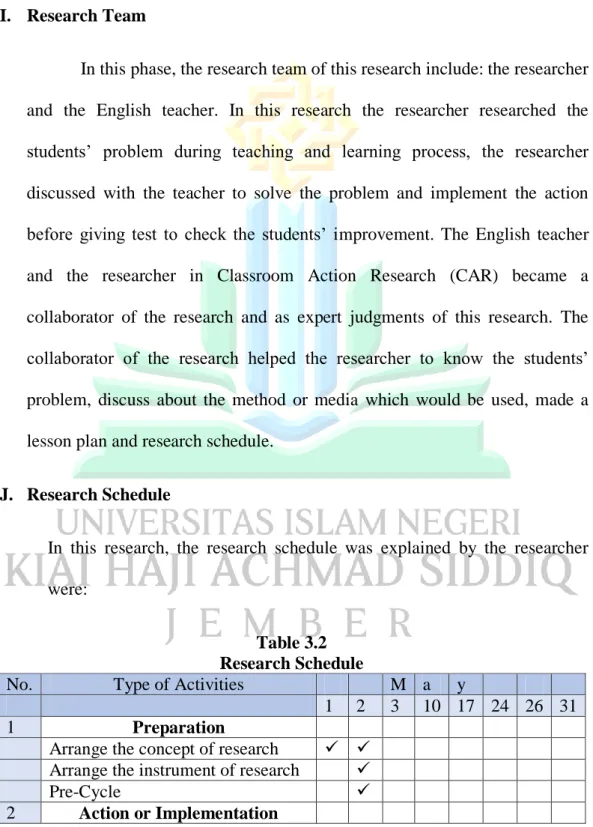
Table 3.2 Research Schedule ... 48
Table 4.1 Students’ Scores from English Teacher in Preliminary Research (pre- cycle) ... 54
Table 4.2 Students’ Scores from Multiple Choice Test ... 71
xii
LIST OF APPENDIXES
1. Appendix 1 : Matrix of Research and Pernyataan Keaslian Tulisan 2. Appendix 2 : Surat Pengajuan Penelitian
3. Appendix 3 : Surat Keterangan Selesai Penelitian 4. Appendix 4 : Silabus Pembelajaran Bahasa Inggris 5. Appendix 5 : RPP
6. Appendix 6 : Multiple Choice Test 7. Appendix 7 : The Result of Interview 8. Appendix 8 : Observation Result 9. Appendix 9 : Nilai Kelas X
10. Appendix 10 : Instrumen Validasi Penelitian 11. Appendix 11 : Field Note
12. Appendix 12 : Data Guru Siswa, Guru, dan SK Mengajar 13. Appendix 13 : Students’ Scores of the Test
14. Appendix 14 : Jurnal Aktifitas Penelitian 15. Appendix 15 : School’s Map
16. Appendix 16 : Documentations
17. Appendix 17 : Researchers Biography
1
CHAPTER I INTRODUCTION
A. Research Background
Language serves as a communication instrument which is used in daily activity to carries some information, opinion, or argument to other people.2 In this case the role of English is needed both in mastering communication technology and interacting directly. as a means of global communication, English must be mastered actively both orally and in writing. related to the importance of mastering a foreign language. Besides, understanding and mastering the own language as mother tongue and national language, English should be learned as a global language which plays a very important role toward global interaction and communication in line with the progress and competition of globalization. Besides that, English has become a keyword that can cover all aspects, be it business, politics, social or culture. English is still considered one of the most important subjects.3 Therefore, beginning teachers can find the responsibility of teaching it both exciting and challenging, it is described as the most important of all school subject, principally because reading, writing, speaking and listening are needed to a greater or lesser degree in every school’s subject
In Q.S Ibrahim 4, which read:
2 Yulia Agustin, Kedudukan Bahasa Inggris sebagai Bahasa Pengantar dalam Dunia Pendidikan, (Jakarta: Rineka Cipta) 4
3 Yulia Agustin, Kedudukan Bahasa Inggris sebagai Bahasa Pengantar dalam Dunia Pendidikan, (Jakarta: Rineka Cipta) 6
ٓ اَمَو اَنْلَسْرَأ نِم ٍ لوُسَّر ٍَّلِّإ ٍِناَسِلِب ۦ ٍِهِمْوَ ق ٍَنِّيَ بُيِل ٍْمُهَل ٓ ٍ لِضُيَ ف ٍُهَّللٱ نَم ٍُء ٓ اَشَي ىِدْهَ يَو نَم
ٍُء ٓ اَشَي ٓ ٍَوُهَو ٍُزيِزَعْلٱ ٍُميِكَحْلٱ
Arabic Spilling: Wa mā arsalnā mir rasụlin illā bilisāni qaumihī liyubayyina
lahum, fa yuḍillullāhu may yasyā`u wa yahdī may yasyā`, wa huwal-'azīzul-ḥakīm (Q.S Ibrahim: 4)
Meaning: “We did not send a messenger, but in the language of his people, so that he could explain clearly to them. So, Allah leads astray whom He wills, and guides whom He wills. And He is God Almighty, most wish”4
From the verse (surah) above, Indirectly Allah told the messengers (Rasul/ apostles) to teach other people that Allah sent them (human) messenger from among themselves who spoke the same language as them, so that they could understand the messengers and understand the messages brought by them (messengers). Therefore, Islam has told people to know foreign language for dakwah and keep themselves from crime, fraud, or maybe misunderstanding each other.
Vocabulary is one of English elements that is important to be taught, it is kind of learning language foundation.5 In learning language students have to master the vocabulary to know new words meaning. Without knowing the meaning of the words, it is impossible for them to understand the language.
Vocabulary is the critical part of a language. Understanding English means to
4 Departemen Agama Republik Indonesia, Alquran dan Terjemahan. (Semarang: Toha Putra, 1989), 389.
5 Fajar Muttaqien, Penggunaan Media Audio-Visual dan Aktivitas Belajar dalam Meningkatkan Hasil Belajar Vocabulary Siswa, (Garut: Jurnal wawasan ilmiah, 2017), 25-41.
understand the vocabulary as well. Vocabulary has a big role to get a language because vocabulary is one of the keys to express the language.6 Mastering vocabulary will improve four skill of English such as speaking, reading, writing and listening. In speaking skill, According to Akdogan, Kufaishi conveys that students need vocabulary which can support to produce and use meaningful sentences because vocabulary is part of the sentence. They cannot communicate their ideas transmitted to them.7 Vocabulary mastery must be acquired by students in order to get other competencies like listening, speaking, reading, and writing.8 Therefore, the students have to develop their vocabulary and master it in order to communicate with each other.
Further, vocabulary mastery takes an important role in mastering four basic skills of English. It is an inseparable part of any language learning, for example: in speaking. In learning English, the ability to know vocabulary is one of the most important abilities for students. It would be impossible to learn a language without vocabulary. It should be presented, explained, included in all kinds of language learning activities and must be learnt by students. Vocabulary mastery would be very helpful for the students in learning English. Vocabulary is not only a symbol for ideas but also a part of how to improve language skills in the target language.9 The more vocabulary which student master, the more ideas
6 Prudent Injeeli, Mind Your Words: Master the Art or Learning and Teaching Vocabulary, (Singapore: TRAFFORD, 2013), 7.
7 Esra Akdogan, Developing Vocabulary in Game Activities and Game Materials, (Turkey: Journal of Teching and Education), 31-66
8 Fika Megawati, Kesulitan Mahasiswa dalam Mencapai Pembelajaran Bahasa Inggris secara Efektif, (Sidoarjo: PEDAGOGIA 2016), 148.
9 Yulia Agustin, Kedudukan Bahasa Inggris sebagai Bahasa Pengantar dalam Dunia Pendidikan, (Jakarta: Rineka Cipta) 7.
they could have, so they can communicate by using their ideas more effectively.10 Therefore, beginner learner should master vocabulary because it is a core part of learning English.
The main objective of learning English is directed to improve students’
ability to communicate in English, both orally and written. In the process of learning the language, most students have not been able to listen, speak, read, and write well even with simple sentences. Some of students do not like English subject and have not been able to communicate in the language because of having a very low vocabulary mastery.11 Generally, students have some difficulties in learning English, especially in improving vocabulary: (1) They think that English subject is a boring subject; (2) They also have a low motivation in learning English; (3) Sometimes they do not understand the teacher’s explanation when they are speaking English because their vocabulary mastery is very low.12
Recently, teaching English to students cannot be considered only as teaching a language. It is a very challenging process, teachers deliver a knowledge about a language to their students who are childish with this language and need to create, find, and apply a unique way of delivering the materials for the students to improve students’ vocabulary in English. Therefore, it is necessary for teachers to
10 Mutmainnah, the effectiveness of Mnemonic keyword Method to Improve Student’s Vocabulary Mastery, (Parepare: Doctoral dissertation, 2020) 5.
11 Fajar Muttaqien, Penggunaan Media Audio-Visual dan Aktivitas Belajar dalam Meningkatkan Hasil Belajar Vocabulary Siswa, (Garut: Jurnal wawasan ilmiah, 2017), 25-41.
12 Dewi Untari, Using Keyword Mnemonic Strategy to Improve Students’ Vocabulary Achievement of Physical Education and Recreation Department, (Jember: Jurnal Pendidikan, Sosial Dan Keagamaan, 2015), 28-34.
make the students interested in learning activities. One of the best ways which can be applied to overcome these problems is using mnemonic as the supporting method in learning English process, especially in learning vocabulary.
Mnemonic is a method to remember something easily. It can be very effective and easy to be applied.13 It helps students remember how to spell difficult words and memorize information. There are a variety of mnemonic that can be used in learning vocabulary. One of them is song mnemonic, Song mnemonic is one of the most popular types in mnemonic devices used to help student remember the fact. It is chosen because many students prefer to memorize song lyric rather than lessons. It also motivates the students in improving their vocabularies easier and fun and the classroom during the teaching and learning activities is more interesting.
A large number of research studies has explored on the effectiveness of using mnemonics technique for students at various levels. Mnemonic Technique has significant contribution to increase student vocabulary mastery. It can be identified from number of students’ vocabulary. Mnemonic Device Technique builds up student confidence in remembering vocabulary. Students have new experience and technique to increase number of vocabularies.14 mnemonic technique is one way of teaching teachers to make it easier for students to remember and understand information received by converting short-term memories into long-term memories. Mnemonic techniques would help to enhance English vocabulary and applicable for other subject teaching and learning. The present study looks at the perspectives of primary
13 Erin Blackford, Mnemonic Devices: The Solution to Memory Failure, (Journal on Best Teaching Practice, 2015), 24-26.
14 Bambang Nur Alamsyah Lubis & Diani Syahputri, Mnemonic Device Technique Increase Students’ Vocabulary Mastery, (Sumatra Utara: IJESSR, 2022), 28-33.
school English language regarding the usage and suitability of mnemonic technique in teaching English vocabulary.15
In addition, there were only several researches that used song mnemonic for creative solutions to improve vocabulary memory ability. Almost researchers did not used it for English subject but to improve Mufradat (Arabic’s vocabulary) , biology’s material, chemistry, and Islamic studies. The previous study about song mnemonic to improve mufrodat was conducted by Sultan and Hafidah entitled “Mnemonics:
Creative Solutions to Improve Students' Arabic Vocabulary Memorizing Ability in Nurul Jadid Islamic Senior High School” the results of this study indicated: First, the application of Arabic vocabulary learning using the association and rhyme method runs well and smoothly, the learning process becomes more fun, can foster student enthusiasm, thus it can be concluded that the teaching of vocabulary using these methods proved effective for improving student learning outcomes.16 Another previous research was conducted by Claudia, Adib, and Fitri entitled:
“Pengaruh penerapan metode Mnemonik Terhadap Daya Ingat Anak Usia 5-6 Tahun di TK Amanah Sekayu” the result was having a significant influence between mnemonic methods on children's memory.17 Thus, the drawing on the previous research, many researches have been conducted that Mnemonic technique can improve student’s memory ability, especially vocabulary mastery.
15 Fajar Muttaqien, Penggunaan Media Audio-Visual dan Aktivitas Belajar dalam Meningkatkan Hasil Belajar Vocabulary Siswa, (Garut: Jurnal wawasan ilmiah, 2017), 25-41.
16 Sultan Firdaus & Siti Hafidah, Mnemonik: Solusi Kreatif untuk Meningkatkan Kemampuan Menghafal Kosa Kata Bahasa Arab Siswi Madrasah Aliyah Nurul Jadid, (Probolinggo: PALAPA Jurnal Studi Keislaman dan Ilmu Pendidikan, 2020), 83-84.
17 Kathy Claudia. Sabera Adib. & Izza Fitri, Pengaruh penerapan metode Mnemonik Terhadap Daya Ingat Anak Usia 5-6 Tahun di TK Amanah Sekayu, (Palembang: JIIP, 2020), 5.
Based on the preliminary observation at the tenth grade students of Asy- Syafaah Vocational High School, some problems in teaching English are found, those are: (1) The direct method and teacher-centred technique used by the teacher are inappropriate and do not attract the students’ attention; (2) Most of students do not have interest in learning English subject because they consider that English is difficult subject; (3) The English teacher explained that the teaching learning activities in this school is still teacher-centered. Students only listen and note-taking the teacher’s explanation during the teaching and learning activities. It has been observed those problems from the observation during the teaching learning activities in the class and their admission about those problems.
Therefore, based on the preliminary studies and some theoretical view that song mnemonic can be useful to improve the vocabulary learning of the students.
Relating to the background above, the researcher interested in researching
“Implementing of song mnemonic to improve student’s vocabulary mastery at tenth grade students of Asy-Syafaah Vocational High School of Year 2022/2023)”.
B. Research Question
Based on the background of study, the problem formulates as “how can the implementation of song mnemonic improve student’s vocabulary mastery at 10th grade students of Asy-Syafaah vocational High school?.” the study concerns with the finding of suitable strategy in implementing song mnemonic method for English language teaching process at Asy-Syafaah Vocational high school.
C. Research Objective
Related to the statement of the research problem, the aim of this research was to improve students’ vocabulary mastery by using song mnemonic at 10th grade of Asy-Syafaah vocational high school that had problem in mastering vocabulary to learn English.
D. Action Hypothesis
From the objectives mentioned above, the hypothesis that is produced in the form of possibility of improving the students' vocabulary mastery by using the implementation of song mnemonic strategy. In the assumption, song mnemonic is very helpful to memorize something, as song gives them double the opportunity to remember. By remembering one word, it is likely they will be able to find the suitable word to finish the song. A simple little song can help students remember a complex order of events that most struggle to remember.
Also, it is stated that song is a little part of music. by using the song mnemonic, teachers give their students a better chance of remembering important information and help students remember a complicated order of events that strain to remember. Therefore, it can be hypothesized that song mnemonic can help the students to improve their vocabulary mastery through the advantage of song mnemonic in which it helps the students to memorize and remember the vocabulary easier.
E. Research Significances
The results or findings of this research are expected to be useful theoretically and practically. Theoretically, the finding of this research is expected to give contribution or additional source about a method that can be used in the teaching and learning activities, especially in improving students’ vocabulary using song mnemonic. Practically, this research is useful for:
1. For teachers, this research is expected to be useful for teachers, especially English teacher. They can use song mnemonic as one of the solutions to improve students’ vocabulary.
2. For students, this research is expected to give an information about a method that can be used in improving vocabulary.
3. For the next researcher, this research is expected to give contribution and information for next researchers who want to do research in the same field.
F. The Definition of Key Terms
To avoid the misunderstanding of terms used in this research, it is important for me to give some explanations or definitions as follows:
1. Mnemonic
Mnemonic is a creative way in helping students remember difficult facts and information. By implementing a mnemonic method into the teaching and learning activities, especially learning vocabulary helps the teacher can fix those problems and it should become every teacher’s goal.
2. Song Mnemonic
Song is a little part of music. Meanwhile, Song mnemonic is a way to help students remembering difficult facts and to recall important information with the help of song.
3. Vocabulary
Vocabulary is one of English components that brings an effect and contribution to four English skills, those are: reading, speaking, writing, and listening. Some vocabularies which use in this research: general vocabularies.
11
CHAPTER II
REVIEW OF RELATED LITERATURE
A. Previous Studies
This chapter presented literature review. It consisted of relevant previous studies; The goal of the study was to see if there was any improvement through mnemonic technique. In order to strengthen this study, the researcher gives a discussion from five previous studies which were relevant. It could be references for helping this research. The previous research had been conducted by several researchers but each research had its own uniqueness. This is due to different in places of research, research objects, and literature used by researchers.
The first previous research was from Fatima Risa S. the research was conducted classroom action research, entitled: “The Effectiveness of Mnemonic Technique to Improve Students' English Vocabulary at the Eighth Grade of SMP Negeri 6 Parepare”. It found some problems during the teaching and learning activities. Students cannot listen clearly and understand what they read because the lack of vocabulary. Mnemonic is one of technique that was used by the researcher to train good vocabulary. Classroom action research method was used in this research. From the collecting data, the mean score of cycle I was 60.83 and cycle II was 86.04. It proved that the students’ score has improved from the cycle I to the cycle II.18 Thus, using mnemonic could solve the problem faced
18 Fatima Risa S, The Effectiveness of Mnemonic Technique to Improve Students' English Vocabulary at the Eighth Grade of SMP Negeri 6 Parepare (Parepare: Doctoral dissertation, 2020), 45.
by the students and she concluded that mnemonic technique is effective to improve students’ vocabulary mastery in SMP Negeri 6 Parepare.
The second previous research was from Daniar Sofeny and Siti Muamanah from Islamic Darul Ulum University, Lamongan. Entitled “Keyword Mnemonic in Boosting the Students’ Vocabulary Memorization for Young Learners Level” the subject of this research was fifth grade students. The purpose of this research was to explain the effectiveness of the Keyword Mnemonic Technique in boosting student’s English vocabulary memorization. This research used quantitative and the quasi non-equivalent experimental was used as a type of the research. It consisted of two groups, the experimental class and the control class. The research instruments used are the lesson plan and Mnemonic Keyword test, the test was post-test and pre-test. The research results show that there are two results obtained namely the effectiveness of the mnemonic keyword method and student achievement in memorizing English vocabulary after getting the mnemonic keyword method.
The results of the effectiveness of the above mnemonic keyword method show that the pre-test significance value is 0.231 > 0.05, then H_0 was accepted and H_1 was rejected, which means there is no average difference between the control class and the experimental class. The post-test significance value of 0,000
< 0.05, then H_0 was rejected and H_1 is accepted, which means there was an average difference between the control class and the experimental class. The results of the students' achievement in memorizing English vocabulary after getting the mnemonic keyword method above showed that memorization average
results of experimental class students are worth. The average entry at an interval of 61 x 0,05, it can be concluded that H_0 was rejected and H_1 was accepted.19 It means that the category of memorization ability on the experimental class students after being given the mnemonic method is good
The third previous research was from Yustina Gulo, Restu Damai L, Lies Dian M. Ndraha from study program students of Nias Raya University. Entitled”
Improving Students’ Vocabulary Mastery on Narrative Text Through Mnemonic Method at The Seventh Grade of SMP 1 HURUNA”. The purpose of this research was to improve the students’ vocabulary mastery through Mnemonic Method and the research used classroom action research method (CAR). There were four stages of the method planning, implementing, developing and evaluating. The research did action research in 2 cycles. The result of students’ Improvement show data percentage in Vocabulary Score for Each Cycle from 24 students was only 11 Students (45,8%) who were able to pass the MCC that had been determined and 13 students (54,2%) who were not able to pass the MCC in cycle I. Meanwhile, there were 21 or (87,5%) students who pass the MCC and only 3 students or (12,5%) who did not pass the MCC.20 In this case, the researcher concluded that this research was successful since most students obtained better result of the test and could pass the MCC that had been determined and it showed that mnemonic method gave improvement in vocabulary mastery.
19 Daniar Sofeny & Siti Muamanah, Keyword Mnemonic in Boosting the Students’ Vocabulary Memorization for Young Learners Level, (Lamongan: Getsempena English Education Journal, 2021), 105.
20 Yustina Gulo, Restu Damai L, and Lies Dian M. Ndraha,” Improving Students’ Vocabulary Mastery on Narrative Text Through Mnemonic Method at The Seventh Grade of SMP 1 HURUNA” (Nias Selatan: RELATION Journal, 2022), 8.
The next previous research was from Intan Permata Sari, Elva Elvinna Asahra, and Yana. The title was “Improving Students’ Vocabulary Mastery Using English Song” the method of this research was classroom action research (CAR).
The purpose and subject of the research ware to improve tenth grade students of Wirasaba Karawang vocational high school in academic year of 2018/2019 in mastering vocabulary using English songs. 30 students with 20 females and 10 males that consisted in the class. The researcher used 2 cycles in the research to know the result of using song could improve vocabulary mastery. The result of the research showed that there was improvement from Cycle I to Cycle II in the students’ participation in introduction, discussion and practice. In the students’
achievement cycle I was 67.33 and the average score of the Cycle II was 83.7.
Based on the results obtained on student learning outcomes, student activities and teacher activities in cycle II showed a significant increase due to the use of song.21 Therefore, memorizing English songs can be considered as the right technique to improve students' vocabulary mastery and memorizing English songs can be a good technical choice in teaching and learning vocabulary.
For the last previous research was from Muhammad Syahrip, Ibrahim Manda, Sam Hermansyah, Buhari, Andi Sadapotto. Entitled “Improving Students Vocabulary Mastery by The Used of Mnemonic Technique”. The subject of this research was the seventh-grade students of Junior high school 3 Dua pitue Kalosi in academic years 2018/2019 with the number of total samples were 30 students
21 Intan Permata Sari, Elva Elvinna Asahra, and Yana “Improving Students’ Vocabulary Mastery Using English Song” (Cimahi: PROJECT professional journal of English education, 2019) 413.
and it used quantitative method and pra-experimental as the type used. The instruments used in this study were pre-test and post-test, the research calculate the mean score and the purpose of this research was to improve students’
vocabulary mastery by the used of mnemonic technique. There are four stages of the research those were Pre-test, Treatment, evaluated, and Post-test.
The result for pre-test group were 27 (90%) students were classified into very poor, and 2 (7%) students were classified into poor, and 1 (3%) student were classified into fair. There were not any students classified good a very good. the students’ score in test result for post-test most of them were in good category, 4 (13%) students were classified into very good, 3 (10%) students were classified into good, 17 (57%) students were classified into fair and 5(17%) students were classified into poor. There were 13%) students classified into very poor. the mean score of the students in post-test (65.36) was greater than pre-test (37.93). It is supported by the difference between the test mean score of post-tests (65.36) that was higher than the pre-test (37.93), It means score of post-tests was 65.36. The data in previous section showed that applying four card game in learning vocabulary was effective to improve students’ vocabulary mastery.22 It means score of post-tests was 65.36. The data in previous section showed that applying four card game in learning vocabulary was effective to improve students’
vocabulary.
22 Muhammad Syahrip, Ibrahim Manda, Sam Hermansyah, Buhari, and Andi Sadapotto, Improving Students Vocabulary Mastery by The Used of Mnemonic Technique (Sidenreng rappang: La Ogi English Education Journal, 2019) 168.
Table 2.1
The Similarities and Differences between Previous Research and this Research
No. Author and Title Similarities Difference
1.
Fatima Risa S. “The Effectiveness of Mnemonic Technique to Improve Students'English
Vocabulary at the Eighth Grade of SMP Negeri 6 Parepare”
a. Bot of the research used Classroom action research (CAR).
b. Both of the research focused on a
technique that can help students easier to master vocabulary.
a. The subject of this previous research was eight grade junior high school student
b. The technique mnemonic used keyword mnemonic in this research
2.
Daniar Sofeny and Siti Muamanah “Keyword Mnemonic in Boosting the Students’ Vocabulary Memorization for Young Learners Level”
a. Both of the research used mnemonic technique
b. Both of them focused on student’s
vocabulary
a. The previous research used quantitative and the quasi non-equivalent experimental
b. The previous
research subject was students of
elementary school c. The previous
research used mnemonic keyword technique
3.
Yustina Gulo, Restu Damai L, Lies Dian M. Ndraha.
“Improving Students’
Vocabulary Mastery on Narrative Text Through Mnemonic Method at The Seventh Grade of SMP 1 HURUNA”
a. Both of the research used classroom action research method
b. Both of them focused on student’s
vocabulary mastery c. Both of them used
mnemonic technique
a. The previous research used narrative text to improve student’s vocabulary mastery b. The previous subject
was seventh grade of junior high school student
4.
Intan Permata Sari, Elva Elvinna Asahra, and Yana.
“Improving Students’
Vocabulary Mastery Using English Song”
a. Both of the research used classroom action research b. Both of them used
song as media to improve student’s vocabulary
c. Both of them focused on vocabulary
mastery d.
a. The previous research did not use mnemonic technique for improving student’s vocabulary mastery
b.
5.
Muhammad Syahrip, Ibrahim Manda, Sam Hermansyah, Buhari, Andi Sadapotto. “Improving Students Vocabulary Mastery by The Used of Mnemonic Technique”
a. Both of the research used focus on student’s vocabulary mastery.
b. Both of the research used mnemonic technique.
a. The previous research used quantitative method and pra-experimental.
b. The previous
research subject was junior high school student
c. Previous research
Based on the explanation above, it may be concluded that there are similarities and differences between this research and the previous research. Those previous researches showed that using mnemonic was very helpful in improving students’ vocabulary. The mnemonic created an interesting situation in the classroom during the teaching and learning activities.
From those previous researches, the researcher tried to do the same thing by using mnemonic in the teaching and learning vocabulary. However, there was a little different. It was about the type of mnemonic applied by this research. It used song mnemonic to improve students’ English vocabulary. Besides, the subject of this research is the tenth-grade students of Asy-Syafaah vocational high school in Sumbersari, Jember
B. Theoretical Framew ork 1. Vocabulary
a. Definition of Vocabulary
Vocabulary is the most important material in language. Learning language cannot be separated from learning vocabulary. Vocabulary is the most important language component because it affects the language skills,
they are speaking, reading, listening, and writing. Nowadays, mastering vocabulary has become a big problem for most of students. If they have limited vocabularies, they will be difficult to communicate each other.
Without having many vocabularies, it is impossible to build communication.
Vocabulary is all about words. In learning English, it has important roles. Vocabulary is one of English components which brings an effect and contribution to four language skills. Before mastering language skills, students have to master language components because English skills are supported by language components, they are: structure, pronunciation, and vocabulary. Vocabulary is important to study because of its function in mastering a language. It must be the main thing for students who want to learn English.23
b. Type of Vocabulary
There are two types of vocabulary, they are active and passive vocabulary. Active vocabulary (productive) is used in writing and speaking and it is made up of words that come up in person’s mind immediately when she or he has to produce a written and spoken sentence.
Passive vocabulary (receptive) is known but not used by a person.
She or he understands when it is heard or read. Passive vocabulary is usually larger rather than active vocabulary. The active vocabulary may seem to be more important in communication, however the purpose of
23 Zerah Dano Majaga, Improving Vocabulary Mastery of the Eighth Grade Students through Crossword Puzzle, (Kulawi: e-Journal of ELTS, 2013), 1-14.
teaching learning foreign language is to extend both the students’ active and passive vocabulary and increase the four basic language skills:
reading, listening, speaking, and writing.24 c. Aspect of Learning Vocabulary
There are many ways that will help students extending their vocabulary, they are:
1) Word Classes
Word classes are classified as a part of speech. They are PANCAVIP, pronoun, adjective, noun, conjunction, adverb, verb, interjection, and preposition.
a) Pronoun
Pronoun is a word that takes place of a noun. There are type of pronouns as follows:
1. Subject: I, you, we, they, she, he, it.
2. Object: me, you, us, them, her, him, it.
3. Possessive Adjective: my, your, our, their, her, his, its.
4. Possessive Pronoun: mine, yours, ours, theirs, hers, his, its.
5. Reflexive Pronoun: myself, ourselves, yourself, themselves, himself, herself, itself.
6. Demonstrative Pronoun: this, that, these, those.
7. Indefinite Pronoun: someone, everything, anybody, nobody, several, much, many.
24 Batu Bara & Ummi Kalsum, Improving the Students’ Vocabulary Mastery by Using English Song at Eight Grade of MTS Islamic Zending Medan, (Sumatra Utara: REPOSITORY, 2019)
b) Adjective
Adjective is a word that is used to explain a noun. There are type of adjective as follow:
1. Determiner
Determiners consist of a small group of structure words withoutcharacteristic form.
a. Articles: the, a, an.
b. Demonstrative adjectives: This – These: That – Those.
c. Possessive adjectives: From pronouns: my, your, her, one’s, etc.
From nouns: John’s, the girl’s, Jane’s, etc.
d. Adjectives or indefinite quantity: some, few, all, more, etc. e.
Relative and interrogative adjectives: whose, which, what, etc.
2. Descriptive adjectives
Descriptive adjectives usually indicate a constitutional quality or a physical state such as age, size, etc.
c) Nouns
Noun is one of part of speech. Its arrangement with the verb helps to form the sentence.
1. Function of Noun a. Noun as subject
Example: Joni has read the book for 3 hours.
b. Noun as complement
Example: Mr John is a doctor.
c. Noun as direct object
Example: He bought a car last week.
d. Noun as indirect object
Example: She gave her mother a flower.
e. Noun as preposition
Example: She has arrived at the airport 2. Type of Noun
a. Countable Noun
Example: Mango – Mangoes (Mangga – beberapa mangga), book – books, door – doors, etc.
b. Uncountable Noun
Example: sugar, oil, water, sand, etc.
c. Proper Noun
A proper noun begins with a capital letter. It concludes personal name; name of geographic units such as cities, rivers, countries, etc.; name of nationalities and religions; name of holiday; name of time units.
Example: Gramedia, Jakarta, Yogyakarta, Indonesia,etc.
d. Common Noun
Common noun is a noun referring to a person, place of thing in general.
Example: city, shop, market, town, etc.
e. Abstract Noun
Abstract noun is a noun that cannot be observed with sense.
Example: love, hate, feel, romance, etc.
f. Concrete Noun
Concrete noun is the antonym of abstract noun.
Example: book, school, bread, table, etc.
g. Collective Noun
Collective noun is a word for a group of people, animals, or objects considered as a single unit.
Example: class, team, pair, etc.
d) Conjunction
Conjunction is a group of words connecting sentences, clause, or phrase. There are three types of conjunction, such as:
1. Coordinating Conjunction
Coordinating conjunction is used to joins word with other words, phrase, or sentence with another sentence. Example: for, and, nor, but, or, yet, and so.
2. Correlative
Conjunction Correlative conjunction used to join elements of sentences.
Example: both … and, not only … but also, either … or, neither
… nor.
3. Subordinating Conjunction
Subordinating conjunction is word can be used to form adverbial clause form main sentence. There are five types of subordinating conjunction, such as:
a. Conjunction used to explain time: Before, after, since, as long as, as soon as, by the time, etc.
b. Conjunction used to explain opposition: Although, even though, whereas, while, etc.
c. Conjunction used to explain cause - effect: Because, now that, such … that, as in, etc.
d. Conjunction used to explain conditional: If, unless, only, whether or not, even if, etc.
e. Conjunction used to explain purpose: In order to, in order that, so that, etc.
e) Adverb
Adverb is a group of words describing or adding to the meaning of adverb, adjective, another adverb or a whole sentence.
Type of adverbs, such as:
1. Adverb of place and direction: there, south, north, west, east, etc.
2. Adverb of time: yesterday, tomorrow, now, later, last month, all day, for a year, etc.
3. Adverb of manner: accidentally, badly, beautifully, etc.
4. Adverb of degree: amazingly, so, enough, very, too, much.
5. Adverb of frequency: always, usually, often, seldom, twice, etc.
6. Adverb of purpose: so, so that, in order to, because, since, therefore, hence, etc.
7. Adverb of certainly: certainly, maybe, perhaps, probably, etc.
8. Adverb of quantity, it is used to describe quantity or how often an event happened. Example: lots, few, too many, much, lot, etc.
9. Relative adverb: therefore, moreover, why, although, etc.
10. Interrogative adverb, used to create question such as: where, why, how, when, etc.
f) Verb
Verb is a word or group of words used in describing an action, experience, or state. There are kinds of verb, such as:
1. Transitive verb
Example: Raka closed the window last night. Fajrul drinks a cup of coffee. Mufied is eating bread.
2. Intransitive verb
Example: Raka goes to school. Fajrul is sitting on the chair.
Mufied stands next to Raka.
3. Regular verb
Regular verb is formed by adding –ed.
Example: kick-kickedkicked, plant-planted-planted, water- watered-watered, etc.
4. Irregular verb
Irregular verb changes in the past tense completely.
Example: eat-ate-eaten, drink-drank-drunk, bring- broughtbrought, etc.
5. Auxiliary verb
Auxiliary verb is helping verb used with a main verb to help express the main verb’s tense, voice, or mood. Kinds of auxiliary verb such as: is, am, are, was, were, do, does, did, has, have, had, can, could, may, might, will, would, shall, should, must. Example: You should not swim in the river, Raka does not eat bread, John did not go to school, etc.
6. Phrasal verb
Phrasal verb is formed by adding an adverb or a preposition to a verb to produce new meaning.
Example: give up, wake up, look after, come in, look for, etc. example: My neighbour asks me to look after her cat, I am looking for my glasses.
g) Interjection
It is a word or phrase which used to express a feeling, to request, or demand something
Example: Wow! Oh My God! Excellent!
h) Preposition
Preposition is a word used to show the relationship of noun or pronoun to some other word. It is divided into two types as follow:
1. Preposition that consists of one word, they are: at, in, on, up, under, front, besides, etc.
2. Preposition that consists of two words or more, they are:
according to, instead of, next to, despite of, etc.
2) Word Families
Word family is group of word that share the same root but it takes different endings so that words have own meaning. Derivative is a word that result from addition of an affix to a root, and which has different meaning from the root. Derivatives and inflexions are both formed by the process of affixation.
3) Word Formation
Word formation is the formation of new word. These are types of word formation, such as:
a) Affixation
Affixation is the act of adding something else to form new words.
Two types of affixes, such as:
1. Prefixes
Prefixes are affixes that are added in the beginning of root word.
The prefixes can add by re, dis, un, non, etc
example: limit-unlimited, connect-disconnect, write-rewrite, etc.
2. Suffixes
Suffixes are affixes that are added in the end of root. The suffixes can add by –ful, -ish, -ist. Example: beauty-beautiful, child-childish, use-useful, etc.
a. Compound word
Compound word is the combination of two or more independent words. It consists of two patterns. a. Noun + verb + -er
example: hair dryer, bus driver, record player, etc. b. Noun + noun, example: classroom, bathroom, toothpaste, etc.
b. Blending
Blending is the fusion of two words into one, usually the first part of one word with the last part of another word, so that the resultant blend consists of both original meanings.
example: Breakfast + lunch = brunch, Information + entertainment = infotainment.
c. Clipping
Clipping is a process which a word is formed by shortening a lot of one. Clipping appears when the longer word has very common use and a short from result because it is simple and easy to be understood.
Example: Cho-chocolate, phone-telephone.
d. Acronym
Acronym is the result of forming a word from the first letter or letters of each word in a phrase
Example: VIP – Very Important Person WHO – World Health Organization NASA – National Aeronautics and Space Administration.
e. Coinage
Coinage is pure creations of writers, investors, and other who are in need of a term to name an item or product.
Example: aspirin, Vaseline, zipper, etc.
4) Word meaning a) Synonym
Synonym is linguistic forms that have the same meaning or similar meaning.
Example:
Learn = study Plan = grow Simple = plain Sad = upset Think = Consider Happy = glad, etc
b) Antonym
Antonym is word expressing an idea directly opposite to that of another word in the same language.25
2. Mnemonics
a. Definition of Mnemonic
Mnemonic is a technique someone can use to help students improve their ability to remember and to better focus the brain. so, it is able to recall important information. Mnemonic is not limited to a certain group of students either and it should become more popular as a good in the teaching learning activities, as it has been proven by countless research projects to be effective. Mnemonic should be used as one of the best teaching practices.26
Mnemonic (pronounced “ne-mo-nik”) is memory. The word
“Mnemonic” comes from Greek, namely “Mnemosyne”, (remembrance
‘Ingatan’). Mnemonic is memorizing something with help. Such assistance can be in the form of abbreviations, conditionals with objects, or “linking”
mengingat sesuatu berdasarkan hubungan dengan suatu hal lain), besides that, Mnemonic is a technique to remember information that is very difficult to recall.
Mnemonic is a method used to help improving students’ ability to remember and it is able to recall information. It is a creative way in
25 Nia Lestari, The Use of Mnemonics Technique to Increase Students’ Vocabulary Mastery (A Classroom Action Research at the Eighth Grade Students of SMPN 2 Banyubiru in the Academic Year of 2016/2017), (Salatiga: E-Repository, 2016),
26 Erin Blackford, Mnemonic Devices: The Solution to Memory Failure, (Journal on Best Teaching Practice, 2015), 24-26.
helping students remember difficult facts and information. By implementing a mnemonic method into the teaching and learning activities, especially learning vocabulary should become every teacher’s goal. If more teachers used mnemonic, students would be more ready for having test where being ready for tests would create more confident and education-hungry students because many students in today’s school are scramble with the process of memorization and recall. Mnemonic can be more than a phrase used to remember specific information and it can also be used to better store and recall information.27 Mnemonic is a learning tool that can be used as a method of learning and memory.28
b. Types of Mnemonic
There are many types of mnemonic method. those are:29 1) Peg Word Mnemonic
Turkington says that peg-word is best method introduced by John Sambrook in England 1879.30 It uses components that have been mastered before and formatted in pair, example: merah-saga and panas-
27 Erin Blackford, Mnemonic Devices: The Solution to Memory Failure, (Journal on Best Teaching Practice, 2015), 24-26.
28 Claire F. Smith, The Twelve Cranial Nerves of Chrismas; mnemonics, Rhyme, and anatomy- seeing the Lighter Side. (:Anatomical Science Education, 2019), 673-677.
29 Margo A.Mastrpieri, & St.Louis R, Enhancing School Success with Mnemonic Strategies, (Intervention in School and Clinic, 1998), 201-208.
30 Fatima Risa S, The Effectiveness of Mnemonic Technique to Improve Students' English Vocabulary at the Eighth Grade of SMP Negeri 6 Parepare (Parepare: Doctoral dissertation, 2020), 16.
api. Those words used to remember words that have the same character, they are: lipstick and hell.31
2) Acronyms Mnemonic
Another popular type of mnemonic is acronyms. Acronyms is when the first letter of each word in a chain of words spells out another word.32 For example: To remember rainbow’s colours, the acronym of MEJIKUHIBINIU could be used: MErah, JIngga, KUning, HIjau, BIru, NIla, and Ungu. Another example is prophets who have epithet of Ulul Azmi; Muhammad SAW, Isa a.s, Musa a.s, Ibrohim a.s, and Nuh a.s become MIMIN, an easy word to remember.
3) Loci Mnemonic
Loci mnemonic uses the famous and special places as a way to put words or terms that have to be remembered by students. In this case, the names of heroes, cities, street, numbers and building can be used for placing word which relevant in the meaning and a similarity in character or situation. For example, the parts of body here are used for loci number 1 to 10, they are: one is head, two is eyes, three is nose, four is mouth, five is ears, six is neck, seven is breast, eight is stomach, nine is foot, and ten is hand.33
31 Ina Rosdiana, The Effectiveness of Mnemonic Devices in Vocabulary Learning Process (a Pre- Experimental Study at the Fifth Grade of SDN Babakan 1), (Jakarta: UIN Syarif Hidayatullah, 2010).
32 Erin Blackford, Mnemonic Devices: The Solution to Memory Failure, (Journal on Best Teaching Practice, 2015), 24-26.
33 Ayu Puspita Sari, Improving Students’ English Achievement through Mnemonic for the Fourth Grade Students of SDN 3 Karanganom Klaten in the First Semester of the Academic Year of 2012/2013 (Yogyakarta: State University of Yogyakarta, 2013), 33-38.
4) Keyword method
Keyword mnemonic is a tool for remembering the meaning of target word. Keyword mnemonic is usually formatted especially for learning foreign words. When using this method, the students learn a keyword that sound similar to the similar word. Here are some examples of keyword mnemonic;
Table 2.2
Example of Vocabulary in Keyword Mnemonic Type
Word Phonetic Code
(Keyword) Mnemonic)
Meaning
Accept ǝk’sept Asep Menerima
Adult ǝ’dÄlt Adul Orang Dewasa
Astute ǝ’stuwt Astuti Cerdik
Direct Dǝ’rekt Derek Langsung
Deny Di’nai Deni Menyangkal
Enact E’nǣkt Enak Memerankan
Enchant En’cǣn Encan Memikat
5) Song Mnemonic
Song mnemonic is very helpful to memorize something, as song gives them double the opportunity to remember. By remembering one word, it is likely they will be able to find the suitable word to finish the song. A simple little song can help students remember a complex order of events that most struggle to remember.34
34 Erin Blackford, Mnemonic Devices: The Solution to Memory Failure, Journal on Best Teaching Practice, 2015), 24-26.
One way to successfully encode the information into students’
brain is to use song mnemonic. A well-known example is the “A-BC”
song. There is no end to what students learn when it is set to music.
They learn the country, names of animal, flowers, noun, verbs, etc.
Besides, kindergarten students’ song consisting of morality messages as an example.
Song is a little part of music. By using the song mnemonic, teachers give their students a better chance of remembering important information and help students remember a complicated order of events that strain to remember.35
35 Erin Blackford, Mnemonic Devices: The Solution to Memory Failure, (Journal on Best Teaching Practice, 2015), 24-26.
34
CHAPTER III RESEARCH METHOD
This chapter presented about research methodology. It consisted of research design and procedure, research settings, data collection technique, data analysis technique, and achievement indicator (criteria of success).
A. Research Design
This research used classroom action research (CAR). It was used to investigate how song mnemonic improve students’ vocabulary mastery. In the classroom action research, the teacher gives an action to the students during the teaching and learning activities in the class. As stated in “Doing Action Research in English Language Teaching” book, Action research is a broad movement that has been going on in education centre. Generally, it is related in the ‘reflective practice’ ideas and ‘teacher as researcher’. In conclusion, one of the main aims of action research is to identify a problematic happened in classroom during the teaching and learning activities.36
Classroom action research is a systematic approach improving teacher’s teaching practice. It is best seen as a way teacher approach the work in the classroom. It is a model for teaching with good transparency
36 Anne Burns, Doing Action research in English Language Teaching, (New York & London:
Rouledge, 2010), 54.
that enables teachers to determine students’ achievement in the classroom during the teaching and learning activities.37
In this research the researcher used some steps to implement the strategy, these were including: planning, implementing, observing and reflecting. Here, the explanations about the steps of Classroom Action Research (CAR):
1. Planning
Planning in this research was an action composed by researcher that had been discussed in first meeting with the teacher based on reflective preliminary observations.38 In this classroom action research, the planning was done after identifying and diagnosing the students’ problem in learning English. It occurred in the class that proven by observing and interviewing. In this phase the researcher should prepare a lesson plan to teach the students in order to improve their English. Preparing the lesson plan aims to provide the teacher with the guideline of teaching process.
In this research, the researcher involved several activities before implementing the action. Those are as follows:
a. The researcher observed the class and interviewed the English teacher and the students to get the data about students’ problem in learning English.
b. The researcher established research schedule.
c. The researcher determined to choose the song as media.
37 Robert Pelton, Action Research for Teacher Candidates Using Classroom Data to Enhance Instruction, (Lanham: Association of Teacher Educators, 2010), 3-24.
38 Rustiyarso & Tri Wijaya, Penelitian Tindakan Kelas, (Yogyakarta: Noktah, 2020), 41.
d. The researcher made a lesson plan (on the lesson plan, the steps of song are mentioned).
2. Implementing
Implementing in classroom action research is an action by the teacher as a researcher consciously, planned, and in accordance with the lesson plan.39 The researcher taught the students in accordance with the planning that has been arranged. There was one cycle in this research. In this cycle consisted of 3 meetings, 2 meetings for teaching and 1 meeting for test. In this phase, the researcher and the collaborator included some steps that must be considered in implementing the action, as follows:
a. The researcher explained about the material by using song as media.
b. The researcher asked the students to make an example of the material.
c. The researcher asked the students to improve their material by making a rhyme from vocabulary to be sung.
d. The researcher asked the students to explain the material they made.
e. The researcher asked the students to answer the researcher questions.
3. Observing
Observing phase was the time to gathering data and documenting the effect or impact of the actions.40 It can be concluded that, observing is a responsive activity by documenting the actions occur in the field note using open eyes and open-minded during observation. In this phase, the researcher collaborated with the English teacher as collaborator to observe
39 Rustiyarso & Tri Wijaya, Penelitian Tindakan Kelas, (Yogyakarta: Noktah, 2020), 43.
40 Rustiyarso & Tri Wijaya, Penelitian Tindakan Kelas, (Yogyakarta: Noktah, 2020), 45.
the class situation while implementing the action. The researcher and the collaborator observed the class situation include of: the students’ English subject activity, and the students’ responses during teaching and learning activities, the students’ enthusiastic participant during learning process, the students’ interaction, and while the students doing exercise. The researcher and teacher as collaborator also made some notes during observation by using observation checklist.
4. Reflecting
Reflecting is aimed to reflect or evaluate from the phase before.41 In this research the researcher and the collaborator analyzed the score of students’ vocabulary test based on the formula about average score and the class percentage which passed the minimal mastery level criterion (KKM) in part of data analysis and based on the criteria of success. When the result is successful, the research can stop. But, when the result is still failed, the researcher will revise the plan and continue to the next cycle 5. Revising the plan
In this research, revised plan is needed, when the action of the cycle did not make improvement on students’ English skill. It means that the revised plan was conditional to the next cycle or second cycle. In this research, the researcher adopted The Classroom Action Research procedure by Kemmis and Taggart model, 2006.
41 Rustiyarso & Tri Wijaya, Penelitian Tindakan Kelas, (Yogyakarta: Noktah, 2020), 46.