Produced by the Indiana Business Research Center at Indiana University’s Kelley School of Business
Indianapolis Impact Study 2008
1
Table of Contents
TABLE OF CONTENTS ... 1
EXECUTIVE SUMMARY ... 4
Core Mission Benefits ... 5
Collateral Benefits ... 5
CHARACTERISTICS OF IUPUISTUDENTS ... 8
Student Origin ... 8
Student Characteristics ... 11
Access and Affordability ... 12
Settlement of Alumni ... 13
CONTRIBUTION TO HUMAN CAPITAL ... 15
Degrees Conferred ... 15
Expected Lifetime Earnings ... 17
Adding to Indiana’s Talent Pool ... 21
UNIVERSITY RESEARCH AND BUSINESS DEVELOPMENT ... 24
Research Inputs ... 24
Research Outputs ... 25
CIVIC CONTRIBUTION ... 27
Service-Learning ... 27
Volunteering ... 30
Charitable Contributions ... 35
Resources for the Community ... 36
THE ECONOMIC FOOTPRINT OF THE UNIVERSITY ... 40
Methodology ... 40
Principal Findings ... 40
CONCLUSION ... 45
Figures Figure 1: IUPUI Campus Region ... 7
Figure 2: IUPUI Application Residency by Student Status, Fall 2007 ... 8
Figure 3: Residence of Origin for Full-Time Students of IUPUI, Fall 2007... 10
Figure 4: IUPUI Students by Age and Gender, Fall 2007 ... 11
Figure 5: Ethnic Distribution of IUPUI Students, Fall 2007 ... 12
2
Figure 6: Financial Aid and Family Income Status of Full-Time IUPUI Students, 2006-2007 ... 12
Figure 7: Settlement Pattern of IUPUI Graduates, Degrees Conferred 1998-2002 ... 14
Figure 8: Baccalaureate Degrees Conferred at Indiana Public Universities, 2002-2007 ... 15
Figure 9: Master’s Degrees Conferred at Indiana Public Universities, 2002-2007 ... 16
Figure 10: Professional Degrees Conferred at Indiana Public Universities, 2002-2007 ... 16
Figure 11: Doctoral Degrees Conferred at Indiana Public Universities, 2002-2007 ... 17
Figure 12: Life Sciences Degrees Conferred at IUPUI and Selected Indiana Public Universities, 2002-2007 .. 22
Figure 13: Residence of IUPUI Alumni with Life Sciences Degrees, 2008 ... 23
Figure 14: Annual IUPUI Sponsored Research Expenditures, FY 2000-2008 ... 24
Figure 15: Sponsored Research Expenditures by Funding Source, IUPUI, Three-Year Average, FY 2006-2008 ... 25
Figure 16: Number of Service-Learning Faculty and Courses, 2000-2007 ... 28
Figure 17: IUPUI Service-Learning Courses, Number of Students and Hours of Service, 2000-2007 ... 29
Figure 18: Volunteer Time Spent by Activity for IUPUI Students, 2006-2007... 32
Figure 19: Volunteer Time Spent by Activity, IUPUI Faculty and Staff, 2006-2007 ... 34
Tables Table 1: Estimated Benefits of Student and Staff Civic Contributions, IUPUI, 2006-2007 ... 6
Table 2: Estimated Employment and Economic Footprint, IUPUI, 2006-2007 ... 6
Table 3: Top 10 States for Full-Time IUPUI Students, Fall 2007 ... 9
Table 4: Top 10 States for IUPUI Graduates, Degrees Conferred 1998-2002 ... 13
Table 5: Estimated Lifetime Earnings for Female Baccalaureate Degree Graduates, IUPUI, 2002-2007 ... 17
Table 6: Estimated Lifetime Earnings for Female Advanced Degree Graduates, IUPUI, 2002-2007 ... 18
Table 7: Estimated Lifetime Earnings for Male Baccalaureate Degree Graduates, IUPUI, 2002-2007 ... 19
Table 8: Estimated Lifetime Earnings for Male Advanced Degree Graduates, IUPUI, 2002-2007 ... 20
Table 9: Difference in Lifetime Earnings between IUPUI Graduates (Baccalaureate Degree or Higher) and U.S. Associate’s Degree Graduates ... 21
Table 10: Technology Transfer Outputs of IU School of Medicine Research, FY 2004-2007 ... 26
Table 11: Technology Transfer Outputs of IUPUI Non-School of Medicine Research, FY 2004-2007 ... 26
Table 12: Indianapolis Area Start-Ups Utilizing Licensed IU Technologies, 2000-2008 ... 26
Table 13: Economic Benefit of Service-Learning, IUPUI, 2006-2007 ... 29
Table 14: Economic Benefit of Student Volunteering Activities, IUPUI, 2006-2007 ... 32
Table 15: Economic Benefit of Employee Volunteering Activities, IUPUI, 2006-07 ... 34
3
Table 16: Economic Benefit of Student Charitable Contributions, IUPUI, 2006-2007 ... 35
Table 17: Economic Benefit of Employee Charitable Contributions, IUPUI, 2006-2007 ... 36
Table 18: Community Resources Offered by IUPUI ... 37
Table 19: Estimated Economic Footprint of IUPUI, 2006-2007 ... 41
Table 20: Estimated Employment Footprint of IUPUI, 2006-2007 ... 41
4
Executive Summary
Indiana University–Purdue University Indianapolis (IUPUI) has played a fundamental role in its region since it was established in 1969. IUPUI provides central Indiana residents with affordable and convenient access to a range of continuing education, certificate and degree offerings at a premier research university. As a result, IUPUI strengthens the economic competitiveness of the state and increases the earning power of its residents. IUPUI’s impact on the state extends beyond its academic mission. The university’s budget, the civic engagement of students and staff, and the campus’ cultural contributions also bestow many economic benefits to the region.
The present study was undertaken to measure how IUPUI improves the lives of Hoosiers in the Indianapolis region. This report presents policymakers, university officials and Indiana taxpayers with comprehensive yet conservative estimates of the university’s impact. IUPUI receives a significant commitment of state resources, and it is useful for any public institution, including universities, to show the rewards of such commitment.
One way to present how Indiana benefits from IUPUI is to consider results related to the core mission of the university as well as results that are collateral to the university achieving its core mission. The core mission is education and research. Collateral benefits would include the economic benefits of the university spending associated with its core mission or the economic benefits of, for example, the service-learning that mobilizes students to work for free in the community.
A variety of methods were used to measure the core and collateral benefits of IUPUI. The core benefits—meaning those benefits that relate to the university’s core mission of education and research—are derived from university records or government data sources. These data highlight characteristics of the student body, the number and type of degrees conferred, the settlement patterns of recent graduates, and the amount of outside research funding IUPUI attracted. Core benefits data help to answer many key questions including: Do alumni apply their skills in the state or find work elsewhere? Does IUPUI curriculum support Indiana’s economic development priorities in the life sciences? Does university research and development generate private-sector commerce?
This analysis of core benefits focuses almost exclusively on tangible metrics within the state.
However, many benefits associated with the university’s educational and research mission are difficult to quantify and are global in reach. Moreover, some benefits that flow from IUPUI’s core mission result in tangible economic benefits to the individuals who attend the university, namely, the expected increase in lifetime earnings resulting from higher educational attainment.
Following the presentation of the core benefits, attention turns to the collateral benefits of IUPUI.
These benefits recognize the effects that university expenditures and the activities of students, staff and visitors have on the local community. For instance, traditional input-output analysis reveals the economic activity related to the university’s operating budget and student spending. The monetary value of student service-learning and student volunteering is also added into the total of collateral benefits. Additionally, the value of faculty and staff civic engagement is also measured.
5
The following bullet points summarize the key findings of these analyses.
Core Mission Benefits
The first section of this report, Characteristics of IUPUI Students, presents profiles of the student population and its recent graduates. IUPUI’s fall 2007 enrollment totaled 28,300 students—90 percent of whom were Indiana residents. Of the university’s 19,700 degree recipients between 1998 and 2002, 72 percent were residing in Indiana as of 2008. The two leading counties of residence for this cohort are Indiana’s Marion and Hamilton counties.
The Contribution to Human Capital section examines IUPUI’s degree output and the economic value of these degrees to recipients. IUPUI conferred 21,800 baccalaureate, master’s, professional and doctoral degrees between 2002 and 2007, 13 percent of the total for all of Indiana’s public universities. The most common fields of study at the baccalaureate level were arts and humanities and business administration while business administration was the most frequent master’s degree conferred. The university awarded 6,000 degrees related to life sciences over this period.
IUPUI graduates can expect far greater lifetime earnings than people with a two-year associate’s degree. The typical male IUPUI graduate can expect to earn $2.1 million over his lifetime and the typical female graduate can anticipate $1.5 million in lifetime earnings. These figures are 64 percent and 50 percent greater, respectively, than the expected lifetime
earnings of male and female associate’s degree recipients.
The section on University Research and Business Development details annual
sponsored research expenditures at IUPUI, as well as technology transfer and business start- up activity. IUPUI has averaged $166 million in annual research expenditures supported by external contracts and grants in fiscal years 2006 through 2008. Eighty-seven percent of these funds went to support research at the IU School of Medicine. Between 2004 and 2007, university research generated 348 new invention disclosures, 131 new patent applications and 54 new patents issued.
Collateral Benefits
This report measures the economic benefits of IUPUI’s Civic Contribution. Through the imputed value of service-learning programs, and volunteerism, students, staff and faculty
“give back” to their community and to the campus region (see Figure 1). Table 1 presents the imputed dollar value of their contributions.
In addition, this report notes that members of the IUPUI community also made $4.3 million in charitable contributions to organizations operating within the Indianapolis area.
IUPUI also enriches its region through its community engagement programs, facilities and cultural offerings. Whether it’s the Herron Art Galleries, the IUPUI Sports Complex or University Library, IUPUI gives area residents something to be proud of.
6
Finally, the Economic Footprint section reports the employment and economic
significance of spending by the university, students and visitors. The estimates in Table 2 report the effects of direct expenditures (e.g., university purchases and compensation of faculty and staff) as well as the “ripple effects” of these expenditures within the community.
In addition to IUPUI’s employment of 7,051 faculty and staff, university spending accounts for an additional 13,210 jobs in the region.
Table 1: Estimated Benefits of Student and Staff Civic Contributions, IUPUI, 2006-2007
Civic Contribution Estimate of
Economic Benefit
Service-Learning $387,500
Student and Staff Volunteerism $3,022,800
Total $3,410,300
Source: Indiana Business Research Center (IBRC)
Table 2: Estimated Employment and Economic Footprint, IUPUI, 2006-2007
Type of Spending
Total Employment Effects
(number of jobs)
Total Economic Output Effects
(in millions)
Faculty and Staff Compensation 3,970 $699.6
University Purchases and Construction
Expenditures 2,380 $447.7
Medical School Supplemental Expenditures 6,860 $775.0 Student and Visitor Expenditures 3,760 $551.3
Total 16,970 $2,473.6
Source: IBRC, using IMPLAN model results
7
Figure 1: IUPUI Campus Region
Source: Indiana Business Research Center
8
Characteristics of IUPUI Students
In the fall of 2007, student enrollment at IUPUI stood at 28,321 students. Sixty-one percent of these students attended full-time, while the remaining 39 percent attended part-time.
Student Origin
Overall, 90 percent of IUPUI students are Indiana residents. This varies significantly by student status, however: Four percent of undergraduates come from out of state, compared to 23 percent of graduate students (see Figure 2).
Figure 2: IUPUI Application Residency by Student Status, Fall 2007
Source: IBRC, using data from the Office of University Planning, Institutional Research and Accountability
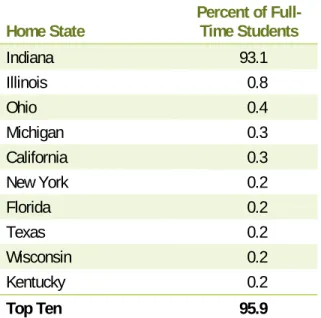
Students come to IUPUI from 44 states plus the District of Columbia. As Table 3 shows, each state other than Indiana accounts for less than 1 percent of the full-time student body.
0 5,000 10,000 15,000 20,000 25,000
Undergraduate Graduate
Number of Students
Non-Residents Residents
9
Table 3: Top 10 States for Full-Time IUPUI Students, Fall 2007 Home State Percent of Full-
Time Students
Indiana 93.1
Illinois 0.8
Ohio 0.4
Michigan 0.3
California 0.3
New York 0.2
Florida 0.2
Texas 0.2
Wisconsin 0.2
Kentucky 0.2
Top Ten 95.9
Note: The international/unknown category accounts for 2.3 percent of full-time students.
Source: IBRC, using data from the Office of University Planning, Institutional Research and Accountability
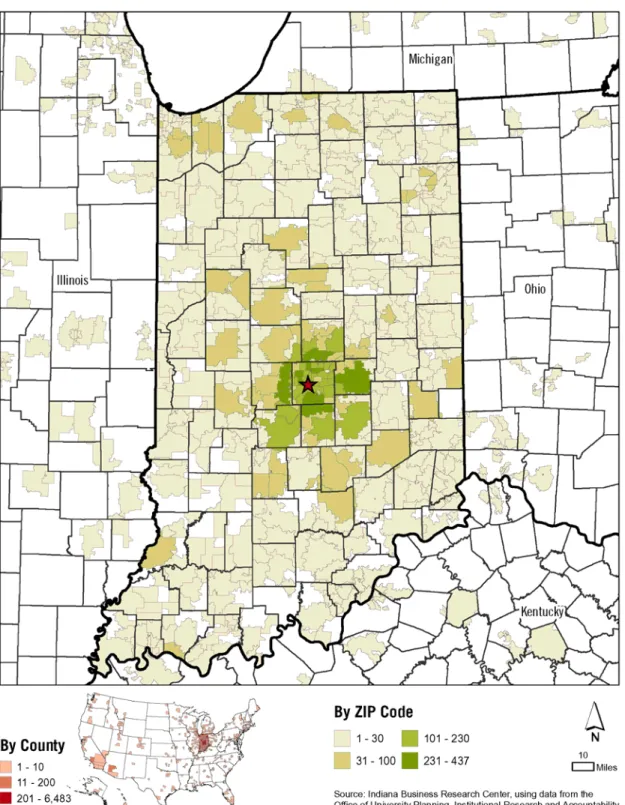
Figure 3 shows the number of full-time students by ZIP code for Indiana and the surrounding areas.
10
Figure 3: Residence of Origin for Full-Time Students of IUPUI, Fall 2007
11
Student Characteristics
Age and Gender
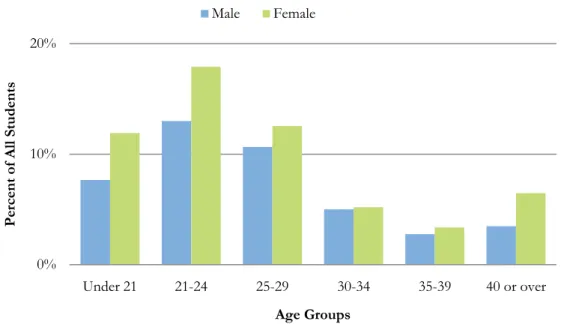
Thirty-one percent of IUPUI students are between the ages of 21 and 24. Women comprise 57 percent of the student body. As shown in Figure 4, women outnumber men in every age group, particularly among those under the age of 21 (where women comprise 61 percent of that age group) and those 40 or older (of whom women account for 65 percent).
Figure 4: IUPUI Students by Age and Gender, Fall 2007
Source: IBRC, using data from the Office of University Planning, Institutional Research and Accountability
Ethnicity
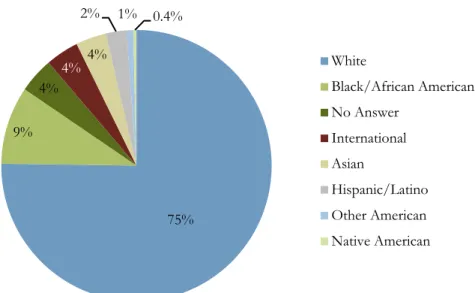
Three-quarters of the student body categorize themselves as white (see Figure 5). Under-represented minorities (blacks, Hispanics and Native Americans) account for 12 percent of all students. Blacks comprise 9.3 percent of the student body, followed by Hispanics at 2.5 percent and Native
Americans at 0.4 percent. Note that all international students are grouped together because ethnicity data were collected only for students applying from within the United States.
0%
10%
20%
Under 21 21-24 25-29 30-34 35-39 40 or over
Percent of All Students
Age Groups Male Female
12
Figure 5: Ethnic Distribution of IUPUI Students, Fall 2007
Note: Data on ethnicity were collected only for students applying from within the United States. The international category includes all those who applied from elsewhere in the world because the concept of ethnic identification varies from country to country. The Native American grouping includes both the American Indian/Alaska Native and Native Hawaiian/Other Pacific Islander categories.
Source: IBRC, using data from the Office of University Planning, Institutional Research and Accountability
Access and Affordability
Figure 6 shows that well over half of full-time IUPUI students receive financial aid. Additionally, about 29 percent of students both receive financial aid and are from households with family incomes lower than the Indiana median of $47,074.
Figure 6: Financial Aid and Family Income Status of Full-Time IUPUI Students, 2006-2007
Note: Where family income data for financial aid recipients is “unknown,” income data may have been suppressed due to confidentiality requirements or the aid recipient may not be an Indiana resident.
Source: IBRC, using data from the Indiana Commission for Higher Education 75%
9%
4%
4% 4%
2% 1% 0.4%
White
Black/African American No Answer
International Asian
Hispanic/Latino Other American Native American
29.2%
10.0%
17.7%
43.0%
Receiving Financial Aid / Below Median Family Income Receiving Financial Aid / Unknown Family Income Receiving Financial Aid / Above Median Family Income No Financial Aid
13
Settlement of Alumni
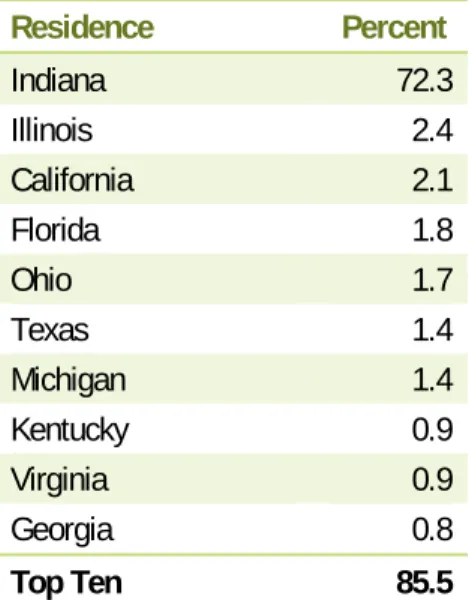
Where alumni settle after graduation plays a key role in analyzing the ultimate significance of a university campus. In contrast to those who leave, alumni who remain make ongoing contributions (e.g., increased productivity, income and cultural contributions) to their geographic region well after they complete their degrees. Table 4 shows that 72 percent of recent IUPUI graduates—those who received their degrees between 1998 and 2002—resided in the state as of 2008. The next most popular states were Illinois and California.
Table 4: Top 10 States for IUPUI Graduates, Degrees Conferred 1998-2002
Residence Percent
Indiana 72.3
Illinois 2.4 California 2.1
Florida 1.8
Ohio 1.7
Texas 1.4
Michigan 1.4
Kentucky 0.9
Virginia 0.9
Georgia 0.8 Top Ten 85.5
Note: The international/unknown category accounts for 3.7 percent of graduates. Graduates who earned their degrees at the IUPU Columbus campus during this time frame are included in this data set.
Source: IBRC, using data from the IU Alumni Association as of February 2008
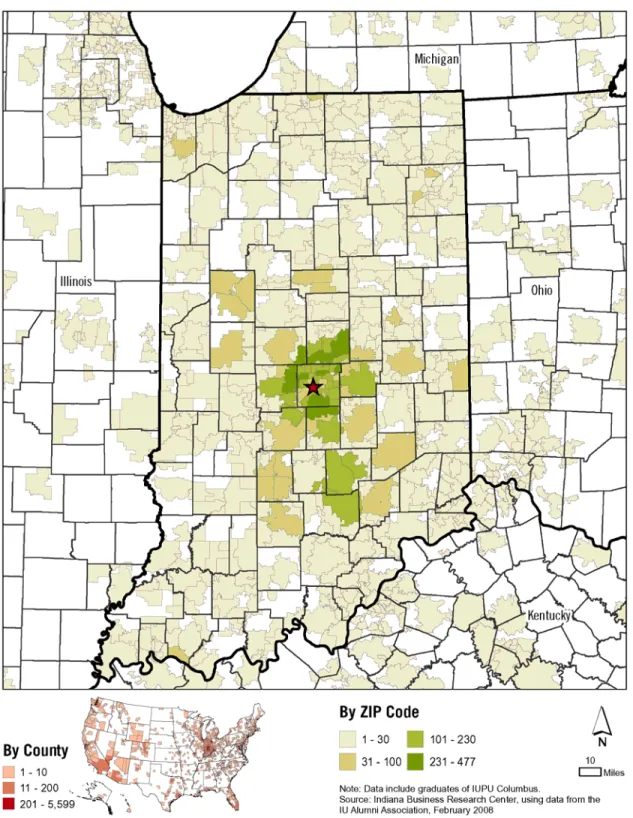
Figure 7 shows the settlement pattern for recent graduates by ZIP code for Indiana and the
surrounding states. IUPUI graduates who earned their degrees between 1998 and 2002 have settled in every Indiana county. In 2008, those recent graduates tended to settle in Marion (5,599 graduates), Hamilton (2,026 graduates) and Hendricks (974 graduates) counties—all part of the campus region.
Overall, 55 percent of IUPUI’s 19,748 degree recipients between 1998 and 2002 lived in the campus region in 2008.
14
Figure 7: Settlement Pattern of IUPUI Graduates, Degrees Conferred 1998-2002
15
Contribution to Human Capital
Degrees Conferred
Of the 121,285 baccalaureate degrees conferred in the past five years by Indiana’s public universities, IUPUI granted 10 percent. System-wide, IU campuses constituted almost 44 percent (see Figure 8).
Purdue University campuses represented another third of these degrees and the other three state universities granted 23 percent.
Figure 8: Baccalaureate Degrees Conferred at Indiana Public Universities, 2002-2007
Source: IBRC, using data from the Indiana Commission for Higher Education
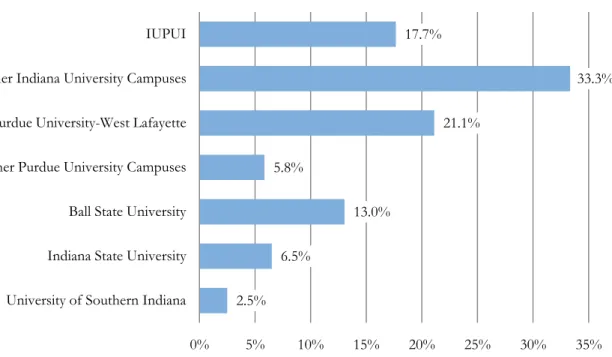
Figure 9 shows that IUPUI conferred 18 percent of the master’s degrees conferred by Indiana public schools, behind IU Bloomington and Purdue University–West Lafayette. Together, Ball State
University, Indiana State University and the University of Southern Indiana granted less than a quarter of these degrees.
4.4%
5.8%
12.8%
8.1%
25.1%
33.7%
10.2%
0% 5% 10% 15% 20% 25% 30% 35% 40%
University of Southern Indiana Indiana State University Ball State University Other Purdue University Campuses Purdue University-West Lafayette Other Indiana University Campuses IUPUI
16
Figure 9: Master’s Degrees Conferred at Indiana Public Universities, 2002-2007
Source: IBRC, using data from the Indiana Commission for Higher Education
Leading the state, IUPUI constituted well over half of all professional degrees (e.g., law and medical degrees) conferred by public universities in Indiana in the past five years. Figure 10 shows that other IU campuses accounted for a quarter of these degrees and Purdue University–West Lafayette
granted the remaining fifth of these degrees.
Figure 10: Professional Degrees Conferred at Indiana Public Universities, 2002-2007
Source: IBRC, using data from the Indiana Commission for Higher Education
Since most of IU’s doctoral programs are hosted by IU Bloomington, IUPUI granted relatively few (4 percent) of the doctoral degrees granted by Indiana’s public schools. Leading the way is Purdue University–West Lafayette, which granted virtually half of these degrees. The two other public schools granting doctoral degrees—Ball State University and Indiana State University—accounted for just over 5 percent each (see Figure 11).
2.5%
6.5%
13.0%
5.8%
21.1%
33.3%
17.7%
0% 5% 10% 15% 20% 25% 30% 35%
University of Southern Indiana Indiana State University Ball State University Other Purdue University Campuses Purdue University-West Lafayette Other Indiana University Campuses IUPUI
19.8%
25.2%
55.0%
0% 10% 20% 30% 40% 50% 60%
Purdue University-West Lafayette Other Indiana University Campuses IUPUI
17
Figure 11: Doctoral Degrees Conferred at Indiana Public Universities, 2002-2007
Source: IBRC, using data from the Indiana Commission for Higher Education
Expected Lifetime Earnings
Indiana University provides an education that not only enriches its graduates intellectually, but also financially. By granting baccalaureate, master’s, professional and doctoral degrees in diverse fields, IU allows Indiana residents the opportunity to greatly enhance their career options and wage-earning potential beyond what they may have earned with merely an associate’s degree or less. Here we consider the increased lifetime earnings for female and male graduates completing the most popular degrees on the IUPUI campus. Lifetime earnings are estimated synthetically by summing the average wages for different age cohorts of full-time, year-round workers for each degree level and field.1 Table 5 shows that a recent female IUPUI baccalaureate graduate is expected to earn close to $1.3 million from employment over the course of her lifetime. The most popular degree field—arts and humanities—is associated with lifetime earnings of over $1.3 million, along with many other popular fields such as business administration and management and nursing, even without completing an additional graduate degree.
Table 5: Estimated Lifetime Earnings for Female Baccalaureate Degree Graduates, IUPUI, 2002-2007
Field of Study
Average Annual Number of Graduates
(2002-2007)
Lifetime Earnings per Person
(in thousands)
Arts and Humanities (except Music,
Visual & Performing Arts) 306 $1,303 Education (except Administrative and
Math & Science Education) 210 964
1 For more detail, please read the methodology section of the main report.
5.3%
5.3%
49.4%
35.7%
4.4%
0% 10% 20% 30% 40% 50% 60%
Indiana State University Ball State University Purdue University-West Lafayette Other Indiana University Campuses IUPUI
18
Field of Study
Average Annual Number of Graduates
(2002-2007)
Lifetime Earnings per Person
(in thousands)
Business Administration and
Management 208 1,347
Nursing 202 1,368
Social Sciences (except Economics) 136 1,182 Allied Health Fields (except Nursing) 122 1,370 Public and Educational Administration
and Management 64 1,173
Drama / Fine, Visual & Performing Arts 56 1,222
Communications 52 1,329
Criminal Justice/Protective Services 42 1,323
Other Fields 113 1,489
Overall 1,512 $1,272
Note: Numbers may not sum due to rounding. Lifetime earnings are synthetic estimates based on average wages for graduates by age, degree level and field. Figures have been adjusted to 2006 dollars and future earnings have been discounted at 3 percent.
Source: IBRC, using data from the Indiana Commission for Higher Education and the National Survey of College Graduates
Female graduates who earn advanced degrees at IUPUI typically earn an estimated $1.8 million from employment over their lifetimes (see Table 6). Popular master’s degrees in education and public and educational administration and management can earn graduates $1.2 million and $1.4 million, respectively. Graduates of master’s degrees in business administration and management can earn even more at $1.8 million. Doctoral degree graduates in the most popular allied health and social sciences fields potentially earn over $1.7 million over their careers. Highest of all are professional degree graduates who have lifetime earning potentials above $2.4 million.
Table 6: Estimated Lifetime Earnings for Female Advanced Degree Graduates, IUPUI, 2002-2007
Degree
Type Field of Study
Average Annual Number of Graduates
(2002-2007)
Lifetime Earnings per Person
(in thousands)
Master’s Education (except Administrative and
Math & Science Education) 133 $1,242 Master’s Public and Educational Administration
and Management 129 1,388
Master’s Business Administration and
Management 94 1,848
Master’s Library Science 81 1,150
Master’s Nursing 78 1,626
Master’s Other Fields 193 1,533
19
Degree
Type Field of Study
Average Annual Number of Graduates
(2002-2007)
Lifetime Earnings per Person
(in thousands)
Professional Medicine/Dentistry/Optometry 152 2,759
Professional Law/Legal Studies 121 2,453
Doctoral Allied Health Fields (except Nursing) 14 1,765 Doctoral Social Sciences (except Economics) 10 1,744
Doctoral Other Fields 6 1,679
Overall 1,010 $1,783
Note: Numbers may not sum due to rounding. Lifetime earnings are synthetic estimates based on average wages for graduates by age, degree level and field. Figures have been adjusted to 2006 dollars and future earnings have been discounted at 3 percent.
Source: IBRC, using data from the Indiana Commission for Higher Education and the National Survey of College Graduates
Meanwhile, men who recently completed baccalaureate degrees are expected to earn $1.7 million dollars in lifetime earnings from employment (see Table 7). The most popular degree field—
business administration and management—is associated with lifetime earnings of $1.9 million, even if these graduates do not complete an additional advanced graduate degree. Other popular degree fields are arts and humanities and technology, and these fields allow graduates lifetime earnings of over $1.5 million and $1.7 million, respectively.
Table 7: Estimated Lifetime Earnings for Male Baccalaureate Degree Graduates, IUPUI, 2002-2007
Field of Study
Average Annual Number of Graduates
(2002-2007)
Lifetime Earnings per Person
(in thousands)
Business Administration and
Management 203 $1,902
Arts and Humanities (except Music,
Visual & Performing Arts) 188 1,553
Technology And Technical Fields
(Including Computer Programming) 81 1,731 Computer and Information Science (not
programming) 79 $1,965
Social Sciences (except Economics) 73 1,757 Education (except Administrative and
Math & Science Education) 66 1,250
Engineering (except Bio-, Biomedical,
Material & Metallurgical) 56 2,046
Communications 46 1,539
Drama / Fine, Visual & Performing Arts 38 1,405 Criminal Justice/Protective Services 27 1,435
20
Field of Study
Average Annual Number of Graduates
(2002-2007)
Lifetime Earnings per Person
(in thousands)
Other Fields 98 1,718
Overall 955 $1,707
Note: Numbers may not sum due to rounding. Lifetime earnings are synthetic estimates based on average wages for graduates by age, degree level and field. Figures have been adjusted to 2006 dollars and future earnings have been discounted at 3 percent.
Source: IBRC, using data from the Indiana Commission for Higher Education and the National Survey of College Graduates
Male graduates who earn advanced degrees at IUPUI typically earn over $2.5 million from employment over their lifetimes (see Table 8). By far the most popular master’s degree field is business administration and management and these graduates can earn $2.4 million over their careers. Doctoral degree graduates in the most popular biological, agricultural and food sciences field potentially earn $2.4 million over the life course. Highest of all are professional degree graduates who have lifetime earning potentials above $2.9 million.
Table 8: Estimated Lifetime Earnings for Male Advanced Degree Graduates, IUPUI, 2002- 2007
Degree
Type Field of Study
Average Annual Number of Graduates
(2002-2007)
Lifetime Earnings per Person
(in thousands)
Master’s Business Administration and
Management 255 $2,420
Master’s Biological, Agricultural & Food Sciences 47 1,405 Master’s Public and Educational Administration
and Management 42 1,634
Master’s Education (except Administrative and
Math & Science Education) 39 1,367
Master’s Allied Health Fields (except Nursing) 36 2,149
Master’s Other Fields 116 1,860
Professional Medicine/Dentistry/Optometry 206 3,488
Professional Law/Legal Studies 135 2,903
Doctoral Biological, Agricultural & Food Sciences 10 1,980 Doctoral Allied Health Fields (except Nursing) 6 2,383
Doctoral Other Fields 1 2,111
Overall 892 $2,515
Note: Numbers may not sum due to rounding. Lifetime earnings are synthetic estimates based on average wages for graduates by age, degree level and field. Figures have been adjusted to 2006 dollars and future earnings have been discounted at 3 percent.
21
Source: IBRC, using data from the Indiana Commission for Higher Education and the National Survey of College Graduates
The value of obtaining a four-year college degree or higher is highlighted when one compares the difference between the estimated lifetime earnings of IUPUI’s baccalaureate and advanced degree graduates with the earnings of associate’s degree graduates nationwide (see Table 9). Over the life course, IUPUI’s female graduates are expected to make $494,000 more (or 50 percent) more than associate’s degree graduates. Male graduates are expected to make over $819,000 more (or 64 percent) more than associate’s degree graduates.
Table 9: Difference in Lifetime Earnings between IUPUI Graduates (Baccalaureate Degree or Higher) and U.S. Associate’s Degree Graduates
Category Women
($1000s) Men
($1000s)
Average Lifetime Earnings for IUPUI Alumni (2002-2007) with
Baccalaureate Degrees or Higher $1,476 $2,097
Average Lifetime Earnings for U.S. Associate’s Degree Graduates $983 $1,278 Additional Lifetime Earnings Attributable to Higher Degree $494 $819 Note: Numbers may not sum due to rounding. Lifetime earnings are synthetic estimates based on average wages for graduates by age, degree level and field. Figures have been adjusted to 2006 dollars and future earnings have been discounted at 3 percent.
Source: IBRC, using data from the Indiana Commission for Higher Education, National Survey of College Graduates and the U.S. Census Bureau
Combining the additional earnings of baccalaureate and advanced degree graduates of IUPUI (compared to holders of associate’s degrees) leads to an estimated $2.7 billion increase in lifetime earnings related to degrees conferred annually. Of course, not all of this remains in Indiana, and it can’t properly be considered an economic impact of the campus in the traditional sense.
Nonetheless, the figure does convey a sense of the incremental value placed on the education received by graduates of IUPUI.
Adding to Indiana’s Talent Pool
Indiana University plays a vital role to the state’s economic development efforts by training future leaders and practitioners with skills that are closely aligned with major industries. This report focuses on the high-paying life sciences industry—key among Indiana’s industrial initiatives—since the state is among the “nation’s top four life sciences leaders” due to its high number and concentration of life sciences–related jobs.2
Life Sciences
IUPUI produced 6,478 life sciences degree graduates for the academic years 2002-2007 (see Figure 12), just about 500 fewer than Purdue University–West Lafayette and almost as many as all other IU campuses combined (6,525). All told, the IU system graduates 13,003 life sciences degrees or 48
2 This information comes from the Indiana Economic Development Corporation: www.in.gov/iedc/industry.htm
22
percent of these degrees among Indiana’s four-year public universities—ahead of Purdue University (9,467 or 35 percent) and other institutions (Ball State University, Indiana State University and the University of Southern Indiana) which make up the remaining 17 percent of these degrees.
Figure 12: Life Sciences Degrees Conferred at IUPUI and Selected Indiana Public Universities, 2002-2007
Source: IBRC, using data from the Indiana Commission for Higher Education
Over half (58 percent) of IUPUI’s life sciences graduates remain in the state. Figure 13 displays their settlement pattern by ZIP code.
2,016 919
1,822 2,518
6,949 6,525 6,478
0 1,000 2,000 3,000 4,000 5,000 6,000 7,000 8,000 University of Southern Indiana
Indiana State University Ball State University Other Purdue University Campuses Purdue University-West Lafayette Other Indiana University Campuses IUPUI
23
Figure 13: Residence of IUPUI Alumni with Life Sciences Degrees, 2008
24
University Research and Business Development
Major research universities such as IU receive several hundred million dollars annually from external sources including the federal government, private foundations, nonprofit organizations and
corporations. As home to the IU School of Medicine, the Indianapolis campus accounts for the majority of the University’s sponsored research funding (64 percent of the total between 2006 and 2008).3 This funding supports cutting-edge faculty research that employs professional and support staff as well as students and creates a demand for goods and services in the local economy.
Research Inputs
IUPUI’s sponsored research expenditures totaled $181 million in fiscal year 2008. This amount has grown at a 9 percent average annual rate and is nearly twice as large as expenditures in 2000 (see Figure 14). The campus’s full-time faculty has grown from 1,717 to 2,205 over this same period. Yet even when research expenditures are examined on a dollar per full-time faculty basis, this increase remains substantial. Research expenditures averaged $82,217 per full-time faculty member in 2008 compared to $53,016 in 2000—a 5.6 percent average annual rate of growth. The 2000 figure for research expenditures per faculty member becomes $67,358 when presented in 2008 dollars (using the Consumer Price Index) and brings the inflation-adjusted average annual growth rate to 2.5 percent.
The medical school is the IU system’s top recipient of sponsored research funding. Using a three- year average from fiscal years 2006 to 2008, the medical school was responsible for 87 percent of IUPUI’s total sponsored research expenditures and 56 percent of IU’s system-wide total.
Figure 14: Annual IUPUI Sponsored Research Expenditures, FY 2000-2008
Source: IBRC, using the Executive Reporting Environment (ERE) of the Indiana University Office of Research Administration
3 University totals do not include the Fort Wayne campus, as it is not managed by Indiana University. More detailed information is available in the full report.
$0
$20
$40
$60
$80
$100
$120
$140
$160
$180
FY 2000 FY 2001 FY 2002 FY 2003 FY 2004 FY 2005 FY 2006 FY 2007 FY 2008
Millions of Dollars
School of Medicine Other Departments
25
Seventy-two percent of IUPUI’s sponsored research expenditures between 2006 and 2008 were supported by the federal government (see Figure 15). Given the important role that the medical school plays at IUPUI, it is not surprising that the National Institutes of Health accounted for 89 percent of the federally supported research over this period.
Beyond federal contracts and grants, private foundations were the largest sponsors of research, accounting for 11 percent of expenditures. Nonprofit organizations represented 8 percent of research expenditures followed by sub-contracts from other colleges and universities at 5 percent.
Only 2 percent of IUPUI’s sponsored research expenditures was funded by the State of Indiana.
Figure 15: Sponsored Research Expenditures by Funding Source, IUPUI, Three-Year Average, FY 2006-2008
Source: IBRC, using the Executive Reporting Environment (ERE) of the Indiana University Office of Research Administration
Research Outputs
Some research efforts at the Indianapolis campus have commercial applications that create income for the university and, in some cases, result in start-up companies that create new jobs. Table 10 details some key metrics of the IU School of Medicine’s technology transfer. The school has had a spike in invention disclosures, license agreements and patent applications in recent years.
Furthermore, research at the school has resulted in 54 patents issued between fiscal years 2004 and 2007.
Federal, 72%
Foundations, 11%
Non-profit, 8%
Higher Ed. (Sub Contracts), 5%
Commercial, 3%
State of Indiana, 2%
26
Table 10: Technology Transfer Outputs of IU School of Medicine Research, FY 2004-2007
FY 2004 FY 2005 FY 2006 FY 2007 New Invention Disclosures 30 60 164 94
New Licenses 10 7 29 36
Total New Patent Applications 19 29 27 56 Total New Patents Issued 12 16 10 16 Source: Indiana University Research and Technology Corporation
Table 11 highlights IUPUI’s technology transfer activities outside of the medical school. Fiscal year 2007 saw substantial increases in invention disclosures and patent applications while licensing remained consistent with previous years. Non-medical research at IUPUI also produced 10 patented inventions over this period.
Table 11: Technology Transfer Outputs of IUPUI Non-School of Medicine Research, FY 2004-2007
FY 2004 FY 2005 FY 2006 FY 2007 New Invention Disclosures 11 22 36 66
New Licenses 14 5 11 12
Total New Patent Applications 5 3 13 26
Total New Patents Issued 6 2 0 2
Source: Indiana University Research and Technology Corporation
Since 2000, licensed IU technologies have generated 11 start-up companies employing roughly 160 people in the Indianapolis area. As Table 12 illustrates, nine of these firms are engaged in Indiana’s burgeoning life sciences industry. The other two start-ups, Angel Learning and BehNeem, are involved in the information technology field. While the creation of start-ups is merely one small byproduct of the true mission of university research, these businesses provide tangible examples of the impact that IU research has on the local economy.
Table 12: Indianapolis Area Start-Ups Utilizing Licensed IU Technologies, 2000-2008
Company Name (Fiscal Year Licensed) Field Employees Angel Learning (2000) Information Technology >100 Semafore Pharmaceuticals Inc. (2003) Life Sciences 11 LabRat Software Systems, LLC (2004) Life Sciences 7 EndGenitor Technologies (2005) Life Sciences 12
CS Keys, LLC (2006) Life Sciences 7
ImmuneWorks, LLC (2007) Life Sciences 5
Marcadia Biotech, Inc. (2007) Life Sciences 3
27
Company Name (Fiscal Year Licensed) Field Employees Indiana Nanotech, LLC (2007) Life Sciences 3 PharmacoPhotonics, LLC (2007) Life Sciences 3 BehNeem, LLC (2007) Information Technology 8 Apex Therapeutics, Inc. (2008) Life Sciences 6 Source: Indiana University Research and Technology Corporation
Civic Contribution
Service-Learning
4Civic engagement is one of three primary elements of IUPUI’s mission, so it is no surprise that the economic impact of IUPUI service-learning is particularly high. The campus has been nationally recognized five times for its community service since 2004—most recently by receiving the 2006 United States Presidential Award.
The Office of Serving Learning (OSL) works to facilitate and support faculty in the creation and maintenance of community service opportunities as part of IUPUI educational programs. At least 105 service-learning courses were offered to students according to preliminary estimates for the academic year 2006-2007. These courses were led by 92 faculty members who created 178
community partnerships. Over 2,600 students served nearly 42,000 hours. A popular service-learning course during this year was “R100: Introduction to Sociology” in which 284 students in the fall and 112 students in the spring contributed a combined 3,026 hours of community service. Students worked at 11 sites including the Damian Center (anti-abuse center for women and children), the Wheeler Mission (hunger and homelessness relief center) and the George Washington Community School.
Figure 16 and Figure 17 chart the rising influence of service-learning programs at IUPUI since 2000.
The number of faculty and courses involved in service-learning doubled. There was also a
tremendous increase in the number of student hours in service, from 13,006 hours in the 2000-2001 school year to a high of 53,648 hours in the 2005-2006 school year.
OSL also coordinates the Sam H. Jones Community Service scholarship program, which grants a wide range of scholarships to support students in their continued work in service to the Indianapolis community. In 2001-2002, 48 scholarship awardees received $104,250. That support expanded to 313 awardees receiving $467,864 by the 2006-2007 school year.
4 Information on hours and type of work for the betterment of the local community comes from the IUPUI Center for Service &
Learning Annual Report 2006-2007, courtesy of Kathryn Steinberg (Center for Service & Learning) and from the IUPUI website:
http://www.iupui.edu/civicengagement/
28
Overall, the service-learning activities of IUPUI students amounted to a total of 41,800 hours during the 2006-2007 academic year (see Table 13), or $530,800 in equivalent employment costs. This equates to an economic impact of service-learning at IUPUI of $387,000.5
Figure 16: Number of Service-Learning Faculty and Courses, 2000-2007
Source: IBRC, using data from the IUPUI Center for Service & Learning
5 This study accounts for the possibility that not all services provided by volunteers would be funded if the organization, or the organization’s clients, had to pay fair market value. The literature on volunteering suggests using a 0.73 factor of proportionality between market price of service and client value. Please see the methodology section in the full IU Impact Study for more information.
0 20 40 60 80 100 120 140 160 180
2000-01 2001-02 2002-03 2003-04 2004-05 2005-06 2006-07 Faculty Courses
29
Figure 17: IUPUI Service-Learning Courses, Number of Students and Hours of Service, 2000-2007
Source: IBRC, using data from the IUPUI Center for Service & Learning
Table 13: Economic Benefit of Service-Learning, IUPUI, 2006-2007
School/Department (Volunteer Role) Reported Hours
Equivalent Hourly Compensation
Equivalent Annual Compensation
Business 3,337 $9.52 $31,767
Computer Information Technology (computer
support/development) 1,200 18.41 22,093
Dentistry (dental assistant) 3,538 16.19 57,283
Education (child tutor) 3,059 10.43 31,903
Engineering & Technology (building designer) 2,630 20.44 53,747
Herron (marketing designer) 1,670 17.33 28,938
Liberal Arts 12,171 9.52 115,863
Liberal Arts (child tutor) 241 10.43 2,513
Liberal Arts (environmental steward) 609 10.54 6,417
Liberal Arts (mentor) 345 12.63 4,357
Liberal Arts (office assistant) 440 12.10 5,323
Liberal Arts (translation) 998 15.68 15,650
Medicine (medical assistant) 800 13.08 10,466
Nursing (health promotion) 1,230 11.22 13,800
Physical Ed (fitness/recreation aide) 903 9.83 8,880 0
10,000 20,000 30,000 40,000 50,000 60,000
0 500 1,000 1,500 2,000 2,500 3,000
2000-01 2001-02 2002-03 2003-04 2004-05 2005-06 2006-07
Number of Hours
Number of Students
Students Hours
30
School/Department (Volunteer Role) Reported Hours
Equivalent Hourly Compensation
Equivalent Annual Compensation Physical Ed (physical therapist aide) 200 11.21 2,242
Physical Ed (researcher) 240 17.31 4,154
Science 20 9.52 190
Science (child tutoring) 477 10.43 4,975
Science (environmental steward) 1,368 10.54 14,415
Social Work (child mentoring) 128 12.63 1,616
SPEA 958 9.52 9,120
SPEA (child mentoring) 938 12.63 11,845
SPEA (environmental steward) 172 10.54 1,812
SPEA (research) 4,125 17.31 71,389
Total 41,797 $530,759
Price-to-Client Value Ratio 73%
Overall Economic Benefit of Service-Learning $387,454 Note: Numbers may not sum due to rounding. Equivalent hourly compensation is based on wages and benefits of
similar occupations and the overall economic impact assumes a 0.73 market price-to-client value ratio. Please see the methodology section for details.
Source: IBRC, using reported hours of service provided by the IUPUI Center for Service & Learning and wage data from the U.S. Bureau of Labor Statistics
Volunteering
The Office of Community Service (OCS) promotes a wide range of volunteer activities for students, faculty and staff to engage in throughout the year. Over the 2006-2007 academic year, OCS
maintained Internet and notice board listings of volunteer activities, hosted volunteer fairs and coordinated 36 events. Among the larger events were the Dr. Martin Luther King Jr. Day of Service involving 341 IUPUI volunteers, the Day of Caring (208 volunteers) and the series of Jaguars in the Street events (197 volunteers). Through OCS events throughout the year, IUPUI volunteers
contributed 7,400 hours of service to Indianapolis and surrounding communities.
In addition, the Office of Neighborhood Partnerships (ONP) strives to build long-term partnerships between IUPUI and surrounding neighborhoods through initiatives such as the Great Indy
Neighborhoods Initiative designed to improve quality of life for local residents. ONP also manages the Community Outreach Partnership Center (COPC) initiative which fosters IUPUI’s partnership with the Westside Cooperative Organization (WESCO). The COPC makes use of a $150,000 HUD Office of University Partnerships New Directions grant to increase health promotion and housing accessibility for residents living in neighborhoods west of the IUPUI campus. The COPC initiative also includes service-learning courses, healthy family nights and grants to teachers in the local George Washington Community School.
31
Some major civic engagement resources at IUPUI are as follows:
America Reads/Counts Tutoring
Backpack Attack School Supply Drive
Basile Center for Art, Design and Public Life
Biomechanics and Biomaterials Center
Center for Earth and Environmental Science
Center for Service and Learning
Center for Urban and Multicultural Education
Center for Urban Policy and the Environment (IUPUI School of Public and Environmental Affairs)
Center on Philanthropy at Indiana University
DWD Lifelong Learning Institute (LLI)/ School of Continuing Studies Partnership
Herron School of Art
Hoosier Scholars Helping Democracy
Indiana Campus Compact (ICC)
Indianapolis Indians Baseball in Education
Informatics Research Institute
Jaguars in the Streets
Jam the Jaguars Bus Food Drive
Lake Institute on Faith & Giving
Lugar Center for Renewable Energy
Office of Multicultural Outreach
Office of Neighborhood Partnerships
Political Engagement Project
School of Medicine
Solution Center
Speakers Bureau
Transportation Active Safety Institute
United Way Campaign
United Way Fundraising Drive & Day of Caring
William S. and Christine S. Hall Center for Law and Health
IUPUI students volunteered an average of 56.1 hours over the 2006-2007 academic year according to the IU Student Survey of full-time students. Figure 18 shows that the most popular volunteer activities were religious activities and arts and recreation instruction for these full-time students.6 While hospital activities are not popular forms of volunteer service for most other IU campuses, these activities were the third most popular among IUPUI students.
6 Full-time students were analyzed and reported because they more likely reflect volunteering that would not have occurred “but for”
the presence of the university. In addition, this also implies that the economic benefit figures for volunteering are conservative.
32
Figure 18: Volunteer Time Spent by Activity for IUPUI Students, 2006-2007
Source: IBRC, using volunteer data from the IU Student Survey 2008
Extrapolating the student survey results to the entire full-time student body, IUPUI students’ service totaled over 974,000 volunteer hours. This service was conducted overwhelmingly within the
campus region, namely Boone, Hamilton, Hancock, Hendricks, Johnson, Marion, Morgan and Shelby counties. Table 14 summarizes the volunteer services of IUPUI students. A conservative estimate of volunteering economic impact counts only those hours provided by students from outside the campus region, as many would argue that students from within the region would have volunteered anyway. The resulting conservative estimate of net economic benefit to the region is over $2.3 million.
Table 14: Economic Benefit of Student Volunteering Activities, IUPUI, 2006-2007
Volunteer Role
Total Annual
Hours
Percent of Hours in
Campus Region
Equivalent Hourly
Compensation Equivalent Annual Compensation Religious Activities 262,491 77.5 $11.97 $2,434,168 Arts & Recreation Instruction 173,799 83.1 9.74 1,405,994 Hospital Activities 124,106 80.6 12.78 1,278,158
Child Mentoring 86,679 75.6 12.63 827,820
School Volunteering 63,217 77.0 10.43 507,797
Child Tutoring 51,077 80.7 10.43 429,616
Animal Care 53,718 78.7 9.22 389,832
Religious Activities 29%
Arts & Recreation Instruction
17%
Hospital Activities 6%
Child Mentoring 6%
School Volunteering 5%
Other 37%
33
Volunteer Role
Total Annual
Hours
Percent of Hours in
Campus Region
Equivalent Hourly
Compensation Equivalent Annual Compensation
All Other Activity 39,565 79.5 9.52 299,607
General Office Assistance 26,293 88.0 12.10 279,902
Administration 17,235 84.2 14.31 207,640
Poverty Relief 26,230 79.0 9.22 190,859
Adult Mentoring 13,084 86.7 14.35 162,720
Media 11,448 87.5 13.05 130,726
Neighborhood Cleanup/
Housing Development 10,882 85.0 10.54 97,482
Camp Volunteering 11,448 60.0 9.74 66,877
Adult Tutoring 2,894 70.4 17.11 34,837
Total 974,166 $8,744,034
Percent of Students Not from Campus Region 37.49%
Price-to-Client Value Ratio 73%
Overall Economic Benefit of Student Volunteering $2,393,041 Note: Numbers may not sum due to rounding. Equivalent hourly compensation is based on wages and benefits of similar occupations. The overall economic impact accounts only for students who did not previously reside in the campus region and assumes a 0.73 market price-to-client value ratio. Table reports full-time students. In the fall of 2007, the number of full-time students was 17,360. Please see the methodology section for details.
Source: IBRC, using volunteer data from the IU Student Survey 2008, student origin data from the Indiana University Office of University Planning, Institutional Research and Accountability and wage data from the U.S. Bureau of Labor Statistics
IUPUI employees are doing their volunteering part too. The IU Faculty and Staff Survey conducted in early 2008 revealed that the survey participants volunteered an average of 36.5 hours over the 2006-2007 academic year. Figure 19 shows the most popular volunteer activities among IUPUI employees. While religious activities were the most popular, 16 percent of volunteer service was for administration in many organizations throughout the Indianapolis metropolitan area.