
Indonesian Financial Transaction Reports and Analysis Center (INTRAC) Jl. PREPARATION TEAM OF THE UPDATED 2015 INDONESIA RISK ASSESSMENT ON MONEY LAUNDERING CRIME. The updated 2015 Indonesia risk assessment on money laundering crime identifies any predicate crimes (TPA) that have the potential to become money laundering crime (TPPU), including drug crime, corruption crime, tax crime, banking crime, forestry crime, capital market crime.
Anti Money Laundering Regulation and Legislation
Anti Money Laundering Regime in Indonesia
SRA on money laundering offenses in the financial services sector (banking, securities companies, investment managers, insurance companies and finance companies). Risk of Money Laundering Through Legal Arrangement Schemes Based on Legal Entity: Corporations and Non-Reporting Parties.
Anti-Money Laundering Regime Stakeholders
The main task of the Indonesian Financial Transaction Reporting and Analysis Center, in accordance with Article 39 of the Money Laundering Law, is to prevent and eradicate money laundering crimes. The community plays a very important role in preventing and eradicating money laundering crimes.
Major Risks OF THE UPDATED 2015 INDONESIA’S RISK
Domestic Risk
Law enforcement officers' perception related to money laundering offenses potential level based on predicate offenses. Law enforcement officers' perception against the level of mean value of money laundering crimes based on predicate crimes.
Foreign In-Ward Risk and Foreign Out-Ward Risk
Determining the threat level of foreign-originating criminal antecedents as a source of funds for money laundering in Indonesia. Determining the threat level of the country or foreign jurisdiction where the money laundering offenses occur while the preceding offenses are committed in Indonesia.
Mitigation of Money Laundering OFFENCE in THE PERIOD OF 2015 TO
Narcotics Crimes
Regulation of the Chief of the National Narcotics Board of the Republic of Indonesia Number 13 of 2018 regarding Guidelines for the Preparation of Regulations for the Prevention and Eradication of Narcotics Abuse and Trafficking in Narcotics and Narcotics Precursors. Regulation of the Chief of the National Narcotics Board of the Republic of Indonesia Number 4 of 2018 regarding the Guidelines for the Preparation of the Formation of the Functional Position of the Investigator of the National Narcotics Board. Regulation number 5 of 2018 of the head of the National Narcotics Board regarding the Technical Instructions for the Implementation/Transition of the Functional Position of the Investigator of the National Narcotics Board.
Decree of the head of the National Narcotics Board No. 6 of 2018 on qualification standards for the functional position of investigator of the National Narcotics Board. SOP preliminary investigation and investigation of money laundering obtained from drugs and drug precursors. SOPs for requests for mutation, blocking, confiscation account opening and non-drug money laundering account opening.
Circular for Financial Service Providers Regarding the Specification of Signatures in Relation to Requests for Transaction Data, Blocking, Blocking for Forfeiture and Opening of Account Blocked Due to Unverified Breach Investigation.
Corruption Crimes
Strengthening coordination and supervision through the establishment of regional coordinators (Korwil) based on areas vulnerable to corrupt crime. There are 9 (nine) regional coordinators). 3) The Commission for the Eradication of Corruption, which serves as a trigger mechanism, has guided a total of 34 provincial governments, including 542 district and city governments. Indonesia is one of the founding members of the IACA and is listed as the 49th party to endorse the establishment of the IACA.
In this meeting, the Indonesian delegation expressed Indonesia's opinion, suggesting that anti-corruption education is one of the main instruments in trying to prevent and eradicate corruption crime. Improvement of the management system of the Directorate for Network Development and Cooperation between Commissions and Agencies (PJKAKI) according to international standards based on the quality management system SNI ISO 9001 and the anti-bribery management system SNI ISO 37001. Technical guidelines for dealing with the crime of money laundering in the context of corruption based on its typology.
The Corruption Eradication Commission, together with the National Police, the Attorney General's Office and the Indonesian Financial Transaction Reports and Analysis Center, issued Indonesia's Money Laundering Corruption Risk Assessment (SRA Corruption) in 2017.
Banking Crimes
The establishment of the APU and PPT Task Force is always determined by the Decision of the Financial Services Authority Board of Commissioners which is signed directly by the Chairman of the Financial Services Authority Board of Commissioners. The Financial Services Authority together with the Indonesian Financial Transaction Reports and Analysis Center issued a Risk Assessment of Money Laundering in the Financial Services Sector in Indonesia (SRA Financial Services Sector) in 2017. The TA-IMF is a follow-up to the collaboration between the Legal Department (LEG) of the IMF and the Financial Services Authority from 2015, where the Financial Services Authority requests assistance from the IMF.
Activities carried out by other parties where the Danish Financial Supervisory Authority is invited as a speaker. Financial Services Sector Communication and Coordination Forum a form of synergy between the Financial Services Authority and the financial sector to increase understanding and compliance with the implementation of the anti-money laundering and countering the financing of terrorism in the financial sector through Among other things, others, information exchange activities, education/awareness, rulemaking, research and development. Based on its mandate, the Financial Services Authority has entered into several cooperation agreements with eight foreign authorities (Japan FSA, CBRC, Taiwan FSC, Dubai FSA, Bank Negara Malaysia, Banco.
Furthermore, based on the SOP on the exchange of information with the supervisory agency for foreign financial services institutions (SOP for the exchange of information), it is regulated that the exchange of information is done either at the request or initiative of any party (spontaneous) can be.
SUCCESS OF MITIGATION MEASURES AGAINST MONEY
Domestic Risk
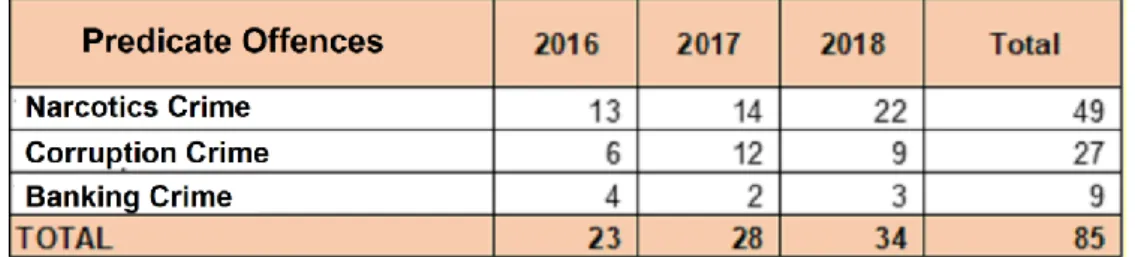
The number of decisions on money laundering offenses related to drug offenses in the period 2016 to 2018 increased, while the number of decisions on banking crime increased in the period 2017 to 2018. The number of decisions on money laundering based on 3 (three) previous of criminal offenses in the period Period 2016 to 2018. Number of verdicts on criminal offenses of money laundering issued by courts in the context of 6 (six) previous criminal offenses in the period 2016 to 2018.
The Narcotics SRA 2017 has identified types of narcotics that pose a high risk of money laundering, namely methamphetamine, heroin and cocaine. The 2017 SRA on Corruption has identified types of corruption crimes that carry a high risk of money laundering crimes, namely in the form of state financial losses, bribery and gratuities. Number of cases of corruption crimes in the period 2017 to 2018, classified by type 4.1.3 Banking crime.
Forms of banking crime in the period 2016 to 2018 based on court rulings on money laundering crimes.
Mitigation Measures by INTRAC
INTRAC, together with all stakeholders, has developed guidelines for reporting parties regarding the Principles of Recognizing Service Users (PMPJ) of Customer Due Diligence (CDD). The provisions of the Principle of Recognizing Service Users (PMPJ) or CDD require all reporting parties to carry out a risk assessment of money laundering crimes (risk-based approach) for entities and their service users. Legislation regarding the obligation to implement the Principles of Recognizing Service Users (PMPJ), namely Article 18 of Law No.
7 of 2017 on the implementation of the principle of recognition of service users for other providers of goods and/or services. 11 of 2017 on the implementation of the principles of recognition of users of scribe services. 55 /PMK.01/2017 on the principles of recognition of service users (PMPJ) for accountants and public accountants, as amended by the regulation of the Minister of Finance no. 155 / PMK.
Regulation from the Minister for Cooperatives and SMEs No. 06/Per/M.KUKM/V/ 2017 regarding the implementation of the principles for recognition of service users for cooperatives that operate savings and loan businesses.
Case Study
Transfer an amount of IDR to a bank account in the name of FRK (in connection with drug transactions). Transfer an amount of IDR to a bank account in the name of TH (repeat drug-laundering offenders). Transfer an amount of IDR to a bank account in ANS (Repeat Drug Laundering Offenders).
Transfer an amount of IDR to a bank account in the name of RSL (a frequent perpetrator of drug laundering crimes). Received transfer from a bank account in the name of HSN (account controlled HYT/convicted person in narcotics cases) for an amount of IDR. Received transfer from a bank account in the name of ANS (former prisoner of a money laundering crime) of an amount of IDR.
Transfer an amount of IDR to a bank account in the name of SUD (account controlled by MDY, a drug crime offender). Transfer an amount of IDR to a bank account in the name of ANS (former prisoner of narcotic money laundering offences). Transfer an amount of IDR to a bank account in the name of AY (account related to drug trafficking syndicate).
Conclusions and Recommendations
Conclusions
Drug crime involving the abuse of methamphetamine and ecstasy are the most common forms of drug crime. Corruption crimes in the form of bribery and corruption in the procurement of goods/services/state funding are the most common types of corruption crimes. Based on the courts' rulings on money laundering on banking crimes, the most common method found in this sector is illegal banking, then followed by fictitious loans, forgery of bank card books, theft of customer funds in their savings accounts and embezzlement of customer funds.
Recommendations
Strengthening national coordination and synergy between law enforcement, regulatory authorities and all stakeholders in combating money laundering, as well as international cooperation to strengthen the prevention and eradication of money laundering. Improving capacity and capability of law enforcement authorities, including asset tracing and asset recovery.
Attachments
In the process of identifying threat factors for money laundering crimes in the period from 2015 to 2018, the NRA team of Indonesia collected data/information from various stakeholders of the Anti-Money Laundering and Counter-Terrorism Financing Regime. FGD on PESTEL of analysis of money laundering crimes in Indonesia and FGD of finalizing the draft of NRA update report. Law enforcement behavior with multidoor approach, in this case imposing a combination of laws to eradicate money laundering crimes.
Issuance of Anti-Money Laundering and Anti-Terrorist Financing Guidelines for fintech. Analysis of the risk of money laundering and financing of terrorism in the non-bank foreign exchange business sector (BUY BB) and remittance operator. White Papers Update Indonesia's Risk Mapping Vulnerabilities Against Money Laundering Crimes in the Tax Sector.
Sectoral risk assessment of savings and loan cooperatives against money laundering crimes and countering the financing of terrorism.

