The word Capital refers to be the total investment of a company of firm in money, tangible and intangible assets. Whereas budgeting defined by the “Rowland and William” it may be said to be the art of building budgets. Budgets are a blue print of a plan and action expressed in quantities and manners.
The examples of capital expenditure:
1. Purchase of fixed assets such as land and building, plant and machinery, good will, etc.
2. The expenditure relating to addition, expansion, improvement and alteration to the fixed assets.
3. The replacement of fixed assets.
4. Research and development project.
Definitions
According to the definition of Charles T. Hrongreen, “capital budgeting is a long-term planning for making and financing proposed capital out lays.
According to the definition of G.C. Philippatos, “capital budgeting is concerned with the allocation of the firms source financial resources among the available opportunities.
The consideration of investment opportunities involves the comparison of the expected future streams of earnings from a project with the immediate and subsequent streams of earning from a project, with the immediate and subsequent streams of expenditure”.
According to the definition of Richard and Green law, “capital budgeting is acquiring inputs with long-term return”.
According to the definition of Lyrich, “capital budgeting consists in planning development of available capital for the purpose of maximizing the long-term profitability of the concern”.
It is clearly explained in the above definitions that a firm’s scarce financial resources are utilizing the available opportunities. The overall objectives of the company from is to maximize the profits and minimize the expenditure of cost.
Need and Importance of Capital Budgeting
1. Huge investments: Capital budgeting requires huge investments of funds, but the available funds are limited, therefore the firm before investing projects, plan are control its capital expenditure.
2. Long-term: Capital expenditure is long-term in nature or permanent in nature.
Therefore financial risks involved in the investment decision are more. If higher risks are involved, it needs careful planning of capital budgeting.
3. Irreversible: The capital investment decisions are irreversible, are not changed back. Once the decision is taken for purchasing a permanent asset, it is very difficult to dispose off those assets without involving huge losses.
4. Long-term effect: Capital budgeting not only reduces the cost but also increases the revenue in long-term and will bring significant changes in the profit of the company by avoiding over or more investment or under investment. Over investments leads to be unable to utilize assets or over utilization of fixed assets.
Therefore before making the investment, it is required carefully planning and analysis of the project thoroughly.
CAPITAL BUDGETING PROCESS
Capital budgeting is a difficult process to the investment of available funds. The benefit will attained only in the near future but, the future is uncertain. However, the following steps followed for capital budgeting, then the process may be easier are.
Identification of Various Investments
Evaluation of Proposals Fixing Property
Final Approval Implementation
Identification of Various Investment Proposals
Feedback
Steps
Screening or Matching the Available Resources
Fig. 9.1 Capital Budgeting Process
1. Identification of various investments proposals: The capital budgeting may have various investment proposals. The proposal for the investment opportunities may be defined from the top management or may be even from the lower rank.
The heads of various department analyse the various investment decisions, and will select proposals submitted to the planning committee of competent authority.
2. Screening or matching the proposals: The planning committee will analyse the various proposals and screenings. The selected proposals are considered with the available resources of the concern. Here resources referred as the financial part of the proposal. This reduces the gap between the resources and the investment cost.
3. Evaluation: After screening, the proposals are evaluated with the help of various methods, such as pay back period proposal, net discovered present value method, accounting rate of return and risk analysis. Each method of evaluation used in detail in the later part of this chapter. The proposals are evaluated by.
(a) Independent proposals
(b) Contingent of dependent proposals (c) Partially exclusive proposals.
Independent proposals are not compared with another proposals and the same may be accepted or rejected. Whereas higher proposals acceptance depends upon the other one or more proposals. For example, the expansion of plant machinery leads to constructing of new building, additional manpower etc. Mutually exclusive projects are those which competed with other proposals and to implement the proposals after considering the risk and return, market demand etc.
4. Fixing property: After the evolution, the planning committee will predict which proposals will give more profit or economic consideration. If the projects or proposals are not suitable for the concern’s financial condition, the projects are rejected without considering other nature of the proposals.
5. Final approval: The planning committee approves the final proposals, with the help of the following:
(a) Profitability
(b) Economic constituents (c) Financial violability (d) Market conditions.
The planning committee prepares the cost estimation and submits to the management.
6. Implementing: The competent autherity spends the money and implements the proposals. While implementing the proposals, assign responsibilities to the proposals, assign responsibilities for completing it, within the time allotted and reduce the cost for this purpose. The network techniques used such as PERT and CPM. It helps the management for monitoring and containing the implementation of the proposals.
7. Performance review of feedback: The final stage of capital budgeting is actual results compared with the standard results. The adverse or unfavourable results identified and removing the various difficulties of the project. This is helpful for the future of the proposals.
KINDS OF CAPITAL BUDGETING DECISIONS
The overall objective of capital budgeting is to maximize the profitability. If a firm concentrates return on investment, this objective can be achieved either by increasing the revenues or reducing the costs. The increasing revenues can be achieved by expansion or the size of operations by adding a new product line. Reducing costs mean representing obsolete return on assets.
METHODS OF CAPITAL BUDGETING OF EVALUATION
By matching the available resources and projects it can be invested. The funds available are always living funds. There are many considerations taken for investment decision process such as environment and economic conditions.
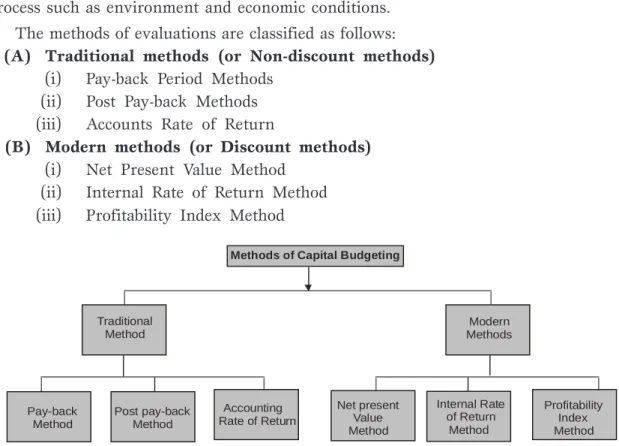
The methods of evaluations are classified as follows:
(A) Traditional methods (or Non-discount methods) (i) Pay-back Period Methods
(ii) Post Pay-back Methods (iii) Accounts Rate of Return
(B) Modern methods (or Discount methods) (i) Net Present Value Method
(ii) Internal Rate of Return Method (iii) Profitability Index Method
Methods of Capital Budgeting
Traditional Method
Post pay-back Method
Accounting Rate of Return
Net present Value Method
Internal Rate of Return
Method
Profitability Index Method Modern
Methods
Pay-back Method
Fig. 9.2 Capital Budgeting Methods
Pay-back Period
Pay-back period is the time required to recover the initial investment in a project.
(It is one of the non-discounted cash flow methods of capital budgeting).
Pay-back period = Initial investment Annual cash inflows Merits of Pay-back method
The following are the important merits of the pay-back method:
1. It is easy to calculate and simple to understand.
2. Pay-back method provides further improvement over the accounting rate return.
3. Pay-back method reduces the possibility of loss on account of obsolescence.
Demerits
1. It ignores the time value of money.
2. It ignores all cash inflows after the pay-back period.
3. It is one of the misleading evaluations of capital budgeting.
Accept /Reject criteria
If the actual pay-back period is less than the predetermined pay-back period, the project would be accepted. If not, it would be rejected.
Exercise 1
Project cost is Rs. 30,000 and the cash inflows are Rs. 10,000, the life of the project is 5 years. Calculate the pay-back period.
Solution = Rs. 30,000
Rs. 10,000 = 3 Years
The annual cash inflow is calculated by considering the amount of net income on the amount of depreciation project (Asset) before taxation but after taxation. The income precision earned is expressed as a percentage of initial investment, is called unadjusted rate of return. The above problem will be calculated as below:
Unadjusted rate of return = Annual Return
Investment × 100
= Rs. 10,000
× 100 Rs. 30,000
= 33.33%
Exercise 2
A project costs Rs. 20,00,000 and yields annually a profit of Rs. 3,00,000 after depreciation @ 12½% but before tax at 50%. Calculate the pay-back period.
Profit after depreciation 3,00,000
Tax 50% 1,50,000
1,50,000 Add depreciation
20,00,000 12 %12 2,50,000
Cash in flow 4,00,000
Solution
Pay-back period = Investment Cash flow = 20,00,000
4,00,000 = 5 years.
Uneven Cash Inflows
Normally the projects are not having uniform cash inflows. In those cases the pay-back period is calculated, cumulative cash inflows will be calculated and then interpreted.
Exercise 3
Certain projects require an initial cash outflow of Rs. 25,000. The cash inflows for 6 years are Rs. 5,000, Rs. 8,000, Rs. 10,000, Rs. 12,000, Rs. 7,000 and Rs. 3,000.
Solution
Year Cash Inflows (Rs.) Cumulative Cash Inflows (Rs.)
1 5,000 5,000
2 8,000 13,000
3 10,000 23,000
4 12,000 35,000
5 7,000 42,000
6 3,000 45,000
The above calculation shows that in 3 years Rs. 23,000 has been recovered Rs. 2,000, is balance out of cash outflow. In the 4th year the cash inflow is Rs. 12,000. It means the pay-back period is three to four years, calculated as follows
Pay-back period = 3 years+2000/12000×12 months
= 3 years 2 months.
Post Pay-back Profitability Method
One of the major limitations of pay-back period method is that it does not consider the cash inflows earned after pay-back period and if the real profitability of the project cannot be assessed. To improve over this method, it can be made by considering the receivable after the pay-back period. These returns are called post pay-back profits.
Exercise 4
From the following particulars, compute:
1. Payback period.
2. Post pay-back profitability and post pay-back profitability index.
(a) Cash outflow Rs. 1,00,000
Annual cash inflow Rs. 25,000
(After tax before depreciation)
Estimate Life 6 years
(b) Cash outflow Rs. 1,00,000
Annual cash inflow (After tax depreciation)
First five years Rs. 20,000
Next five years Rs. 8,000
Estimated life 10 Years
Salvage value Rs. 16,000
Solution
(a) (i) Pay-back period
= Initial investment Annual cash inflows
= 1,00,000
25,000 = 4 Years (ii) Post pay-back profitability
=Cash inflow (Estimated life – Pay-back period)
=25,000 (6 – 4)
=Rs. 50,000 (iii) Post pay-back profitability index
= 50,000
1,00,000 × 100 = 50%
(b) Cash inflows are equal, therefore pay back period is calculated as follows:
(i)
Year Cash Inflows (Rs.) Cumulative Cash Inflows (Rs.)
1 20,000 20,000
2 20,000 40,000
3 20,000 60,000
4 20,000 80,000
Contd....
5 20,000 1,00,000
6 8,000 1,08,000
7 8,000 1,16,000
8 8,000 1,24,000
9 8,000 1,32,000
10 8,000 1,40,000
(ii) Post pay-back profitability.
= Cash inflow (estimated life – pay-back period)
= 8,000 (10–5)
= 8000×5 = 40,000 (iii) Post pay-back profitability index
= 40,000
1,00,000×100=40%
Accounting Rate of Return or Average Rate of Return
Average rate of return means the average rate of return or profit taken for considering the project evaluation. This method is one of the traditional methods for evaluating the project proposals:
Merits
1. It is easy to calculate and simple to understand.
2. It is based on the accounting information rather than cash inflow.
3. It is not based on the time value of money.
4. It considers the total benefits associated with the project.
Demerits
1. It ignores the time value of money.
2. It ignores the reinvestment potential of a project.
3. Different methods are used for accounting profit. So, it leads to some difficulties in the calculation of the project.
Accept/Reject criteria
If the actual accounting rate of return is more than the predetermined required rate of return, the project would be accepted. If not it would be rejected.
Exercise 5
A company has two alternative proposals. The details are as follows:
Proposal I Proposal II Automatic Machine Ordinary Machine
Cost of the machine Rs. 2,20,000 Rs. 60,000
Estimated life 5½ years 8 years
Estimated sales p.a. Rs. 1,50,000 Rs. 1,50,000
Costs : Material 50,000 50,000
Labour 12,000 60,000
Variable Overheads 24,000 20,000
Compute the profitability of the proposals under the return on investment method.
(M.Com., Madras and Bharathidasan) Solution
Profitability Statement
Automatic Ordinary
Machine Machine
Cost of the machine Rs. 2,20,000 Rs. 60,000
Life of the machine 5½ years 8 years
Rs. Rs.
Estimated Sales (A) 1,50,000 1,50,000
Less : Cost : Material 50,000 50,000
Labour 12,000 60,000
Variable overheads 24,000 20,000 Depreciation (1) 40,000 7,000
Total Cost (B) 1,26,000 1,37,000
Profit (A) – (B) 24,000 12,500
Working:
(1) Depreciation = Cost ÷ Life
Automatic machine = 2,20,000 ÷ 5½ = 40,000 Ordinary machine = 60,000 ÷ 8 = 7,500 Return on investment = Average profit
Original investment × 100
= 24,000
2,20,000 × 100 12,500 60,000 × 100
10.9% 20.8%
Automatic machine is more profitable than the ordinary machine.
Net Present Value
Net present value method is one of the modern methods for evaluating the project proposals.
In this method cash inflows are considered with the time value of the money. Net present value describes as the summation of the present value of cash inflow and present value of cash outflow. Net present value is the difference between the total present value of future cash inflows and the total present value of future cash outflows.
Merits
1. It recognizes the time value of money.
2. It considers the total benefits arising out of the proposal.
3. It is the best method for the selection of mutually exclusive projects.
4. It helps to achieve the maximization of shareholders’ wealth.
Demerits
1. It is difficult to understand and calculate.
2. It needs the discount factors for calculation of present values.
3. It is not suitable for the projects having different effective lives.
Accept/Reject criteria
If the present value of cash inflows is more than the present value of cash outflows, it would be accepted. If not, it would be rejected.
Exercise 6
From the following information, calculate the net present value of the two project and suggest which of the two projects should be accepted a discount rate of the two.
Project X Project Y
Initial Investment Rs. 20,000 Rs. 30,000
Estimated Life 5 years 5 years
Scrap Value Rs. 1,000 Rs. 2,000
The profits before depreciation and after taxation (cash flows) are as follows:
Year 1 Year 2 Year 3 Year 4 Year 5
Rs. Rs. Rs. Rs. Rs.
Project x 5,000 10,000 10,000 3,000 2,000
Project y 20,000 10,000 5,000 3,000 2,000
Note : The following are the present value factors @ 10% p.a.
Year 1 2 3 4 5 6
Factor 0.909 0.826 0.751 0.683 0.621 0.564
(MBA, Madurai-Kamaraj University, May 2005) Solution
Cash Inflows Present Present Value of Net Cash
Value of Rs. Inflow
Year Project X Rs. Project Y Rs. 1 @ 10% Project X Rs. Project Y Rs.
1 5,000 20,000 0.909 4,545 18,180
2 10,000 10,000 0.826 8,260 8,260
3 10,000 5,000 0.751 7,510 3,755
4 3,000 3,000 0.683 2,049 2,049
5 2,000 2,000 0.621 1,242 1,242
Scrap Value 1,000 2,000 0.621 621 1,245
Total present valueInitial 24,227 34,728
investments 20,000 30,000
Net present value 4,227 4,728
Project Y should be selected as net present value of project Y is higher.
Exercise 7
The following are the cash inflows and outflows of a certain project.
Year Outflows Inflows
0 1,75,000 -
1 5,50,000 35,000
2 45,000
3 65,000
4 85,000
5 50,000
The salvage value at the end of 5 years is Rs. 50,000. Taking the cutoff rate as 10%, calculate net present value.
Year 1 2 3 4 5
P.V. 0.909 0.826 0.751 0.683 0.621
Solution
Year Cash Inflows Present Value Present Value
Rs. Factor @ 10% of Cash Inflows
1 35,000 0.909 31,815
2 45,000 0.826 37,170
Contd....
3 65000 0.751 48815
4 85000 0.683 58055
5 50000 0.621 31050
5(Salvage) 50000 0.621 31050
Total present value
of cash inflows 237955
Less : Total present value of outflows
Cash outflow at the beginning 1,75,000 Cash outflow at the end of first
Year 50000×0.909 45,450
Total value of outflows 2,20,450
Net Present Value 17,505
If the cash inflows are not given in that cases the calculation of cash inflows are Net profit after tax+Depreciation. In this type of situation first find out the Net profit after depreciation and deducting the tax and then add the deprecation. It gives the cash inflow.
Exercise 8 From the following information you can learn after tex and depreciation concept.
Initial Outlay Rs. 1,00,000
Estimated life 5 Years
Scrap Value Rs. 10,000
Profit after tax :
End of year 1 Rs. 6,000
2 Rs. 14,000
3 Rs. 24,000
4 16,000
5 Nil
Solution Depreciation has been calculated under straight line method. The cost of capital may be taken at 10%. P.a. is given below.
Year 1 2 3 4 5
PV factor @ 10% 0.909 0.826 0.751 0.683 0.621
Depreciation = Initial cash outflow – scrap value Estimated Life of the project
= 1,00,000 –10,000 5
= 90,000
5 = Rs.18,000
Year Profit after Tax Depreciation Cash Inflow
1 6,000 18,000 24,000
2 14,000 18,000 32,000
3 24,000 18,000 42,000
4 16,000 18,000 34,000
5 Nil 18,000 18,000
Net Present Value
Year Cash Inflow Discount factor @ 10% Present value (Rs.)
1 24,000 0.909 21,816
2 32,000 0.826 26,432
3 42,000 0.751 31,542
4 34,000 0.683 23,222
5 18,000 0.621 11,178
Total present value of cash inflows 1,14,190 Less : Initial cash investment 1,00,000
Net present value 1,41,90
Internal Rate of Return
Internal rate of return is time adjusted technique and covers the disadvantages of the traditional techniques. In other words it is a rate at which discount cash flows to zero.
It is expected by the following ratio:
Cash inflow Investment initial Steps to be followed:
Step1. find out factor
Factor is calculated as follows:
F= Cash outlay (or) initial investment Cash inflow
Step 2. Find out positive net present value Step 3. Find out negative net present value Step 4. Find out formula net present value Formula
IRR =Base factor + Positive net present value Difference in positive and DP Negative net present value
×
Base factor = Positive discount rate DP = Difference in percentage Merits
1. It consider the time value of money.
2. It takes into account the total cash inflow and outflow.
3. It does not use the concept of the required rate of return.
4. It gives the approximate/nearest rate of return.
Demerits
1. It involves complicated computational method.
2. It produces multiple rates which may be confusing for taking decisions.
3. It is assume that all intermediate cash flows are reinvested at the internal rate of return.
Accept/ Reject criteria
If the present value of the sum total of the compounded reinvested cash flows is greater than the present value of the outflows, the proposed project is accepted. If not it would be rejected.
Exercise 9
A company has to select one of the following two projects:
Project A Project B
Cost Rs.22,000 20,000
Cash inflows:
Year 1 12,000 2,000
Year 2 4,000 2,000
Year 3 2,000 4,000
Year 4 10,000 20,000
Using the Internal Rate of Return method suggest which is Preferable.
Solution
F = Cash outlay Cash inflow Project A
Cash Inflow = Total cash inflow No. of years
= 28,000
4 = 7000
= 22000
7000 = 3.14
The factor thus calculated will be located in table II below. This would give the estimated rate of return to be applied discounting the cash for the internal rate of returns. In this of project A the rate comes to 10% while in case of project B it comes to15%.
Project A
Cash Inflows Discounting Factor Present Value
Year Rs. at 10% Rs.
1 12000 0.909 10908
2 4000 0.826 3304
3 2000 0.751 1502
4 10000 0.683 6830
22544
Less: Initial Investment. 22000
Net Present Value 544
The present value at 10% comes to Rs. 22,544. The initial investment is Rs. 22,000.
Interest rate of return may be taken approximately at 10%.
In the case more exactness is required another trial which is slightly higher than 10%(since at this rate the present value is more than initial investment) may be taken.
Taking a rate of 12% the following results would emerge.
Cash Inflows Discounting Factor Present Value
Year Rs. at 12.6% Rs.
1 12,000 0.893 10,716
2 4,000 0.794 3,188
3 2,000 0.712 1,424
4 10,000 0.636 6,380
21,688
Less: Initial Investment Value 22,000
Net Present Value (–)312
IRR=Base factor + Positive net present value Difference in positive and DP Negative net present value
×
Base factor= 10%
DP = 2%
= 10% + 544
544 – (–312)×2%
= 10% +5 4 4 8 5 6 ×2
= 10+1.27
= 11.27%
Project B
Year Cash Inflows Discount Present value
Rs. Factor at 15% Rs.
1 2,000 0.909# 1,818
2 2,000 0.826 1,652
3 4,000 0.751 3,004
4 20,000 0.683 13,660
Total present value 20,134
Less: Initial investment 20,000
Net present value 134
IRR= 10% 134
134–(2676)× 5%
= 10% + 0.24% IRR = 10.24%
Thus, internal rate of return in project ‘A’ is higher as compared to project ‘B’. Therefore project ‘A’ is preferable.
Exercise 10
A project costs Rs. 16,000 and is expected to generate cash inflows of Rs. 4,000 each 5 years. Calculate the Interest Rate of Return.
Solution
F =16,000 4,000 = 4
Facts may lays between 6% to 8%
4.221 for 6%
3.993 for 8%
4000 × 4.21 = 16,840 4000 × 3.99 = 15,960 6% present value 16,840 Less: Investment 16,000 Net present value 840
8% present value 15,960 Less: Investment 16,000 –40 IRR = 6% + 840
840 – (–40)×2%
= 6% +1.91%
= 7.91%.
Excess Present Value Index
Excess present value is calculated on basis of net present value. It gives the results in percentage.
Exercise 11
The initial of an equipment is Rs. 10,000. Cash inflow for 5 years are estimated to be Rs.
3,500 per year. The management is desired minimum rate of excess present value index.
Solution
Present value of Rs. 1 received annually for 5 years can be had form the annuity table.
Present value of 3,500 received annually for 5 years.
Excess present value index =Total present value of cash inflows Total present value of cash outflows
= 11,732
10,000 × 100
= 117,32%
Capital Rationing
In the rationing the company has only limited investment the project are selected according to the profitability. The project has selected the combination of proposal that will yield the greatest portability.
Exercise 12 Let us assume that a firm has only Rs. 20 lakhs to invest and funds cannot be provided. The various proposals along with the cost and profitability index are as follows.
Proposal Pool of the project Profitability Index
1 6,00,000 1.46
2 2,00,000 .098
3 10,00,000 2.31
4 4,00,000 1.32
5 3,00,000 1.25
Solution
In this example all proposals expect number 2 give profitability exceeding one and are profitable investments. The total outlay required to be invested in all other (profitable) project is Rs. 25,00,000(1+2+3+4+5) but total funds available with the firm are Rs. 20 lakhs and hence the firm has to do capital combination of project within a total which has the lowest profitability index along with the profitable proposals cannot be taken.
RISK AND UNCERTAINLY IN CAPITAL BUDGETING
Capital budgeting requires the projection of cash inflow and outflow of the future.
The future in always uncertain, estimate of demand, production, selling price, cost etc., cannot be exact.
For example: The product at any time it become obsolete therefore, the future in unexpected. The following methods for considering the accounting of risk in capital budgeting.
Various evaluation methods are used for risk and uncertainty in capital budgeting are as follows:
(i) Risk-adjusted cut off rate (or method of varying discount rate) (ii) Certainly equivalent method.
(iii) Sensitivity technique.
(iv) Probability technique (v) Standard deviation method.
(vi) Co-efficient of variation method.
(vii) Decision tree analysis.
(i) Risk-adjusted cutoff rate (or Method of varying)
This is one of the simplest method while calculating the risk in capital budgeting increase cut of rate or discount factor by certain percentage an account of risk.
Exercise 13 The Ramakrishna Ltd., in considering the purchase of a new investment.
Two alternative investments are available (X and Y) each costing Rs. 150000. Cash inflows are expected to be as follows:
Cash Inflows
Year Investment X Investment Y
Rs. Rs.
1 60,000 65,000
2 45,000 55,000
3 35,000 40,000
4 30,000 40,000
The company has a target return on capital of 10%. Risk premium rate are 2% and 8% respectively for investment X and Y. Which investment should be preferred?
Solution
The profitability of the two investments can be compared on the basis of net present values cash inflows adjusted for risk premium rates as follows:
Investment X Investment Y
Discount Cash Present Discount Cash Present
Year Factor10% + 2% Inflow Value Factor Inflow Values
= 12% Rs. Rs. 10% + Rs.
8%=18%
1 0.893 60,000 53,580 0.847 85,000 71,995
2 0.797 45,000 35,865 0.718 55,000 39,490
3 0.712 35,000 24,920 0.609 40,000 24,360
4 0.635 30,000 19,050 0.516 40,000 20,640
1,33,415 1,56,485
Investment X
Net present value = 133415 – 150000
= – Rs. 16585 Investment Y
Net present value = 156485 – 150000
= Rs. 6485
As even at a higher discount rate investment Y gives a higher net present value, investment Y should be preferred.
(ii) Certainly equivalent method
It is also another simplest method for calculating risk in capital budgeting info reduceds expected cash inflows by certain amounts it can be employed by multiplying the expected cash inflows by certainly equivalent co-efficient in order the uncertain cash inflow to certain cash inflows.
Exercise 14
There are two projects A and B. Each involves an investment of Rs. 50,000. The expected cash inflows and the certainly co-efficient are as under:
Project A Project B
Year Cash inflows Certainly Cash inflows Certainly
co-efficient Co-efficient
1 35,000 .8 25,000 .9
2 30,000 .7 35,000 .8
3 20,000 .9 20,000 .7
Risk-free cutoff rate is 10%. Suggest which of the two projects. Should be preferred.
Solution
Calculations of cash Inflows with certainly:
Year Project A Project B
Cash Certainly Certain Cash Certainly Certain
Inflow Co-efficient Cash Inflow Co-efficient Cash
Inflow Inflow
1 35,000 .8 28,000 25,000 .9 22,500
2 30,000 .7 21,000 35,000 .8 28,000
3 20,000 .9 18,000 20,000 .7 14,000
Calculation of present values of cash inflows:
Year Project A Project B
Discount Cash Present Cash Present
Factor @ 10% Inflows Values Inflows Value
1 0.909 28,000 25,452 22,500 20,453
2 0.826 21,000 17,346 28,000 23,128
3 0.751 18,000 13,518 14,000 10,514
Total 56,316 54,095
Project A Project B
Net present value = Rs. 56,316 – 50,000 54,095 – 50,000
= Rs. 6,316 Rs. 4,095
As the net present value of project A in more than that of project B. Project A should be preferred:
(iii) Sensitivity technique
When cash inflows are sensitive under different circumstances more than one forecast of the future cash inflows may be made. These inflows may be regarded on ‘Optimistic’, ‘most likely’ and ‘pessimistic’. Further cash inflows may be discounted to find out the net present values under these three different situations.
If the net present values under the three situations differ widely it implies that there is a great risk in the project and the investor’s is decision to accept or reject a project will depend upon his risk bearing activities.
Exercise 15
Mr. Selva is considering two mutually exclusive project ‘X’ and ‘Y’. You are required to advise him about the acceptability of the projects from the following information.
Project X Projects Y
Rs. Rs.
Cost of the investment 1,0,0000 1,00,000
Forecast cash inflows per annum for 5 years
Optimistic 60,000 55,000
Most likely 35,000 30,000
Pessimistic 20,000 20,000
(The cut-off rate may be assumed to be 15%).
Solution
Calculation of net present value of cash inflows at a discount rate of 15%.
(Annuity of Re. 1 for 5 years).
For Project X
Event Annual cash Discount factor Present value Net Present
Inflow Rs. @ 15 % Rs. value Rs.
Optimistic 60,000 3.3522 2,01,132 1,01,132
Most likely 35,000 3.3522 1,17,327 17,327
Pessimistic 20,000 3.3522 67,105 (32,895)
For Project Y
Event Annual cash Discount factor Present value Net Present
Inflow Rs. @ 15 % Rs. value Rs.
Optimistic 55,000 3.3522 1,84,371 84,371
Most likely 30,000 3.3522 1,00,566 566
Pessimistic 20,000 3.3522 67,105 (32,895)
The net present values on calculated above indicate that project Y is more risky as compared to project X. But at the same time during favourable condition, it is more profitable also. The acceptability of the project will depend upon Mr. Selva’s attitude towards risk. If he could afford to take higher risk, project Y may be more profitable.
(iv) Probability technique
Probability technique refers to the each event of future happenings are assigned with relative frequency probability. Probability means the likelihood of future event. The cash inflows of the future years further discounted with the probability.
The higher present value may be accepted.
Exercise 16
Two mutually exclusive investment proposals are being considered. The following information in available.
Project A (Rs.) Project B ( Rs.) Cost 10,000 10,000
Cash inflows Year Rs. Probability Rs. Probability
1 10,000 .2 12,000 .2
2 18,000 .6 16,000 .6
3 8,000 .2 14,000 .2
Assuming cost of capital at (or) advise the selection of the project:
Solution
Calculation of net project values of the two projects.
Project A
Year P.V. Factor Cash Probability Monetary Present
@ 10 % Inflow Value Value Rs.
1 0.909 10,000 .2 2,000 1,818
2 0.826 18,000 .6 10,800 8,921
3 0.751 8,000 .2 1,600 1,202
Total Present value 11,941
Cost of Investment 10,000
Net present value 1,941
Project B
Year P.V. Factor Cash Probability Monetary Present
@ 10 % Inflow Value Value Rs.
1 0.909 12,000 .2 2,400 2,182
2 0.826 14,000 .6 8,400 6,938
3 0.751 14,000 .2 2,800 2,103
Total present value 11,223
Cost of investment 10,000
Net present value 1,223
As net present value of project A is more than that of project B after taking into consideration the probabilities of cash inflows project A is more profitable one.
(v) Standard deviation method
Two Projects have the same cash outflow and their net values are also the same, standard durations of the expected cash inflows of the two Projects may be calculated to measure the comparative and risk of the Projects. The project having a higher standard deviation in said to be more risky as compared to the other.
Exercise 17
From the following information, ascertain which project should be selected on the basis of standard deviation.
Project X Project Y Cash inflow Probability Cash inflow Probability
Rs. Rs.
3,200 .2 32,000 .1
5,500 .3 5,500 .4
7,400 .3 7,400 .4
8,900 .2 8,900 .1
Solution
Project X
Cash inflow Deviation Square Probability Weighted
from Deviations Deviations
Mean (d) d2 (td2)
1 2 3 4 5
3,200 (–) 6,250 9,30,25,000 .2 18,60,500
5,500 (–) 750 56,2,500 .3 1,68,750
7,400 (+) 1,150 13,22,500 .3 3,96,750
8,900 (+) 2,650 70,22,500 .2 14,04,500
n= 1 Σfd2 = 38,30,500
Standard Deviation (6) = Σfd2 n
= 3830500 1
= 1957.2
Project Y
1 2 3 4 5
3,200 (–) 3,050 9,30,25,000 .1 9,30,250
5,500 (–) 750 5,62,500 .4 2,25,000
7,400 (+) 1,150 13,22,500 .4 5,29,000
8,900 (+) 2,650 70,22,500 .1 7,02,250
n= 1 Σfd2 = 3830500
Standard deviation(6) = Σfd2 n
= 2386500 1
= 1544.8
As the standard deviation of project X is more then that of project Y, A is more risky.
(vi) Co-efficient of variation method
Co-efficient of variation is a relative measure of dispersion. It the projects here the same cost but different net present values, relatives measure, i.e., Co-efficient of variation should be risk induced. It can be calculated as:
Co-efficient of variation =Standard deviation
mean × 100
Exercise 18
Using figure of previous example compute co-efficient of variation and suggest which proposal should be accepted:
Solution
For project X= 1957.2 6250 ×100
=31.31%
For project Y = 1544.8
6250 ×100 = 29.52%
As the co-efficient of variation of project ‘X’ in more then that ‘Y’ project X in more risk.
Hence, project Y should be selected.
(vii) Decision tree analysis
In the modern business world, putting the investments are become more complex and taking decisions in the risky situations. So, the decision tree analysis helpful for taking risky and complex decisions, because it consider all the possible event’s and each possible events are assigned with the probability.
Construction of Decision Tree 1. Defined the problem
2. Evaluate the different alternatives 3. Indicating the decision points
4. Assign the probabilities of the monetary values 5. Analysis the alternatives.
Accept/Reject criteria
If the net present values are in positive the project may be accepted otherwise it is rejected.
Exercise 19
Mr. Kumar in considering an investment proposal of Rs.40,000. The expected returns during the left of the investment are as under:
Year I
Event Cash Inflow Probability
(i) 16,000 .3
(ii) 24,000 .5
(iii) 20,000 .2
Year II
Cash inflows in year1 are:
16,000 24,000 20,000
Cash Prob Cash Prob Cash Prob
Inflows Inflows Inflows
(Rs.) (Rs.) (Rs.)
(i) 30,000 .2 40,000 .1 5,000 .2
(ii) 40,000 .6 60,000 .8 8,000 .5
(iii) 50,000 .2 80,000 .1 12,000 .3
using 10% as the cost of capital, advise about the acceptability of the proposal:
Solution
Calculation of net present values of cash inflows
Year Year I Year II Net Present Joint Expected Net
Prob. Prob. Value Prob. Present value
Cash Inflow Cash Inflow of Inflow
2 30,000 (–) 676 .06 (–) 40.56
.3 1,6000 .6 40,000 7,584 .18 1,365.12
.2 50,000 15,844 .06 950.64
Cash outflow .1 20,000 14,856 .04 742.80
Rs.40,000 .5 24,000 .8 60,000 31,376 .10 2,550.40
.1 80,000 47,896 .06 2,394.80
.2 50,000 19,480 .04 779.20
.2 20,000 .5 80,000 44,260 .10 4,426.00
.3 1,20,000 77,300 .06 4,638.00
1.00 27,806.40
As the proposal yields a net present value of +27806.40 at a discount for of 10%
other proposal may be accepted.
MODEL QUESTIONS
1. What is capital budgeting? Explain its needs and importance.
2. What are the stages of capital budgeting process?
3. Explain the various methods of capital budgeting techniques.
4. What is risk and uncertainty?
5. Calculate the payback period from the following information:
Cash outlay Rs. 50,000 and cash inflow Rs. 12,500. (Ans. 4 years) 6. From the following information, calculate the pay-back periods for the 3 projects.
Which liquors Rs. 2,00,000 each? Suggest most profitable project.
Year Project I Project II Project III
1 50,000 60,000 35,000
2 50,000 70,000 45,000
3 50,000 75,000 85,000
4 50,000 45,000 50,000
5 50,000 – 35,000
7. The machine cost Rs. 1,00,000 and has scrap value of Rs. 10,000 after 5 years. The net profits before depreciation and taxes for the five years period are to be projected that Rs. 20,000, Rs. 24,000, Rs. 30,000, Rs. 26,000 and Rs. 22,000. Taxes are 50%. Calculate pay-back period and accounting rate of return.
(Ans. 4 years 3 months and 11.2%) 8. A company has to choose one of the following two actually exclusive machine.
Both the machines have to be depreciated. Calculate NPV.
Cash inflows
Year Machine X Machine Y
0 –20,000 –20,000
1 5,500 6,200
2 6,200 8,800
3 7,800 4,300
4 4,500 3,700
5 3,000 2,000
(Ans. Machine X is recommended)
9. A machine cost Rs. 1,25,000. The cost of capital is 15%. The net cash inflows are as under:
Year Rs.
1 25,000
2 35,000
3 50,000
4 40,000
5 25,000
Calculate internal rate of return and suggest whether the project should be
accepted of cost. (Ans. Reject the machine)
10. Which project will be selected under NPU and IRR?
A B
Cash outflow 2,00,000 3,00,000
Cash inflows at the end of
1 Year 60,000 40,000
2 Year 50,000 50,000
3 Year 50,000 60,000
4 Year 40,000 90,000
5 Year 30,000 1,00,000
Cost of capital is 10%.
(Reject the two projects because less then the cost of capital).
11. SP Limited company is having two projects, requiring a capital outflow of Rs. 3,00,000. The expected annual income after depreciation but before tax is as follows:
Year Rs.
1 9,000
2 80,000
3 70,000
4 60,000
5 50,000
Depreciation may be taken as 20% of original cost and taxation at 50% of net income:
You are required 10 calculated
(a) Pay-back period (b) Net present value
(c) According rate of return (d) Net present value index.
(e) Internal rate of return.
(Ans. 3.5 years, Rs. 25,745, 43.437%, 108.58%, 13.87%)
12. From the following information, select which project is better.
Cash Inflows (Year) I II
0 –20,000 –20,000
1 7,000 8,000
2 7,000 9,000
3 6,000 5,000
Risk less discount rate is 5%. Project I is less risks as compared to project II.
The management consider risk premium rates at 5% and 10% respectively appropriate for discounting the cash inflows.
13. There are two mutually exclusive projects I and II. Each projects requires an investment of Rs. 60,000. The following are the cash inflows and certainly co-efficient are as follows.
Project I Project II
Year Cash inflow Certainty Cash Inflow Certainty
Co-efficient Co-efficient
1 30,000 .7 25,000 .9
2 25,000 .8 25,000 .8
3 25,000 .9 30,000 .7
Risk-free cutoff rate is 10%. Evaluate which project will be considered.
(Ans. Project II is considered) 14. Mr. X is considering two mutually exclusive investment I and II. From the
following details advice Mr. X.
Project I Project II
Cost of investment 75,000 75,000
Annual income for 5 years Optimistic 37,500 41,250
Most likely 26,250 22,500
Pesionistic 15,000 15,000
The cutoff rate is 12%.
(Ans. Project B is preferred)
15. Two mutually exclusive projects are being considered. The following detail is available.
Year Project A Project B
Rs. Profitability Rs. Profitability
1 12,000 - 12,000 -
2 10,000 .2 10,000 .2
3 15,000 .6 20,000 .6
4 25,000 .2 20,000 .2
(Ans. select Project B) 16. Mr. A is considering two mutually exclusive investment projects, from following information select the Project on the basis of standard deviation and co-efficient of variation method.
Cash Project I Project II
Rs. 15,000. Rs. 15,000
Cash inflow Rs. Probabilities Rs. Probabilities
Year
1 3,000 .3 4,000 .1
2 4,000 .2 6,000 .4
3 7,000 .3 7,000 .3
4 6,000 .2 3,000 .2
(Ans. I Rs. 1673 and 33.46%
II Rs. 1581 and 31.62%
Select Project II) 17. Mr. X is considering the project an investment of Rs. 26,000. The expensed
returns during the life if the project of are as follows:
Year I Event Cash inflow Probability
a 12,000 .2
b 14,000 .6
c 9,000 .2
Year II
Cash inflows is year I are.
Rs. 12,000 Rs. 14,000 Rs. 9,000
Cash inflow Probability Cash inflow Probability Cash inflow Probability
1 18,000 .3 22,000 .2 28,000 .4
2 20,000 .4 26,000 .7 32,000 .5
3 20,000 .3 30,000 .1 35,000 .1
Using 10% as the use of capital, advise about the acceptability of the proposal.
(Ans. Accept the project because+Rs. 6657 at 10%)