ISOPOD SYSTEMATCIS AND EVOLUTION
Edited by
BRIAN KENS LEY
Smithsonian Institution, Washington
D. C,
USARICHARD C. BRUSCA
Columbia University, Oracle, Arizona, USA
Kensley, B. 2001. Biogeography of the marine Isopoda of the Indian Ocean, with a check-list of species and records.
Pp. 205-264
In:
B. Kensley and R.C.Brusca (eds.). Isopod Systematics and Evolution. Crustacean Issues 13.Rotterdam/Brookfield: A.A. Balkema. 357 pages.
Biogeography of the marine Isopoda of the Indian Ocean, with a check-list of species and records
BRIAN KENSLEY
Department of invertebrate Zoology, NatiofUlI Museum ofNatural History, Smithsonian Institution, Washington, D.C.,USA
The marine isopod fauna of the Indian Ocean is reviewed in terms of its species diversity and biogeography. For the purposes of the review, the northeastern boundary of the Indian Ocean is defined at Cape Talpot in northern Western Australia and at Rottnest Island/
Perth in southern Western Australia. The history of isopod systematics in the Indian Ocean is reviewed by region, and the great lack of knowledge for Madagascar, parts of Western Australia, the east coast of Africa, and the continental shelf/slope overall, is noted. Previous research on the biogeographical provinces or regions of the Indian Ocean is briefly reviewed. For some groups of organisms, an impression of overall homogeneity for the tropical-subtropical area may prevail. However, close examination dispels the idea of homogeneity, and a number of sub-provinces or regions can be characterized. For a biogeographic review of the Indian Ocean marine isopods, a species list was compiled, which includes as many records for each species as could be found. This list contains ap- proximately 1000 species in 303 genera. About 84% of the species are endemic to the Indian Ocean overall, but only 18% of the genera, a pattern consistent with the geological history especially of theTethys Sea and the evolution of the Indian Ocean. This pattern is also consistent for a benthic-dwelling group which lacks a pelagic stage and whose juve- niles emerge from the brood-pouch as small versions of the adults. More than half the species are known from only a single record. Seven sub-provinces or regions are charac- terized in terms of their isopod fauna: I. Sub-Antarctic Region, 79% of 135 species are endemic; 2. South African Region, 68% of 226 species are endemic; 3. Western Australia Region, 58% of 115 species are endemic; 4. East African Region, 46% of 144 species are endemic; 5. Red Sea Region, 63% of 105 species are endemic; 6. Indian Region, 62% of 268 species are endemic; and 7. Madagascar Region, 63% of 168 species are endemic.
These levels of endemism are higher than those seen for most organisms for which data exist.
The identification of large collections of isopod material from the granitic Seychelles, Aldabra Atoll, scattered collections from several sites in the Indian Ocean in the collec- tions of the National Museum of Natural History, as well as material from Zanzibar Island
and Phuket, Thailand, prompted the compilation of a list of marine isopod species re- corded from the Indian Ocean with an accompanying bibliography. Once the list was compiled, it became obvious that at least a preliminary biogeographic analysis of the ma- rine Isopoda for the entire region was possible and perhaps desirable, given the very few published biogeographical reviews for invertebrate groups from the Indian Ocean. In the interest of brevity, new records, represented by material in the NMNH and ZMUC collec- tions, are marked by an asterisk, but are not further elaborated upon, as no section on Systematics is included here.
The geographic limits of the Indian Ocean on its northern, western and southwestern mar- gins are not in dispute, being the Indian subcontinent, the eastern coast of Africa, and the eastern coast of South Africa to Cape Agulhas respectively. With the southern margin being open to the Antarctic, the Indian Ocean embraces the southern ocean from south of Africa eastwards to south of Australia, and includes the sub-Antarctic islands of Marion and Prince Edward, Crozet, Kerguelen, MacDonald, Shag and Heard, and St. Paul and Amsterdam. The eastern boundaries, however, are less well defined. Where on the Aus- tralian continent the line of demarcation should be drawn, is debatable. Similarly, where the northeastern boundary should be placed in the maze of Indonesian Islands and the northern Australian continent, in uncertain.
The Oceanographic Atlas of the International Indian Ocean Expedition (HOE) (Wyrtki 1971) sets the eastern boundary at I 47°E, the longitude of the South Cape of Tasmania in the south of Australia, and Cape York in the north. This northeastern boundary would en- compass the Timor and Arafura seas, all of the coast of the Northern Territory, and the Gulf of Carpentaria. While for oceanographic purposes, these boundaries may be logical, for biologists amore restricted eastern boundary has been used, given the geographic and zoogeographic complexity of the Indonesian region.
Cohen (1973), in a comprehensive discussion of the zoogeography of the fishes of the Indian Ocean, stated in the caption to his Figure I: 'Cape Talpot about 127°E on the coast of Western Australia is taken asthe demarcation between the eastern Indian ocean and the western Pacific.' Klausewitz (1978:25), also discussing fish biogeography (families Chaetodontidae and Pomacanthidae) in the Indian Ocean, stated: 'The border runs west of the Malayan Peninsula and Sumatra and even west of the Andamans, Nicobars and the se- ries of islands - Simueloe-Nias-Mentawei-Nassau.' In this study, Cape Talpot is taken as the limit of the Indian Ocean in northwestern Australia.
The eastern boundary insouthern Australia isalso problematic. The HOE limits would include much of South Australia, Victoria, and southern Western Australia, all of which form part of a temperate biogeographic region characterized by high endemism, and hav- ing affinities with the rest of Australia, rather than with the subtropical-tropical Indian Ocean. This high endemism is well illustrated in several papers on the isopods of southern Australia (Cohen & Poore 1994, Poore 1987,1994, Poore & Bardsley 1992, Poore & Lew Ton 1988a, 1988b). Wells (1993), basing his conclusions on a broad floral and faunal sur- vey, noted that the area of Rottnest Island and Perth, Western Australia, lies in the overlap region between the southern temperate and northern tropical regions, and that the mari- time fauna is dominated by warm temperate southern Australian species. The Leeuwin
Current, flowing south off Western Australia, carries the larvae of tropical species, some of which eventually settle on the outer continental shelf, but not in-shore where the warm- temperate South Australian species dominate. For this study, the limit of the Indian Ocean is regarded as broadly in the region of Rottnest Island and Perth, Western Australia.
3 illS TORY OF ISOPOD COLLECTION AND RESEARCH IN THE INDIAN OCEAN
Information on the marine isopod fauna of the Indian Ocean is scattered through a host of publications, but there exists no single work that brings together all that is known for the region. There are several isopod works dating from the 19th Century, e.g., Krauss (1843), on southern African isopods, and Beddard (1886), dealing with Challenger Expedition material. The first really substantive works were those of Stebbing (1904a), who contrib- uted a paper on the isopods of the Maldive and Laccadive archipelagoes, in 1905 reported on the isopods of the Gulf of Manaar (India-Sri Lanka), and in 1910a described the iso- pods collected by the Percy Siaden Trust Expedition to the Indian Ocean, carried out in
1905.
Since Stebbing's work, isopods from various parts of the Indian Ocean have received attention. Although Krauss (1843) was the first to report on the isopods of the southern African region, T.R.R. Stebbing and K.H. Barnard described the bulk of the shallow-water fauna, while Kensley (1975a, 1978a, 1984b) documented portions of the deeper shelf fauna on the southeastern coast, an area dominated by the southward-flowing Agulhas Current. Barnard also contributed to the knowledge of the fauna of Madagascar (1960), Mozambique (1926, 1958), and India (1935, 1936).
The East African coast from Mozambique to Somalia has been relatively poorly sam- pled. Holdich & Jones (1973), N.L. Bruce (1981), Jones & Icely (1981), and H.-G. Muller (1989a) have described isopods from this region, while N.L. Bruce & Jones (1978) and Wiigele (1981a, 1981b) contributed short papers on the Red Sea fauna. Madagascar with its extensive coastline is still poorly documented; Roman (1970, 1974, 1979) produced three reports, but much of the coastline remains to be sampled. Bruce (1997b) lists and illustrates 27 species from East Africa and the western Indian Ocean islands.
The northern areas of the Indian Ocean have received some attention: Javed and Ah- med (1987, 1988a, 1988b) have reported on material from Pakistan, Pillai (1954-1967) on India, Muller (199Ia, 1991d, 1991e, 1991f, 1991g, 1991h) on Sri Lanka. Muller (1990a, 1990b, 1991b, 1991 e) also documented isopods from Reunion Island, but for neighboring Mauritius there are still only records of 19 species.
Western Australia too, is still poorly collected. Baker (1908, 1910), Thomson (1946, 1951), Poore (1975, 1980, 1987), Kensley & Poore (\982), and N.L. Bruce (\997) have all added to the knowledge of the area, but the northwestern region especially, is largely unexplored below the intertidal. Jones & Morgan (1993) in a checklist of the fauna and flora of Rottnest Island list 18 species of marine isopods.
The sub-Antarctic islands of the Indian Ocean, often explored as an extension to re- search carried out in the Antarctic, have consequently received some attention: St. Paul and Amsterdam Islands (Brocchi 1875, Kensley 1976, 1989); Crozet Islands (Kens ley 1980b ); Kerguelen Island (VanhOffen 1914, Carvacho 1977, Cleret 1973, Kussakin &
Vasina 1980, 1982a, 1982b); Marion and Prince Edward Islands (Cleret 1971, Branch et al. 1991).
Outside of the Antarctic/sub-Antarctic region, the continental shelf has been sampled in very few areas: on the Indian Ocean coast of South Africa, a series of cruises revealed a largely endemic fauna with occasional links to the sub-Antarctic (Kens ley 1975a, 1978a, 1978b, 1978f, 1984). Aside from South Africa and a few early stations of the Challenger Expedition only five reports of deep-sea isopods could be found: Robinson & Menzies (1961), Gulf of Aden; Muller (1989), Gulf of Aden; Mezhov (1988, 1989), Arabian Sea;
Hobbins & Jones (1993), Red Sea. Thus continental shelf records of isopods have very little bearing on our understanding of the biogeography. Neyman et al. (1973) suggest in some general remarks on the biogeography of benthic invertebrates of the Indian Ocean that up to 50% of the deep sea invertebrates of the northern Indian Ocean are common to the Pacific Ocean, while in the southern Indian Ocean, almost 80% of the benthos are Antarctic forms. Unfortunately, data on specific groups of organisms are not offered to support these views. The present analysis is based almost entirely on shallow-water rec- ords.
Ekman (1967) dealt with the Indian Ocean in the broadest terms, speaking of the major oceanographic expeditions such as the John Murray Expedition of 1933-1934, the Danish expeditions of 1937 and 1938 to the Persian Gulf, and referred fleetingly to the endemic crinoid and decapod crustacean fauna. Briggs (1974: 14) addressed the diversity of the tropical Indo-West Pacific, which he considered to be the most important and diverse ma- rine center worldwide, and noted that while there is a basic homogeneity caused by many wide-ranging species, there are great differences in diversity among the various parts of the region. This basic homogeneity, however, is only apparent in some organisms, such as decapod crustaceans. For groups such as the isopods, a pattern of localized endemism, with very few wide-ranging species, is the norm.
Several individual groups of animals have received some attention from a zoo- geographic point of view. Klausewitz (1972, 1976) recognized eastern and western sub- provinces of the Indo-West Pacific region, with the border between them being a line through the Maldives-Laccadives-Chagos islands, and running south almost to Mauritius.
In 1978, he noted several important points regarding the zoogeography of littoral fishes in the Indian Ocean, including a decrease in the number of species form east to west, and that the turbidity of the water from rivers along the coasts of India acted as a barrier and led to an absence of reefs. He also noted an increase in the number of endemic species in isolated or peripheral areas. He concluded that: I.The Indian Ocean was not a homogene- ous area, 2. The border between the Malaysian and Indian Provinces was along the middle of the main islands of the Indo-Australian Archipelago, and 3. The Madagas- car/Mascarene complex formed a separate sub-province, as did the Red Sea, Gulf of Aden and Persian Gulf.
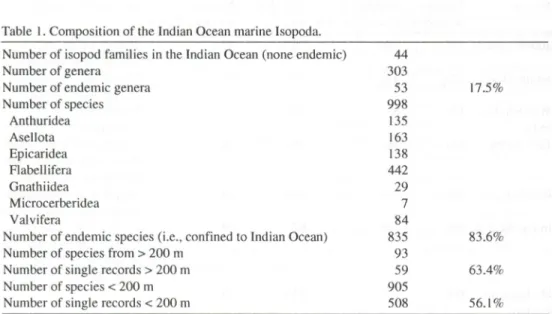
5 MARINE ISOPOD DISTRIBUTION IN RELATION TO THE BIOGEOGRAPHIC PROVINCES OF THE INDIAN OCEAN: DIVERSITY, ENDEMISM, AFFINITIES A breakdown of the approximately 1000 species of marine isopods in the attached list is given in Table I, while abreakdown by biogeographic region is summarized in the Table 2.
From aglobal point of view, the Indian Ocean may be a single basin, but its different parts have different histories, and this isreflected in the differences in their faunal compo- sition.
The present distribution of groups such as the isopods (and probably all of the Peraca- rida) is probably the result of the formation and breakup of the Tethys Sea. The dismem- bering of Pangea in the Mesozoic into Laurasia and Gondwana formed the broad band of the Tethys Sea, which included the current Indo-West Pacific oceanic region. The Tethys was circum-global from the Jurassic. In the Triassic (200-180 m.y.a.) the breakup of Gondwana began, with Africa, India and Antarctica separating; with the Jurassic, the In- dian Ocean opened up even further. By the end of the Cretaceous, Madagascar had sepa- rated, and the Indian plate was moving still further north (see Hocutt 1987). With major cooling and reduction of the area of shallow seas during the Cretaceous and Cenozoic, the wide distribution of reefs was reduced by subduction along plate edges. The earlier spread of species over wide areas was fractured by these geological events, leaving isolated al- lopatric populations tospeciate yet further. During the early Cenozoic, the marine inverte- brate fauna was probably fairly uniform throughout the Tethys Sea (Hocutt 1987), but the northward drift of the Indian plate and its collision with Asia closed the Indo- Mediterranea-Atlantic seaway by the early Miocene. This evolution of the Indian Ocean and the drift of the Indian plate would explain the patterns of isopod endemism of the re- gion today, aswell as the wide distribution of many isopod families and genera.
It isno surprise that the southern cold-water province isvery different from the rest of
the Indian Ocean, nor that both the South African and Australian regions, with their tem-
Table I.Composition of the Indian Ocean marine Isopoda.
Number of isopod families in the Indian Ocean (none endemic) Number ofgenera
Number of endemic genera Number ofspecies
Anthuridea Asellota Epicaridea Flabellifera Gnathiidea Microcerberidea Valvifera
Number of endemic species (i.e., confined to Indian Ocean) Number ofspecies from> 200 m
Number ofsingle records> 200 m Number of species <200 m Number ofsingle records <200 m
44 303 53 998
135 163 138 442 29 7 84 835
93 59 905 508
perate components, should also display major differences. It is in the subtropical-tropical region, which is the major part of the Indian Ocean, with its coral reefs distributed roughly within the 20°C surface water isotherm, that we might expect greater uniformity, or at least some overarching similarities. In fact, we find that the tropical-subtropical Indian Ocean can be divided into several more or less distinct areas or sub-provinces (as was shown by Klausewitz 1972), as reflected in Table 2, and especially in the high numbers of endemic species in the various regions.
5.1 Patterns of endemism
Some scattered information is available on endemism for several groups of animals in the Indian Ocean, which can be used for comparison with the Isopoda.
Coelenterates: Most of the Indian Ocean corals are of Mesozoic Tethys origin (Hocutt 1987), with most families and genera being widespread by the mid-Tertiary, but the west- ern Indian Ocean may constitute a more recent and separate sub-province (Rosen 1971).
Briggs (1974) suggested that 15% of the Red Sea corals are endemic.
Molluscs: Hocutt (1987) suggested that molluscs were distributed pan-tropically throughout the Tethys Sea by the early Tertiary, and that later temperature fluctuations re-
Table 2. Distribution of Indian isopods by zoogeographic area. Sub-Antarctic/Antarctic region: in- cludes Marion and Prince Edward, Crozet, Kerguelen, St.Paul, Amsterdam, Heard, MacDonald, and Shag islands. South African region:from Cape Agulhas to northern Natal.Western Australia:
includes coast of Western Australia north of PerthiRottnest Island, and northwestern shelf to Cape Talpot. East African region: includes coastline from southern Mozambique to Gulf of Aden, and Zanzibar.Red Sea region:includes Red Sea, Gulf of Aden, Persian Gulf, and Gulf of Oman. Indian Region: includes Pakistan, India,Myanmar, Arabian Sea, Bay of Bengal, Sri Lanka, Maldive Is- lands, Lakshadweep Islands (Laccadives),Gulf of Manaar, and Andaman Sea. Madagascan Region:
includes Madagascar,Mauritius, Reunion, Comoros, Seychelles,Aldabra, and Cargados Carajos.
Region Number Number of %endemic Number of Species in common of species endemic species species species> 200 m.
sub-Antarctic 135 106 79% 32 18spp. with S. Africa
10spp. with Australia
South Africa 226 153 68% 32 25 spp. with East Africa
8spp.with Australia
Western Aus- 115 67 58% 3 39 spp. with rest of
tralia. Australia
East Africa 144 66 46% 6 21 spp. with Madagascar
26 sp.with Indian region 12spp. with Red Sea
Red Sea 105 67 63% 14 9spp.with Madagascar
16spp.with Indian region
Indian Region 268 166 62% 4 27spp.with Madagascar
I I spp.with Red Sea 37spp. with eastern
Indo-Pacific
Madagascan 168 106 63% 0
Region
suited in a decline in diversity. Briggs (1974) referred to a high degree of endemism for some mollusc groups along the east African coast, the Arabian Peninsula, and the Red Sea.
Crustaceans: Abele (1982) recognized a 21% endemism among the Indo-West Pacific decapods, and 96% for the Hoplocarida, but this very broad geographic area represents an overlap of several of the biogeographic regions of the Indian Ocean. Kurian (1973) pro- vided no biogeographic information on the relatively few samples of Cumacea available from the Indian Ocean.
Bryozoans: Hayward (1983) found a high degree of endemism (65%) off South Africa in the genus Adeonella, with 25% restricted to the Indo-West Pacific.
Echinoderms: Briggs (1974) estimated a 24% endemism for the western Indian Ocean, 15%for the Red Sea, and 49% for northwestern Australia.
Chaetognaths: Nair &Rao (1973) suggested that 47% of the epiplanktonic species oc- curring in the Arabian Sea were endemic.
Fish: Briggs (1974) estimated a 10-15% endemism for marine fishes in the Red Sea, 36-42% for the Western Indian Ocean, while Hocutt (1987) recognized a 14.3% ende- mism for fishes on the southern African coast.
When these numbers are compared with those for the marine isopods (see Tables 1and 2), we note for the latter relatively higher levels of endemism, ranging from 46-79%, for the various biogeographic regions of the Indian Ocean. For example, the Red Sea region shows a 15% endemism for corals, fishes, and echinoderms, while isopod endemism is a much higher 63%. These high levels of species endemism for the Indian Ocean isopods are in line with a pattern seen elsewhere, especially with regard to coral reef fauna (Ken- sley 1998), namely, widespread families and genera (only 17.5% endemic genera in the Indian Ocean), but high local endemism at the species level (83.6% for the overall Indian Ocean, 46-79% for individual biogeographic regions).
5.2 Widespread species
From the Species List, it can be seen that there are a number of widespread species, whose distribution may, to some degree, be explained by reference to their lifestyle or habitat preference. Thus some species of Limnoriidae and Sphaeroma are wood borers. Their distribution could becomplicated by, or in part explained, by their presence in drifting and floating wood. Some species are either fish parasites (all of the Cymothoidae; see Brusca 1981) or micro-predators of fish (several of the Aegidae; see Brusca 1983). Their distri- bution is closely linked tothe distribution oftheir fish hosts. Insome cases, these fish may have very wide distributions throughout the Indo-West Pacific region. Some isopod spe- cies (Epicaridea) are parasites of other crustaceans, especially of the Decapoda. Their dis- tribution may reflect the distribution of their crustacean hosts, especially if these latter have some capability of dispersal as adults, i.e., by transporting ovigerous females of the parasite. Some species may have been introduced, e.g., Paradella dianae (see Javed &
Ahmed 1987) and Paracerceis sculpta (see Bruce 1986c) by being transported in the fouling organisms of ships, or, aswith Carpias algicola (Morris &Mogelberg 1973, Ken- sley, inpress), transported byrafting in floating algae.
As a basis for a biogeographical discussion, and as a resource for future research on In- dian Ocean isopods, it was felt that a list of all isopod records for the region would be a useful tool, and has thus been attempted.
The list has been constructed in the following way: suborders, families within subor- ders, genera within families, and species within genera are listed alphabetically. For each species, author, date, and type locality are provided. The first geographic record following the author and date, isthe type locality. In a few cases, the type locality is unknown. Ad- ditional records, including non-Indian Ocean records, with depths where available, are listed after the initial entry, along with author and date. New records are indicated with an asterisk (*).Where known, the host for epicaridean parasites is provided. In several cases, Indian Ocean records have been given specific names of European or Mediterranean spe- cies. These cases are indicated by the use of 'non' followed by the original author, to indi- cate a probable misidentification. While the list is primarily of marine species, a few freshwater records of species with obvious marine affinities (e.g., species ofAnnina) have been included.
ORDER ISOPODA
SUBORDER ANTHURIDEA Family Antheluridae
Ananthura elegans (Kussakin, 1967). Kerguelen Is.;McDonald Is.
Anthomuda cracens (Kensley, I980a). Mozambique; Somalia, 42-61 m.
Anthomuda hapla (Kens ley, 1980a). Mauritius; Mozambique, 110 m.
*
Mahe Is., Seychelles, I m.Anthomuda hovea Poore & Lew Ton, 1988a. Western Australia; Great Barrier Reef, in- tertidal. 18 m.Reunion Is., 0.5-1 m (Muller 1990a).
Anthomuda poorei MUller, 1990a. Reunion Is., 0.5-1 m.
*
Anthomuda sp. novoAldabra Atoll, intertidal 25 m.Family Anthuridae
Alloanthura sculpta Kensley, 1980a. Mozambique, 135 m.
Amakusanthura africana (Barnard, 1914b). Saldanha Bay, South Africa, 146 m. Namibia to Jeffreys Bay, South Africa, 11-200 m (Kensley, 1982).
Amakusanthura agonis Poore & Lew Ton, 1988c. Northwestern shelf; Queensland, 5-42 m.
Amakusanthura copperingi (Barnard, I 925a). Northern Territory, Australia, 31 m. NW Shelf, Australia, 40 m (Poore & Lew Ton, 1988c).
*
Amakusanthura cosmoledo sp. novoCosmoledo Is.,Aldabra Atoll, 1-22 m.Amakusanthura dubia Barnard, 1914b. False Bay, South Africa, intertidal. Saldanha Bay to Transkei, South Africa, intertidal-200 m (Kensley 1982).
Amakusanthura hibbertia Poore & Lew Ton, 1988c. Great Barrier Reef, 4 m; NW Shelf, Australia, 52 m.
Amakusanthura moragallae Muller, 1991a.Sri Lanka, intertidal.
Amakusanthura pori (Wage Ie, 1981 b).Red Sea.
Amakusanthura stock; Muller, 1991a.SriLanka.
Apanthura addui WageIe, 1981b. Maldive Is.
Apanthura insignifica Kensley, 1978c. East London to Natal, South Africa, 90-850 m.
Apanthura microps Kensley, 1980a. E Arabian Sea; off Somalia & Mozambique, 42- 95m.
Apanthura motasi Negoescu, 1980. Gulf of Aden.
Apanthura pultenaea Poore & Lew Ton, 1988c. NW Shelf, Australia, 39-82 m; Queen- sland, 11-34 m.
Apanthura sandalensis Stebbing, 1900. Loyalty Is. Travancore, India (Barnard 1935).
Chilka Lake, India (Chilton 1924). Off Somalia; Mozambique; Mauritius; Sumatra, intertidal 62 m (Kensley 1980a). Madagascar (Roman 1970).
Apanthura stanjeki Wagele, 1981 b. Red Sea, Gulf of Suez.
Apanthura wudu Muller, I 990a. Reunion Is., 0.5-1.5 m.
Apanthura xenocheir Stebbing, 1910a. Egmont Reef, Chagos Archipelago.
Apanthura zeewykae Kensley & Poore, 1982. Houtman Abrolhos Is., Western Australia, 1.3m.
*
Apanthuroides sp. novo A. Aldabra Atoll, intertidal 10m.*
Apanthuroides sp. novoB. Aldabra Atoll, intertidal 6 m;Mahe Is., Seychelles, 8m.Apanthuroidesfoveolata (Kensley 1978c). Off Natal, South Africa, 550-850 m.
Arabanthura enigmatica Kensley & Reid, 1984. Persian Gulf, 1.3-3m.
Caenanthura indica Negoescu, 1980. Gulf of Oman; Djibouti.
Centranthura caeca (Kensley 1975c). Lambert's Bay to Mossel Bay, South Africa, 5- 68 m.
Chelanthura ajuga Poore & Bardsley, 1990. Western Australia; Queensland, Australia, 1.3m.
Cyathura bentotae Muller, 1991 f.Sri Lanka, intertidal 0.5 m.
Cyathura estuaria Barnard, 1914b. Algoa Bay, East London, South Africa, estuarine- intertidal. Langebaan toNatal, South Africa (Kensley 1982).
Cyathura francispori Negoescu, 1981. Suez Canal.
Cyathura indica Barnard, 1925a. Sri Lanka; Singapore; Thailand, 1-26 m. Quilon, Tra- vancore, India (Barnard 1935).
Cyathura milloti Chappuis, Delamare Deboutteville & Paulian, 1956. Reunion Is., inter- stitial.
Cyathura pusilla Stebbing, 1904b. Sri Lanka; Tanzania. Travancore, India (Pillai 1954).
Cyathura rudloei Kensley, 1980a. Mozambique; Madagascar, intertidal-73 m.
Cyathura terryae Muller, I990a. Reunion Is., 0.5-1 m.
Exallanthura sexpes Kensley, 1980a. Off Somalia, 49 m;off Singapore, intertidal.
Expanathura ardea (Poore & Kensley, 1981). Great Barrier Reef, intertidal. Houtman Abrolhos Is., Western Australia, 3-5 m (Kensley & Poore 1982).
Expanathura haddae (Kensley& Poore, 1982). Houtman Abrolhas Is., Western Australia, 1-3 m.
Expanathura macronesia (Kensley , I980a). Madagascar; off Mauritius, intertidal-1.5 m.
*
Aldabra Atoll, intertidal-16 m.*
Mahe Is., Seychelles, intertidal-8 m.*
Comoro Is., 3-5 m.Haliophasma adinae (Negoescu, 1980). Gulf of Oman; Gulf of Aden, 24-110 m.
Haliophasma austroafricana Kensley, 1982. Saldanha Bay to Natal, South Africa, 19- 620m.
Haliophasma beaufortia Poore & Lew Ton, 1988d. Western Australia, NW Shelf, 31- 134m.
Haliophasma blandfordia Poore & Lew Ton, 1988d. Western Australia, NW Shelf, 31- 122 m;Queensland, 6-45 m; Bass Strait, 51-329 m.
Haliophasma darwinia Poore & Lew Ton, 1988d. Queensland; NW Shelf, Australia, 24- 37m.
Haliophasma dillwynia Poore & Lew Ton, 1988d. Western Australia; NW Shelf 122-134 m.
Haliophasma palmatum Wagele, 1981 b.Red Sea, 1m.
Haliophasma poorei Kensley, 1980a. Off Bombay, India, 55 m; off Somalia, 95 m. Sri Lanka, intertidal-0.5 m (Miiller 1991 a).
Haliophasma tricarinata Barnard, 1925a. Agulhas Bank, South Africa, 80 m. Saldanha Bay to East London, South Africa, 48-183 m (Kensley 1982).
*
Heptanthura sp. novoPhuket Is., Thailand, intertidal.lndanthura carinata Pillai &Eapen, 1966. West coast of India, 36 m.
*
Malacanthura sp. novo Persian Gulf, 1.5-7 m.Malacanthura coronicauda (Barnard, 1925a). Saldanha Bay, South Africa, 174 m. Sal- danha Bay to Agulhas Bank, South Africa, 26-174 m(Kensley 1982).
Malacanthura foveolata (Barnard, 1940). Algoa Bay, South Africa, intertidal. Saldanha Bay to Algoa Bay, South Africa, intertidal to 148 m (Kensley 1982).
Malacanthura linguicauda (Barnard, 1920). OffNatal, South Africa, 190 m.
Malacanthura mombasa Kensley, 1980a. Mombasa, Kenya 3.5 m.
Malacanthura pseudocarinata (Barnard, 1940). Algoa Bay, South Africa, intertidal. Sal- danha Bay to Port Elizabeth, intertidal to 4 m (Kensley 1982).
Malacanthura schotteae Kensley, 1982. Still Bay to Transkei, South Africa, 80-775 m.
Malacanthura serenasinus (Kensley, 1975a). Saldanha Bay to Still Bay, 5-125 m.
Malacanthura transkei Kensley, 1982. Transkei, South Africa, 71 0-775 m.
Mesanthura albinotata Thomson, 1951. Western Australia, sublittoral.
Mesanthura bipunctata Thomson, 1951.Western Australia, shallow.
Mesanthura catenula (Stimpson, 1855). False Bay, South Africa. Table Bay to East Lon- don, South Africa, intertidal to 4ill(Kens ley 1982).
Mesanthura dimorpha Kensley, 1982. Natal to Algoa Bay, South Africa, 84~90 m.
Mesanthura gerlachi Wagele, 1981 b.Maldive Is.,0-4 m.
Mesanthura maculata (non Haswell, 1881). Travancore, India (Pillai 1954). Sri Lanka;
New Zealand (Pillai 1966). Madagascar (Roman 1970).
Mesanthura nigra Miiller, 1993. Kenya, 0.5 m.
Mesanthura protei Kensley, 1980a. Madagascar; Mozambique, intertidal-73 m. Houtman Abrolhos Is., Western Australia, 1.3 m (Kensley & Poore 1982). Malaysia; Kenya, in- tertidal-I m(Miiller 1993).
*
Phuket, Thailand, 1m.Mesanthura pulchra non Barnard, 1925a. Madagascar (Roman 1970).
*
Mesanthura sp. novoMahe Is., Seychelles, intertidal-I m.Minyanthura jiringae Miiller, 1990a. Reunion Is., 0.5-1 m.
Panathura amstelodami Kensley, 1976. St. Paul & Amsterdam Is., upper infralittoral to 80 m. Madagascar; Mozambique, 38-62 m (Kensley 1980a). Natal, South Africa to Mozambique, 71 0-775 m (Kensley 1982).
Panathura serricauda (Barnard, 1920). Table Bay, False Bay, South Africa, intertidal.
Vatta Kayal, Alleppey, India (Barnard 1935). St. Paul & Amsterdam Is., upper infrati- dal (Kensley 1976). Liideritz, Namibia to East London, South Africa, intertidal - 90ill
(Kensley 1982).
*
Pendanthura sp. novoA. Aldabra AtolI, 0.5-18 m.*
Pendanthura sp. novo B. Aldabra AtolI, intertidal-5 m.*
Pendanthura sp. novo C. Thailand, 13-18 m.*
Quantanthura sp. novo Phuket Is., Thailand.Quantanthura remipes (Barnard, 1914b). Off Cape Peninsula, South Africa, 312 m. Lam- bert's Bay to Agulhas Bank, South Africa, 78-312 m (Kensley 1982).
Family Hyssuridae
*
Eisothistos sp. novoA. Thailand.*
Eisothistos sp. novo B. Aldabra AtolI, intertidal.Eisothistos anomala (Kensley ,1980a). Madagascar, 1-1.5 m.
Eisothistos antarcticus Vanhoffen, 1914. Antarctic.
Eisothistos bataviae Kensley & Poore, 1982. Houtman Abrolhos Is., Western Australia, 1.3m.
Eisothistos crateris Kensley, 1976. St.Paul Is., upper infratidal.
Eisothistos maledivensis Wagele, 1979. Maldive Is., 35 m.
Eisothistos neoanomalus Shyamasundari, Kumari, Rao & Mary, 1991. Visakhapatnam, India, intertidal.
Eisothistos vermiformis non HaswelI, 1884. Madagascar (Roman 1970).
*
Kupellonura sp.novoAldabra AtolI, intertidal-26 m.*
Neohyssura sp. novoAldabra AtolI, Madagascar, 1-25 m.Neohyssura skolops Kensley, 1978c. East London to Natal, South Africa, 90-850 m.
Xenanthura linearis PilIai, 1954. Kerala, India.
Xenanthura orientalis Barnard, 1935. Southwest coast of India.
Xenanthura sinaica Wagele, 1981 a.Gulf of Aqaba, Red Sea.
Xenanthura ulawa Poore & Lew Ton, 1988b. Northern and western Australia; Queen- sland, 1.5-134 m.
Family Paranthuridae
*
Accalathura sp. novoA. Aldabra AtolI, intertidal.*
Accalathura sp. novo B. Phuket Is., Thailand, 2-7 m.*
Accalathura sp. novoC. Aldabra AtolI, intertidal-I m.Accalathura borradailei (Stebbing, 19IOa). Maldive Is., 42 m. Chilka Lake, India (Chil- ton 1924). Travancore, India (PilIai 1954). Thailand (PilIai 1966). Zanzibar (Monad
1968).
Accalathura indica (Nierstrasz, 1941). Java Sea, 73 m. Natal, South Africa to Mozam- bique, 17-100 m (Kens ley 1982).
Accalathura laevitelson (Kensley, 1975a). Still Bay, South Africa, 30 m.
Accalathura sladeni (Stebbing, 1910a). Cargados Carajos & Saya de Malha, 48-51 m.
Andaman Is.; Cargados Carajos; Mozambique; Somalia; Madagascar; Thailand; Su- matra, intertidal-90 m(Kensley I980a).
Aenigmathura lactanea Thomson, 1951. Western Australia and Victoria, intertidal-24 m.
Bourbonanthura littoralis Muller, 1990a. Reunion Is. 0.5 m.
Califanthura pingouin (Kensley, 1980a). Crozet Is., 155-187 m. Marion & Prince Edward Is. (Branch et al. 1991).
Colanthura anophthalma Kussakin &Vasina, 1982a. Kerguelen Is.,3-15 m.
Colanthura latimana Kussakin &Vasina, 1982a. Kerguelen Is., 268 m.
Colanthura pigmentata Kensley, 1980a. Madagascar, intertidal-1.5 m.
*
Aldabra Atoll, 6- 22m.Colanthura uncinata Kensley, 1978c. Natal to Transkei, South Africa, 150-775 m.
Cruranthura simplicia (Thomson, 1946). Western Australia.
*
Leptanthura sp.novoA.Aldabra Atoll, intertidal-l 5 m.*
Leptanthura sp. novoB. Maile Is., Seychelles, 0.5-12 m.Leptanthura agulhasensis Kensley, 1975a. Saldanha Bay to East London, South Africa, 26-320 m.
Leptanthura laevigata (Stimpson, 1855). False Bay, South Africa. Orange River mouth, South Africa to Mozambique Channel, 42-1360 m (Kensley 1982).
Leptanthura minuta Kensley, 1978c. Off Natal, South Africa, 550-850 m.
Leptanthura natalensis Kensley, 1978c. Off Natal, South Africa, 90-850 m.
Leptanthura thalassae Negoescu, 1980. Gulf of Aden, 24-110 m.
Leptanthura urospinosa Kensley, 1975a. False Bay to Still Bay, South Africa, 5-200 m.
*
Paranthura sp. novo A. Aldabra Atoll, intertidal-8 m.*
Paranthura sp. novo B. Mahe Is., Seychelles, intertidal-6 m.*
Paranthura sp. novo C.Mahe Is., Seychelles, 0.5-5 m.Paranthura antarctica Kussakin, 1967. Crozet Is., Kerguelen Is., Antarctica.
Paranthura deodata Muller, 1990a. Reunion Is., 0.5-1 m.
Paranthura elegans non Menzies, 1951 b. Madagascar (Roman 1970).
Paranthura latipes Barnard, 1955. Mozambique, intertidal. Pakistan (Javed & Yasmeen 1992).
Paranthura neglecta Beddard, 1886. Kerguelen Is., 232 m.
Paranthura plumosa Pillai, 1966. Quilon, India.
Paranthura possessia Kensley, 1980b. Crozet Is., 142-490 m. Marion &Prince Edward Is. (Branch et al. 1991).
Paranthura punctata (Stimpson, 1855). False Bay, South Africa. Orange River mouth to Natal, South Africa, 7-200 m(Kens ley 1982). New Zealand; New South Wales; West- ern Australia; Tasmania; South Australia (Jones & Morgan 1993).
Pseudanthura tenuis Kensley, I978e. Natal to Transkei, South Africa, 560-850 m.
SUBORDER ASELLOT A Family Acanthaspidiidae
Acanthaspidia acanthonotus (Beddard, 1886). Kerguelen Is., 3063-3398 m.
Acanthaspidia natalensis (Kens ley , 1977). Southern Mozambique, 1360 m.
lanthopsis beddardi Kussakin & Vasina, 1982b. Kerguelen Is., 200 m.
lanthopsis certus Kussakin & Vasina, 1982b. Kerguelen Is., 130-305 m.
lanthopsis studeri Kussakin &Vasina, 1982b. Kerguelen Is., 460 m.
Family Dendrotiidae
Acanthomunna spinipes (VanhOffen, 1914). Antarctic, 385 m. Natal, South Africa (Ken- sley 1978a). Crozet Is.(Kens ley 1980b).
Family Desmosomatidae
Desmosoma auritum Carvacho, 1977.Kerguelen Is., 20-102 m.
Disparella longimana (Vanhoffen, 1914). Antarctic, 2735 m. St. Paul & Amsterdam Is., 2200 m (Kensley 1989).
Family Eurycopidae
Eurycope glabra Kensley, 1978a. Natal, South Africa, 680-810 m.
Eurycope sarsii Beddard, 1886. Marion Is., 2514-2926 m.
Munneurycope murrayi (Walker, 1903). North Atlantic, 530-780 m. Bay of Bengal (Bar- nard 1936). Marion Is. (Nierstrasz 1941).
Storthyngura jragilis (Beddard, 1886). Marion Is., 2880 m, southern Indian Ocean; off Ja- pan, 3431 m.
Storthyngura spinosa (Beddard, 1886). Antarctic, 4932 m.
Family Gnathostenetroididae
*
Maresiella sp. novoAldabra Atoll, 15-25 m.Maresiella indica Muller, 1992. Reunion Is., intertidal.
Family Haploniscidae
Antennuloniscus quadratus Menzies &Schultz, 1968. SW Madagascar, 2270 m.
Haploniscus gernekei Kensley, 1978a. Natal, South Africa, 550-680 m.
Family Ilyarachnidae
Echinozone bispinosa Kussakin & Vasina, 1982b. Kerguelen Is., 460 m.
Echinozone quadrispinosa (Beddard, 1886). Kerguelen Is., 229 m. Antarctica; South Georgia, 200-1500 m(Nierstrasz 1941).
Echinozone cf. spicata (Hodgson, 1910). Antarctic. Crozet Is., 36-560 m (Kensley 1980b).
Ilyarachna antarctica VanhOffen, 1914. Antarctic, 3397-3423 m. Crozet Is., 196-217 m;
Kerguelen Is., 305 m (Kussakin & Vasina 1982b).
Ilyarachna crozetensis Kensley, 1980b. Crozet Is., 195-930 m.
Ilyarachna wolffi Kensley, 1977. Off Natal, South Africa, 550 m.
Family Ischnomesidae
Haplomesus zuluensis Kensley, 1984b. Zululand, South Africa, 800-810 m.
lschnomesus glabra Kensley, 1984b. Transkei, South Africa, 1800-1950 m.
Stylomesus natalensis Kensley, 1984b. Natal, South Africa, 690-850 m.
Family Janiridae
Austrofilius arnaudi Kussakin &Vasina, 1980a. Kerguelen Is., 24 m.
Austrofilius furcatus Hodgson, 1910. Antarctic, <40 m. Kerguelen Is., 10 m;South Geor- gia; Falkland Is.,Tierra del Fuego (Nierstrasz 1941).
Caecianiropsis ectiformis (Vanhoffen, 1914). Kerguelen Is. St. Paul & Amsterdam Is., sublittoral (Kensley 1976).
*
Caecijaera horvathi Menzies, 1951 a. California. Hawaii (Cooke 1977). Cuba, 0.5 m (Kensley et al. 1997).*
Phuket Is., Thailand, 10m.*
Carpias sp. novo Mozambique, 32 m.*
Carpias cf. algicola (Miller, 1941). Hawaii. Caribbean; Gulf of Mexico; India (Pires 1982).*
Aldabra Atoll, intertidal-22 m.*
Cornaro Is., 3-5 m.*
Red Sea, 0-8 m.*
Mau-ritius.
Carpias brucei (Monod, 1974). Seychelles, 3.2 m.
Carpias crosslandi (Stebbing, 191Ob). Red Sea. Egmont Is., Chagos Archipelago (Steb- bing 1910a).
Carpias longimanus (Pillai, 1954). Travancore, India. Quilon, India (Pillai 1963a).
Carpias nanus (Stebbing, 1905). Sri Lanka.
Carpias stylodactylus (Nobili, 1906a). Tuamotu Is. Gulf of Suez, Red Sea (Monod 1933).
South Pacific (Nordenstam 1946). Caribbean (Menzies &Glynn 1968).
*
Carpias cf. triton (Pires, 1982). Belize, intertidal.*
Zanzibar, intertidal.Ectias angusta (Barnard, 1920). False Bay, South Africa, intertidal. Amsterdam Is., 25 m (Kensley 1976).
lais pubescens (Dana, 1853). Tierra del Fuego. Sri Lanka (Stebbing 1904b). Travancore, India (Pillai 1954). Kerguelen Is.; Marion Is.; Gough Is.; Tasmania; New Zealand;
Tristan da Cunha; Falkland Is.; Antarctic; Namibia to Natal, South Africa (Barnard 1914b, Kensley I978c).
laniropsis palpalis Barnard, 1914a. Table Bay, False Bay, South Africa, Intertidal. St.
Paul & Amsterdam Is. (Kensley 1976). Swakopmund, Namibia to East London, South Africa, intertidal-40 m (Kens ley 1978d).
lanisera trepidus Kensley, 1976. St.Paul & Amsterdam Is., 30-100 m.
lathrippa capensis (Barnard, 1914a). Table Bay, False Bay, South Africa, intertidal. St.
Paul & Amsterdam Is., upper infralittoral to sublittoral (Kensley 1976). LUderitz, Na- mibia toAlgoa Bay, South Africa, 13-84 m(Kensley 1978d).
lathrippa chilensis (Menzies, 1962a). Southern Chile. Kerguelen Is. (Kussakin & Vasina I980a).
lathrippa longicauda (Chilton, 1884). New Zealand. Tierra del Fuego; Falkland Is.; South Georgia Is.; Kerguelen Is.; South Africa (Kussakin & Vasina 1980a).
lathrippa sarsi (Pfeffer, 1887). South Georgia, 0-700 m. Subantarctic islands; Antarctica (Nordenstam 1933). Kerguelen Is.; South Georgia Is. (Nierstrasz 1941). Crozet Is.,
120-600 m(Kensley 1980b).
Neojaera antarctica (Pfeffer, 1887). South Georgia. Kerguelen Is.; Argentina; Tierra del Fuego; Falkland Is. (Nierstrasz 1941).
Neojaera expansa (Kensley, 1984b). Off Natal, South Africa, 90-850 m.
Neojaera serrata (Barnard, 1914b). Table Bay, South Africa, intertidal. Orange River mouth to Port Elizabeth, South Africa, intertidal-320 m (Kensley 1978d).
Protocharon arenicola Chappuis, Deboutteville &Paulian, 1956. Reunion, interstitial.
Tole extans (Barnard, 1914b). Table Bay, False Bay, South Africa, intertidal. M6we Bay, Namibia toEast London, South Africa, intertidal (Kens ley 1978d).
Family Joeropsididae
*
Joeropsis sp. novo A. Mahe Is., Seychelles, intertidal-3 m.*
Joeropsis sp. novo B. MaM Is.,Seychelles, 0.5 m.*
Joeropsis sp. nov. C. MaM Is., Seychelles, 1-3m.*
Joeropsis sp. novoD.Madagascar, intertidal.*
Joeropsis sp. novoE. Mahe Is., Seychelles, 1-5 m.*
Joeropsis sp. novo F. MaM Is., Seychelles, I m.*
Joeropsis sp. novoG. Aldabra Atoll, 1-6 m.Joeropsis beuroisi Kensley, 1975b. St. Paul & Amsterdam Is.,0.3-80 m.
Joeropsis bourboni MUller, 1991 b. Reunion Is.,0.5-1 m.
Joeropsis ceylonensis Muller, 1991d. Sri Lanka.
Joeropsis curvicornis (Nicolet, 1849). Patagonia. Sri Lanka (Stebbing 1905). Marion Is.;
Falkland Is.; Macquarie Island; Chile; Magellan Straits, Tierra del Fuego (Kensley 1975b). Kerguelen Is. (Kussakin &Vasina 1982b).
Joeropsis faurei Muller, 1991 b. Reunion Is., 0.5-1 m.
*
Joeropsis indicus Muller, 1991d. Sri Lanka, intertidal.*
Mahe Is.,Seychelles, intertidal- 3 m.*
Zanzibar, intertidal.Joeropsis integer Kensley, 1984b. East London, South Africa, 90 m.
Joeropsis intermedius Nordenstam, 1933. Argentina & Tierra del Fuego, 100 m;Falkland Is., 22-150 m. Kerguelen Is. (Kussakin & Vasina 1980a).
Joeropsis letourneuri Muller, 1991 b. Reunion Is., 0.5-1 m.
Joeropsis marionis Beddard, 1886. Marion Is., 252 m. Kerguelen Is. (Carvacho 1977). Off Crozet Is., 180 m (Kensley 1980b).
Joeropsis meteor Muller, 1991c. Off Aden, 76 m.
Joeropsis paulensis Vanhoffen, 1914. St. Paul & Amsterdam Is., sublittoral. Gough Is.
(Kensley 1975b).
Joeropsis sanctipauli Kensley, 1989. St. Paul & Amsterdam Is., 160-165 m.
Joeropsis serrulus Kensley, 1984b. East London, South Africa, 90 m.
Joeropsis waltervadi Kensley, 1975b. Walter's Shoal, SW Indian Ocean, 38-46 m.
Joeropsis wolttl Muller, 1991c. Gulf of Aden, 214-237 m.
Family Katianiridae
Natalianira spinosa Kensley, 1984b. Natal, South Africa, 550-850 m.
Family Macrostylidae
Macrostylis amplinexa Mezhov, 1989. Arabian Sea, 2385-4221 m.
Macrostylis capito Mezhov, 1989. Central Indian Ocean, 2218-4737 m.
Macrostylis carinifera carinifera Mezhov, 1988. Arabian Sea, 3074-4458 m.
Macrostylis carinifera dilatata Mezhov, 1988. Arabian Sea, 2540 m.
Macrostylis porrecta Mezhov, 1988. Off Sumatra, 6433 Ill.
Macrostylis rectangulata Mezhov, 1989. South-central Indian Ocean, 5220 m.
Macrostylis urceolata Mezhov, 1989. Bay of Bengal, 2596 m.
Macrostylis wolffi Mezhov, 1988. Arabian Sea, 2385-3717 m.
Family Microparasellidae
Angliera cosettae Coineau &Rao, 1972. Andaman Is., interstitial.
Angliera gracilis Ganamuthu, 1954. India, interstitial.
Angliera phreaticola phreaticola Chappuis & Delamare Deboutteville, 1952. Mediterra- nean, interstitial. Madagascar; India, interstitial littoral (Coineau 1971).
Angliera xarifae Siewing, 1959. Gulf of Aden, interstitial.
Family Munnidae
Astrurus crucicauda Beddard, 1886. Kerguelen Is., 240 m.
Echinomunna uroventralis Kensley, 1976. St. Paul &Amsterdam Is., sublittoral.
Munna antarctica (Pfeffer, 1887). Antarctic, 2-310 m. Kerguelen Is.; South Georgia
(Nierstrasz 1941).
Munna concavifrons (Barnard, 1920). Table Bay, Durban, South Africa. Saldanha Bay to Durban, South Africa, intertidal (Kensley 1978d).
Munna crozetensis Kussakin &Vasina, 1982b. Crozet Is., 215 m.
Munna dentata Vanhoffen, 1914. Kerguelen Is.
Munna instructa Cleret, 1971. Marion Is.
Munna kerguelensis Kussakin & Vasina, 1982b. Kerguelen Is., 148 m.
Munna maculata Beddard, 1886. Kerguelen Is., 51 m. Falkland Is. (Nierstrasz 1941).
Munna neglecta Monod, 1931a. South Orkney Is. Falkland Is., 22-40 m (Nordenstam 1933). Crozet Is., 142-600 m (Kens ley 1980b). Kerguelen Is. (Kussakin & Vasina 1980a).
Munna paUida Beddard, 1886. Kerguelen Is., 55 m. Falkland Is. (Nierstrasz 1941).
Munna spinifera Robinson & Menzies, 1961. Gulf of Aden, 1201 m.
Munna studeri Hilgendorf, 1893. Kerguelen Is., 0-2 IO m. South Georgia (Nierstrasz 1941).
Uromunna brevicornis (Thomson, 1946). Western Australia, 1 m. South Australia (Poore 1984).
Uromunna nana (Nordenstam, 1933). Falkland Is., 1-16 m. St. Paul & Amsterdam Is., 0.6-120 m (Kens ley 1976).
Uromunna schauinslandi (Sars, 1905). New Zealand. Kerguelen Is.; Chatham Is. (Nier- strasz 1941).
Family Munnopsidae
Acanthocope spinicauda Beddard, 1886. SW Indian Ocean, 3240 m.
Acanthocope pentacornis Muller, 1989a. Gulf of Aden, 1830 m.
Munnopsis mandibularis Wolff, 1962. Off Kenya, 1510 m.
Munnopsoides australis (Beddard, 1885). Marion Is., 2880 m. Antarctica, 400-500 m (Monod 1926b).
Family Paramunnidae
Munnogonium adenensis Muller, 1991c. Gulf of Aden, 228-235 m.
Munnogonium subtilis Kensley, 1976. St.Paul & Amsterdam Is., 50-60 m.
Paramunna dilatata Vanhoffen, 1914. Kerguelen Is.
Paramunna foresti Carvacho, 1977. Kerguelen Is. Crozet Is. (Kensley 1980b).
Paramunna kerguelensis VanhOffen, 1914. Kerguelen Is. Crozet Is. (Kensley 1980b).
Paramunna laevifrons Stebbing, 1910c. Off East London, South Africa, 75 m.
Paramunna rostrata (Hodgson, 1910). Antarctic. Kerguelen Is.; South Georgia, 0-549 m (Nierstrasz 1941).
Family Pleurocopidae
Pleurocope dasyura Walker, 190 I. Mediterranean, 20 m. Sri Lanka (Stebbing 1905).
*
Pleurocope sp. novo Phuket Is.,Thailand, 77 m;Aldabra Atoll, 6-16 m.Family Pleurogoniidae
Coulmannia unicornis Kensley, 1976. St. Paul &Amsterdam Is., 80-100 m.
NeaseUus kerguelensis Beddard, 1885. Kerguelen Is., 240 m.
Notoxenoides acalama Kens1ey, I984b. Off Natal, South Africa, 820 m.
Pleurogonium albidum Beddard, 1886. Kerguelen Is., 240 m.
Family Pseudojaniridae
*
Pseudojanira sp. novo Madagascar, shallow; Mozambique, 42-88 m.; Natal, South Af- rica, 69 m.Pseudojanira investigatoris Poore & Just, 1990. South Australia; Victoria; Western Aus- tralia, 1-60 m.
Pseudojanira stenetrioides Barnard, 1925b. Natal, South Africa. Natal, South Africa to Mozambique, 55-62 m (Kens ley 1978d). Madagascar (Roman 1970).
*
Tangaroa sp. novoRodriques Is., 91 m.Family Santiidae
Halacarsantiajusti Wolff, 1989. Andaman Sea, 8 m.
*
Santia sp. novo A. Somalia, 47-49 m; Aldabra Atoll, 25 m.*
Santia sp. novo B. Aldabra Atoll, 1-26 m; Mahe Is., Seychelles, 1-6 m; Zanzibar, inter- tidal.Santia bicornis (Cleret, 1971). Marion Is.
Santia concavata (Carvacho, 1977). Kerguelen Is.
Santia dimorpha (Menzies, 1962a). Chile. St. Paul & Amsterdam Is., upper infralittoral to 80 m (Kens ley 1976).
Santia hispida (VanhOffen, 1914). St. Paul & Amsterdam Is., upper infratidal to 60 m.
Auckland Is.; Falkland Is.; Antarctica (Nierstrasz 1941).
Santia hofsteni (Nordenstam, 1933). South Georgia, intertidal. St. Paul & Amsterdam Is., 45-100 m (Kensley 1976).
Santia marmorata (Vanh6ffen, 1914). St. Paul Is. Kerguelen Is.; South Georgia Is. (Nier- strasz 1941).
Family Stenetriidae
*
Hansenium sp. novo A. Aldabra Atoll, 21 m.*
Hansenium sp. novoB. Madagascar, 1-1.5 m;Zanzibar, 9 m.*
Hansenium remocarpus sp. novoMahe Is., Seychelles, 2-5 m.Hansenium chiltoni (Stebbing, 1905). Sri Lanka. Amirante Is., Seychelles, 61 m; Gulf of Suez (Monod 1933).
Hansenium dodo (Muller, 199Ig). Reunion Is., intertidal.
*
Hansenium monodi (Nordenstam, 1946). Gulf of Suez.*
Mahe Is., Seychelles, 0.5-6 m.Liocoryphe gertrudae (Muller, 1991 g). Reunion Is., intertidal.
*
Liocoryphe siamense (Hansen, 1905). Thailand.*
Zanzibar, 10m; Phuket Is., Thailand, 3-6 m.*
Mizothenar sp. novo Aldabra Atoll, 12-21 m; Zanzibar, 9-10 m.Protallocoxa abyssale (Wolff, 1962). Tasman Sea, 4510 m; Kermadec Trench, 4540 m.
Natal, South Africa (Kens ley 1978d).
*
Stenetrium sp. novo A. Zanzibar, intertidal-7 m.*
Stenetrium sp. novo B. Comoro Is., 3-5 m; Aldabra Atoll, 0-10 m; Zanzibar, 16-25 m.*
Stenetrium sp. novo C. Zanzibar, 8-25 m.Stenetrium bartholomei Barnard, 1940. Still Bay, Algoa Bay, South Africa, intertidal.
False Bay to Natal, South Africa, intertidal-22 m (Kens ley 1978d).
Stenetrium crassimanus Barnard, 1914a. False Bay, South Africa, intertidal. St. Paul &
Amsterdam Is., sublittoral (Kensley, 1976). False Bay to Natal, South Africa, inter- tidal-l20 m (Kens ley 1978d).
Stenetrium dagama Barnard, 1920. Off Cape Point, South Africa, 348-420 m. Natal, South Africa, 680 m (Kens ley 1978d).
Stenetrium diad Barnard, 1920. False Bay, South Africa, intertidal. False Bay to Port Elizabeth, South Africa, 27-80 m (Kensley 1978d).
Stenetrium esquartum Schultz, 1982. False Bay to East London, South Africa, 6 m.
Stenetrium glauerti Nicholls, 1929. Western Australia, intertidal.
Stenetrium macrochirium Nicholls, 1929. Western Australia.
Stenetrium magnimanum Schultz, 1982. False Bay, South Africa, 52 m.
Stenetrium perestrelloi Kensley, 1984b. East London, South Africa, 90 m.
Stenetrium saldanha Barnard, 1920. Saldanha Bay to Cape Point, South Africa, 229-247 m. St. Paul & Amsterdam Is., 50-90 m (Kensley 1976). Saldanha Bay to Still Bay, South Africa, 50-250 m (Kensley 1978d).
Stenetrium spinirostrum Nicholls, 1929. Western Australia, intertidal.
Stenetrium truncatum Nicholls, 1929. Western Australia, sublittoral.
*
Stenobermuda sp. novoZanzibar, 25 m.Tristenium acutirostrum (Milller, 1991c). Gulf of Aden, 228-235 m.
Tristenium bourboni (Milller, 1991 g). Reunion Is., I m.
SUBORDER EPICARIDEA Family Bopyridae
Allokepon hendersoni (Giard & Bonnier, 1888). Madras, India, on Thalamita callianassa.
Allokepon sinensis (Danforth, 1972). Hong Kong, on Lissocarcinus orbicularis. Phuket, Thailand, onPortunus pelagicus (Markham 1985).
Anathelges mossambica Barnard, 1958. Delagoa Bay, Madagascar, on hermit crab.
Aporobopyrina lamellata Shiino, 1934. Japan, on Petrolisthes coccineus. Madagascar and Pakistan, on Petrolisthes spp. (Bourdon 1983). Karachi, Pakistan, on Petrolisthes ru- fescens (Markham, 1980). Phuket, Thailand, on Petrolisthes lamarckii (Markham
1985).
Aporobopyroides upogebiae Nobili, 1906c. Red Sea, on Upogebia (Calliadne) savignyi.
Aporobopyrus aduliticus Nobili, 1906c. Red Sea, on Petrolisthes rufescens. Gulf of Suez, onPolyonyx sp. (Monod 1933).
Aporobopyrus dollfusi Bourdon, 1980a. Red Sea, on Aliaporcellana suluensis and A. quadrilobata.
Aporobopyrus ryukyuensis Shiino, 1939. Okinawa, Japan, on Petrolisthes hastatus and P. asiaticus. Karachi, Pakistan, onP. boscii (Markham 1980).
Argeia lowisi Chopra, 1923. Andaman Is., onAlpheus sp.
Argeiopsis inhacae Kensley, 1974. Mozambique, onStenopus hispidus.
Asymmetrione asymmetrica Shiino, 1933. Japan, on Clibanarius bimaculatus. Phuket, Thailand, on C. merguiensis (Markham 1985).
Asymmetrione nossibensis Bourdon, 1976b. Madagascar. Host unknown.
Athelges aegypticus Codreanu, Codreanu &Pike, 1965. Red Sea, onDiogenes senex.
Athelges caudalis Barnard, 1955. Mozambique, intertidal, onDiogenes senex.
Bopyrella deformans (Hay), var. indica Chopra, 1923. Pakistan, on Synalpheus huluensis.
India; Gulf of Suez; Malaysia; South China Sea (Monod 1933).
Bopyrella malensis Bourdon, 1980b. Maldive Is., on Synalpheus biunguiculatus.
Bopyrella tanytelson Markham, 1985. Krabi, Thailand, onAlpheus sp.
Bopyrina giardi Bonnier, 1900. Andaman Is., onHippolyte ventricosus (Chopra 1923).
Bopyrina sewelli Chopra, 1930. Nicobar Is., on Chlorotocella gracilis.
Bopyrinella albida Shiino, 1958. Japan, onAthanas kaminatoensis. Phuket, Thailand, on Athanas dimorphus (Markham 1985).
Bopyrinella (?)stricticauda Monod, 1933. Gulf of Suez, onSpongia.
Bopyrione woodmasoni (Chopra, 1923). Andaman Is., on Synalpheus sp.
Bopyrissa Uberorum Markham, 1985. Phuket, Thailand, onCUbanarius merguiensis.
Bopyrus squillarum Latreille var. bimaculatus Chopra, 1923. Ganges Delta, India, on Le- ander styliferus. Near Bombay, India (Chopra 1930).
Dactylokepon catoptri Stebbing, 1910a. Seychelles, 54 m, on Catoptrus nitidus.
Dactylokepon holthuisi Bourdon, 1967. Gulf of Aqaba, onScyllarus lewinsohni.
Dactylokepon richardsonae Stebbing, 1910a. Seychelles, on Trapezia cymodoce. Bang- kok, Thailand, onPortunus tuberculosus (Markham 1991).
Dactylocepon seychellensis (Danforth, 1972). Seychelles Is., on Tetralia glaberrima.
Dicropleon bifidus (Bourdon, 1967). Maldive Is., onPericlimenes inornatus.
Dicropleon processae Markham, 1980. Gulf of Manaar, onProcessa aequimana.
Diplophyrxus alphei Shiino, 1934. Japan, on Alpheus sp. Delagoa Bay, Mozambique, on Alpheus edwardsii (Barnard 1958).
Diplophryxus jordani Richardson, 1904. Japan, on Palaemon serrifer. Una Is., Mergui Archipelago, on Leander serrifer (Chopra 1923). Gulf of Manaar, on Leander tenui- cornis (Chopra 1930).
Diplophryxus kempi Chopra, 1930. Andaman Is., on Gnathophyllumfasciolatum.
Diplophryxus richardsoni Chopra, 1930. Andaman Is.,onPontophi/us lowsii.
Entophilus omnitectus Richardson, 1903. Hawaii, on Munida normanni. Madagascar, on Munida incerta (Bourdon 1976b).
Eophrixus brevicauda (Chopra, 1923). Andaman Is., on Synalpheus sp.
Eophrixus fiUformis (Chopra, 1923). Andaman Is., onAlpheus sp.
Eophrixus nigrocinctus (Chopra, 1923). Andaman Is., on Periclimenes elegans. Nicobar Is., on Periclimenes amymone &Leander tenuicornis (Chopra 1930).
Eophrixus shojii Shiino, 1941. Japan, onAlpheus japonicus. Phuket, Thailand, onAlpheus sp. (Markham 1991).
Epipenaeon elegans Chopra, 1923. Ganges Delta, India, onPenaeus carinatus.
Epipenaeonfissurae Kensley, 1974. Natal, South Africa, onParapenaeusfissurae, 70 m.
Epipenaeon georgei Devi, 1982. India, on Parapenaeopsis sculptilis, P. stylifera, Metape- naeopsis barbata. Bay of Bengal, onParapenaeus longipes (Bourdon 1979). Madagas- car, on Parapenaeus longipes (Bourdon 1979). Indonesia, on Parapenaeus longipes (Markham 1994).
Epipenaeon ingens Nobili, 1906c. Red Sea, on Penaeus sp. Northern Territory, Australia (Monod 1933).
Epipenaeon ovalis Pillai, 1954. Travancore, India, on Parapenaeopsis stylifera.
Epipenaeon qadrii Qasi, 1959. Pakistan, onParapenaeopsis stylifera.
Gigantione moebii Kossmann, 1881. Mauritius, onRupellia impressa.
Gigantione rathbunae Stebbing, 1910a. Chagos Archipelago, onActaea sp.
Gigantione sagamiensis Shiino, 1958. Japan, on Carpi/odes lophopus boninensis. Mo- zambique,42 m,on Paratergatis longimanus (Kens ley 1974).
Grapsicepon messoris (Kossmann, 1880). Red Sea. Red Sea, on Metopograpsus messor (Monod 1933).
Hemiphryxus malindiae (A.J. Bruce, 1974). Kenya, on Coralliocaris superba.
Hypoperphryxus latilamellaris Nierstrasz & Brender
a
Brandis, 1932. Red Sea, on Synal- pheus triunguliculatus.Hypophryxusjilijormis Chopra, 1923. Andaman Is., onAlpheus paracyclone.
Hypophryxus leptochelae Pillai, 1966. Kerala, India onLeptochela aculeocaudata.
Hypophryxus pikei AJ. Bruce, 1968. Zanzibar Is., onlschnopontonia lophos.
lone tubulata Bourdon, 1976b. Madagascar.
Kepon halimi Stebbing, 191Oa. Cargados Carajos, 54 m, onHalimus sp.
Kepon orienta lisMarkham, 1985. Phuket, Thailand, onMetaplax distinctus &M. elegans.
Kepon typus Duvernoy, 1841. Mauritius, onGrapsus strigosus.
Megacepon choprai George, 1946. India, onSesarma tetragonum.
Mesophryxus ventralis (A.J. Bruce, 1973a). Zanzibar, onHarpiliopsis beaupresi.
Metabopyrus irregularis Markham, 1985. Phuket, Thailand, onWolffogebia phuketensis.
Metaphrixus intutus A.J. Bruce, 1965. Zanzibar Is., onPalaemonella vestigialis.
Minicopenaeon apertum (Bourdon, 1979). Madagascar, on Metapenaeopsis andamanen- sis.
Minicopenaeon crosnieri (Bourdon, 1979). Madagascar, on Metapenaeopsis andamanen- sis.
Miophrixus latreutidis Barnard, 1955. Mozambique, intertidal, onLatreutes pygmaeus.
Nikione natalensis Kensley, 1974. Natal, South Africa, 43 m, onNikoides danae.
Orbione digitata Bourdon, 1982a. India, onSolenocera choprai.
Orbione halipori Nierstrasz & Brender
a
Brandis, 1923. Indonesia, on Haliporus sibogae.Japan, on Haliporus sibogae (Shiino 1949). Madagascar, onH. sibogae madagascari- ensis and Hymenopenaeus halli (Bourdon 1979). Philippines, onHaliporoides sibogae (Markham 1994).
Orbione kempi Chopra, 1923. Andaman Is., on Sicyonia bispinosa. India, onMetapenaeus brevicornis and M. lysianassa (Devi 1982). New Caledonia, on Sicyonia truncata (Markham 1994).
Orbione thielemanni Nierstrasz &Brender
a
Brandis, 1931. Gulf of Thailand, onMetape- naeopsis stridulans. Madagascar, on Metapenaeopsis sp. (Bourdon 1979).Orophryxus shiinoi AJ. Bruce, 1972. Zanzibar Is., onPericlimenes grandis.
Parabopyrella angulosa (Bourdon, 1980b). Djibouti, onAlpheus sp.
Parabopyrella delagoae (Bourdon, 1982b). Mozambique, onAlpheus (?)edwardsi.
Parabopyrella hodgarti (Chopra, 1923). Bay of Bengal, on Alpheus crassimanus. Mo- zambique, onAlpheus crassimanus (Barnard 1955). Natal, South Africa, 200 m, on al- pheid shrimp (Kensley 1978d).
Parabopyrella incisa (Bourdon, 1982b). South Africa, onAlpheus sp.
Parabopyrella indica (Chopra, 1923). Pakistan, India, on Synalpheus huluensis.
Parabopyrella nierstraszi (Chopra, 1930). Andaman Is., onHippolysmata vittata.
Parabopyrella saronae (Bourdon & A.J. Bruce, 1979). Kenya, on Saron marmoratus.
Parabopyrella tanyensis (Bourdon, 1979). Madagascar, on Synalpheus neomeris.
Parabopyrella thomsoni (Bonnier, 1900). Andaman Is., onAlpheus sp.
Paracepon nierstrazi Pillai, 1954. Travancore, India.
Paragigantione papillosa Barnard, 1920. Off East London, South Africa, 540 m, on Mu- nida sanctipauli.
Parapagurion calcinicola Shiino, 1933. Japan, on Calcinus elegans. Phuket, Thailand, on Paguristes sp. (Markham 1985).
Parapenaeon coarctatum coarctatum Bourdon, 1981. Madagascar, onMetapenaeopsis sp.
Parapenaeon expansus Bourdon, 1979. Madagascar, onPenaeus teraoi. New Caledonia, on Metapenaeopsis gaillardi; Indonesia, on M. sinica; Seychelles, on M. faouzii;
Madagascar, onM mogiensis consobrina (Markham 1994).
Parapenaeonjaponicum (Thielemann, 1910). Japan, on Penaeus sp. Burma, on Parape- naeopsis sculptilis; Madagascar, onMetapenaeus monoceros (Bourdon 1979). Indone- sia, on Metapenaeopsis sinica; Philippines, onMetapenaeopsis velutinus; Madagascar, onMetapenaeopsis hilarula (Markham 1994).
Parapenaeonella lamellata Bourdon, 1979. Andaman Is., on Metapenaeus monoceros &
M. ensis.
Parapleurocrypta alphei Chopra, 1923. Andaman Is., onSynalpheus sp.
Parapleurocrypta digitata Bourdon, 1976b. Madagascar.
Parathelges weberi Nierstrasz & Brender
a
Brandis, 1923. Andaman Is.Parionina pacifica Nierstrasz & Brender
a
Brandis, 1929. Madagascar, on Allogalathea elegans.Pleurocrypta yatsui (Pearse, 1930). Japan. Persian Gulf & Red Sea, on Pachycheles na- talensis &Petrolisthes boscii (Bourdon 1976a).
Pleurocryptella crassandra Bourdon, 1976b. Madagascar, on Munidopsis cylin- drophthalmus.
Pleurocryptella infecta tuberculata Bourdon, 1976b. Madagascar, onMunida tricarinata.
Portunicepon savignyi (Stebbing, 19IOa). Cargados Carajos, onActaea granulatus.
Probopyrus abhoyai (Chopra, 1923). Ganges Delta, India, onPalaemon sp.
Probopyrus alcocki (Chopra, 1923). India, onPalaemon sp.
Probopyrus bengalensis (Chopra, 1923). Ganges Delta, India, onPalaemon malcomsoni;
Bangkok, onPalaemon concinnus (Chopra 1930).
Probopyrus brachysoma (Chopra, 1923). Ganges Delta, India, onPalaemon mirabilis.
Probopyrus buitendijki (Horst, 1910). Ganges Delta, India, on Palaemon carcinus. Java, on P. carcinus (Chopra 1930). Bangladesh & India, on Macrobrachium rosenbergii;
Bangkok, Thailand, onM. rosenbergii; Papua New Guinea, on M. rosenbergii (Mark- ham 1985).
Probopyrus demani (Weber, 1892). India. Godaveri Delta, India, on Palaemon sp.
(Chopra 1923).
Probopyrus gangeticus Chopra, 1923. Ganges Delta, India, onPalaemon sp.
Probopyrus godaveriensis (Chopra, 1923). Godaveri Delta, India, onPalaemon sp.
Probopyrus pica (Chopra, 1923). India, on Palaemon sp. andLeander potamiscus.
Probopyrus prashadi (Chopra, 1923). Ganges Delta, India, onPalaemon spp.
Procepon horridulum Markham, 1985. Phuket, Thailand, onWolffogebia phuketensis.
Procepon insolitum Shiino, 1937. Japan, on Upogebia major. Phuket, Thailand, on Upo- gebia lincolni (Markham 1985).
Pseudione andamanicae Bourdon, 1976b. Madagascar, onMunida andamanica.
Pseudione crenulata Sars, 1898. Norway. East London toNatal, South Africa, on Galat- hea dispersa and Munida sanctipauli (Kensley 1978d).
Pseudione indica Chopra, 1930. Andaman Is., on Pontophilus plebs. Strait of Makassar, onPlesionika narval (Markham 1980).
Pseudione itsindrae Bourdon, 1976b. Madagascar, onMunidopsis trifida.
Pseudione munidae Barnard, 1920.East London, South Africa, on Munida sanctipauli.
Pseudione minimocrenulata Nierstrasz &Brender
a
Brandis, 1931. Madagascar, on Mu- nida incerta.Pseudostegias dulcilacuum Markham, 1982. Hong Kong, on Diogenes edwardsi. Phuket, Thailand, on Clibanarius merguiensis (Markham 1985).
Pseudostegias setoensis Shiino, 1933. Japan, on Clibanarius bimaculatus. Phuket, Thai- land, on Clibanarius padavensis (Markham 1985).
Rhopalione incerta (Bonnier, 1900). Madagascar. Host unknown.
Rhopalione uromyzon Perez, 1920. Persian Gulf, on Ostracotheres spondyli.
Schizobopyrina andamanica (Chopra, 1923). Andaman Is., onPericlimenes elegans.
Schizobopyrina cochinensis (Chopra, 1923). Cochin, India, onPericlimenes grandis.
Schizobopyrina gracilis (Chopra, 1923). Andaman Is., on Urocaridella gracilis.
Schizobopyrina kossmanni (Chopra, 1923). Andaman Is., onPericlimenes elegans.
Shiinoella gracilipes Bourdon, 1972. Mauritius, on Synalpheus sp.
Stegoalpheon choprai Pillai, 1954. Travancore, India, onAlpheus paludicolla.
Stegoalpheon kempi Chopra, 1923. Andaman Is., onAlpheus sp.
Trapezicepon amicorum Bonnier, 1900. Seychelles, 61 m,onActumnus sp.
Trapezicepon domeciae Danforth, 1972. Maldive Is., onDomecia glabra.
Trapezicepon thalamitae Markham, 1985. Phuket, Thailand, on Thalamita crenata.
Tylokepon bonnieri Stebbing, 1904a. Maldive Is., on Tylocarcinus styx.
Upogebione phuketensis Markham, 1985. Phuket, Thailand, on Wolffogebia phuketensis.
Upogebiophilus rhadames Nobili, 1906c. Djibouti, onUpogebia rhadames.
Family Cryptoniscidae
Cirolanoniscus willeyi Pillai, 1963b. Kerala, India, onCirolana willeyi.
Danalia longicollis (Kossmann, 1880). Red Sea, onChlorodius (Leptodius) exaratus.
Family Dajidae
Dajus afromysidis Pillai, 1963c. Trivandrum, India, onAfromysis macropsis.
Notophryxus lobatus Pillai, 1963c. Trivandrum, India, on Rhopalophthalmus tattersallae.
Prodajus gastrosacci Pillai, 1963c. Trivandrum, India, on Gastrosaccus simulans.
Prodajus ovatus Pillai, 1963c. Trivandrum, India, onGastrosaccus muticus.
Prophryxus globicaudatus A.J. Bruce, 1973b. Kenya, on Coralliocaris graminea.
Family Entoniscidae
Diogenion vermifactus Codreanu, Codreanu & Pike, 1960. Red Sea, onDiogenes senex.
SUBORDER FLABELLIFERA Family Aegidae
Aega antillensis Schioedte & Meinert, 1879. Cuba. West Indies, 298-422 m (Richardson 1905). Natal, South Africa, 200 m (Barnard 1925b). South Australia (Hale 1929). St.
Paul & Amsterdam Is. (Kensley 1976).
Aega chelipous Barnard, 1960. Madagascar, 160 m.
Aega crozetensis Kussakin &Vasina, 1982a. Crozet Is., 280 m.
Aega deshaysiana (H. Milne Edwards, 1840). Mediterranean. Seychelles; Japan; Hawaii;