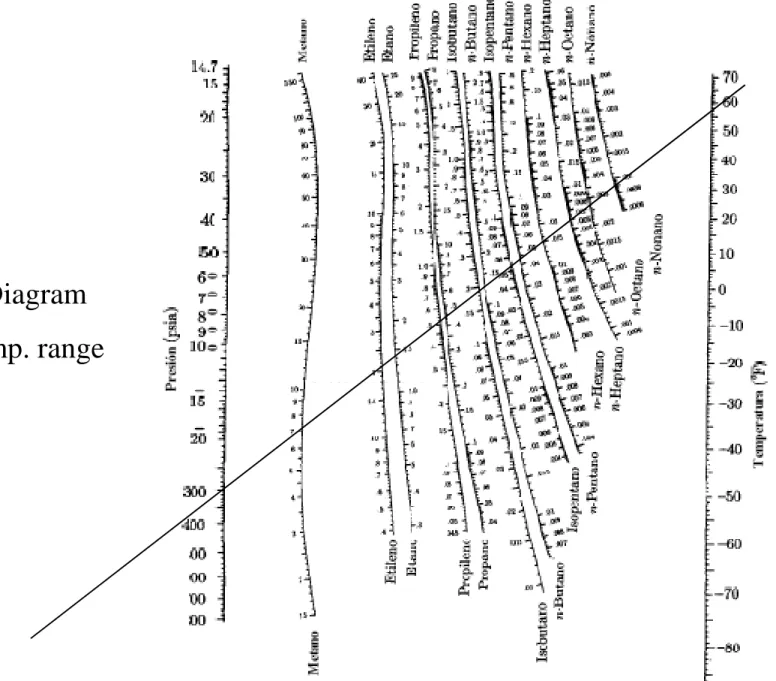
Kesetimbangan Uap/Cair :
Pendahuluan Pendahuluan
Dosen: Bregas S T Sembodo
Kesetimbangan Fase
• Aplikasi
– Distilasi, absorpsi, dan ekstraksi membuat kontak antar fase-fase yg berbeda
• Sejauh mana perubahan dan kecepatan
• Sejauh mana perubahan dan kecepatan
transfer massa antar fase, tergantung pada
keberangkatan sistem dari kesetimbangannya.
• Perhitungan kuantitatif transfer massa; T dan P
saat kesetimbangan; dan komposisi tiap fase
harus diketahui
• Sebuah kondisi statis di mana tidak ada perubahan terjadi dalam sifat-sifat
makroskopik sistem terhadap waktu.
• Pada tingkat mikroskopik, kondisi tidak statis.
Transfer massa molekuler adalah sama pada
Sifat Kesetimbangan
Transfer massa molekuler adalah sama pada
kedua arah, dan secara netto transfer massa antarfase sama dgn nol.
• Sistem terisolasi yg terdiri dari fase cair & uap dalam kontak yg akhirnya mencapai keadaan di mana tdk ada kecenderungan perubahan terjadi di dlm sistem.
Saat itu suhu, tekanan, dan komposisi fase tetap.
Phase rule vs. Duhem’s theorem
• (The number of variables that is independently fixed in a system at equilibrium) = (the number of variables that characterize the intensive state of the system) - (the
number of independent equations connecting the variable):
number of independent equations connecting the variable):
• Phase rule:
• Duhem’s rule:
– for any closed system formed initially from given masses of prescribed chemical species, the equilibrium state is completely determined when any two independent variables are fixed.
– Two ? When phase rule F = 1, at least one of the two variables must be extensive, and when F = 0, both must be extensive.
N N
N
F = 2 + ( −1)(
π
) −(π
−1)( ) = 2−π
+[
( 1)( )] [
( 1)( )]
22+ − + − − + =
= N N N
F
π π π
VLE: qualitative behavior
• When two chemical species:
– phase rule:
– the maximum value of F = 3 ( π = 1), namely, P, T, and one mole fraction. All equilibrium states of the system can be
= 2 N
π
−
= 4 F
mole fraction. All equilibrium states of the system can be
represented in three-dimensional P-T-composition space.
• Within this space, the states of pairs of phases coexisting at equilibrium define surfaces.
– The subcooled-liquid region lies above the upper surface; the superheated-vapor region lies below the under surface.
– UBHC
1and KAC
2represent the vapor pressure-vs.-T curves for pure species 1 and 2.
– C
1and C
2are the critical points of pure species 1 and 2.
– L is a bubble point and the upper surface is the bubblepoint surface.
surface.
– Line VL is an example of a tie line, which connects points representing phases in equilibrium.
– W is a dewpoint and the lower surface is the dewpoint surface.
• Pxy diagram at constant T
• Txy diagram at constant P
• PT diagram at constant composition
• Fig 10.8 (a)(b), Negative
departures from P-x1 linearity:
strong liquid-phase inter-
molecular attractions between unlike than between like pairs of molecules.
• Fig 10.8 (c)(d), Positive
departures from P-x1 linearity:
strong liquid-phase inter-
molecular attractions between like than between unlike pairs like than between unlike pairs of molecules.
• Fig 10.8 (b)(d), the
“azeotrope”: the point where x1 = y1 the dewpoint and
bubblepoint curves are tangent to the same horizontal line.
The liquid does not change in composition as it evaporates.
No separation of such a constant-boiling solution is possible by distillation.
Fig 10.9
(a) tetrahydrofuran(1)/
carbon tetrachloride(2) (b) Chloroform(1)/ /
tetrahydrofuran(2) (c) Furan(1)/ carbon
tetrachloride(2)
(d) Ethanol(1)/ toluene(2)
Fig 10.10
(d) Ethanol(1)/ toluene(2)
(a) tetrahydrofuran(1)/
carbon tetrachloride(2) (b) Chloroform(1)/ /
tetrahydrofuran(2) (c) Furan(1)/ carbon
tetrachloride(2)
(d) Ethanol(1)/ toluene(2) (d) Ethanol(1)/ toluene(2)
Simple models for VLE
• The simplest are Raoult’s law and Henry’s law.
• Raoult’s law:
– the vapor phase is an ideal gas (apply for low to moderate pressure)
moderate pressure)
– the liquid phase is an ideal solution (apply when the species that are chemically similar)
–
• although it provides a realistic description of actual behavior for a small class of systems, it is valid for any species present at a mole fraction approaching unity, provided that the vapor phase is an ideal gas.
) ..., , 2 , 1
(i N
P x P
yi = i isat =
) ..., , 2 , 1
(i N
P x P
yi = i isat =
) ..., , 2 , 1
(i N
P x
P =
∑
i isat ==1
∑
i
yi
For bubblepoint calculation
=1
∑
i
xi
) ..., , 2 , 1 / (
1 i N
P P y
i
sat i i
=
=
∑
For dewpoint calculation )
..., , 2 , 1
(i N
P x P
i
i
i =
=
∑
Binary system
1 2
1
2
( P P ) x
P
P =
sat+
sat−
satFor bubblepoint calculation
Binary system acetonitrile (1)/nitromethane(2) conforms closely to Raoult’s law.
Vapor pressures for the pure species are given by the following Antoine equations:
(a) Prepare a graph showing P vs. x1 and P vs. y1 for a temperature of 75°C.
(b) Prepare a graph showing t vs. x1 and t vs. y1 for a pressure of 70 kPa.
00 . 224 /
47 . 2724 2945
. 14 /
ln 1
− +
= t C
kPa Psat
o / 209.00
64 . 2043 2972
. 14 /
ln 2
− +
= t C
kPa
Psat o
1 2
1
2
( P P ) x
P
P =
sat+
sat−
sat(a) BUBL P
21 .
1sat
= 83
At 75°C
P P
1= 83 . 21 P
2sat= 41 . 98
At 75°C
P
2= 41 . 98
)
198 . 41 21
. 83 ( 98 .
41 x
P = + −
e.g. x1 = 0.6 0.748372 . 66
) 21 . 83 )(
6 . 0
1 (
1
1 = = =
P P y x
sat
72 .
= 66 P
At 75°C, a liquid mixture of 60 mol-% (1) and 40 mol-% (2) is in equilibrium with a vapor containing 74.83 mol-% (1) at pressure of 66.72 kPa.
Subcooled liquid
Superheated vapor
sat sat
sat
P P
P x
1P
2−
= −
(b) BUBL T, having P = 70 kPa
P
1sat sat00 . 224 /
47 . 2724 2945
. 14 /
ln 1
− +
= t C
kPa Psat
o / 209.00
64 . 2043 2972
. 14 /
ln 2
− +
= t C
kPa Psat
o
Select t t vs. x1
sat t vs. y1
sat
sat
P
x P
2 1
1
= −
P
2satSelect t t vs. x1
P P y x
sat 1 1 1 =
t vs. y1
t/o C
Superheated vapor
Subcooled liquid
Henry’s law
• For a species present as a very dilute solute in the liquid phase, the partial pressure of the species in the vapor phase is directly proportional to its liquid-phase mole fraction:
• H = Henry’s Constant
• See table 10.1
i i
iP x H
y =
Assuming that carbonated water contains only CO2 (species 1) and H2O (species 2) , determine the compositions of the vapor and liquid phases in a sealed can of
“soda” and the pressure exerted on the can at 10°C. Henry’s constant for CO2 in water at 10°C is about 990 bar.
Henry’s law for species 1: y1P = x1H1 Raoult’s law for species 2: y2P = x2P2sat
Psat
x H
x
P = 1 1 + 2 2
Assuming x1 = 0.01 Assuming x1 = 0.01
912 . 9 ) 01227 .
0 )(
99 . 0 ( ) 990 )(
01 . 0
( + =
= P
1 1
1P x H
y = assuming y1 = 1.0 01
.
1 = 0 x
Psat
x P
y2 = 2 2 0012
.
2 = 0 y
9988 .
1 = 0
y Justified the assumption Justified the assumption
VLE modified Raoult’s law
• Account is taken of deviation from solution
ideality in the liquid phase by a factor inserted into Raoult’s law:
) ...
, 3 , 2 , 1
(i N
P x P
yiP = xi
γ
iPisat (i =1, 2, 3,...N) yi = iγ
i i =The activity coefficient, f (T, x
i)
=
∑
i
sat i i
i P
x
P
γ
=
∑
i
sat i i
i P
P y
γ
/ 1For the system methanol (1)/methyl acetate (2), the following equations provide a reasonable correlation for the activity coefficients:
2 2 1 (2.771 0.00523 )
lnγ = − T x lnγ2 = (2.771−0.00523T)x12
424 . 33 )
(
31 . 59158 3643
. 16 /
ln 1
− −
= T K
kPa Psat
The Antoine equations provide vapor pressures:
424 . 53 )
(
54 . 25326 2665
. 14 /
ln 2
− −
= T K
kPa Psat
Calculate
(a): P and {yi} for T = 318.15 K and x1 = 0.25 (b): P and {xi} for T = 318.15 K and y1 = 0.60 (c): T and {y } for P = 101.33 kPa and x = 0.85 (c): T and {yi} for P = 101.33 kPa and x1 = 0.85 (d): T and {xi} for P = 101.33 kPa and y1 = 0.40
(e): the azeotropic pressure and the azeotropic composition for T = 318.15 K (a) for T = 318.15, and x1 = 0.25
51 .
1sat = 44
P P2sat = 65.64 γ1 =1.864 γ2 =1.072
50 . 73 )
64 . 65 )(
072 . 1 )(
75 . 0 ( ) 51 . 44 )(
864 . 1 )(
25 . 0
( + =
=
=
∑
i
sat i i
i P
x
P
γ
sat i i i
iP x P
y =
γ
y1 = 0.282 y2 = 0.718(b): for T = 318.15 K and y1 = 0.60
51 .
1sat = 44
P P2sat = 65.64
A iterative process is applied, with γ1 =1
2 =1
γ =
∑
i
sat i i
i P
P y
γ
/ 1Psat
P x y
1 1
1
1 =
γ
x2 =1 x− 1Converges at: P = 62.89 kPa γ1 =1.0378 γ2 = 2.0935 x1 = 0.8169
(c): for P = 101.33 kPa and x1 = 0.85
2 1, γ γ initial
71 .
1sat = 337
T T2sat = 330.08
A iterative process is applied, with
57 . 336 )
15 . 0 ( )
85 . 0
( 1 + 2 =
= Tsat Tsat T
1 =...
γ γ2 =...
1sat =...
P
=
∑
i
sat i i
i P
x
P
γ
424 . 33 )
(
31 . 59158 3643
. 16 /
ln 1
− −
= T K
kPa Psat
Converges at: T = 331.20K γ1 =1.0236 γ2 = 2.1182 y1 = 0.670 y2 = 0.330
initial T
(d): for P = 101.33 kPa and y1 = 0.40
71 .
1sat = 337
T T2sat = 330.08
A iterative process is applied, with
13 . 333 )
60 . 0 ( )
40 . 0
( 1 + 2 =
= Tsat T sat T
1 =1
γ γ2 =1
1sat =...
P
i i i
sat
i T K C
A B kPa
P = − −
) / (
ln
2sat =...
P 31
. 3643
T
initial
=
∑
i
sat i i
i P
x
P γ
Converges at: T = 326.70K γ1 =1.3629 γ2 =1.2523 x1 = 0.4602 x2 = 0.5398
1 =...
x x2 =...
1 =...
γ γ2 =...
1sat =...
P P2sat =...
424 . 33 )
(
31 . 59158 3643
. 16 /
ln 1
− −
= T K
kPa Psat
(e): the azeotropic pressure and the azeotropic composition for T = 318.15 K
Define the relative volatility:
2 2
1 1 12
x y
x y α ≡
Azeotrope y1 = x1 y2 = x2 α12 =1
sat i i i
iP x P
y =
γ
sat sat
P P
2 2
1 1
12 γ
α = γ
052 . ) 2 00523 .
0 771 . 2 exp(
2 1
0
12 x1= = sat sat− =
P
T
α P 0.224
) 00523 .
0 771 . 2
2 exp(
1 1
12 1 =
= −
= P T
P
sat
sat
α x
Since α
12 is a continuous function of x1: from 2.052 to 0.224, α
12 = 1 at some point There exists the azeotrope!
1
2 2
1 1
12 = satsat = P P γ
α γ 1.4747
1 2 2
1azaz = satsat = P
P γ
γ
2 2 1 (2.771 0.00523 )
lnγ = − T x
2 1 2 (2.771 0.00523 )
lnγ = − T x ln 2 (2.771 0.00523 )( 2 1) (2.771 0.00523 )(1 2 1)
1 = − T x − x = − T − x
γ γ
az
az y
x1 = 0.325 = 1 γ1az =1.657
kPa P
Paz = γ1az 1sat = 73.76
VLE from K-value correlations
• A convenient measure, the K-value:
i i
i x
K ≡ y
– the “lightness” of a constituent species, i.e., of its tendency to favor the vapor phase.
– The Raoult’s law:
– The modified Raoult’s law:
P K P
sat i i =
P K P
sat i i i
= γ
Fig 10.13 De Priester Diagram
For Low-Temp. range
Fig 10.13
De Priester’s Diagram for High-Temp. range
Fig 10.14
For a mixture of 10 mol-% methane, 20 mol-% ethane, and 70 mol-% propane at 50°F, determine: (a) the dewpoint pressure, (b) the bubblepoint pressure. The K- values are given by Fig. 10.13.
(a) at its dewpoint, only an insignificant amount of liquid is present:
P = 100 (psia) P = 150 (psia) P = 126 (psia) Species yi Ki yi /Ki Ki yi /Ki Ki yi /Ki Methane 0.10 20.0 0.005 13.2 0.008 16.0 0.006
Ethane 0.20 3.25 0.062 2.25 0.089 2.65 0.075 Propane 0.70 0.92 0.761 0.65 1.077 0.762 0.919 Σ(yi /Ki) = 0.828 Σ(yi /Ki) = 1.174 Σ(yi /Ki) = 1.000 Σ(yi /Ki) = 0.828 Σ(yi /Ki) = 1.174 Σ(yi /Ki) = 1.000
(b) at bubblepoint, the system is almost completely condensed:
P = 380 (psia) P = 400 (psia) P = 385 (psia) Species xi Ki xi Ki Ki xi Ki Ki xi Ki
Methane 0.10 5.60 0.560 5.25 0.525 5.49 0.549 Ethane 0.20 1.11 0.222 1.07 0.214 1.10 0.220 Propane 0.70 0.335 0.235 0.32 0.224 0.33 0.231 Σ(xi Ki) = 1.017 Σ(xi Ki) = 0.963 Σ(xi Ki) = 1.000
Flash calculations
• A liquid at a pressure equal to or greater than its
bubblepoint pressure “flashes” or partially evaporates when the pressure is reduced, producing a two-phase system of vapor and liquid in equilibrium.
system of vapor and liquid in equilibrium.
• Consider a system containing one mole of nonreacting chemical species:
= 1 + V
L z
i= x
iL + y
iV
The moles of liquid
The moles of vapor
The liquid mole fraction
The vapor mole fraction
V y V
x
z
i=
i( 1 − ) +
i) 1 (
1+ −
=
i i i
i V K
K y z
) 1 1 (
1 =
−
∑
+i i i
K V
K z
The system acetone (1)/acetonitrile (2)/nitromethane(3) at 80°C and 110 kPa has the overall composition, z1 = 0.45, z2 = 0.35, z3 = 0.20, Assuming that Raoult’s law is appropriate to this system, determine L, V, {xi}, and {yi}. The vapor pressures of the pure species are given.
Do a BUBL P calculation, with {zi} = {xi} :
kPa P
x P
x P
x
Pbubl = 1 1sat + 2 2sat + 3 3sat = (0.45)(195.75)+(0.35)(97.84)+(0.20)(50.32) =132.40
Do a DEW P calculation, with {zi} = {yi} : P kPa
y P
y P
Pdew y sat sat sat 101.52 /
/ /
1
3 3 2
2 1
1
+ =
= +
mol V
L =1− = 0.2636 P
y P
y P
y1 / 1 + 2 / 2 + 3 / 3
Since Pdew < P = 110 kPa < Pbubl, the system is in the two-phase region,
P K P
sat i
i = K1 =1.7795 K2 = 0.8895 K3 = 0.4575 1
) 1 (
1 =
−
∑
+i i i
K V
K
z V = 0.7364 mol
) 1 (
1+ −
=
i i i
i V K
K y z
5087 .
1 = 0 y
3389 .
2 = 0 y
1524 .
3 =0 y
mol V
L =1− = 0.2636
i i
i x
K ≡ y 2859
.
1 = 0 x
3810 .
2 = 0 x
3331 .
3 = 0 x