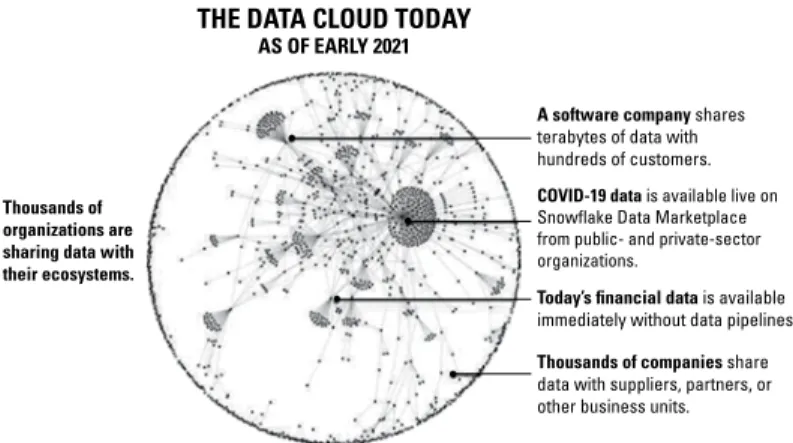
The Data Cloud is a global network where thousands of organizations mobilize data with virtually unlimited scale, concurrency and performance. The Data Cloud enables the discovery, management and sharing of data between business units, suppliers, other business partners and customers. Healthcare providers use the Data Cloud to securely share live health data internally and with partners to deliver high-quality patient outcomes, reduce costs and accelerate time to market.
Case studies on organizations using the Data Cloud to unify, share and mobilize their data.
Sizing Up Challenges and Opportunities
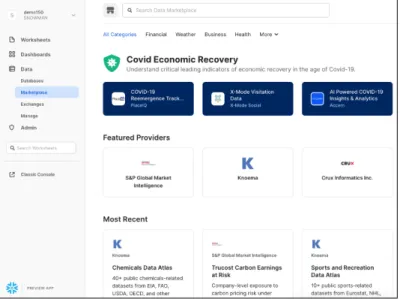
As part of the Data Cloud, your data gains value through connection with other data in the Data Cloud ecosystem. For example, Data Cloud facilitates the process of easily sharing regulated data with partners while leveraging a cohesive set of data services. The Marketplace is a component of the Data Cloud and provides a rich supply of datasets and data services.
The Data Cloud brings the right technology to life, enabling thousands of organizations to mobilize data in the service of their businesses.
Understanding the Value and Capabilities
The data cloud also simplifies the secure sharing of data within your organization and with your external ecosystem of partners, suppliers, customers and other stakeholders. The data cloud allows you to eliminate data silos so that you can manage all the data that matters to your business. Organizations of all sizes and across many industries are centralizing their data in the data cloud to efficiently run a variety of analytical workloads.
In addition, the data cloud supports the controlled sharing of data and services without the need to copy files or create data silos. Similarly, anyone can plug into the data cloud to access, manage and activate their data and connect to the larger data ecosystem, including access to third-party data and data services in the Snowflake Data Marketplace. A data cloud can host both business-generated and machine-generated data in native formats.
However, the real value of the Data Cloud is not just the ease with which your data can be stored, managed and secured. As introduced in Chapter 1, the Data Cloud enables a global network where thousands of organizations can quickly mobilize and share their data. Snowflake's cost-effective usage model ensures that Data Cloud organizations pay only for the capacity they use, in one-second increments.
The data cloud allows you to store all your data while providing fast, controlled and secure access to that data. Furthermore, the Data Cloud complies with regulatory and data privacy policies to ensure the correct handling of sensitive data.
Collaborating in the Data Cloud
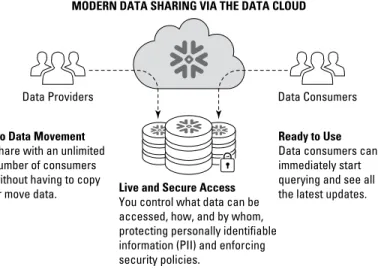
The data cloud uses Snowflake's Secure Data Sharing technology, which replaces these traditional data sharing methods. Instead of archaic, maintenance-intensive, manual software procedures, Secure Data Sharing allows two or more organizations to share and consume live data securely in the cloud by simply setting access permissions. Thanks to the extensive governance and security of the data cloud, data providers can securely share data with partners while maintaining data control within their Snowflake accounts.
Data providers maintain security and control, but may choose to share portions of their data with other members of the Data Cloud. For example, a software company that offers travel management services can use the Data Cloud to share credit card purchases, expense data, and budget information to help customers analyze business travel expenses. Financial services companies can use the Data Cloud to publish data on market trends and exchange rates, allowing stock brokers and investment firms to monitor market movements.
And virtually any company that wants to connect with suppliers, partners, and external business units can use the Data Cloud to collaborate (see Figure 3.2). To further these goals and encourage the expansion of new data capabilities, the Data Cloud includes the Snowflake Data Marketplace, where hundreds of datasets and data services are available from more than 125 commercial providers, including FactSet, Starschema, Weather Source, S&P Global, Wunderman Thompson, Epsilon, Tapad, AccuWeather, Airlines Reporting Corporation (ARC) and many others. Authorized data consumers can securely access the data they are allowed to view.
These customers integrate data with their applications, web portals and statistical packages to make critical decisions. Now, FactSet deploys its datasets once to the Data Cloud, making them immediately available to an almost unlimited number of customers through the Snowflake Data Marketplace.
Deploying the Data Cloud Across Industries
Insurance companies use the Data Cloud to access third-party data sets from partner companies and publicly available data sets on Snowflake Data Marketplace. The Data Cloud gives insurance experts immediate access to this third-party data, facilitating collaboration across the insurer's business ecosystem. The Data Cloud provides secure data management capabilities while supporting both routine administrative reporting and advanced analytics and data science initiatives.
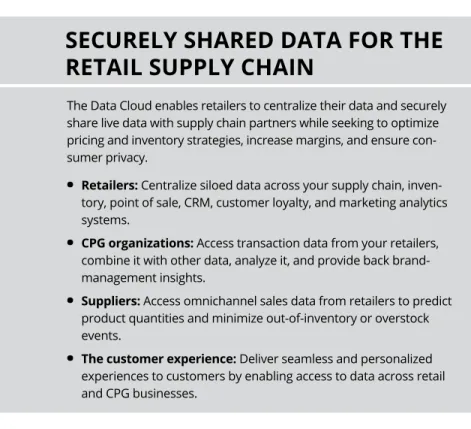
With the Data Cloud, Komodo customers can use frameworks, such as R, and programming languages, such as Python, to directly query these data assets. The Data Cloud allows retailers and CPG companies to easily share POS and other data while building mutually beneficial relationships and forging extensive partner networks. Retailers and CPG companies also rely on the Data Cloud to run their analytics, often using third-party data available in Snowflake Data Marketplace.
The data cloud allows organizations to implement controls that enable compliance with increasingly stringent data governance requirements. Today, Office Depot uses the Data Cloud to unify all the structured and semi-structured data it needs. The data cloud aggregates consumer and subscriber data across platforms and channels along with purchase information.
Media firms use Data Cloud to securely share regulated data across brands, advertisers, ad platforms and enrichment providers. Equally important, the Data Cloud provides secure and controlled access to all citizen data. Public sector organizations can create more effective and cost-effective information systems by placing their data in the Data Cloud and using a growing set of third-party data services in the Snowflake Data Marketplace.
Public sector organizations use Data Cloud to improve collaboration with direct and revocable access to critical data while complying with agency and departmental governance policies.
Drilling into Snowflake’s Platform
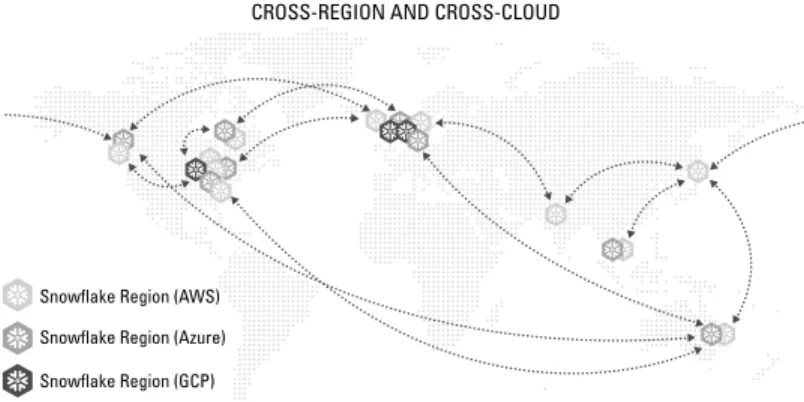
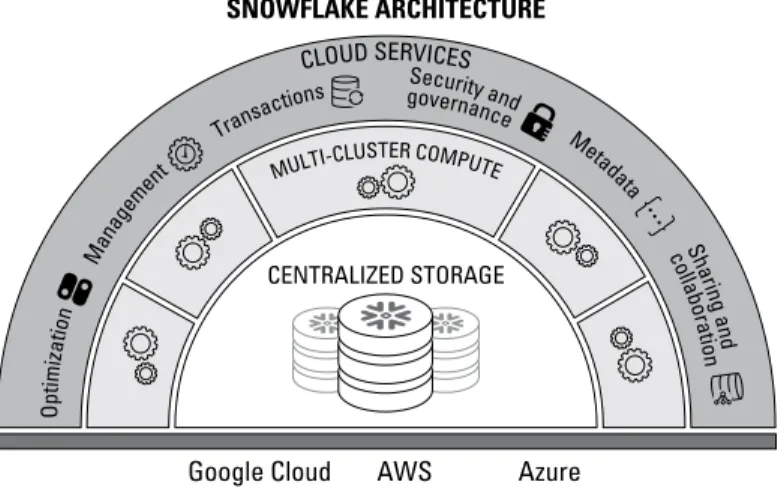
This unique architecture allows many types of users to freely collaborate via data, both within an organization and with business partners, customers, the rapidly growing Snowflake Data Marketplace, and the thousands of organizations that make up the Data Cloud. The Data Cloud spans the major public clouds and many of their regions across four continents (see Figure 5-2). This means Snowflake only scans the subset of data that is relevant to your query.
Your DBAs can focus on deriving value from the data rather than managing the platform. The data cloud allows users to store, manage and query structured and semi-structured data types using standard SQL. Whether you store data in Snowflake or an external storage such as an object store from one of the cloud infrastructure providers, all users have a consistent interface to query, view and manage the data.
By establishing a common repository for many types of data and data workloads, Data Cloud simplifies data management tasks and eliminates silos. Having centralized data reduces the number of stages the data has to move through before users can act on it. Policy-based security controls, such as dynamic data masking and row access policy features, edit values based on the permissions granted to each user querying the data or limit the visibility of data depending on a user's role.
Snowflake Streams and Tasks uploads new data to the Data Cloud within minutes of committing transactions. Placing your data in the Data Cloud simplifies data governance by making it easier for business users to comply with industry- and region-specific data sovereignty requirements while protecting sensitive corporate data and personal information. personally identifiable information (PII).
Running All Your Workloads
Now, customers can store this data within the Data Cloud itself or keep the data in object stores and access it via external tables. They can leverage all the power, security and governance that the Data Cloud provides across their entire dataset. The reason is that the Data Cloud does much more than just store your data.
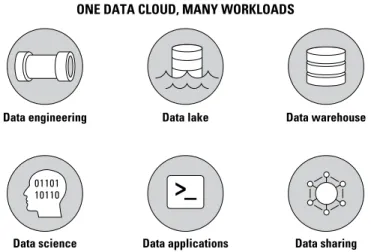
The data cloud also helps data engineers create data pipelines to streamline data ingestion and transformation. Data Cloud also has utilities for connecting event streams via the Snowflake Kafka connector. Data engineers can build sophisticated data ingest pipelines that route multiple flows and tasks, all within the data cloud.
The data cloud simplifies the entire data science life cycle of machine learning, artificial intelligence and predictive application development. The data cloud offers virtually unlimited computing capacity for developing applications and running resource-intensive workloads. Companies with traditional software can use the data cloud to bring their existing applications into the modern age.
The data cloud provides nearly unlimited computing and storage resources for development, iteration, testing and quality assurance (QA) of new data apps. As described in this book, Data Cloud offers unique opportunities for organizations that want to collaborate and share data.
Six Steps to Getting Started with
If you want to refresh that data set as new transactions occur, establish a data pipeline to manage a continuous stream of data. If you plan to load data from existing applications and databases, read Snowflake Data Marketplace for commercial data providers that offer solutions to push data from those silos to the Data Cloud. Decide who is responsible for controlling and securing your data, both for your initial data load and continuously as new data is ingested (see Chapter 2 for more details).
Your organization can expand its global presence in the Data Cloud by easily accessing additional Snowflake regions from your original account. Are you planning to share data only within your organization or also with customers and partners? Identify outdated data sharing methods, such as FTP and email, and figure out how to replace them with Snowflake's Secure Data Sharing technology.
Do you plan to use third-party data and data services from the Snowflake Data Marketplace or monetize your data and data services by offering them to other Snowflake customers. Enrich your data with secure access to query-ready datasets from over 125 third-party data sources.