Reza Adirahman Djojosugito∗
1. Introduction
Project Finance and Asset Securitization are becoming the main vehicles for the development of modern banking sector. The importance of such vehicles cannot be undermined for Islamic banking. The combination of Project Finance and Assets Securitization will serve as a powerful tool for Islamic banking to mobilize funds from the market and to extend financing which is based on the principles of risk mitigation and allocation where return is justified by risk taking. It is without doubt that the creation of conducive environment for Islamic Banking necessitates the development of such vehicles, especially the legal aspects of them as sufficient and sound legal system pertaining to Islamic Project Finance and Asset Securitization will certainly strengthen the operation of Islamic banking.
Having adopted a dual banking system through the promulgation of Law No. 10 year 1998 concerning banking law, Indonesia has a sufficient legal basis for such development in Islamic banking field. However, due to their complex nature, Indonesia still needs a strong legal framework which can deal with the Islamic Project Finance and Asset Securitization. In this context, the paper will assess the legal aspects of Project Finance and Asset Securitization and propose such framework in the light of Indonesian legal system and the principles of Shari[ah.
∗ At the time of writing the author was an employee of the Legal Department, Islamic Development Bank, Jeddah, Saudi Arabia. However, the views and opinions expressed herein are personal and do not represent those of the Legal Department or the Islamic Development Bank.
10
Legal Aspects of Islamic Project Finance and Asset Securitization in Indonesia: A Vehicle for the
Development of Islamic Banking
The paper will review the existing laws, as well as the one in draft form, related to Islamic banking, Project Finance and Asset Securitization.
Moreover, special emphasis will be made on leasing mode of financing as it is necessary for creation of Shari[ah compatible securitization. The Paper will also assess the ramification of the existing unresolved fiqh issues related to leasing and asset securitization, and describe how the Islamic Project Finance and Assets Securitization will form a bridge between the traditional banking and Islamic banking.
The development of Islamic Project Finance and Asset Securitization will not only promote the development of Islamic banking but also galvanize the establishment of an Islamic economic and financial system in Indonesia.
2. The Importance of Project Finance and Asset Securitization
2.1 The Ideal Islamic Banking System
Islamic banking is part of the broader concept of Islamic economics which aims at the introduction of value system and ethics of Islam into the economic sphere. Because of this ethical foundation, the concept of Islamic Banking for the follower of Islamic faith is more than merely a concept on how to do banking. It is the embodiment of the submission to Allah since following the Islamic precepts is a religious obligation. Based on this tenet, the Islamic banking can be elaborated as a system of banking which provides just financing, is free from factors unlawful to Islam and offers benefits not only to the shareholder of the bank but also to the stakeholder of the bank.
Therefore, some basic characteristics can be drawn to identify an Islamic banking. It is the element of justice which makes it prohibited for Islamic banking to charge exorbitant profit. The distribution of profit depends on the magnitude of risk assumed, while the distribution of loss is based on the ability of one to bear such losses. Moreover, Islamic banking is participatory in nature. An Islamic bank is supposed to assume all normal risk of business that an entrepreneur/a businessperson will assume. Profit or loss irrespective of its quantum should be shared between the bank and the customer. Return on the bank’s investment is not normally the function of time and when the return is pre-determined, it is pre-determined in absolute terms and not affected by any delay or pre-payment.
Consequently, it is sufficient to say that, in economic sense, the Islamic banking should avoid the potential huge divergence between real assets and real liabilities which may be translated into a Profit and Loss Sharing Banking
with some elements of morality and justice.1 It is true that in practice the Islamic banking consists of Profit and Loss Sharing (PLS) and Non-PLS mode of Financing in assets side. However, the heavy reliance on the Non- PLS mode often attracts sarcastic criticisms that most Islamic Finance techniques used at present bear no difference in substance to the conventional finance and that the superficial distinction of the Islamic and conventional finance is mainly centred in the use of Arabic names and in the disguised trade transactions for conventional transaction which are substantially similar to those of conventional finance. Even though this notion can be refuted by the development of myriad Shari[ah justifications for a restricted scope of application of some conventional techniques, it is sufficient to say that efforts should be directed toward the revival of the early concept of double tier mudarabah in Islamic banking in order to minimize the effects of the above-mentioned sarcastic criticisms.
In this context, the Project Finance and Assets Securitization become very important. The nature of Project Finance in terms of assumption of risk and the flexibility of the assets securitization arrangements enable the creation of ideal Islamic banking system. The explanation of the role of the two will be given in the subsequent sub-section.
2.2 The Role of Project Finance and Assets Securitization
Project finance which involves assuming risk beyond credit risk and entails allocating risk to the parties who can handle the risk best is so far the closest conventional mode of financing to those of Islamic finance. The inherent assumption of risk has caused the lender in any project finance transaction to become more responsible as the success of the venture depends on the project being able to generate enough cash flows to repay the financing. This attitude is relevant to the core principles of Islamic finance.
Therefore, transforming the form of the conventional project finance to employ acceptable Islamic modes of financing may lead to the creation an Islamic compatible mode of financing which is acceptable not only to Islamic banks but also traditional banks.
Moreover, the other major obstacle for Islamic banking is the difficulties of raising the resources2 through international money markets, something that the conventional banks take for granted. Since, the fundamental basis for such a market is interest, unless a similar infrastructure which is compatible to Shari[ah is created, mobilization of resources through ordinary means as the one employed by conventional banks is virtually impossible. It is true that steps toward the creation of Islamic money market have been started.
However, it is not viable in the near future. Therefore, the only option
available for Islamic banks is to utilize the existing conventional infrastructure of the money market. The capital market is the most appropriate solution to these problems. As long as the means of mobilizing the capital is Shari[ah compatible, the structure is acceptable. The instruments which are most compatible with Islamic Shari[ah are the equity instruments. However, for financing institutions, giving up their equity position is not desirable as it can dilute their interest or it is simply too expensive. Therefore, the viable alternative to this is through securitizing the assets of the financial institution or any subsidiary thereof.
The combination of asset securitization and project finance will also provide Islamic bank with the means for connecting the mobilized deposits and the investment in performing the intermediary function. This connection will enable the creation of true double tier mudarabah which was, so far, difficult to be implemented.
Another facet of this combination is that the securitization of the non- recourse projects will not only provide a means for the mobilization of capital but also create an internal system which will allow the matching of different maturities of the first tier mudarabah (the deposit) with the second tier mudarabah (the investment).3
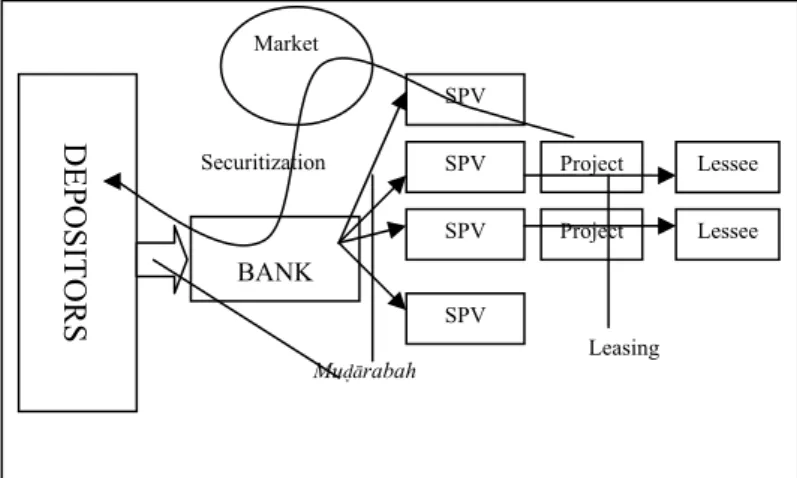
Below is the simplified diagram of the structure of the Islamic Banking (Figure 1) which is based on the double-tier mudarabah model. (It is to be noted that the diagram is a very simplified one. The structure can be very complicated, it can also consist of some hybrid structures or some enhancements.
Figure 1: The Double-Tier Mudarabah Islamic Banking Structure.
Securitization
BANK
SPV SPV SPV
SPV
Project Lessee
DEPOSITORS
Market
Project Lessee
Leasing Mudarabah
The structure is based on two tier mudarabah model, where the Depositors will place their fund as a mudarabah deposit in the Bank which in turn invest the fund through mudarabah in several project. Such mudarabah is structured as a non-recourse project finance transaction using leasing as a main vehicle where the repayment of the financing was convened only to actual revenue generated by the project. Then, each individual project is securitized and sold back to the bank. Because all projects are converted into marketable quasi equity security, the risk of maturity mismatch between the first tier mudarabah and the second tier mudarabah can be avoided.
3. The Indonesian Present Legal Environment
Indonesian laws have adopted a dual banking system through the promulgation of Law No. 10 year 1998, concerning amendments to banking law4 which forms a legal basis for the development of Islamic Banking in Indonesia. And through the law No. 23 year 1999,5 concerning Bank Indonesia which paved the way for the creation of the Shari[ah based regulatory and supervisory framework. Bank Indonesia (The Indonesian Central Bank) has been very active in this regard. Soon after the promulgation of the Law No 10 year 1998 which gives Bank Indonesia the power to supervise and regulate the banking sector in Indonesia,6 it promulgated several Bank Indonesia Regulations (Peraturan Bank Indonesia) which were intended to regulate the Islamic banking. These regulations are quite comprehensive. They cover almost every facet of administrative aspect of Islamic banking. However, the same is not the case for the operational aspects of Islamic banking. The present legal and regulatory regimes are insufficient in this regard. A significant problem is the lack of legal bases for Islamic Banking.
3.1 Laws related to Project Finance
One of the milestones of Indonesian banking law development is the promulgation of the Law No. 7 year 1992, concerning banking. It simplifies the banking system in Indonesia and creates a unified law dealing with the banking system.7 The 1992 Banking law also introduce the banking system based on the principles of profit sharing.8 The law also relaxes the security requirements on the banking activities. While under the Law No. 14 year 1967 the banks had to provide security for each and every credit it extend.9 The Law of 1992 requires only to have confidence in the debtors that they can repay the financing according to the financing agreement.10 So long as the banks can satisfy itself with the creditworthiness of the debtor, the security
might cover only the things which are financed by the financing.11 The 1992 law was later amended by the Law No 10 year 1998. The most important feature of it is the introduction of dual banking system in Indonesia.12 Through the promulgation of 1998 banking laws, a bank is at liberty to choose whether to operate as a conventional bank or as an Islamic bank.13 As the Islamic banking perspectives toward risk is rather different than those of conventional banking, the introduction of Islamic banking gives another opportunity to banks to conduct financing which has different risk profile than conventional banks.
The relaxation of the requirements for security since 1992 and the gradual recognition of Islamic banking14 opened the possibility of Indonesian banks to engage into project finance activities. As banks are not required to take additional security in financing a project, the notion of reliance only to the ability of the financed project to generate repayment is a possibility under Indonesian banking laws. However the law stops at recognition, so far there is no adequate supporting institutions for successful project finance. Example for this is the law related to secured transactions. The absence of Floating Charges make it difficult to mitigate the risk associated with Project Finance.
3.2 Laws related to Assets Securitization
Despite the fact that the Asset Securitization is one of the most important mechanisms for finance, Indonesia has not yet had any law governing such institution. There is however, an attempt by the Government of Indonesia to create such a law.15 Unfortunately, the draft law is not compatible with Islamic principles. The draft law clearly states that the securitization can only be conducted over debts.16
3.3 Laws related to Leasing
The laws related to leasing are centred around the Presidential Decree No. 61 year 1988 which stipulates the activities allowed to be carried out by a financial institution.17 At the outset, this decree does not pose any legal hurdle for application of leasing according to Shari[ah principles. However, the implementing regulation on leasing activities contains a requirement which may contradict the Shari[ah principles. The Decree of the Minister of Finance, No. Kep.Men.Keu.RI.No1169/KMK.01/1991, puts an obligation on the parties to a leasing agreement to put a clause which determines the liability18 of a lessee in the event of non-functionality of the object of the lease agreement.19 The point of the above example is that while the decree neither permit nor forbid that those activities carried out through Islamic means, this decree cannot be considered as the legal basis for Islamic leasing.
Moreover, the fact that this Presidential Decree was based on the laws which do no recognize the principles of Shari[ah20 can further support above argument.
4. Analysis on Laws related to Islamic Banking, Project Finance and Assets Securitization
4.1 Inadequacy of Indonesian Legal System
4.1.1 The Inadequacies Related to Basic Norms of the Legal Sources and Legislative Order under Indonesian Laws
As a country following civil law system, Indonesia put a heavy emphasis on the codification of laws and requires that all laws be transformed into written laws. This emphasis necessitates a basis on which the laws should be created. Consequently, the basis which determines the Legal Source and Legislative Order becomes the most important part of Indonesian Legal System. This basis was laid out by the highest political body in Indonesia,21 the People’s Consultative Assembly. Through its Decree No. III/MPR/2000, it lays out the Legal Source and Legislative Order of Indonesian Legal System which should be the basis in creating Indonesia Legal System. It is mentioned that the Source of Indonesian law is the state ideology, Pancasila22and that the Legislative Order which shall be the followings:
i) The 1945 Constitution;
ii) Decrees of the People’s Consultative Assembly of the Republic of Indonesia;
iii) Statutes/Laws
iv) Government Regulations in lieu of Statutes v) Government Regulations;
vi) Presidential Decrees;
vii) Regional Regulation.
The important aspect of this decree is that the principle which dictates that lower level laws/regulations cannot contradict higher level laws/regulations.23 In regard to the Islamic principles, this decree presents difficulties as most of the laws (in the level of Government Regulation and above) rarely recognize directly the Islamic principles or mention any
reference to Islamic legal principles. Even though the Decree refers to the unwritten laws as another source of laws, it cannot be argued that the unwritten laws mentioned in this decree encompasses Islamic principles as most treatises construe these unwritten laws as the conventions24 in state governance practices and not as a general principles of laws or a custom where the Islamic principles are likely to be part of.25
4.1.2 The Absence of Basic Laws for Islamic Banking
Even though the existence of Islamic banking is recognized in Indonesia through the promulgation of the Law No. 10 Year 1998 and Law No. 23 year 1999, the part which deals with the Islamic banking is minimal.26 The laws cover only the very basic tenets of Islamic banking. The Laws for instance fail to address the issue of double taxation in Islamic financial transactions or the specific supervisory needs of Islamic bank and contain general requirements for banking industries which impede the development of Islamic banking.
4.1.3 The Inexistence of Laws Related to the Islamic Mode of Financing
It is unfortunate that as a largest Muslim country in the World, Indonesia does not yet have the laws related to Islamic Mode of Financing. Even the compilation of Islamic laws in Indonesia27 does not even mention any Islamic Mode of Financing. The only legal or regulatory instrument which deals with Islamic Mode of Financing is the Regulation of Bank Indonesia. Some Regulations of Bank Indonesia defines some Islamic modes of financing and for limited extent the mechanism thereof.
4.1.4 The Laws Related to Asset Securitization Compatible to Islam
In conventional financing, success of securitization as an alternative source of financing is premised upon creation of secured transactions regimes that allow for the effective creation, perfection and enforcement of security interests in receivables. It is also the requirement for Islamic financing, however, such requirement is more stringent for Islamic asset securitization as the securitized assets cannot be in the form of debt. This necessitates the use of trust. For Indonesia, as a country following civil law system, the arrangement will be complicated as the institution of trust is not known in civil law system. Moreover, in regard to draft law on asset securitization, the Islamic banks will likely face difficulties when attempting to employ the asset securitization in its operation since the draft law clearly states that the securitization can only be conducted over debts.28
4.2 The Need for Specialized Legal and Regulatory Regimes for Islamic Banking
Due to the uniqueness of Islamic banking, it is necessary to develop a specialized law (lex specialis) which lays down a sound foundation for the operation of Islamic banking to complement existing legal and regulatory infrastructure. The current laws in Indonesia unfortunately overlook some unique facets of Islamic banking which may result in unfair treatment of Islamic banks. Some examples may be cited in this regard. Under the current legal environment, a bank is not supposed to conduct any business transaction unrelated to conventional banking business—whereas permissibility of such transactions is essential for Islamic banking.29 Similarly, the prohibition for banks of making capital participation (in the form of owning shares) in certain businesses work against the nature of Islamic banking.
Moreover, the absence of any law related to Islamic mode of financing will also create operational difficulties for Islamic banking. Two examples may be cited to highlight this point. The first example is related to mudarabah mode of financing. Indonesian laws cannot protect adequately the parties to the mudarabah transaction as the nature of the transaction is not within the ambit of the Indonesian legal system. The mudarabah transaction entails transfer of ownership which resembles the common law trust.30 As a country following civil law system,31 Indonesian laws do not recognize dual ownership32 in equity and at law which is the essential facet of mudarabah transaction. While the profit sharing aspects of mudarabah transaction may be covered by the freedom of contract principle,33 other aspects of it cannot be governed by Indonesian law.34 The second example is related to the leasing mode of financing. Indonesian law governs the leasing transaction through the Presidential Decree No. 61 year 1988 which stipulates the transactions which may be carried out by a financial institution.35 While this decree does not pose any legal hurdle for application of leasing according to Shari[ah principles, the subsequent implementing regulation on leasing contains a requirement which may contradict the Shari[ah principles.36
As for the regulatory regimes, the main impediment is the lack of legal bases for operational aspect of Islamic banking. The present legal regimes do not provide sufficient room for Bank Indonesia as the regulator and supervisory authority under the Law No. 10 year 1998. As the regulation of Bank Indonesia is not within the ambit of the People’s Consultative Assembly’s Decree No. III/MPR/2000, it is safe to say that the regulation can only serve as an administrative rule within the domain of Bank Indonesia37 and does not have the authority of a law. Therefore, the main
problem does not lie with the regulatory regimes but with the legal basis underlying the regulatory regime.
4.3 The Need for Supporting Legal Institutions
There is also a need for development of supporting legal institutions closely related to the operation of Islamic banking which are not exclusively for Islamic banking. Such legal institutions are non-recourse project finance, leasing and asset securitization. Non-recourse project finance38 will serve as the tool for developing Islamic financing which is based on allocation and mitigation of risk between parties in a banking transaction where the return will be justified by the involvement of risk taking. Leasing will be the basis of mode of financing which will enable the creation of Shari[ah compatible asset securitization. However, merely securitizing the assets is not solving the problems as the assets to be securitized should be in the form of equity or any form that represent ownership over real assets. This necessitates the creation of an arrangement enabling the financier to hold the assets of the venture while securitizing some sort of right of ownership over the assets to the investor. Trust arrangement can easily achieve this through separating the legal ownership from the beneficial ownership.
It is, therefore, sufficient to say that the principles of equity (as opposed to common law) are crucial to the success of the implementation of the Islamic banking. However, what can be easily implemented in a common law country encounter a major legal impediment when it is to be applied in a civil law country. Some sort of legal reform should be undertaken before the arrangement can be done. Indonesia, being a civil law country, faces this very problem. Since, it upholds the principles of unity of ownership, an attempt to introduce the principles of equity will face some legal hurdles. However, taking into account Indonesia’s past experience in dealing with issues related to the implementation of the principles of equity,39 it is not impossible to introduce a reform based on experiences of other civil law countries in implementing the principles of equity into its legal system.40
4.4 The Issue of International Standard
The New Capital Adequacy Framework of the Basel Committee on Banking Supervision does not take into consideration the different nature of Islamic banking operations. This can result in unfair treatment of these banks as the risk of the Islamic banking would be perceived higher than the conventional banking institutions.
The mudarabah structure, where the assets of the Islamic banking institutions comprise of non-recourse projects, which are securitized and linked to the depositors and the market, provide solution to this problem.
The Project Finance structure offers a relatively more certain revenue and provides easier corporate governance which will decrease the undue risk taking and moral hazard. Thus it will enable the assessment of Islamic banks on the conventional standards of soundness and stability without jeopardizing their interests.
4.5 The Unresolved Fiqh Issues
The idea of Project Finance is to create an off balance sheet portfolio consisting of the self sufficient projects which can generate enough revenue for repayment of the financing. In this context, the structure can overcome some unresolved fiqh issues, especially in relation to the issue of operating lease and sale of debt. By creating a special purpose vehicle (SPV) which is financed through mudarabah, the responsibility of the lessor can be transferred to the SPV. Therefore, the SPV can structure the lease arrangement as an operating lease instead of financial lease without affecting the balance sheet of the Bank. Consequently, avoiding fiqh objection on financial lease.41
The structure can also solve the fiqh issue related to the sale of debt. As all investment will be conducted in the mudarabah mode of financing which can be considered as a quasi equity, the assets to be securitized will not be in the form of debts over which the securitization cannot be done.42
5. A Note for Further Development
It is sufficient to say that for emerging volatile economy such as that of Indonesia, the Islamic banking system should be the fundamental basis for its economic development or at least, effort should be directed toward the creation of conducive environment to Islamic banking which might enable the transformation of conventional banking to Islamic banking. In this respect, two aspects will be dealt with in this section. The first is related to the necessary legal framework and the second subchapter will be dealing with the possibility of transforming conventional banking.
5.1 The Need for Comprehensive Legal Framework
While some Islamic scholars proposed some models based on profit and loss sharing, most Islamic banking in Indonesia still operates in substance just
as their conventional counterpart.43 Therefore, effort should be taken to rectify such situation.
Indonesia regulatory framework related to Islamic banking was unfortunately not yet directed to the creation of Islamic banking based on the double-tier mudarabah model.44 There is a need for regulatory framework conducive to creation of such Islamic banking. However, the regulatory framework for banking is not enough. Because the regulatory framework is just a manifestation of a legal framework, the creation of conducive legal framework is inevitable, especially for operational aspects of Islamic banking.
Hence, a sufficient level of infrastructure is needed to allow Islamic banking to grow. In the case of Indonesia, the necessary legal framework is the establishment of the basic laws for Islamic banking, the laws related to the Islamic mode of financing, the laws related to Islamic leasing and the laws related to asset securitization.
5.1.1 The Implementation of the Framework
Since the Indonesian Laws in principle do not recognize the principle of stare decisis or the binding force of precedence,45 it is imperative that the framework be implemented in legal products which are not open to interpretation.46 To achieve this, the legal basis should be one of the law/regulation listed in the People’s Consultative Assembly Decree No.
III/MPR/2000. In this respect, the issue of the recognition of Islamic principles is more substantial than merely providing facilities to the players in this industry. It will create a legal foundation for Islamic financial activities; it is important that the legal basis be in the form of statute. The reason for establishing the legal basis through statute is that the statute is the only legal products apart from the Constitution and the Decree of the People’s Consultative Agency promulgated through the involvement of the legislative authority of the country.47
Other important part of the framework is that the statute to be established should embody the Islamic principles and not only lay down the administrative procedures for carrying out such activities. The importance of establishing the statute incorporating Islamic principles through Parliament cannot be more highlighted, as the Parliament is the embodiment of the peoples of Indonesia. From legal point of views, they are the only institution that carries a mandate and has the obligation to dig the values living in the society and to reflect them in the laws. By establishing such a legal basis, not only the existing practices can be accommodated, but also the future development of such activities can be legalized.
5.1.2 Applicability of the Framework in Indonesia
Although not widely practiced and representing only a tiny portion of Indonesian financial market share, Islamic banking activities have been carried out in practice without any significant legal problem. Moreover, the attitude of the government of Indonesia toward Islamic finance is quite positive. Both facts actually prove that the proposed framework can be applied in Indonesia. However, relying on the two facts alone is not enough, as there are two preconditions that must be taken into account to asses the applicability of any legal framework. Those preconditions are that the legal framework must be acceptable legally and sociologically.
Apart from being a country with a large Muslim population, Indonesia has experienced a period where the Islamic values were the norm of Indonesian society; and to some extent it also formed the legal system of the country in the form of Adat law. This was the case until the declaration of independence in 1945. Therefore, it is fair to conclude that there will be no social resistance in reintroduction of the Islamic principles through the proposed framework into the Indonesian Legal System. The second precondition is that the framework should be within the ambit of the Indonesian basic legal structure. The fact that the framework will be created in accordance with the MPR Decree No. III/MPR/2000 will make it acceptable from legal point of view.
Moreover, there are three factors which must exist, namely the certainty of law, the utilitarian factor of the law and the element of justice. The framework will certainly fulfil all three factors. The framework will ensure the certainty of the law as it will fill the gaps which are the result of the inexistence of law pertaining to Islamic banking institutions. The utilitarian factor will also be fulfilled as the framework will cater the need of the Muslim majority. The fulfilment of the need of the majority will certainly create the greatest total of individual happiness. Finally, this framework will restore the neglected rights of the Muslim majority which are to be ruled by the principles of Shari[ah. The restoration of rights will certainly serve as the manifestation of justice for Indonesian society.
However, the fact that the proposed framework can be applied in Indonesia is not enough for the development of Islamic banking in Indonesia. The proposed framework will not have an impact unless the law derived from such framework can function as a tool for social engineering.
The framework must be able to drive Indonesian society towards the establishment of Islamic economic system. This objective can only be
attained through creation of a framework which accommodates the practice of Islamic banking, coupled with few reforms in Indonesian legal system.
Reforms are necessary in the banking sector, especially in relation with the introduction of the principle of equity and the imposition of the doctrine of the binding force of precedent (the principle of stare decisis). By introducing the principle of equity, it will be possible to create a legal institution close to the classical mudarabah and musharakah which will pave the way for the establishment of a double-tier mudarabah Islamic bank or other financial activities which are based on mutual interest and shared responsibilities.
Moreover, the recognition of the principle of stare decisis will open the possibility to build gradually the legal foundation for activities which are based on the living value in the society such as Islamic values. Furthermore, the creation of sound legal bases for Islamic banking operations will result in the comprehensive legal and regulatory framework for Islamic banking.
5.2 The Possibility for Transforming Conventional Banking
At the outset, Islamic principles and modern commercial practices are diametrically opposite. Modern commercial practices which base their activities on the concept of “time value of money” create a heavy bias towards the interest based system. Islamic principles, on the other hand, condemn such reliance, though it does accept the notion that the capital is not free. However, a common understanding can be reached, especially in relation to risk concerning one particular transaction if both the Islamic bankers and the conventional bankers are willing to assume risk beyond merely the credit risk. In the case of project finance, it is the nature of the arrangement that the banker should assume risks beyond credit risk of the recipient of the financing. Thus, in practice, there is no significant difference between conventional and Islamic banking where project finance arrangement is exploited. While the assumption of risk in conventional commercial practice was valued based on the interest rate imposed to the borrower, the Islamic banking takes the assumption of risk as a pre-requisite to the financing.
This fact opens the possibility for the convergence between the conventional and Islamic project finance. Everything being equal, the only differing view is on the consequences of the assumption of risk. In fact, the valuation of the interest rate can be easily converted into provision of profit sharing as it is possible in project finance to calculate exactly the return of a physical transaction involving real assets as opposed to financial assets.48
Taking into account the possible convergence of Islamic and conventional banking in the Project Finance, the fact that the business of Islamic banking market has crossed the USD 100 million threshold and the fact that Muslims in the world constitute 20% of the World population with 10% of the Global GDP,49 it is fair to expect enormous desire of the conventional banker to attempt to share this cake, if the environment is conducive for employing project finance. Thus, it is sufficient to say that provided the legal and regulatory regimes in Indonesia are conducive to such convergence, the transformation of conventional banking into Islamic banking will be inevitable.
6. Conclusion
It is sufficient to say that the combination of Islamic Project Finance and Assets Securitization will serve as a powerful tool for the development of Islamic banking to mobilize funds from the market and to extend financing which is based on the principles of risk mitigation and allocation where return is justified by risk taking. The development of sufficient and sound legal framework pertaining to Islamic Project Finance and Asset Securitization will certainly create conducive environment for Islamic banking, strengthen the operation of Islamic banking and lay down a firm legal basis for Islamic banking activities. However, as the framework must be able to drive Indonesian society towards the establishment of Islamic economic system, it is necessary that such a framework is coupled with few reforms in Indonesian legal system. In this respect, the necessary reforms are the introduction of the principle of equity and the imposition of the doctrine of the binding force of precedent.
Finally, the development of a comprehensive legal framework related to Project Finance and Asset Securitization will not only promote the development of Islamic banking and its regulatory regimes but also encourage the transformation of traditional banking into Islamic banking which in turn will galvanize the establishment of an Islamic economic system in Indonesia.
The creation of conducive environment for Islamic banking will reduce the huge divergence of real assets and real liabilities in banking sectors which in time will create a robust financial environment more resistant to financial shocks and banking crises.
Notes
1 Equality and Justice are the core principles of Islamic Economic System. These principles are manifested mainly in the form of prohibition of interest. However, the Islamic ban on interest does not mean that the capital is “free of charge” in an Islamic system. Islam recognizes capital as a factor of production but it does not allow this factor to make a prior or predetermined claim on the productive surplus in the form of interest. The permissible viable alternative is the profit-sharing system.
The reason behind rendering profit-sharing admissible in Islam as opposed to interest is that in the case of the former it is only the profit-sharing ratio not the rate of return itself predetermined. Another rationale for Islamic finance is that wealth should be put into productive use in order that others may share in its benefits. It is therefore unjustified to charge an interest for the mere use of money. The owner of wealth should invest it in a productive and real transaction. However, profit-sharing is only one side of a coin. The other side is that losses should also be shared between the parties which can bear such losses, however, the inability to bear a loss will exonerate such obligation.
2 To illustrate the difficulties, we may cite an example of the Interbank Mudarabah Investment Certificate. While the innovative initiative has to be applauded, there is no clarity on the relationship between the fund transferred on mudarabah basis to the investment made by the recipient bank except to the overall revenue or profit generated by the recipient bank in one particular period. This lack of clarity may lead to criticisms on some quarters having different interpretations on the mudarabah mechanism. Another example is in relation to Wadi[ah Certificate. While the wadi[ah mechanism envisaged resembles the mechanism of bailment without administrative charge, the wadi[ah mechanism entails the giving out of bonuses by Bank Indonesia which are determined according to the indicated remuneration of the Shari[ah Interbank mudarabah Investment Money Market or the average indicated remuneration of the Shari[ah Interbank Mudarabah Investment certificates which are recorded in the Shari[ah Interbank Mudarabah Investment Money Market. Even though, there is no obligation in the part of the Bank Indonesia to pay the bonuses, it is implied in the Peraturan Bank Indonesia No. 2/9/PBI/2000 concerning the Bank Indonesia Wadi[ah Certificate that the bonuses will be paid. Moreover, the lack of legal bases also resulted in different treatment between the conventional and Islamic banking. The clear example of this is the prohibition of conventional banking in issuing the Shari[ah Interbank Mudarabah Investment Market certificate.
3 One factor that creates difficulty in matching the deposit mudarabah and the investment mudarabah is the illiquid nature of the mudarabah investment. By using asset securitization, the mudarabah investment is in fact, becomes liquid which make the redemption of the deposit mudarabah much easier even in the case of the maturity mismatch between the deposit and investment mudarabah.
4 State Gazette No. 182 year 1998.
5 State Gazette No. 66 year 1999.
6 See Article 24-35 of Law No. 23 year 1999. It is to be noted that under the previous banking regime in Indonesia, despite the fact that BI sets and administers the operative rules and regulations related to banking operations, it was the Ministry of Finance that had the ability to enforce the rules, through its authority to issue and revoke banking licenses. See Nasution (June 1994), p.78.
7 Even though the Law No. 14 year 1967 was intended to be the only law dealing with banking system, the Indonesian legislative still promulgated special laws dealing with banking system, especially related to state owned banks. Such laws are Government Regulation in Lieu of Law No. 21 year 1960 tentang.
Bank Pembangunan Indonesia (Indonesian State Gazette year 1960 No. 65, Supplement No. 1996); Law No. 13 year 1962 tentang Ketentuan- ketentuan Pokok Bank Pembangunan Daerah (Indonesian State Gazette year 1962 No. 59, Supplement No 2490); Law No. 17 year 1968 tentang Bank Negara Indonesia 1946 (Indonesian State Gazette year 1968 No. 70, Supplement No 2870); Law No. 18 year 1968 tentang Bank Dagang Negara (Indonesian State Gazette year 1968 No. 71, Supplement No. 2871); Law No. 19 year 1968 tentang Bank Bumi Daya (Indonesian State Gazette year 1968 No. 72, Supplement No. 2872); Law No. 20 year 1968 tentang Bank Tabungan Negara (Indonesian State Gazette year 1968 No. 73, Supplement No. 2873); Law No. 21 year 1968 tentang Bank Rakyat Indonesia (Indonesian State Gazette year 1968 No. 74, Supplement No 2874); and Law No. 22 year 1968 tentang Bank Ekspor Impor Indonesia (Indonesian State Gazette year 1968 No. 75, Supplement No. 2875).
8 Article 6 para m of Law No. 7 year 1992.
9 See Article 24 of Law No. 14 year 1967.
10 Article 8 of Law No. 7 year 1992.
11 Elucidation of Article 8 of Law No. 7 year 1992 which states “Kredit yang diberikan oleh bank mengandung risiko, sehingga dalam pelaksanaannya bank harus memperhatikan asas- asas perkreditan yang sehat. Untuk mengurangi risiko tersebut, jaminan pembelian kredit dalam arti keyakinan atas kemampuan dan kesanggupan debitur untuk melunasi hutangnya sesuai dengan yang diperjanjikan merupakan faktor penting yang harus diperhatikan oleh bank. Untuk memperoleh keyakinan tersebut, sebelum memberikan kredit, bank harus melakukan penilaian yang seksama terhadap watak, kemampuan, modal, agunan, dan prospek usaha dari debitur.
Mengingat bahwa agunan menjadi salah satu unsur jaminan pemberian kredit, maka apabila berdasarkan unsur-unsur lain telah dapat diperoleh keyakinan atas kemampuan debitur mengembalikan hutangnya, agunan dapat hanya berupa barang, proyek, atau hak tagih yang dibiayai dengan kredit yang bersangkutan. Tanah yang kepemilikannya didasarkan pada hukum adat, yaitu tanah yang bukti kepemilikannya berupa girik, petuk, dan lain-lain yang sejenis dapat digunakan sebagai agunan. Bank tidak wajib meminta agunan berupa barang yang tidak berkaitan langsung dengan obyek yang dibiayai, yang lazim dikenal dengan "agunan tambahan"”.
12 Conventional and Islamic banking
13 Article 1 para 3 of Law No. 10 year 1998.
14 The recognition of the Islamic banking is not directly related to the development of Project Financing. However, it indicates the changing attitude toward banks assuming risk beyond credit risk.
15 At present, Draft Law concerning Asset Securitization is being considered in the Ministry of Law and Human Rights of the Republic of Indonesia.
16 See Article 3 of the Draft Law on Assets Securitization.
17 Article 2 stipulates the activities which are Leasing, Venture Capital, Trading in Commercial Papers, Factoring, Credit Card and Consumer Finance.
18 It is true that the contract can determine that the liability being 0%. However it is clear that this regulation is not intended to be the basis of Islamic Leasing.
19 According to Shari[ah, the lessee to an ijarah contract cannot be held responsible for the damage or any loss due to the non functionality of the object of the lease.
20 This Presidential decree was based on the Constitution, the Commercial Code, Civil Code, Law No. 12 year 1967 concerning Cooperatives and Law No. 14 year 1967 concerning Banking. See the Recital of the Presidential Decree No. 61 year 1988. It is to be noted that the Commercial Code and the Civil Code were initially intended for the European and were the codification of living values of Netherlands/western society. Prior to Indonesian independence, the Islamic majority native Indonesians were subject to adat law which consists of among other Islamic law.
21 Even though this statement is not absolutely accurate given the fact that the recent amendments to Indonesian Constitution have curtailed most of the power of this institution. However, it is still sufficient to regard this institution as the highest political body as its power still encompasses the legislative, judicative and executive branch of Indonesian state political apparatus. It is to be noted that Indonesian system is not purely based on the trias politica concept. Similar concept exists in the second echelon of Indonesian political institution, where the President, the Parliament (Dewan Perwakilan Rakyat) and the Supreme Court holds respectively the executive [and legislative to limited extent], legislative and judicative power.
22 See Article 1 of the MPR Decree No. III/MPR/2000.
23 Article 4 of the MPR Decree No. III/MPR/2000
24 See for instance, Apeldoorn (2001), at p.321.
25 There is a notion to regard Islamic Principles as a part of general principles of laws or a custom under Indonesian Laws, however this is a minority view. Islamic Principles are more inclined to be regarded as a living value in society. See subsequent section dealing with this.
26 See Law Office of Remy and Darus (2002), p.91.
27 Presidential Instruction no. 1 year 1991 concerning Islamic Laws Compilation.
28 See Article 3 of the Draft Law on Assets Securitization.
29 For more elaborated explanation See Law Office of Remy and Darus (2002), p.91.
30 Some Islamic Financial Institution even used the terminology “trust financing” to denote the mechanism contemplated in classical mudarabah.
31 For concise and brief explanation about the difference between Common Law and Civil Law system, See Raoul-Duval (1997), p.181-182. Among the principal difference is that the treatment of statute provisions and legal principles by Judges in their decision making.
32 It is true that the notion of ownership in mudarabah transaction is not exactly the same as the notion of ownership in common law trust. However, it is safe to say that both are similar. Therefore, it is appropriate to take the example of the dual ownership of the common law system to highlight the problem associated with the implementation of mudarabah under Indonesian legal system.
33 Article 1338 Burgelijk Wetboek.
34 The consequences which may arise are related to the status of the mudarabah object in case of insolvency of the mudarib, the liability of the mudarib and the rights of the investor. As the explanation will make this paper unnecessarily long, the writer will not make elaboration on this issue.
35 Article 2 stipulates the activities, which are Leasing, Venture Capital, Trading in Commercial Papers, Factoring, Credit Card and Consumer Finance.
36 See previous subsection on the legal aspect of Leasing in Indonesia.
37 Which basically means banks (and their organ) under Bank Indonesia supervision and cannot be extended to other stakeholder of banking system.
38 See previous subsection on the laws related to Project Finance. It can be argued that even though the employing project finance is possible under the current law, there is still a need for some supporting legal institutions.
39 Indonesian Law is mostly developed from the 19th Century Dutch Law. Similar to the Dutch Law, Indonesian Law recognizes forms of ownership which are less than absolute ownership such as usufruct or easement. In addition, Indonesian adat community also recognized a concept resembling dual ownership in the concept of ulayat land. Under this concept, one person can obtain ownership to land so long as he is looking after the land. If he neglects the land, ownership is transferred back to the community.
40 Based on their method of accepting the principles of equity, there are three categories of civilian countries. The first is for countries which adopt and incorporate the principles of equity in their legal system. The second is for countries which neither adopt nor incorporate the principles of equity, but which create a new legal vehicle similar to the concept of trust. The third is for countries which in adopting the principles of equity, create such a concept within the civilian legal framework.
41 For more elaborated explanation See Chapra and Khan (2000), p.74.
42 For more elaboration See id at 77.
43 70% of the typical Islamic banks’ portfolio is in the form of murabahah. While murabahah principles is acceptable to Shari[ah as long as the bank secure a real ownership of the commodity, most of the murabahah financing entails only a constructive ownership of the commodity.
44 See previous section dealing with the reason why an ideal Islamic Bank should be based on double tier mudarabah.
45 See Article 1917 of the Burgelijke Wetboek voor Indonesië Staatsblad 1847 No. 23.
46 Not in absolute term as it is impossible to create a law with absolute clarity.
47 Article 5 and 20 of the Indonesian 1945 Constitution. See Government of Indonesia (1945).
48 Khan (1997), p.16.
49 Khan (1997), p.13.
References
Apeldoorn (2001), “Pengantar Ilmu Hukum” in Inleiding tot de Studie van het Nederlandse Recht, Jakarta: Pradya Paramita, Jakarta.
Bank Indonesia (2002), Peraturan Bank Indonesia (Bank Indonesia Regulations) No. 2/9/PBI/2000.
Bank Pembangunan Indonesia (1960), Indonesian State Gazette, year 1960, No 65, Supplement No. 1996
Chapra, M. Umer and Tariqullah Khan (2000), Regulation and Supervision of Islamic Banks, Jeddah: Islamic Research and Training Institute, IDB.
Government of Indonesia (1847), Burgelijke Wetboek voor Indonesië Staatsblad 1847 No. 23.
Government of Indonesia (1945), Constitution of Indonesia.
Government of Indonesia (1962), Law No. 13 in Indonesian State Gazette year 1962, No. 59, Supplement No. 2490.
Government of Indonesia (1967), Law No. 12 and Law No. 14 in Indonesian State Gazette year 1967.
Government of Indonesia (1968a), Law No. 17 in Indonesian State Gazette year 1968, No. 70, Supplement No. 2870.
Government of Indonesia (1968b), Law No. 18 in Indonesian State Gazette year 1968, No. 71, Supplement No. 2871.
Government of Indonesia (1968c), Law No. 19 in Indonesian State Gazette year 1968, No.72, Supplement No. 2872.
Government of Indonesia (1968d), Law No. 20 in Indonesian State Gazette year 1968, No. 73, Supplement No. 2873.
Government of Indonesia (1968e), Law No. 21 in Indonesian State Gazette year 1968, No. 74, Supplement No. 2874.
Government of Indonesia (1968f), Law No. 22 in ,Indonesian State Gazette year 1968, No. 75, Supplement No 2875.
Government of Indonesia (1988), Recital of the Presidential Decree No. 61 year 1988.
Government of Indonesia (1998), Law No. 10 in State Gazette year 1998, No 182.
Government of Indonesia (1999), Law No. 23 in Indonesian State Gazette year 1999, No. 66.
Government of Indonesia (undated), Draft Law on Assets Securitization.
Unpublished.
Khan, Mansoor H. (1997), “Designing an Islamic Model for Project Finance”, International Financial Law Review, June, pp.16.
Law Office of Remy and Darus (2002), Naskah Akademik Rancangan Undang- Undang tentang Perbankan Syariah, Unpublished Paper dated October 2002.
Ministry of Finance (1991), Decree of the Minister of Finance No.
Kep.Men.Keu.RI. No.1169/KMK.01/1991.
Nasution, Anwar (1994), “An Evaluation of the Banking Sector Reforms in Indonesia, 1983-1993”, Asia Pacific Development Journal, 1, (June), p.78.
People’s Consultative Assembly of the Republic of Indonesia (2000), MPR Decree No. III/MPR/2000.
Raoul-Duval, Pierre (1997), “English and French Law: the Search for Common Principles” in International Business Lawyer, International Bar Association, London, April, pp. 181-182.