
The study concluded that more early-age screen viewing was associated with more autism spectrum disorder (ASD)-like symptoms later (Heffler et al., 2020). Regarding social interaction, researchers argue that media use has increasingly impaired social behavior in children (Tanimura et al., 2007). Healthy population therefore also shares several of the autistic characteristics that the clinical population does (Hoekstra et al., 2011).
Sebuah studi analisis faktor yang dilakukan oleh Grove et al. 2013) menemukan bahwa skor Autistic Spectrum Quotient (AQ) dimuat pada faktor empati, sedangkan perhatian terhadap detail dimuat pada faktor sistemisasi, menunjukkan hubungan antara Teori Empati-Sistemisasi (E-S) dan Autistic Spectrum Quotient (AQ). Autistic Spectrum Quotient (AQ) mencakup aspek-aspek defisit pada anak autis, seperti: (1) komunikasi; (2) keterampilan sosial; (3) pengalihan perhatian; (4) perhatian terhadap detail; dan (5) imajinasi (Baron-Cohen et al., 2001). Sebuah studi analisis faktor yang dilakukan oleh Grove et al. 2013) menemukan bahwa skor Autistic Spectrum Quotient (AQ) dimuat pada faktor empati, sedangkan perhatian terhadap detail dimuat pada faktor sistemisasi, menunjukkan adanya hubungan antara Teori Empathizing-Systemizing (ES) dan Autistic Spectrum Quotient (AQ).
Autistic traits in children are quantified via the Autism Spectrum Quotient: Children's Version (AQ-Child; Auyeung et al., 2008), while empathy and systemizing are measured with Empathy Quotient for Children (EQ-C) and Systemizing Quotient for Children (EQ -C). SQ-C) scales (Auyeung et al., 2009). The translation of the scales follows the translation steps of scale adjustment (Peneva et al., 2014). The Autism Spectrum Quotient: Children's Version (AQ-Child) scale is a parent questionnaire that quantifies autistic traits in children aged 4 to 11 years old (Auyeung et al., 2008).
Autism Spectrum Quotient: Child Version (AQ-Child) merupakan kuesioner laporan orang tua yang mengukur ciri-ciri autis pada anak usia 4-11 tahun (Auyeung et al., 2008).
Result
As for finding the relationship between media use and the extreme male brain, the D-Score is also calculated to find a specific correlation pattern. The D-Score measured as a comparison of individual performance on the Empathy Quotient for Children (EQ-C) and Systemizing Quotient for Children (SQ-C) using standardized scores. The D-Score is the basic score for evaluating each child's relative ability to empathize or systematize; it is derived from the average of the subtraction of the standardized Systemizing Quotient (SQ) score by the standardized Empathy Quotient (EQ) score (Auyeung et al., 2009).
Hasil
Differences in screen media time between weekdays and weekends were also examined. Children have been reported to spend a lot of time using screen media in general. It has been reported that children spend an average of more than four hours a day using screen media.
Doing homework was reported as the third most common screen-based activity among children, while a lesser time in screen-based media use was for engaging in social media and surfing the Internet (see Table 2). . Secara total, anak reported to be lost, rerata, lebih dari empat jam per hari dalam penganauan media beasis layar. Independent samples t-test was performed to determine if there was a difference between age group means for each screen-based activity.
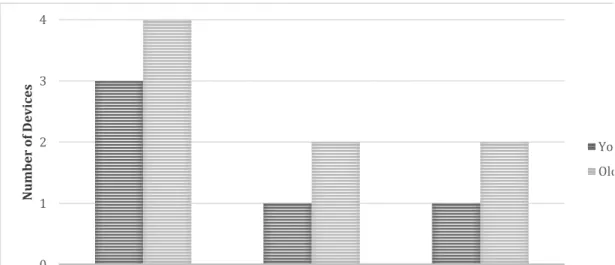
As shown in Table 4, children in the older age group (10-12 years old) spent a significant amount of time on screen-based media use compared to the younger group, with a statistically significant difference (M = 4.3; In contrast, reported that children in the younger age group spent significantly less time on screen-based activities.Overall, the children in the older age group spent more than four hours per day on screen-based media (M = 10.19; SD = 2.93) on average.
Sebaliknya, anak-anak di kelompok yang lebih muda melaporkan menghabiskan lebih sedikit waktu untuk melakukan aktivitas berbasis layar. Secara keseluruhan, anak-anak pada kelompok usia lebih tua menggunakan media berbasis layar rata-rata lebih dari empat jam per hari (M = 10.19; SD = 2.93). Mengenai kemungkinan hubungan antara penggunaan media dan variabel dependen serta menentukan dampak durasi penggunaan media berbasis layar terhadap variabel dependen yang diukur, dilakukan analisis regresi linier.
The total time children spent on screen-based media use was a significant predictor of systematization and D-Score, explaining only 4.2% of the variance in systematization (adjusted R2 = .042;). Furthermore, the correlation analysis was also conducted for time on each screen-based media use activity towards the Empathy Quotient (EQ), Systemizing Quotient (SQ), D-Score and Autism Spectrum Quotient (AQ). A clear relationship was found for each type of screen-based activity and the dependent variables.
Discussion
Diskusi
Penelitian ini menemukan bahwa total durasi penggunaan media berkorelasi signifikan dengan Systemizing Quotient (SQ) tetapi tidak dengan Empathy Quotient (EQ) pada anak-anak Indonesia. Anak-anak Indonesia dalam sampel saat ini menghabiskan rata-rata lebih dari empat jam per hari dalam penggunaan media berbasis layar. Berdasarkan penelitian yang dilakukan saat ini, durasi penggunaan media berbasis layar oleh anak-anak di Indonesia berkorelasi positif dengan Systemizing Quotient (SQ).
Menurut penelitian ini, durasi penggunaan media berbasis layar anak Indonesia berkorelasi positif dengan Systemizing Quotient (SQ). Ketika durasi penggunaan media berbasis layar bertambah atau berkurang, tingkat Systemizing Quotient (SQ) juga akan meningkat atau menurun. Meskipun ditemukan hubungan positif antara penggunaan media berbasis layar dan sistemisasi, penelitian ini tidak memberikan bukti bahwa total durasi penggunaan media berbasis layar berhubungan dengan Empathy Quotient (EQ).
Korelasi yang diharapkan antara total durasi penggunaan media layar dan ciri-ciri autis tidak ditemukan dalam penelitian ini. Oleh karena itu, dampak penggunaan media layar terhadap emosi anak-anak tidak hanya disebabkan oleh paparan media; Korelasi yang diharapkan antara total waktu menatap layar dan ciri-ciri autis tidak ditemukan dalam penelitian ini.
Berbeda dengan temuan yang tidak signifikan mengenai sikap autis, penggunaan media berbasis layar berkorelasi positif dengan ekstremitas otak laki-laki, sebagaimana dibuktikan oleh D-Score. Berdasarkan penjelasan yang ada, penelitian ini menunjukkan bukti empiris mengenai hubungan penggunaan media berbasis layar dengan sifat autis pada anak Indonesia. Dari hasil tersebut dapat disimpulkan bahwa: (1) pada anak-anak Indonesia, total waktu yang dihabiskan menggunakan media berbasis layar memprediksi Systemizing Quotient (SQ) dan karakteristik otak maskulin yang ekstrim, serta kecil kemungkinannya berhubungan dengan Empathy Quotient (EQ); dan (2) hubungan penggunaan media berbasis layar dengan variabel yang diukur cenderung bergantung pada konten.
Meskipun terdapat temuan bahwa penggunaan media berbasis layar memberikan kontribusi yang relatif kecil terhadap ciri-ciri autis, korelasi menunjukkan bahwa penggunaan media secara signifikan dikaitkan dengan perkembangan ciri-ciri autis. Oleh karena itu, penting bagi orang tua untuk menetapkan aturan untuk mengontrol penggunaan media oleh anak-anak. Pencegahan terhadap dampak negatif penggunaan media yang berlebihan (terkait dengan dampaknya terhadap sensitivitas anak) sangat diperlukan.
Temuan bahwa penggunaan media layar berhubungan positif dengan keterampilan sistemisasi mungkin menunjukkan bahwa penggunaan media mendukung perkembangan analitis otak. Disarankan untuk menggunakan buku harian mingguan yang mencatat waktu harian yang dihabiskan menggunakan media layar untuk membantu orang tua memperoleh data yang lebih akurat.
Additionally, it is of interest to determine the short-term and long-term direct effects of media use on autistic characteristics through a longitudinal study design or a five-year follow-up study. As no association was found between autism spectrum quotient (AQ) or autistic traits with total duration of screen media use, concerns regarding the possible roles of screen media use compulsiveness should be considered, as studies in adults have reported an association with autistic traits. The Autism Spectrum Quotient (AQ): Evidence for Asperger's Syndrome/High Functioning Autism, Males and Females, Scientists and Mathematicians.
Gender-related differences in toys, television shows, computer games, and outdoor activities of 5- to 13-year-old children. Video game access, parental rules, and problem behavior: A study of boys with autism spectrum disorder. Brief report: examining the association between autistic traits and compulsive internet use in a non-clinical sample.
Empathizing, systemizing, and autistic traits: Latent structure in individuals with autism, their parents, and general population controls. Video games as virtual teachers: Prosocial video game use by children and adolescents from different socioeconomic groups is associated with increased empathy and prosocial behavior. Association of early social and digital media experiences with the development of autism spectrum disorder-like symptoms.
The construction and validation of a shortened version of the Autism Spectrum Quotient (AQ-Short). Television, video game, and social media use among children with ASD and typically developing siblings. Children with autism spectrum disorder and screen time: Results from a large, nationally representative US study.
Measuring autistic traits in the general population: a systematic review of the autism spectrum quotient (AQ) in a non-clinical population sample of 6,900 typical adult men and women. Determining reactive and proactive aggression and empathy levels of high school students regarding their video game preferences. Screen-based clusters of media use are associated with other activity behaviors and health indicators in adolescents.

