OF POLYNUCLEAR METAL-METAL BONDED COMPLEXES
Thesis by
Daniel George Nocera
In Partial Fulfillment of the Requirements for the Degree of
Doctor of Philosophy
California Institute of Technology Pasadena, California
1984
(Submitted 16 August 1983)
KoA&n.
ACKNOWLEDGEMENTS
I express my deepest gratitude to past and present
Gray group members for creating a scientifically stimulating and challenging environment in which to pursue my scientific goals. I thank Harry Gray for his friendship, encouragement and scientific insight during my tenure at Caltech. Harry's capacity to linger in the delta-star excited state for
exccecfing-fi/ long periods of time has resulted in many of my chemical endeavors. Many colleagues have contributed to my research effort: John Buhr, Andrew Maverick, Steven Rice, and Terry Smith deserve special credit for their guidance during my initial scientific ventures; Mike Hopkins, Vinnie Miskowski, and Tom Zietlow (Zeitlow ?) for their solicited
(and more frequent, unsolicited) critiques of my work; and Vince Cammarata and Doug Mackenzie for sacrificing their undergraduate research careers at my hands. I also thank Jay Winkler for his friendship and for accompanying me during my sojourn in bioinorganic chemistry.
I am indebted to many people outside the Gray group.
For their many helpful discussions, I thank Professors Fred Anson, John Bercaw, Terry Collins, Rudy Marcus, and Bill Schaefer. Special thanks goes to: Fred Anson for per
mitting the use of his electrochemical equipment; Bill Schaefer who performed the entire crystal analysis of
NBu4Re2Brg; and Professor Oliver Wulf for many enlightening discussions on the electronic spectroscopy of diatomic
molecules. I also thank Dan Buttry and Mark Paffett for their electrochemical expertise and Don Berry and Eric Moore for their synthetic prowess.
Certainly, one of the many pleasant aspects of the Gray group is the establishment of scientific collaborations with visiting research scholars. In conjunction with my work in bioinorganic chemistry, thanks go to Professors Emilio
Bordignon, John Chesick, George "Gold Shooter" McLendon, and Israel Pecht; and I am further indebted to Professor Woody Woodruff for sharing with me his knowledge of Raman
3 2-
spectroscopy and for beginning the TR studies on the M^X^4 clusters.
I acknowledge the financial support from a Sun Company graduate fellowship during the 1982-83 academic year and summer recess.
I was fortunate to establish friendships with many people outside of Caltech. Among them are those with Roy Harrison, Melissa Patton, and Betsa and Vincent Richards (and their families). I especially thank Noah, who should be
taller than I any day now, for his special friendship and many wonderful experiences.
The love and support which I have received from my parents and sisters have been guiding lights throughout my formal educational years.
And finally, the radiant love, steadfast loyalty, and tireless patience of my wife, Karen, have been the sources of my strength and inspiration.
ABSTRACT
The spectroscopic, electrochemical, and photochemical properties of two d metal polynuclear complex systems4
were investigated: the quadruple bond complex, Re2Clg , 2- and the M^X^^ halide cluster ions of molybdenum(II) and2- tungsten(II).
The vibrationally structured luminescence spectrum of Re2Clg at 5 K has confirmed that emission arises from2-
* 2-
the έδ singlet state. Both Re^Cl^ and electronically z o
2- 2-*
excited Re2Clg (Re2Clg ) undergo facile one-electron oxidation and reduction reactions. Aromatic amines quench Re2Clg luminescence and a Marcus analysis of the steady-2-*
state quenching rate constants suggest that Re2Clg*^ ∣D+ is formed in the quenching reaction and that the ion-pair
decays rapidly by back electron transfer. The luminescence of Re2Clg is also quenched by electron acceptors (TCNE2-*
and chloranil) in nonaqueous solutions, forming Re^Cl^
z o
and reduced acceptor. The back electron transfer reactions are near the diffusion controlled limit. Electrochemical measurements suggested that photogenerated Re2Clg anion could be trapped by Cl to produce Re2Clg , thereby2-
circumventing the efficient back reaction. Irradiation (λ>660 nm) of nonaqueous solutions of Re2Clg and chloranil2- or TCNE in the presence of excess Cl does, indeed, produce Re2Clg in quantitative yield. Photolysis reactions 2-
employing a quencher (e.g. 2,3-dichloro-5,6-dicyano-
benzoquinone) possessing a redox couple with a potential greater than that of Re2Clg /2 (0.53 V vs. SCE) yielded Re2Clg as a final product. Thus, a single low energy photon facilitates a two-electron oxidation of Re^Cl^2-
2 o 2- *
Direct two-electron oxidation of Re2Clg by chlorine atom transfer reagents such as PtClg to produce Re2Clg2- was also attempted. Irradiation (λ>590 nm) of dichloro-
2- 2- methane solutions containing Re2Clg and PtClg
quantitatively yield Re^Cl^ . Qualitative kinetic experiments measuring the wavelength dependence of the reaction rate
suggest that the photochemical reaction proceeds by a free radical pathway involving the A2^ ligand field excited 3 state of PtCl^ and does not involve an atom transfer 2-
6
reaction mechanism. These experiments are not without their ambiguities, however, and further areas of research are
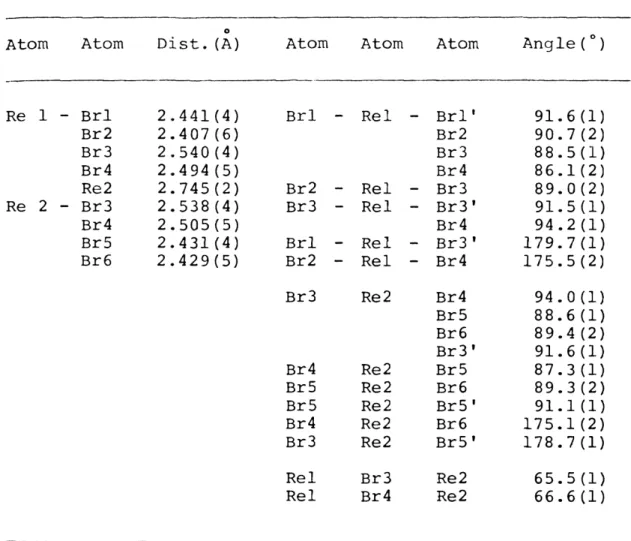
discussed. The crystal structure analysis of NBU4Re2Brg is also presented.
The (M=Mo,W; X=Cl,Br,I) ions are intensely luminescent in the solid state and solution and the photo
physical properties of the six cluster ions are documented.
These results in conjunction with those of the EPR
spectra of the electrochemically generated MgX^ anions are discussed in terms of recent theoretical models for
the electronic structure of the cluster ions. Electrochemical experiments were also conducted and showed the MgX^2-
cluster ions to undergo reversible single-electron oxidation reactions. For Mo^Cl..
b 14 , a quasi-reversible one-electron
Mo^Cl..
6 14
reduction wave was observed in addition to its oxidation wave. The electrochemical and photophysical properties of MOgClig suggested electrogenerated chemiluminescent2-
behavior of the cluster ion. Emission, characteristic of MOgCli^ , is observed upon electrochemical generation of2-*
and Mo,Cl- 3 . o ±4
TABLE OF CONTENTS
Page
List of Figures ix
List of Tables xi
I, INTRODUCTION 1
References 9
II THE OCTACHLORODIRHENATE ANION 12
A. Introduction 13
B. Experimental 21
C. Spectroscopy of Octachlorodirhenate 36 D. Binuclear Rhenium Halide Electrochemistry 55 E. Photoredox Chemistry of Octachlorodirhenate 79
F. References 126
III. MOLYBDENUM(II) AND TUNGSTEN(II) HALIDE CLUSTER 134 IONS
A. Introduction B. Experimental
C. Electronic Structure and Photophysics D. Electrochemistry
E. References
135 141 150 171 185
IV. FINAL REMARKS 188
References 195
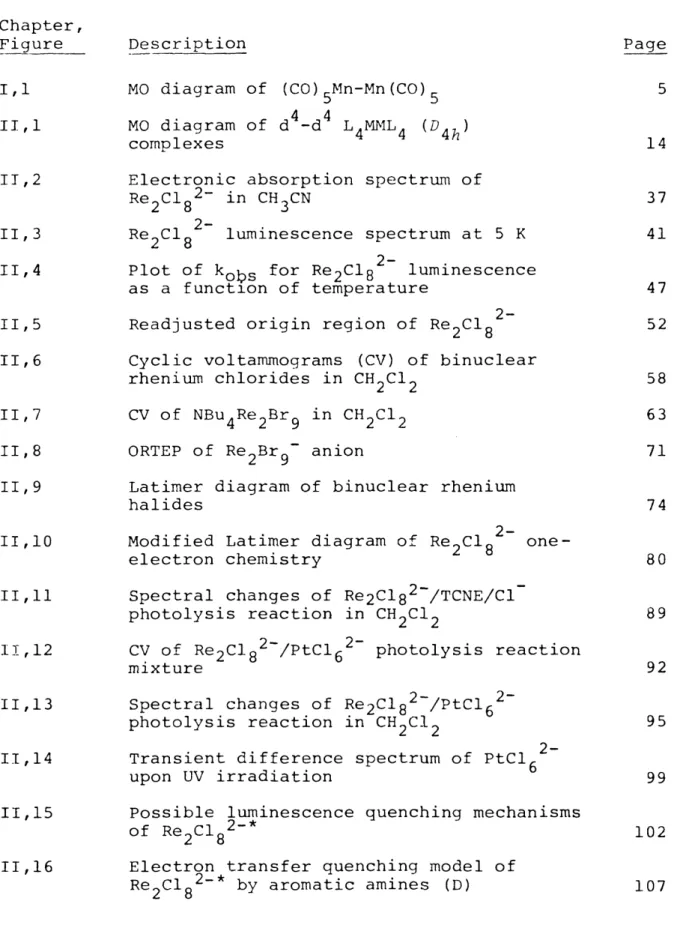
LIST OF FIGURES
Chapter
Figure Description Page
f
1,1 11,1 11,2 11.3 11.4 11.5 11.6 11.7 11.8 11.9 11.10 11,11 11,12 11.13 11.14
MO diagram of (CO)5Mn-Mn(CO)5 4 4
MO diagram of d -d L.MML. (P.^) complexes
Electronic absorption spectrum of Re2Clg2" in CH^CN
Re^Cl^ luminescence spectrum at 5 K 2- 2 o
Plot of ko^g for Re2Clg luminescence 2- as a function of temperature
Readjusted origin region of Re2Clg2-
Cyclic voltammograms (CV) of binuclear rhenium chlorides in CH2CI2
CV of NBU4Re2Br9 in CH2CI2 ORTEP of Re2Brg- anion
Latimer diagram of binuclear rhenium halides
Modified Latimer diagram of Re2Clg one- 2- electron chemistry
Spectral changes of Re2Clg2^^∕τCNE∕Cl photolysis reaction in CH2CI2
O— Q —
CV of Re2Clg^ /PtClg photolysis reaction mixture
Spectral changes of Re2Clg2^∕ptClg2 photolysis reaction in CH2CI2
Transient difference spectrum of PtCl^ 2- upon UV irradiation
11.15 Possible luminescence quenching mechanisms of Re2Clg2^*
11.16 Electron transfer quenching model of Re2Clg2^* by aromatic amines (D)
5 14 37 41 47 52 58 63 71 74 80 89 92 95
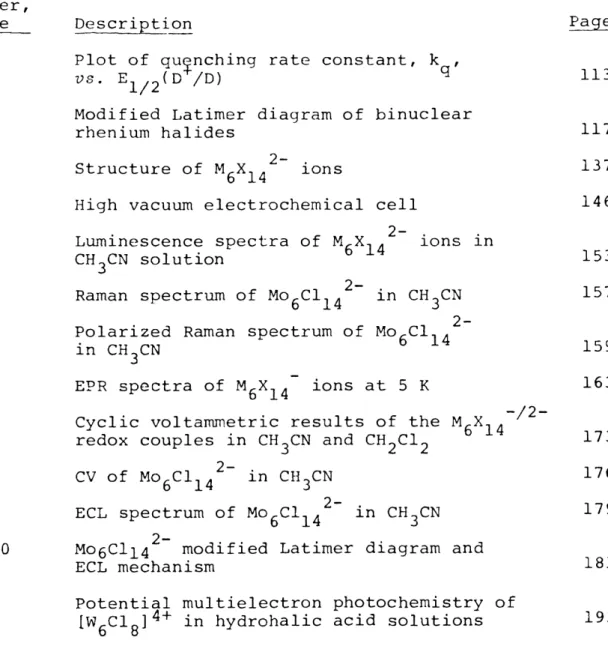
99 102 107
Chapter,
Figure Description Page
11,17 Plot of quenching rate constant, k ,
rs. E^^/D) 3 113
11,18 Modified Latimer diagram of binuclear
rhenium halides 117
111,1 2-
Structure of M^X.. 10ns 137
111,2 High vacuum electrochemical cell 146
111,3 2-
Lumιnescence spectra of M,X-,. 10ns in
CH3CN solution ° 153
111,4 2-
Raman spectrum of MθgCl^4 in CH^CN 157
111,5 2-
Polarized Raman spectrum of Mo,Cl^.
in CH3CN ° A4 159
111,6 EPR spectra of M^X44 ions at 5 K 163
111,7 -∕2-
Cyclic voltammetric results of the MgX44
redox couples in CH^CN and CH2CI2 173 111,8 CV of Mo^Cl, 2^ in CH^CN
0 14 3 176
111,9 2- .
ECL spectrum of MθgCl44 in CH^CN 179
111,10 2-
Mθ6Cl14 modified Latimer diagram and
ECL mechanism 181
IV,1 Potential multielectron photochemistry of
[W,C1^]4+ in hydrohalic acid solutions 192
LIST OF TABLES Chapter,
Table Description Page
11,1 Vibrational structural data of the
Re2Clg2 emission band 43
11,2 2-
Observed emission lifetime of Re2Clg
as a function of temperature 45
11,3 Vibrational structure of the 6-÷-<S*
absorption band and luminescence band
of Re2Clg2- at 5 K 50
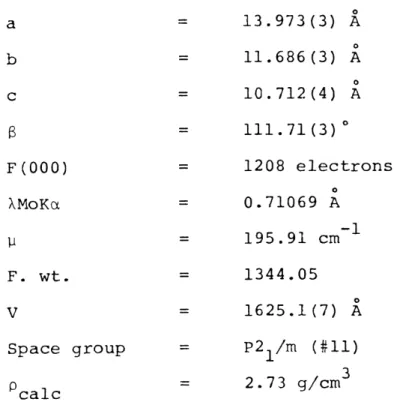
11,4 Crystal data for NBU4Re2Brg 66
11,5 Final parameters for all atoms except
hydrogen in NBU4Re2Brg crystal structure 68 11,6 Anisotropic thermal parameters for
Re2Br9- anion 69
11,7 Bond distances and angles in Re2Brg
anion 70
11,8 +
Bond distances in NBU4 cation for
NBU4Re2Brg crystal structure 73
11,9 2-
Structural parameters for Re^X- and
Re2X9- 77
11,10 Quenching rate constants of Re2Clg2
luminescence by aromatic amines 83 11,11 Rate constants for quenching of
Re2Clg2^ luminescence by oxidative
quenchers and their back reactions 87
111,1 2-
Photophysιcal data for MgX^ ions 152
CHAPTER I
INTRODUCTION
A central theme of inorganic photochemistry during the past two decades is the activation of small molecules by transition metal complexes. A major difficulty of this activation chemistry lies in the kinetic and/or thermo
dynamic barriers which typically confront these small molecule reactions. Inorganic photochemistry is an
extremely important area of chemistry, because the energy of the electronically excited transition metal complex may be utilized to surmount these reaction barriers. The long excited state lifetimes exhibited by many transition metal complexes entitles them to be viewed as authentic chemical reagents with their own reaction chemistry. Indeed, a major development in inorganic chemistry has been the incorporation of electronically excited molecules in bimolecular
processes.^ Prominent among these are electron transfer
reactions. Many small molecule activation reactions involve 2 multielectron transfer processes, and it would therefore
be desirable to involve the excited state directly in these multielectron transfer reactions. Unfortunately, inorganic photochemistry, to date, has ignored excited state multi
electron transfer chemistry. The shortcoming of employing single-electron transfer reactions of photoreagents to drive multielectron transfer processes arises from large kinetic barriers which are built into such reaction pathways.
Nowhere is this problem better illustrated than in solar energy conversion chemistry.
The storage of solar energy in chemical species has been a topic for intensive photochemical investigation, due principally to the ramifications of such reactions for alternate fuel sources. The photochemical energy storage reaction which has challenged the imaginations of most photochemists is the splitting of water by a transition metal catalyst, M, to produce hydrogen and oxygen
∏2° solar energy
M + 02'
a reaction which stores 2.46 eV of chemical energy. Present solar energy conversion schemes emphasize one-photon/one- electron/catalyst cycles; the most popular of which employ
2+ 4
Ru(bpy)^ (bpy = bιpyrιdιne) as a photosensitizer. In all systems, a heterogeneous catalyst or relay catalyst is required to couple the one-electron chemistry of the
photosensitizer to the multielectron transfer chemistry of the water splitting reaction. The design of such energy conversion schemes imposes severe limitations on the overall efficiency of the reaction.
Owing to our interest in small molecule activation chemistry, we have concentrated on effecting multielectron transfer reactions with polynuclear metal complexes. These compounds are well-suited for multielectron photochemistry with their coordinative unsaturation and juxtaposed redox centers in a single molecule (which can be electronically
excited with a single photon of light). It should be possible to facilitate multielectron reactions at the available coordination sites of the cluster species.
The photochemistry of polynuclear metal complexes in recent years has primarily involved cluster compounds which are comprised of two and three metal centers. From these investigations, homolytic cleavage of the metal- metal bond has emerged as a general reaction pathway for
5
polynuclear complexes in their excited state. Dimanganese decacarbonyl is the cornerstone example of this photochemistry, which may easily be understood in terms of the metal σ and
τr molecular orbital interactions schematically represented in Figure 1. The lowest energy transitions in M∏2(CO)^g arise from the promotion of an electron from a σ or π molecular orbital to σ*. Of course, both transitions significantly weaken the metal bond, thereby inducing
metal-metal bond cleavage. The photofragmentation chemistry 7
of RU3(CO)12 may be similarly explained by excitation of the analogous metal localized σ -÷ σ* transition in the trinuclear cluster. In order to preserve the excited8
state polynuclear complex for bimolecular reaction chemistry, it is obvious that metal-metal bond cleavage chemistry
must be circumvented. Two primary classes of compounds have developed along these lines. One class of compounds is comprised of binuclear d -d complexes in which the8 8 structural integrity of the polynuclear complex is maintained by ancillary ligands which bridge the two
Figure 1. Qualitative σ and π interactions of metal d orbitals in
ENERGY'
(CO^Mn. (CO)5M∩--Mn(CO)5 *M∩ (CO)5
metal centers. Simple molecular orbital theory suggests9 that the excited state metal interaction is much stronger than in the ground state! Electronic absorption and emission spectra^O and resonance Raman spectroscopy of the ground and excited states of these dimers substantiate the11 predictions of theory. The excited states of these
complexes readily undergo bimolecular oxidative and reductive electron transfer reactions. " The second class of compounds consists of clusters with cores of multiply bonded metal
centers. In these systems, occupation of metal-metal
antibonding molecular orbitals by a single electron promotion only slightly weakens the extensive metal-metal bonding
framework.
Herein are described our experiments on compounds of this second class of polynuclear complexes, cluster
compounds of d metals at two bonding extremes: single4 multiple and multiple single metal-metal bonding. In the former system, the four d electrons of one metal are utilized to form one quadruple bond to another metal.
Chapter II describes our investigations of the spectroscopy, electrochemistry and photochemistry of octachlorodirhenate dianion, Re^Clg , the prototypal quadruple metal bonded2- system. At the other bonding extreme, the four d electrons of each metal center are used to make four single bonds to four other metal centers in the octahedral metal core of the M,X-,. (M=Mo,W; X=Cl,Br,I) cluster compounds. To 2-
o 14
emphasize the similarity between these two seemingly diverse
polynuclear complexes, the MgX^ cluster may be viewed2- as the condensation product of three quadruple bond systems. Experiments aimed at the elucidation of the 13
electronic structure and redox chemistry of MgX^ clusters 2- are documented in Chapter III.
REFERENCES
1. (a) Balzani, V.; Bolletta, F.; Gandolfi, M. T.;
Maestri, M. Topics Curr. Chem, 1978, 75., 1*
(b) Balzani, V.; Moggi, L.; Manfrin, M. F.; Bolletta, F.;
Laurence, G. S. Coord. Chem. Rev. 1975, 15_, 321.
2. (a) Meyer, T. J. Prog. Inorg. Chem. 1983, 30, 389 and references therein. (b) Meyer, T. J. Acc. Chem. Res.
1978, 11, 94.
3. (a) Gray, H. B.; Maverick, A. W. Science 1981, 214, 1201. (b) Maverick, A. W.; Gray, H. B. Pure. Appl.
Chem. 1980, 52, 2339. (c) Sutin, N.; Creutz, C.
Pure Appl. Chem. 1980, 52, 2717. (d) Sutin, N.
J. Photochem. 1979, _10, 19.
4. (a) Brugger, P.-A.; Grätzel, M. J. Am. Chem. Soc.
1980, 102, 2461. (b) Lehn, J.-M.; Sauvage, J. P.;
Ziessel, R. Nouv. J. Chim. 1981, ⅜, 291. (c)
Brugger, P.-A.; Cuendet, P.; Grätzel, M. J. Am. Chem.
Soc. 1981, 103, 2923. (d) Kalyanasundaram, K.;
Grätzel, M. Angew. Chem., Int. Ed. Engl. 1980, 19, 646. (e) Borgarello, E.; Kiwi, J.; Pelizzetti, E.;
Visca, M.; Grätzel, M. J. Am. Chem. Soc. 1981, 103,
6324. (f) Chan, S.-F.; Chou, M.; Creutz, C., Matsubara, T Sutin, N. J. Am. Chem. Soc. 1981, 103, 369.
(g) Nijs, H.; Cruz, M. I.; Fripiat, J. J.; Van Damme, H.
Nouv. J. Chim. 1982, 6, 551. (h) Grätzel, M.
Acc. Chem. Res. 1981, 14^ 376. (i) Shafirovich, V.;
Khannanov, N. K.; Strelets, V. V. Nouv. J. Chim.
1981, 4, 81. (j) Collin, J. P.; Lehn, J.-M.;
Ziessel, R. Nouv. J. Chim. 1982, <5, 405.
(k) Krishnan, C. V.; Sutin, N. J. Am. Chem. Soc. 1981, 103, 2141. (1) Humphry-Baker, R.; Lilie, J.;
Grätzel, M. J. Am. Chem. Soc. 1982, 104, 422.
(m) Brown, G. M.; Brunschwig, B. S.; Creutz, C.;
Endicott, J. F.; Sutin N. J. Am. Chem. Soc. 1979, 101, 1298.
5
6
7
8
(a) Geoffroy, G. L.; Wrighton, M. S. "Organometallic Chemistry"; Academie Press: New York, 1979.
(b) Wrighton, M. S.; Graff, J. L.; Luong, J. C.;
Reichel, C. L.; Robbins, J. L. in "Reactivity of Metal-Metal Bonds"; Chisholm, M. H., ed.; American Chemical Society: Washington, D. C., 1981; ACS Symposium Ser. No. 155.
(a) Wrighton, M. S.; Ginley, D. S. J. Am. Chem. Soc.
1975, 97v 2065. (b) Wrighton, M. S. Topics Curr.
Chem. 1976, ^5, 37. (c) Fox, A.; Poë, A.;
Ruminski, R. J. Am. Chem. Soc. 1982, 104, 7327.
(d) Karny, Z.; Naaman, R.; Zare, R. N. Chem. Phys.
Lett. 1978, 59, 33
Johnson, B. F. G.; Lewis, J.; Twigg, Μ. V.
J. Organomet. Chem. 1974, 22, C75.
Tyler, D. R.; Levenson, R. A.; Gray, H. B. J. Am.
Chem. Soc. 1978, 100, 7888.
9. (a) Lewis, N. S.; Mann, K. R.; Gordon, J. G. II;
Gray, H. B. J. Am. Chem. Soc. 1976, 9J3, 7461.
(b) Mann, K. R.; Thich, J. A.; Bell, R. A.; Coyle, C. L.;
Gray, H. B. Inorg. Chem. 1980, 19y 2462.
(c) Mann, K. R.; Gray, H. B. Adv. Chem. Ser. 1979, 173, 225. (d) Gray, H. B.; Miskowski, V. M.;
Milder, S. J.; Smith, T. P.; Maverick, A. W.; Buhr, J. D.;
Gladfelter, W. L.; Sigal, I. S.; Mann, K. R.
Fundam. Res. Homogeneous Catal. 1979, 3^, 819.
(e) Che, C.-M.; Butler, L. G.; Gray, H. B. J. Am.
Chem. Soc. 1981, 103i, 7796. (f) Che, C.-M.;
Schaefer, W. P.; Gray, H. B.; Dickson, M. K.;
Stein, P. B.; Roundhill, D. M. J. Am. Chem. Soc. 1982, 104, 4253.
10.
11.
12.
(a) Rice, S. F.; Gray, H. B. J. Am. Chem. Soc. 1981, 103, 1593. (b) Rice, S. F.; Milder, S. J.; Gray, H. B.;
Goldbeck, R. A.; Kliger, D. A. Coord. Chem. Rev. 1982, 43, 349. (c) Rice, S. F. Ph.D. Dissertation,
California Institute of Technology, 1982.
Dallinger, R. F.; Miskowski, V. M.; Gray, H. B.;
Woodruff, W. H. J. Am. Chem. Soc. 1981, 103, 1595.
Milder, S. J.; Goldbeck, R. A.; Kliger, D. S.; Gray, H. B.
J. Am. Chem. Soc. 1980, 102, 6761.
13. 2-
Indeed, Mo^Cl^^ may be prepared simply by heating the quadruple bond complex, Mo^Cl^ , to 300°C.4-
z o
(Jödden, Von K.; Schäfer, H. Z.Anorg. Allg. Chem.
1977, 430^ 5).
CHAPTER II
THE OCTACHLORODIRHENATE(III) ANION
A. INTRODUCTION
The chemistry of multiple metal-metal bonded dimers has been an area of active research during the past two
1 3-
decades. The trrnuclear rhenium halide cluster, RegCl^ , was the first inorganic molecule in which multiple metal-metal bonding was predicted. On the basis of a simple molecular2 orbital analysis, a metal core of doubly bonded rhenium atoms was formulated. Interestingly, since the discovery
3-
of Re3Cl12 in 1963, few other doubly bonded metal-metal complexes have been realized, and it was the synthesis and characterization of triply and quadruply bonded metal-metal dimers which spurred the development of multiple bonded
metal complex chemistry. Indeed, it was the identification of the octachlorodirhenate dianion, Re2Clg , to possess a 2- quadruple metal-metal bond which kindled the search for 3 other such multiply bonded species. A plethora of
quadruply bonded metal-metal complexes are now known, comprised primarily of molybdenum, tungsten and rhenium metal cores, with a variegated array of ligating systems.
The prevalence of quadruply bonded metal complexes has engendered numerous theoretical and experimental
investigations directed toward elucidating their electronic structures. The general molecular orbital diagram depicted 4 in Figure 1 has evolved from these studies. The metal-metal bonding in L4MML4 quadruply bonded dimers is most easily derived from a MM core symmetry) in which the 2 axis
Figure 1. Qualitative σ, π, and 6 interactions of metal d orbitals in a MM (P∞^) core and L^MML^ complex. A
2 4 2
ground state σ π 3 electronic configuration is generated in 4 4
d -d L4MML4 complexes, corresponding to quadruple bond formation. (Ref. 4b).
ENERGY
of a right-handed Cartesian coordinate system is chosen to lie along the metal-metal axis. Linear combinations of the d ?, (d , d ) and (d 9 9, d ) atomic orbitals on each metal produce bonding and antibonding molecular orbitals of σ, π, and 6 symmetries, respectively. The π and <S molecular orbitals are each doubly degenerate in a D∞⅞ point group.
From the nodal theorem and atomic orbital overlap consid
erations, the molecular orbital energy ordering of an MM
diatomic core shown in Figure 1 is obtained. The equidistant positioning of eight ligands in a L4MML4 complex perturbs the bonding of the diatomic metal core by lowering the symmetry of the system to P4^, thereby splitting the <5
orbital degeneracy. By definition of the coordinate system in Figure 1, the ligands will lie along the χ and y axes and their orbitals will overlap with the d^ ½2 derived ό and δ orbitals. The linear combination of these ligand
*
and metal orbitals causes the δ (big) and ό (&2u.) °rbitals to increase dramatically in energy. As designated in
Figure 1, the b^ and bg^ orbitals are essentially σ metal- ligand antibonding in character. The energies of the σ, τr, and δ (d ) molecular orbitals, for the most part, are
unperturbed as the ligands approach the metal core and the L4MML4 molecular orbital diagram shown in Figure 1 is
obtained. Occupation of the σ, π, and 6 molecular orbitals with eight electrons gives a quadruple bond. The charac
teristic properties of a diamagnetic ground state, eclipsed ligand geometry, and 6xcgg^fκgZ^ short metal-metal bond
exhibited by quadruple bond complexes are clearly explained by this bonding scheme.
According to the simple molecular orbital diagram in Figure 1, the lowest energy transition arises from the promotion of an electron from the g to the g* molecular orbital. Polarized electronic absorption spectroscopic
investigations of numerous quadruply bonded metal complexes ' 4b 5 verify that their lowest energy absorption band corresponds to the g -÷ g* transition. Excitation of the g →- g*
transition frequently leads to luminescent excited states with lifetimes greater than 50 ns. As we shall discuss
later, the luminescence, when observed, typically originates
A
from the όό singlet state.
Quadruply bonded metal-metal dimers possess many properties of an ideal polynuclear photoredox reagent.
First, the longevity of the 66 excited state should permit the electronically excited metal complex to participate in bimolecular reactions,in addition to any unimolecular photoprocesses available to higher energy excited states.
Second, the all inorganic quadruple bond metal complexes should be robust photoreagents, capable of maintaining their structural integrity upon irradiation. Bimolecular photo
chemical reactions will, of course, proceed through the gg excited state. Theoretical estimates predict the
overall energetic contribution of the g bond to the total quadruple bond energy to be less than 10¾. Irradiation 6 of the g -÷ g transition will, therefore, only nominally
weaken the metal-metal bond and photoinduced metal-metal bond cleavage reactions will be circumvented in these complexes. Third, the multiple metal-metal bond may act as an electron source or sink in multielectron transfer
reactions while maintaining a strong metal-metal interaction Walton and coworkers have prepared a series of L4MML4
2 4 2 *2
triply bonded metal complexes with σ π ό 0 ground state electronic configurations. In all cases investigated,7 these complexes demonstrated facile electron transfer reactions at electrode surfaces. The absence of the δ8 bond does not greatly perturb the L4MML4 structural unit
9 as evidenced by the crystal structures of Re2Clg(PEtg)2
2 4 2 *2 10
and triply bonded (σ π δ δ ) Re2Cl4(PEt3)4 complexes, which show ReRe bond distances of 2.222(3)A and 2.232(5)A,
respectively. The ability of the multiple metal-metal bond to undergo only minor structural reorganization upon changes in the ό and ό orbital electronic configurations may
greatly facilitate the photoredox chemistry of quadruple bond metal complexes.
In view of the attractive photochemical properties of quadruple bond metal complexes along with their extensive reaction chemistry, it is rather surprising that the
photochemistry of these systems has virtually been ignored.
The Re2Clg dιanιon undergoes a metal-metal bond cleavage 2- reaction when irradiated with ultraviolet light.H The
mononuclear photoproducts, ReCl4(CH3CN)2 and ReCl3(CH3CN)3, were demonstrated to arise from high energy excited states
of Re^Cl^ . Further work indicated a solvent assisted 2- 2 o
metal bond cleavage reaction. The only other reported12 photochemistry of quadruple bond metal complexes deals with the photo-oxidation chemistry of molybdenum dimers.
Ultraviolet irradiation of aqueous acidic solutions of
4- 4+
Mθ2(SO4)4 and Mθ2(aq) yields the oxidized products,
3- 4 +
Mθ2(SO4)4 and Mθ2(aq)(μ-OH)2 , respectively, and
hydrogen as the reduction product. Similarly, irradiation13 of Mθ2Xg (X=Cl,Br) dimers in hydrohalic acid solutions4- gives the hydrido bridged oxidation product, Cl3M0(μ-H)-
(μ-Cl)2M0Cl3 , which thermally reacts with another mole 3- 14 . . . .
of HX to produce hydrogen. Similar reactivity was
observed for solutions of Mθ2Cl4(PR3)4 (R=alkyl) dimers.15 The photo-oxidation chemistry of the above systems was demonstrated to arise from high energy excited states
(probably ligand-to-metal charge transfer states). In no case has bimolecular photochemistry of quadruple bond
complexes yet been described in which one reactant is not a solvent molecule. 16
In light of the potential importance of polynuclear metal complexes in photochemical energy storage reactions
in homogeneous solution, we turned our attention toward17
the systematic development of the όό* excited state chemistry of quadruply bonded metal-metal complexes. The thrust of our
work has been directed toward the photochemistry of the octachlorodirhenate dianion, Re2Clg . The motivation for 2- ιnvestιgatιng Re2Clg is two-fold: (1) its chemical2-
reactivity and physical properties are the best defined of any quadruple bond metal complex and (ii) the long-lived
2- 12
luminescence of Re2Clg in fluid solutions (0.14 μs in CHgCN; 0.08 μs in CH2CI2) permits bimolecular reactivity of the electronically excited molecule. The following sections describe our investigations of the spectroscopy and the thermal and photochemical redox chemistry of the Re2Clg anion.2-
Since the electronically excited molecule is a reactant in a photochemical process, elucidation of the properties of the excited state is imperative to a comprehensive
understanding of the photochemistry of the system. New luminescence properties of the όά excited state are*
presented in Section C. Section D documents the electro- chemical reactions of Re2Clg and structurally related2- binuclear rhenium halides. As we shall see, these
electrochemical studies were a beacon to the ensuing
photochemical investigations of Re2Clg which are discussed 2- in Section E of this chapter.
B. EXPERIMENTAL
BinuclearRhenium Halide Compounds. The tetrabutylammonium salt of Re-Cl^ was prepared by either of two procedures: 2-
z o
(i) hypophosphorus acid reduction of potassium perrhenate18 or (ii) reductive coupling of NBU4ReO4 with benzoyl chloride
(PhCOCl). Reagent grade solvents and acids were19
thoroughly deoxygenated prior to use, otherwise they were used as received. The necessary solvent transfers associated with the above synthetic routes were carried out under
high purity argon. Tetrabutylammonium perrhenate was prepared by addition of a hot aqueous solution of NBu4Br
(Eastman) to one of KReO4 (Alfa Ventron). The white
flocculent precipitate was thoroughly washed with diethyl ether and dried under vacuum for 24hr . The crude blue powder of (Bu4N)2Re2Clg, obtained from either of the above synthetic routes, was purified as a microcrystalline solid upon cooling hot acidified methanol solutions which were saturated with the compound. Large, rectangular prismatic crystals of (BU4N)2Re2dg were grown from acetonitrile solutions which had been layered with diethyl
ether. The cesium salt of Re2Clg was prepared by the2-
slow addition of a hot CsCl (Aldrich Chemical Co.) saturated ethanol solution to a boiling, acidified ethanol solution of (BU4N)2Re2Clg with constant stirring. After a few minutes, CS2Re2Clg precipitated as a bluish-green powder.
Constant boiling HC1 solutions of CS2Re2Clg, upon cooling in
an air-tight dewar, produced crystals which were large
enough for electronic spectroscopy. The tetrabutylammonium salt of RegBrg was prepared and recrystallized according 2- to published procedures.20
The quadruple bond complex, Re2Clg(PEtg)2, prepared by its reported synthetic route and recrystallιzed from21 a dichloromethane solution layered with light petroleum ether, was obtained from Jay R. Winkler. The hexafluoro- phosphate salt of Re2Cl4(PMe2Ph)4 cation was generously 2+
supplied from the laboratories of Dr. R. A. Walton at Purdue University. Due to the instability of this
compound with respect to reduction, a small quantity of Re2Cl5(PMe2Ph)3 was also present.
The confacial bioctahedral monoanions, Re2Xg" (X=Cl,Br) were prepared from their quadruply bonded rhenium halide analogues. The conversion of the quadruply bonded dimer22
* to product was monitored by the disappearance of the 3 -⅛- 3 absorption band. Small, wafer-thin, green platelets of NBU4Re2Clg were recrystallized from chloroform. Crude NBU4Re2Brg was dissolved in dichloromethane, and enough chloroform was added to produce a solution saturated in
confacial bioctahedra. Upon standing in a beaker overnight, large, highly reflective, prismatic crystals of NBu Re^Br^
were deposited on the beaker wall.
The preparation of Re2Clg by the reduction of 2-
Re2Clg with various metals (Cu, Zn and Hg) gave violet oils which seldom crystallized. A better synthetic method
involved dissolution of NBU4Re2Clg in a CH2Cl2∕ethanol
solution to saturation, followed by the addition of a molar excess (to that of NBU4Re2Clg) of NBU4Cl. A stream of
hydrogen was passed over a platinum gauze which was immersed in solution, causing the green solution to turn violet
within minutes. As CH2CI2 evaporated with continued
bubbling, purple microcrystalline (BU4N)2Re2Clg precipitated from the ethanol enriched solution. The purity of the
product was confirmed by its electronic absorption spectrum.
Quenchers. All aromatic amines were obtained from Aldrich Chemical Co., with the exception of 10-methylpheno- thiazine (10-MPTH), which was purchased from Pfaltz and
Bauer. ∕V,∕V-dimethylaniline (DMA), ^,^-diethylaniline (DEA), and A∖Λ'-dimethyl-p-toluidine (DMT) were distilled onto
activated Linde 4A Molecular Sieve (ufde SMpru) and stored under argon, which had been passed through a MnO
scrubbing tower. Phenothiazine (PTH) and /;,Æ,A'',A?'-tetra- methyl-p-phenylenediamine (TMPD) were vacuum sublimed twice before use. Diphenylamine (DPA), 4,4'-dimethoxydiphenylamine
(DMDPA) and 10-MPTH were recrystallized three times from benzene/petroleum ether solutions. After purification, liquid quenchers were colorless and solid quenchers were white with melting points within 2 °C of their reported values.
Tetracyanoethylene (TCNE; Aldrich Chemical Co.) was recrystallized from chlorobenzene and vacuum sublimed twice before use. Chloranil (2,3,5,6-tetrachloro-l,4-benzoquinone;
Aldrich) was recrystallized three times from toluene to give yellow rectangular platelets. Sodium 12-tungstophosphate, Na3PW12O4Q*lO H2O, prepared by the method of Wu with23 minor modification^^ and recrystallized three times from
1 M H2SO4 and once from 1 M HC1, was supplied by
Andrew W. Maverick. Orange-red 2,3-dichloro-5,6-dicyano- benzoquinone (DDQ) was purchased from Aldrich and used as received. The potassium and sodium salts of TONE and chloranil radical anions, respectively, were prepared according to published procedures.25
2- 2- The tetrabutylammonιum salts of PtCl^ and PtCl4 are obtained by the addition of aqueous solutions of
NBU4Cl to 1 M HC1 solutions of (H^O^PtCl^ (Aldrich) and K^PtCl^ (Alfa ventron), respectively. Dichl.roπ,ethane solution of (BU4N)2PtCl6 which was treated with petroleum ether, yielded orange crystals when stored at -40°C.
Attempts at growing (BU4N)2PtCl4 crystals by the same
procedure produced red-brown oily residues, which persisted after solvent evaporation under a dynamic vacuum. The oil solidified only after violent agitation with pre-cooled
(-40°C) petroleum ether. A crystalline PtCl4 salt which 2- is soluble in nonaqueous solvents is found with tetraphenyl- arsonium (Ph4As ) cation. Large, red-brown bricks of the Ph4As+ salt are deposited from dichloromethane solutions layered with hexane.
9⅛her Reagents. Tetrabutylammonium perchlorate (TBAP), obtained from Southwestern Analytical Chemicals, Inc. as a
white damp powder, was dissolved in ethyl acetate, dried over MgSOg, and filtered. The filtrate was heated to boiling
and hexane was added until a saturated solution of TBAP was achieved. Slow cooling produced colorless rectangular crystals which were collected, washed with ice-cooled
ethyl acetate/hexane solution and dried for 48 hr. at 60°C under vacuum. Tetrabutylammonium chloride was purchased from Southwestern Analytical Chemicals and used without
further purification. Tetrabutylammonium trifluoromethane- sulfonate, NBu^TFMS, prepared by Brändström's procedure, 26 was donated by Andrew W. Maverick and was recrystallized
from uerz∕ cola 2-propanol/diethyl ether solution.
Poly(methyl methacrylate) (PMMA) and methyl methacrylate (MMA) were purchased from Aldrich Chemical Co. and used
without further purification.
Solvents. Electrochemical, spectroscopic (electronic absorption, electronic emission, time-resolved laser, laser transient and flash photolysis), and photochemical
experiments employed solvents which were purified by the following procedures. All solvents were stored in glass containers which consisted of a one liter flask equipped with a high vacuum valve. Linde 3A and 4A Molecular Sieve and Woelm Grade I alumina (Nutritional Biochemicals) were activated by baking at 500°C for 24 hr. under a dynamic vacuum (<1 micron). Acetonitrile (UV), dichloromethane, tetrahydrofuran, chloroform, and acetone were obtained from
Burdick and Jackson Laboratories. Chloroform, acetone, and dichloromethane were degassed by seven freeze-pump-thaw cycles and then vacuum distilled onto activated Linde 4A
Molecular Sieve. Tetrahydrofuran was degassed, also by seven freeze-pump-thaw cycles, and vacuum distilled into a flask containing benzophenone and sodium metal. Upon warming, the blue benzophenone radical anion immediately formed and after one day the violet dianion was produced, indicating an extremely dry, deoxygenated solvent. Acetonitrile was degassed by seven freeze-pump-thaw cycles , vacuum distilled onto Grade I alumina and stirred for one day after which it was distilled onto activated Linde 3A Molecular Sieve.
Electronic^AbsorptionandEmissipn^Bxperiments. Electronic absorption spectra were measured on a Cary 17 spectrometer.
Steady-state emission spectra were recorded on an instrument built at Caltech. Excitation light from 150 W Xe or 200 W 27 Hg(Xe) arc lamps was wavelength selected with a 220 mm
Sρex Minimate monochromator and chopped at 535 Hz by a
PAR 125A light chopper. Emitted light was monochromated by a 500 mm Spex monochromator (variable slit control) which was scanned by a Spex 1872 ∏inidrive motor. Photon detection was by a Hamamatsu R955 (extended multi-alkali response) or a dry-ice cooled R406 photomultiplier tube. The signal from the PMT was amplified by a PAR 181 preamplifier and fed into a PAR 186A Synchro-het lock-in amplifier.
Emission studies entailed various sample preparations.
Solutions were prepared by vacuum distillation of the
appropriate solvent into all glass cells, after which the solution was subjected to five freeze-pump-thaw cycles.
Poly(methyl methacrylate) films of (BU4N)2Re2Clg were prepared by adding a dichloromethane solution of the
compound to one of PMMA, followed by slow solvent evaporation.
Films were microscopically scrutinized to insure that
(Bu4N)2Re2Clg had not precipitated during solvent evaporation.
Samples for quantum yield measurements of (BU4N)2Re2Clg in PMMA were prepared by the following procedure. Approximately
1 mg of (BU4N)2Re2Clg in 0.35 ml of CH^CN was added to 4 ml of methyl methacrylate in a 1 cm fluorescence cuvette. The solution was treated with 0.85 mg of 2,2'-azobisisobutyro- nitrile (a radical initiator), degassed under an argon flow, sealed from the atmosphere, and heated at 80°C for two days.
After the methyl methacrylate had completely polymerized, the cell was pumped under dynamic vacuum for 48 hr. The absolute quantum yield of Re2Clg in PMMA was estimated by 2-
2- -4
comparison to a CH^CN solution of Re2Clg (φ^=10 ) with identical absorbance (A=0.2). The corrections enumerated by Demas were applied to all quantum yield calculations.2 8 The observed emission spectra were corrected for mono
chromator and photomultiplier response.
Emission lifetimes were measured with a time-resolved laser system constructed at Caltech, the design of which has
been discussed elsewhere. All dinuclear rhenium halide 29 species were excited with the third harmonic (^gχc=353 nm;
40 mj/pulse; 8 ns fwhm) from a Quanta Ray DCR-1 Nd:YAG laser
equipped with a harmonic generator and separator.
Luminescence was wavelenyth selected with a 350 mm MacPherson monochromator and detected by an RCA 928 PMT with a 50 Ω
terminating resistance (RC time constant of vl.5 ns).
Luminescence decay signals were photographed from a Hewlett-Packard 466 storage oscilloscope. For signal
averaged lifetime measurements, the signal passed through a LeCroy (model VV101ATM) amplifier to a 50 Ω impedance input of a 6500 Biomation waveform recorder. Laser triggering, data acquisition and analysis were controlled by a
PDP 11/03-L Digital Computer.
Low temperature measurements employed a Cryogenic
Technology Inc. (Model 20) cryocooler which was appropriately modified for use with our spectrometers. Samples were
usually mounted on a quartz disk affixed to a copper block by an Apiezon H grease/Cu powder mixture which also served as a thermal conductor between block and sample. Liquid helium spectra were measured with an Andonian 0-24 variable tempera
ture optical dewar. Sample temperature was determined with a calibrated carbon glass resistor. Polycrystalline samples of RegClg were sandwiched between two quartz plates and 2- mechanically mounted in the helium dewar sample compartment.
Emission spectra were recorded from front surface luminescence of the crystalline sample.
Stern-Volmer__ Quenching Experiments. Acetonitrile solutions of (Bu.N)^Re^Cl^ (typically 5x10 4 M) and TBAP (μ=0.1 M) were
4 2 o
prepared on an all glass vacuum line which attained final pressures of <1 micron. The cell used for steady-state
quenching experiments consisted of a 10 ml round bottom with a quartz cuvette sidearm. The two chambers were isolated from the atmosphere by a Kontes quick release valve. The cell was connected to the vacuum line a glass U-tube.
Acetonitrile was transferred to the cell by bulb-to-bulb distillation and was then degassed by five freeze-pump-thaw cycles. Special precautions were taken to permit quencher additions to be performed under high vacuum. Liquid
quenchers, which were measured with a 250 μl Finn-pipette that was calibrated to dispense liquid with greater than 98⅞ accuracy, were added to the U-tube and subjected to
five freeze-pump-thaw cycles before bulb-to-bulb distillation into the quenching cell. Inefficient luminescence
quenchers required high amine concentrations in order to observe significant changes in Re^Clg luminescence. Their 2- addition caused the solution volume to increase during the course of an experiment. The volume changes were conven- ιently monitored by the absorbance of Re^Clr, at 680 nm . 2-
z o
(ε÷680=2340 M 1 cm 1). A calibration curve describing the dependence of the emission intensity on Re^Clg concen2- tration was used to correct Stern-Volmer constants. All quenching experiments were performed with 660 nm excitation light (150W Xelamp), 5 mm entrance and exit slit widths
for both monochromators and R955 PMT detection. Luminescence intensities (I^) were averages of three measured spectra
at each quencher concentration. Since the luminescence band shape did not change with quencher additions, was
measured from the emission band maximum of the uncorrected spectrum. Sample orientation and instrument stability were carefully monitored during quencher experiments to insure confidence in quenching data.
Electrochemical^Exper^ments. Cyclic voltammograms were obtained with a Princeton Applied Research (PAR) 173
potentiostat/galvanostat driven by a PAR 175 universal
programmer with a Pt button working, Pt wire auxiliary, and Ag wire reference electrodes. The auxiliary electrode was concentrically wrapped around the working electrode to provide uniform current densities for scan rates greater
than 500 mVs ∖ in these experiments, cyclic voltammograms were displayed on a Tektronix digital oscilloscope. A
conventional H-cell design was used in most electrochemical experiments. A small volume cell with a 1 ml working
electrode compartment, the design of which is available in these laboratories, permitted electrochemical measurements on small sample quantities. Cyclic voltammograms were typically measured on solutions which were2mM in compound and 0.1 M in supporting electrolyte. Solvent purity was maintained by conducting all transfers under an argon counterflow.
Electrode potentials for binuclear rhenium chloride species were related to the standard calomel reference
2-∕3- 47 potential through the previously reported Re2Clg ' couple, which was present in all cyclic voltammograms. Ferrocene was used as an internal standard to correct for uncompensated cell resistance. Cyclic voltammograms of dinuclear rhenium bromide compounds and aromatic amines were referenced to the ferrocene potential (0.31 VPs. SCE). 30
Bulk electrolysis experiments were performed with the above electrochemical apparatus in conjunction with a
PAR 179 coulometer. Pt basket working and Pt foil auxiliary electrodes facilitated electrolysis. A
Hewlett-Packard Model 8450A electronic absorption spectrom
eter was used to record optical spectra of electrolysis products.
Crystal,Structure Solution_and Refinement-of-NBU4Re2Brg.
The crystal structure analysis of NBU4Re2Brg was performed by Dr. William P. Schaefer at Caltech. Preliminary
oscillation and Weissenberg photographs indicated a monoclinic cell. The only systematic absences, 0k0 with k=2n+l, are
consistent with space groups P2^ or P2^∕m. Wilson statistics indicated the centric space group P2^∕m and the successful solution and refinement of the structure confirmed it. A prismatic crystal with edges .309, .292 and .374 mm was mounted and carefully centered on a Syntex P2^ diffractom
eter with the 2? axis (0.374 mm) roughly parallel to φ.
Cell dimensions were obtained by a least-squares fit to the setting angles of five reflections (four forms each of three
and two forms of one) with 27°<2θ <30°. Intensity data were collected using graphite-monochromatized MoKct
radiation. Reflections with 3°<2θ<50° were scanned in a θ-2θ mode at 2°/min; background was counted for one-half the scan time at each end of the scan, which was from 1°
below 2θ(Kα^) to 1° above 2θ(Kct2). Three reflections were measured every 100 reflections; they showed an
average decrease of 7.5% and the data were corrected for this decay, for absorption, and for Lorentz and polarization factors. From the 2585 reflections scanned, 2424 independent reflections were obtained, of which 2146 had F >0 and 2
o 1275 had F^ >3σ(F 2).
o o '
The structure was solved by Patterson and Fourier methods and refined by full-matrix least squares using
programs of the CRYRM system. After the atoms of the anion were refined, we were able to pick out the cation atoms.
The nitrogen atom lies on the mirror plane and two of the κ-butyl groups lie near this plane in a disordered fashion.
The other group (and its mirror image) is even less well defined. Least squares refinement of a scale factor,
positional parameters for all the atoms, anisotropic thermal parameters for Re and Br atoms and isotropic thermal
parameters for N and C led to an R-index of 0.108 for all positive reflections and 0.066 for those with F^>3σ(F^)2 2
(R = ∑(]F^-]F^]))∕ΣF^). The goodness of fit ( = EΣw(F2-p2)2∕
(n-p)]^) is 2.13 for n = number of data = 2424 and p = number of parameters = 115; this high value reflects the
fact that the thermal motion of the anion is large and that our model for the tetrabutylammonium ion is very poor.
Residual electron density near the heavy atoms and in the region of the cation is as high as 2.3 e/A , the isotropic thermal parameters of the carbon atoms run as high as 32 A
O 0
and the carbon-carbon distances range from 1.12 A to 1.49 A.
The residual peaks did not correspond to any better geometry and differing models of the cation had no effect on the
refinement of the anion, so this unsatisfactory model was retained.
Photolysis^Experiments. Steady-state photolysis experiments were performed in two arm evacuable cells equipped with
Kontes quick release teflon valves. Tetrabutylammonium
chloride was placed in one arm of the cell and (BU4N)2Re2Clg in the other. Quencher was added to the cell against an argon counterflow after the NBu.Cl had been dried for 4 hr.
at 100°C under dynamic vacuum (<1 micron). The cell was re-evacuated and the solvent was transferred by vacuum
distillation. All solutions were subjected to five freeze- pump-thaw cycles. Photolyses were performed with a 1000 W high pressure Hg(Xe) lamp and high energy light was
eliminated with a series of Corning cut-off filters. In a typical experiment, 1 mM (BU4N)2Re2Clg, 10 mM quencher, and 100 mM NBU4Cl were irradiated in CH^CN or Ci^C^
solution at 10±l°C. Photolysis products were separated from irradiated solutions by column chromatography. Florasir
was the absorbent and CHgClg/CHgCN solvent systems were
used for elution; CH^CN greatly reduced the elution times of all compounds from the column.
Flash photolysis experiments were performed on an instrument built at Caltech. Data were collected with31 single 300 joule pulses from xenon flash lamps. Corning
high energy cut-off filters were used to selectively irradiate the desired spectral regions of the compound of interest.
Flash cells consisted of a 15 cm pathlength monitoring chamber, a 50 ml round bottom and a 1 cm quartz cuvette, each of which wore constructed at a 90° angle to its
neighboring compartment. Samples were prepared by bulb-to- bulb solvent distillation. Solutions were subjected to five freeze-pump-thaw cycles and blanketed with argon. The TCNE" and chloranil anion molar extinction coefficients used for back reaction rate constant calculations were
- 3 -1 -1
measured to be: TCNE , ^43g = 7.43x10 M cm (C^C^);
3 -1 -1
chloranil anion, = 4.90x10 M cm (CH-,CN), and =
460 3 466
4.92x10^ M ^cm (acetone).
Other Procedures. The thermal oxidation kinetics of Re2Clg2^ (CH2CI2; P=0.1 M, NBu^Cl) by high purity chlorine was monitored by the absorbance of the solution at 685 nm.
Tetrabutylammonium chloride was dried under vacuum for 30 min.
EPR spectra were recorded on a Varian E-line Century Series X-Band spectrometer equipped with an Air Products Heli-Trans low temperature system. All EPR experiments were
performed at 10K on frozen CH2CI2 solutions which had undergone five freeze-pump-thaw cycles.
SPECTROSCOPY OF OCTACHLORODIRHENATE
The electronic spectroscopy of the Re^Clg anion is of long-standing interest since the compound remains the prototypal quadruply bonded metal-metal dimer. The bonding in Re-Cl^ is aptly described by the molecular orbital 2-
o
diagram for L^MMLg dimers (see Figure 1). The electronic absorption spectrum of Re^Clg in acetonitrile is2-
illustrated in Figure 2. The beautiful blue color of RegClg solutions arises from the absorption band at2-
14,700 cm 1. The transition associated with this band was the source of much confusion during the early years of quadruple bond chemistry. It is now agreed, however, that the absorption band arises from the orbitally and spin
* 1 1
allowed δ →- δ ( A^^ "*^ A^^) transition, first assigned by Cowman and Gray in 1972 on the basis of the band's temperature independence and a polarization.32
The higher energy absorption bands of Re^Clg have 2- also been investigated, most notable of which are those centered at 566 nm and 478 nm, first assigned to δ -÷ π*
<‰ " ∖g' a∏3 6 ÷ ÷ respectively.^
A recent study using improved crystal absorption spectra attributes the 566 nm band system to both the δ -÷ τr* and
* 1 1
π -÷ ΰ ( E^g -*- Aqg) transitions and the 478 nm profile to
* 3 1 34
the orbitally allowed π -÷ τr ( A^^ A^^) transition.
Within the context of the photochemistry reported herein,
Figure 2. Electronic absorption spectrum of (Bu.N)-Re Cl- 4 z z o in acetonitrile solution at room temperature.
.uj3^gθ!∕3
λ∕∩r∩
it suffices to note that the transitions immediately to higher energy of ό -⅛- ό* are metal localized ones involving π orbitals.
Both crystals and nonaqueous solutions containing
(BU4N)2Re2Clg luminesce in the near infrared upon excitation of the 6 -> 6* transition. A structureless luminescence band was first reported from a single crystal of (Bu.N)^Re^Cl^
at 1.3K upon 650 nm excitation and was assigned to the
spin forbidden ό* -+ 6 (^*^A-^g ^A2^) transition.Fluorescence decay from the ^2^ state was contested because of the lack of overlap of the emission band with the 0-0 transition in absorption and the absence of mirror symmetry between the emission and absorption (^**A2^ ÷- ^^^A^g) profiles. Emission from was not completely ruled out, however, as the authors noted that a large geometrical distortion in the
^A^u state could account for non-overlapping emission and absorption systems. Subsequent studies proposed, in fact, on the basis of the emissive properties of the structurally rigid Hθ2Cl4(PR3)4 (R=alkyl)(i)4⅞) quadruple bond dimers,
that the emissive state in Re2Clg possessed an equilibrium 2- geometry near F4j (or P4) symmetry (arising from the
torsional rotation of the two ReCl4 units about the metal-
36 . . *
metal axis). Emission was assigned to δδ (singlet)
(P4 or ^÷ 3 2 1( Apg)' This assignment is in accord with theoretical studies which place the A^u state only 30003
-1 1 37
to 4000 cm above the A^g ground state.
Elucιdatιon of Re2Clg excited state's energy,2-
geometry and lifetime is crucial to a complete description of RegClg photochemistry. Recent correspondence with2- Professor R. D. Peacock at the University of Glasgow, in which he described a vibrationally structured emission band of RegClg , prompted us to re-examine the low 2- temperature luminescence properties of Re2Clg . New 2- 1nformat1on from the Re2Clg emissive state is now 2- presented.
Results
The luminescence spectrum of polycrystalline
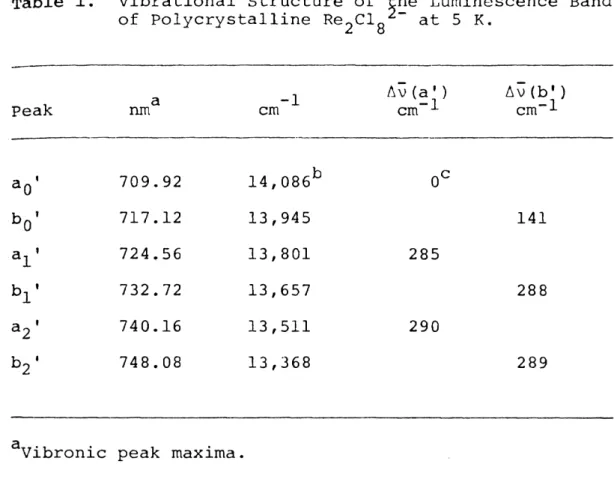
(BU4N)2Re2Clg at5K is displayed in Figure 3. Vibronic3 8 maxima resolve on the high energy side of the emission
band. The relative intensities of the peaks are not in accord with those predicted for a single harmonic Franck-
39 The peak intensities do, however, Condon progression.
suggest two vibrational progressions built on a^ and b^.
The peak positions and energy spacings are shown in
Table 1, with ±10 cm 1 uncertainty. The 288 cm 1 average energy spacing of both progressions may reasonably be interpreted to be the symmetric ReRe stretching vibration;
the ground state v.
'lg
(ReRe) stretching frequency is 275 cm-1 as determined from Raman measurements
structure is unresolved at 30 K.
40 The vibrational
The emission quantum yield, φ^, of crystalline (Bu.N)^ReτCl^ at room temperature appears to be much
4 z z o
Figure 3. Uncorrected emission spectrum of polycrystalline (BU4N)2Re2Clg at 5 K (680 nm excitation, 50 cm ^*^ resolution)
'20'25'30
AUSN31Ni
Table 1. Vibrational Structure of the Luminescence Band of Polycrystalline Re^Clg^" at 5 K.
Peak a
nm -1
cm
∆v(a') cm^l
∆v(b') cm*l
⅝' 709.92 14,086^ 0≈
717.12 13,945 141
*i 724.56 13,801 285
⅛' 732.72 13,657 288
740.16 13,511 290
⅛' 748.08 13,368 289
^Vibronic peak maxima.
b.-,- -1
±10 cm
€
The absorption (aQ*') and emission (aQ*) vibronic maxima establish the pure electronic origin at
14,129 cm^l (see text).
greater than solution values. Similarly, a more
quantitative measurement showed φ^ of Re2<llg in PMMA2- to be 20 times that of φ (CH-,CN) even though the emission
e -3
lifetime of Re^Cl^ was 127 ns in the PMMA film and 2- z o
140 ns in CH^CN. Miskowski et at. also noted that the quantum yield of Re^Cl- in a 2:1 2-methyltetrahydrofuran:2-
4L O
propionitrile glass at 77K was a factor of 75 greater than the solution value (at room temperature),^ despite the identιcal lifetimes of RegClg in the two environments 2-
(ι.e. rigid us. solution). The emission quantum yield 41 reflects the excited state lifetime through the relation,
k k +k
r nr obs
k τ ,
r obs (1)
are the radiative and nonradiative φe
where k^ and k
r nr
rate constants, respectively, of the excited state. The above experiments clearly demonstrate the capacity of a rigid environment to significantly increase k^^^ relative to solution; that the observed lifetime does not change indicates k^, << k^., and k^g is predominantly represented by k∏r* The temperature dependence of k^g in crystalline
(BU4N)2Re2Clg is summarized in Table 2. To a first approximation, the observed lifetime may be defined by,
+ k .^AE∕kT k . obs
1 + e-ΔE∕kT
(2)
Observed Emission Lifetime as a Function of Temperature in Polycrystalline Re-Cl 2^.
Table 2
T(K)
a
^obs ns
k , xlθ^6 obs
s^l
4.6 231 4.33
4.8 231 4.33
7.7 232 4.31
10.6 219 4.57
14.0 235 4.25
22.1 236 4.24
37.0 230 4.35
49.0 232 4.31
57.0 225 4.44
79.0 194 5.15
81.0 194 5.15
93.0 185 5.41
103.0 177 5.65
105.0 178 5.62
113.0 172 5.81
122.0 167 5.99
132.0 165 6.06
143.0 158 6.33
153.0 159 6.29
163.0 158 6.33
173.0 165 6.06
184.0 166 6.02
193.0 158 6.33
202.0 161 5.92
213.0 169 5.92
222.0 167 5.99
233.0 167 5.99
243.0 166 6.02
253.0 160 6.25
263.0 160 6.25
a±5 ns.
where ΛE is the energy separation between two thermally equilibrated states, the lower of which is characterized by nonradiative rate constant k^, and the upper state by k^.
A plot of k^bg T is shown in Figure 4. The temperature independence of k^g at small T defines k^ to be 4.33xl0^ sec
(Tφ=232±5 ns). A two parameter fit of the lifetime data in Table 2 with equation 2 (indicated by the solid line in
Figure 4) yields a state energy separation of 120 ±20 cm and k^ to be ll.llxlθ^ sec (τ^=90±10 ns).
The luminescence properties of other dirhenium quadruple bond complexes are less well-defined. Crystals of the
cesιum salt of Re-Cl^ at 5K show luminescence (λ 2- >
2 8 max,em
820 nm) considerably red-shifted from the emission band
of the tetrabutylammonium salt. The lower energy luminescence may be attributed to the weaker metal-metal interaction of RegClg anion due to the axial coordination of H2O in the 2- cesium salt's crystal lattice. The effect of phosphine42 substitution on emission properties of molybdenum halide quadruple bond dimers stimulated the investigation of43 ERe2Cl4(PMe2Ph)4](PF6)2. An unstructured, extremely weak emission band (λ > 910 nm) is observed upon 710 nm
max,em
excitation of crystalline solid at 77 K. The presence of Re2Cl5(PMe2Ph)3 as an impurity in these samples makes interpretations of the luminescence spectrum tenuous, at best. Interestingly, highly purified crystalline samples and solutions of Re2Clg(PEt2)2 demonstrate no luminescence at room temperature nor 77 κ.
Figure 4. Plot of observed rate constant (*) for
luminescence decay in polycrystalline (Bu^N)2Re2Clg as a function of temperature. Two parameter fit of equation 2 with data in Table 2 (kg=4.30xl0^ s ∖ τ^=232(+5) ns) yields
∆E=120(+20) cm^l and k^=ll.llxlθ^ s^^ (τ^=90(+10) ns).
Calculated fit designated by solid line.
tb <b fi tb sf
st,.39S^0t∕^
τ∕κ
Discussion
The structured luminescence of Re2Clg permits a 2- much stronger comparison between ground and excited state properties than was possible in past spectroscopic
investigations. The vibronic structural data from Cowman's landmark investigation of the electronic absorption
spectrum of Re2Clg is included in Table 3 along with the2- luminescence data from Table 2. The luminescence spectrum may be interpreted in terms of two vibrational progressions
in quanta of 288 cm 1, corresponding to v (ReRe), built on a^' and b^'. Similarly, the absorption system shows two progressions in quanta of 248 cm 1, also attributable to V (ReRe), and built on a., and b„. Closer examination of the absorption spectrum reveals that the electronic
origin is not well-defined. Indeed, it is bothersome that the energy spacing between v^ and v. is 224 cm ^*^, while
u 1
all the other energy spacings in the progression are
249±1 cm 1 (see Table 3). These results suggest that the vibronic maximum of the 0-0 transition in the absorption spectrum is 25 cm to lower energy than the previously assigned value of 14,183 cm 1. Choosing 14,157 cm ^*^ as the vibronic maximum of the 0-0 transition (designated aj' ) results in a 141 cm energy separation between a^" and b,Q the energy of which agrees with the ReReCl bending mode of e symmetry.
<τ3
Gπ)
ca φο
g φο
ta
Φ G .r)
Gi Φ 43 43 ρ ΦG
ΌG
coΦ
GΟ -rl
43
⅛
Οto Λ<
<<3 Μ + te
ε 43φ to
!>ι ω
GΟ
Ή Μto Ή Με
43'^^)
— ί ε
< ο
'—) ∞ Cħ
St CO co
r—1 ΓΊ
φ—ί CD L∏ σ
! CO σι
ε (N C4
<! u
t—ί )
ε
υ
33Φ t⅛Φ
υ
CO LT) r—1
co st O
CD 00
-t co en r-{ t—ί t—ί
C∖i C4 te σt '—t LT) cr⅛ r- -t
0 <—t Γ4
r-
r* r—! CO L∩ r—1 Ό
<O un en en en en r-( r-i rH
C4 ko 00 ,—] CD
e4 O 00
en -3* -t r- t^- r-
Ο Ο r-4 r-
Φ 33 Φ 43 fN C4 Φ 33
'Ί
te 43 Φ 33Φt 43f)
∞
⅛4 r4
ο υCN φ ΦEU 433 φ U G 3 -f-4 T3
⅛4 r-4
43 r4 ε
Μ φ Φ
43 43
to to
Φ >1 >1
G G ω
0 U
-t >1 G
43 r-t 0
Φ 0 Ή
⅛ a< 43
*W ⅛4 (⅛G
> 0 0 to 33<
<n
Φ 4c
3) †
g *e
33ι**t
— I
<3 υε
L∏ L∏ L∏ Cn co en 0
r—1 st st st st st -3*
r*H (N (N CN CN Γ4
Φ t—ί
— t
< uε
CD -ty
Γ4Γ4 -st "3*σs
04
∞ -t (N
CD un (N
St00 c\]
en 00 (N -3- 00 en co CN !--t un o\ Ό
,—] co CΓt 0 St L∩ co CD en un CO 0 CN -y CO
t r-i CN -3* L∩ ^O σt 0 <—ί 04 St un Ό r-
su st -st -3< St "3* St L∩ te tD te un un tn t—) t—ί r^Ι r—) !—Ί !-- ) ,-- ί r-∣ r*Ι t—t r-Î r-l t—ί
kθ r-ί c∖i un r—ί -3< CD to O un CT\ 04 O σ∖
CD -st r-Ί te ^y (N CD O 0 n <N r-t 0 Ct)
φ
ε L∩ cn st OJ CO r-Ι un 0 St